Gold-Technical Update

printprofile

Gold prices rose significantly in the last few days and peaked at $1410 an ounce. And now, there appears to be a recent bearish cross on the daily chart’s Stochastic (slow), highlighting significant downward momentum building on this commodity’s price. In addition, the Williams Percent Range and Relative Strength Index have the price floating in the over-bought region, suggesting that more pressure is on the way. Forex traders may want to take this opportunity to catch the downward correction on gold, which appears to be imminent.

gold 22-2-2011

Forex Daily Market Commentary

By GCI Forex Research

Fundamental Outlook at 0800 GMT (EDT + 0400)

USD

Risk appetite declined sharply during the Asia session as tensions in Libya increased, New Zealand was struck by another powerful earthquake, and Moody’s lowered the outlook on Japan’s sovereign rating from stable to negative. Sentiment was not helped by a sudden (but brief) 30-pip spike in USDJPY as the Asia session got underway. EURUSD has traded 1.3563-1.3685, and USDJPY 82.84-83.54. Asian stocks are down about 1-2%, and US stock futures are also pointing lower. After first breaking above $1410/oz, gold slipped as the risk-averse mood took hold, and is trading back below $1400/oz at the time of writing. Signs of growing unrest in the Middle East kept the price of crude elevated, despite the risk-off backdrop. In the US, Minneapolis Fed President Kocherlakota, often seen as a reluctant supporter of QE2, is due to speak later today. Our US economists are broadly in line with the consensus and expect February consumer confidence to come in virtually unchanged. They also expect the latest S&P/Case-Shiller survey to register a further fall in US house prices.
EUR

Portugal’s Finance Minister dos Santos said the country already has enough cash to cover two-thirds of the bond redemptions due in April and June. He added that 70% of this cash came from overseas investors, and that 10% of this cash was of Chinese origin.
ECB Executive Board member Stark said that, although inflation expectations are still well anchored, the ECB is prepared to act “quickly and decisively” on inflation if necessary. He said the key question now is to decide whether Europe is facing a temporary inflation “hump”, or a more protracted period of inflation. He warned too that if second-round effects do materialize, the current monetary policy setting would put the ECB behind the curve.
Stark dismissed the idea that last week’s surge in emergency ECB lending might influence the ECB’s decision on whether to phase out non-standard liquidity provision. He described the sharp increase in usage of the ECB’s marginal lending facility as a “very short-lived event mainly due to developments in Ireland”.
Stark went on to say that the EFSF, and its proposed successor (the ESM), should be allowed to purchase bonds in the secondary markets, but that this would not necessarily mean an end to ECB bond purchases, given that the latter is a monetary policy decision. These comments suggest that the ECB’s Securities Markets program could remain in place for quite some time to come, although Stark did add that the program should not continue any “longer than absolutely necessary”. The ECB settled ?711 mn worth of bond purchases last week, after three weeks of inactivity.
Greek Prime Minister Papandreou described as “unsustainable” the interest rates charged on rescue loans to Greece. He repeated that Greece would not default on, or restructure, its debt. He added that it is not an option for individual member states to leave the Eurozone as it would be negative for everyone.
Outgoing ECB Governing Council member Weber compared the process of fiscal consolidation to marathon running and predicted that the hardest part of the journey lay ahead for fiscally vulnerable member states. Weber sensationally added that fiscal austerity measures “have shaken and fundamentally damaged the foundations of monetary union.” He also voiced his opposition to the concept of fiscal union at least for now, stressing that “the crisis mechanism should not become the gateway for institutionalised transfer payments within the currency union”.
JPY

Moody’s lowered its outlook for Japan’s sovereign rating to negative from stable, citing “heightened concern that economic and fiscal policies may not prove strong enough to achieve the government’s deficit reduction target and contain the inexorable rise in debt”. Moody’s went on to say that a JGB funding crisis is unlikely in the near to medium term, and that it sees no immediate change in JGB investor behaviour.
Before the outlook change, Economy and Fiscal Reform Minister Yosano pointed to an advantage of a strong yen, noting that it provides some insulation against the rise in oil prices.
GBP

BoE MPC member Weale noted the UK is at risk of stagflation, and again made the case for an early rate hike, predicting that a small rise now would reduce the need for an even larger hike later. Both Weale and MPC member Sentance voted for a 25bp rate hike at the January meeting, and the market continues to speculate about whether another hawkish MPC member has since come forward to cast his vote. Hence, the release of the minutes of the Feb. 10 policy meeting will be key for sterling on Wednesday.
MPC member Posen, who voted for an expansion of Gilt purchases in January, is due to speak at 1700 GMT. Any indication that he is reconsidering his stance would be seen as further evidence of a hawkish shift in thinking on the MPC, and would likely be sterling-positive.
NZD

The NZD sold off heavily after another strong earthquake hit Christchurch. Extensive destruction was reported. Fitch said that the impact of the earthquake by itself is not expected to lead to a sovereign downgrade.

TECHNICAL OUTLOOK
EURCHF 1.2867 support.
EURUSD BULLISH A move above 1.3744 would expose 1.3826. Near-term support at 1.3546.
USDJPY BULLISH As long as 82.34 continue to cap the downside risks, expect recovery towards 83.98.
GBPUSD BULLISH Upside gains are stalled at 1.6279/99 resistance zone. Support is defined at 1.6076.
USDCHF BEARISH Currently holds support at 0.9425, a move below this would expose 0.9329/01 support area. Initial resistance at 0.9539.
AUDUSD BULLISH Break of 1.0018 exposes 0.9944, but overall focus in on the upside with initial resistance at 1.0158 ahead of 1.0200.
USDCAD BEARISH Move below 0.9816 would expose 0.9745/12 area. Near-term resistance at 0.9905.
EURCHF NEUTRAL A break below 1.2867 would trigger negative tone. Initial resistance is at 1.3029.
EURGBP BEARISH Break of 0.8356 would lead to the extension of losses towards 0.8332/13 support zone. Near-term resistance is at 0.8450.
EURJPY BULLISH Look for a break above114.94 for extension of the bull trend towards 115.42/68. Near-term support holds at 112.09.

Forex Daily Market Commentary provided by GCI Financial Ltd.

GCI Financial Ltd (”GCI”) is a regulated securities and commodities trading firm, specializing in online Foreign Exchange (”Forex”) brokerage. GCI executes billions of dollars per month in foreign exchange transactions alone. In addition to Forex, GCI is a primary market maker in Contracts for Difference (”CFDs”) on shares, indices and futures, and offers one of the fastest growing online CFD trading services. GCI has over 10,000 clients worldwide, including individual traders, institutions, and money managers. GCI provides an advanced, secure, and comprehensive online trading system. Client funds are insured and held in a separate customer account. In addition, GCI Financial Ltd maintains Net Capital in excess of minimum regulatory requirements.

DISCLAIMER: GCI’s Daily Market Commentary is provided for informational purposes only. The information contained in these reports is gathered from reputable news sources and is not intended to be U.S.ed as investment advice. GCI assumes no responsibility or liability from gains or losses incurred by the information herein contained.

NZ Quake and Technical Pressure Weighing on Kiwi

By Greg Holden

Following yesterday’s earthquake in New Zealand – which some expect will claim upwards of 70 lives – the Reserve Bank of New Zealand (RBNZ) appears poised to reduce interest rates in order to ease concerns. New Zealand stocks also plummeted yesterday as a result of the 6.3-magnitude quake.

Further weighing on the Kiwi, however, are a number of technical indicators which seem to show additional bearishness for the NZD ahead of a potentially wide swing in value.

As we can see in the chart below, the AUD/NZD appears to have formed a clear head-and-shoulders pattern.

What is worth highlighting is the shoulder line. As shown, the pair still has some room to run before touching the shoulder line of this chart formation, meaning traders may want to speculate on further bearishness for the Kiwi this week.

To support this notion we can also see on the MACD that the bearish cross is near completion, but not yet fully formed (i.e. the cross has not yet crossed). The Stochastic (slow) also appears to have fallen below the over-bought 80 line, hinting that technical pressure may have eased, allowing the pair to continue rising to at least 1.3400, and perhaps a bit higher, before meeting solid resistance.

If this head-and-shoulders pattern comes to fruition, the downward retracement should see the pair falling towards a range near 1.2950 over the subsequent weeks. But traders should also note the historically significant level at 1.3050 which has caused halting movements in both directions over the past year.

AUD/NZD – Daily Chart

Forex Market Analysis provided by ForexYard.

© 2006 by FxYard Ltd

Disclaimer: Trading Foreign Exchange carries a high level of risk and may not be suitable for all investors. There is a possibility that you could sustain a loss of all of your investment and therefore you should not invest money that you cannot afford to lose. You should be aware of all the risks associated with Foreign Exchange trading.

Danish Krone Bearish after Moody’s Downgrade

printprofile

Last week’s downgrade of five top-listed Danish banks by Moody’s Investor Services has put moderate sell pressure on the krone (DKK).

After touching its Feb. 9 low of 5.4333, the USD/DKK pushed back towards 5.5000 following the risk adjustment by Moody’s.

The New York-based investor service provider downgraded Danske Bank A/S, Erhvervsbank A/S, BankNordik P/F, Spar Nord Bank A/S and Ringkjoebing Landbobank A/S after the Danish government dropped the losses suffered by the bailout of Amagerbanken A/S onto senior creditors.

Further downgrades may take place later in the month as three other top Danish banks will be up for review by Moody’s in the near future. On the chopping block are Nordea Bank AB’s Danish unit, Sydbank A/S and Jyske Bank A/S.

The failure of Denmark’s fifth largest lender, Amagerbanken A/S, on February 6 represents the eighth bank bailout since 2008, and the first bailout since the new government ruled in favor of dropping its blanket guarantee of deposits and senior debt.

The resultant pressure on the Danish krone appears to have been expected, but took place prior to the cyclical uptick within its current consolidating pattern. The pair now appears poised to climb towards 5.5500 before meeting any resistance.

USD/DKK’s Latest Uptick Part of Long-Term Consolidation Trend

On the bright side of Denmark’s latest lending woes is the fact that the krone appears to be trading within a clearly defined consolidation pattern against the US dollar.

As can be seen on the chart below, the pair has been trading within a long-term downtrend since last June. The recent upsurge resisting this long-term trend, begun in early November of 2010, has pushed the pair into a consolidation pattern, with its tip at 5.5500.

The downgrade by Moody’s pushed the DKK lower against the dollar, lifting the pair before it could reach the lower border of its consolidation pattern. Additional upward mobility is expected since both the Stochastic (slow) and MACD reveal fresh or impending bullish crosses.

It may be reasonable to expect the pair to climb towards 5.5500 before meeting any resistance. Whether or not it can break past that point is up for debate, however, since that price level has historically generated strong profit-taking behavior from Scandinavian currency traders.

USD/DKK – Daily Chart
USDDKK - Daily Chart

Crude Oil Soars on Middle East Risk Premium

Source: ForexYard

Spot crude oil prices rose to their highest level of the year following further violence in Libya and Yemen, as well as protests in Iran. As unrest spreads, crude oil and the US dollar look to benefit from further geopolitical risk aversion.

Economic News

USD – US Dollar Firms over Presidents Day Trade

The US dollar strengthened versus the majors during yesterday’s trade as geopolitical events in the Middle East helped to move traders into the greenback. Renewed violence in Libya, Bahrain, and Yemen sparked dollar buying. US markets were closed yesterday in observance of Presidents Day.

Over the weekend, the House of Representatives approved new budget cuts of $61B. A vote from the Senate is not expected until next week.

In Asian trading, the EUR/USD was down at 1.3580 from an opening week price of 1.3692. The GBP/USD was lower at 1.6156 from 1.6250 while the USD/CHF was up at 0.9485 from 0.9445.

After a day lacking US economic data releases, US consumer confidence numbers will be released today at 15:00 GMT. Market expectations are for the report to show improving sentiment in the US economy which could support the dollar. The greenback slumped last week versus the majors as growing expectations for interest rate increases in Europe expanded.

The EUR/USD has support and resistance that comes in at 1.3540 and 1.3740, respectively.

EUR – EUR Falls despite Strong Economic Data from Europe

The euro was lower in yesterday’s trading despite strong economic data from the euro zone. Yesterday’s flash PMI for manufacturing was reported higher at 59.0 from 57.3, a new high. Flash service PMI increased to 57.2 from a previous reading of 55.9. The German Ifo survey was also higher at 111.2 from 110.3.

Also a potential impact on Germany was the defeat of German Prime Minister Angela Merkel’s CDU party in the Hamburg Elections. This will reduce the size of the CDU representation in the upper house of parliament and is a sign of the weakening grip Merkel and the CDU have on Germany’s political moves. This could have further implications down the road as elections in six other states will begin next month.

Due up on the economic calendar from Europe is German consumer data and British Public Net Borrowing.

The EUR/CHF continues to weaken after failing to move above its 200-day moving average. A breach below the 1.2900 support could trigger further losses to the 1.2770 level. Resistance is found at Friday’s high of 1.2990.

JPY – Moody’s Warns Japan

Moody’s Investor Services warned Japan it was reducing the outlook on the nation’s bond rating from stable to negative due to its widening debt load.

The USD/JPY rose following the news and finished the day at 83.35 from an opening day price of 83.20.

Since breaking higher above a triangular consolidation pattern and rising to a high of 84.00, the USD/JPY has fallen to a low yesterday of 82.79. However, a bullish consolidation pattern looks to have formed already.

The recent declines in the USD/JPY have created a bullish flag on the daily chart. An estimate of the move from the chart pattern would suggest an additional 1.00 yen move higher to the resistance level of 84.50. Support for the pair is found in a range near 82.50.

Crude Oil – Crude Oil Rockets Higher to $98 on Middle East Turmoil

Protests were met with violence in the Middle East as the geopolitical events rolled the commodity markets, with spot crude oil rising to a price not seen in the past 2.5 years.

Libya is the first oil exporter to be engulfed in violence as reports of the regime opening fire on protesters to disperse the demonstrations has reached major news outlets. Protests have also been put down by violence in Iran, Bahrain, and Yemen.

Spot crude oil prices spiked in overnight trading to a high of $98.37, finally settling at $96.40 after opening the week at $89.90.

The geopolitical events appear to have added an extra risk premium now that the protests have spread to oil producing nations such as Libya, OPEC’s seventh largest producer. Traders will be eyeing further events in the Middle East as the risk of crude oil supply disruptions could spread throughout the region.

Following today’s price spike, the $100 price level seems well within reach this week.

Technical News

EUR/USD

The pair has sold off in overnight trading, falling to the 1.3570 level. This comes on the heels of Friday’s breakout higher from a bullish flag pattern. For those traders that missed the original breakout, the EUR/USD has retraced back to the upper line of the chart pattern, setting up a buying opportunity. An estimate of the price move from the chart pattern suggests a 3 cent move, a level that fits nicely with the February high of 1.3860.

GBP/USD

The Cable has found resistance from a trend line that falls off of the January 2010 and February 2011 highs. A breach above the trend line, and the February high of 1.6280, could spur further buying to the January high of 1.6450 as well as the November 2009 high of 1.6870.

USD/JPY

The recent declines in the USD/JPY have created a bullish flag on the daily chart. An estimate of the move from the chart pattern would suggest an additional 1.00 yen move higher to the resistance level of 84.50. Support for the pair is found in a range near 82.50.

USD/CHF

The 61.8% Fib retracement from the December move has proven to be a powerful resistance level that has consistently sent the pair lower. Traders may want to be patient and wait for better levels to sell this pair. Support is found at Friday’s low of 0.9440.

The Wild Card

Silver

The commodity has pushed above its all-time high, and the $34.00 level, in its latest move. Rising momentum hints at further gains for the commodity. Forex traders will want to be long on the commodity with stops below the support at $31.20.

Forex Market Analysis provided by ForexYard.

© 2006 by FxYard Ltd

Disclaimer: Trading Foreign Exchange carries a high level of risk and may not be suitable for all investors. There is a possibility that you could sustain a loss of all of your investment and therefore you should not invest money that you cannot afford to lose. You should be aware of all the risks associated with Foreign Exchange trading.

Japanese Yen Outlook for the Current Week

Events having significance affect over the trading of Japanese Yen against the US dollar are as follows:-

Yesterday markets remained closed in United States due to President’s Day holiday. Today Japan reported its difference between imported and exported goods over the month in its trade balance report.

In United States official data on consumer confidence, industry report on house prices and report on manufacturing activity in Richmond is to be published.

On Wednesday United States will report its official data on homes sales which considered as one of the leading economic indicator for US economic health.

On Thursday February 24th, 2011 official data on consumer price inflation will reported by Japanese government. In United States several key economic reports will be released which include data on jobless claims, report on new homes sales and data on durable goods orders.

On February 25th, 2011 initial report on gross domestic product will be reported for the fourth quarter. Revised data on consumer sentiment and inflation expectations will also be released by University of Michigan on Friday.

About the Author

Daily forex trading news written by Rehan from DailyForexTrade.com

Current Week’s Outlook for Euro

The list of events that could affect the trading of the euro in the current week is as follows:-

The US markets remained closed on Monday due to President’s Day holiday whereas in official data on manufacturing and services sector was published in euro zone. Germany and France also reported their manufacturing and services data separately.

Today on February 22nd a report on German consumer climate is to be published by Gfk a research group. In United States official data on consumer confidence will be reported by Conference Board while industry report on house prices will also be published. Data on manufacturing activity in Richmond is also to be published on Tuesday.

On February 23rd, 2011 official report on industrial new orders will be published in United Kingdom while United States will report is data on existing home sales.

On February 24th, 2011 United States will report data on durable goods and jobless claims as well as official report on new home sales. In euro zone Germany will report its fourth quarter

On Friday February 25th, 2011 the preliminary data on fourth quarter’s gross domestic product is to be reported by United States, moreover report on consumer sentiment and inflation expectations will also be published by University of Michigan.

Germany will report its initial data on consumer price inflation on Friday while France is expected to publish its report on consumer spending. In euro zone ECB is will report data on M3 money supply and private lending.

About the Author

Daily forex trading news written by Rehan from DailyForexTrade.com

British Pound Outshining Euro in Forex Trading

printprofile

A slew of recent analyses have shown mixed results for the EUR over the past several days, brought on by speculation surrounding Mid-East unrest; but how has the EUR compared with its British counterpart?

Despite Britain’s recent inflationary woes, the UK pound has actually remained relatively bullish versus most of its currency counterparts. The GBP/JPY was up this morning, trading near 134.80 before correcting back towards 134.55 prior to the opening of the European session.

The GBP/NZD was also trading much higher, though analysts expect this to be a result of the recent earthquake in New Zealand and not a signal of any particular strength in the sterling.

Looking at the pound in comparison with a number of other currencies, on the other hand, shows a weakening trend in GBP values. The pound has experienced declines against the Swiss franc (CHF), Canadian dollar (CAD), and recently the US dollar (USD).

Across the English Channel, the euro, while expected to actually benefit from the turmoil spreading throughout the Middle East, appears bearish versus the pound. The rapid buy-in on commodities, particularly Crude Oil, has the US dollar weakening, thus driving its Atlantic rival, the EUR, higher.

Positive data out of the euro zone has also given impetus to a relatively stable EUR, despite periodic, short-term downturns.

If we look closer at the EUR/GBP we can see that the pound does in fact appear to be outpacing its European neighbor. The pair has been trading within a long-term consolidation pattern, with a consolidation point residing between 0.8400 and 0.8450.

After falling below its 38.2% Fibonacci support line at 0.8480, the pair has seen continuous losses, pushing towards the subsequent Fib level near 0.8320. Given the historic strength of the consolidation pattern, which has been in development since last June, we can expect this pair to find solid support above the next Fib line, potentially bouncing back towards its consolidation zone after touching 0.8350.

This gives forex traders a great opportunity for setting entry positions around the expected targets. The short-term downward target for this pair appears to be 0.8350, with a bounce back target near 0.8450.

EUR/GBP – Daily Chart
EURGBP - Daily Chart

NZD/USD Tumbles in Wake of New Zealand Earthquake

printprofile

The Kiwi was sharply lower following an earthquake that measured 6.3 on the Richter scale and sent buildings tumbling. The NZD/USD is currently testing the 0.7500 support line. A move below this level could trigger further selling to the 0.7350 mark.

Commodities such as gold, silver, and crude oil are higher across the board following violence in Libya, Bahrain, Yemen, and Iran, with increased risk of protests spreading to other nations in the region.

Today’s calendar events:

GBP – Public Sector Net Borrowing – 09:30 GMT
Expectations: -0.2B. Previous: 15.3B.
Increasing expectations of an interest rate hike by the BOE have the pound performing well against the US dollar. Strong bids for the currency should continue in the near term. Resistance for the GBP/USD is 1.6270. Support is Friday’s low of 1.6150.

CAD – Core Retail Sales – 13:30 GMT
Expectations: 0.7%. Previous: 1.0%.
The Canadian dollar is receiving more bids given its close correlation to oil prices which are at a 2.5 year high. Support for the USD/CAD is found at this year’s low of 0.9810. Resistance comes in at 0.9980.

USD – CB Consumer Confidence – 15:00 GMT
Expectations: 65.1. Previous: 60.6.
The dollar is up sharply in today’s morning trade. The EUR/USD has support and resistance that comes in at 1.3580 and 1.3740. A move lower could trigger stop losses and target the February low of 1.3430.

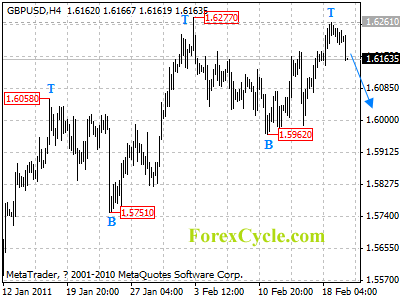
GBPUSD pulled back from 1.6261

Being contained by 1.6277 resistance, GBPUSD pulled back from 1.6261, suggesting that a cycle top had been formed on 4-hour chart. Deeper decline could be expected in a couple of days and target would be at 1.5900 area. Initial resistance is now at 1.6261, only break above this level could trigger another rise towards 1.6500 zone.

gbpusd

Forex Signals