NZD Sees Slight Correction in Overnight Session

Source: ForexYard

Following yesterday’s devastating earthquake in New Zealand, the NZD/USD dropped close to 200 pips, reaching as low as 0.7430 before staging a slight correction in the Asian session. The pair is currently trading just above the 0.7500 level. Meanwhile the price of crude oil remains close to a 30-month high due to the widespread unrest in Libya.

Economic News

USD – Dollar Remains Bearish Against Franc and Yen

The US dollar continued to fall against the safe haven yen and Swiss franc in overnight trading, as the widespread political unrest in Libya has driven investors away from riskier currencies. Confidence in the pace of the global economic recovery has been severely dampened, causing the dollar to drop against several of its main currency rivals. The USD/JPY has fallen almost 75 pips from yesterday’s high of 83.40. Currently the pair is trading around the 82.60 level. The USD/CHF has dropped well over 100 pips in the last 24 hours, and is currently trading around the 0.9370 level.

Turning to today, a lack of significant news out of the US means the dollar is forecasted to remain bearish. That being said, traders will want to pay attention to the US Existing Home Sales figure, set to be released at 15:00 GMT. Analysts are predicting today’s figure to be slightly below last month’s. If true, investor confidence in the US economic recovery may remain low, and the greenback could take further losses in afternoon trading.

In addition, traders will want to pay attention to any news out of Libya, as the conflict there continues to impact investor attitudes toward the current state of the global economy. Further unrest in the Middle East is likely to cause the dollar to tumble further.

EUR – EUR Once Again Above 1.3700 against Dollar

Hawkish comments from the European Central Bank yesterday continued to boost the euro against the US dollar during the Asian trading session. The EUR/USD is once again trading above the 1.3700 level, up from 1.3650 early last night.

While the euro has moved up against the dollar, it has remained largely bearish against the Swiss franc. Investors worried about the current state of the global economic recovery have turned to the CHF as of late, enhancing the currency’s safe haven appeal. The EUR/CHF dropped well over 100 pips yesterday before staging a slight upward correction. Currently the pair is trading right around the 1.2830 level.

Today, EUR traders will want to pay attention to a speech from ECB President Trichet scheduled to take place at 17:00 GMT. Any comments from Trichet regarding a future euro-zone interest rate hike may cause investors to shift their assets toward riskier currencies and boost the euro as a result.

JPY – Yen Sees Small Gains against USD during Asian Session

The USD/JPY dropped over 30 pips during the Asian session, as investors appear to be flocking to the yen as a safe haven currency amid the recent turmoil in Libya. It appears that as long as the recent wave of unrest in the Middle East continues, safe haven currencies like the yen are likely to remain bullish. The USD/JPY is currently trading around the 82.60 level, down from 82.90 earlier tonight.

Today, yen traders will want to pay attention to any news regarding the ongoing conflict in Libya. Investors are likely to remain with the yen until some semblance of order is brought to that country. Furthermore, the US Existing Home Sales is forecasted to come in slightly below last month’s figure. If true, the yen could see more gains.

Crude Oil – Crude Oil Remains Close to Record High

Investor fears that crude oil supplies could be damaged as a result of the recent wave of political turmoil in Libya drove the commodity to a 30-month high in trading yesterday. After falling slightly during the evening, the price of oil began to go up once again during the overnight session, and is currently trading around $95.75 a barrel.

Today, oil traders will want to pay attention to any news out of Libya. Analysts are largely in agreement that unless some measure of order is brought to the country, the price of crude oil is likely to remain at its current high. Until investors are confident that stockpiles in the Middle East are secure, prices are unlikely to come down.

Technical News

EUR/USD

The Williams Percent Range on the 8-hour chart has crossed into the overbought zone indicating that a bearish correction is likely to occur. In addition, a bearish cross has formed on the daily chart’s Stochastic Slow. Going short may be the preferred strategy for today.

GBP/USD

The daily chart’s MACD has formed a bearish cross, indicating that downward pressure is likely to occur in the near future. At the same time, the Relative Strength Index on the hourly charts are in neutral territory. Traders may want to take a wait and see approach for this pair today.

USD/JPY

The Williams Percent Range on the 4-hour chart has crossed into the oversold region, indicating that bullish movement could occur in the near future. This theory is supported by the Relative Strength Index on the 8-hour chart. Opening long positions may pay off for this pair today.

USD/CHF

A bullish cross on the daily chart’s Slow Stochastic is indicating that upward movement could occur later today. The Relative Strength Index is also in oversold territory. Traders will want to open long positions for this pair today.

The Wild Card

EUR/CHF

The Williams Percent Range on the 8-hour chart is in oversold territory. In addition, the daily chart’s Stochastic Slow has formed a bullish cross, indicating upward movement is likely to occur. Now may be a great time for forex traders to open up long positions before the upward breach occurs.

Forex Market Analysis provided by ForexYard.

© 2006 by FxYard Ltd

Disclaimer: Trading Foreign Exchange carries a high level of risk and may not be suitable for all investors. There is a possibility that you could sustain a loss of all of your investment and therefore you should not invest money that you cannot afford to lose. You should be aware of all the risks associated with Foreign Exchange trading.
Events to affect trading of British Pound for the Week ending February 25th, 2011

The US markets remained closed yesterday on observance of President’s Day holiday. In United Kingdom industry data on house prices was reported yesterday.

Today in United Kingdom official report on public sector net borrowing is released while United States will publish its consumer confidence report and data on house prices. Manufacturing activity in Richmond will also be reported today in United States.

On Wednesday February 23rd, 2011 minutes of recent meeting for Britain’s future monetary policy outlook will be reported by Bank of England. UK’s official report on mortgage approvals will also be published by British Bankers Association. In United States industry data on home sales will be reported on Wednesday.

On Thursday February 24th 2011 official data on retail sales will be reported in United Kingdom while United States will report its data on jobless claims, new home sales and durable goods orders.

On Friday United Kingdom will report it gross domestic product for the fourth quarter and will also publish data on initial business investments. Moreover official data on UK’s consumer confidence will be reported by Gfk. In United States key economic indicators such as GDP for fourth quarter and consumer sentiment and inflation expectation reports will be released.

About the Author

Daily forex trading news written by Rehan from DailyForexTrade.com

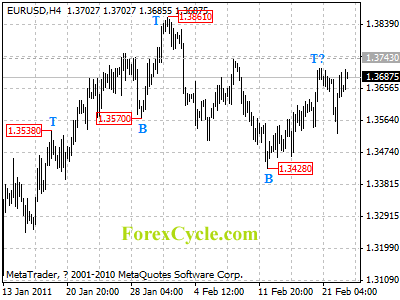
EURUSD is facing 1.3743 resistance again

EURUSD is facing 1.3743 resistance again, a break above this level will indicate that the fall from 1.3861 had completed at 1.3428 already, and the bounce from 1.3428 could be treated as resumption of uptrend from 1.2874 (Jan 10 low), then the following upward move could bring price to 1.4000 zone. However, as long as 1.3743 resistance holds, the rise from 1.3428 is treated as correction of downtrend from 1.3861, and another fall towards 1.3300 is still possible.

eurusd

Daily Forex Analysis

Forex Market Commentary with Currency Analyst Michael Wright from DailyFx

By Zac, CountingPips.com

Today, I am pleased to share a forex interview and commentary on this week’s major events and forex trends with currency analyst at DailyFx.com, Michael Wright. Michael specializes in fundamental and technical analysis and is an active trader in currencies, stocks and options. Michael authors articles ranging from Fundamentals Versus Technical’s, Weekly Spotlight, and Forex Trading Weekly Forecast for DailyFx and FXCM in New York.

Q: Of the major data releases and events on the schedule this week, what do you feel may turn out to be the most important event to watch for concerning the forex markets this week?

The currency markets may witness whipsaw price action this week as the economic docket is filled with event risks. Following Monday’s muted trade in light of President’s Day in the U.S., market participants were faced with New Zealand’s 2 year inflation report on Tuesday which was released in line with expectations. However, the spotlight was placed on the region’s deadliest earthquake in 80 years which rattled the kiwi and lead risk aversion to regain its footing. Besides the developments in New Zealand, market participants will closely monitor the Bank of England Minutes which will be released on Wednesday at 9:30 GMT.  The minutes are of particular importance due to the fact that the split amongst committee members is expected to widen as the economic outlook remains uncertain, while inflation is stubbornly high. Other key events that will be important for the forex markets will be U.S. durable goods orders, new home sales, economic activity and the University of Michigan confidence reports.

Q: In the case of further Mid East turmoil, what currency pair or pairs do you see as being the most sensitive to those events?

Tensions in the Middle East will largely affect the Canadian dollar in addition to other high yielding currencies such as the Australian and New Zealand dollar’s as traders seek safety amid global instability. As of late, these three currencies have pushed lower against the greenback and are expected to continue their south bound journey as the unrest in Iran, Yemen, and Algeria continue. If protests escalate further, I do not rule out a risk off environment which will lead the Aussie, Kiwi, and loonie to extend their decline.

Q: The Bank of England minutes are out this week. Is a hawkish stance on interest rates likely Pound positive or is this information potentially already priced into the currency?

The hawkish stance on interest rates amongst policy makers is positive for the British pound. Heading into the Bank of England minutes, policy makers Andrew Sentence and Martin Weale are pushing for a rate hike of twenty five basis points as consumer prices remain stubbornly above the central bank’s target. As inflation is expected to increase from 4.0 percent amid the rise in value added tax (VAT) measures, traders should not rule out a vote by another policy member, calling for a rate hike. This result will likely push the pound to new highs. Meanwhile, Adam Posen continues to push for additional asset purchases due to the uncertain economic outlook in the region. With the region’s largest spending cuts since the Second World War expected to weigh on growth, Mr. Posen will likely remain firm and if another MPC member joins him, the pound may revisit the 1.60 area. All in all, the stance amongst Andrew Sentence, Adam Posen, and Martin Weale is priced into the currency, but a shift by another member will dictate GBP price action.

Q: The AUD/USD pair last week regained some momentum higher and the pair trades over parity at time of writing. Do you think it is likely we see a retest or surpass the 1.0255 all time high made in late December?

Following the recent flood, cyclone, and earthquake in Australia, the aussie is unlikely to regain its high of 1.025 as economic activity slows on these negative developments. Also worth noting is the fact that Middle East tensions and debt concerns in the 17 member euro area are leading investors to seek safety, which weighs on the aussie. From a technical standpoint, indicators are pointing to further downside risks in the high yielding currency. The MACD has yet to reverse course after signaling for losses February 10th, while the slow stochastic indicator remains bearish.  Looking ahead, a break and a close below the 100-day simple moving average will validate my bearish bias and expose the 0.98 area.

Q: The Swiss franc bounded back with strength last week particularly versus the Euro, Yen and Dollar. Do you feel this is a resumption of the downtrends for these currencies against the Swissy?

The Swiss franc rallied against the Euro, Dollar, and the Japanese yen as of late due to the uncertain economic outlook in these regions. It is important to note and relate the Swissie’s rally to its safe haven appeal rather than its own fundamental developments. The Swiss Franc is known as a safe haven currency due to the fact that the Swiss National Bank keeps a large part of its reserves in gold. Therefore, as fears rattle the markets, the franc gains ground against its counterparts on the back of safety demand. In turn, I do feel that this is the resumption of the downtrends in yen, euro, and greenback. Specifically, debt concerns in the euro may lead the EURCHF to retest 1.26, while Moody’s downgrade of Japan’s credit rating combined with its decade of deflation reaching into 2011 could lead the CHFJPY to push higher. Furthermore, slack in the recent fundamental developments in the world’s largest economy to regain its footing may extend USDCHF losses. All in all, I do not rule out CHF gains against most major currencies as concerns in the global economy remain.

Thank you Michael for taking the time for participating in this week’s forex interview. To read Michael’s latest currency analysis and trading strategies be sure to visit DailyFx.com.

Forex: US Dollar gains on Canadian Loonie as USD/CAD trades at 10-day high

By CountingPips.com

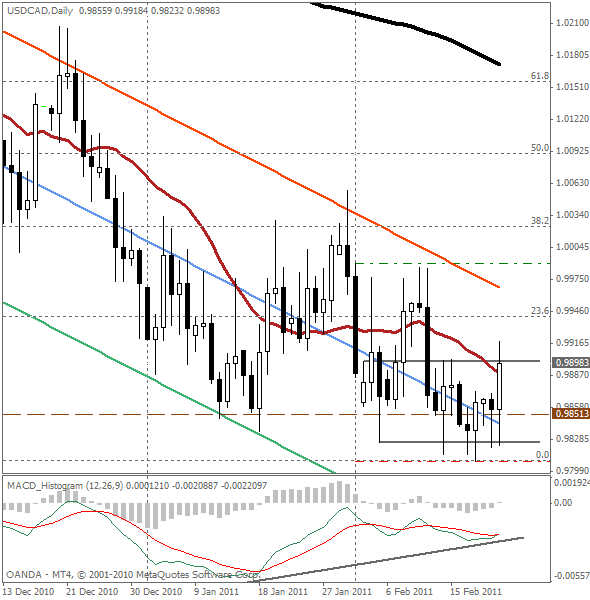
The US dollar has gained today on the Canadian loonie in forex trading as the USD/CAD has traded at its highest level since February 11th. This currency pair has been trading in a fairly tight range since February 13th through February 21st with the top of the range being roughly 0.9900 and the bottom close to 0.9800.

Today’s move may potentially position the pair to gain some upward momentum and break this persistent range in the coming days if the dollar can remain in favor.

The USD/CAD is currently trading around 0.9905 level and has ascended above the 20-day moving average (in red). Further upside movement may see resistance at the 23.6 Fibonacci level (on the down move from 1.0372 to 0.9862) and near this month’s high point at very close to parity level.

On the downside, the 0.9850 level has been previously significant support while 0.9825/00 has also provided support recently.

Forex: USD/JPY falls lower on risk aversion

By CountingPips.com

The US dollar has been trading lower today against the Japanese yen in forex trading on risk aversion due to the conflict in Libya. The dollar/yen pair had closed higher in yesterday’s trading after falling lower to finish last week. Today’s decline that has brought the USD/JPY down to the 82.70 exchange rate.

The USD/JPY had been on an upswing for most of February with a top culminating at the 83.96 exchange rate on February 16th. The pair tested (for the first time since June 2010) but failed to close above the 200-day moving average (in black) and instead bounced off and decreased lower.

The pair currently trades just above a previous support line near the 82.50 level after today breaking through the 50.0 Fibonacci retracement level (on the move down from 85.92 to 80.17). Further bearishness could bring a test of the 38.2 Fibonacci level at 82.35 while upside barriers are present at the 50.0 Fibonacci retracement level near 83.00 and resistance around 83.50.

The MACD indicator signals a potentially imminent bearish cross, suggesting further bearish price action could be in store.

USD/JPY Daily Forex Chart

Forex Update: US Dollar mixed. Gold, Oil rise as Mid-East turmoil weighs on markets

By CountingPips.com

The US dollar has been mixed in forex trading today against most of the major currencies as political turmoil in Libya has pushed investors into safe haven assets. The dollar has been gaining ground versus the euro, British pound sterling, Australian dollar, New Zealand dollar and the Canadian dollar while losing ground to the Japanese yen and the Swiss franc, according to currency data in the afternoon of the US session.

The New Zealand dollar, meanwhile, has been on the defensive today against all major currencies as a magnitude 6.3 earthquake struck New Zealand’s second-largest city Christchurch. This was the second earthquake to hit New Zealand since September.

The US stock markets have had a sharply lower session on risk aversion today with the Dow Jones industrial average dropping by over 150 points, the Nasdaq decreasing by over 60 points and the S&P 500 down by approximately 25 points.

In commodities, Oil has traded higher by $5.63 to $91.83 while gold futures have risen by $10.30 to $1399.30 per ounce.

Options Trading Analysis: Netflix (NFLX) and Open interest report

By JW Jones, optionstradingsignals.com

“I love the smell of napalm in the morning” Lt Col Bill Kilgore, Apocalypse Now

One of the opportunities available to the knowledgeable options trader is the ability to capitalize on major price movements while maintaining an acceptable risk profile. These opportunities are particularly attractive when they occur late in the options cycle because of the rapidly accelerating decay of the time premium of options. In appropriately structured positions, this time decay can be a wind at your back as the time premium relentlessly goes to zero at the closing bell on options expiration Friday.

Let us consider the recent opportunity presented during the current options expiration week by NFLX. As an aside, for those of you who have read my columns before, remember that we recently discussed an earnings trade on this underlying. Lest you think my screen is stuck on this underlying, remember that not all vehicles exhibit adequate liquidity for options trading.

NFLX is a prime example of such a stock with huge Open Interest (OI), tight bid/ask spreads, and tremendous daily volume. These are the types of vehicles that work best for option trading. Beware of options with little liquidity, they can lead to “Hotel California” syndrome; you can check in but you can’t check out.

But I digress; let’s return to the situation in NFLX. This past Monday, the beginning of the February options expiration week, NFLX gapped up and reached an intraday high of $247.55, a price which represented an all time historic high for this stock. The chart is displayed below:

As is always the case in options trades, it is important to consider the reaction of the implied volatility to this price spike. As shown in the chart below, the rapid price rise resulted in a volatility spike. The at-the-money options went from an implied volatility (IV) of 34% at market close Friday to an IV of 44% at market close Monday. As another aside, many option traders consider that IV is inversely correlated to price. This current reaction demonstrates the more accurate view that IV is more closely correlated to the velocity of price change.

(click on charts to enlarge)

These factors together with my prognostication that this spike in price was, at least for the short term, not sustainable led to the initiation of a high probability trade. The structure of the trade was that of a put butterfly constructed with a bearish directional bias. The essence of the trade was twofold:

1. I expected downward movement in the price of NFLX.
2. A dual impact on the time premium sold within the butterfly.

This hypothesized dual impact would be both time decay into expiration and decreases in IV as the unsustainable price velocity slowed. The structure of the trade implemented Monday afternoon and its expected P&L behavior is graphed below:

Pay particular attention to the lowest broken line; this represents the P&L characteristics at the time the trade was initiated. Using the options expiration break even points as stops, the point at which the solid red line crosses the 0 point, a potential risk:reward in excess of 1:7 is possible.

Over the next 2 days of market action, the prediction of a decrease in price came to fruition. At market close Wednesday I removed half of the trade and captured a return of 32.6% on invested capital. The remainder of the trade remains in place and currently shows a profit of around 40% on invested capital.

One of the important functional characteristics of option positions in general is the extreme dynamic nature of their profitability. It is for this reason that it is often wise to remove part of a profitable position in order not to suffer economic loss, and, more importantly, the damage to emotional capital from allowing a winning position turning into a loser.

When considering the dynamic nature of option positions, one of the fastest potential movers is a butterfly at expiration. As the position approaches expiration, the rapid decay of time premium results in extreme sensitivity to price movement. Butterflies turn from gentle creatures lazily flapping their wings in the breeze to man eating dragons as expiration approaches. Be prepared to slay the dragon before he can take your hard earned profits.

Get My Trade Ideas Here: www.optionstradingsignals.com/profitable-options-solutions.php
JW Jones

Currensee Hits $2 Billion Milestone in Volume Traded through Trade Leaders Program

Program grows in popularity as innovative alternative investment in world currency markets

The International Traders Expo New York, Feb. 22, 2011 – Today, Currensee (www.currensee.com), the alternative investment service that gives investors unique access to the world currency markets, announced that more than $2 billion in volume has been traded through its recently launched Trade Leaders™ Investment Program. This milestone demonstrates the growing interest in the world’s currency markets as a viable alternative asset class, a topic being addressed by CEO Dave Lemont at the International Traders Expo in New York this week.

Core to the growth of the program is the performance of Currensee Trade Leaders, an exclusive group of top foreign exchange (Forex) traders hand-picked from the growing Currensee social network. Trade Leaders must pass a rigorous series of performance and risk assessments before being accepted into the program. The program continues to attract traders who believe they are the next great Trade Leaders. Currensee has reviewed more than 1,000 Trade Leader applications, of which less than 2 percent have been accepted into the program.

“What’s been missing from Forex trading and investing has been the transparency,” said Martin Huff-Kotkom of Janus Trading, a top Currensee Trade Leader. “The Currensee Trade Leaders Investment Program removes the mystery so that anyone can take advantage of the currency markets. The investors who chose to follow Janus Trading and replicate our trades have open access to our trading strategies and performance charts and can see their trades in real-time. It’s exciting to make our success their success.”

The performance of Trade Leaders forms the foundation of this first-of-its-kind service for self-directed investors seeking investment options that are not correlated to the stock market. The Trade Leaders program enables investors to leverage the expertise of Trade Leaders by automatically replicating the trades of selected traders, and was launched Oct. 29, 2010. In the six months ending January 2011, Trade Leaders cumulatively returned 62.1 percent, compared to the S&P 500, which returned just 16.4 percent. It is important to keep in mind that investor returns may vary from Trade Leader returns based on a variety of factors such as slippage, fees, broker spreads, volatility or other market conditions.

More than 1,500 trades per day are being executed through the Currensee Intelligent Trade Replication Technology™, a sophisticated trade automation engine powered by proprietary algorithms and designed to precisely manage the timing and round-turn execution of trades to ensure investors receive a price as close as possible to the Trade Leader’s price. Investors have real-time access to their Trade Leaders portfolio, can see all executed trades in a single dashboard view and benefit from interactive performance charts and metrics to measure their success.

“What I like the most about the Currensee Trade Leaders program is the transparency it delivers,” said François Tremblay, an individual investor in the Trade Leaders Investment Program. “Currensee gives me direct access to the currency markets, and I can trust the experts to make the trade decisions but I’m still in the driver’s seat with complete control over my portfolio. The website makes it easy for me to track my performance and see how I’m doing at any time. The best part is that I am seeing results, and the Currensee team has outstanding focus on client profitability and service.”

Dave Lemont, CEO of Currensee, said: “The time has come for the world’s currency markets to earn their recognition as a viable alternative asset class. The foreign exchange market is a viable alternative to investing in stocks, bonds or other traditional investments, as it is truly uncorrelated to the S&P, gold and other major indices. Through the Currensee Trade Leaders Investment Program, we’ve opened up the currency markets to more than 250 investors from almost 50 countries and hitting the $2 billion traded mark in such a short period of time is momentous for us.”

About Currensee
Currensee is the alternative investment service that puts the power of world currency markets in the hands of every investor. With the Currensee Trade Leaders™ Investment Program, investors build their own automated trading portfolios of Trade Leaders, top foreign currency traders hand picked from the thousands of members of the Currensee social network. The program offers investors an alternative to traditional asset classes and Trade Leader performance is completely uncorrelated to the stock market. Currensee delivers complete account control to investors, who can see every trade in real time, manage and modify investment allocations with one click and benefit from the safety and security of proprietary online investing technology. Currensee is funded by North Bridge Venture Partners, Egan-Managed Capital and Vernon & Park Capital and is a member of the National Futures Association (NFA) and registered by the Financial Services Authority (FSA). For more information, visit us at www.currensee.com. Find us on Facebook, follow us on Twitter, and watch us on YouTube.

Please note that over the counter retail foreign currency (Forex) trading may involve significant risk of loss. It is not suitable for all investors and you should make sure you understand the risks involved before trading, and seek independent advice if necessary. Performance, strategies and charts shown are not necessarily predictive of any particular result. Past performance is no indication of future results. Investor returns may vary from Trade Leader returns based on slippage, fees, broker spreads, volatility or other market conditions.

British Pound Outshining Euro in Forex Trading

By Greg Holden

A slew of recent analyses have shown mixed results for the EUR over the past several days, brought on by speculation surrounding Mid-East unrest; but how has the EUR compared with its British counterpart?

Despite Britain’s recent inflationary woes, the UK pound has actually remained relatively bullish versus most of its currency counterparts. The GBP/JPY was up this morning, trading near 134.80 before correcting back towards 134.55 prior to the opening of the European session.

The GBP/NZD was also trading much higher, though analysts expect this to be a result of the recent earthquake in New Zealand and not a signal of any particular strength in the sterling.

Looking at the pound in comparison with a number of other currencies, on the other hand, shows a weakening trend in GBP values. The pound has experienced declines against the Swiss franc (CHF), Canadian dollar (CAD), and recently the US dollar (USD).

Across the English Channel, the euro, while expected to actually benefit from the turmoil spreading throughout the Middle East, appears bearish versus the pound. The rapid buy-in on commodities, particularly Crude Oil, has the US dollar weakening, thus driving its Atlantic rival, the EUR, higher.

Positive data out of the euro zone has also given impetus to a relatively stable EUR, despite periodic, short-term downturns.

If we look closer at the EUR/GBP we can see that the pound does in fact appear to be outpacing its European neighbor. The pair has been trading within a long-term consolidation pattern, with a consolidation point residing between 0.8400 and 0.8450.

After falling below its 38.2% Fibonacci support line at 0.8480, the pair has seen continuous losses, pushing towards the subsequent Fib level near 0.8320. Given the historic strength of the consolidation pattern, which has been in development since last June, we can expect this pair to find solid support above the next Fib line, potentially bouncing back towards its consolidation zone after touching 0.8350.

This gives forex traders a great opportunity for setting entry positions around the expected targets. The short-term downward target for this pair appears to be 0.8350, with a bounce back target near 0.8450.

EUR/GBP – Daily Chart

Forex Market Analysis provided by ForexYard.

© 2006 by FxYard Ltd

Disclaimer: Trading Foreign Exchange carries a high level of risk and may not be suitable for all investors. There is a possibility that you could sustain a loss of all of your investment and therefore you should not invest money that you cannot afford to lose. You should be aware of all the risks associated with Foreign Exchange trading.