Forex Daily Market Commentary: Dollar advanced against both the yen and the Swiss franc

By GCI Forex Research

Fundamental Outlook at 0800 GMT (EDT + 0400)

USD

The dollar advanced against both the yen and the Swiss franc during the Asia session, despite the lack of news flow. AUDUSD came under modest selling pressure after the RBA policy statement suggested no urgency in tightening further. EURUSD traded 1.3781-1.3830, USDJPY 81.74-82.24. Asian equities were broadly stronger after the S&P 500 finished +0.565% ahead. The Chicago PMI surprised to the upside as did the Dallas Fed manufacturing activity index while pending home sales dropped slightly more than consensus estimates. St. Louis Fed President Bullard said the Fed will get the balance sheet back to normal over a roughly five-year period, which is a more aggressive timeframe than had been mentioned by other Fed speakers. Bullard said most other FOMC policymakers are opposed to adjusting the current program of bond purchases. New York Fed President Dudley said it would be unwise for the Fed to overreact to recent commodity press pressures and there are signs that core inflation is now stabilizing. Next to speak is Fed Chairman Bernanke, who begins his semi-annual testimony to Congress on monetary policy.

EUR

We raised our 1m and 3m EURUSD forecasts to 1.37 (prev. 1.30) and 1.30 (prev. 1.25), respectively, amid elevated oil prices and Middle East turmoil and relatively hawkish perceptions of the ECB. But these factors notwithstanding, our medium-term case for dollar strength remains intact. Our analysts expect the Fed will finish quantitative easing by June, while other G7 central banks are unlikely to hike interest rates as fast markets as expect, and fiscal austerity is likely to curb growth in the Eurozone and UK.
Final January CPI numbers in the Eurozone were revised down slightly to -0.7% m/m and 2.3% y/y from the preliminary -0.6% m/m and 2.4% y/y estimates. Core inflation was also revised down to 1.1% y/y, which suggests that most of the acceleration in price pressures is non-core based. ECB policymakers have said that their main concern is second-round price effects, so these numbers could give a slight boost to the doves ahead of Thursday’s policy decision.

GBP

In addition to our higher short-term forecasts for EURUSD, we also raise our 1m and 3m cable forecasts to 1.61 (prev. 1.53) and 1.53 (prev. 1.47), respectively. Like the ECB, the BoE has turned more hawkish on inflation. But we continue to see cable as a sell on rallies, as the BoE is unlikely to tighten as rapidly and by as much as the market expects.

AUD

The RBA kept policy unchanged, in line with consensus. The accompanying statement offered little in the way of policy guidance, noting only that the board “judged that the current mildly restrictive stance of monetary policy remained appropriate in view of the general macroeconomic outlook”.

CAD

A stronger than expected Q4 GDP print and an upward revision to the previous quarterly reading has kept the Canadian dollar well supported over the past 24 hours. We upgraded our Canadian dollar forecasts on the back of the better relative recovery along with elevated oil prices.
Our analysts are in line with the consensus and expect no policy shift from the Bank of Canada at today’s policy announcement.

TECHNICAL OUTLOOK
GBPUSD pressures 1.6299.
EURUSD BULLISH The pair eyes 1.3862 resistance; break of the level would expose 1.3948/74 zone. Near term support is at 1.3705.
USDJPY BEARISH Bearish pressure found support at 81.62 ahead of 81.13. Initial resistance is at 82.52.
GBPUSD BULLISH Upside rally held at upper boundary of the 1.6279/99 resistance zone, a break would open 1.6379. Support is defined at 1.6072.
USDCHF BEARISH Support zone is at 0.9228/00, breach of this would expose 0.8951 next. Near-term resistance at 0.9392.
AUDUSD BULLISH Break of 1.0200 has opened up the way towards 1.0256. Support lies at 1.0088.
USDCAD BEARISH Decline through 0.9745/12 support area has exposes 0.9700. Resistance at 0.9800.
EURCHF BEARISH Support lies at 1.2706, break of this would expose 1.2686 and 1.2592. Near-term resistance is at 1.2958 holds.
EURGBP BULLISH Initial resistance is at 0.8555, move above this level would expose 0.8593. Near-term support lies at 0.8470.
EURJPY BULLISH Rise above 113.46 exposes 114.19, while support lies at 111.96.

Forex Daily Market Commentary provided by GCI Financial Ltd.

GCI Financial Ltd (”GCI”) is a regulated securities and commodities trading firm, specializing in online Foreign Exchange (”Forex”) brokerage. GCI executes billions of dollars per month in foreign exchange transactions alone. In addition to Forex, GCI is a primary market maker in Contracts for Difference (”CFDs”) on shares, indices and futures, and offers one of the fastest growing online CFD trading services. GCI has over 10,000 clients worldwide, including individual traders, institutions, and money managers. GCI provides an advanced, secure, and comprehensive online trading system. Client funds are insured and held in a separate customer account. In addition, GCI Financial Ltd maintains Net Capital in excess of minimum regulatory requirements.

DISCLAIMER: GCI’s Daily Market Commentary is provided for informational purposes only. The information contained in these reports is gathered from reputable news sources and is not intended to be U.S.ed as investment advice. GCI assumes no responsibility or liability from gains or losses incurred by the information herein contained.

Silver Hits $34.40 Level

By Anton Eljwizat

Silver prices rose significantly in the past month and peaked at $34.40 an ounce. However, the daily chart is suggesting that a recent upwards trend is loosing steam and a bearish correction is impending. Forex traders involved with commodities like this can take advantage of this knowledge by going short on silver now, and at a great entry price!

• Below is the 4-hour chart for silver by ForexYard.

• The technical indicators used are the Slow Stochastic, RSI and Williams Percent Range.

• Point 1: The Slow Stochastic indicates a bearish cross, signaling that the next move may be in a downward direction.

• Point 2: The Williams Percent Ranges is showing that this pair is heavily over-bought and may be experiencing strong downward pressure.

• Point 3: The RSI signals that the price of this pair currently floats in the over-bought territory, suggesting downward pressure.

Siver 1-3-2011

Forex Market Analysis provided by ForexYard.

© 2006 by FxYard Ltd

Disclaimer: Trading Foreign Exchange carries a high level of risk and may not be suitable for all investors. There is a possibility that you could sustain a loss of all of your investment and therefore you should not invest money that you cannot afford to lose. You should be aware of all the risks associated with Foreign Exchange trading.

US Dollar Remains Weak despite Dip in Commodity Prices

Source: ForexYard

This week may provide the decision point for the USD. With Non-Farm Payrolls due this Friday, the uncertainty surrounding the American recovery will undoubtedly be made clearer. Today’s report on US personal spending at 12:30 GMT may provide a glimpse into other growth prospects before this week’s more important data releases get published.

Economic News

USD – USD Lower as Libyan Tensions Escalate

The declining value of the US dollar over the past few weeks has many traders anticipating a potential direction change, particularly as the greenback approaches significant support lines. The EUR/USD rose as high as 1.3840 on Monday, before returning to trade near 1.3815 in today’s early morning hours. The GBP/USD also hit as high as 1.6286, up from its recent dip to 1.6030.

The sudden rise in risk appetite was one explanation being offered for this most recent USD boost. The tensions spreading across the Middle East, however, have some speculating a return of risk aversion as tensions in Libya become more pronounced. This has led many investors to begin shifting away from riskier assets and seeking safety in commodities, which has also driven the USD lower.

This week may provide the much-needed decision point for the USD. With Non-Farm Payrolls due this Friday, the uncertainty surrounding the American recovery will undoubtedly be made clearer. Today’s report of the ISM Manufacturing PMI at 15:00 GMT may provide a glimpse into other growth prospects before this week’s more important data releases get published.

EUR – EUR Bullish, but Speculation on NFP Could Undermine Gains

The EUR remained in bullish trading patterns against most of its rivals at the start of this week. The surge into riskier assets has pushed commodity prices higher, driving the USD lower and European currencies to key resistance levels. The EUR/USD currently trades around the 1.3830 level, up slightly since Friday; the EUR/GBP, on the other hand, fell to 0.8485 from Friday’s high of 0.8592.

Fiscal concerns continue to plague Europe and, despite forecasts for a sluggish economic recovery in the US, the euro zone remains categorized as a relatively safer investment for many at this time. As such, the EUR continues to trade higher, but recent signals have indicated that risk aversion may be on the rise. This week’s NFP report seems to be carrying a stronger-than-usual impact in currency speculation.

The euro zone will be undergoing a relatively intense session on today’s economic calendar, with Britain and Europe publishing a long list of indicators throughout the day. It appears likely that at least a few of the major pairs will see sharp movements today and tomorrow, given that this week will experience very significant data releases practically every day, climaxing with Friday’s NFP.

JPY – Yen Bearish from Increased Risk Appetite in Europe

The Japanese yen saw a bearish trading session yesterday, losing ground against all of its currency crosses, except the US dollar. The JPY fell against the GBP and closed around 133.50. The yen also lost 130 points versus the EUR, ending Monday at 113.25, up from Friday’s 111.95.

The JPY’s trends will be affected by the rallies of its primary currency pairs today. It seems that the GBP and EUR are expected to continue trading volatile today with the release of a vast array of indicators.

Traders should keep a close look on the news coming from Britain and Europe as these economies will be the deciding factors in the JPY’s movement today. It is also advisable for traders to follow any unexpected comments coming from key Japanese governmental figures, as this is also likely to lead to further JPY volatility.

Crude Oil – Crude Oil Plummets over $5 a Barrel

During yesterday’s early afternoon hours, Crude Oil received a hasty sell-off when investors unwound their positions for riskier assets. With a recent boost to equity markets, the USD has also found itself losing strength to a number of its currency rivals, particularly the EUR. If this stock rally can continue, we may see these trends persist throughout the rest of the week.

The price of Crude Oil also dropped sharply as the demand for the commodity appears to have abated. U.S. Crude Oil inventories posted a mild decrease in the amount of Crude stocks in storage. The report failed to meet market expectations, helping to drive the price of Crude lower, reaching $96.86 from last week’s high of $103.34.

Technical News

EUR/USD

The recent upswing seen in this currency pair has the price floating near the upper border of the Bollinger Bands on the 4-hour and daily charts, signaling moderate downward pressure. The recent bearish cross on the 4-hour chart’s Stochastic (slow) adds weight to the notion of an imminent downward correction. Going short with tight stops might be a wise choice today.

GBP/USD

This currency pair is currently giving off mixed signals. With the RSI on the hourly chart showing the price floating in the over-bought territory, there may be a downward correction in the nearest future. However, with the price floating in the over-sold territory on the daily chart’s RSI, the longer-term movement will likely be in an upward direction. Capturing the imminent downward correction and then riding out the uptrend may be a wise strategy today.

USD/JPY

The price of this pair appears to be floating in the over-sold territory on the RSI of the daily chart, indicating modest support to the latest price dip in this pair. There also appears to be a bullish cross forming on the daily chart’s Stochastic (slow) which supports this notion. Going long might be a good choice today.

USD/CHF

This pair appears to have found solid support at the 0.9290 level. The daily RSI has the price in over-sold territory and the daily Stochastic (slow) shows a fresh bullish cross and an ascending price movement. These indications appear to suggest an imminent upturn in this pair. Going long may be a smart tactic today.

The Wild Card

USD/SEK

After the latest plummet in price, this pair appears to have a number of indicators approaching corrective territory. Forex traders will want to keep an eye on the daily and weekly Stochastic (slow) indicators, as well as the RSIs on both charts for any signs of the impending swing. The key support line to watch for is 6.3025, after which we may likely see corrective price action with targets near 6.4000 and 6.5000, sequentially.

Forex Market Analysis provided by ForexYard.

© 2006 by FxYard Ltd

Disclaimer: Trading Foreign Exchange carries a high level of risk and may not be suitable for all investors. There is a possibility that you could sustain a loss of all of your investment and therefore you should not invest money that you cannot afford to lose. You should be aware of all the risks associated with Foreign Exchange trading.

The Dollar Index declines to Lowest in Four Months on Monday

The US dollar remained under severe selling pressure on Monday’s trading session as the dollar index DXY recorded its lowest in four months. The main reason behind the falling of dollar was the optimism for single currency that traders maintain ahead of meeting of European Central Bank this week.

Investors are looking for countries and their currencies which are soon to increase their key interest rates to tackle inflationary pressures. Euro zone happens to be the top in that list and is expected to go for higher interest rates to handle the region’s sovereign debt problem.

The Euro surged to 1.3804 versus the US dollar as compared to 1.3750 on Friday’s North American trading session. The single currency has advanced 0.6 percent in the month of February versus the greenback. The Euro also performed versus the Japanese Yen and gained 0.5 percent to 112.86 versus the Yen.

The dollar index DXY which measures the greenback’s movement versus its six major counterpart currencies dropped to 76.756 on Monday which happens to be the lowest since November 2010. As compared to February the index has declined by 1.1 percent whereas it has reported the decline of 2.7 percent since the start of 2011. The index stood at 77.24 on Friday’s trading session.

The British Pound also moved up to 1.6265 on Monday against the US dollar as compared to 1.6094 on late Friday’s trading session. The pair GBP/USD gained 1.4 percent in the month of February.

The US dollar however gained versus the Japanese Yen to 81.78 on Monday as compared to 81.66 as on Friday.

About the Author

Daily forex trading news written by Rehan from DailyForexTrade.com

Trading on the “Fibs” Can be Enhanced When Momentum is Confirmed

If the truth be known, all retail forex traders are speculators, and speculating is all about effectively picking your entry and exit points in a volatile and fast-paced market.  Larger, more capitalized competitors are geared to squeeze every last “pip” out of a pricing move, creating an environment where what appears to be an excellent arbitrage opportunity at one point can vanish in an instant.  Using the best tools available, coupled with a decisive and disciplined decision making demeanor, becomes paramount for any individual attempting to survive and thrive in this complex profession.

One of the earliest concepts taught to aspiring traders is that prices can create various support and resistance levels as they seek the balanced view of market forces.  At some point a breakout or reversal will occur from this pattern when one of the opposing forces in the scenario gains the upper hand and dictates the direction of future movements.  It is the trader’s primary objective to anticipate the timing and direction of these changes, and the tools designated best for this process form a class called oscillators.

Oscillators were designed with one purpose in mind, to signal the presence of overbought and oversold conditions in a market.  The chart below depicts AUD USD with three of the most popular oscillators in use today in the forex and other trading markets:

The concept of Stochastics (“STO”), the first of the three indicators above and the “Slow” version, was developed by George Lane who observed that, as markets get overbought, the closing prices tend towards the daily highs, and vice-versa for oversold conditions.  The indicator consists of two lines, “%K” and “%D”, that “oscillate” between an upper and lower limit, as do the other indicators shown here, to produce their various trading signals.  These signals may occur before a price actually demonstrates a peak or valley, necessitating some interpretation by the trader.  Line intersections may aid in this process, as does the use of another indicator.  There are “slow” and “fast” versions of this oscillator, but traders favor the “slow” version as being more accurate.

The Relative Strength Index (“RSI”) is also a popular oscillator that is generally presented on most common forex commentary charts and in trading tutorials presented by forex brokers.  It was developed by Welles Wilder, and is based on measuring the relative differences between lower and higher closing prices.  Its developer believed that the strength of the RSI rested in its ability to diverge in direction from the price of the underlying currency or security.

The Commodity Channel Index (“CCI”) owes its origination and design to Donald Lambert.  The mathematical foundation of this oscillator deals with the mean price of the currency and the difference of that figure from the average of mean prices over a pre-set period of time.  Once again, overbought and oversold conditions are generated when the indicator crosses over upper and lower boundary limits.

By visually comparing each oscillator in the chart, each one produces its own “flavor” of signal for the trader to interpret at varying degrees of strength and velocity.  Typically, a trader would have recognized the “triple-top” formation and related support and resistance levels in the latter half of the above pricing behavior.  Anticipating the actual downward reversal that ensued would have come from his experience with the oscillator of his choice and his ability to interpret the messages presented.

Traders need every edge that they can find to win in the risky forex market.  Gauging pricing momentum with an appropriate oscillator is one way to achieve this objective.

Article courtesy of forextraders.com

Silver Hits $34.40 Level

printprofile

Silver prices rose significantly in the past month and peaked at $34.40 an ounce. However, the daily chart is suggesting that a recent upwards trend is loosing steam and a bearish correction is impending. Forex traders involved with commodities like this can take advantage of this knowledge by going short on silver now, and at a great entry price!

• Below is the 4-hour chart for silver by ForexYard.

• The technical indicators used are the Slow Stochastic, RSI and Williams Percent Range.

• Point 1: The Slow Stochastic indicates a bearish cross, signaling that the next move may be in a downward direction.

• Point 2: The Williams Percent Ranges is showing that this pair is heavily over-bought and may be experiencing strong downward pressure.

• Point 3: The RSI signals that the price of this pair currently floats in the over-bought territory, suggesting downward pressure.

Siver 1-3-2011

Pepperstone Full Weekly FX Market Forecast – 28th Feb 2011

Pepperstone – Full Weekly Forecast

U.S. Dollar.

Our bias BEARISH, we’ll be looking to sell the Dollar on rallies.

FUNDAMENTALS: Last week, the U.S. Dollar finished lower against almost all of its G10 counterparts, continuing the multi-month downtrend ahead of this week’s critical economic data. The markets focus will be on Fridays NFP jobs number and expectations may force sharp, short term moves ahead of the release as the U.S. Dollar nears significant lows against other major currencies. Forecasts call for a 183k jobs gain for the month of February and market participants will be watching the ISM Manufacturing, ADP Employment Change, Initial Jobless Claims, and ISM Services results to gauge the likelihood that the February print will meet the forecast. Meanwhile, the U.S. Federal Reserve shows little urgency in withdrawing QE2 stimulus amidst generally weak inflation data and lackluster jobs growth. The controversial Quantitative Easing measures have been a major driving force behind Dollar weakness with a number of analysts saying it would take a substantial shift in the Fed’s stance and rhetoric to force a sustained Greenback recovery. Without such a change, the Greenback will likely need a broader shift in the financial markets to drive a major rally and subsequent reversal. The CFTC Commitment of Traders data shows that Non-Commercial traders (typically large speculators) remain heavily net-short the U.S. Dollar on a steady downtrend and as such, trend traders will likely favor continued Greenback weakness into the week ahead. Additionally, FX Options market risk reversals likewise suggest that many traders have continued to bet on and hedge against Greenback weakness. Given that the first week of the month quite often sets the pace for subsequent trading, it will be important to pay special attention to whether the U.S. Dollar can show any real sign of recovery through the month of March.

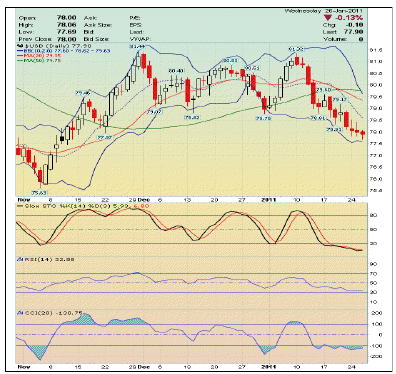
TECHNICALS: Fridays close saw the Dollar at 77.21 after tumbling from an early week rally to the 78.32 level. Price traded all week below the key psychological 78.00 level which now exposes downside risks to 75.63 support over the coming days and weeks with only a sustained close above 78.50 negating our bearish bias.

Euro Dollar.

Our bias BULLISH, we’ll be looking to buy the Euro on dips.

FUNDAMENTALS: Looking ahead this week, the markets preoccupation with Thursday’s Minimum Bid Rate and Monetary Policy Statement expectation is so intense that it has basically ignored a tentative risk aversion move. With the market pricing in 95 bps of hikes over the coming 12 months, undoubtedly the bar has been set high. With that in mind, there will be great interest in Thursday’s ECB rate decision considering the central bank has held its hand on changing rates for nearly two years now. There seems little doubt that the ECB will hold rates steady yet again and all of the recent hawkish speculation will require some level of confirmation from the ECB to maintain the Euro Dollar’s bullish charge. A boost to growth or inflation expectations, rhetoric that suggests a withdrawal of atypical stimulus measures or even a subtle change in key terminology could quite easily boost Euro bulls’ convictions. Supporting interest rate expectations is particularly important for the Euro Dollar’s performance because without the promise of higher returns down the line, the market will once again have to price in the uncertainties related to the region’s sovereign financial troubles. Fear of another financial crisis overtaking another EU member has cooled off these past week’s thanks largely to policy officials’ open-ended vows to expand their support of the region’s troubled economies. With the upcoming EU summit that is to vote on a range of proposals designed to ensure Euro-Zone financial stability, said policy officials rhetoric is likely to be exposed as meaningful or meaningless. Lastly, this week the German unemployment change figures may steer the economic side of market policy expectations but more pertinent though will be the Euro-Zone CPI estimate due Tuesday. Forecasts for an unchanged 2.4% annual growth may keep a hawkish Euro Dollar outlook in place without further accelerating the markets rate tightening expectations.

TECHNICALS: Friday saw price dip below the 78.6 fib of the Feb 2nd – 14th decline to close at 1.3748. Notably, price failed to close below the 9th Feb resistance level by 1.3730 which suggests price may head higher and test the 2011 high by 1.3860 over the coming sessions and beyond that, the key psychological 1.4000 level. At present, we have an open long position from 1.3775 targeting 1.4000, with only a daily close below 1.3700 negating our early week bullish bias.

Japanese Yen.

Our bias NEUTRAL, we’re on the sidelines until a clearer picture emerges.

FUNDAMENTALS: Last week, the Japanese Yen rallied against all of its major counterparts on the back of a sharp drop in risk appetite amid fears that turmoil in the Middle East will push up oil prices and threaten to derail the global recovery. Typically, the Yen strengthens in times of stress as risk aversion spurs an unwinding of carry trades funded cheaply in the perennially low-yielding Japanese currency. This time around however, the story had more to do with US Treasury yields: rising jitters sent capital out of stocks (as well as other risk-geared assets) and into the safety of – among several favorite havens – US government debt. This drove up bond prices, sending yields sharply lower. A firm inverse correlation between a trade-weighted index of the Yen’s average value and the long end of the US yield curve meant that it also translated into strengthening for the Japanese unit. So with this in mind, the coming week promises to be anything but quiet. While worries about the oil price may have calmed a bit after Saudi Arabia pledged to boost production to offset any Libyan-linked shortages, a packed economic docket of scheduled data promises to keep sentiment trends in flux. The US economic calendar alone is reason enough to expect dramatic price movement, with the ISM Manufacturing Survey, the Fed’s Beige Book and the all-important NFP jobs report along with a hefty dollop of second-tier releases all due to cross the wires. This includes a long list of Federal Reserve speakers – headlined by Chairman Ben Bernanke’s semiannual congressional testimony. Additionally, there is the possibility of renewed sovereign jitters in the Euro Zone as Portugal rolls over a tranche of debt while Spain and Belgium tap the markets threatens to compound market volatility. Taken together, this makes for a complicated landscape, with the likelihood of sharp price moves the only firm conclusion to be made about the Yen’s trajectory over the next five days.

TECHNICALS: Last week, price came under some intense pressure to trade back below 82.00, however, overall price action remains largely consolidative and we would expect to see the market once again well supported in the 81.00’s. For now, 81.00 remains the key level to watch below, and only a close below this figure would negate the current range-bound price action and give reason for concern. As such, we like the idea of buying on dips into the 81.00’s in favor of a bullish reversal and daily close above 82.00.

British Pound.

Our bias NEUTRAL, we’re on the sidelines until a clearer picture emerges.

FUNDAMENTALS: Last week, Sterling lost ground against the U.S. Dollar, falling some 1.08% amid uncertainty surrounding the region’s economic outlook, while risk aversion sentiment regained a footing due to tensions in the Middle East and North Africa. This weeks U.K. economic docket will be fairly muted, however, as technical studies begin to paint a bearish picture for Cable, this weeks price action may see additional loses in the Pound. GBPUSD witnessed whipsaw price action over the past 5 days as fundamental developments failed to provide market participants with a clear bearing towards the chance of a rate hike by the Bank of England in the near term. As of late, consumer prices remain stubbornly above the central bank’s target and are expected to push higher due to the increase in VAT. Moreover, BoE Governor Mervyn King warned that inflation could push somewhere in the area between 4 and 5% over the next few months. As a result, the Bank of England Minutes showed that Spencer Dale joined Andrew Sentance and Martin Weale in pushing for a rate hike. Additionally, 4th quarter economic activity posted a -0.6% contraction (-0.5% forecast) while total business investment slumped 2.5% in the same period. Also concerning for U.K. policy makers was the fact that CBI reported sales posted its lowest reading since June 2010. This week, Sterling traders will looking to the Nationwide and Halifax house price index readings, PMI manufacturing, and M4 money supply prints for a bearing going forward. As the U.K. economic outlook comes into question, dismal releases will not only send the Pound lower against most of its counterparts, and may lead the central bank to take a wait and see approach before tightening monetary policy.

TECHNICALS: Price remains largely locked in consolidation after continuously stalling out ahead of key resistance by 1.6300. From here, it is difficult to establish a clear directional bias and we will need to see a sustained close above 1.6300 or below 1.6100 for additional clarity. We have an open short position from 1.6140; however, expected U.S. Dollar weakness this week may see us cut out of the position early until a clearer picture develops.

Canadian Dollar.

Our bias BULLISH, we’ll be looking to buy the Loonie on dips.

FUNDAMENTALS: The Canadian Dollar finished last week stronger against the U.S. Dollar, rallying on the surge in oil prices amid turmoil in the Middle East and North Africa. Surprisingly, Retail Sales dropped for December, falling 0.2% from the month prior. However, stripped of automobile sales, the Retail Sales print actually increased 0.6%, a figure in line with expectations which sent the Loonie higher for the remainder of the session. With the Loonie falling away from parity against the Greenback, key releases this week could dictate whether or not USDCAD tests similar levels once again. The week ahead is packed with significant market moving data from nearly all of the G-7 economies, and the Bank of Canada rate decision and monetary policy statement on Tuesday will be a driving force behind volatility for the North American session after its release at 13:30 GMT. Credit Suisse Overnight Index Swaps price in a 4.0% chance of a 25 bps move, but the market will be paying close attention to the ensuing commentary to get BoC insight with regard to future monetary policy. With inflationary pressures rising in Canada and CPI increasing by 2.3% year-over-year in January, the markets have priced in a 75 bps increase over the next 12-months. Despite the fact that the key interest rate is suggested to hold at 1.00%, with an implied overnight interest rate of 1.32% for March, BoC Governor Mark Carney’s statement will be particularly important as to learn when the BoC believes an actual rate hike will occur. Accordingly, hawkish commentary by Governor Carney could send the Loonie higher against the Dollar. Before Tuesday’s rate decision, Gross Domestic Product data will hit the newswires on Monday. Growth during the fourth quarter of 2010 is forecasted to increase by 3.0% at an annualized rate, in line with moderate growth expectations. However, should the reading come in higher than expectations, market speculators could drive USDCAD lower amid projected hawkish commentary from BoC policymakers.

TECHNICALS: Technical studies point lower for USDCAD with key support coming in by 0.9709. A daily close below this level exposes downside risks toward the 2007 low at 0.9056. Expected U.S. Dollar weakness over the coming days and weeks suggest the short side with this pair is where price is heading.

Australian Dollar.

Our bias BULLISH, we’ll be looking to buy the Aussie on dips.

FUNDAMENTALS: Last week, the Australian Dollar finished slightly higher than the U.S. Dollar after a week of whipsawing price action, falling on sharp U.S. S&P 500 declines only to recover into the Friday close. The market will now look ahead to a packed week of economic data to drive moves in AUDUSD. Given that the Australian Dollar nears important peaks against the U.S. Dollar, it could very well be a key week for the AUDUSDs’ 10 month impressive uptrend. Friday’s U.S. NFP jobs report headlines a busy week and the usual wave of pre-NFP data releases will shape expectations leading up to the event. The Reserve Bank of Australia may likewise drive volatility through their scheduled interest rate announcement on Tuesday at 03:30 GMT. Credit Suisse Overnight Index Swaps (OIS) price in a 0% chance of any change in interest rates, but it will still be important to monitor the post-announcement statement from RBA Governor Glenn Stevens. Those same OIS show that overall interest rate hike expectations continue to trend lower for the Australian central bank; 12-month interest rate expectations remain near their lowest levels since the second half of 2010. Though the RBA has stated concerns that domestic inflation may hit the top end of their target through 2012, recent rhetoric suggests no sense of urgency in further monetary policy tightening. Any hawkish shifts could further fuel Australian Dollar gains. Some second-tier Australian economic data may spark shorter-term volatility, but broader financial market risk sentiment will likely remain the most significant driver of AUDUSD price action. The key question is whether broader geopolitical turmoil may be enough to force a more sustained shift in ‘risk’ and a commensurate correction in financial market sentiment. An Australian Dollar above parity is hardly a sign of market troubles, and indeed we will have to see a much larger AUDUSD turn lower before claiming that the AUDUSD is in danger of a sharp correction.

TECHNICALS: AUDUSD continues to advance, thus a bullish resolution to the sideways trade since October appears increasingly certain. Only a daily close below 0.9800 would confirm a reversal to the downside. The market appears set on testing the recent 1.0255 high over the coming sessions and expected U.S. Dollar weakness over the coming days and weeks is likely to see AUDUSD probe higher.

New Zealand Dollar.

Our bias NEUTRAL, we’re on the sidelines until a clearer picture emerges.

FUNDAMENTALS: Last weeks devastating earthquake is enough to potentially detract 0.5% of growth from the New Zealand economy, further complicating a recovery that was already shaky given the imbalance of domestic factors and the strains of the global stabilization. In the aftermath of the earthquake, the market has seen expectations for one or two quarter-point rate future hikes turn into a forecast for 10 bps of cuts. The market has fully priced in the possibility of a 25 bps cut at the next meeting on March 9th and there is debate that the move could be as large as 50 basis points. Maintaining rates is one thing; but seeing yield potential drop is another altogether. As interest rate expectations have retreated over the past week, we have seen the Kiwi react in kind and while this slide has clear fundamental roots, we need to be cautious in our expectations of a trend reversal. The Kiwis 3.00% yield will offer a strong reason for investors to keep capital in the market until there is confirmation that a rate cut is on the way. At the same time, the view of market wide risk appetite sentiment will play a more prominent role here. Normally, a high yielding currency would still attract support when short term risk appetite sentiment has a corrective pullback, but the wider market’s bearings will be seen as a added weight to the RBNZ’s’ efforts going forward. Apart from the early week Trade Balance and business confidence reports, the economic calendar is empty for the Kiwi which means price action is likely to be determined by wider market sentiment going forward. All in all, the markets panicked reaction to the earthquake and its implications may be slowly retraced over the coming week as investors acclimatize to the new fundamental reality for the Kiwi Dollar with accompanying U.S. Dollar weakness.

TECHNICALS: NZDUSD has continued lower but found support just ahead of 0.7400. A drop below 0.7342 is needed to confirm our bearish bias. Until then, bullish potential does remain (although looking less certain) and a rebound to 0.7655 cannot be ruled out with a daily close above this level negating our bias. Near term resistance comes in by 0.7520/0.7575. We have two open short positions from 0.7475/0.7512 and with expected U.S. Dollar weakness over the coming day and weeks, confidence is waning to the short side. As such, we’ll be monitoring closely and may look to cut out of these positions early in the week to wait for a clearer picture to emerge.

About Pepperstone

Pepperstone is a global provider of online trading services, specializing in foreign exchange (forex or FX). Successful traders and investors understand that superior technology and low trading costs hold the key to greater returns. Pepperstone provides access to fair, competitive and transparent pricing across all major currency pairs by equipping traders with best-in-class trading technology and customer service. The company is based in Melbourne, Australia.

Pepperstone Metatrader 4 Forex Broker

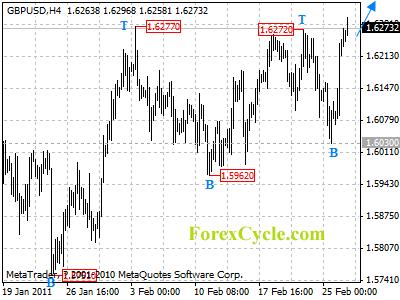
GBPUSD broke above 1.6277 resistance

GBPUSD broke above 1.6277 resistance, suggesting that a cycle bottom has been formed at 1.6030 level on 4-hour chart, and the longer term uptrend from 1.5344 (Dec 28, 2010 low) has resumed. Further rise towards 1.6500 area would likely be seen in a couple of days. Support is at 1.6215, as long as this level holds, uptrend from 1.6030 could be expected to continue.

gbpusd

Forex Signals

David Rodriguez from DailyFx talks USD, Euro and Jobs Report in latest Forex Commentary

By Zac, CountingPips.com

Today, I am pleased to share a forex interview and market commentary on this week’s major events and forex trends with quantitative analyst at DailyFx.com, David Rodriguez. David’s specializes in statistical studies in currency trading markets and algorithmic trading systems for the Managed Accounts Programs offered by parent company, FXCM.

Q: The US nonfarm payrolls government job report is due on Friday with the DailyFX calendar showing an early projection of 182,000 jobs to be gained for February. Many analysts concluded that January’s report was lower due to weather conditions in the US. Do you expect a “rebound” in the jobs report and do you feel this would have a positive effect on the US dollar?

We not only expect a rebound, but we must absolutely see a rebound if expectations of US economic growth are to hold steady. January’s dismal NFP result was indeed blamed on seasonal effects due to the weather. But if the weather was David Rodrigueztruly to blame, we should see a strong bounce in February data as workers return to their posts. If we don’t, we could see the US Dollar weaken considerably as pressure mounts on the US Federal Reserve to keep monetary policy exceptionally loose through the foreseeable future.

Q: There are many major data releases and events on the schedule this week, what do you feel may turn out to be the most important event to watch for concerning the forex markets this week?

Nonfarm Payrolls remains the obvious choice for top-billing across global economic calendars. Historically one of the largest market movers across financial markets, this particular release date takes on renewed importance due to January’s dismal jobs report. NFPs matter because they set the tone for subsequent US Federal Reserve monetary policy, and any substantial misses could really hurt the Greenback against major currencies.

Q: The Reserve Bank of Australia’s interest rate decision is due out this week while the Bank of Canada’s interest rate decision is also coming out with the expectations that both bank’s will be holding the interest rates steady. Which do you feel may possibly have more of an impact on their respective currencies?

Both central banks are almost unanimously expected to leave interest rates unchanged, but the Australian Dollar has historically proven far more sensitive to RBA rate expectations than has the Canadian Dollar to BoC expectations. Overnight Index Swaps currently price in fairly limited rate moves from the Reserve Bank of Australia through the coming 12 months. Thus risks arguably remain to the topside, as a surge in hard commodity prices reignite risks for inflation and generally buoyant Australian economic data support the case for higher rates. It will be important to keep a close eye on the post-decision statement from the RBA.

Q: Can you share your analysis on the EUR/USD pair? What do you feel is driving this pair at the moment and where do you think it may be headed?

The Euro/US Dollar is being driven by broader US Dollar weakness and not necessarily Euro strength. In fact the single currency has been a relative under-performer as of late, and we expect USD trends to continue driving the pair through the near term. Given bearish US Dollar momentum, we could expect the EUR/USD continue to test recent peaks until a broader recovery for the beleaguered US currency.

Q: The USD/CAD currency pair has broken out of its fairly tight range to the downside and the price of oil will likely be very sensitive to the political unrest in the Middle East. Do you think this continues to push the Loonie higher versus the dollar? Is USD/CAD at all likely to test the low levels from 2007 near 0.9400?

The Canadian Dollar continues to defy calls for a substantive correction, and oil prices remain one of the most important drivers of further Loonie gains. One troubling sign is nonetheless that CFTC Commitment of Traders data shows large speculators the most net-long the CAD (short USDCAD) since the currency topped through early 2010. Sentiment extremes are incredibly different to time and are only clear in hindsight. Thus we remain cautious with the USDCAD on the risk that it could see a substantive correction through the near term, but the timing of any such move is anything but clear.

Q: On a technical basis, do you have any specific currency pairs in your sights that may warrant watching?

Almost all US Dollar pairs continue to challenge important support and resistance levels, making it a make-or-break week for the US currency. We are watching the Euro/US Dollar, Australian Dollar, British Pound, Japanese Yen, and other key pairs to see if the Greenback holds support. It will be critical to watch whether the downtrodden USD can bounce from important technical levels.

Thank you David for taking the time for participating in this week’s forex interview. To read David’s latest currency analysis and trading strategies you can visit DailyFx.com.