Sterling Rises on Hawkish Comments

printprofile

The pound was bid this morning versus the euro and the dollar following hawkish comments from Bank of England Monetary Policy Committee member Andrew Sentance.

Earlier today BOE MPC member Andrew Sentance said the decline in inflationary pressures may be only temporary given sterling’s deprecation. This could send inflation above 5% and increasing the need for an adjustment higher to the interest rate. Sentance claims that a weak pound has kept inflationary pressures high as imported goods continue to add to inflation levels. A stronger pound would help to counteract rising import prices as this would make imported goods less expensive

Sentance is one of the most hawkish members of the MPC and has voted to raise interest rates at every MPC meeting since June of last year.

Recent data shows inflationary pressures run high 2010 CPI rose by 4%. While the inflation level is above the target of the Bank of England the data was well below expectations for a year over year increase of 4.4%. The lower than expected inflation numbers has pushed back market expectations for a BOE interest rate increase to August from May.

Sentance expects inflation will pick up and has voiced his concerns repeatedly, but his term as an MPC member expires in May and his comments may be shrugged off by traders as the day progresses.

After the comments hit the news wires the GBP/USD traded higher at 1.6353. Support for the Cable is at last Monday’s high of 1.6180 with resistance at 1.6425 and 1.6460. The EUR/GBP was lower at 0.8824 with support found at the trend line off of the mid-February low at 0.8790. Resistance comes in at the October high of 0.8940.

This afternoon a slew of US data releases are on the calendar with the most important being the Core CPI m/m release at 12:30 GMT. Lower than expected inflationary pressures in the US should keep the dollar on its back foot going into the weekend.

G20/IMF to Address China; May Push Down on USD

Source: ForexYard

As the debate on international imbalances intensifies, China’s monetary policies are coming under direct pressure and could have significant impact on the US bond market, which may be partially behind the USD’s decline since yesterday evening.

Economic News

USD – Differing Monetary Policies in US and Europe Drags on USD

The divergence between the monetary policies of Europe and the United States has begun to cause reactionary movements in the foreign exchange market. The US dollar, recently gaining ground on positive fundamentals and rising risk aversion, now appears on the defensive as risk appetite returns.

Much of these losses may be attributed to a return of confidence in regards to the euro zone as a few analysts have begun to forecast something resembling an end to the region’s debt woes. The EUR/USD, in today’s morning hours, felt some sharp reverberations as traders shifted back into EUR positions. This has pulled down on the dollar, moving the pair back towards 1.4500. Whether or not the dollar will fall beneath this support line is anyone’s guess, but for the moment the G7 meetings appear to have produced favorable results for the European currencies.

As with yesterday’s economic calendar, today’s market events are almost exclusively American. Most important today will be the publication of the Consumer Price Index (CPI) and the University of Michigan’s (UoM) Consumer Sentiment report. Both are expected to show stability and growth, respectively, and may help the USD regain some of yesterday morning’s glory before closing out for the weekend.

EUR – G20 and IMF Meetings May Affect EUR Sharply

The euro’s return into a dominantly bullish posture in yesterday’s late trading hours is largely explained by two market forces. The first are the G20 and IMF meetings taking place since yesterday, which have been discussing the Japanese nuclear crisis in more depth, but also addressing the direction of the Chinese Yuan.

As rhetoric on international imbalances intensifies, China’s monetary policies are coming under direct pressure and could have significant impact on the US bond market, which may be partially behind the USD’s decline since yesterday evening.

The second market force boosting the EUR is a return of risk appetite as many analysts have begun to believe that Europe is handling its debt crisis effectively and may in fact raise rates once more in the immediate months ahead. Adding into the euro’s rise is also a policy of euro-buying by US reserve managers, according to a report by BNP Paribas.

European inflationary figures on the consumer side are set to be released today and may help traders gauge how effectively growth rates are maintaining throughout the region. Europe’s trade balance will also be published, but this figure has historically had little impact on the EUR. Traders will want to watch any developments out of the G20 meetings today as any direct attacks on China could undermine US bond strength, thus pushing investors into the EUR en masse prior to the week’s close.

JPY – JPY Granted Reprieve as Investors Shift Focus; Turns Bearish

The Japanese yen was trading lower this morning as Japanese pension funds and a variety of importers began to purchase US dollars with yen amid a downturn in negative news regarding Japan. The reprieve from international skepticism helped alleviate international pressures on the JPY, allowing many investors to shift direction in their portfolios heading into the early Asian session today.

Discussions about a future intervention by the Bank of Japan (BOJ) have begun to crop up lately, but many maintain the sentiment that now is not the time for Japan to intervene simply due to the international climate surrounding the G20/IMF meetings.

Japan’s currency strength has traditionally hindered its exporting capability, but at a time of national reconstruction and emergency management the increased buying power is actually helping the Japanese economy for the time being. Traders should, of course, be on the watch for any news of an intervention, but shy of such a move the JPY should continue to trade near its present value.

Crude Oil – Oil Prices Supported by Stockpile Data and G20/IMF Meetings

A decline in US crude stockpiles initially supported the price of Crude Oil, but a sudden shift in risk appetite caused a sharp downturn in oil prices back towards $106 a barrel. As of this morning, however, the price of oil received a large injection of support from economic fundamentals favoring commodity buy-ins.

Traders have been eyeing the G20/IMF meetings begun yesterday for any news regarding major oil consumers, since volatile shifts in currency values could undermine growth. So far, though, the meetings have been positive for risk appetite and thus growth, and appear to be revealing stability in the commodity markets, though with reservations about China. Today’s meetings will likely be more impactful considering the topic of discussion and traders will want to keep an eye out for any comments emerging from the discussions.

Technical News

EUR/USD

The 8-hour chart is showing mixed signals with its RSI fluctuating at the neutral territory. However, the daily chart’s RSI is already floating in the overbought territory, suggesting a downward correction may be imminent. When the downwards breach occurs, going short with tight stops appears to be preferable strategy.

GBP/USD

The pair has been range-trading for a while now, with no specific direction. The Daily chart’s Slow Stochastic providing us with mixed signals. The 4 hour charts do not provide a clear direction as well. Waiting for a clearer sign on the hourlies chart might be a good strategy today.

USD/JPY

The price of this pair appears to be floating in the over-sold territory on the 8-hour chart’s RSI indicating a downward correction may be imminent. The upward direction on the daily chart’s Slow Stochastic also supports this notion. Going long with tight stops may turn out to be the right choice today.

USD/CHF

The pair has recorded much bearish behavior in the past several days. However, the technical data indicates that this trend may reverse anytime soon. For example, the daily chart’s Stochastic Slow signals that a bullish reversal is imminent. An upward trend today is also supported by the 8-hour chart’s RSI. Going long with tight stops may turn out to pay off today.

The Wild Card

Crude oil

Crude oil prices rose significantly yesterday and peaked at $108.70 a barrel. However, the daily chart’s RSI is floating in an overbought territory suggesting that a recent upwards trend is loosing steam and a bearish correction is impending. This might be a good opportunity for forex traders to enter the trend at a very early stage.

Forex Market Analysis provided by ForexYard.

© 2006 by FxYard Ltd

Disclaimer: Trading Foreign Exchange carries a high level of risk and may not be suitable for all investors. There is a possibility that you could sustain a loss of all of your investment and therefore you should not invest money that you cannot afford to lose. You should be aware of all the risks associated with Foreign Exchange trading.

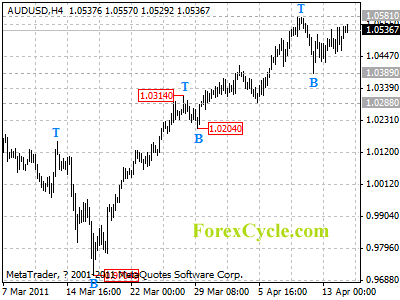
AUDUSD stays in a trading range

AUDUSD stays in a trading range between 1.0389 and 1.0581. As long as 1.0389 key support holds, the price action in the trading range is treated as consolidation of uptrend from 0.9704, another rise towards 1.1000 is still possible, however a break above 1.0581 is needed to confirm the resumption of uptrend. On the other side, a breakdown below 1.0389 will indicate that the uptrend from 0.9704 had completed at 1.0581 already, then deeper decline could be seen to 1.0100-1.0200 area.

audusd

Forex Signals

First Solar President to Leave Company; Shares Plunge

First Solar (FSLR) said today its president of operations, Bruce Sohn, is leaving the company effective April 30, and will not be replaced. First Solar said Sohns direct reports will continue their current responsibilities with new reporting lines, in many cases to CEO Rob Gillette.

Learn How to Use Bar Patterns to Spot Trade Setups

Bar chart patterns often introduces sizable moves in price
April 14, 2011

By Elliott Wave International

To many novice investors, chart patterns might as well be tea leaves. Can they really tell you anything reliable? And even if they can, how in the world do you know what to look for?

Experienced traders know that the answer to the first question is a resounding “yes.” As for the second one, we at EWI are all about recognizing chart patterns. To help you get started on this path, we’ve put together a free Club EWI resource called How to Use Bar Patterns to Spot Trade Setups.

It’s a collection of lessons in trading and pattern recognition by one of EWI’s top trading seminar instructors, Jeffrey Kennedy (who is also the firm’s senior commodities analyst).

Enjoy this quick excerpt — and for details on how to read this report in full, free, look below.

Chapter 1: How To Use Bar Patterns To Spot Trade Setups
Double Inside Bars

While many of my co-workers jog, bicycle or play in bands for a hobby, I amuse myself by looking through old price charts of stocks and commodities. Let’s look at a bar pattern that I call a “double inside day.”

Many of you who subscribe to my Daily Futures Junctures have seen me mention this bar pattern. I think everyone should be familiar with it. Why? Because it often introduces sizable moves in price — always a good reason for a trader to pay attention.

So let’s begin with a basic definition: A double inside day, or bar, occurs when two inside bars appear in a row. An inside bar is simply a price bar with a high below the previous high and a low above the previous low.

Notice that the range of price bar number two encompasses price bar number one, and price bar number three encompasses price bar number two.

Figures 11-2 (Wheat) shows an example of double inside days and the price moves that followed. (Continued.)

Read the rest of this 15-page report online now, free! All you need is to create a free Club EWI profile. Here’s what else you’ll learn:

  • How To Use Bar Patterns To Spot Trade Setups
  • How To Make Bar Patterns Work For You
  • How To Use An Outside-Inside Reversal to Spot Trade Setups

Keep reading this free report now — all you need to do is create a free Club EWI profile.

This article was syndicated by Elliott Wave International and was originally published under the headline Learn How to Use Bar Patterns to Spot Trade Setups. EWI is the world’s largest market forecasting firm. Its staff of full-time analysts led by Chartered Market Technician Robert Prechter provides 24-hour-a-day market analysis to institutional and private investors around the world.

Dollar Risks Being Left Behind in the Search for Higher Returns

During times of economic uncertainty, buying and holding U.S. dollar-denominated assets has long been the standard “flight to safety” many investors have relied upon for shelter from the storm. In recent years however, this trend is waning and investors are turning more and more to the yen and Swiss franc to minimize losses as both currencies have proven more resilient to exchange rate fluctuations.

But it is not just as a “safe harbor” that the dollar is losing popularity. When market conditions are more favorable, risk appetite naturally increases and investors are willing to accept greater risk in the search for higher returns, and on this front, the dollar is also overshadowed. While most other major economies have either already implemented interest rate increases or appear close to doing so, the Federal Reserve continues to favor a continuation of the current record-low rate.

U.S. Losing the Interest Rate Race

Simply put, the dollar is losing the interest rate race and is seriously at risk of being left behind. Australia will continue to hold the top-spot on the list with a benchmark interest rate of 4.75 percent with New Zealand next at 2.5 percent. The European Central Bank hiked rates by a quarter-point last week to 1.25 percent and Governor Trichet strongly hinted that further increases are likely. The Bank of Canada, while opting not to implement an increase earlier this month, stated quite plainly that it expects to put forward a series of hikes later in the year if the economy continues to expand at the current rate.

Contrast these actions and comments with those emanating from the Federal Reserve. Growth is returning to the U.S. and employment is improving but it remains to be seen how the economy reacts with the wrap-up of the “QEII” stimulus spending program scheduled to conclude in June. We will soon learn if the economy has recovered sufficiently to stand on its own without the need for another multi-billion dollar round of spending.

With respect to interest rates, Fed Chair Ben Bernanke has essentially ruled-out an increase in interest rate hikes until late in the year at the earliest. This could be moved ahead if the economy exceeds expectations, but with the stimulus spending due to end in the early part of the summer, and with unemployment still around 8.7 percent or so, the Chairman’s prediction seems reasonable and a cap of 0.25 percent may be with us for some time yet.

USD to Fund Carry Trades?

So what does this mean for the dollar? From an interest rate standpoint alone, the dollar is without question at a disadvantage. In fact, we are seeing a greater use of the dollar to fund carry trades whereby investors sell the dollar in order to buy higher yielding currencies such as the Australian dollar or even the euro. If this continues, there will be even greater selling pressure on the dollar over the coming months.

Article by Scott Boyd, forexblog.oanda.com

Weekly Initial Jobless Claims rise more than expected. Producer Prices increase

By CountingPips.com

U.S. jobless claims increased by more than expected in the week that ended on April 9th, according to a release by the U.S. Labor Department today. Weekly initial jobless claims rose by 27,000 workers to a total of 412,000 unemployed workers and marked the highest claims level in two months. The 4-week moving average of unemployed workers increased by 5,500 workers from the previous week to a total of 395,750.

Market forecasts were expecting jobless claims to decline to 380,000 workers following the previous week’s 385,000 revised number of claims.

Meanwhile, workers seeking continuing claims for unemployment benefits for the week ending April 2nd decreased for the week. Continuing claims declined by 58,000 workers to a total of 3,680,000 unemployed workers. The 4-week moving average of continuing claims decreased by 20,750 workers to a total of 3,728,750.

Produer Inflation increases

The Producer Price Index, released in a separate report by the Department of Labor, rose for a ninth straight month in March as energy costs increased and pushed prices higher on finished goods.

Producer prices increased by 0.7 percent in the month of March following an increase of 1.6 percent in February and a 0.8 percent rise in January. The annual rate of increase for March showed that producer prices were 5.8 percent higher than March of 2009 after February’s annual rate registered a 5.6 percent increase.

Market forecasts were expecting monthly producer prices to increase by 1.0 percent for March. Contributing to the higher producer prices for the month was an increase in the energy index by 2.6 percent and a rise in gasoline prices by 5.7 percent.

Core producer prices, excluding food and energy prices, rose by 0.3 percent in March following a rise of 0.2 percent in February. The data was just higher than market expectations of a 0.2 percent gain.

Currensee Raises $4M in Series C Financing from North Bridge Venture Partners, Egan- Managed Capital and Vernon & Park Capital

BOSTON – April 14, 2011 – Currensee, (www.currensee.com), the alternative investment service that gives investors unique access to the world currency markets, today announced that it has secured an additional $4 million as Series C financing from North Bridge Venture Partners, Egan-Managed Capital and Vernon & Park Capital. The C round money brings the Currensee total financing to date to $16.8 million.

“Currensee continues to fundamentally change foreign exchange investing, and its approach has been validated by the market with an incredible year of growth,” said Jim Moran, partner at North Bridge Venture Partners. “Currensee has not only brought transparency to Forex trading, but has also opened up the world’s currency markets to the rapidly growing population of retail investors.”

The past year was marked with the October 2010 launch of the Currensee Trade Leaders™ Investment Program, a service that lets retail investors automatically replicate the trades of some of the most successful traders in the world, called Currensee Trade Leaders. Since the launch, more than $3 billion in volume has been traded through the program. The company has also received more than 1,000 applications from professional and independent expert traders, vying for a coveted place on the Currensee Trade Leader Leaderboard, which showcases each Trade Leader’s performance, risk, return data and investor count. Currensee has also expanded operations into the United Kingdom and created partnerships with European investment banks and brokers.

The latest round of funding will be used to develop new decision-making, collaboration and portfolio management tools for investors to make currency investing even simpler and more transparent. It will also be used to fortify the Currensee technology infrastructure including data center expansion and enhancements to the Currensee Intelligent Trade Replication Technology™, a sophisticated trade automation engine that precisely manages the timing and round-turn execution of trades. The funds will also drive further international development, including the expansion of the Currensee sales teams in the United Kingdom and Europe, as well as new global partnership deals in Asia and Europe.

“Our customers come to us and invest in Trade Leaders mainly because of the lackluster returns and lack of transparency that come with traditional investments,” said Dave Lemont, CEO of Currensee. “We are bringing the world currency markets to every investor looking to move beyond the stock market, while creating a viable alternative asset class for the market as a whole. This new funding will help us expand our distribution globally so that investors and professional money managers can benefit from the fast growing foreign exchange market.”

About Currensee
Currensee is the alternative investment service that puts the power of world currency markets in the hands of every investor. With the Currensee Trade Leaders™ Investment Program, investors build their own automated trading portfolios of Trade Leaders, top foreign currency traders hand picked from the thousands of members of the Currensee social network. The program offers investors an alternative to traditional asset classes and Trade Leader performance is completely uncorrelated to the stock market. Currensee delivers complete account control to investors, who can see every trade in real time, manage and modify investment allocations with one click and benefit from the safety and security of proprietary online investing technology. Currensee is funded by North Bridge Venture Partners, Egan-Managed Capital and Vernon & Park Capital and is a member of the National Futures Association (NFA) and registered by the Financial Services Authority (FSA). For more information, visit us at www.currensee.com. Find us on Facebook, follow us on Twitter, and watch us on YouTube.

Please note that over the counter retail foreign currency (Forex) trading may involve significant risk of loss. It is not suitable for all investors and you should make sure you understand the risks involved before trading, and seek independent advice if necessary. Performance, strategies and charts shown are not necessarily predictive of any particular result. Past performance is no indication of future results. Investor returns may vary from Trade Leader returns based on slippage, fees, broker spreads, volatility or other market conditions.

About North Bridge Venture Partners

North Bridge Venture Partners is an active, bi-coastal, early-stage venture capital firm based in Boston, Massachusetts and San Mateo, California. Established in 1994, North Bridge provides seed-to-growth financing and company-building expertise. Together with North Bridge Growth Equity, our mid-market focused growth capital fund, North Bridge manages over $3 billion. For North Bridge Venture Partners, success is derived through a partnership with entrepreneurs that produce industry-leading companies in large emerging markets. Historically, the firm’s partners have played a significant role in organizing, starting and building successful companies. Working in concert with entrepreneurs, North Bridge adds value by providing strategic guidance, sharing operating experience, industry specific knowledge, team-building skills and an in-depth understanding of both private and public financings.  North Bridge’s sector focus includes Software, Communications, Healthcare Technology, Digital Media, and Materials. For more information about North Bridge go to www.northbridge.com.

About Egan-Managed Capital

Egan-Managed Capital is a New England focused venture capital firm that provides funding for early-stage high-technology start-ups. Egan-Managed Capital delivers field-tested strategies, first-hand technology expertise and hands-on management involvement. Some of the region’s most promising start-ups have been funded by the firm, including Pyxis Mobile, OnePIN, OwnerIQ and uTest. Founded in 1997, the firm currently manages funds with $233 million in committed capital. For more information on Egan-Managed Capital and its team please visit www.egancapital.com.


About Vernon & Park Capital

Vernon & Park Capital is a private equity firm that focuses on investments in the Financial Markets Sector. Since 2001, Vernon & Park and affiliated parties have combined industry expertise and experience with rigorous financial analysis to successfully deploy its investment capital in the Sector. Through its investment activities, Vernon & Park provides capital to its portfolio companies and utilizes its extensive network of industry contacts as a strategic resource to help those companies realize their full economic potential. Vernon & Park will consider investments in companies at any stage of development ranging from earlier-stage emerging growth companies to more mature businesses in the Financial Markets Sector. For more information, visit the website www.vernonpark.com.