Today’s Fed Statement a “Make-or-Break” Moment for USD?

Source: ForexYard

The euro witnessed a sharp surge in yesterday’s trading as investors became uncertain about the monetary policy statements expected by the Fed later today. The statements to be released have caused a stir among market analysts as it may actually represent a make-or-break moment for the US dollar. In the meantime, the EUR is gaining from the dollar-averse trading environment, reaching a 16-month high in yesterday’s trading versus its primary Atlantic rival, the greenback.

Economic News

USD – View of the Fed Maintaining its Lagging Monetary Policy Weighs on USD

The divergence between the monetary policies of Europe and the United States has caused reactionary movements in the foreign exchange market since yesterday. The US dollar, recently gaining ground on positive fundamentals and rising risk aversion, now appears on the defensive as risk appetite returns and traders eye the Fed’s impending decision on monetary policy.

The EUR/USD, in today’s morning hours, felt some sharp reverberations as traders shifted back into EUR positions, pushing the pair to a 16-month high of 1.4630. Whether or not the dollar will rise back to previous levels at this point is anyone’s guess, but for the moment the Fed’s policy statement today will no doubt be a main driver in currency values.

Today’s news, however, will also witness a spattering of impactful data releases from Europe and Great Britain. Following a poor industrial order expectation reading out of Britain yesterday, today’s euro zone figure on industrial orders could cause a flight to safe havens should it also disappoint. Traders will want to eye this figure, and Britain’s GDP, as both may carry the possibility of driving traders back into the arms of the US dollar.

EUR – EUR Returns Full Force as Traders Weigh US Fed Meeting

The euro witnessed a sharp surge in yesterday’s trading as investors became uncertain about the monetary policy statements expected by the Fed later today. The statements to be released have caused a stir among market analysts as it represents a make-or-break moment for the US dollar. In the meantime, the EUR is gaining from the dollar-averse trading environment, reaching a 16-month high in yesterday’s trading versus its primary Atlantic rival.

A second market force boosting the EUR is a return of risk appetite as many analysts have begun to believe that Europe is handling its debt crisis effectively and may in fact raise rates once more in the immediate months ahead, despite dovish statements by the European Central Bank (ECB) last week. A potential deterrence to the euro’s recent rise, though, is today’s industrial orders data. After yesterday’s dismal reading from the UK, the euro zone is now under the microscope for similar shortfalls in industry, representative of a sinister impediment to recent growth forecasts.

German inflationary figures on the consumer side are also set to be released today and may help traders gauge how effectively growth rates are maintaining in the region’s largest economy. Traders, however, may want to pay closer attention to the United States today as the statements made by the Federal Open Market Committee (FOMC) today at 17:30 and 19:15 GMT will likely carry the most significant impact on currency values.

JPY – JPY Largely Bearish as Capital Flows towards Europe

The Japanese yen was trading lower this morning as Japanese pension funds and a variety of importers began to purchase US dollars with yen amid a downturn in negative news regarding Japan. The reprieve from international skepticism helped alleviate international pressures on the JPY, allowing many investors to shift direction in their portfolios heading into the early Asian session today.

Japan’s currency strength has traditionally hindered its exporting capability, but at a time of national reconstruction and emergency management the increased buying power is actually helping the Japanese economy for the time being. Traders should, of course, be on the watch for any news of an intervention, but shy of such a move the JPY should continue to trade near its present value. The most important news today for JPY traders will no doubt be the direction the US Federal Reserve takes in regards to its monetary policy.

Crude Oil – Oil Prices Steady after Dropping below $112

Crude Oil prices declined yesterday as analysts said market participants appeared reluctant to aggressively push crude in either direction ahead of the start of the two-day Federal Open Market Committee (FOMC) meeting Tuesday and a scheduled press conference by Federal Reserve Board Chairman Ben Bernanke on Wednesday. The anticipation of the Fed’s statement has caused a dip in USD values, though, which some expect could lift oil back above $112. In the meantime, oil prices are steady.

Reports have also begun to show that high oil prices may be positive for the US in the long-run. US Treasury Secretary Timothy Geithner said a continuation of high oil prices are a strong signal for future US economic growth, but also stated that current prices won’t put recovery at risk, according to the Wall Street Journal. This contradiction to the statements of OPEC, President Obama and officials at Aramco gives further impetus to a climb in oil prices, even though today’s movement was bearish from previous sentiment. Traders will want to pay close attention to today’s Fed statement for indications about where the USD will be heading in the weeks ahead; pushing oil prices in the process.

Technical News

EUR/USD

There is a fresh bearish cross forming on the 4-hour chart’s Slow Stochastic indicating a bearish correction might take place in the nearest future. The downward direction on the weekly chart’s Momentum oscillator also supports this notion. Going short with tight stops might be the right strategy today.

GBP/USD

The pair has been range-trading for a while now, with no specific direction. The Daily chart’s Slow Stochastic providing us with mixed signals. All oscillators on the 4 hour chart do not provide a clear direction as well. Waiting for a clearer sign on the hourlies might be a good strategy today.

USD/JPY

The pair has recorded much bearish behavior in the past several days. However, the technical data indicates that this trend may reverse anytime soon. For example, the daily chart’s RSI signals that a bearish reversal is imminent. . Going short with tight stops might be a wise choice.

USD/CHF

The USD/CHF cross has experienced a bearish trend for the past several days. However, it seems that this trend may be coming to an end. The RSI of the daily chart shows the pair floating in the oversold territory, indicating that an upward correction will happen anytime soon. Going long with tight stops might be a wise choice.

The Wild Card

EUR/GBP

This pair’s sustained upward movement has finally pushed its price into the over-bought territory on the 4-hour chart’s RSI. Not only that, but there actually appears to be a bearish cross on the Slow Stochastic pointing to an imminent downward correction. Forex traders have the opportunity to wait for the downward breach on the hourlies and go short in order to ride out the impending wave.

Forex Market Analysis provided by ForexYard.

© 2006 by FxYard Ltd

Disclaimer: Trading Foreign Exchange carries a high level of risk and may not be suitable for all investors. There is a possibility that you could sustain a loss of all of your investment and therefore you should not invest money that you cannot afford to lose. You should be aware of all the risks associated with Foreign Exchange trading.

Dollar Index Continues To Fall

US Dollar Index update

The Dollar index is under further downside pressure as the majors push higher this week.  EURUSD is making new highs and with the Federal Open Market Committee rate statement due, investors are pricing in their belief that the existing low interest rate will stay at 0.25 percent.

The US debt situation is also weighing heavily on the Greenback with ongoing discussions around a potential default by the US on its payments. The chances of this happening are extremely low but this negativity is the last thing the Dollar needs at present.

With this in mind it is hard to see any respite for the Dollar in the near term.

The attached chart show how the Dollar index has eased through a significant historical support area and is now falling towards the 2008 lows – which dollar bulls will hope offers some kind of demand.

Nick can be found writing further Dollar analysis at www.forex-fx-4x.com


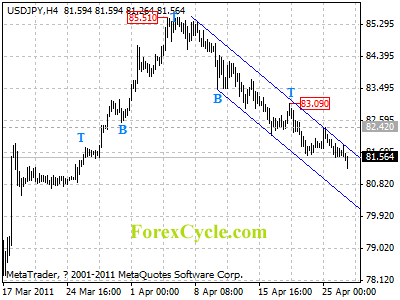
USDJPY’s downward move extended to 81.26

USDJPY continued its downward movement from 85.51, and the fall extended further to as low as 81.26. Initial resistance is at the upper border of the price channel on 4-hour chart, as long as the channel resistance holds, the downward move could be expected to continue and next target would be at 80.50-81.00 area. Only a clear break above the channel resistance could indicate that the fall from 85.51 is complete, then further rally could be seen to 83.50 zone.

usdjpy

Forex Signals

Bull Market Coming to an End?

By Sara Nunnally, Editor, Smart Investing Daily, taipanpublishinggroup.com

Have you heard the expression, “Offense wins games, defense wins championships”? If so, you might want to take a look at your investment portfolio and find out if you’re ready for the current bull market to end. Check this out from Forbes’ Great Speculations blog:

Exactly a year ago today the stock market was celebrating first-quarter earnings reports, reaching for new highs, after recovering from a stumble in February on concerns about situations outside the U.S., notably rising inflation in Asia and the debt crisis in Europe.

This week the stock market is celebrating first-quarter earnings reports, reaching for new highs, after recovering from a stumble in February on concerns about situations outside the U.S., notably inflation in Asia, the return of the debt crisis in Europe, and the earthquake/tsunami disaster in Japan.

But that’s not all… Other similarities are creating some suspicious investors.

The Forbes article notes a string of negative economic reports on jobs and housing and consumer confidence over the past few months mirrors the same reports from last year. Even commentary from the talking heads and the Federal Reserve is similar enough to make some analysts take pause.

Why? I think this chart says it all:

S&P 500
View larger chart

This is a two-year chart of the S&P 500. The red circle indicates the month of April, and the red arrow shows the subsequent fall — a loss of 16% in two months.

With so many economic issues mirroring this time last year, we could be in for another harsh pullback.

Another Forbes article quotes Carl von Clausewitz, author of On War and military strategist during the Prussian War, as saying in part, “The great uncertainty of all data in war is a peculiar difficulty, because all action must, to a certain extent, be planned in a mere twilight.”

Every investment plan is made on assumptions. These assumptions are based on things that are not certain. This means as an investor, you have to have a certain amount of flexibility, balanced with hard-and-fast rules for changing your investment strategy.

For example, you may have bought a particular stock as a long-term buy-and-hold asset… maybe something to give the grandkids when they graduate college… but something drastically changed within the company that affected its value. You may have to change your perspective, and sell that company because it no longer reflects your strategic goal.

Knowing when to sell is just as important and knowing what to buy.

In general there are three reasons to sell: You made a mistake in analyzing the fundamentals; the stock’s valuation isn’t reflected by the price; and the price has climbed drastically, and it’s time to take gains.

But these three reasons are good barometers when the market is still chugging along.

When the market turns against you, it’s a whole other ball game. That’s when you have to really pay close attention to each holding.

(Investing doesn’t have to be complicated. Sign up for Smart Investing Daily and let me and my fellow editor Jared Levy simplify the stock market for you with our easy-to-understand investment articles.)

In essence, you have to become a position trader. These traders are much more active than traditional buy-and-hold investors. A position trader is pretty much synonymous with a trend trader. Position traders jump into a trending stock — a stock whose share price is making higher highs (or lower lows for those who short stocks) — and stays in for as long as the trend remains intact.

They don’t have price targets. They get out when the company breaks out of its established trend.

This is important right now. If the markets are headed for two months of losses, you should to be prepared to sell some stocks and limit losses.

Trailing stop-losses might be effective in this market, in case the markets do decide to climb a little higher here. A trailing stop-loss is a percentage-based exit point that moves higher with share prices. So let’s say Company X is trading for $10, and your trailing stop is 10%. Your initial exit point is $9. But if Company X climbs to $15, the trailing stop moves to $13.50.

Trailing stops can help you lock in gains, rather than having a fixed exit point that might be below your initial entry price.

If you are a position trader you can also set a fixed stop-loss at the bottom of the current trend, which can keep you in a position for a longer period of time than a trailing stop, particularly if it’s a conservative percentage.

XOM Chart
View larger chart

On this chart, a position trader could set a stop-loss to a corresponding point on the green trend line. He or she might have to check in often and change this stop-loss should the stock — in this case Exxon Mobil (XOM:NYSE) — continue to climb higher without coming back to the green line.

Some buy-and-hold investors will choose to just hedge their long-term positions with options, however, rather than have to get out of potentially thousands of shares of a particular company.

It’s not a bad strategy, and Jared can actually talk you through buying options in his service WaveStrength Options Weekly.

But not all companies offer options, so knowing when to sell a company is sometime your only recourse for when the market turns against you.

We’ve started to see some consolidation in the S&P 500, which could signal a pullback in the near future, particularly if the poor economic issues persist. We’re also seeing some pretty low trading volume on some of the indexes, which could make trading a little more volatile…

So be ready for unexpected price swings, and protect your investment portfolio accordingly.

Editor’s Note: Our team of financial analysts has just stumbled on a hidden market “sector” that has shown some stunning 10-fold gains. Get the details on this financial investment opportunity.

About the Author

Sara is Managing Editor of Smart Investing Daily. As Senior Research Director and global correspondent, Sara Nunnally’s diverse resume includes studies in art history, computer science and financial research. She has appeared on news media such as Forbes on Fox, Fox News Live, and CNBC’s Squawk Box, as well as numerous radio shows around the country. Most recently, Sara co-authored a book with Sandy Franks called, Barbarians of Wealth.

As Senior Research Director, global correspondent and managing editor of Smart Investing Daily, Sara has traveled all over the world in search of the best investment opportunities to recommend to her readers, be they in developed economies like France and Italy, in emerging markets like the Czech Republic and Poland, or in frontier terrain like Vietnam and Morocco. Her unique “holistic” approach of boots-on-the-ground research has given her an edge in today’s financial marketplace as she searches for the next investment opportunities in hot sectors like alternative energy, currency markets and commodities.

Dollar Weaker Ahead of FOMC Statement

The dollar continued its week-long slide against the euro just one day before the next Federal Open Market Committee statement and investors are strongly of the belief that the FOMC will maintain the current low interest rate policy capping the Federal Funds rate at just 0.25 percent.

A low interest rate tends to devalue a currency; this is because lower interest rates mean weaker yields for investors. As a result, investors will sell lower-yielding currencies for currencies providing higher returns and this exactly what has been happening with the dollar. Looking ahead, the dollar sell-off will likely increase as the interest rate gap between the U.S. and other countries continues to widen with rate increases in Australia, Canada, and most recently the Eurozone, taking the shine off the greenback.

Geithner Pledges Support for Strong Dollar

Regardless of the high probability that the Fed will maintain the historical low Federal Funds rate – an action that continues to encourage a weaker currency – U.S. Treasury Secretary Timothy Geithner today repeated his earlier mantra that the Treasury believes in promoting a strong U.S. dollar.

“Our policy has been and will always be, as long as I will be in office, that a strong dollar is in the interest of the country,” Geithner said at a New York conference earlier today. “ We will never embrace a strategy to weaken the dollar.”

Based on Geithner’s comments, it is clear that the Fed and the Treasury Department are not – publically at least – reading from the same playbook. In fairness, the Fed is “independent” of the government with a mandate to ensure full employment while promoting sustainable growth and it is the Fed’s ability to set interest rates that makes it possible for the Fed to achieve these goals.

Nowhere does it say that the Fed is responsible for maintaining the value of the dollar. In fact, considering its actions in the wake of the last recession, it appears a weaker dollar is exactly what the Fed is working towards.

Not that this is necessarily a bad thing at this time. A weaker dollar is beneficial for exporting companies as it helps make products made in America more affordable for foreign buyers. For example, recent earnings reports from large multinationals such as IBM and Intel were bolstered by surging global demand for their products. Certainly, these companies make good products, but so do other manufacturers but having a discounted dollar has helped foreign sales. If demand continues to grow, this could translate into employment gains for American workers.

So, while Geithner continues to pledge his allegiance to a strong dollar, look to Bernanke and tomorrow’s statement from the Fed for a realistic picture of America’s real fiscal policy. Also, keep in mind that Geithner is more politician than economist and it would not be very politically astute for him to announce publically that a weak dollar is his objective. Bernanke has proven he has no such qualms.

Scott Boyd is a regular contributor for the OANDA MarketPulse FX blog.

Options Report: April 26, 2011

Welcome to the Financial News Network Options Report. On the call side, Central European Distribution calls are seeing a lot of activity today, currently at close to 8 times their average volume. Valassis Communications calls are near 7 times their average volume ahead of their quarterly earnings report this week. Lexmark calls are 5.5 times their normal volume despite missing EPS estimates this morning. Entropic Communications calls are also very active today, at 5 times their average volume. Finally, Cummins calls close out the list at close to 5 times their average volume after the company beat earnings estimates this morning. Taking a look at the put side of the ledger, Blackstone Group put are seeing a large amount of volume today, currently trading at over 13.5 times their average volume. Longtop Financial puts are over 10.5 times the average volume today. Shares of the company have also hit a 52-week low. Veeco Instruments puts are trading at 9 times their average volume, despite better than expected earnings results. Frontier Communications puts are very active today, currently trading at over 5 times their average volume. Finally, Boston Scientific puts close out the list at 5 times the average amount despite positive news from the FDA. This has been you daily options update from the Financial News Network. Stay tuned for more insight into where the big money is placing their bets each day.

4-26-11 MTS Video: In Front of the Fed

http://mrtopstep. om Tim Top Notch Haefke, Top Notch Trading – The SPM “finnally” got above the contract high at 1337.70 and is now pushing towards the lead month high of 1342.80 which was made by the MARCH contract.

Citi Continues to Expand CitiFX Pro

New York, April 26, 2011 –  Amid changes in the marketplace, Citi (NYSE: C) continues to expand the services of CitiFX Pro, its margin foreign exchange trading platform for small- to mid-sized institutions and experienced individual traders, and reaffirms its commitment to the margin FX market.

In 2011, CitiFX Pro plans to launch in other key European, Middle Eastern and Asian markets. In addition, CitiFX Pro plans to introduce a new FIX-API solution which will provide state-of-the art technology to sophisticated clients. This service will be available to clients in May 2011.

“We have been extremely pleased with the response to CitiFX Pro among small- and mid-sized institutions as well as experienced individual traders,” said Sanjay Madgavkar, Global Head of Margin Foreign Exchange Trading at Citi. “In order to meet growing demand from this important segment of the margin FX market, we are increasing our investment in the product, particularly in relation to technology. We expect our new API solution will offer market-leading, low-latency liquidity to active FX traders.”

Since its launch in 2008 in the United States, CitiFX Pro has expanded to new markets including the United Kingdom, Switzerland, Singapore and other Asian markets and has become one of the leading platforms in targeted segments of the FX market.

CitiFX Pro offers highly competitive spreads starting from 1.2 pips in the EURUSD for individual clients and provides its users access to both CitiFX Strategy and Technical reports—both of which consistently rank at the top of the market polls. Its platform was named Best Retail Platform by Profit & Loss magazine for the past two years running. Citi will soon be the only major bank offering Margin FX in the United States.

“With CitiFX Pro, we believe we have the right platform to service this important client segment”, said Jeff Feig, Citi’s Global Head of G10 Foreign Exchange. “Our latest investment shows our commitment to this growing market and will ensure CitiFX Pro will offer its clients the highest standards of technology and liquidity.”

About CitiFX Pro

CitiFX Pro is Citi’s online forex trading platform for active individual and small institutional clients including commodity trading advisors, broker-dealers, money managers, and hedge funds. Additional information may be found at www.citifxpro.com.

About Citi

Citi, the leading global financial services company, has approximately 200 million customer accounts and does business in more than 160 countries and jurisdictions. Through Citicorp and Citi Holdings, Citi provides consumers, corporations, governments and institutions with a broad range of financial products and services, including consumer banking and credit, corporate and investment banking, securities brokerage, transaction services, and wealth management. Additional information may be found at www.citigroup.com or www.citi.com.