BRIC Nations Add New Member

By Sara Nunnally, Editor, Smart Investing Daily, taipanpublishinggroup.com

In mid-March, we heard from Smart Investing Daily reader C.L.V. who asked if South Africa should be considered part of the emerging market bloc of nations known as BRIC — Brazil, Russia, India and China.

I outlined some of the differences between South Africa and the BRIC nations, and concluded that from my perspective, South Africa should not be considered part of the BRIC bloc. Well, earlier this week, C.L.V. wrote in again to ask for our perspective on the recent gathering of BRIC nations…

And I might have to eat my words.

From Forbes:

Thursday’s [April 14] BRICS Summit will likely focus on what the big emerging markets can do about high commodity prices, finalized by the usual joint statement on global governance signed by the nations’ leaders. It’ll be their third meeting. With each passing year, the ad-hoc group gets stronger economically and politically in world affairs.

It’s a motley crew, indeed, that’s going to meet Thursday in the south China resort city of Sanya. Brazil, Russia, India, China — and newcomer South Africa — are as diverse economically as they are culturally.

The group of BRIC nations invited South Africa to join their group late last year, and after their meeting last week, put out a statement in support of closer cooperation on things like food security and other commodity production.

Smart Investing Daily reader C.L.V. asks, “Who came out with what at the just ended BRIC gathering? Could you please break it down to the point of what its effects would have on global investments and its volumes? How is this going to affect the African, North American and European (ex UK) blocs?”

This is a massive question that will take far more than one Smart Investing Daily article to answer, but let’s start with an overview of what was talked about at the BRICS summit.

BRICS Summit

In brief, China and India agreed to reestablish defense ties and initiate closer border cooperation. China also agreed to deepen its “strategic partnership” with Russia, but there hasn’t been much elaboration on any specifics of this partnership. A Russian bank speaking at a financial forum held during (but separate from) the BRICS Summit hinted that it is considering issuing bonds denominated in yuan, selling them in Hong Kong.

The joint statements released after the summit point to continued exploration of nuclear power plants as part of an overall energy portfolio needed to support industrial growth.

They also announced an agreement to open lines of credit in their national currencies in order to dilute their overreliance on the U.S. dollar.

In my opinion, the biggest thing to come out of the summit was BRIC access to Africa via its newest member, South Africa. China and India already have a huge presence on the continent, and expanding ties with Africa’s largest economy — though beneficial to South Africa itself — could be more of a boon to BRIC nations in search of vast new quantities of commodities.

China’s been buying up interests in uranium projects in Namibia, along with shares of companies, over the past three years and more. China’s also been involved in oil exploration in Sudan. Russia has been trying to get into the oil markets in Angola and Nigeria.

India is China’s closest rival in the amount of investment it’s been doing in Africa, which is an interesting relationship, considering the history of Gandhi and South Africa. Just before the global financial crisis hit, India lost some lucrative oil contracts to China.

And in early 2010, Brazil’s Vale S.A. (VALE:NYSE) announced it would expand into Mozambique. But trade between Brazil and Africa has seen huge growth. Between 2000 and 2008, trade jumped from $3 billion to $18.5 billion.

The BRIC nations will gain most from this new partnership with South Africa, certainly.

But here’s another aspect of the BRICS joining economic forces…

The group — including South Africa — accounts for over 40% of the world’s population, but only 18% of its GDP in 2010. But this could change very rapidly, even if South Africa isn’t included.

The IMF says that BRIC nations will account for 21.6% of the world’s GDP by 2015. A significant increase, but it could be just the tip of the iceberg. The International Business Times reports that BRIC nations are expected to represent 47% of the world’s GDP by 2030.

That’s huge growth, though investors should take it with a grain of sand — the research came from the China Center for International Economic Exchanges.

And yet, the fastest growth we’ve seen has come from BRIC nations as developed economies continue to struggle into recovery mode.

(Investing doesn’t have to be complicated. Sign up for Smart Investing Daily and let me and my fellow editor Jared Levy simplify the stock market for you with our easy-to-understand investment articles.)

From an investment standpoint, we could see a number of BRIC-based companies make forays into Africa, and as commodity prices continue to rise, even smaller projects could be profitable — or at least “purchase-able.”

Continue to look for China to snap up bits and pieces of key energy projects, and keep an ear to the ground for any Russian interest in oil exploration.

But be careful — the smaller projects can change hands pretty quickly, so you might want to consider these types of investments highly risky. A quick Internet search will bring up tons of information on specific mining and exploration projects and who’s involved, so it might be tempting to see these projects as bigger than they really are.

From the brief research I’ve done so far, most Western companies involved are big companies, which would be little influenced by smaller projects in Africa.

It could be, though, that BRIC countries will shoulder out Western companies of some concessions, but we don’t quite know yet how that would affect access to sought-after commodities.

Again, this topic is far too complex to break down in a single article, and we’ll more than likely come back to this issue as investment perspectives come into play.

Overall, to me, it makes sense that BRIC nations are inviting South Africa into their group… It’s a big stepping-stone into the continent. From a strict economically based perspective, I just don’t get it.

Editor’s Note: Explosive new market sector yields string of stunning 10-fold winners! With single trade gains that are mind-boggling… you’d be CRAZY to ignore this hidden niche. Follow this link to find out how to get in on the ground floor of the NEXT potential winner. Get the details from our new service, 180 Trader.

About the Author

Sara is Managing Editor of Smart Investing Daily. As Senior Research Director and global correspondent, Sara Nunnally’s diverse resume includes studies in art history, computer science and financial research. She has appeared on news media such as Forbes on Fox, Fox News Live, and CNBC’s Squawk Box, as well as numerous radio shows around the country. Most recently, Sara co-authored a book with Sandy Franks called, Barbarians of Wealth.

As Senior Research Director, global correspondent and managing editor of Smart Investing Daily, Sara has traveled all over the world in search of the best investment opportunities to recommend to her readers, be they in developed economies like France and Italy, in emerging markets like the Czech Republic and Poland, or in frontier terrain like Vietnam and Morocco. Her unique “holistic” approach of boots-on-the-ground research has given her an edge in today’s financial marketplace as she searches for the next investment opportunities in hot sectors like alternative energy, currency markets and commodities.

Turkey Pressured to Hike Rates or See TRY Depreciate

By Greg Holden

Last week’s statement by Goldman Sachs that the Turkish lira (TRY) will come under selling pressure if the Turkish central bank doesn’t hikes rates has begun to see results. Advising its clients to hold long positions on the USD/TRY, Goldman Sachs’ strategy appears to be creeping across the forex world and the pair has indeed moved bullish since Friday.

The Central Bank of the Republic of Turkey is scheduled to meet this Thursday to discuss its monetary policy and bank regulations. Goldman doesn’t expect the bank to hike its rates beyond their current 6.25%, nor to adjust capital requirements for its banks.

As a result, many are joining the chorus and recommending long positions against the lira as part of their short- and mid-term portfolio. Should the central bank raise rates, the TRY’s strength may return. But for now a downturn is expected.

Turkey has always battled with what world it belongs to, the Middle East or Europe. With the growth prospects in Europe and the recent rate hike by the ECB, Turkey would need to follow suit to keep pace with its northerly neighbors. But the Middle East is in turmoil and the region’s currencies are under significant pressure. To keep its goods competitive with its southerly neighbors a weakened currency will be required.

This Thursday’s meeting will be a clash between those who view Turkey a part of Europe and those who view it as a part of the Middle East. With Turkish Prime Minister Recep Tayyip Erdogan leaning towards its Arab neighbors to the south, a Turkish policy in favor of holding rates steady and weakening its currency may be expected, thus depreciating the TRY over the next several weeks.

Forex Market Analysis provided by ForexYard.

© 2006 by FxYard Ltd

Disclaimer: Trading Foreign Exchange carries a high level of risk and may not be suitable for all investors. There is a possibility that you could sustain a loss of all of your investment and therefore you should not invest money that you cannot afford to lose. You should be aware of all the risks associated with Foreign Exchange trading.

EUR/USD Anticipating Reversal?

Source: ForexYard

As most investors eye Wednesday’s monetary policy meeting by the US Federal Reserve, the possibility exists for the Fed to view the latest string of economic reports, particularly from the housing market, as a signal to release a hawkish assessment of the American economy. Consumer confidence has also risen lately and traders appear to be anticipating an uptick by the greenback against its Atlantic rival this week.

Economic News

USD – USD Hesitant Prior to Week’s Fed Meeting

The US dollar has found itself in a position to rebound strongly in the days ahead if this week’s policy meeting by the Federal Reserve produces a hawkish assessment. Most reports released at the end of last week had begun to call for a fast-paced injection of trading volume, deemed almost certainly to go towards the euro instead of the buck.

However, the beleaguered currency seems to have caught a break with China delaying its monetary revaluation and with a minor shift in fundamentals. Considering the series of negative reports to have piled atop the greenback over the past month-and-a-half, much of the bearish pressure has likely already been priced-in by investors. As such, the Fed should see numerous reasons to be optimistic moving ahead, though the national deficit remains an appalling concern.

As for today’s trading, the global economy exits its holiday break and reenters the market full bore. This liquidity injection should make trading interesting today as the weekend’s flat trading period gets reevaluated by well rested eyes. The Conference Board (CB) will be publishing its consumer confidence report today at 15:00 GMT, with an expectation to rise somewhat from last month – adding weight to the potential for hawkishness from the Fed. Traders may want to anticipate the bull run on the USD should fundamentals shift as expected.

EUR – EUR-Traders Anticipating Return of Euro Zone Liquidity

The euro has been experiencing relatively flat results against most of its currency rivals as the region was on holiday in observance of Easter. The EUR/USD has held relatively stable as of Friday and did not appear to have momentum in either direction until this morning. Traders have viewed the return of liquidity with optimism as markets should provide clearer direction this week, though not necessarily as expected from Friday.

The euro zone continues to grapple with its sovereign debt woes, but some movement in risk appetite has helped push the EUR mildly higher by the start of this week against most of its currency rivals. The speculation of a move by China to revalue its currency had also convinced many that a broad sell-off in the USD would take place early this week, but rumors are spreading that this move may get delayed, helping the USD hold its ground against losses.

As most investors eye Wednesday’s monetary policy meeting by the US Federal Reserve, the possibility exists for the Fed to view the latest string of economic reports, particularly from the housing market, as a signal to release a hawkish assessment of the American economy. Consumer confidence has also risen lately and traders appear to be anticipating an uptick by the greenback against its Atlantic rival this week.

As for today’s trading, the euro zone may have returned to actively engaging the market, but no reports are expected today, meaning the USD may actually take the reins and guide the market. Traders will want to pay attention to the 15:00 GMT release of the CB Consumer Confidence report out of the US as it is the most impactful event on today’s calendar.

JPY – JPY in Decline as US Bond Yields Rise

The Japanese yen slumped against its major counterparts in early Asian deals on Monday as US bond yields rose ahead of today’s auction of $35 billion in two-year debt. Investor concern that the recent S&P downgrade of US debt outlook will push up borrowing costs likely played into this sell-off in JPY, but this week’s monetary policy meeting by the Bank of Japan (BOJ) also influenced much of the recent movements.

Growing concerns regarding Japan have driven the JPY lower recently amid deteriorating fundamentals out of the island economy. However, yesterday’s all industries index experienced a 0.7% rise, beating out forecasts and helping add to the recent atmosphere of market optimism. For today traders will want to look to the USD for market direction but the JPY’s current momentum shift appears to be dominant. This means going short on the yen may continue to remain appealing in the short-term.

Crude Oil – Price of Oil Dips as Saudi Arabia’s Aramco Expresses Concern

The price for a barrel of Crude Oil took a dip yesterday after the CEO of Aramco, Khalid al-Falih, stated his concern for the impact high oil prices would have on the global economy. His remarks came during an industry gathering in South Korea and the impact of such a sentiment rippled across the oil market rapidly with prices slipping below $112 a barrel on Tuesday morning.

Soaring oil price gains have been remarked upon by the Organization of Petroleum Exporting Countries (OPEC), US President Barack Obama and now by a leading oil producer and exporter Aramco, all of whom have stated that the current price is an aberration from current levels of supply and demand and may carry detrimental effects onto the world’s economic recovery. Whether such warnings will come soon enough to push prices back down is yet to be seen, but these latest remarks appear to have made an impact, no matter how small it may have been.

Technical News

EUR/USD

Ever since the EUR/USD pair peaked at the 1.4650 level it has begun slightly correcting downwards, and is currently trading near the 1.4530 level. On the 4-hour chart, both the Slow Stochastic and the MACD are providing bearish crosses, suggesting that the bearish correction may proceed today. Going short with tight stops seems to be the right strategy today.

GBP/USD

The GBP/USD pair is currently in the midst of a bearish correction and has fallen about 150 pips during the past few days. In addition, as all oscillators on the 4-hour chart are providing bearish indications, it seems that the cable might slide further, with potential to reach the 1.6350 level.

USD/JPY

There is a very accurate bearish channel formed on the 4-hour chart, as the pair is currently floating in the middle of it. The MACD and the RSI on both the 4-hour and the 1-day charts are suggesting that the bearish move has more room to go. Going short appears to be the right choice today.

USD/CHF

The USD/CHF continues to slide and is now trading near the 0.8840 level. Nevertheless, as a bullish cross takes place on both the 4-hour chart’s Slow Stochastic and MACD, it seems that a bullish correction might take place today, with a key-target level of 0.8920.

The Wild Card

Gold

After breaking an all-time record high of $1,518 an ounce, it appears that a technical correction has been initiated, and gold is currently trading near the $1,500 level. In addition, as all the oscillators on the 4-hour chart are pointing down, it seems that another bearish session might take place today, providing a great opportunity for forex traders to join a very popular trend.

Forex Market Analysis provided by ForexYard.

© 2006 by FxYard Ltd

Disclaimer: Trading Foreign Exchange carries a high level of risk and may not be suitable for all investors. There is a possibility that you could sustain a loss of all of your investment and therefore you should not invest money that you cannot afford to lose. You should be aware of all the risks associated with Foreign Exchange trading.

Gold Closes Above Key 1500 Level

Gold Still Bullish Above Key 1500 Level


Gold and the dollar

Gold has closed above the key 1500 level, on the weekly timeframe, and continued the strong bullish trend that has been in place since 2008.

The weak dollar is playing a major part in this trend and as long as the Fed keeps pushing a huge quantity of dollars into markets the decline in the dollar will likely continue.

Metals, and Gold in particular, are viewed as a fit for purpose alternative to the dollar as it slowly loses its reserve currency status.


Gold Technical Analysis

The recent strong bullish move through 1500 – and the subsequent consolidation that had formed around the key figure – seems to show gold is being driven by fundamentals rather than technicals at present.  Technical traders will no doubt be looking to buy any dips to the lower trend line, as seen on the attached chart.

The upper parallel trend line may provide some kind of resistance as medium term traders scale out of positions. There are few technical resistance points above the current highs but, as always, a sudden change in sentiment could provide a price action reversal signal.  I will not be looking to call a top on this trend for some time to come though.


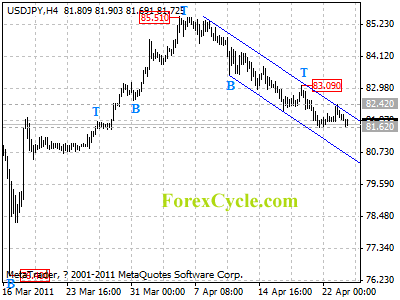
USDJPY stays in a price channel

USDJPY stays in a falling price channel on 4-hour chart, and remains in downtrend from 85.51. Key resistance is now at 82.42, as long as this level holds, downtrend could be expected to continue, and next target would be at 81.00 area. On the other side, a break above 82.42 will indicate that a cycle bottom has been formed at 81.62 level on 4-hour chart, and the fall from 85.51 has completed, then the following upward movement could bring price back to 83.50 zone.

usdjpy

Daily Forex Analysis

Netflix Beats on Q1 Earnings, Q2 Guidance Mixed

Netflix (NFLX) reported Q1 EPS of $1.11 per share, vs. analyst estimates of $1.08 per share. Revenue was $718.5 million, vs. expectations of $704 million. For Q2, the company is guiding for revenue of $762 to $778 million, vs. Street estimates of $763 million. EPS are seen at $0.93 to $1.15 per share. The Street view is $1.19 per share. It’s unclear if these earnings numbers are comparable.

Week Ahead Market Report: 4/25/2011

Investors will be digesting corporte earnings reports the entire week for signs of a sustained economic recovery. Good morning, I’m Sayoko Murase, with the Week Ahead Market Report for April 25, 2011.

What Explains the Aussie Dollar’s Rapid Rise?

What Explains the Aussie Dollar’s Rapid Rise?

By Kris Sayce

In this week’s Money Weekend: G7 bailout continues to boost Aussie dollar… Aussie dollar keeps running… Buy gold stocks now… Bullion buying is easy… Risk taking is at a high…

There’s no other way to describe it. The Aussie dollar has gone ballistic.

Since the G7 bailout of the foreign currency markets in March, the Aussie dollar has gained 9%:

Since the G7 bailout of the foreign currency markets in March, the Aussie dollar has gained 9%
Click here to enlarge
Source: Google Finance

Wednesday’s The Age reported:

“After punching through the 106 US-cent mark yesterday the Australian dollar barely stopped for breath on its way to another record early today when it climbed past 107 US cents – and kept going.”

The paper quoted Thomas Averill, managing director at Rochford Capital:

“It’s not just increased risk appetite, it’s a general aversion to holding US dollars at the moment which looks set to continue in the medium term.”

Over at Bloomberg News, Kurt Magnus, executive director at Nomura Holdings said:

“The U.S. dollar is in a new trend lower. Fund managers are actively shifting toward liquid, growth currencies like the euro and Aussie.”

For more thoughts on the Aussie dollar’s latest move, click here to see a free video market update from Murray Dawes over at the Slipstream Trader YouTube channel.


Aussie dollar run not over yet

Of course, Diggers & Drillers editor, Dr. Alex Cowie has also given his opinion on the moves in the Aussie dollar. Three weeks ago he wrote:

“So it’s no surprise the Aussie dollar is now on fire. It hit 1.037 against the US last night. My money is on this being the next leg up for the Aussie (time for you to think about that trip to Bali later in the year). It’ll bang its head against 1.055 for a bit and then who knows where it will next consolidate? Somewhere in the $1.08-1.15 region by the second half of the year is my wager. Parity is history.”

With the Aussie hitting $1.07 this week, “the second half of the year” could be a losing bet… try the first half of the year!

Dr. Cowie is bullish on the Aussie dollar because he’s bullish on the Aussie commodities market. They go hand in hand.

Having picked the bull run in the copper and tin markets, and getting in quickly with potash stocks, the Stock Doc has put all his energy into silver.

In fact, the Diggers & Drillers portfolio has contained silver since it was trading at USD$15 per ounce back in 2008. But despite the tripling in price since then, the Stock Doc reckons there’s more to come.

Just today he told me:

“I think we are now officially seeing the market waking up to the fact that silver is still hugely undervalued.

“The price may have gone vertical in the last few months, but really it’s just making up for fifteen years of the price doing very little.

15 Year Silver Price in USD/oz

Source: Silverprice.org

“The price is also going vertical because of the insane levels of demand. The fact is that industry is getting through about 55% of mine production, and investors are rushing to take up the rest. Unlike gold however, there’s very little silver bullion sitting around as spare supply. Central banks gave it to industry to use up, as it was worth so little. This now looks like an even more disastrous move than the UK selling half its gold at the bottom of the market!

“Diggers & Drillers has been recommending investing in silver for more than two years, and I hold silver bullion myself. In fact, I bought more this week, and will keep buying as the price goes up as I expect it will go far higher. There’s only one problem my plan – it’s in such short supply that it’s hard to find!”

Gold stocks are still a buy

The Stock Doc is bullish on gold too. So bullish, he’s looking to add another gold stock to the Diggers & Drillers portfolio this month. He’s already got five gold stocks on the books, but given his view he’s keen to add more.

If you’d like to find out Dr. Cowie’s stock picks, including his latest pick when it’s released, click here for more details.

The Stock Doc isn’t the only one tucking into precious metals. Sound Money. Sound Investments editor, Greg Canavan wrote the following in June last year:

“Last week we showed you how silver had become systematically de-monetised by governments over the past 150 years or so. These actions have seen the gold/silver ratio move from its long term historical average of around 15:1 to 66:1 today. In other words, one ounce of gold is now equivalent to 66 ounces of silver.”

He went on to write:

“In this week’s essay, we’ll show you why silver could potentially be one of the cheapest assets in the world right now. The silver market is not at all analysed by mainstream investors and for this reason remains very much overlooked as an investment opportunity.”

That was nine months ago. Today, the gold/silver ratio is 34:1. And the price of silver per troy ounce has increased from about USD$17 to the current price of USD$45.

This week Reuters reported:

“Bullion powered to a lifetime high for a fifth consecutive session on Thursday on a sharply weaker dollar, while lingering tensions in the Arab World, worries about the euro zone crisis and U.S. fiscal health offered additional support.”

But doesn’t all this mean gold and silver are in a bubble?

Buying bullion

If you look at the charts, it’s an easy conclusion to come to. Personally, we don’t believe it is. Besides, if you’re investing in gold with just a portion of your portfolio, and you don’t use leverage – which is the case for most bullion buyers – holding gold shouldn’t give you too many sleepless nights.

In fact, like the Stock Doc, your editor bought more bullion this week. We dropped into a bullion dealer in the Melbourne CBD this week to increase our portfolio exposure to about 25% precious metals.

It’s always a nice feeling holding onto the shiny metal before handing it back for them to lock in a secure vault. Although if you’ve got secure facilities to store it at home we’d recommend you do that, the key is to make sure it’s secure.

But here’s the thing. We dropped in there on Wednesday lunchtime… along with three other people. If the length of queues is a guide of anything, it’s certainly not pointing to a gold bubble.

Looking at Greg Canavan’s recommended portfolio weightings, he suggests a big exposure to precious metals and precious metal stocks too. To find out Greg’s ideal weightings and which gold stocks he’s recommending right now, click here for more details.

So, what’s driving the move in gold and the Aussie dollar?

It’s all about risk

There are a few theories. One of the more wishful theories is that the Aussie dollar is becoming reserve currency as central bankers hedge their exposure to the US dollar.

The reality is the opposite.

Investors are convinced the global economic recovery is in full flow. That consumers worldwide are spending, that the Chinese economy will continue to grow, and therefore the demand for raw materials will increase…

Hence, investors are piling into the Aussie dollar to punt on it going higher, and so they can buy Australian resources stocks.

That tells you investors are happy taking on risky positions… just as they were happy to take risky punts on the resources sector from 2003 to 2008. A five-year period that coincided with one of the biggest resources bull runs in history.

But what happened next?

That’s right, when investors got nervous, and the economy turned south, the Aussie dollar soon lost favour with investors.

You can see the impact on the Aussie dollar on the chart below. The Aussie dollar is the blue line:

impact on the Aussie dollar
Click here to enlarge
Source: Google Finance

As you can see, the Aussie dollar collapsed.

But the chart also shows you why I’m quite happy holding gold. Gold is often seen as a hedge against inflation or political risk.

But you can also say that gold is a hedge against a falling Aussie dollar. You’ll notice on the chart below that when the Aussie fell from late 2008, the price of gold in Aussie dollars increased:

Gold Chart

Source: CMC Markets Stockbroking


[Ed note: This price chart is the GOLD exchange traded fund which trades at one-tenth the price of gold]

Then, as the Aussie dollar climbed in 2009, the price of gold in Aussie dollars dropped.

But during the recent move in the Aussie dollar, starting early last year, the price of gold in Aussie dollars has been fairly constant.

In a nutshell – as I’ve written before – don’t expect to make a fortune from gold in the short term. But when the second great modern resources boom ends, and investors lose interest in the Aussie dollar again, holding gold in your portfolio should be a good way to protect your wealth.

Cheers.
Kris.