US Dollar Takes Beating as Fed Reaffirms Record Low Rates

Source: ForexYard

The US dollar took a beating yesterday following statements from the Federal Open Market Committee (FOMC) that removed any doubt on the persistence of record low interest rates. According to the FOMC report and subsequent statement by Federal Reserve Board Chairman Ben Bernanke, inflation is on track to healthy growth and the energy prices should stabilize and decline in the months ahead, which convinced the Fed to hold rates steady for the foreseeable future. The result has been a broad sell-off of the USD as investors took the statement as a sign that the greenback would not be finding support anytime soon.

Economic News

USD – US Dollar Dropping Sharply after FOMC Statement

The US dollar took a dive yesterday following statements from the Federal Open Market Committee (FOMC) that removed any doubt on American interest rates in the near future. The record low interest rates will persist for the foreseeable future, according to the FOMC report and subsequent statement. Federal Reserve Board Chairman Ben Bernanke reiterated this sentiment in his remarks given shortly after the official statement was announced.

As a result, traders who had been hesitant to short the greenback found in the FOMC statement and monetary policy sentiment a reason to push hard against the greenback, pummeling the currency to new lows. The EUR/USD rose to a two-and-a-half year high after the statement, reaching towards 1.4865, a price unseen since December 2009. The GBP/USD witnessed a similar spike, climbing to a November 2009 high of 1.6726.

With today’s Advance GDP figures being published at 13:30 GMT, traders may find additional reasons to dump the USD in exchange for higher yielding currencies. The continuation of record low rates fuels this investment shift as well. Today’s GDP may show the US economy slowing somewhat, with expectations for only a 1.9% quarter-on-quarter growth, down from last quarter’s 3.1%. There does not appear to be any reason to resist the bear session on the USD during the remainder of the week.

EUR – EUR Bullish as Traders Seek Higher Yields after Fed Statement

The euro gained in yesterday’s trading following statements by the US Federal Open Market Committee (FOMC) regarding US monetary policy. The statement affirmed the notion that the Fed would hold interest rates at their record low for the foreseeable future, driving traders away from the greenback en masse and into higher yielding assets.

The EUR posted gains against all of its rivals immediately following the statement. Troubling for the euro zone, however, was a lower-than-forecast release of regional industrial orders. The figure revealed a growing weakness among industry that has stricken Great Britain, Japan and parts of the United States over the past two months. Ascendant oil prices are playing their part in deterring exports, but a general sluggishness also appears present in the market recently. Should global industry falter further, a second recession may occur, largely driven by sky-rocketing energy costs.

As for the remainder of this week, the euro looks to be gaining against the greenback as traders find additional reasons to pull out of their dollar positions in exchange for higher yields. France will be publishing its consumer spending report at 7:45 GMT and may also reveal a slowdown in growth, linked with the faltering industrial sector in the euro zone. Germany may also show a small decline in its employment sector. These factors, however, will likely be outweighed by the shift in sentiment towards the buck after yesterday’s FOMC statement.

JPY – USD/JPY Lower as Japanese Industrial Production Plummets

The JPY lost ground against almost all of its rivals yesterday. An S&P downgrade of Japan’s debt outlook from stable to negative has caused a shift away from the island economy in the short- to mid-term. The USD/JPY, however, was trading lower as investors fled the greenback after the Fed’s monetary policy statements yesterday afternoon. After reaching upwards of 82.75, the pair quickly dropped to a daily low of 81.61 before stabilizing.

This morning’s sharp downturn in industrial production, linked with similar downturns in Great Britain, Europe and the United States, also played a role in pushing the dollar/yen back to its current consolidation level. While the yen suffers from its own economic concerns, dollar bears outpaced the yen’s in this morning’s trading hours, helping to lift the yen despite its dire economic standing. The pair also looks to be continuing this movement for the foreseeable future given the shift in sentiment away from the US dollar.

Crude Oil – Price for a Barrel of Oil Supported by Weakened US Dollar

Oil prices ended yesterday trading slightly higher on the day after statements by the US Federal Reserve affirmed the continuation of record low interest rates. As investors bailed out of their long positions with the USD, oil prices found support, pushing the commodity back towards $113 a barrel with a closing price of $112.76.

Combative remarks have been tossed about lately by politicians and business leaders searching for blame on the recent spike in energy costs. Gas prices in the United States are approaching nominal highs, causing stirs and outrage by US consumers. The high transportation costs for exporting nations are also feeling the pinch as global industry appears to have begun faltering. The reasons for industry short falls may be tied with high oil prices, but could also be due to an atmosphere of pessimism towards growth in the near-term, analysts have said.

As for today, crude oil traders may want to consider that commodities, which are linked to the value of the US dollar, are likely going to receive a boost in the immediate future due to yesterday’s monetary policy statements. Hawkish statements about economic growth may suffice to hold prices stable between $112 and $115, but many speculators are beginning to anticipate another bull run in commodity prices and traders would be wise to watch for the bounce after the price corrects from yesterday’s movement.

Technical News

EUR/USD

There is a very distinct bullish channel formed on the daily chart, as the pair is currently trading near its upper boarder. In addition, both the RSI and the MACD on the 4-hour chart are providing bullish signals, suggesting that the bullish move has potential to proceed today. Going long appears to be the right choice today.

GBP/USD

The cable is in the midst of a very strong bullish momentum after the pair climbed about 300 pips in a single trading day. The cable is currently trading near the 1.6720 level and seems on its way to ascend further, with a key-target level of 1.6850.

USD/JPY

Despite a minor technical correction, the pair’s bearish momentum proceeds, and the USD/JPY is currently trading near the 81.70 level. The pair’s next significant support is placed near the 81.20 level, and if it falls below the support level, it has potential to reach as low as the 80.00 level.

USD/CHF

The USD/CHF pair continued with the free-fall yesterday, and reached as low as the 0.8690 level. Currently, as a bearish cross takes place on the 4-hour chart’s Slow Stochastic and MACD, it looks that another bearish session may take place. Going short seems to be the right strategy today.

The Wild Card

Crude Oil

Crude oil saw yet another bullish session yesterday and reached as high as $113.65 a barrel. In addition, as a bullish cross takes place on the daily chart’s Slow Stochastic, it appears that the bullish momentum has more room to go. This might be a great opportunity for forex traders to join what seems to be a long-lasting trend.

Forex Market Analysis provided by ForexYard.

© 2006 by FxYard Ltd

Disclaimer: Trading Foreign Exchange carries a high level of risk and may not be suitable for all investors. There is a possibility that you could sustain a loss of all of your investment and therefore you should not invest money that you cannot afford to lose. You should be aware of all the risks associated with Foreign Exchange trading.

Daily Market Review for the 28.04.2011

EUR/CHF

Time: 00.30  Rate: 1.2935

Strategy: long

Daily time frame

The price stopped the second time at the level of 1.2750 and the second time signaled major green candlestick. We believe that the break out of the price at the level of 1.3000-1.2970 will bring it to the level of 1.3200.

As can be seen by the graph bellow:

4 hour time frame

Potential trade

Long

Enter: 1.2985

Stop: 1.2725

Target: 1.3200

As can be seen by the graph bellow:

AUD/JPY

Time: 00.40  rate: 89.30

Strategy: long

Daily time frame

The price is about to get to the level of 90.00 the last highest level. The breakout of this will bring most probably to the level of 84.00.

As can be seen by the graph bellow:


4 hour time frame

In the daily market review of yesterday there were two options, one short under the level of 87.20 and one for long above the level of 88.60. The price broke out the level of 88.60 and upon our estimation it is one its way to the level of 90.70.

As can be seen by the graph bellow:


RISK DISCLAIMER

Forex trading involves high risk. Before any trade, you should consider carefully the investment objectives and the level of risk. The data sent by mail is not necessarily real-time data or precise. Real-Forex is not liable for the losses resulting from the utilization of the data. Real-Forex (Finnocorp Trading Solution Ltd

.) is not liable for losses or damages as a result of reliance on the information provided by e-mail or on the overall data, quotes, charts, signals buy / sell. It is hereby clarified that the investor must be aware of risks involved in trading in financial markets, which is a form of investment that may contain potential risks.

Real-Forex team

Trade like the pro’s with a true ECN Forex broker

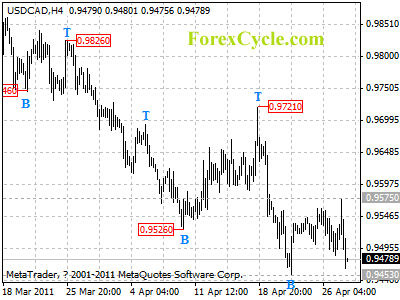
USDCAD formed a sideways consolidation

USDCAD formed a sideways consolidation in a range between 0.9453 and 0.9575. As long as 0.9453 support holds, lengthier consolidation in the range is expected, and another rise to 0.9650 to reach next cycle top on 4-hour chart is still possible. On the other side, the fall from 0.9575 could possibly be resumption of downtrend from 0.9973, a breakdown below 0.9453 could trigger another fall towards 0.9300-0.9400 area.

usdcad

Forex Signals

How To Use Fibonacci Ratios in the Real World

A free Club EWI report teaches the basics of Fibonacci analysis of commodities and other markets
April 27, 2011

By Elliott Wave International

What tools help you with the difficult task of identifying the market trend, riding it, and getting out before it reverses?

Consider Fibonacci ratios: Mathematical proportions by which moves on a market chart relate to each other. Fibonacci mathematics is an integral part of Elliott wave analysis; Frost & Prechter’s classic “Elliott Wave Principle — Key to Market Behavior” has an entire chapter on it.

And here’s an excerpt from a free Club EWI report on the subject. Enjoy — and for details on how to read the entire report free, look below.

How To Apply Fibonacci Math to Real-World Trading
(excerpt; full copy here)
By Jeffrey Kennedy
EWI Senior Tutorial Instructor
EWI Senior Commodity Analyst

It’s hard to imagine a wrong way to apply Fibonacci ratios or multiples to financial markets, and new ways are being tested every day. Let’s look at just some of the ways that I apply Fibonacci math in my own analysis. …

Elliotticians often calculate Fibonacci extensions to project the length of Elliott waves. For example, third waves are most commonly a 1.618 Fibonacci multiple of wave one, and waves C and A of corrective wave patterns often reach equality (Figures 7-3 and 7-4).

Cotton - December Contract, Daily Data

Soybeans - November Contract, 60 Minute Data

One approach I like and have used for a number of years is a “reverse Fibonacci” application… (Continue reading this free report now with a free Club EWI password.)

This article was syndicated by Elliott Wave International and was originally published under the headline How To Use Fibonacci Ratios in the Real World. EWI is the world’s largest market forecasting firm. Its staff of full-time analysts led by Chartered Market Technician Robert Prechter provides 24-hour-a-day market analysis to institutional and private investors around the world.

UK GDP grows by 0.5% in 1st Quarter. British Pound Sterling rises in Forex Trading

By CountingPips.com

The United Kingdom gross domestic product rebounded in the first quarter of 2011 to show economic growth following a decline in the fourth quarter of 2010. The report for the U.K. GDP data showed that economic activity increased by 0.5 percent in the January through March quarter following a decline by 0.5 percent in the fourth quarter of 2010, according to the latest report by the Office of National Statistics.

The GDP advance matched economic forecasts that were looking for the 0.5 percent rise for the quarter.

On an annual basis, the first quarter GDP rose by 1.8 percent from the level of the first quarter of 2010 following a fourth quarter increase in GDP by 1.5 percent. The annual data also matched economic forecasts which were expecting an increase by 1.8 percent.

Contributing to the rise in GDP for the first quarter was an increase in total services output by 0.9 percent while total production output was higher by 0.4 percent. The business services and finance sector rose by 1.0 percent and the transport, storage & communication sector increased by 2.7 percent to contribute positively to the GDP in the first quarter. The manufacturing sector also advanced by 1.1 percent in the first quarter.

British pound gains ground in forex trade

The British pound has been boosted by the news and has increased versus the major currencies in forex trading today. The pound has been increasing against the euro, US dollar, Japanese yen, Swiss franc, Canadian dollar, New Zealand dollar and the Australian dollar, according to currency data by Oanda.

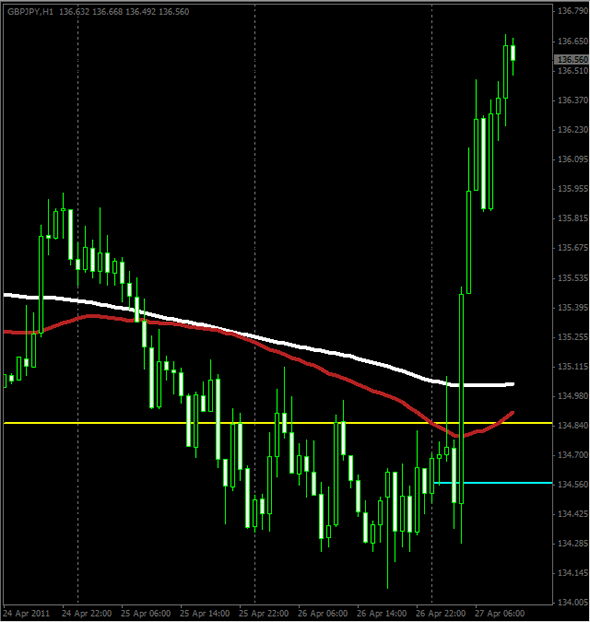
GBP/JPY Forex Chart – The British Pound Sterling rising sharply higher in forex trading versus the Japanese yen today after the GDP report. The GBP/JPY is higher by over 200 pips since the day’s opening.


Sterling Trading Higher After GDP Data as All Eyes Turn To Bernanke

printprofile

The pound is the best performer on the day after the Q1 GDP data while the yen is down. All this leads up to the US interest rate announcement and the inaugural Fed press conference with Chairman Ben Bernanke to follow.

Following the release of UK Q1 GDP numbers the pound traded higher with sterling the best performing currency so far today. The release was in line with market expectations of 0.5% and stands in stark contrast to the Q4 2010 numbers that showed the UK economy contracted by -0.5%. The GBP/USD jumped higher to 1.6580 before trading back to 1.6550. A rebound in UK growth should support sterling in the short term and a GBP/USD target still remains at the 2009 high of 1.7040. Support comes in today at 1.6420 near the upper channel line from the consolidation pattern of late last week.

The yen is on its back foot across the board as recent gains in the Japanese currency are being unrolled. The cause of today’s JPY declines is the S&P cut to the sovereign rating outlook due to increased costs from the earthquake and tsunami. The rising cleanup and recovery costs do not come as a surprise, but nevertheless the announcement by S&P helped to trigger a yen reversal. Recent yen strength has been apparent since mid-April after traders who were long on the JPY have recovered from the hit they took following the unilateral intervention to weaken the JPY. The USD/JPY is trading higher at 82.30 and the momentum of today’s move could carry the pair higher to the 83.00 level.

All eyes now turn to the Federal Reserve as today will mark the first quarterly news conference by the Fed Chairman. Prior to the press conference the Fed Funds Rate will be released and no changes are expected. This mantra goes as well for the QEII program as most Fed watchers forecast the US central bank to carry out the full $600B of bond purchases. The accompanying FOMC statement may indicate a slight improvement in the US economy as growth looks to have picked up and inflationary pressures have increased but are still below a level that would prompt any withdrawal of the loose monetary policy that helps to support the economic recovery.

Volatility in the dollar may increase given the new Q&A session Bernanke will endeavor upon. He should face questions not only pertaining to monetary policy and unemployment rates but also the weakness in the dollar will likely be addressed. The new format may not increase transparency into the Fed’s future actions but market volatility should be increased.

Look to Go Long on Asia in May, Analysts Say

By Greg Holden

A climb in Asian currencies appears to be led by the soaring Singapore dollar (SGD), which reached a record last Friday, alongside a 13-year peak by the Malaysian ringgit, as many expect regional central banks to continue hiking rates to battle inflation, according to Bloomberg.

The Bank of Thailand joined this trend last Wednesday with its sixth rate hike this year and expectations for further such tightening in the near future. The Bloomberg-JPMorgan Asia Dollar Index rose to its highest point since 1997 as investors bought far more stocks than they sold in the Asian economies of Thailand, India, South Korea and Taiwan.

The Singapore dollar appears to have lost some steam as of this morning, but peaked last Friday at 1.2317 against the greenback, its highest mark since at least 1981. Many analysts are forecasting a continuation to the SGD’s surge as the region makes continued gains from a recent boom in consumer confidence towards companies with large bases in the region.

Alongside the SGD’s ascent are the concurrent rises in Asian currencies such as China’s yuan, Malaysia’s ringgit, Thailand’s baht, and the South Korean won. All of the aforementioned are in bullish channels against their Western counterparts with expectations for further monetary policy tightening in the months ahead which will no doubt fuel this rapid climb. Look to go long on Asia in the weeks ahead.

Forex Market Analysis provided by ForexYard.

© 2006 by FxYard Ltd

Disclaimer: Trading Foreign Exchange carries a high level of risk and may not be suitable for all investors. There is a possibility that you could sustain a loss of all of your investment and therefore you should not invest money that you cannot afford to lose. You should be aware of all the risks associated with Foreign Exchange trading.