How Apple is Set to Bring NFC Technology to the Mainstream

Steve Jobs would be very proud…

Last week, Apple (Nasdaq: AAPL) reported its fiscal first-quarter results for 2012, and the results were nothing short of astounding:

  • Quarterly revenue hit an all-time high of $46.3 billion.
  • Earnings rose to never-before-seen levels.
  • iPhone, iPad and Mac sales also all reached new highs.

Even more, Apple’s CEO Tim Cook says this is only the beginning. He states, “Apple’s momentum is incredibly strong, and we have some amazing new products in the pipeline.”

One of these innovations, the company announced, will almost certainly be the introduction of near-field communication, or NFC, technology in new iPhones and iPads this year.

And for the NFC market, this means a huge boost is just around the corner…

NFC Tech Set for Major Growth

We’ve covered NFC technology extensively at Investment U over the past year. David Fessler was even predicting Apple’s move into this space last July.

But Apple’s announcement comes at a very interesting time… And it strengthens our case that NFC is set for the mainstream.

Consider this… in just three months following Steve Jobs’ passing, Apple sold 37.04 million iPhones and 15.43 million iPads. That means over half a million iPhone and iPad devices are being sold every day.

Pretty soon, all of these phones will have NFC capabilities. That’s a huge market for NFC to tap into.

Plus, Apple is just one of many players hopping on the NFC train. Samsung Electronics, HTC, Nokia and RIM already launched NFC-enabled smartphone models last year. And Microsoft has plans to make its Windows Phone equipped with NFC this year.

DigiTimes reports, as a result, NFC featured in smartphones is set to increase four-fold in just the next two to three years. By 2015, over half of the smartphones in existence will have NFC capability.

But even this could be a conservative estimate.

That’s because NFC technology can do more than just pay for items with your smartphone. It also has the ability to easily share documents and media with the simple tap of two devices.

This is undoubtedly a revolutionary technology in my opinion. And some companies are ready take advantage…

NFC Companies to Consider

When researching NFC technology, one company you’ll hear a lot about is NXP Semiconductors (Nasdaq: NXPI).

After all, NXP is the semiconductor maker that essentially invented NFC technology. But it also isn’t the only company to watch in this space.

Investors will want to track big combo chipmakers such as Broadcom (Nasdaq: BRCM) and Qualcomm (Nasdaq: QCOM). NXP will benefit early as phones use standalone NFC chips. But just like Bluetooth, GPS Navigation, etc… it will be much cheaper to include NFC capability on a combo-chip than to use a separate standalone NFC chip. And NXP doesn’t currently make combo-chips. So eventually they may have to survive on patent royalties alone.

And like NXP, Broadcom and Qualcomm are both semiconductor suppliers for Apple. But unlike NXP, Broadcom and Qualcomm are developing the combo-chips that will include NFC technology for much cheaper production costs.

No matter what happens between within the semiconductor industry, 2012 could be a breakout for NFC technology. And it could very soon completely change the way most people pay for goods and exchange information.

Good Investing,

Mike Kapsch

Article by Investment U

Healthcare: The Hottest Stock Market Sector in 2012

Too many investors are focused on high unemployment, weak economic growth, problems in the Eurozone and runaway deficit spending. They seldom note the positives, including low inflation, rock-bottom interest rates, falling food and energy prices (coal and natural gas), expanding opportunities in emerging markets, low valuations and – not least of all – all-time record corporate profits.

So don’t let the doomsayers get you down. There are always opportunities out there, even during the most difficult economic times.

The Healthcare Sector in 2012

In particular, I see the planets aligning for medical technology right now. Why? Baby Boomers are moving into their golden years (and will soon need more healthcare services). Product innovation is continuing apace. Hospitals and clinics are busy upgrading their technology to cut costs, increase safety and minimize errors. And the healthcare sector is less sensitive to the vagaries of the business cycle.

Let me use just one example from my Oxford Trading Portfolio: Cerner Corp. (Nasdaq: CERN).

Cerner makes systems that automate records in hospitals and doctors’ offices. This is much more efficient than handwritten notes. It’s also much safer.

Automation reduces errors. Doctors – famous for illegible handwriting – can cause the wrong drug to be inadvertently dispensed at a hospital or pharmacy. They can forget to renew old prescriptions. Cerner prevents that.

The company is also a leader in billing software, with a much wider range of offerings than any of its competitors. For example, its scalable Millennium software is already installed in more than 9,000 hospitals, pharmacies and doctors’ offices. And a new federal push for records automation will only increase that footprint.

Paper records can be easily lost, stolen, misplaced, or destroyed in a fire. That doesn’t benefit the doctor or the insurance company – and certainly not the patient.

The whole world is going digital and the healthcare sector has lagged behind for too long. Digital medical records are safer, better organized, more accessible and less susceptible to human error. Whenever I see an opportunity this big, I know huge profits are just around the corner.

$4-Trillion Influx

Cerner is just one of many healthcare stocks that promise huge capital gains in the weeks and months ahead. And my colleague Marc Lichtenfeld, Editor of FirstLine Investor Alert, has uncovered dozens more.

FirstLine aims to profit from the $4 trillion that’s going to flood the healthcare sector over the coming years. Thanks to nearly four million Baby Boomers turning 65 every year, companies involved in biotech, genomics, regenerative medicine, medical technology and personalized medicine will soon experience explosive growth.

In a recent chat with Marc, he told me about four companies in particular that have huge upside potential right now.

The first is a firm poised to take advantage of the frenzy in the hepatitis C space. Investors have seen buyout premiums of 89% and 163% in the past two months. Plus, in April, the company is expected to have the first drug approved that addresses the cause of a very serious disease, rather than just the symptoms.

The second is an emerging leader in regenerative medicine. In early clinical trials, its treatments produce dramatic improvements in patients with chronic heart disease. If approved, this procedure would both save both lives and millions of healthcare dollars.

The third is a small firm with a drug that nearly doubles the survival of patients with an aggressive cancer, with few side effects.

The last – and potentially the biggest opportunity – is a company that reads the DNA of cancer tumors. This helps doctors determine the proper course of treatment, allowing the patient to avoid chemotherapy.

Look Beyond Negative Headlines

I can’t emphasize strongly enough how important it is for investors today to look beyond all the negative political and economic headlines and focus on companies that are set to knock the ball out of the park for shareholders.

When Willie Sutton was asked why he robbed banks, he answered simply, “Because that’s where the money is.” For the very same reason, you should invest in the fastest growing companies in the healthcare sector today.

Good Investing,

Alexander Green

Article by Investment U

Weekly Market Wrap: January 30, 2012

Investors are ringing in the new trading week with caution as they continue to follow news from talks to resolve Europe’s ongoing debt woes, and continue to digest a weak US growth report issued on Friday. Good morning, this is Kristin Bianco with the Week Ahead Market Report for Monday January 30, 2012.

Dollar Stages Upward Correction Following Poor Euro-Zone News

Source: ForexYard

printprofile

The USD came off a six-week high against the euro in trading today, after news that Greece had once again failed to come to reach a debt swap deal with its creditors. Earlier in the day, the EUR/USD reached as high as 1.3231 before investors began selling off the pair. The AUD/USD also saw a substantial drop, falling well over 100 pips during the European trading session. The greenback failed to move up against the yen, as investors chose to keep their funds with the safe-haven Japanese currency.

Turning to tomorrow, dollar pairs are likely to be influenced by any announcements out of the euro-zone which may lead to further risk aversion. Traders will want to pay particular attention to any news out of Greece. While a Greek debt swap deal is likely to be finalized by the end of the week, safe-haven currencies may continue to go up until a final agreement is announced.

With regards to the rest of the week, traders will want to keep in mind that a batch of US data is forecasted to have a significant impact on the markets. Wednesday’s ADP Non-Farm Employment Change figure, as well as the ISM Manufacturing PMI are both considered valid indicators of the current state of the US economy. Furthermore, a speech from the Fed Chairman on Thursday, followed by the Non-Farm Employment Change figure on Friday, are both likely to generate substantial market activity.

Forex Market Analysis provided by ForexYard.

© 2006 by FxYard Ltd

Disclaimer: Trading Foreign Exchange carries a high level of risk and may not be suitable for all investors. There is a possibility that you could sustain a loss of all of your investment and therefore you should not invest money that you cannot afford to lose. You should be aware of all the risks associated with Foreign Exchange trading.

Investing in German Bonds with ETFs

By The Sizemore Letter

If there is one word that summarizes the choppy, volatile year that was 2011, it would be “Europe.”  Last year the market lived or died based on developments (or lack thereof) in the ongoing European sovereign debt crisis.  When they weren’t running to the safety of U.S. treasuries, they ran to the (relative) safety of German bunds.  With the periphery of Europe threatening to descend into chaos, mighty German seemed a rock of stability.

Today, getting access to the German bond market is as easy as buying a share of General Electric or Wal-Mart with the arrival of the ProShares German Sovereign/Sub-Sovereign ETF (NYSE: $GGOV).  The ETF gives investors access to euro-denominated bonds issued by the Federal Republic of Germany, the state governments of Germany, and various federal and state agencies.

Before, it was somewhat difficult for individual investors (and even professional traders) to get access to the German bond market.  The world’s bond markets are far more opaque than the respective stock markets, and few of the popular retail brokers gave their clients ready access.  Buying a foreign bond meant going through the bond desk and often paying a frustratingly large bid-ask spread.  In other words, it wasn’t easy and it wasn’t cheap.  But now with GGOV, you can have instant exposure to German bond market with a click of the mouse.

But while buying German bonds is now easy, this doesn’t necessarily mean it’s a good idea.   The 10-year bund yields a pitiful 1.85 percent, according to Bloomberg.  This is even lower than the less-than-inspiring 1.87 percent offered by the 10-year U.S. Treasury note.  At a sub-2-percent yield, German bunds are not worth buying for income.

For dollar-based investors, German bunds could be a way to get exposure to a rally in the euro.  But for most investors, there are easier and more direct ways to trade the euro that don’t involve interest rate risk.

And we must not forget the elephant in the room; if the European debt crisis takes a turn for the worse and Germany finds itself in the unenviable position of having to bail out the rest of the Eurozone, how safe is Germany’s AAA credit rating, and would bunds still be considered the safe haven they are today?

There is no good way to answer this question, of course, but it certainly makes me think twice before putting capital at risk.  To paraphrase a  quote from newsletter writer Jim Grant, at current low yields government bonds no longer represent a risk-free return.  Instead, they offer a return-free risk.

If you are going to put capital at risk, you should expect a reasonable return on your investment.  You’re not going to get that with shares of GGOV at current prices and yields.

This does not mean that Europe is without its attractions.  In my view, blue-chip European multinationals offer some of the best potential returns in the world at current prices.  In the Sizemore Investment Letter, I’ve highlighted plenty, including Spain’s Telefonica (NYSE: $TEF) and the Anglo-Dutch consumer products giant Unilever (NYSE: $UL).

Investors looking for a one-stop ETF option should consider the iShares MSCI Germany ETF (NYSE: $EWG).  EWG is a basket of Germany largest and most globally diversified blue chips.  With a dividend of 3.51 percent, you’re getting nearly double the yield of GGOV with the possibility of substantial capital gains in 2012.

If you liked this article by Sizemore Insights, you’d probably enjoy The Sizemore Investment Letter, our premium members-only newsletter. Click here for more information.

Forex & Dealing with Your Losses

Forex trading is intense and your emotions can cause more harm than good. Many beginners and experienced Forex traders never learn the basics of money management and emotional control. In fact, over 95% of traders are at a loss in each trade and continue to jump from one decision to another without thinking. You cannot become emotionally attached to your accounts, trades or losses; the potential harm involved with emotional trading can ruin your career. You need to take a step back to see if you’re prepared for the losses and create strategies to overcome them. 

Keep your emotions out of the equation. 

Forex trading is not the center point in your life. Your income (or additional stream) of income comes from experience, work ethic and objectivity. Objectivity provides a sounding board for logic to guide your decision-making. You save money, time and effort in chasing emotions if you think of trading as an outside event instead of your life’s work. Every trader must realize that trading is only a part of their life, and not obsess over the smallest losses. 

Let the markets lead the way. 

You cannot control the markets. People may say that the market controlled by the “people”, but it is not true. In general response, you cannot control a trade’s outcome. Pessimistic or optimistic behaviors can hurt the way you view your opportunities. Take a step back to see where you are and if you are aligned with your trading strategy. 

Pay attention to your bad habits. 

What is your overall strategy? Do you have a maximum loss in mind? Are you prepared for a potential loss anyway? You have to plan for losses in your trading strategies to save time, money and worry. Losing money in the markets is inevitable and building a resilience to those experiences can determine how long your trading account survives. Notice your bad habits, correct them and make another trade with less sensitivity of a potential loss. 

Treat each dollar as a step. 

Losses prepare Forex traders for future success. It is your responsibility to document each trade’s outcome, your expectations and then the actual results. Monitor the amount of money you invest in each and work on minimizing your trades to maintain a cash reserve. Make each dollar worth it. Know that the successful trades are okay to celebrate in the future, but do not let them interfere with your logic. 

Admit Mistakes 

Anyone can make the mistake of allowing emotions to control their decisions. Self-discipline, objectivity and resilience chances the way you work, view trades and watch your spending. Without these qualities, your Forex trading career can end in days or even hours under pressure. 

The markets are going to move without your input; focus on the trades instead of the potential losses you can have. Use optimism after you finish your day, but check the emotions and ego at the door before you buy. If you find yourself using Forex trading in the wrong capacity, stop trading immediately. Focus on emotional control and gain discipline in identifying emotional buys versus logical buys. 

A guest post by Elizabeth Goldman on behalf of Sunbird Forex – home to the MetaTrader forex platform.


Beijing Shoppers “Snatching Up Gold”, Germany “Failing to Learn Lessons of History” with Greek Fiscal Plan

London Gold Market Report
from Ben Traynor
BullionVault
Monday 30 January 2012, 09:00 EST

THE SPOT MARKET price of buying gold climbed to $1728 an ounce Monday morning London time – a slight drop from last week’s close – while stock markets, commodities and the Euro all fell and government bond prices rose as European leaders met for their latest summit in Brussels.

The cost of buying silver fell to $33.08 at one point – a 2.6% drop from where it ended last week.

Gold fell as low as $1718 per ounce Monday morning, dropping steadily during Asian trading, though this represented a loss of only 1% on Friday’s closing price.

“Everybody seemed to be expecting profit taking out of Shanghai after the two Chinese bourses came back online,” said one Hong Kong dealer.

“As far as we can see, there wasn’t much of that.”

During last week’s Lunar New Year holiday, China saw a “gold rush”, with consumers spending more on buying gold than during the 2011 festival, according to a China Daily report.

“People seem crazy about gold, snatching it up more like a cheap cabbage than such a precious metal,” it quotes Beijing resident Miao Miao.

The value of sales at two of Beijing’s top gold retailers, Caibai and Guohua, reportedly hit 600 million Yuan ($95.28 million) – a 49.7% rise on last year’s sales. The gold price in Dollars meantime rose around 25% over the same period.

The Yuan also appreciated against the Dollar over that time, gaining around 3.6%, which implies a rise in Chinese domestic gold prices of around 20%.

Despite strike action in Belgium that has brought transport to a halt, European leaders met in Brussels on Monday, where the issues of budget discipline and the Greek debt crisis were expected to dominate discussions.

“Solidarity and reliability are really coming together in this context,” German finance minister Wolfgang Schaeuble said last week.

“We are credibly addressing the problems in the affected countries…and in the meantime we have to demonstrate solidarity.”

Britain however has already walked away from the new budget treaty currently being drafted.

“To write into law a Germanic view of how one should run an economy and that essentially makes Keynesianism illegal is not something we would do,” one British official told newswire Reuters.

Denmark, which does not use the Euro, has negotiated a concession that fines imposed on a country that breaches new deficit rules would only go into the Eurozone bailout fund if the fined country were a Eurozone member – otherwise they will go to the European Union’s general budget.

Greece meantime has rejected a German proposal that an EU budget commissioner should have power over Greek taxes and spending.

“I think it’s wrong that money from the EU’s structural development fund is being spent on bicycle stands,” German foreign minister Guido Westerwelle said on Friday, arguing that EU funds are being squandered.

The proposed budget commissioner would have the power to veto any decisions that were not consistent with targets set by Greece’s international creditors.

“I would rather resign as a minister than allow anybody to tell us the way we should be spending our money,” Greece’s culture minister Pavlos Yeroulanos told the BBC.

Greek finance minister Evangelos Venizelos said the proposal “ignores some key historical lessons”.
‘Nein! Nein! Nein!’ said the front page of Greek tabloid Ta Nea on Monday, which showed a picture of German chancellor Angela Merkel as a puppeteer, with the map of Greece depicted as a marionette.

Ahead of Monday’s EU summit, there was still no news of a voluntary agreement between the Greek government and private holders of its debt over how that debt should be restructured and how large should be the losses private sector bondholders take.

Greece needs to its second bailout, worth €130 billion, to be approved if it is to meet €14.5 billion of maturing bond payments on March 20.

Eurozone economic confidence meantime rose for the first time since March last year, according to the European Commission’s economic sentiment indicator.

“The outlook for economic growth in Europe in 2012 is not a healthy one,” warns Ian Scott, London-based chief global strategist at Nomura.

“Nevertheless, even a recession in the Euro area, and very slow growth elsewhere, is unlikely to be sufficient to undermine the market if governments and central banks are able to stabilize sovereign spreads and lessen the immediate tail risk of a messy sovereign default.”

Over in New York, the difference between bullish and bearish futures and options contracts held by Comex traders for selling and buying gold – the so-called speculative net long – rose for the third week in a row in the week ended last Tuesday, according to the latest data from the Commodity Futures Trading Commission.

“The change in the net position was largely the result of speculative longs being added,” notes Standard Bank commodities strategist Marc Ground.

“Net spec length is still far off Q3 2011 levels,” adds a note from precious metals consultancy VM Group.

“[This suggests] further moves higher are likely should sentiment remain bullish.”

Ben Traynor
BullionVault

Gold value calculator   |   Buy gold online at live prices

Editor of Gold News, the analysis and investment research site from world-leading gold ownership service BullionVault, Ben Traynor was formerly editor of the Fleet Street Letter, the UK’s longest-running investment letter. A Cambridge economics graduate, he is a professional writer and editor with a specialist interest in monetary economics.

(c) BullionVault 2011

Please Note: This article is to inform your thinking, not lead it. Only you can decide the best place for your money, and any decision you make will put your money at risk. Information or data included here may have already been overtaken by events – and must be verified elsewhere – should you choose to act on it.


Currency Futures: Forex Speculators raise Euro bearish bets. Aussie, Kiwi & Mexican Peso bets rise

By CountingPips.com

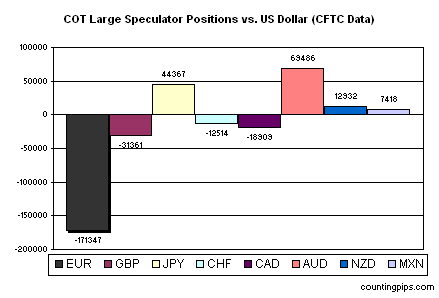
The latest Commitments of Traders (COT) report, released on Friday by the Commodity Futures Trading Commission (CFTC), showed that large futures speculators continued to pile into bets against the European common currency for a fifth consecutive week.

Non-commercial futures traders, usually hedge funds and large speculators, added to their short positions for the euro while trimming short positions in the British pound sterling, Swiss franc and the Canadian dollar. The Australian dollar, New Zealand dollar and the Mexican peso saw higher long positions directly against the US dollar while the Japanese yen decreased for a second consecutive week.

Individual Currencies:

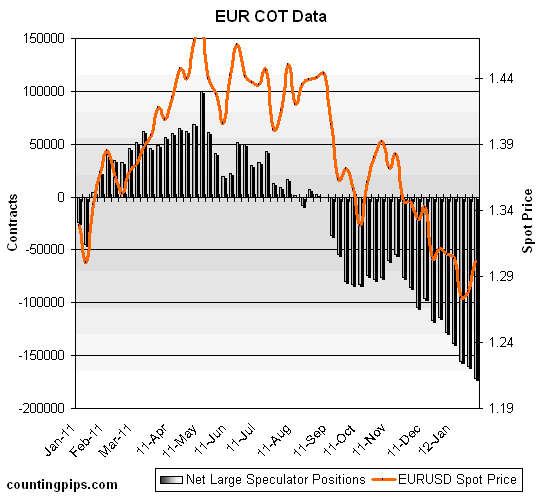
EuroFX: Currency speculators added more to their Euro short positions for a fifth week as of January 24th and raised their short bets to a new record high once again. Euro short positions totaled 171,347 net short contracts from the previous week’s total of 160,030 net short contracts as speculator sentiment for the common European currency for futures speculators remained dismal last week.


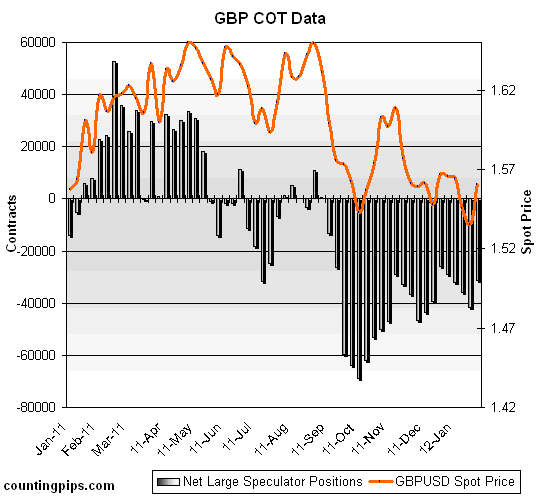
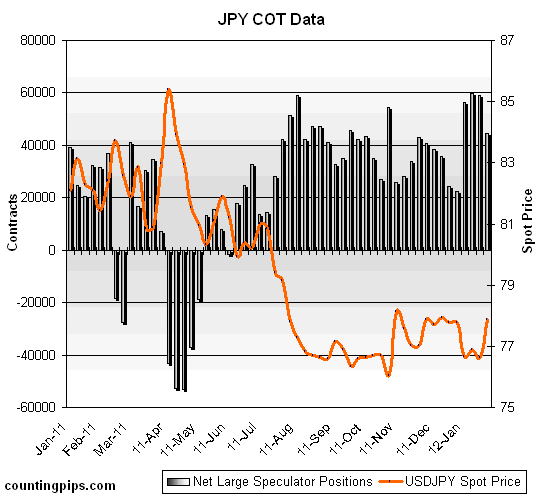
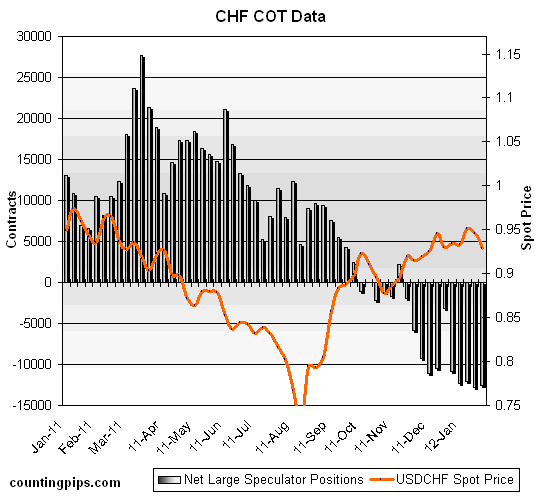
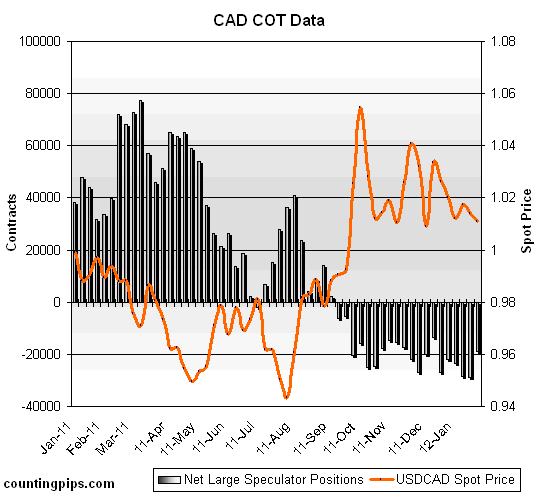
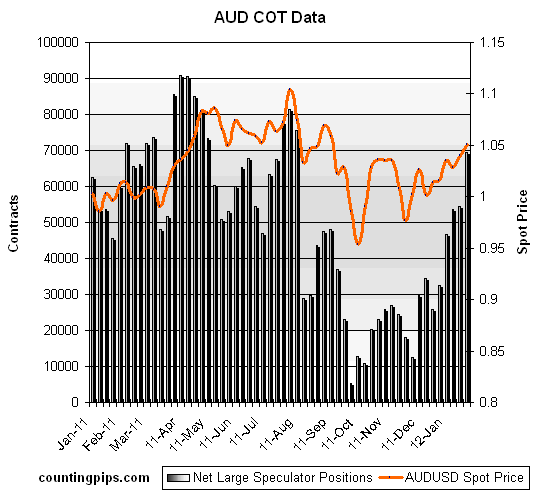
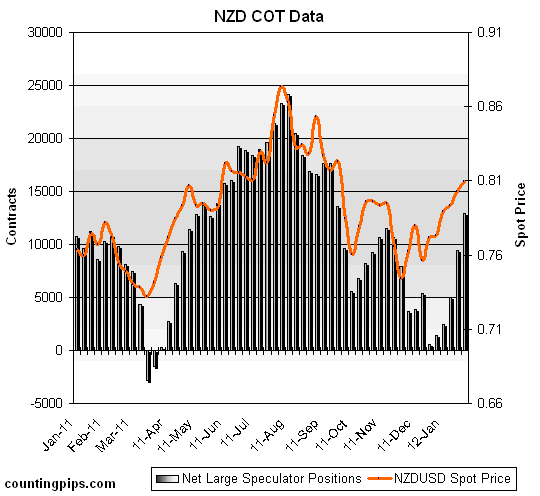
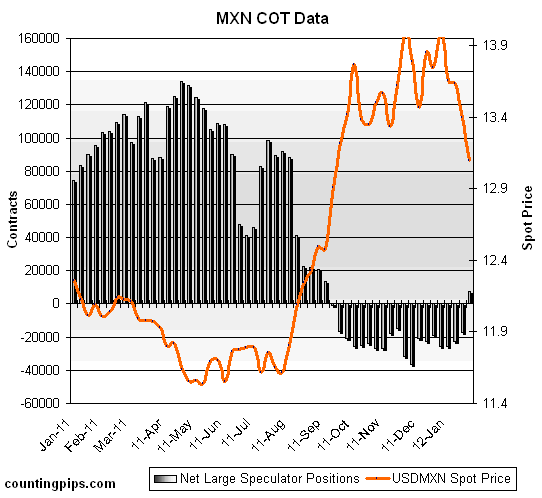
The COT report is published every Friday by the Commodity Futures Trading Commission (CFTC) and shows futures positions as of the previous Tuesday. It can be a useful tool for traders to gauge investor sentiment and to look for potential changes in the direction of a currency or commodity. Each currency contract is a quote for that currency directly against the U.S. dollar, where as a net short amount of contracts means that more speculators are betting that currency to fall against the dollar and net long position expect that currency to rise versus the dollar. The graphs overlay the forex spot closing price of each Tuesday when COT trader positions are reported for each corresponding spot currency pair.

GBP: British pound sterling positions showed improvement following four consecutive weeks of declines as of January 24th. British pound positions saw a total of 31,361 short positions on January 24th following a total of 41,634 net short positions registered on January 17th.

JPY: The Japanese yen net long speculative contracts declined lower for a second consecutive week, according to the latest data on January 24th. Yen long positions decreased to a total of 44,367 net long contracts reported on January 24th following a total of 58,862 net long contracts that were reported on January 17th. Yen speculative positions on January 10th had registered their highest level in over a year surpassing the August 2nd level when long positions leveled at 58,833 contracts.

CHF: Swiss franc speculators slightly trimmed their short bets against the Swiss currency as of January 24th although positions have barely changed in the past four weeks. Speculator positions for the Swiss currency futures numbered a total of 12,514 net short contracts on January 24th following a total of 12,822 net short contracts as of January 17th. Swiss contracts have now been on the short side by more than 10,000 contracts for five consecutive weeks.

CAD: Canadian dollar positions improved after declining for three consecutive weeks. Canadian dollar positions improved to a total of 18,909 net short contracts as of January 24th following a total of 28,730 short contracts reported on January 17th. CAD positions on January 17th marked their lowest level in over a year.

AUD: The Australian dollar long positions continued higher for a fifth consecutive week as of January 24th. Australian dollar positions increased to a total net amount of 69,486 long contracts on January 24th after totaling 54,306 net long contracts reported as of January 17th. The AUD speculative positions are at their highest level since August 2nd when Australian dollar long positions totaled 75,598.

NZD: New Zealand dollar futures speculator positions rose higher and increased for a fifth consecutive week through January 24th. NZD contracts advanced to a total of 12,932 net long contracts as of January 24th following a total of 9,455 net long contracts on January 17th. NZD positions have now risen for five straight weeks from the December 20th low standing (which was the lowest position since March 29th when positions equaled 239 long contracts) to the highest level since September 20th.

MXN: Mexican peso speculative contracts improved for a third consecutive week and crossed back over to a positive long position against the US dollar. Peso long positions numbered a total of 7,418 net long speculative positions as of January 24th following a total of 17,328 net short contracts that were reported on January 17th. Peso contracts are now in a positive long position for the first time since September 6th win contracts were positive by 13,246.

COT Currency Data Summary as of January 24, 2012
Large Speculators Net Positions vs. the US Dollar

EUR -171347
GBP -31361
JPY +44367
CHF -12514
CAD -18909
AUD +69486
NZD +12932
MXN +7418

Other COT Trading Resources:

Trading Forex Using the COT Report


USD Bearish Ahead of Heavy Trading Week

Source: ForexYard

The US dollar closed last week on a bearish note, as it took significant losses against most of its main currency rivals, including the euro and Japanese yen. The dollar began to decline during the middle of the week, following an announcement from the Fed saying that record low US interest rates would likely remain for the next several years. A softer than expected US Advanced GDP figure on Friday only caused the currency to drop further. This week, all eyes will be on the US Non-Farm Payrolls figure. Should the figure come in below expectations, the dollar will likely extend its bearish trend.

Economic News

USD – USD Looks to Reverse Last Week’s Losses

Last week’s announcement by the Fed that US interest rates would likely remain at their current, near-zero levels until 2014 sent the USD tumbling against virtually all of its main currency rivals. The announcement was followed up by a worse than expected US Advance GDP figure, which added to the gloomy outlook investors have regarding the US economic recovery. The dollar closed out the week above the 1.3200 level against the euro, while it gave back virtually all of the gains made against the yen several days before.

The greenback will have ample opportunities to recoup its earlier losses this week, as a series of significant US economic indicators are scheduled to be released. While all eyes will most certainly be on Friday’s Non-Farm Employment Change figure, traders will also want to note the results of Wednesday’s ADP Non-Farm Employment Change and ISM Manufacturing PMI. A solid figure from either of the two indicators may help the USD in mid-week trading.

Turning to today, the direction markets take will likely be determined by euro-zone news. Specifically, investors will be eyeing Greece to see if it reaches a debt-swap deal with its creditors. Should such a deal be announced, riskier currencies may see a boost which would likely mean that the dollar will extend its losses.

EUR – Possible Greece Debt Deal May Boost EUR

Negative economic news out of the US last week briefly overshadowed the euro-zone debt crisis and led to significant gains for the euro to close out the week. A worse than expected US Advance GDP figure sent the EUR/USD above the 1.3200 level on Friday. Whether or not the pair will continue to rise this week depends on a number of economic indicators which are sure to generate plenty of market volatility in the coming days.

Today, traders will want to watch out for any announcements out of the euro-zone concerning a Greek debt-swap deal. Greece has been in negotiations with its creditors for some time now regarding its debt. A successful deal will likely give the euro a boost against its main currency rivals. At the same time, fears that Portugal could also default on its debt in the near future could limit the common currency’s upward momentum. Analysts are quick to warn that while the euro has turned bullish in trading as of late, much still has to be done before a euro-zone debt crisis is resolved. Any negative European news could bring the currency tumbling down.

JPY – Yen May Be Able to Extend Gains This Week

Despite the significant losses the Japanese yen took during mid-week trading, the currency was able to stage a recovery on Thursday and Friday following negative US news which sent trader to the safe-haven currency. The USD/JPY tumbled over 150 pips over the course of two days to close out the week at the 76.66 level. Against the euro the yen had more mixed results, but was still able to close Friday’s session at 101.39. The EUR/JPY was down some 75 pips from its weekly high when markets closed for the weekend.

Turning to this week, yen values will likely be determined by euro-zone and US news. Today, the yen could take some losses should the details of a Greek debt deal be announced. At the same time, traders will want to pay attention to any negative news out of Portugal which could limit the euro’s upward momentum. Later in the week, significant US news is scheduled to be released. Any indicator which causes investors to doubt the US economic recovery is likely to boost the yen.

Crude Oil – Crude Closes Out Week below $100 Level

Despite the boost riskier currencies like the euro saw toward the end of last week, crude oil saw mixed trading during Friday’s session and eventually closed below the $100 a barrel level. Analysts attributed the downward movement to the news that any EU embargo on Iranian oil will likely not go into effect for several months. The news calmed supply side fears among investors which eventually brought the commodity down.

This week, oil traders will want to pay attention to both euro-zone and US news. Should the euro maintain its bullish momentum, oil will likely become more attractive to international investors and prices could go up as a result. At the same time, any better than expected US news could lead to the opposite affect and turn oil bearish.

Technical News

EUR/USD

According to technical indicators on the daily chart, this pair is in overbought territory and may see a downward correction in the near future. A bearish cross has formed on the Stochastic Slow, while the Williams Percent Range is currently at the -10 level. Traders may want to go short in their positions ahead of the downward breach.

GBP/USD

Technical indicators are showing that this pair may have hit a significant resistance point and could see a correction in the near future. The daily chart’s Relative Strength Index is in well into the overbought zone, while a bearish cross has formed on the Stochastic Slow. Going short may prove to be the wise choice.

USD/JPY

Technical indicators on both the daily and weekly charts are showing that this pair is oversold and may see an upward correction in the near future. The daily chart’s MACD/OsMA has formed a bullish cross, while the weekly chart’s Relative Strength Index is hovering close to the oversold zone. Traders may want to go long in their positions.

USD/CHF

Most technical indicators show this pair trading in the oversold zone, meaning that an upward correction could take place in the near future. The Williams Percent Range on the daily chart is at the -90 level, while the Relative Strength Index on the same chart has dropped to the 15 level. Going long may be the preferred strategy today.

The Wild Card

GBP/CHF

The 8-hour chart’s Stochastic Slow has formed a bullish cross, indicating that upward movement may occur in the near future. This theory is supported by the daily chart’s Williams Percent Range, which is currently at the -90 level. This may be a good opportunity for forex traders to open long positions ahead of a possible upward correction.

Forex Market Analysis provided by ForexYard.

© 2006 by FxYard Ltd

Disclaimer: Trading Foreign Exchange carries a high level of risk and may not be suitable for all investors. There is a possibility that you could sustain a loss of all of your investment and therefore you should not invest money that you cannot afford to lose. You should be aware of all the risks associated with Foreign Exchange trading.