Book Review: The Big Retirement Risk

By The Sizemore Letter


The financial planning industry has no shortage of voices offering advice.  Unfortunately, they all tend to say the same thing, and it’s not what most investors need or want.  In fact, it’s often the exact opposite.

Above all, most investors want security.  They want to know that the nest egg they’ve spent a lifetime building will be there when they need it.  Somewhere along the way, the financial planning industry lost sight of this and turned the profession into something resembling a Las Vegas casino.  The retirement hopes of millions of Americans depend on the stock market rising ever higher.  Yes, the same stock market that lost half of its value during the 2007-2009 meltdown and had negative returns after inflation over the past decade.

Erin Botsford is a refreshing voice of prudent common sense, and her new book The Big Retirement Risk should be required reading for every financial planner in America.  Clients would be well served if their planner used it as an instruction manual.  Individual investors—particularly the 77 million American Baby  Boomers fast approaching retirement—will also find its insights valuable.

If there is one dominating focus in Erin Botsford’s financial practice, it is risk.  The identification and elimination of risk is something of an obsession for Botsford, and this is not merely an academic exercise for her.  As a woman whose early life was marked by tragedy, she has the instincts of a survivor and does a fine job of translating those instincts into actionable financial advice.

The “big retirement risk” that Botsford warns against is running out of money before you run out of time, and Botsford’s perspective here is unique.  As a young girl, she witnessed it happen to her own family.  With the death of her father at the age of 50, Botsford’s family saw her family’s comfortable middle-class lifestyle reduced to one of poverty and constant worry. Tragedy struck a second time when, as a teenager, Botsford was in an automobile accident in which another motorist died.  Faced with mounting legal bills, her family nearly lost their home.

As if these setbacks were not enough, in her early 20s Botsford got firsthand experience with investment risk.  After winning a modest windfall as a contestant on Wheel of Fortune, she trusted her newfound wealth to a stockbroker.  In short order, the broker lost it all by taking risks that were woefully inappropriate.

Suffice it to say, The Big Retirement Risk is written by an author who knows a thing or two about risk and about the disastrous effects that a lack of planning can have on a family.  Proper planning can never totally eliminate risk, but it can give you the means to manage it.

Botsford uses the opening chapters to explode a number of popular myths that dominate the investment profession (the stock market always goes up over time, diversification and asset allocation reduce risk, your net worth determines your lifestyle, etc.) and instead takes an approach that is a little reminiscent of Rich Dad, Poor Dad author Robert Kiyosaki.  She focuses on the generation of income, correctly pointing out that “Your net worth has no relevance to your lifestyle if it isn’t in a form that can quickly be converted to cash to provide for your everyday living expenses.”

Well said, Erin.

In later chapters, Botsford outlines the investments and strategies employed in her financial practice, including bonds, real estate, options strategies, and investment products that offer guaranteed returns and focuses on her trademarked Lifestyle-Driven Investing.  Her focus throughout is not on “beating the market” or on generating some arbitrary annual return.  Instead, her focus is on the preservation of her clients’ lifestyles by guaranteeing sufficient and diverse income streams.

The Big Retirement Risk is a welcome addition to the existing literature on investing and financial planning, and fills in several gaps that sorely needed to be filled.  Our compliments to Erin Botsford on a job well done.

USD/JPY Weekly outlook – 30 Jan – 03 Feb 2012

USD/JPY Weekly outlook – 30 Jan – 03 Feb 2012

After a slow start to 2012 the USD/JPY finally came to life last week with the bulls initially pushing the pair higher, quickly followed by the bears gaining control once again dragging the market back down. Since early November of 2011, the Dollar has been stuck in a range against the Yen producing a slow moving market with few trading opportunities.

usdjpydailyoutlook300112

With the strong and obvious downtrend this market has been following, shorts in line with current momentum would be preferable. A look at the weekly charts shows the pair closing last week with a strong bearish pin bar rejecting the upper level of the range.

usdjpydailyoutlook300112weekly

Unfortunately, the price was unable to close below the lower level of the range which could hinder the chances of taking any shorts at this current level.

However, with the strength of last weeks pin and the rejection of the upper level of the range we will be looking to short this market back down to the 75.50 area providing the market can break and close below the lower level of the range in the coming week. A break below this level would suggest further bearish momentum to be expected.

With the month coming to an end on Tuesday it would be wise to take a look at the monthly timeframe to better understand the markets movements. At the time of writing this the monthly candle is forming a bearish pin bar (similar to the weekly TF). Should the pin hold until the end of the month our bearish outlook would be further supported.

Article by vantage-fx.com

EUR/JPY Daily outlook – 30 Jan 2012

EUR/JPY Daily outlook – 30 Jan 2012

The EUR/JPY has so far shown traders a month of two halves. Initially, bears were in control of the market, continuing its bearish theme seen for the majority of 2011; however the last fortnight has opened the doors for the bulls with the pair recovering early January losses.

Last Friday’s price closed the day with a bullish pin bar rejecting lower technical and psychological support at 101.00 suggesting the recent bullish momentum could be set to continue into the coming week.

eurjpydailyoutlook300112

Next resistance comes in at the 102.50 area which would be an initial target for any long trades taken.

eurjpydailyoutlook300112tgt

Should we see the bulls disregarding the area at 102.50 further gains to 105.00 (next resistance) could be possible.

However the 102.50 area of resistance is strengthened by a 61.8% Fib retracement from the markets most recent down swing. With the markets previous ‘bounces’ of this area and the Fib retracement, 102.50 seems a logical initial target area.

eurjpydailyoutlook300112tgt

Depending on any weekend gaps the market may produce we’ll be looking to long the pair to initially 102.50 with 105.00 in sight depending on the strength of the bulls at 102.50.

We’ll look to buy at a potential 50% retracement of Fridays pin, placing our stops just below Fridays lows giving us an initial R:R of approximately 1:3.

Article by vantage-fx.com

RBNZ Governor Alan Bollard to Step Down This Year

The Reserve Bank of New Zealand Governor, Alan Bollard, has announced that he will be stepping down as Governor when his current term ends on the 25th of September this year.  Dr Bollard was appointed in September 2002, and is currently in his second five-year term.  The Chair of the Reserve Bank Board, Dr Arthur Grimes, noted that the Board will be searching in New Zealand and abroad to identify a successor to Dr Bollard.  The Governor of the Reserve Bank is appointed by the Minister of Finance on the recommendation of the Board.  


Speculation on potential candidates to replace Dr Bollard include, internally; Deputy Governor and Head of Financial Stability, Grant Spencer; Assistant Governor and Head of Economics, Dr John McDermott.  Possible external candidates include: Adrian Orr, a former Deputy Governor of the Reserve Bank, and current Chief Executive of the New Zealand Superannuation Fund; Rod Carr, a former Deputy Governor and acting Governor of the RBNZ, currently Vice Chancellor of Canterbury University; Murray Sherwin, also a former Deputy Governor of the RBNZ, and currently Chair of the Productivity Commission.

Dr Bollard said he will remain fully focused during his remaining time on the job on the “serious economic and financial challenges facing New Zealand”.  Bollard said: “As I noted last week, the Bank is ready to respond to ongoing developments overseas, especially in Europe, the US and China, as well as domestically, particularly the Canterbury earthquakes.  In addition, the Bank’s expanded prudential regulatory responsibilities mean we will continue to introduce new prudential requirements this year, especially in the insurance and non-bank sectors.”

Cheap Small-Cap Stocks to Kick Off 2012

By MoneyMorning.com.au

One chart we like to keep our eye on is the S&P/ASX200 Small Ordinaries Index (XSO)… Because this index provides the benchmark for Aussie small-cap investments…

When it’s trending up, it’s a sign small-cap stocks could go up too. But if it’s stuck in a rut or trending down… Well, let’s just say the promise of 1,000% gains overnight on a 1-cent ‘penny dreadful’ gets even more elusive.


After having a bit of a run in the second half of 2010, XSO spent 2011 trending down. And it now finds itself at an important resistance level.

The index is trading near a 16-month low… That means small-cap stocks could be relatively cheap.

As you can see on the far right of the graph below, the small ord’s index has had trouble breaking past 2400… It’s tried 3 times – and failed – since September 2011. And now it’s set to have a crack at it again.

Will it break through to the upside this time and send small-cap stocks off to the races? Or will small-caps spend the first half of 2012 in the sin bin?

Keep an eye on this index over the next few weeks to find out for sure.

S&P ASX/200 Small Ordinaries Index
Click here to enlarge

Source: Google Finance

Aaron Tyrrell
Editor, Money Morning

From the Archives…

Is There a Reason You’re Not Using the 90/10 Strategy?
2012-01-27 – Kris Sayce

In the Market or Under the Mattress?
2012-01-26 – Keith Fitz-Gerald

What if the Australian Dollar Was a Stock?
2012-01-25 – Kris Sayce

Why Tungsten and Other Strategic Metals Could Prove Good Investments
2012-01-24 – Dr. Alex Cowie

Will These Commodities Help You Claim The Best Investment Gains Of 2012?
2012-01-23 – Dr. Alex Cowie


Cheap Small-Cap Stocks to Kick Off 2012

Liquidity Liquor and the Battle Ahead

By MoneyMorning.com.au

Equity markets have been charging ahead for a few weeks. Not just here in the U.S., either.

They’ve been rising in Europe too. Even China’s Shanghai Composite, after falling 22% last year, has been percolating higher.

Thanks to the ECB filling Europe’s punchbowl, last year’s sovereign debt hangover has been mellowed by some 100-proof “hair-of-the-dog” liquidity liquor…

And it feels good.

This party atmosphere is infectious!

After the European Central Bank (ECB) poured some $600 billion (and counting) into the party bowl and let teetering European banks ladle themselves out as much as they could stomach, the Federal Reserve signaled that it wanted to throw in some free “shots,” in the form of more quantitative easing or some other easy money contribution, to make sure Europe isn’t the only party house on the block.

And now the International Monetary Fund (IMF) – the usually stodgy party-poopers of fiscal discipline fame – are trying to get themselves invited!

They know they’re not usually welcome while any economic bacchanal is raging, so they’re asking for donations of $500 billion to $600 billion (on top of the $400 billion in commitments they’re already packing), so they can man the kegs and stills and pump in whatever juice is necessary to make the budding soiree a true world party.

It’s amazing how giddy easy money makes everyone feel.

How else could we go from fearing the next “Lehman moment” to feeling like there’s enough money and time for over-indebted countries and increasingly strung-out banks to heal themselves?

Don’t get me wrong: I love a good party. I’ll stay until the music stops, or until the punchbowl is empty. I just hope I hear the music stop before everyone realises the punchbowl’s been cracked.

There’s no reason not to be participating in this market rally. And there’s no reason not to be aware of what’s driving it.

Shah Gilani
Capital Waves Strategist, Money Morning (USA)

Publisher’s Note: This article originally appeared in Money Morning (USA)

From the Archives…

Is There a Reason You’re Not Using the 90/10 Strategy?
2012-01-27 – Kris Sayce

In the Market or Under the Mattress?
2012-01-26 – Keith Fitz-Gerald

What if the Australian Dollar Was a Stock?
2012-01-25 – Kris Sayce

Why Tungsten and Other Strategic Metals Could Prove Good Investments
2012-01-24 – Dr. Alex Cowie

Will These Commodities Help You Claim The Best Investment Gains Of 2012?
2012-01-23 – Dr. Alex Cowie


Liquidity Liquor and the Battle Ahead

Is Ben Bernanke Secretly Buying Gold and Silver Stocks?

By MoneyMorning.com.au

The Fed announced its plan to keep interest rates at zero until the end of 2014 last week.

This is becoming a joke.

US interest rates were slashed to zero more than three years ago as an emergency measure.

Then that got pushed out by 18 months to mid-2013.

Now the Fed has added another 18 months of zero interest rates by pushing it out again to the end of 2014. That’s three more years.

This will make it a total six years of emergency-level interest rates.


The theory is this stimulates the economy – by reducing debt repayments and making it easier to take out new loans.

It’s sinister. Rather than encourage people to pay debts off, the Fed is making it easier to stay in debt, and also go further into debt.

Anything to get indebted consumers spending money they don’t have!

But it gets worse. This policy also punishes savers, and other investors looking for fixed-income returns. It gives people less incentive to save.

Now it will be three years before money in US banks will earn any interest. That’s if the Fed doesn’t extend this policy again!

And because US inflation is now 3%, the purchasing power of money saved in US banks is in fact falling at 3% a year. It’s like swimming against a tide.

The interest rates are effectively negative. It’s the same situation in China and Europe.

Savers also face the ever-growing risk of the bank going belly up. Instead of a ‘risk-free return’, savers are getting ‘return-free risk’.

So, if savers want to get a return on their cash, they are now forced into higher-risk investments to find it.

This policy will divert more money away from savers’ and funds’ cash holdings, and towards riskier assets, like stocks.

The Solution to the Problem

Somehow, many people still believe holding precious metals is riskier than holding cash. So now that cash holders have to move into ‘riskier assets’ to get a return on their money, gold and silver have both jumped 5% in a few days.

One argument you often hear against buying gold and silver is that neither metal will pay you interest. Now US banks won’t pay interest to savers either. Savers won’t feel like they are missing out on interest payment if they invest in gold and silver over the next three years. Or even longer if the Fed extends this policy yet again, which is quite possible.

Having another three years of zero interest rates in the US is a game changer for gold and silver prices. Gold may be up 14% since late December, and silver more than double this with a 30% gain in the same time. But both stand to keep rising this year on the Fed’s latest move.

Analysts will need to increase their precious metal price forecasts.

Institutional investors rely on precious metal price forecasts to work out how to value gold stocks. So, higher gold and silver price forecasts will lead to higher gold and silver stock valuations and prices.
Something very interesting has already happened with analysts’ gold price forecasts recently. For the first time, they are starting to forecast gold prices to go up.

Year after year, mainstream analysts forecast the gold price to fall. And year after year, it has risen. Back in 2007, the average gold forecast for the following five years looked like this.

In 2007, the gold forecast was for it to be just $500 today

Consensus Forecast Gold Prices

By this reckoning, gold would have been US$500 by now. It is in fact 250% higher than this today.

Gold didn’t fall in 2007. It finished the year UP BY 31%, closing around $800 an ounce.

This was a bit embarrassing for the forecasters, so in 2008 they came up with a new five-year forecast. It had gold starting at $800, then falling for five years from there.

But despite everything that happened in 2008, gold didn’t fall. It gained 5.6%.

So the forecasters started higher again in 2009, forecasting prices to fall from there for five years. But again it rose in 2009.

This has happened every year since. Each year the analysts forecast a falling price, get it wrong, and try again.

How to get the five-year gold forecast wrong every year

Consensus Forecast Gold Prices

For the first time, the consensus view is that gold may actually rise. The Fed’s plan to keep rates low for three more years will now just send these forecasts higher. To add fuel to this fire, Bernanke also said the Fed would consider another dose of quantitative easing this year.

This is another reason why gold and silver prices are rising. Quantitative easing devalues the US dollar. Anything priced in US dollars has to rise in price to compensate.

The Fed can’t raise interest rates while it floods the market with cheap money. So the extension of the Fed’s zero interest rates to the end of 2014 gives it space to use more quantitative easing.

The prospect of the Fed forcing money back into the stock market, at the same time as causing higher precious metals prices, is a powerful combination for gold and silver stock prices.

Riskier gold stocks, like explorers, are now really starting to fly. They had a tough time in 2011, but 2012 is looking very different.

This chart shows a junior gold stocks index (GDXJ) over the last two years – and I’ve highlighted in red the bounce we have seen this month.

2012 looking excellent for gold explorers

2012 looking excellent for gold explorers
Click here to enlarge

Source: stockcharts


The four gold explorers I’ve tipped in Diggers and Drillers are now up by 57% on average. The best performer is up by 150%.

These stocks are early stage, and I expect them to rise in price much further as they develop successfully on the road towards production in coming years.

The market conditions for them to thrive are perfect now the Fed has forced investors into riskier assets, as well as turbo-charging the gold price. I’ll be looking to tip more gold explorers for Diggers and Drillers to capitalise on this set up this year.

Don’t Forget Silver


The Fed’s moves are also very bullish for silver stocks. A silver producer I tipped last year is down overall but has rallied 15% over the last month and is following the silver price up strongly.

A more recent silver recommendation, an early stage explorer, is up 14% in a few months. This is only just getting started. With successful exploration, the same forces carrying gold explorers up will carry this silver explorer much higher.

Silver usually outperforms gold in a rally, and has done twice as well as gold in this current one. So this silver explorer could be the most explosive of the precious metals tips this year.

The Fed’s answer to everything is to print money. It’s scary that after more than three years since the start of crisis, they are handing out the same medicine. Like a scene from Groundhog Day, it’s not hard to imagine them still keeping rates down and printing money beyond 2014.

Clearly Bernanke has no grasp on economics – just a grasp on the money printer. If he understood anything, I’m sure he’d put his own money into precious metals and precious metals stocks. Somehow I don’t think he’s smart enough to spot the opportunity.

Dr. Alex Cowie
Editor, Diggers & Drillers

Related Articles

The Conference of the Year for Australian Investors

Silver Price Ready to Explode

Will the Gold Bull Keep Running in 2012?


Is Ben Bernanke Secretly Buying Gold and Silver Stocks?

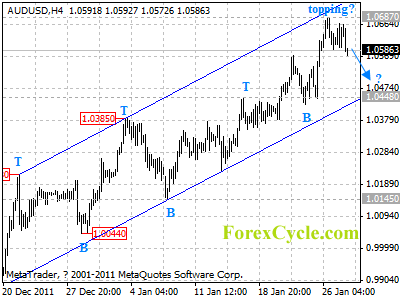
AUDUSD pulled back from 1.0687

Being contained by the upper line of the price channel on 4-hour chart, AUDUSD pulled back from 1.0687, suggesting that a cycle top is being formed. Deeper decline towards the lower line of the channel would likely be seen in a couple of days. As long as the channel support holds, the fall could be treated as consolidation of uptrend from 0.9861, another rise towards 1.0900 is still possible after consolidation, and a break above 1.0687 will signal resumption of uptrend.

audusd

Daily Forex Analysis

Technical Indicators: A Love-Hate Relationship

Part I: How One Technical Indicator Can Identify Three Trade Setups

By Elliott Wave International

Trading using technical indicators — such as the MACD, for example — can do one of two things: help you or hurt you.

Elliott Wave International’s Jeffrey Kennedy explains what he loves and hates about technical indicators and shows you how he uses them to his advantage in this excerpt from his FREE eBook, The Commodity Trader’s Classroom.


I love a good love-hate relationship, and that’s what I’ve got with technical indicators. Technical indicators are those fancy computerized studies that you frequently see at the bottom of price charts that are supposed to tell you what the market is going to do next (as if they really could). The most common studies include MACD, Stochastics, RSI, and ADX, just to name a few.

The No. 1 (and Only) Reason to Hate Technical Indicators
I often hate technical studies because they divert my attention from what’s most important – PRICE.

Have you ever been to a magic show? Isn’t amazing how magicians pull rabbits out of hats and make all those things disappear? Of course, the “amazing” is only possible because you’re looking at one hand when you should be watching the other. Magicians succeed at performing their tricks to the extent that they succeed at diverting your attention.

That’s why I hate technical indicators; they divert my attention the same way magicians do. Nevertheless, I have found a way to live with them, and I do use them. Here’s how: Rather than using technical indicators as a means to gauge momentum or pick tops and bottoms, I use them to identify potential trade setups.

Three Reasons to Learn to Love Technical Indicators
Out of the hundreds of technical indicators I have worked with over the years, my favorite study is MACD (an acronym for Moving Average Convergence-Divergence). MACD, which was developed by Gerald Appel, uses two exponential moving averages (12-period and 26-period). The difference between these two moving averages is the MACD line. The trigger or Signal line is a 9-period exponential moving average of the MACD line (usually seen as 12/26/9�so don’t misinterpret it as a date). Even though the standard settings for MACD are 12/26/9, I like to use 12/25/9 (it’s just me being different). An example for MACD is shown in Figure 10-1 (Coffee).

The simplest trading rule for MACD is to buy when the MACD line (the thin line) crosses above the Signal line (the thick line), and sell when the MACD line crosses below the Signal line. Some charting systems (like Genesis or CQG) may refer to the MACD line as MACD and the Signal line as MACDA. Figure 10-2 (Coffee) highlights the buy-and-sell signals generated from this very basic interpretation.

Although many people use MACD this way, I choose not to, primarily because MACD is a trend-following or momentum indicator. An indicator that follows trends in a sideways market (which some say is the state of markets 80% of the time) will get you killed. For that reason, I like to focus on different information that I’ve observed and named: Hooks, Slingshots and Zero-Line Reversals. Once I explain these, you’ll understand why I’ve learned to love technical indicators.


Keep reading about Hooks, Slingshots, and Zero Line Reversals in The Commodity Trader’s Classroom. This free eBook is filled with 32 pages of actionable trading lessons, such as:

  • How to Make Yourself a Better Trader
  • How the Wave Principle Can Improve Your Trading
  • When to Place a Trade
  • How to Identify and Use Support and Resistance Levels
  • How to Apply Fibonacci Math to Real-World Trading
  • How to Integrate Technical Analysis into an Elliott Wave Forecast

Download your FREE Commodity Trader’s Classroom eBook today!

This article was syndicated by Elliott Wave International and was originally published under the headline Technical Indicators: A Love-Hate Relationship. EWI is the world’s largest market forecasting firm. Its staff of full-time analysts led by Chartered Market Technician Robert Prechter provides 24-hour-a-day market analysis to institutional and private investors around the world.


Japan’s Endgame Nears

By The Sizemore Letter

I read a fact this week that I never expected to read in my lifetime: “The Japanese government is expected to announce Wednesday that the country recorded its first annual trade deficit since 1980″ (see ” End of Era for Japan’s Exports “).

Trade deficit? Japan?

Japan’s economy has been a slow-motion train wreck for the past 20 years. The bursting of the country’s 1980s credit, stock market and real estate bubble would have wreaked more than enough havoc on any economy. But on top of the normal debt deflation that would follow the bursting of a financial bubble, Japan adds the worst demographics of any developed country. Japan is aging rapidly, and its population is shrinking.

Most of the research on the effects of Japan’s demographics have focused on skilled labor shortages and pension funding. These are legitimate concerns, to be sure. But you don’t have to be an Ivy League economist to see that there is a much larger problem.

If you own a business—anything from a world-class automaker like Toyota (NYSE: $TM) to a neighborhood corner café—you have a smaller pool of potential customers every year, and within that smaller pool a larger percentage are elderly consumers who buy less. Some companies grow at the expense of others, but it becomes a zero-sum game. Growth in the aggregate becomes impossible. The math simply doesn’t add up.

Unless, of course, you export. And this is what Japan has been quite adept at doing for the past 20 years. Until now.

In his 2011 book Endgame , New York Times best-selling author John Mauldin calls Japan a “bug in search of a windshield,” and it’s a great metaphor. Like a bug buzzing along a highway, Japan’s economy has bumbled along for the past two decades, not really growing but not imploding either. In the not-too-distant future, Japan may be in for a good “splat.”

Two things have kept Japan’s economy afloat all these years: its healthy trade surpluses and its government’s ability to borrow large sums of money at ridiculously low interest rates to fund enormous budget deficits. The high price of the yen and prolonged weakness in the United States and Europe are doing a fine job of denting exports. And soon, the low interest rates may be under attack.

Anyone reading this article is well aware of Europe’s debt woes. But Japan’s debts make Europe’s look like pocket change. Italy, the most indebted of the major Eurozone countries, started to see its market bond yields reach punitive levels when its debt-to-GDP ratio reached 120 . As a comparison, Japan’s debt-to-GDP ratio is an almost unbelievable 220 percent (IMF).

The only reason that Japan hasn’t had a run on its bonds is that they are all by and large purchased by domestic buyers. As Mauldin explains it in Endgame, “94 percent of all JGBs have been bought by the Japanese.” But demographically, Japan is fast shifting from a nation of middle-aged workers saving for retirement to a nation of elderly retirees liquidating their savings to pay their bills. The savings rate has been in stark decline.

The domestic demand for Japanese bonds cannot last forever, and when it dries up, Japan will find itself at the mercy of international banks and investors. Ask Greece and Italy how that worked out for them.

Japan can look forward to a currency and debt crisis that makes Europe’s look mild by comparison. Yet betting on Japan’s collapse is a little like fraternity hazing for macro hedge fund managers. It’s just a rite of passage that they have to go through. They short Japan’s bonds, lose a fortune, and learn a few painful lessons.

Knowing this, I’m not going to recommend you short the yen or Japanese stocks or bonds — yet. Wait until you see Japanese yields starting to creep up. And when they do, position your portfolio for the potential short of a lifetime.