Why Chinese Real Estate is the Most Important Sector in the World Right Now

By MoneyMorning.com.au

The outlook for China matters enormously to markets and the world economy.

So it’s a shame that the argument over whether or not it will have a ‘soft landing’ is framed so poorly.

What most pundits seem to mean by a soft landing is nothing of the kind. It doesn’t even qualify as a landing.

And they seem to be ignoring the risks for what is probably the most important sector in the world right now – Chinese real estate

Chinese Real Estate Investment is Slowing Very Fast

When analysts talk about a soft landing in China, they mean a scenario in which growth gently slows to around 8%. This is widely assumed to be the minimum growth figure the country needs to maintain a solid job market and generally keep its citizens happy.

This scenario seems unlikely to me, to say the least. Especially when you look at what’s going on in the Chinese property market.

Real estate investment grew around 28% year-on-year in 2011. But it has been decelerating sharply. The year-on-year pace was 25% in October, 20% in November and 12% in December.

Chinse property accounts for around 13% of China’s economy directly and impacts on as much as 25% of GDP through related sectors. So a major slowdown here would inevitably be a serious drag on the economy.

In fact, it’s not much of an exaggeration to view Chinese real estate as the single most important sector in the world right now.

Chinese export manufacturing is facing slower demand from Europe and the rest of the world. The government seems unlikely – for now – to embark on the kind of aggressive stimulus it followed in 2008-2009. And consumer spending is obviously not going to fill the gap.

So why does this matter? Because most people seem to expect Chinese real estate investment growth of around 12-14% in 2012. That’s about half the 2011 pace, and would give you 8% overall GDP growth.

However, real estate is very cyclical. When it stops growing fast, it tends not to plateau, but to contract. And if real estate investment shrinks even a little bit, GDP growth is likely to be closer to 6%.

That might still seem pretty good. It’s certainly not a hard landing by any reasonable definition. But in an economy that has been growing as fast as China, that sort of shift in pace would be very noticeable.

Any drop may not show up fully in the headline GDP figures, which are measured year-on-year. But these tend not to capture the full extent of a slowdown, so long as growth picks up again relatively quickly.

Quarter-on-quarter growth was an annualised 8.2% in Q4 2011 from 9.5% in Q3, according to the official figures. I wouldn’t be surprised to see that rate drop much further. The ingredients are there for a much more abrupt change in the economy than most analysts want to admit.

China Needs Slower, Better Growth


This isn’t necessarily a bad thing. If growth falls because the government is deliberately trying to restrain property investment, it shouldn’t be seen as a sign of weakness. Rather, it reflects policies that should be beneficial in the long run.

I don’t believe the Chinese property bubble is anything like as big as some argue. But there’s absolutely no doubt that property developers in China are exactly the same as everywhere else: fond of piling on the leverage and overbuilding when times are good, then going bust when the cycle turns.

Western economies let real estate get out of hand and are now paying the price. Chinese policymakers are being more proactive: they’ve been clamping down on the industry for over a year.

For most of 2011, analysts constantly expected them to loosen curbs in the near future. That hasn’t happened. There have been some minor moves towards loosening Chinese monetary policy more broadly, but little relief for real estate.

Hopefully they’ll stick to this; an economy where real estate plays a smaller part will be a healthier one. But any move towards better quality growth will clearly reduce the growth rate – and not just for the next few months.

China’s trend growth rate has probably peaked. In hindsight, the mid-2000s will probably seem exceptional. With exports to the West now unable to grow so fast, the demographic dividend of cheap labour from the countryside getting smaller, and less scope for high levels of investment in real estate, the pace is likely to slow.

Indeed, the government’s target is now for 7% annual growth in 2011-2015, below the fabled 8% that analysts continue to use as a lower bound. A target has little value in itself: growth regularly beat official goals by a large margin in the past decade.

But the change suggests a shift in policy, where runaway sectors such as real estate will not be tolerated solely in the name of higher GDP.

So if China’s growth comes in lower than expected over the next year, it shouldn’t be seen as too alarming. In fact, if the brakes come off and real estate investment is allowed to accelerate again, that would be more worrying for the long-run health of the economy.

But whether the market will see it that way round is another question.

Cris Sholto Heaton
Contributing Editor, MoneyWeek (UK)

Publisher’s Note: This article originally appeared in MoneyWeek (UK)

From the Archives…

Is There a Reason You’re Not Using the 90/10 Strategy?
2012-01-27 – Kris Sayce

In the Market or Under the Mattress?
2012-01-26 – Keith Fitz-Gerald

What if the Australian Dollar Was a Stock?
2012-01-25 – Kris Sayce

Why Tungsten and Other Strategic Metals Could Prove Good Investments
2012-01-24 – Dr. Alex Cowie

Will These Commodities Help You Claim The Best Investment Gains Of 2012?
2012-01-23 – Dr. Alex Cowie


Why Chinese Real Estate is the Most Important Sector in the World Right Now

How Warren Buffett Plays the Tortoise and Not the Hare

By MoneyMorning.com.au

On 12 January Britain’s largest supermarket chain, Tesco, reported weaker than expected Christmas sales. It threw in a profit downgrade for good measure. As a result, the share price fell 16 per cent. It was Tesco’s largest share price decline in over 20 years.

Amongst the panic, Warren Buffett’s investment vehicle Berkshire Hathaway increased its stake in the food retailer to more than 5 per cent. Buffett first invested in Tesco in 2006. In the five years since, the stock price is down from where Buffett first bought in.

Yet he just purchased more.


This approach is what sets Warren Buffett apart from 99.9 per cent of investors. After investing in a company for 5 years, with the stock price going nowhere, most investors would ‘throw in the towel’ and sell after a profit downgrade and 16 per cent price plunge.

It’s the emotion of it all. We’re fixated on price. If the price is not doing what we want (moving steadily higher) we get restless. Sharp price movements invite an emotional response.

This is Warren Buffett’s strength. He avoids the emotional response because he focuses on the business not the stock price. Business value (and therefore share price value) is hard to grasp. It’s subjective. And you have to believe that in the long run value will always rise to the top. You just don’t know how long the long run really is.

Investing is a marathon. Slow and steady wins the race. Trying to catch every rally and moving from one sector to the next ‘hot’ area of the market is a mug’s game. It makes you feel like you’re doing something but you’re really just chasing your tail.

Over the long term, the market will deliver returns commensurate with the business performance of the companies listed on the exchange. If you invest in companies that offer the prospect of above average long-term returns, you will beat the market – over the long term.

Warren Buffett’s performance over the decades validates this approach. He is the ultimate tortoise. But keep in mind he beats the market, first, by buying companies at a good price. And second – and perhaps more important – by overcoming the emotional constraints to successful investing.

Greg Canavan
Editor, Sound Money. Sound Investments.

Ed Note: You can learn first-hand in Sydney what Greg thinks are the biggest opportunities – and risks – facing Australian investors, retirement savers and homeowners in 2012 by attending our “After America” conference. Find out more by clicking here

From the Archives…

Is There a Reason You’re Not Using the 90/10 Strategy?
2012-01-27 – Kris Sayce

In the Market or Under the Mattress?
2012-01-26 – Keith Fitz-Gerald

What if the Australian Dollar Was a Stock?
2012-01-25 – Kris Sayce

Why Tungsten and Other Strategic Metals Could Prove Good Investments
2012-01-24 – Dr. Alex Cowie

Will These Commodities Help You Claim The Best Investment Gains Of 2012?
2012-01-23 – Dr. Alex Cowie


How Warren Buffett Plays the Tortoise and Not the Hare

Will Australian Property Prices Keep Falling?

By MoneyMorning.com.au

Many years ago as a backpacker, the timing chain went on my knackered old Falcon XF. That was the end for ‘old Falco’.

As I stood in despair with the bonnet up, an irate local ran over to me. He was yelling ‘Put the bonnet down! You don’t want those Holden-driving buggers gloating, DO YA!?’

As a fresh-to-the-Lucky-Country pom, I thought this passion was great. These days, it seems this passionate division of opinion has migrated from Ford vs. Holden over to the Australian property debate.

With good reason. Property makes up a cornerstone of many Australian’s wealth. And Aussie property has had a bull market like no other. It started in the 1970s, decades before things got going in the United States. Over 40 years, Aussie property has gained an average of about 3% a year. Doesn’t sound like much, but it adds up quickly.

From the 1990s onwards, Australian house prices went up a few gears, and never looked back. Prices rose at an average rate of 6% a year at that time.

Is the Party Over?


Australian property prices pulled back from gravity-defying heights by at least 3.7% last year. Melbourne houses are down 9%.

Many home owners are nervous. Is this pullback the start of something bigger? Nearly every property market elsewhere in the world has spent the last few years imploding. US property prices are down by 40% in six years. Compare US prices in blue on the chart below against Australian house prices (in red)

Is the 40-year run up in Aussie property setting us up
for the crash of all crashes?

Is the 40-year run up in Aussie property setting us up for the crash of all crashes?

Source: whocrashedtheeconomy.com

When looked at like this, if property prices were to fall, you get a sense of just how far they could go. The 40% pullback in US prices that started in 2005 would be a picnic.

But WILL they fall?

There are wildly diverse opinions on where house prices are heading. That’s what makes a market.

Part of the reason for differing opinions is that there is more than one property market in Australia.

The resource-rich states, such as Western Australia, can be rising. While an economy with slow growth, such as Victoria, can be falling. Top tier suburbs can outperform the boondocks. Boiling the country down to just one market oversimplifies it, but it is the right place to start before scratching deeper.

Another reason for differing opinions is that some commentators have a vested interest in maintaining high prices. It’s impossible for them to be objective. It’s human nature.

For example, residential property loans makes up the vast majority of banks’ balance sheets. It’s not in their interest to put out negative research that could reduce the value of their portfolio.

Yesterday’s ANZ report suggests ‘…housing market fundamentals remain supportive’. And it pins any falls during 2012 purely on sentiment.

Don’t Underestimate Sentiment

Australia dodged a crash last time because the government juiced the market with cheap loans in the form of First Home Buyers Grants. Now this sugar-hit has faded and prices are falling again, sentiment has really turned. Buyers are just waiting, knowing that house prices are likely to fall further. As they fall, their view is vindicated so they wait some more. It becomes self-fulfilling. Sentiment can quickly send a fragile market south.

Australian property has many home-grown critics.

There is now a long and growing list of international experts expecting prices to fall.

Last month, rating agency, Moody’s, reckoned current prices were ‘not sustainable’ based on simple metrics. Metrics such as the average-price-to-average-salary ratio being close to 7, when the average in the developed world is 3.

Moody’s also pointed out that city house prices have quadrupled since 1990, and household debt has tripled. The point is that this puts home owners in a very delicate position in the event of an economic shock.

The Economist Magazine calculates that, based on the ratio of rent to price, Australian property is overvalued by 53%. A leading US real estate analyst, Jordan Wirsz, is calling for the Aussie housing market to fall by as much as 60%. He said ‘I’m bearish about world real estate but I couldn’t be more bearish about the Australian market’.

This is just part of a growing chorus of voices from overseas ‘experts’. But what do ratings agencies, magazines and analysts really know? They don’t have their money on the line.

What I put more weight on is when people start putting their money where their mouth and start making bets against property.

The world’s biggest hedge fund, Bridgewater Associates, with about $120 billion in management, expects Australian property to fall and is betting heavily against the Australian dollar this year.

Bridgewater was one of the few hedge funds to make money last year, and notched up one of the best returns in the hedge fund sector at 23%. This is on the back of consistently outperforming the market over 20 years.

No one knows for sure. But taking a calculated approach, my view is the risk of a crash outweighs the chance of making a meagre gain. I voted with my feet and sold out of property a year ago, buying gold with the proceeds. My mates thought I was nuts. But so far it has been a good trade. I’ll swap back when the time is right.

Most Australian ‘experts’ reckon Australia property won’t crash, and deny it is even in a bubble.

Alan Greenspan and Ben Bernanke said the same thing to Congress in 2005.

Right before the US housing market started a 40% fall that continues today.

Dr. Alex Cowie
Editor, Diggers & Drillers

Publisher’s note: If you enjoy reading Alex’s essays in Money Morning, we bet you’d love to meet him in person. It just so happens that he’s appearing live at the first ever Port Phillip Publishing Investment Symposium in March. It’s in Sydney. You should come. To meet Alex and hear his views on China, America and Australia – go here

Related Articles

The Conference of the Year for Australian Investors

Strong Currency Hides Australia’s Housing Bubble

Another Housing Market Myth Busted


Will Australian Property Prices Keep Falling?

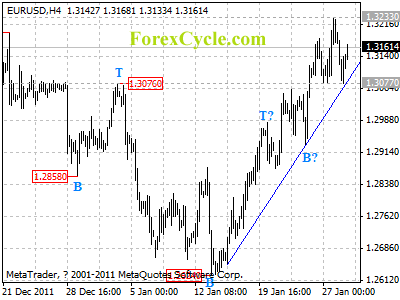
EURUSD rebounded from 1.3077

After testing the support of the upward trend line on 4-hour chart, EURUSD rebounded from 1.3077. The bounce would possibly be resumption of uptrend from 1.2624, further rise is expected later today, and next target would be at 1.3300 area. On the other side, a breakdown below 1.3077 will suggest that a cycle top has been formed at 1.3233 on 4-hour chart, then pullback towards 1.2800-1.2900 area could be seen.

eurusd

Forex Signals

Analyst Moves: BAC, K

Bank of America (BAC) was downgraded today by Goldman Sachs (GS) from buy to neutral. The firm believes that Bank of America needs to cut costs, and that the current busienss model faces a high degree of execution risk.

Daily Market Wrap: January 30, 2012

Stocks closed fractionally lower in another very light volume trading session on news of a delay in the finalization of Greece’s aid program. However, all three major averages did recover from earlier losses in a Monday afternoon rally.