Facebook IPO: No Where to Go But Down?


Facebook IPO

Unless you’ve been living under a rock for the last few months, you know that Facebook has filed its initial paperwork with regulators for its initial public offering (IPO). And they’ve hired five underwriters for the job, with Morgan Stanley (NYSE: MS) taking the lead role.

The company is currently looking at a valuation of $75 billion to $100 billion, which would be one of the largest initial public offerings in U.S. history.

These Numbers Make No Sense…

Facebook generated $3.7 billion in revenue in 2011, and a nice $1 billion in net income. For those of us who truly value fundamentals: If Facebook goes public and hits its high end with a $100-billion market cap – that means it would have a P/E of 100 times trailing earnings.

Forbes took a look at what that number means and the rarified air that type of market cap puts you above. Look at the following companies and tell me Facebook should be worth more:

  • Boeing (NYSE: BA) – $57-billion market cap, $69 billion in revenue, $4 billion in profits.
  • Disney (NYSE: DIS) – $7- billion market cap, fiscal year September 2011 revenue of $40.9 billion and $4.8 billion in profits.
  • Hewlett-Packard (NYSE: HPQ) – $58-billion market cap, fiscal year October 2011 revenue of $127.2 billion, non-GAAP net income of $10.4 billion.

How Would You Make Money?

Your Mom is on Facebook. Your spouse is on Facebook. Your kid is on Facebook. To state the obvious, almost everyone is on Facebook. The company’s numbers say they have 845 million users each month and 483 million active each day. However, if you got in early, you should be worried whether the company can grow beyond this activity.

Could you double your money? There are less than 20 companies with a valuation that high. At $200 billion, the company would shoot past AT&T (NYSE: T), Procter & Gamble (NYSE: PG) and Johnson & Johnson (NYSE: JNJ), and roughly be on par with General Electric (NYSE: GE), Google (Nasdaq: GOOG), or Berkshire Hathaway (NYSE: BRK-A).

The Risk Involved

Remember that any slip-up after this IPO valuation will cause a decrease in value. And their S1 actually makes points of what could cause this hiccup.

Here are a few points that they brought to light that could hurt or slow growth in the future:

  • If we fail to retain existing users or add new users, or if our users decrease their level of engagement with Facebook, our revenue, financial results and business may be significantly harmed.
  • We generate a substantial majority of our revenue from advertising. The loss of advertisers, or reduction in spending by advertisers with Facebook, could seriously harm our business.
  • Our business is highly competitive and competition presents an ongoing threat to the success of our business.
  • Improper access to or disclosure of our users’ information could harm our reputation and adversely affect our business.
  • Our business is subject to complex and evolving U.S. and foreign laws and regulations regarding privacy, data protection and other matters. Many of these laws and regulations are subject to change and uncertain interpretation, and could harm our business.

So let’s not look at this initial public offering as the cool new platform that all of our family friends use that will be around forever. View the Facebook IPO by the numbers, and the pros and cons that could happen after this initial market capitalization. It can still grow and evolve and be successful. But if its success isn’t over-the-top, you’re going to lose money if you get in early.

Good Investing,

Jason Jenkins

Article by Investment U
Is the Debt Crisis In Europe Spreading to the U.S.?


This just in: Government dependency is growing…

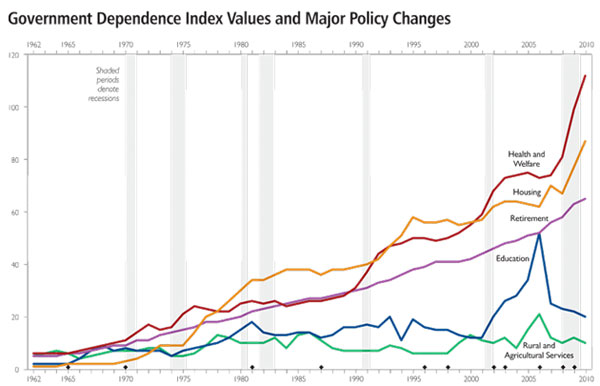
A CNN article about the expansion of government assistance first clued us in to the fact on February 7. The following day, the Heritage Foundation, a conservative think-tank, published a total of 18 extremely disturbing economic charts on the subject.

And from there, Business Insider, Investor.com and a slew of other websites and commentators picked up the story, broadcasting the fact that government dependency is on the rise.

Really, that’s not exactly shocking news considering the exponentially expanding government debt and deficit, not to mention dramatically visible societal shifts in the past few decades. But the problem becomes even more obvious when looking at Chart 11 of the Heritage Foundation’s list:

eurozone debt crisis

Source:
http://www.heritage.org/research/reports/2012/02/2012-index-of-dependence-on-government

Since the Great Society – which included the creation and implementation of Medicare, Medicaid, the Higher Education Act, and the Department of Housing and Urban Development – was first formed under President Lyndon B. Johnson in 1965, people have grown more and more attached to what many call the “nanny state.”

A nanny state assumes responsibility for its citizens’ well-being right down to their food, clothing and income if it deems necessary. Essentially, it’s one of those nice ideas that just doesn’t pan out in the long run, as evidenced by the ongoing turmoil in Europe.

Europe: The Definition of “Unsustainable”

Ironically enough, it was allegedly a European, British Parliament member Iain Macleod, who first coined the term “nanny state” back in 1965.

In 1965, that form of government had already long since taken root in England and mainland Europe. But since then, it has grown enormously.

According to Visual Economics, Germany spends 17.9% of its GDP on public healthcare and another 10.5% on education services, adding up to well over a quarter of its financial intake. France spends 16.7% and 11.4% respectively (28.1%), the U.K. spends 16.3% and 11.5% (27.8%), Spain spends 15.5% and 11.3% (26.8%), and Italy spends 13.2% and 10.3% (23.5%).

Add in unemployment benefits, housing, cash benefits, personal social services and various grants depending on the country, and that tally hikes up a lot higher. And that’s all on top of more traditional government spending on infrastructure, the military, public protection in the form of police and firemen, and government employee pay, as well as international aid and global organizations such as the United Nations.

Put it all together and you get the Eurozone debt crisis, complete with financial headaches, very real threats of default and rioting in the streets, as the world repeatedly saw in Greece, Italy, Spain and the U.K. last year… and will undoubtedly see again in 2012.

Nice idea though it is, nanny statism is flat-out unsustainable. And Europe proves it.

The United States of Dependency

The United States is no lightweight when it comes to spending, either, of course. It just happens to be in a slightly more advantageous position at this point for a few different reasons, including:

  • The dollar is still the world’s official reserve currency.
  • The U.S. didn’t turn to nanny state policies quite as quickly or drastically as Europe and therefore has – or used to have – a larger percentage of workers to draw revenue (i.e. taxes) from.
  • The U.S. government only has to fight with itself in order to get anything done whereas, in the Eurozone’s case, there are multiple governments involved, complete with multiple interests and agendas.

All the same, those factors can only go so far when the United States is set on spending $13.2 trillion per year, as it budgeted for in 2008, but bringing in less than $5 trillion. And that difference has only gotten worse since.

As the Heritage Foundation explained before introducing its 18 charts, “Annual deficits far greater than the government’s revenue are fueling explosive levels of debt. One such significant area of rapid growth is those programs that create economic and social dependence on government.”

Every new American added to the list of government dependence (around 45% in some form or another), brings the United States that much closer to becoming the next Europe… and that isn’t something we want to see.

Good Investing,

Jeannette Di Louie

Article by Investment U

Traders cautious ahead of meeting of European leaders tomorrow


By TraderVox.com

The euphoria over the Greek deal was short lived today with limited reaction from the market. The Euro has given up all the gains of the day due to cautious approach of the traders. The cautious approach is due to many aspects need clarification. It is still trading above the 1.3200 levels at 1.3218, marginally in the green for the day. The support may be seen at 1.3200 and below at 1.3150. The resistance may be seen at 1.3250 and 1.3325.

The sterling pound is also marginally trading in green and given up the gains of the day. It has retracted from the high of 1.5826 and is currently trading below 1.5800 levels at 1.5780 just 5 pips above its opening price of the day. The support may be seen at 1.5750 and below at 1.5700. The resistance may be seen at 1.5800 and 1.5825 levels.

After trading mostly in red during the day, USD/CHF is going towards its opening price and towards the high for the day of 0.9159. The support may be seen at 0.9000 and below at 0.9070. The resistance may be seen at 0.9150 and above at 0.9200. The pair is currently trading at 0.9150, almost flat for the day.

The USD/JPY pair has turned into the red and is currently trading at 77.49, 5 pips down the opening price of 77.54. The support may be seen at 77.30 which is a strong support and the resistance may be seen at 78.

The Australian dollar gained levels during the European session to the high of 1.0777. But it failed to hold on to these gains and is currently trading below 1.0750 at 1.0736, still up almost half a percent. The resistance may be seen at 1.0775 and 1.0800. The support may be seen at 1.0700 and below at 1.0650/60. The 1 hour chart is making the lower lows since the late European session. The bias remains bearish.

The US dollar index is gaining the levels and is approaching the 79 levels. It is currently trading just shy of 79 at 78.98. Tomorrow is an important day for the single currency as European leaders will meet to decide the Greek deal. 

Article provided TraderVox.com
Tradervox.com is a Forex News Portal that provides real-time news and analysis relating to the Currency Markets.
News and analysis are produced throughout the day by our in-house staff.
Follow us on twitter: www.twitter.com/tradervox

Week Ahead Market Report: February 13, 2012

Investors will be digesting news from Europe this week, as Greece’s parliament approved strict financial reforms needed to obtain a new bailout package as protesters burned buildings in Athens. Good morning, this is Kristin Bianco with the Week Ahead Market Report for February 13, 2012.

World’s Most Contrarian Investment


Contrarian Investment Opportunities

How do you identify great contrarian investment opportunities?

Two ways. First, rather than limiting yourself to your national borders, you seek out opportunities worldwide. Next, you insist on two essential factors: abject pessimism and extreme valuations. That’s exactly what we have in European stocks today.

Ask your friends and neighbors which stocks in Europe they’re buying right now and they’ll ask you to sit down so they can feel your forehead. After all, no one in his right mind would buy stocks in a region where socialist policies reign, economic growth is almost nonexistent and the currency – the euro – is coming apart at the seams, right?

Wrong. The fact that almost no one is enthusiastic about Europe right now – indeed, most see it as a ticking time bomb – tells you that sentiment is entirely negative.

How about valuations? Those are compelling, too. The benchmark MSCI Europe Index, for example, currently sells for just 9.8 times estimated 2012 earnings, versus an average of 17 times earnings over the past 25 years. Plus, the drop in prices has boosted the dividends on many of the well-known global companies based in Europe.

Lower Values, Higher Dividends…

In sum, you have low valuations, high dividends and extremely negative sentiment. Yet the vast majority of investors reading these words won’t plunk a dime in these markets. (And, if history is any guide, a year or two from now they’ll scratch their heads and say they just can’t fathom how European stocks could have rallied so strongly.)

Not that buying contrarian investments in this troubled region doesn’t present some risks. After all, the European Central Bank (ECB) is propping up troubled banks. Many Eurozone countries are teetering on the brink of recession. And there’s a decided lack of bold political leadership in the region.

But the good news is that all these factors are already well known and fully priced into European stocks. (That’s why they’re so darn cheap.) Meanwhile, the U.S. economy has stabilized – reducing a big risk to the global economy – and the ECB has at least addressed liquidity problems at the banks.

Plus, a weaker euro is actually boosting the earnings prospects for the many companies that export to other parts of the world where economic growth (and currencies) are stronger.

Prime examples are:

  • Siemens AG (NYSE: SI),
  • Nestle (Pink: NSRGY),
  • Novartis (NYSE: NVS), and
  • BMW (OTC: BAMXY.PK).

So how do you play this contrarian investment opportunity? One of the best ways is with a low-cost, Europe-focused ETF like the Vanguard MSCI Europe Fund (NYSE: VGK). It’s easily the least expensive ETF in the sector with annual expenses of just .14%.

Companies in the U.K. account for around 34% of VGK’s assets, while France, Germany and Switzerland make up approximately 40%. The fund holds more than 450 stocks, but a quarter of its $2.4-billion portfolio is in its top 10 holdings, which include Vodafone, Royal Dutch Shell and HSBC Holdings. You’ll earn a 4.4% dividend here.

If you want to benefit even more from a potential slingshot recovery in these markets, try the WisdomTree Europe SmallCap Dividend Fund (NYSE: DFE). It keeps a third of its assets in smaller British companies and the rest in small-cap stocks in the Eurozone.

Remember, when an equity market rallies, the small-cap issues generally outperform larger stocks. And your contrarian investment will get a whopping 5.8% dividend here.

So there you have it, two great ways to play one of the most compelling opportunities in the world right now. Of course, most investors simply cannot bring themselves to invest against the herd. That’s how they got stuck in internet stocks a decade ago and residential real estate five years ago.

It’s also why this is perhaps one of the best contrarian investment opportunities today.

Good Investing,

Alexander Green

Article by Investment U

Dollar Weakness “Creating Gold Demand” after Greek Deal, Time for American Austerity “Is Not Now” says White House

London Gold Market Report
from Ben Traynor
BullionVault
Monday 13 February 2012, 08:30 EST

SPOT MARKET gold prices touched $1733 per ounce Monday morning – 0.5% up on last week’s close – as stock markets, commodities and the Euro all rallied following Greece’s vote in favor of new austerity measures.

Silver prices meantime hovered around $33.90 per ounce – 0.8% up on the end of last week – while government bond prices dipped and the Dollar fell on the currency markets.

“The weakness in the Dollar…creates a bit of demand for gold,” reckons Bernard Sin, head of currency and metal dealing at Swiss precious metals refiner MKS.

By Monday lunchtime, Euro-denominated gold prices were roughly where they ended last week, at around €42,000 per kilo (€1306 per ounce).

Greek lawmakers last night approved a fresh austerity package, including public sector layoffs, minimum wage reduction and pension cuts. A reported 80,000 people took to the streets in protest, while press reports said up to 30 buildings were firebombed.

Antonis Samaras, leader of the New Democracy party and widely tipped as Greece’s next prime minister, expelled 21 members from his party for voting against the measures. Former prime minister George Papandreou, leader of the socialist Pasok party, also expelled members who did not support the measures.

Eurozone finance ministers are due to meet on Wednesday to review the new agreement, and potentially sign off Greece’s €130 billion second bailout. This in turn should pave the way for a deal with Greece’s private creditors to reduce the country’s debt burden, as well as stave off a default on March 20 when €14.5 billion of 3-Year Greek bonds mature.

“The government may yet find that approving the new measures…proves to be far less of a challenge than implementing them in the months ahead,” reckons one gold bullion dealer here in London.

“We are still looking for more measures out of Europe before we see a sustainable risk rally,” adds Ong Yi Ling at Phillip Futures in Singapore, who expects gold prices to hit resistance at $1760 per ounce.

“That will be the first resistance and the second one is at about the $1800 level. For gold to break the $1800 level, we need more measures, I would say.”

Here in the UK, the latest Bank of England figures relating to Project Merlin – the agreement between the UK government and British banks aimed at promoting lending to business – show that banks lent £214.9 billion overall to business in 2011, against a target of £190 billion.

However, the target for smaller businesses was missed, with £74.9 billion lent versus a target of £76 billion. The final quarter of last year saw a 3% drop in net lending.

“The Merlin targets have failed,” says Andrew Cave, head of external affairs at the Federation of Small Businesses.

“Talking to our members, 30% of them say they missed a growth opportunity because they weren’t able to access finance at the right times, so there is still a problem.”

“The reality,” adds Lee Hopley, chief economist at manufacturers’ federation EEF, “is that small and medium enterprises continue to be frustrated by the cost and terms and conditions around lending, with some opting out of using external finance altogether. This cannot be good for growth.”

China’s government has ordered the country’s banks to begin rolling over its loans to local governments, according to the Financial Times. When the global financial crisis broke in 2007-8, the state launched a massive stimulus program. Local authorities in China now have debts worth an estimated $1.7 trillion the FT says.

US president Barack Obama will today call for higher taxes on millionaires and billions of Dollars’ worth of infrastructure projects to create jobs as part of his 2013 budget proposals, news agency Reuters reports.

“I think there is pretty broad agreement that the time for austerity is not today,” White House chief of staff Jack Lew said Sunday.

Obama is expected to repeat his call made during his State of the Union address for the introduction of the so-called Buffett Rule, which would see millionaires pay a tax rate of at least 30%.

The net difference between bullish and bearish gold futures and options contracts held by traders on New York’s Comex – the so-called speculative net long – went up for the fifth week in a row over the week ended last Tuesday, according to the latest data from the Commodity Futures Trading Commission.

The spec net long and open interest both hit their highest levels since the week ended 15 November.
“It is likely that net spec length may consolidate or even decline in the week to 14 February as futures open interest in the period 8-10 February fell in parallel with the gold price,” reckons Carl Firman at precious metals consultancy VM Group.

“Options open interest in this period also shows a rise in puts relative to calls, suggesting some doubt may be creeping into the sustainability of the price rally.”

The volume of gold bullion held to back shares in world’s largest gold ETF the SPDR Gold Trust (GLD) meantime is at its highest level since 20 December, having risen 0.1% over the course of last week.

Ben Traynor
BullionVault

Gold value calculator   |   Buy gold online at live prices

Editor of Gold News, the analysis and investment research site from world-leading gold ownership service BullionVault, Ben Traynor was formerly editor of the Fleet Street Letter, the UK’s longest-running investment letter. A Cambridge economics graduate, he is a professional writer and editor with a specialist interest in monetary economics.

(c) BullionVault 2011

Please Note: This article is to inform your thinking, not lead it. Only you can decide the best place for your money, and any decision you make will put your money at risk. Information or data included here may have already been overtaken by events – and must be verified elsewhere – should you choose to act on it.


UK Economy is Set to Avoid Recession


By TraderVox.com

Tradervox.com (Dublin) – The UK economy is set to improve as signs of global economic growth are eminent. In the past few weeks reports from leading economies in the world has indicated an improved economic situation which analysts are taking as a sign of stable global economic condition. The recent news from Greece has given hope to the GBP and the UK economy is set to avoid recession.

The Confederation of British Industry expressed optimism of improved recovery and has also understated the need for quantitative easing by the Bank of England. CBI Director General Mr. John Cridland said that there are signs of optimism and he expects to see some marginal growth in the economy this quarter. He stated that in their growth forecast, they do not see any need for another QE from the BOE.

The UK economy had been affected negatively by the euro-debt crisis which resulted to a decreased economy in the fourth quarter. This necessitated the bank of England to make bond purchases on the 9th of February this year. According to Cridland, the signs of recovery from the Greece debt crisis and the positive sentiments from major world economies show resilience hence optimism in the prospect of the UK economy.

He also added that the recovery of the UK economy will depend on the successful resolution of the Greek debt crisis. The approval of the austerity plan by the Greek lawmakers has been seen as one of the signs that the crisis is headed to successful resolution. Another sign that has been central to the recovery prospects is the advancement of the stocks. The MSCI All-Country World Index gained .5 percent while the Stoxx Europe 600 Index increased by .8 percent.

The successful weakening of the yen through government intervention is also another sign of Japan’s economic recovery. The UK economic forecast has picked up among the members of CBI following those efforts as well as the ECB’s decision to increase liquidity to the banking system in the Eurozone. The signs of improvement in the euro area, US, and Germany signal an improved global economy which is conducive for UK economic recovery.

Article provided TraderVox.com
Tradervox.com is a Forex News Portal that provides real-time news and analysis relating to the Currency Markets.
News and analysis are produced throughout the day by our in-house staff.
Follow us on twitter: www.twitter.com/tradervox

Greek News Likely to Impact Markets This Week

Source: ForexYard

The euro took a strongly bearish turn to close out last week, after hitting a two month high against the dollar on Thursday. The downward correction was largely attributed to fresh concerns that Greece may not get a sorely needed bailout it needs to avoid defaulting on its debt. Greek news is once again likely to dominate market sentiment this week. Traders will want to pay particular attention to a meeting on Wednesday of euro-zone finance ministers. Any announcements regarding Greece following the meeting could lead to major market volatility.

Economic News

USD – Risk Aversion Leads to a Bullish Dollar

The US dollar saw gains virtually across the board to close out last week, following negative euro-zone news that caused investors to shift their funds to safe-haven assets like the greenback. The EUR/USD closed Friday’s session at 1.3196, well below the two-month high of 1.3321 the pair reached on Thursday. Against the Japanese yen, the dollar largely maintained its upward momentum, and was able to close out the week at 77.61. Analysts attributed the USD/JPY’s recent uptrend to positive employment data out of the US that has bolstered confidence in the economic recovery.

Turning to this week, traders will want to continue monitoring the situation in Greece for clues as to where the market is heading. Last week’s news cast doubts on whether Greece will qualify for a second bailout package it needs to avoid defaulting on its debt. While analysts are still confident that a bailout will be secured, they are quick to warn that the euro is still in a very fragile position. The dollar may see further upward movement if any additional negative Greek news is released in the coming days.

Additionally, a batch of US economic indicators set to be released throughout the week may influence dollar pairs. Tuesday’s Retail and Core Retail Sales figures, Wednesday’s TIC Long-Term Purchases and Thursday’s weekly Unemployment Claims will further illustrate the current state of the US economy. Positive news may benefit the USD against its main rivals, the EUR, GBP and JPY.

EUR – Euro Unable to Maintain Upward Momentum, Closes Week on a Bearish Note

Following Thursday’s news that Greece reached a deal on an austerity package that would pave the way for a bailout, the euro shot up to a two-month high against the US dollar. That trend drastically reversed itself on Friday, as the combination of demands for additional spending cuts in Greece, as well as political disagreements in that country cast doubts on whether a bailout will be delivered. The EUR/USD closed out the week at 1.3196. Against the Japanese yen, the common currency dropped almost 100 pips on Friday before staging a slight correction. The EUR/JPY pair closed the week at 102.42.

This week, traders will want to closely monitor any developments regarding the current Greek crisis. Particular attention should be given to a meeting of euro-zone finance ministers on Wednesday, which will likely shed some light on the state of current talks to deliver the bailout package to Greece. Most analysts are predicting that Greece will eventually receive the bailout it needs in order to avoid default. The euro may see some upward movement, if and when, the bailout package is agreed upon, but traders should be warned that the possibility for further euro bearishness is still very real.

AUD – Aussie Comes off Recent Highs

The Australian dollar saw some bearish movement to close out last week. The currency moved down against most of its major currency rivals, following negative euro-zone news that drove investors away from riskier assets. The AUD/USD closed Friday’s session at 1.0671, well below the six-month high it reached earlier in the week. Against the Swiss franc, the AUD closed Friday at 0.9776, down over 100 pips from earlier in the week.

This week, Aussie movements will likely be determined by euro-zone news. Providing a Greek bailout agreement is agreed to in the coming days, the AUD could see a boost along with other riskier assets. That being said, any further negative news could drive investors back to safe-havens which may cause the AUD to drop further.

Crude Oil – Greek Concerns Weigh Down on Oil

Renewed fears that Greece could default on its debt weighed down on riskier currencies and commodities, like crude oil, during trading late last week. Commodities like oil often go down in price when they become less affordable to international buyers. Crude closed out the week at $98.99 a barrel, almost a full dollar below where it was trading during Thursday’s session.

This week, in addition to following the ongoing developments in the euro-zone, oil traders will also want to watch fundamental indicators out of the US. Some risk taking might return to the market if any of the US fundamentals show growth in the US economy. The news could signal increased American demand in for oil, which may help boost prices.

Technical News

EUR/USD

The weekly chart’s Stochastic Slow is currently forming a bearish cross, indicating that downward movement could occur for this pair in the near future. This theory is supported by the daily chart’s Williams Percent Range, which is hovering close to the overbought zone. Traders may want to go short in their positions.

GBP/USD

A bearish cross on the weekly chart’s Stochastic Slow indicates that downward movement may occur in the coming days. That being said, most other long-term technical indicators show that this pair is range trading at the moment. Traders may want to take a wait-and-see approach, as a clearer picture may present itself later in the week.

USD/JPY

Most technical indicators on the daily chart show that this pair is overbought and could see a downward correction in the near future. These include the Relative Strength Index, which has cross above 70, and the Williams Percent Range, which is at -10. Going short may be the preferred strategy for this pair.

USD/CHF

The daily chart’s MACD/OsMA has formed a bullish cross, which typically means that upward movement could occur in the near future. This theory is supported by the Stochastic Slow on the weekly chart. Traders may want to go long in their positions for this pair.

The Wild Card

GBP/CHF

The daily chart’s Stochastic Slow has formed a bullish cross, indicating that upward movement could occur in the near future. This theory is supported by the Relative Strength Index on the 8-hour chart, which has crossed into oversold territory. Forex traders may want to go long in their positions ahead of a possible upward breach.

Forex Market Analysis provided by ForexYard.

© 2006 by FxYard Ltd

Disclaimer: Trading Foreign Exchange carries a high level of risk and may not be suitable for all investors. There is a possibility that you could sustain a loss of all of your investment and therefore you should not invest money that you cannot afford to lose. You should be aware of all the risks associated with Foreign Exchange trading.