Bad News All Around Europe


By TraderVox.com

The Euro started the week extremely strongly yesterday but just when we trying to analyze whether that strong start was due to continue, we saw a sharp turn of events as the Euro virtually lost all its hard fought gains of the morning. EUR/USD gained a massive 37 pips at the start of the day and this included the week starting with a gap. It shot up to a daily high of 1.3285 but then it took a sharp turn around midday and ended up closing at 1.3191, 19 pips away from opening price.

We know a lot of hearts get broken, especially with today being Valentine’s Day, when we start saying bad things about the Euro. The most significant event of the weekend was the Greek parliament deciding in favor of some new austerity measures which are built to aid Greece avoid default and consequently obtain another bailout. This new set of austerity measures was met with a lot of resistance as Greek citizens protested angrily against the decision yesterday outside the Greek parliament.

For those who are not verse with the Greek debt situation you will do well to know that if by March 20, the Greek government does not pay back its 14.5 Billion EUR bond debt, it will lead to default. So this debt deal has to be reached as soon as possible.

Elsewhere yesterday, there was bad news all around Europe as Moody downgraded debt ratings of some European countries. Italy, Portugal, Slovakia, Slovenia, Spain, Malta were among those that suffered. The UK, France and Austria did not receive any slack either as their credit outlook was reverted to a negative status. This does not bode well for the Euro at all and has consequently led to low market confidence and consequently risk aversion.

ZEW Survey data is due at 10.00 am GMT. The German and Euro zone specific reports are set to show better data than before though they are likely to stay in negative zone. Industrial Production data will also be released at same time.

Article provided TraderVox.com
Tradervox.com is a Forex News Portal that provides real-time news and analysis relating to the Currency Markets.
News and analysis are produced throughout the day by our in-house staff.
Follow us on twitter: www.twitter.com/tradervox

Bank of Japan Increases APP 10 Trillion Yen to 65 Trillion


The Bank of Japan held its interest rate at 0-0.10% and added 10 trillion to it’s now 65 trillion yen quantitative easing program.  The Bank noted that this will mean the Asset Purchase Program will increase by about 22 trillion yen by the end of 2012, compared to the current implemented level of about 43 trillion yen. The Bank said: “Japan’s economic activity has been more or less flat, mainly due to the effects of a slowdown in overseas economies and the appreciation of the yen.  On the other hand, financial  conditions in Japan have continued to ease.  On the price front, the year-on-year rate of  change in the CPI (all items less fresh food) is around 0 percent.”

The Bank of Japan also announced an inflation target as “a positive range of 2 percent or lower in terms of the year-on-year rate of change in the consumer price index (CPI) and, more specifically, set a goal at 1 percent for the time being”.  The Bank noted that the 2 percent target is what it considers “The price stability goal in the medium to long term”.  The inflation target mirrors that announced by the US Federal Reserve in its January communications package.

At its January meeting the Bank of Japan held policy settings unchanged, after it expanded its asset purchase program in October by another 5 trillion yen to 55 trillion yen, and previously announced additions to its quantitative easing program during its August meeting.  The Bank had previously changed its asset purchase program in March last year, when it added a further 5 trillion yen to its target.  Japan reported annual headline consumer price inflation of -0.2% in December, compared to 0% in October and September, 0.2% in both August, July and June, and 0.3% in both May and April.  

The Bank of Japan is forecasting real 
GDP growth of -0.4 to -0.3% in fiscal 2011, 1.8-2.1% in fiscal 2012, and 1.4-1.7% in fiscal 2013.  Meanwhile, nominal quarterly GDP growth in Japan was recorded at -0.6% in December, 1.7% in September, -0.4% in June and -1.8% in March.  The Japanese Yen (JPY) has gained around 7% against the US dollar over the past year; the USDJPY exchange rate last traded around 78. While the Nikkei 225 has fallen -16% over the past year; last trading around 9,052.

Why Small Cap Stocks Continue to Rally

By MoneyMorning.com.au

Small-cap mining stocks have had a great year so far.

The Emerging Companies Index (XEC), which is a good proxy for small-cap miners, has gained 6.5% in the last three weeks. Meanwhile the ASX200 has gone nowhere in this time.

The XEC index has rallied for six weeks straight now. Before this rally began, I didn’t sleep well for the few nights after calling my December newsletter ‘The buying opportunity everyone else will miss’. At the time, the markets were on their knees, and most self-respecting newsletters were flying their crash-flags high and clear.

But I saw an opportunity and stuck to my guns. The December issue went out on the 20th of December. Since then the XEC index has risen 15% in a straight line to a six-month high.

15% bounce in small-cap mining stocks since the 20th of December

15% bounce in small-cap mining stocks since the 20th of December
Click here to enlarge

Source: Google finance

That doesn’t mean it’s all happy days ahead.

In fact, it’s normally when you start high-fiving like this that the market slaps you in the face, and kicks you in the guts. A trading mate told me that next to his trading screen he has a mirror, and next to that a photo of himself punching the air in victory. Above it, it says ‘Does this guy in the mirror look like this guy? If so, then it’s probably time to sell your positions and take the dog for a walk’.

But I think this rally has further to run. This is the steadiest and longest rally we have seen in over a year, and it’s no coincidence that it started as the European Central Bank (ECB) deployed its own version of quantitative easing, Long Term Refinancing Option (LTRO) in December.

Particularly now the Fed has announced it will keep interest rates close to zero for three more years, and started talking up QE3. Both moves force investors into riskier parts of the market than they would prefer. This diverts more funds into small-cap mining stocks. From such depressed levels, the small caps responded to money flows rapidly, rising in price before the rest of the market and continue to lead the way.

China’s at it too. The people’s bank has been loosening monetary policy, and creating fund mandates designed to force money into the stock market. This has caused a turnaround in the Chinese stock market, taking commodity prices with it.

Chinese stock market (left) bouncing with commodity prices (right)

Chinese stock market (left) bouncing with commodity prices (right)
Click here to enlarge

Source: Bloomberg, D&D edits

Make Hay While the Sun Shines

With the Federal Reserve, the European Central Bank (ECB), and the People’s Bank of China all stimulating the market, this could be the start of a significant risk-on, liquidity-driven rally. Their policies will ultimately fail to fix any fundamental problems, but it doesn’t mean investors can’t profit along the way. As they say: make hay while the sun shines.

But be warned. With the usual amount of unknown risks out there regardless, no one really knows what will happen next.

Maybe Israel’s covert conflict with Iran becomes a real war, and the market collapses. Who knows? If you are risk averse, this current rally is at the very least an opportunity to take a bit of profit on any winners to reduce your overall risk level or a chance to trim your losses on any losers.

Dr. Alex Cowie
Editor, Diggers & Drillers

Publisher’s Note: Dr. Alex Cowie will be appearing at After America: the Port Phillip Publishing Investment Symposium, March 14th-16th at Sydney’s Intercontinental Hotel.

From the Archives…

Picking the Big Investment Story for 2012
2012-02-10 – Kris Sayce

Attention: If You Have Australian Bank Stocks – Sell Them Now
2012-02-09 – Kris Sayce

Why This Bearish Indicator Means it’s Time to BUY Stocks
2012-02-08 – Kris Sayce

Why The RBA Uses The Terms of Trade Indicator… And Why You Should Too
2012-02-07 – Greg Canavan

Why the US Unemployment Rate is a Slippery Statistic
2012-02-06 – Dr. Alex Cowie


Why Small Cap Stocks Continue to Rally

Uranium Stocks – The Restricted Aussie Export That Could Make You Money

By MoneyMorning.com.au

“Mr Shorten said managers needed to do more to improve employee engagement to lift performance and productivity rather than just blame Labor’s Fair Work Act and the unions for their troubles.” – Australian Financial Review, 13 February

That’s rich. For a government to accuse the private sector of being unproductive.

It’s the old pot and kettle situation.

Governments are not only unproductive and inefficient, but thanks to their meddling they harm private sector productivity too.

The fact is most (but not all) businesses achieve success despite government meddling. Not because of it. And there are even some businesses that seem to revel in it.

Why? Because the potential reward is so great that even the pen-pushers can’t put them out of business.


In a moment we’ll discuss the devil-may-care industry that time and again has made investors big returns over the past 20 years.

But first…

Keeping Cheese In, And Rubbers Out


You only have to read the list of import and export restrictions to see the hoops Aussie firms have to jump through to stay on the right side of government red tape.

Want to export “cameras or imaging systems for use underwater”? Forget about it. Unless you’ve got a permit from Defence Department and the Department for Foreign Affairs & Trade.

What about butter, cheese or yoghurt? Make sure you’ve got a permit from the Department of Agriculture, Fisheries & Food (DAFF). Think of the turmoil if people started exporting butter without government say-so!

And if you’ve ever wondered why Australia doesn’t have a bigger presence in the “sausage casings” industry, maybe it’s because you need a meat permit from DAFF before you even think about flying the flag for Aussie sausage casings.

But it’s not just export regulations pinning down Aussie businesses. Be careful what you import too. You’ll be pleased to know the Aussie government restricts the import of “Erasers resembling food in scent or appearance”.

Australia is the last bastion in the fight against novelty erasers. (If you think we’re kidding, check out this link.)

No wonder so many Aussie firms are going bust and laying off workers.

Yet why is it some businesses can overcome these restrictions while others can’t?

The resources sector is a perfect example of a red-tape-beating industry. Australia has a bunch of resources in high demand. And there are few other major competitors. In fact, Australia has huge resources of pretty much every bulk and specialty commodity there is.

That’s not the same for other Aussie industries where there’s plenty of global competition.

And that’s what makes it harder for those industries to compete. It’s not because of extreme capitalists earning a fast buck at the expense of workers. But because high costs and red tape makes it hard for Aussie firms to compete.

But as we say, red tape doesn’t stop everyone.
There are entrepreneurs and capitalists willing to invest time and money in one of the world’s most controversial and restricted industries – uranium.

At face value, you’d have to be mad to even bother about looking for and producing uranium…

There’s the cost of finding a resource and proving it’s viable. There’s the cost and red tape to dig the stuff up. The environmental concerns. The limited list of countries you can export uranium to. And of course there are security concerns.

You’d think there would be an easier way to make money. And there is. But few other sectors provide as much bang for your buck as uranium.

Boom or Bust


When the uranium sector booms it booms. Uranium stock gains of 20%, 40% or 50% in just a few days aren’t uncommon. And over the past 20 years we’ve seen uranium stocks make big triple- and even quadruple-digit gains in months.

Put just $500 into a uranium stock before it booms and you could cash-out with $5,000 or more just a few months later. But, there is a flipside. When uranium stocks lose favour with investors, the bust is just as spectacular.

You only have to look at the long-term chart of two Aussie uranium stocks to see what we mean – Energy Resources of Australia [ASX: ERA] and Extract Resources [ASX: EXT]:

Energy Resources of Australia [ASX: ERA] and Extract Resources [ASX: EXT]
Click here to enlarge

Source: Google Finance


Bottom line: uranium stocks are a great way to make a bunch of money (if you get the timing right). And a great way to lose a lot of money if you get the timing wrong.

But at the moment, our old pal, Diggers & Drillers editor, Dr. Alex Cowie says it’s a great time to speculate on uranium stocks. To the extent he has two open tips on his recommended buy list for subscribers.

In a recent update he wrote:

“When things get sticky for oil, uranium starts looking like a better alternative. In the last few weeks, major uranium stocks have started to pick up significantly. Australia’s largest uranium stock, Paladin (ASX: PDN), is now up 30% since the start of the year. One of Canada’s majors, Uranium One (TSE: UUU) is up 29%.”

Is the rally over? Not according to the Doc. He says, “…institutional investors are recognising deep value in the sector, after prices were overly crucified in the wake of the Fukushima disaster last year.”
(There’s more from the Doc below.)

Add Uranium to Your Portfolio


It goes to show you that if the potential profits are good enough, no amount of government meddling and red tape will stop a good idea from making money. The uranium sector is proof of that.

Unfortunately, red tape ties up many other Aussie businesses. But they don’t have the benefit of big profit margins. Simply because in a competitive world where consumers and other businesses can buy a similar product elsewhere, Aussie firms just can’t compete.

So if you’re looking for a big winner, the secret is to punt on stocks where Australia has a competitive advantage. That remains what it has always been: the resources sector… and given current prices, and if the Doc is right, uranium stocks should be at the top of your buy list.

Cheers.
Kris.

P.S. Dr. Cowie says uranium stocks are great value at the moment. And even after some recent gains in the sector, both the Doc’s tips are still in the buy zone. If you’d like to check them out and register for a no obligation trial subscription, click here for details…

Related Articles

The Conference of the Year for Australian Investors

Will These Commodities Help You Claim The Best Investment Gains Of 2012?

Why Tungsten and Other Strategic Metals Could Prove Good Investments


Uranium Stocks – The Restricted Aussie Export That Could Make You Money

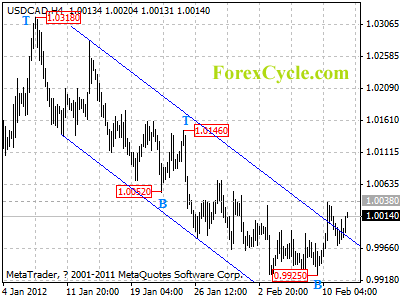
USDCAD pulled back from 1.0038

After breaking above the upper line of the price channel on 4-hour chart, USDCAD pulled back from 1.0038. Range trading between 0.9925 and 1.0038 would likely be seen in a couple of days. As long as 1.0038 level holds, the price action in the range could be treated as consolidation of the downtrend from 1.0318, and one more fall to 0.9800 is still possible. On the other side, a break above 1.0038 will confirm that the fall from 1.0318 had completed at 0.9925 already, then further rally could be seen to 1.0400 area.

usdcad

Forex Signals

Analyst Moves: ESV, WSO

Ensco (ESV) was upgraded today by Goldman Sachs (GS) from neutral to buy, as the firm believes that Ensco should be able to increase prices. Shares are higher by about one percent.

Bernanke Not Fooled by Recent Unemployment Gains

A survey released Friday by the Philadelphia Federal Reserve indicates a majority of the 45 economists invited to participate now believe U.S. unemployment will fall faster this year than previously expected. Those completing the study predict that unemployment will fall to 8.1 percent by the fourth quarter of 2012. A similar survey released this past November was considerably less optimistic with 8.7 percent expected to be the best that could be hoped for this year.

The change in outlook is understandable given the dramatic improvement over the past few months. Just over a year ago, unemployment was at 9.4 percent but as 2011 drew to a close, unemployment had fallen to 8.5 percent. The declining trend continued in January, with unemployment falling to a three-year low of 8.3 percent and it appears that February could bring even more employment gains.

For the first week of February, the U.S. Department of Labor said that the number of people applying for unemployment fell to a seasonally-adjusted 358,000 new applicants. This is the second-lowest level since April 2008 and is a decline of more than 15,000 applicants from the previous week.

Given the string of good news announcements, you would think U.S. Federal Reserve Chair Ben Bernanke would be smiling a bit more these days. But no, the Chairman continues to warn of rising unemployment even when most others believe the job market is improving. Does the Chairman know something the rest of us don’t? Or perhaps he just doesn’t believe the numbers.

In his testimony before the Senate Budget Committee last week, Bernanke said that even with an improving outlook, the U.S. economy will grow at a “sluggish” rate for the remainder of the year. The Fed continues to hold to its earlier outlook that growth will range between 2.2 percent and 2.7 percent for the year with unemployment between 8.2 percent and 8.5 percent by the final quarter of 2012.

Bernanke admonished the Committee saying “it is very important to look not just at the unemployment rate which reflects only people who are actively seeking work”. The term “actively” is key here and Bernanke as much as admits that the current unemployment rate is misleading as it does not include those who are “out of the labor force because they don’t think they can find work”.

Bernanke also cautioned that the ongoing Eurozone debt crisis has the potential to plunge the global economy back into recession. While Bernanke did not go so far as to say that a recession in the Eurozone is inevitable, it is clear that the Fed is erring on the side of caution acknowledging that a recession is a “possibility”.

What’s more, some Eurozone economies are clearly in recession already and should this spread to the entire region, the Fed warns that it anyone’s guess as to how long a recession may last and how much damage it could cause to the American economy.

Bernanke did adopt a more optimistic tone when discussing the efforts U.S. banks have made to reduce European exposure and protect assets. However, Bernanke still cautions that should the Eurozone slide back into recession, the U.S economy and financial system will “still be significantly affected”.

Scott Boyd is a currency analyst and a regular contributor to the OANDA MarketPulse FX blog