Will the Euro’s Recent Rise be Shortlived? – July 8, 2010

EURUSD july 8, euro, eur usd, usd eur, usd euro, US dollar, forex, forex trading, currency trading, online trading, daily forex picks,

Good day FX men and women! Here’s an update on the fiber or the EURUSD pair which I posted on July 2 (please see my last entry here). Back then, I asked if the euro bulls are back in play since the EURUSD had just broken out from an inverted head and shoulders. Indeed the pair continued to rise after the breakout. Though, if you look at today’s chart, you will notice that it is dangerously approaching the long term downtrend line. Now, the pair would most likely experience a lot of selling pressure in that level and it could once again dip if it’s not successful in moving past the mentioned resistance. If the pair manages to break above the downtrend line, it could easily reach for its upside target around 1.3000, which is computed by projecting the height of the inverted head and shoulders from the point of breakout. But if the resistance holds, its obvious support would be the neckline of the said pattern.

The euro’s rise came as a surprise since it happened following a disappointing US Ism manufacturing PMI. As I’ve mentioned previously, downbeat economic data from the major economies usually causes risk aversion which normally leads investors back to the safety of the USD. In any case, the euro continued to swing higher due to the impressive gains in the global equities markets. The Stoxx 50, for one, surged by 2.16% yesterday.

The euro, however, could weaken once more upon the European Central Bank’s decision to maintain its interest rate at a low of 1.00%. Finance officials have been worried about the possible downturn of the global equities markets again. And given the euro zone’s on going battle with debt, having more liquidity in the financial market would better serve the ones that are in fiscal difficulty. Maintaining the current liquidity yet again, though, would be bearish for the EUR.

More on LaidTrades.com …

Euro Reaches 7-week High Against USD

Source: ForexYard

EUR/USD has remained at or near its 7-week high throughout overnight trading, as investor confidence in the 16-nation currency continues to rise. Currently trading around the 1.2665 level, the pair’s next major resistance line is around 1.2676. Should the pair break this level, it could see further gains throughout the day today.

Economic News

USD – Dollar Continues to Fall Against Euro and British Pound

A series of dismal U.S. economic indicators has led to general erosion in confidence in the American economic recovery as well as the U.S. dollar as a whole. Both the EUR/USD and GBP/USD pairs have increased over 100 pips in the last 24-hours. This has led some investors to question the safe haven status of the dollar. That being said, the dollar made some substantial gains against the yen throughout trading yesterday. USD/JPY shot up from 87.05 during morning trading, to its current level of 88.20.

Today, a number of news events are set to shake up dollar pairs. Both the euro-zone and the U.K. will be releasing their respective interest rate reports. While neither is forecasted to raise rates, any statements of optimism from the ECP or MPC regarding the economic recovery are likely to cause the dollar to take more losses in afternoon trading.

Additionally, traders will want to watch out for this week’s U.S. unemployment claims report. Unemployment has been a constant reminder of how fragile America’s economic situation is at this point. While analysts are forecasting a decrease this week in the number of people who filed for first time unemployment insurance, that decrease is likely to be negligible at best. At the same time, should the figures come in well below the expected levels, the USD may see some gains in evening trading.

EUR – EUR Bullishness Expected to Continue Today

The euro is expected to continue gaining on its main currency rivals today, as investors continue to move to riskier positions in the marketplace following a rally in the U.S. stock market. While EUR/USD saw moderate downward corrections in trading yesterday, it still managed to make some significant gains, and is currently trading around a 7-week high. Meanwhile, the 16-nation currency continues to dominate the safe-haven yen. EUR/JPY has soared over 200 pips in the last 24-hours, largely due to the belief that the euro is moving toward solid ground.

Today, both the European Central Bank and British Monetary Policy Committee are scheduled to release statements about their respective interest rates. While neither is expected to raise interest rates, and positive statement will like lead to more gains for the currencies against the U.S. dollar and yen. Also, should the U.S. unemployment claims come in as expected, traders can assume the dollar will slide further against its European counterparts.

JPY – Yen Takes Losses Against Dollar and Euro

A rally in the Asian stock market has caused investors to abandon the safe-haven yen, in favor of riskier currencies like the euro and U.K. pound. EUR/JPY has reached a 2-week high, while GBP/JPY has moved up some 300 pips in the last 24-hours. If the U.S. and Asian stock markets see another bullish day today, traders can expect the Japanese currency to continue to drop.

Additionally, yen values will likely be determined by the European and U.S. economic indicators set to be released throughout the day. Positive news from either Europe or the U.S., will likely cause investors to continue buying up riskier assets. This will likely cause the yen to fall once again. That being said, should the news today voice any concerns about the pace of the global economic recovery, we may see investors return to safe haven assets like the JPY.

Crude Oil – Oil Prices Set to Rise for a 3rd Day

The price of crude oil has soared recently, largely due to an increase in U.S. demand during the busy summer months. In addition, a decrease in U.S. supplies has helped fuel the price increase. Crude oil shot up from 71.70 yesterday morning, to its current level of 74.65. Analysts are forecasting prices to continue to rise as more and more Americans take vacations and drive up demand. The U.S. is the world’s largest oil consumer, and demand reaches its peak during the summer months.

Today, the U.S. Crude Oil Inventories report, set to be released at 15:00 GMT, is forecasted to come in around -1.8 M. Should the report come in at or around this level, traders can expect crude prices to continue to rise in afternoon and evening trading.

Technical News

EUR/USD

The pair has recorded much bullish behavior in the past several days. However, the technical data indicates that this trend may reverse anytime soon. For example, the daily chart’s Stochastic Slow signals that a bearish reversal is imminent. A downward trend today is also supported by the 4-hour chart’s RSI. Going Short with tight stops may turn out to pay off today.

GBP/USD

The bullish trend is loosing its steam and the pair seems to consolidate around the 1.5180 level. The pair currently sits near the upper border of the daily chart’s RSI, suggesting a downward correction may be imminent. When the downwards breach occurs, going short with tight stops appears to be preferable strategy.

USD/JPY

There is a fresh bearish cross forming on the 4-hour chart’s Slow Stochastic indicating a bearish correction might take place in the nearest future. The downward direction on the hourly chart’s Momentum oscillator also supports this notion. Going short with tight stops might be a wise choice.

USD/CHF

The USD/CHF has gone increasingly bearish in the past several days, and currently stands at the 1.05114 level. However, the daily Chart’s RSI is already floating in the oversold territory indicating that a bullish correction might take place in the nearest future. When the upwards breach occurs, going long with tight stops appears to be preferable strategy.

The Wild Card

Crude oil

Crude oil prices rose significantly yesterday and peaked at $74.65 for a barrel. However, the 4-hour chart’s RSI is floating in an overbought territory suggesting that a recent upwards trend is loosing steam and a bearish correction is impending. This might be a good opportunity for forex traders to enter the trend at a very early stage.

Forex Market Analysis provided by Forex Yard.

© 2006 by FxYard Ltd

Disclaimer: Trading Foreign Exchange carries a high level of risk and may not be suitable for all investors. There is a possibility that you could sustain a loss of all of your investment and therefore you should not invest money that you cannot afford to lose. You should be aware of all the risks associated with Foreign Exchange trading.

Forex Daily Market Review July 08, 2010

By eToro – The Euro continued to move higher as investors rejoiced over the potential stress test criteria reported today.  The Euro will likely test the 1.2670 and 1.2750 resistance levels. Click here to read the full daily Review

Forex Market Analysis provided by eToro

Disclaimer: Trading in the Foreign Exchange market might carry potential rewards, but also potential risks. You must be aware of the risks and are willing to accept them in order to trade in the foreign exchange market. Don’t trade with money you can’t afford to lose.

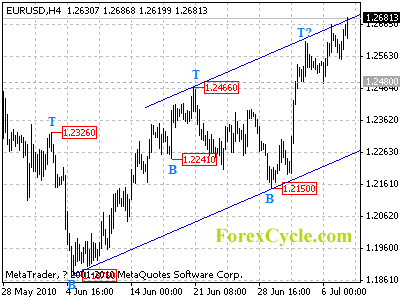
EURUSD’s uptrend extends to 1.2667

EURUSD’s uptrend from 1.2150 extends further to as high as 1.2667 level. As long as 1.2480 key support holds, uptrend is expected to continue and next target would be at 1.2750-1.2800 area. On the other side, the pair is facing the upper boundary of a rising price channel on 4-hour chart, pullback to the lower boundary of the channel is still possible, however, a break below 1.2480 support is needed to confirm such case.

eurusd

Daily Forex Analysis

The Swissy Defying the Odds – July 8, 2010

USDCHF july 8, USD, CHF, US dollar, swiss franc, swissy, forex, forex trading, currency trading, daily forex picks, daily fx picks, online trading

Here’s an update on the USDCHF pair which I last posted on June 29 (check my previous entry here). As you can see, the pair had reached a high of 1.1731 after breaking out from an inverted head shoulders formation. For awhile then, things were looking bright for those who were long. Unfortunately, the pair had ran out of gas and has sunk since reaching the mentioned high. It even fell further when it went back inside the neckline of the inverted head and shoulders.

At present, the pair is trading just above 1.0500. Though, it looks to be consolidating again into probably a bearish flag or pennant before moving lower again. Nonetheless, the 1.0500 support should prevent it from falling lower. A break of this level, however, could send it back down to 1.0100, 1.0000, or 0.9900. But given the pair’s oversold condition and its recent sharp slide, traders could take some profit, which would cause the pair to rally a bit. If it does, the neckline of the previous head and shoulders would again act as a resistance.

Last week, the unexpected upside in Switzerland’s KOF Economic Barometer (2.25 versus 2.17), contributed to the increase in the demand for the Swissy. The pair’s decline even became faster when traders and investors alike sold off the greenback despite the US’s weak employment, manufacturing PMI and home sales figures. Usually, the opposite occurs since investors tend to fly back to the safety of the USD whenever there’s risk aversion in the markets. But last week was a different story.

No other economic reports are due for the rest of the week in Switzerland. Given the lack of economic flows, the pair could stay range bound for awhile. Though, the pair’s short term valuation may be affected by the high impact economic updates from the UK, euro zone, and Canada. Stay tune for these upcoming accounts!

More on LaidTrades.com

Forex Daily Market Commentary

By GCI Forex Research

Fundamental Outlook at 1400 GMT (EDT + 0400)

The euro depreciated vis-à-vis the U.S. dollar today as the single currency tested bids around the US$ 1.2555 level and was capped around the $1.2640 level.  Concerns continue to mount that the global economy is headed toward a double dip recession and higher-yielding currencies like the common currency are at risk.  Traders also pared long euro exposure after it was reported that German May factory orders slid 0.5% following April’s revised print of +3.2%.  Economists had expected a May result of around +0.3% and factory orders were up 24.8% y/y.    Most traders believe the European Central Bank will keep monetary policy unchanged on Thursday. Remarks from President Trichet will likely focus on liquidity provisions by the ECB and stress tests on eurozone banks.  There is increasing chatter the ECB may be forced to adopt a quantitative credit expansion to deal with problems in the eurozone.  Data released in the eurozone today saw EMU-16 Q1 final gross domestic product up 0.2% q/q and 0.6% y/y, unchanged from previous estimates or forecasts.  Also, the French May trade balance worsened to -€5.5 billion from a revised -€4.3 billion.  In U.S. news, Dallas Fed President Fisher said the Fed has “done enough” to stimulate economic growth.  He added “Interest rates are zero.  It’s not the cost of money that the issue…Companies are hoarding cash, they’re holding back, they’re not hiring people, they’re not building plant and equipment at the pace we’d like to see.  This has nothing to do with monetary policy.  We have been as accommodative as possible.”  Fisher also noted “Deflation, as is inflation, are tail risks.” Kansas City Fed President Hoenig reported a 1% federal funds target rate “wouldn’t hurt the economy” and said 3% economic growth is “within the realm of possibility.” Data released in the U.S. today saw MBA mortgage applications move lower to +6.7%.  Euro offers are cited around the US$ 1.2720 level.

¥/ CNY

The yen appreciated vis-à-vis the U.S. dollar today as the greenback tested bids around the ¥87.00 figure and was capped around the ¥87.65 level.  Traders continue to buy yen on concerns the global economic recovery will be difficult to sustain and weak equity markets also fueled yen gains.  An intensification in risk aversion will likely benefit the yen further.  Data released in Japan overnight saw June official reserve assets increase to US$ 1.050 trillion.  Data to be released in Japan tonight include June bank lending, May factory orders, May current account data, and the May trade balance.  Dealers are paying close attention to Japanese politics where Prime Minister Kan’s Democratic Party of Japan party could lose its upper-house majority on 11 July.  Kan and the DPJ are seeking to increase taxes.  The Nikkei 225 stock index climbed 0.77% to close at ¥9,338.04.  U.S. dollar bids are cited around the ¥86.29 level.   The euro moved lower vis-à-vis the yen as the single currency tested bids around the ¥109.30 level and was capped around the ¥110.70 level.  The British pound moved higher vis-à-vis the yen as sterling tested offers around the ¥132.85 level while the Swiss franc moved higher vis-à-vis the yen and tested offers around the ¥82.95 level. In Chinese news, the U.S. dollar depreciated vis-à-vis the Chinese yuan as the greenback closed at CNY 6.7771 in the over-the-counter market, down from CNY 6.7805.  People’s Bank of China official Zhang reported PBoC “must deal with” excess liquidity” even as evidence emerges of slowing domestic growth.  Chinese officials seem intent on countering inflation and containing liquidity. Agricultural Bank of China appears poised to raise US$ 19.2 billion in its initial public offering.  The State Administration of Foreign Exchange reported China’s holdings of U.S. Treasuries “shouldn’t be politicized.”  SAFE added the “nuclear” option of liquidating its U.S. Treasury holdings is “completely unnecessary.”  PBoC official Yi indicated China does not want to fight trade wars.

£

The British pound appreciated vis-à-vis the U.S. dollar today as cable tested offers around the US$ 1.5215 level and was supported around the US$ 1.5080 level.  Data to be released in the U.K. tomorrow include June Halifax house prices, May industrial production, May manufacturing production, and the June NIESR GDP estimate.  Bank of England is expected to keep its headline Bank rate target unchanged tomorrow at 0.50% and to keep its asset purchase program unchanged at £200 billion.  Traders will pay very close attention to tomorrow’s MPC vote to see if there are additional calls for higher rates.    Cable bids are cited around the US$ 1.4620 level.  The euro depreciated vis-à-vis the British pound as the single currency tested bids around the £0.8300 level and was capped around the £0.8335 level.

CHF

The Swiss franc appreciated vis-à-vis the U.S. dollar today as the greenback tested bids around the CHF 1.0525 level and was capped around the CHF 1.0635 level. Data to be released in Switzerland tomorrow include the June unemployment rate.  Data released in Switzerland this week saw June consumer price inflation off 0.4% m/m and up 0.5% y/y, a moderation of price pressures.  Swiss National Bank’s foreign currency holdings declined last month to CHF 225.8 billion from CHF 232.1 billion in May as SNB officials stopped selling francs for euro or U.S. dollars.  Swiss National Bank President Hildebrand this week said he is “closely monitoring” the franc, adding its fluctuation has “clearly increased.”  U.S. dollar offers are cited around the CHF 1.0980 level.  The euro depreciated vis-à-vis the Swiss franc as the single currency tested bids around the CHF 1.3265 level while the British pound moved lower vis-à-vis the Swiss franc and tested bids around the CHF 1.5965 level.

Forex Daily Market Commentary provided by GCI Financial Ltd.

GCI Financial Ltd (”GCI”) is a regulated securities and commodities trading firm, specializing in online Foreign Exchange (”Forex”) brokerage. GCI executes billions of dollars per month in foreign exchange transactions alone. In addition to Forex, GCI is a primary market maker in Contracts for Difference (”CFDs”) on shares, indices and futures, and offers one of the fastest growing online CFD trading services. GCI has over 10,000 clients worldwide, including individual traders, institutions, and money managers. GCI provides an advanced, secure, and comprehensive online trading system. Client funds are insured and held in a separate customer account. In addition, GCI Financial Ltd maintains Net Capital in excess of minimum regulatory requirements.

DISCLAIMER: GCI’s Daily Market Commentary is provided for informational purposes only. The information contained in these reports is gathered from reputable news sources and is not intended to be U.S.ed as investment advice. GCI assumes no responsibility or liability from gains or losses incurred by the information herein contained.

Robert Prechter on CNBC: Prechter’s Perspective on Stocks

Prechter on CNBC: Prechter’s Perspective on Stocks

Robert Prechter joins host Maria Bartiromo on CNBC’s Closing Bell to talk about his bearish forecast for stocks and offer investment advice.

FREE Report: 20 Questions with Robert Prechter
Noted financial commentator Jim Puplava asks Robert Prechter tough questions about fiat currency, gold, the Fed, the Great Depression, financial bubbles, government intervention and how to protect your money — and even profit — in today’s environment. Read Prechter’s candid answers for FREE now. Access the 20-page report here.

About the Publisher, Elliott Wave International
Founded in 1979 by Robert R. Prechter Jr., Elliott Wave International (EWI) is the world’s largest market forecasting firm. Its staff of full-time analysts provides 24-hour-a-day market analysis to institutional and private investors around the world.

20 Questions with Robert Prechter: Devaluation Won’t Work

By Elliott Wave International

The following article is an excerpt from Elliott Wave International’s free report, 20 Questions With Deflationist Robert Prechter. It has been adapted from Prechter’s June 19 appearance on Jim Puplava’s Financial Sense Newshour.

Jim Puplava: In 1933 at the bottom of the crisis, the Roosevelt administration comes in. In its first week they declare a bank holiday, they reopen the banks with the FDIC, they sever gold, they come in with massive fiscal stimulus and they devalue the dollar substantially. The result was from 1933 to1937 we have positive CPI, economic growth, a robust stock market. If fiscal and monetary measures fail to revive the economy and the market, could the government try devaluation to change the deflationary outcome the way they did 1933?

RP: Well, you have to have a benchmark in order to devalue a currency. Our currency isn’t pegged to anything, so I don’t understand even what the term devaluation would mean. What would they do to do create a devaluation?

Editor’s Note: The article you are reading is just one small excerpt from Elliott Wave International’s FREE report, 20 Questions With Deflationist Robert Prechter. The full 20-page report includes even more of Prechter’s insightful analysis on fiat currency, gold, the Fed, the Great Depression, financial bubbles, and government intervention. You’ll learn how to protect your money — and even profit — in today’s environment. Read ALL of Prechter’s candid answers for FREE now. Access the free 20-page report here.

JP: Maybe they come out with a formal saying: the dollar is now worth a half a euro, X amount of yen or it’s a formal statement. They just declare it formally.

RP: Yeah, but everybody already knows what it’s worth, because it’s floating freely against these other currencies. And they certainly couldn’t fix it to a lesser currency like the euro. And then the managers of this other currency would simply make another decree and negate it. That’s not going to work.

Let’s take your example, because it’s very important. The whole idea of the government being ahead of the curve is bogus. You know the collapse was from September 1929 down to July 1932, right? The government did not act until it was over. They waited for the bottom of the collapse—of course—and then they finally decided they’re going to do something about it. So, months after the low in 1932, they finally shut the banks and pass laws such as Glass-Steagall, which created the FDIC, and the Securities and Exchange Act, and that sort of thing, to bring confidence back into the banking system. I think the same thing is going to happen here. They’re going to try the same old stuff, more and more lending, more and more borrowing—which is the problem, not the solution—until everything collapses, and then they’ll go, “Oh maybe we should try something else,” and by that time we’ll already be at the deflationary nadir, and it’ll be time to look for an inflationary outcome.

My whole thesis is exactly along those lines. We want to stay prepared for a deflationary crash, and when it’s over, we’re going to convert whatever money we have to stocks, and raw land, and gold, and whatever else we want to buy. That’s when—if the government makes a political decision to inflate through currency printing—it would make the decision. They’re not going to make it before the bottom. The government has never acted before the bottom, never acted in a new way. Right now these bailouts and other schemes are simply pressing the accelerator harder on what we’ve been doing since 1913.

Editor’s Note: The article you are reading is just one small excerpt from Elliott Wave International’s FREE report, 20 Questions With Deflationist Robert Prechter. The full 20-page report includes even more of Prechter’s insightful analysis on fiat currency, gold, the Fed, the Great Depression, financial bubbles, and government intervention. You’ll learn how to protect your money — and even profit — in today’s environment. Read ALL of Prechter’s candid answers for FREE now. Access the free 20-page report here.

This article, 20 Questions with Robert Prechter: Devaluation Won’t Work,was syndicated by Elliott Wave International. EWI is the world’s largest market forecasting firm. Its staff of full-time analysts lead by Chartered Market Technician Robert Prechter provides 24-hour-a-day market analysis to institutional and private investors around the world.

S&P500 Trading: The “Death Cross” – What it is and how to trade it

By Adam Hewison – In today’s short video, we look at two important aspects of the market – one
is an intraday technique which I will show you how to use to determine where
markets will turn, and the other is the infamous “death cross”.

The death cross does not occur that often, in fact, in the last 2 1/2 years
we’ve only seen this happen three times. The most recent occurred just last
week and is something that every investor and trader should pay close attention
to. I believe that this video will help you understand what the death cross is
and how you can construct it and use it in your own trading. A lot of traders
and investors watch this very closely so you should too.

As always our videos are free to watch and there’s no need for registration.

If you like the video please feel free to comment on our blog and give us your
thoughts on the market.

Watch the S&P500 DeathCross Video Now….

All the best,
Adam Hewison
President of INO.com

A Chance to Ride the Global Gold Rush! – July 7, 2010

gold july 7, au, commodities trading, com-dolls, mining, stock trading, forex, forex trading

Good day finance fans! Here’s an update on the price action of gold which I last posted on June 28 (kindly see my previous entry here). As you can see, the price of gold has weakened after it marked a new all-time high at $1,265.05 per ounce on June 21. Gold has a possibility to dip a little more since it has already broken its shorter term uptrend line. Despite doing so, its long term uptrend remains to be intact and as long as it is, the price of gold would likely trek higher over the longer time frame. With the stochastics in the oversold area, traders could indeed buy it back up any time soon. The presence of a bullish divergence, where the price registers higher highs and the stochastics mark lower lows, also suggest a likely bullish continuation in the coming days. In my opinion, a good long entry point here would be at the intersection of the 50% Fibonacci retracement level that I drew and the long term uptrend line. A break, however, of the long term uptrend line would be a sign of some sour things to come.

Remember that investors generally buy gold during times of economic down swings since unlike most other assets, gold does not lose its intrinsic value. With most of the biggest economies in the world already turning bearish as indicated by the breaks downs in their equity indices (S&P 500, Dow, Nasdaq, FTSE, SSEC), investors and traders alike would surely pull out their funds away from these market and into somewhere where the value of their money could be at least maintained or better. Since gold has been on a bull run as exhibited by its uptrend for almost two years now, investors would likely place their money in it. And given the influx of new funds that that came out of equities, the demand for assets such as gold would likely increase, which of course, would jack up its prices.

If the breakdowns in the mentioned indices worsen and if the Stoxx 500 follows suit, gold will likely be more in demand. Now, if I wish to ride the gold’s uptrend, I could either invest in gold itself or in the commodity currencies such as AUD, NZD, and CHF. I could likewise invest in the listed gold mining companies.

More on LaidTrades.com