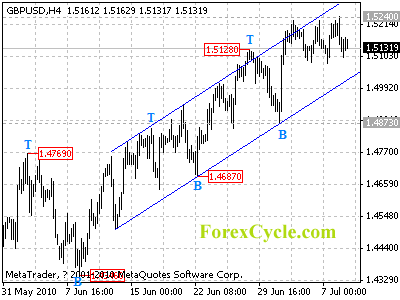
GBPUSD consolidates between 1.5080 and 1.5240

GBPUSD formed a sideways consolidation in a narrow range between 1.5080 and 1.5240 for several days. Lengthier sideways movement is still possible later today. Near term support is at the lower boundary of the price channel on 4-hour chart (now at 1.5027), As long as the channel support holds, the sideways movement is treated as consolidation of uptrend, another rise to 1.5400 is still possible. Key support is at 1.4873, only fall below these levels could indicate that the upward movement from 1.4346 is complete.

gbpusd

Daily Forex Forecast

Can you make money with Forex Trading?

By Forex4you.com

Many people start trading Forex because they have heard that you can make a lot of money relatively quickly and easily. After all trading is what all those guys on Wall Street do who drive expensive sports cars and live in luxury apartments isn’t it, and if they can make caboodle’s of cash why can’t I, right?

Well, the first thing you need to know is that forex trading isn’t easy and whilst the rewards can be high they are not generally so for beginners. As far as the guys on Wall Street go, well, whilst some may be excellent traders, most manage other people’s money and they might not be quite so wealthy if they were trading with their own accounts.  Nevertheless once you have mastered the art of trading there is no better way to ensure financial security. I spoke to one successful Forex trader who described his trading experience like “owning my very own private cash machine.” When he wants some money he simply opens up the laptop, starts trading and after a while – bingo! There it is, a cool $500!

It’s a tantalizing thought being able to magic money out of thin air like a fantasy wizard but in truth where does the money actually come from? One of the things you need to be aware of is that the ‘money’ actually comes from other traders who are losing money on their positions whilst you are making money on yours.

It’s a difficult concept to grasp but all currencies are traded in ‘pairs’ like the US dollar and the Japanese yen (written USD/JPY) so when you buy dollars you buy them with yen and someone on the other side of the transaction is buying yen and selling you the dollars. If the dollar strengthens against the yen you make money but the other person has lost money.

This point is important because essentially trading Forex is a competition and in order to make money you have to consistently outwit the other participants in the market. It is this that makes trading ‘difficult’ because you will be up against seasoned pros and people who work for banks with massive research and analysis departments behind them.

So how do you compete in the Forex market? Well, obviously, at first you will start at the bottom of the pile so you may lose some money. It is important therefore to make sure that isn’t too much money. Start by trading small amounts. Many brokers such as forex4you now offer small lot sizes so you can trade in 10s or even single units of currency.

It’s probably not a good idea to chuck in the day job straight away – start by trading in your spare time. Try to trade longer term with small amounts rather than putting the mortgage on a single short term turn of the dice. Longer term trading is easier than intraday trading as the volatility is more controlled, and the beauty of Forex is that it is a 24 hour market so you can trade anytime day or night.

Secondly educate yourself in the dynamics of the market. Learn about technical analysis either from books or by taking a course. Most countries have official bodies or technical analysis societies which run excellent courses. A good grounding in the major techniques is a must.

Become an amateur economist. You need to understand at least the basics of the financial world and how it works. Learn about the factors which influence currency trading such as interest rates, central banks and economic data. Follow the news and political events as these also often influence movements in the Forex markets.  Don’t believe those stories you read about it being easy to make 80% a month. Only very experienced Forex traders can hope to achieve these sorts of returns. Initially you will be looking to break even or make small wins. If you don’t have a million dollar account it is unlikely you’ll be able to start trading full time straight away. Even if you get good it helps to be well capitalized. Many traders who make it past the first hurdle and learn to profit from the market fall at the next because they can’t actually make enough. Remember it’s a slow process like fermenting wine so keep grafting away and eventually the profits will come and your account will grow but don’t put yourself under too much pressure at first.

Next and just as important learn to know yourself; understand your own particular frailties and be aware of how they affect your trading decisions. Many say discipline is important but this is only part of it, self knowledge is probably more important as it will help you become self aware of emotional extremes. Over confidence and under confidence – or put a more traditional way ‘fear and greed’ – describe the cycles of feeling that all market participants go through as they trade. Basically don’t trade when you are over confident or the chances are you will give all your winnings back to the market. After a good run of wins you need to be able to walk away from the table just at the moment when you probably feel most confident and most tempted to make another big trade. It is important to remember that no-one can be right every single time and all traders go through losing streaks. This is where you need to develop resilience. It is often the case that in the depths of despair lie the first glimmerings of hope – and glitterings of riches. You need to be able to get through a string of loses and keep trading even when you least want to, as it is often at moments like that, in the depths of despair, that the best opportunities present themselves.

The final most important piece of advice is to keep going whatever. View trading as an art which you have decided to dedicate a portion of your life to mastering not a means to quick riches. The majority of traders give up too soon or lose all their money too quickly and so miss out on the possible wealth they might have made if they had stuck at it. Remember, the longer you trade and the more experience you amass the higher up the ladder you will get. The more experienced you become the more traders there will be in the market who are less experienced than you and from whom you can make money. If you hang in there, there is more chance you will be the one on the right side of the trade not the other way round, so enjoy the ride, make trading fun, love it with a passion and you’ll get there eventually!

About the Author

Article courtesy of Forex4You.com
Learn Basics of Elliott Wave Analysis — FREE

By Elliott Wave International

Ralph Nelson Elliott discovered the Wave Principle in the 1930s. Over the decades, his discovery was kept alive by a handful of individuals. A few of those, such as Bolton, Prechter and Frost, educated investors on how to use pattern analysis in financial markets.

To help out Elliott Wave International’s readers in learning the basics of the method, we put together a free 10-lesson online tutorial. Here’s an excerpt. To get it in full, look for details below.

EWI’s Basic Elliott Wave Tutorial
Lesson 1, excerpt

At that time [of his discovery], with the Dow in the 100s, R. N. Elliott predicted a great bull market for the next several decades that would exceed all expectations at a time when most investors felt it impossible that the Dow could even better its 1929 peak. As we shall see, phenomenal stock market forecasts, some of pinpoint accuracy years in advance, have accompanied the history of the application of the Elliott Wave approach.

Under the Wave Principle, every market decision is both produced by meaningful information and produces meaningful information. Each transaction, while at once an effect, enters the fabric of the market and, by communicating transactional data to investors, joins the chain of causes of others’ behavior. This feedback loop is governed by man’s social nature, and since he has such a nature, the process generates forms. As the forms are repetitive, they have predictive value.

The market…is not propelled by the linear causality to which one becomes accustomed in the everyday experiences of life. Nor is the market the cyclically rhythmic machine that some declare it to be. Nevertheless, its movement reflects a structured formal progression. In markets, progress ultimately takes the form of five waves of a specific structure.

Three of these waves, which are labeled 1, 3 and 5, actually effect the directional movement. They are separated by two countertrend interruptions, which are labeled 2 and 4, as shown in Figure 1-1. The two interruptions are apparently a requisite for overall directional movement to occur.

At any time, the market may be identified as being somewhere in the basic five wave pattern at the largest degree of trend.

Read the rest of this 10-lesson Tutorial and see multiple charts now, free! All you need is to create a free Club EWI profile.

Read the rest of this 10-lesson Basic Elliott Wave Tutorial online now, free! Here’s what you’ll learn:

  • What the basic Elliott wave progression looks like
  • Difference between impulsive and corrective waves
  • How to estimate the length of waves
  • How Fibonacci numbers fit into wave analysis
  • Practical application tips for the method
  • More

Keep reading this free tutorial today.

This article, Learn Basics of Elliott Wave Analysis, was syndicated by Elliott Wave International. EWI is the world’s largest market forecasting firm. Its staff of full-time analysts lead by Chartered Market Technician Robert Prechter provides 24-hour-a-day market analysis to institutional and private investors around the world.

Commodities: What’s going on in Crude Oil?

By Adam Hewison – We’ve had a number of requests to do a video on crude oil,
so here it is. This market has been largely trapped in a
broad trading range with support coming in around $70/barrel
and resistance around $80-85/barrel. In this new video, I
show you some of the other factors that could tip this market
one way or the other.

As always our videos are free to watch and there is no need to
register. I hope you enjoy the video and please leave your
comments.

Go to the latest Crude Oil Video Now….

All the best,
Adam Hewison
President of INO.com
Co-founder of MarketClub

Gold Trading Analysis: Why is Gold going down?

By Adam Hewison – This market has surprised many people as they were
expecting gold to continue up to the $2000 level
without any problems. Normally when you have such
the unanimous viewpoint, the markets tend to go
the other way. The reason for this is that everyone
who is bullish is normally long the market. The current
breakdown in the yellow metal has not changed the overall
longer-term bullish trend for this market.

The question is, how far will the gold move to the downside,
and where is support? In this new video we point out some very
positive signs as well as some troubling aspects that we see in
this market.

This is a video I think you will get a lot out of and as always
you are free to watch it without registration. I hope that you
have the time to comment about this video and share your thoughts
on the gold market.

Watch the New Gold Video Now…

All the best,
Adam Hewison
President of INO.com
Co-founder of MarketClub

Stock Trading: Is it time to go short the S&P 500?

By Adam Hewison – The current rally in the S&P 500 is bringing this market back to key levels
of previous support. Normally when you see rallies back to a previous support
level, that support level then acts as resistance.

In our earlier videos, we discussed the death cross as well as some of the
other key indicators that continue to remain negative on this market. Today,
however, I pinpoint exactly where we think this market is going to run into
trouble and where you should perhaps look to go short.

You are free to watch this video with no obligation and no need to register,
but I would really like to get your feedback on this video as well as this market.

Watch the New Video Now…..

All the best,
Adam Hewison
President of INO.com
Co-founder of MarketClub

Forex: Euro hits 2-month high versus US Dollar, touches 1.2700 as risk rises on IMF, economic data

By CountingPips.com

The European common currency reached a fresh two-month high versus the US dollar in Forex trading as investors risk optimism has continued on a data-filled day today. The dollar has fallen to other risk currencies such as the Australian dollar, New Zealand dollar and Canadian dollar while the American currency has managed to trade at higher levels versus the British pound, Swiss franc and the Japanese yen.

The euro touched the 1.2700 exchange rate for the first time since May 12th today before retreating a bit lower from the highpoint. The European currency continues to rally versus the dollar from the four-year low point reached on June 7 and from a more recent low point of 1.2151 reached on June 29th.

Helping to boost the risk optimism in the market today was a report by the IMF that raised their growth projections for 2010. The IMF forecasts that global growth will reach 4.6% in 2010 after a previous estimate that global growth would register 4.2% for the year. Although the IMF projects higher growth, it cautions that the European sovereign debt crisis presented risks to this outlook.

Asia will continue to be the driver of growth as the IMF forecasts Asia to rise by over 7% this year while the US is forecasted to grow by 3.3%, Japan by 2.4% and the euro area by 1.0%. Also, the United Kingdom is forecasted to grow at 1.2% in 2010 while Canada is expected to increase by 3.6%.

Other economic reports released today included a much more than expected rise in Australian employment for the month of June, according to the Australian Bureau of Statistics. Australia’s economy added approximately 45,000 workers in June following a decline of approximately 23,000 workers in May and topped forecasts expecting a gain of 15,000 jobs. This news had a positive impact and boosted the Australian dollar in early forex trading action.

The European Central Bank and the Bank of England had their interest rate announcements today and both held their rates at their current levels as widely expected at 1.00% and 0.50%, respectively.

Economic news out of the U.S. today showed that weekly jobless claims decreased by more than expected in the week that ended on July 3rd, according to a release by the U.S. Labor Department. New jobless claims fell by 21,000 workers to a total of 454,000 unemployed workers while the 4-week moving average of unemployed workers decreased by 1,250 workers from the previous week to a total of 466,000.

Market forecasts were expecting jobless claims to come down to 460,000 workers following the prior week’s 475,000 claims.

Workers seeking continuing claims for unemployment benefits for the week ending June 26th also decreased for the week. Continuing claims dropped by 224,000 workers to a total of 4,413,000 unemployed workers while the four week moving average of continuing claims dropped by 18,750 workers to a total of 4,554,000.

Forex Chart: EUR/USD DailyThe euro/dollar pair increasing higher in Forex trading today and touching the 1.2700 exchange rate for the first time in two months. The daily chart below shows this pair is trading right at the downward trendline that has held since December 09 and presents the euro/dollar with a challenge to its recent rally from off it 4-year lows in early June.

forex-eurusd, forex trading, currencies, euro, us dollar


Aussie Bulls Refusing to Give Up – July 8, 2010

AUDUSD july 8, AUD, USD, US Dollar, Australian dollar, aussie, forex, forex trading, forex market, currency trading, online trading, daily forex picks

In my last post about the AUDUSD pair, I mentioned that if it falls below the neckline of the double bottom, it would likely sink further until it sees some support at 0.8300 or at 0.8100 (kindly check my previous post here). As as you can see, it indeed consolidated into a smaller double bottom after touching 0.8300. It then broke out of this pattern to keep itself back up again above the neckline of the bigger double top formation. In my opinion, those who are long on the Australian dollar would be in a safe position as long as the AUDUSD pair stays above the mentioned significant level (0.8600). Moreover, the pair could further go north since the stochastics are still far from the overbought region. But if fear makes a comeback and the Aussie slides below 0.8600 again, its likely stop would then be at 0.8300.

Just yesterday, the Reserve Bank of Australia kept its interest rate unchanged at 4.50% due to the recent unrest in the global equities markets and Australia’s less-than-stellar CPI and GDP figures.Note that central banks generally hike their rates to control inflation and growth. While the country’s year-over-year CPI in March printed a strong 2.9%, its GDP failed to impress, growing by only 0.50% during the first leg of the year as against the 0.60% prediction. Australia’s housing industry remained damp as seen in the building approval’s 6.6% decline in May. Moreover, Australia’s retail sales continued to fall below the market’s expectation with only a meager 0.2% gain in May.

Despite the above, traders still picked up the Aussie given RBA Governor Glenn Steven’s positive comments regarding the economy. He said that Australia’s expansion would accelerate from its present pace as China grows. Apparently, the governor sees a rapid expansion in the Chinese economy as well as evidenced by their 50% export gain during the last month. Steven highlighted china since it is Australia’s biggest export market. A growth in the Chinese economy, particularly in its exports sector would likewise benefit Australia. But as I’ve mentioned in my post regarding China (kindly see it here), its economy has already started to swing south as evidenced by the breakdown in the Shanghai’s Composite Index. If this is the case, then China’s growth would likely decelerate and so as Australia’s.

More on LaidTrades.com

Forex Market Review 07/08/2010

Market Analysis by Finexo.com

Today is a busy day with both the European Central Bank and the Bank of England scheduled to release statements regarding their interest rate decisions. While neither central bank is expected to raise its benchmark rate, any positive comments could lead to gains for the Euro or the Pound. Also, investors will also want to watch today’s weekly U.S unemployment claims given the relative drought of U.S data, and last week’s disappointing Non-Farm Payrolls release.

EUR/USD
The Euro continued to hover near a seven week high against the Greenback on Thursday, as risk appetite returned to the markets following a sharp rally on Wall Street. The Euro rose to $1.2688 during late Asian trade, its highest price since May 21, as fears over a slowdown in the globally economic recovery subsided. Yesterday, the IMF revised its global growth forecast to 4.6% from 4.2%, reflecting a stronger-than-expected growth in the first half of the year.

Later today, ECB president Trichet is expected to hold rates steady at 1.0%. Instead the meeting’s main focus will be on the fragile state of the European economy and its banking system, as there is still considerable debate over the reliability of the bank stress tests.

Support/Resistance 1.2663/1.2618

AUD/USD
The Australian Dollar struck one a week high against the Dollar this morning, as yesterday’s rally on Wall Street boosted risk appetite and the Australian job growth reported its best quarter since 2006. According to official data, Australian employers added workers in June for a fourth consecutive month, supporting the RBA’s view that the nation’s economy is strengthening. This morning’s report showed that employment rolls rose by 45.9K and the unemployment rate held at 5.1% from its revised reading in May.

Support/Resistance 0.8662/0.8746

Forex Market Review & Analysis by Finexo.com

Disclaimer: Trading the foreign exchange (Forex) carries a high level of risk, and may not be suitable for all investors. All information and opinions contained on this website are to be used for general informational purposes only and do not consitute investment advice.

AUD/USD Provides Signs for Reversal

By Anton Eljwizat – In the last two days trading, the AUD/USD experienced much bullishness, as it stands now at 0.8730. However as I demonstrate below, it seems that the pair’s bullish run may have run of steam, and a bearish correction could be underway soon. Forex traders have the opportunity to wait for the downward breach on the hourlies and go short in order to ride out the impending wave.

• Below is the 4-hour chart of the AUD/USD currency pair.

• The technical indicators that are used are the William Percent Range, Relative Strength Index (RSI), and Slow Stochastic.

• Point 1: There is a “doji” candlestick that has formed on the chart, indicating that a reversal should take place.

• Point 2: The Slow Stochastic indicates an impending bearish cross, signaling that the next move may be in a downward direction.

• Point 3: The Relative Strength Index (RSI) indicates that the price of this cross currently floats in the overbought territory, signaling downward pressure.

• Point 4: The Williams Percent Range also supports the downward direction.

AUD/USD 4-Hour Chart

Forex Market Analysis provided by Forex Yard.

© 2006 by FxYard Ltd

Disclaimer: Trading Foreign Exchange carries a high level of risk and may not be suitable for all investors. There is a possibility that you could sustain a loss of all of your investment and therefore you should not invest money that you cannot afford to lose. You should be aware of all the risks associated with Foreign Exchange trading.