GBP/USD – Multiple Time Period Analysis Signals Changing Trend

By Russell Glaser – Examining the GBP/USD from different time frames shows a shift in the long term trend to the downside.

The weekly chart shows an uptrend that was capped close to 1.5960, close to the 61.8% Fibonacci retracement level from the 2009 August high to this year’s low in May. A bearish engulfing pattern from the previous week’s trading hints at further bearish movement in the pair. A tweezers top reversal also is apparent as the heights of the candlesticks differ only by 2 pips.

The rising trend line looks to be nullified if the GBP/USD will close below the trend line this week. This week’s high price reached as far as the trend line at 1.5700 where the price promptly fell. This resistance coincides with the low from October when the pair was caught in a range trading environment prior to the previous bearish trend.

Moving onto the daily chart, further signals appear hinting at a shift in the long term trend of the GBP/USD. For the last two days the pair has breached and closed below the rising trend line, signaling a shift in the direction of the trend. The 20-day exponential moving average has also turned to the downside, another sign that the trend is reversing from an uptrend to a downtrend.

Support levels are found at yesterday’s low for the day at 1.5500 (S1) followed by the 200-day exponential moving average line at 1.5390 (S2).

Resistance levels come in at this week’s high of 1.5700(R1) and the 61.8% Fibonacci retracement level at 1.5960 (R2).

Forex Market Analysis provided by ForexYard.

© 2006 by FxYard Ltd

Disclaimer: Trading Foreign Exchange carries a high level of risk and may not be suitable for all investors. There is a possibility that you could sustain a loss of all of your investment and therefore you should not invest money that you cannot afford to lose. You should be aware of all the risks associated with Foreign Exchange trading.

Forex Market Review: Daily Forex Analysis 2010-08-19

By Finexo

Coming Up Today (all times GMT)

• GBP Retail Sales m/m. (8:30)
• USD Unemployment Claims (12:30)
• USD Philly Fed Manufacturing Index (14:00)
• USD Natural Gas Storage (14:30)

Amid continuing concerns that economic recovery is slowing, gold traded close to its seven week high as investors sought the safe haven investment. On the riskier side, equities closed flat and most currencies remained range bound. The US dollar fell against the yen, the Euro failed to breach $1.29, and the Canadian dollar gained.

EURUSD An optimistic outlook surrounded the Euro earlier this week due to an increased demand motivated by the German government’s bond auction and the single currency rallied to a $1.2930 resistance level. However, failing to hold firm above $1.29, Euro gains came to an end yesterday.

GBPUSD Recovering from a three week low the pound hit the day’s high 0.1% higher at $1.556. This followed the release of the minutes from the BoE’s Monetary Policy Committee meeting earlier this month.  The data released by the central bank showed an 8-1 vote keeping the interest rate 0.5%, with only one board member favoring an increase. The dissenting vote represented the view that economic conditions have improved sufficiently in the last year, therefore easing could be relaxed and interest rates could be gradually increased. Investors reported option related offers of $1.5660/90, which might limit the Cable’s gain.

Forex Market Review & Analysis by Finexo.com

Disclaimer: Trading the foreign exchange (Forex) carries a high level of risk, and may not be suitable for all investors.

Forex News: Fears of BOJ Intervention Drives Yen Lower

By ForexYard – The Japanese yen dipped against the US dollar on Thursday as jitters about whether Japanese authorities would take new steps to rein in the yen’s rise left investors reluctant to chase it higher.

Investors are watching to see if the central bank will take more monetary easing steps – such as expanding liquidity – ahead of a meeting between Prime Minister Naoto Kan and Bank of Japan (BOJ) Governor Masaaki Shirakawa expected next Monday.

Meanwhile, much stronger-than-expected UK retail sales data this morning lifted the British pound and helped the euro off earlier lows against the greenback, though lingering concerns about the health of countries on the euro zone’s periphery kept it in negative territory.

Forex Market Analysis provided by ForexYard.

© 2006 by FxYard Ltd

Disclaimer: Trading Foreign Exchange carries a high level of risk and may not be suitable for all investors. There is a possibility that you could sustain a loss of all of your investment and therefore you should not invest money that you cannot afford to lose. You should be aware of all the risks associated with Foreign Exchange trading.

EUR/USD Continues To Fall in Overnight Trading

Source: ForexYard

After tumbling in afternoon trading yesterday, the EUR/USD continued to drop in overnight trading, reaching as low as 1.2780. Analysts attribute the drop to the euro’s inability to stay above the psychologically significant level of 1.2900. Today, the greenback could see some more gains against its European counterpart, should the weekly unemployment claims and Philly Fed Manufacturing Index show growth in the U.S. economy.

Economic News

USD – Dollar Pares Losses against Yen, Continues to Gain on EUR and GBP

After coming dangerously close to again hitting a 15-year low against the yen yesterday, the U.S. dollar appears to have made a steady comeback. The USD/JPY has moved up over 30 pips since yesterday afternoon, and is currently trading around the 85.50 level. Furthermore, the dollar has made substantial gains against both the euro and U.K. pound in overnight trading. The EUR/USD is currently down 50 pips since last night, while the GBP/USD is down around 30 in the same amount of time.

Analysts attribute the dollar’s recent gains to rumors that the Japanese government could soon move in to limit the pace of the yen’s growth. The yen has seen substantial growth as of late, which generally tends to damage Japan’s export driven economy.

Today, the dollar will have several opportunities to extend its gains. At 12:30 GMT, the weekly U.S. unemployment figure is set to be released. Analysts are predicting a slight drop in this week’s figure which, if true, would be a welcomed piece of good news for the U.S. economy. An unemployment figure at or below the predicted level of 478K will likely help the dollar maintain its bullish course.

At 14:00 GMT, the Philly Fed Manufacturing Index is forecasted to show further gains in the U.S. manufacturing sector. If the figure comes in as predicted, USD traders may have an excellent opportunity to make some real profits.

EUR – EUR Tumbles vs. Sterling and CAD

The euro fell against most of its main currency rivals throughout the day yesterday and into overnight trading. Investor confidence in the euro’s rival currencies, like the U.K. pound and Canadian dollar, was elevated by a series of positive news events.

The minutes of the most recent British Monetary Policy Committee (MPC) meeting, as well as news of a planned acquisition of a major Canadian company, caused both of those countries’ currencies to shoot up against the euro. The EUR/GBP has fallen about 50 pips in the last day, while the EUR/CAD has gone down over 100 pips in the same amount of time.

Today, analysts are forecasting that the euro will likely maintain its bearish trend, as there is a lack of impacting news events emanating from Europe. That being said, should either the British Retail Sales report, or the U.S. unemployment figure come in at an unexpected rate, the 16-nation currency may be able to recoup some of yesterday’s losses.

JPY – Yen Continues to Make Gains despite Rumors of Government Intervention

Rumors continue to circulate that the Japanese government will soon step in to limit the continued growth of the yen in recent weeks. The Japanese economy is largely export based. When the yen is valued at a high rate, Japanese products are less attractive to foreign buyers.

While the yen continues to make gains against its main currency rivals, it appears that the rumors may be having a slight affect on JPY pairs. The EUR/JPY has steadily gone up in overnight trading, and is currently at the 109.75 level. Similarly, the GBP/JPY has moved up some 60 pips in the last few hours and is trading around the 133.40 level.

Today, yen values will largely be determined by U.S. news events. The yen and dollar are both considered to be safe haven currencies, and the two usually move in a similar fashion. Should any of the news create risk aversion among investors, the yen may continue its profitable run in afternoon and evening trading.

Crude Oil – Oil Prices Continue to Climb Despite Inventories Report

Despite a higher than forecasted U.S. crude oil inventories figure, released on Wednesday, oil prices began rising again throughout yesterday and into overnight trading. Prices are currently up over 120 pips from yesterday’s low point before the inventories report was released. Analysts attribute the increase in price to the recent gains made in the U.S. equities market. Furthermore, with the peak of the hurricane season still ahead, demand for oil could still increase.

Today, any gains in the U.S. stock market will likely benefit the price of oil. Furthermore, if the news set to be published today shows any gains made in the U.S. economy, oil prices could increase further as a result.

Technical News

EUR/USD

The short-term bullish channel appears to have been breached recently and indicators are beginning to show a movement into corrective territory. The hourly and daily RSI indicators are both floating in the over-sold territory, and the daily’s Stochastic (slow) is moving up from a recent bullish cross. All signs see to be pointing towards an upward corrective movement. Going long may be preferable today.

GBP/USD

This pair continues to float in a short-term bearish channel with few indications for future direction at the moment. The daily RSI appears to show the price just entering the over-sold territory, but still moving downward. The daily Stochastic (slow) also has a very recent bullish cross. The pair seems to be clinging to its bearish momentum, but signals are indicating it could reverse at any moment. It may be worth waiting for this swing before going long.

USD/JPY

This pair has witnessed long-term bearish movements and, surprisingly, the technical indicators show little signs of stopping this directionality. In fact, the hourly chart has the price floating in the over-bought territory, and the 4-hour Stochastic (slow) may be developing a bearish cross in the near future. Going short continues to be the wise choice on this pair.

USD/CHF

This pair continues to float in a tightening range, consolidating towards the 1.0450 price mark. Short-term indicators appear to support future downward movement, but the weekly chart’s RSI and Stochastic (slow) show strong indications for bullishness. Momentum for this pair could be building for strong future upward moves. Going long may be the best strategy.

The Wild Card

AUD/CHF

This unique pair appears to be providing early indications of a solid upward movement. It may still be too early to call, but indicators on this pair are just entering the over-sold territory, and a recent bullish cross on the 4-hour Stochastic (slow) highlights the potential for an upward movement. Forex traders have a chance to take a gamble and bet on the continuation of the Aussie’s recent strength, with an upward target near 0.9600.

Forex Market Analysis provided by ForexYard.

© 2006 by FxYard Ltd

Disclaimer: Trading Foreign Exchange carries a high level of risk and may not be suitable for all investors. There is a possibility that you could sustain a loss of all of your investment and therefore you should not invest money that you cannot afford to lose. You should be aware of all the risks associated with Foreign Exchange trading.

Further Bullish Signals Show Potential Appreciation for Spot Crude Oil Prices

By Russell Glaser – The price of spot crude oil fell sharply today but managed to climb back following better than expected weekly inventory data from the U.S. government. Another bullish indicator hints to an end of the short term correction and a potential price appreciation in the near term.

Spot crude oil prices traded as low as $74.18 today as the drop in prices that began in yesterday’s New York trading session continued into today’s trading. Broad based selling was seen following yesterday’s negative report from the American Petroleum Institute (API). The API stated crude oil stockpiles rose more than expected. This sent spot crude oil prices tumbling into today’s trading.

Spot crude oil prices finished the day near the $75.55 level after opening the day at $76.02.

The falling prices continued until today’s release of the U.S. Department of Energy Administration weekly crude oil inventories report showed a smaller than expected decline in crude oil stocks. U.S. crude oil inventories declined by only 0.8M barrels while economists had forecasted a decline of 1.1M barrels.

The contrast in the two data releases may have contributed to the increased volatility in the price of spot crude oil. Spot crude oil traded in a range today of $1.92. The Average True Range (14) for the commodity is only $1.58.

Despite the high price volatility, the bullish trend looks to be intact as spot crude oil prices rallied on today’s positive inventory data. As the price came back from its lows today, a hammer candlestick pattern has formed. This may signal an end to the recent bearish correction.

Technical indicators show the price may be in line for further gains. The bearish correction failed to close below the short term rising trend line, signaling the bullish uptrend is still valid and the failed breach only serves to reinforce the importance of this trend line.

A buy signal is also shown on the daily chart. The Slow Stochastic oscillator displays a bullish cross, indicating the next move of the price may be to the upside. The last time a bullish cross appeared on the stochastic, the price of spot crude oil rose to close above the significant resistance level of $80.
Resistance for spot crude oil trading is found at $78 (R1), followed by 79.90 (R2), and the August high at $83. However, support should be adjusted lower to today’s low at $74.18 (S1), just below the rising trend line. Should the price close below this support level, it would signal a shift in the trend to the downside.

Forex Market Analysis provided by ForexYard.

© 2006 by FxYard Ltd

Disclaimer: Trading Foreign Exchange carries a high level of risk and may not be suitable for all investors. There is a possibility that you could sustain a loss of all of your investment and therefore you should not invest money that you cannot afford to lose. You should be aware of all the risks associated with Foreign Exchange trading.

Forex Daily Market Review Aug 19, 2010

By eToro –The Euro consolidated as the dollar was slightly softer against most major currencies.  The EUR/USD is trading in a 2 big figure range between 1.2935 and 1.2740 and looking for an impetus for future movements. Click here to read the full daily Review

Forex Market Analysis provided by eToro

Disclaimer: Trading in the Foreign Exchange market might carry potential rewards, but also potential risks. You must be aware of the risks and are willing to accept them in order to trade in the foreign exchange market. Don’t trade with money you can’t afford to lose.

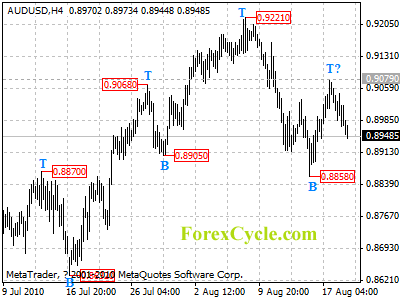
AUDUSD formed a cycle bottom at 0.8858

AUDUSD formed a cycle bottom at 0.8858 level on 4-hour chart. Now the rise from 0.8858 could possibly be resumption of uptrend from 0.8066 (May 25 low) and the fall from 0.9079 is treated as correction of uptrend. Another rise towards 0.9221 would more likely be seen after correction, however, a break above 0.9079 is needed to confirm such case. On the other side, below 0.8858 will indicate that the pair remains in downtrend from 0.9221, then next target would be at 0.8700-0.8800 area.

audusd

Daily Forex Forecast

Forex Daily Market Commentary

By GCI Forex Research

Fundamental Outlook at 1400 GMT (EDT + 0400)

USD

The successful issue of bonds in Spain and Ireland were arguments in favour of the euro yesterday. The fact that the euro was nonetheless unable to defend levels around 1.29 due to weakening stock markets overnight supports our theory though: the structural issues remain, only over boarding risk appetite supports the euro short term. While Greek CDS remain at levels around 800bp market signals are obvious: They do not believe that the aid packet for Greece will work. That is not going to be an issue over the next few days or weeks. But the fact that EUR-USD risk reversals trade more negatively the longer the maturity means that EUR risks are still considered to be real. Even if EUR-USD might be able to appreciate in phases when little data is released (as is the case this week) as long as risk appetite is on the up (as illustrated by the stock market performance of indirectly by the VIX) there is very little upward scope. In particular as the biggest threat for the dollar is unlikely to become virulent today. Fed officials are not planning any speeches. Tomorrow the head of the St. Louis Fed James Bullard might once again fuel doubts about the Fed’s policy with his demands for further bond purchases.

EUR

Ireland’s 2014 and 2020 bond auctions largely passed without incident. Spreads were already tightening ahead of the auction, and final bid-to-cover ratios of 5.4 and 2.4 respectively show that demand remains firm. The Spanish auction of bills was also firm and the sharp decline in borrowing costs will be a welcome respite for the government, though investors will closely monitor fiscal conditions. But the Irish central bank governor signaled that the domestic banking system would need more capital, so financial sector capitalization remains an issue.

GBP

Consumer price inflation in the UK continues to fall but only hesitantly. As expected the yoy rate had eased only slightly in July to 3.1% compared with 3.2% in June. Once again the governor of the Bank of England, Mervyn King, had to explain in a letter to the Minister of Finance why the rate of inflation had exceeded the inflation target of 2% by more than 1 percentage point. In the letter King essentially repeated the information published in the BoE’s last inflation report. Exogenous factors (VAT, commodity prices, weaker Sterling) are responsible for the fact that inflation pressure is easing only slowly and that is unlikely to change soon. While the BoE gives exogenous reasons for the high rate of inflation and continues to assume that the rate will drop to below 2% in 2012 rate rise expectations are likely to be premature. In particular as the core rate of inflation fell more notably than expected to 2.6% in July. The minutes of the last rate meeting due for publication today are likely to show that central bank member Andrew Sentance once again voted in favour of a rate rise. That is unlikely to be enough to support Sterling. Quite the contrary, markets might be disappointed if no other member shared Sentance’s view.

JPY

Kaneko, a DPJ lawmaker in the upper House of Councillors, called for FX intervention on the grounds that “intervention is necessary to show that the government cannot accept the current level”, of the yen although he accepted that the impact of doing so without international coordination would be limited”.

TECHNICAL OUTLOOK

EURUSD BEARISH Momentum is negative; next support below 1.2604 lies at 1.2152 ahead of 1.1877 key low. Initial resistance at 1.2933 ahead of 1.3334

USDJPY BEARISH Next big support below 84.73 lies at 79.95. Near-term resistance at 87.15 ahead of 88.12

GBPUSD NEUTRAL Model is neutral; pressure on 1.5536 initial support break of which would expose 1.5324. Need a break above 1.5999 for resumption of bullish trend.

USDCHF BEARISH Stalled above 1.0332; break of the level would open 1.0131 ahead of 0.9918 key support. Near-term resistance is defined at 1.0534 ahead of 1.0676

AUDUSD NEUTRAL Model is neutral; 0.9222 and 0.8860 mark the near-term directional triggers.

USDCAD NEUTRAL Momentum is slowing; while support holds at 1.0108, resistance is defined at 1.0494 ahead of 1.0680

EURCHF BEARISH Currently holds support at 1.3272 break of which would expose 1.3074. Near-term resistance at 1.3539 ahead of 1.3924

EURGBP BEARISH Outlook is bearish; violation of 0.8068 would expose 0.7694 next. Short-term resistance is defined at 0.8363

EURJPY BEARISH Trend is bearish; focus is on 107.32; move below the level would open 104.72. 111.57 defines the near-term resistance

Forex Daily Market Commentary provided by GCI Financial Ltd.

GCI Financial Ltd (”GCI”) is a regulated securities and commodities trading firm, specializing in online Foreign Exchange (”Forex”) brokerage. GCI executes billions of dollars per month in foreign exchange transactions alone. In addition to Forex, GCI is a primary market maker in Contracts for Difference (”CFDs”) on shares, indices and futures, and offers one of the fastest growing online CFD trading services. GCI has over 10,000 clients worldwide, including individual traders, institutions, and money managers. GCI provides an advanced, secure, and comprehensive online trading system. Client funds are insured and held in a separate customer account. In addition, GCI Financial Ltd maintains Net Capital in excess of minimum regulatory requirements.

DISCLAIMER: GCI’s Daily Market Commentary is provided for informational purposes only. The information contained in these reports is gathered from reputable news sources and is not intended to be U.S.ed as investment advice. GCI assumes no responsibility or liability from gains or losses incurred by the information herein contained.

Slicing the Neckline: A Classic Technical Pattern Agrees with the Elliott Wave Count

By Elliott Wave International

In the August issue of his Elliott Wave Theorist, market forecaster Robert Prechter alerted readers that the U.S. stock market was slicing the neckline of a classic head-and-shoulders pattern in technical analysis, and that this may send the market into critical condition.

Prechter said that when the Elliott wave count and a head-and-shoulders pattern are saying the same thing about the stock market, it’s best to pay attention.

Read some of the latest nuggets directly from Robert Prechter’s desk — FREE. Click here to download a free report packed with recent quotes directly from Prechter’s Elliott Wave Theorist.

Here’s how the August issue of the Elliott Wave Financial Forecast, the sister publication to Prechter’s Theorist, described the head and shoulders pattern unfolding in the stock market:

“The weekly Dow chart [below] shows the development of an intermediate-term, head-and-shoulders pattern from the January high at 10,729.90 to the present. The January high marks the left shoulder, the April 26 high at 11,258 is the head, and the right shoulder is now ending. The April [Theorist] discussed the pertinent characteristics that Edwards and Magee used to define this technical pattern … all apply to the current formation. Observe how weekly stock trading volume has contracted during the development of the right shoulder, a necessary trait of this pattern. The downward-sloping neckline — exactly as on the big ten year pattern — displays market weakness, which is consistent with our interpretation of the wave structure.”

This chart shows the head-and-shoulders pattern.

Total U.S. Stock Market Volume

Here’s what Robert Prechter himself said in a recent Elliott Wave Theorist:

“Generally, when the neckline slopes downward, the right shoulder does not rise to the level of the left shoulder …”

Please look at the chart again — then re-read Prechter’s quote.

Read some of the latest nuggets directly from Robert Prechter’s desk — FREE. Click here to download a free report packed with recent quotes from Prechter’s Elliott Wave Theorist.

This article was syndicated by Elliott Wave International and was originally published under the headline Slicing the Neckline: When the Market May Go into “Critical Condition”. EWI is the world’s largest market forecasting firm. Its staff of full-time analysts lead by Chartered Market Technician Robert Prechter provides 24-hour-a-day market analysis to institutional and private investors around the world.