Forex Market Review: Daily Forex Analysis 2010-08-20

By Finexo

Coming Up Today (all times GMT)

• GBP Retail Sales m/m. (8:30)
• USD Unemployment Claims (12:30)
• USD Philly Fed Manufacturing Index (14:00)
• USD Natural Gas Storage (14:30)

Amid continuing concerns that economic recovery is slowing, gold traded close to its seven week high as investors sought the safe haven investment. On the riskier side, equities closed flat and most currencies remained range bound. The US dollar fell against the yen, the Euro failed to breach $1.29, and the Canadian dollar gained.

EURUSD

An optimistic outlook surrounded the Euro earlier this week due to an increased demand motivated by the German government’s bond auction and the single currency rallied to a $1.2930 resistance level. However, failing to hold firm above $1.29, Euro gains came to an end yesterday.

GBPUSD

Recovering from a three week low the pound hit the day’s high 0.1% higher at $1.556. This followed the release of the minutes from the BoE’s Monetary Policy Committee meeting earlier this month.  The data released by the central bank showed an 8-1 vote keeping the interest rate 0.5%, with only one board member favoring an increase. The dissenting vote represented the view that economic conditions have improved sufficiently in the last year, therefore easing could be relaxed and interest rates could be gradually increased. Investors reported option related offers of $1.5660/90, which might limit the Cable’s gain.

Forex Market Review & Analysis by Finexo.com

Disclaimer: Trading the foreign exchange (Forex) carries a high level of risk, and may not be suitable for all investors.

GBPUSD: A close above (1.5686) or below (1.5496) will determine future direction

Neutral Trend

GBPUSD is struggling in a battle between both market forces (bulls and bears) the instrument has a trading range to break. Any four hours close above (1.56860) will open the way for a little push upward to test the resistance level at (1.57537), and a four hours close below (1.54960) will let the instrument test the next support level at (1.54297).

Important Price Levels
Resistance1.566901.575371.583831.590601.60003
Support1.554901.549601.542971.535231.52677


Forex Market Analysis courtesy of 4xEagleEye.com

EUR and GBP Tumble as Investors Dump Riskier Assets

By ForexYard – Riskier currencies like the euro and British pound tumbled vs. their safe haven rivals in early morning trading today, following news that the Japanese government would not intervene to limit recent yen gains in the marketplace. The yen has seen strong growth in the last few weeks, prompting rumors that the government would take measures to bring the currency down to less volatile levels against the dollar and euro. Drops in the global stock market also contributed to investors abandoning their more risky assets.

EUR/USD has dropped some 60 pips since last night, and is currently hovering right around the 1.2760 level. Against the yen, both the euro and UK pound have fallen approximately 50 pips since last night, and the pairs are currently trading around 109.00 and 0.8210 levels respectively.

This afternoon traders will want to pay attention to the Canadian Core CPI Figure, set to be released at 11:00 GMT. As the only piece of significant news set to be released today, it will likely lead to heavy market volatility. The CAD has seen fairly substantial growth over the last few days. Should the Core CPI figure come in at its predicted level of 0.1%, traders can assume these gains are likely to continue.

Forex Market Analysis provided by ForexYard.

© 2006 by FxYard Ltd

Disclaimer: Trading Foreign Exchange carries a high level of risk and may not be suitable for all investors. There is a possibility that you could sustain a loss of all of your investment and therefore you should not invest money that you cannot afford to lose. You should be aware of all the risks associated with Foreign Exchange trading.

Weak U.S Economic Data Pushes U.S Dollar Higher versus Counterparts

Source: ForexYard

The Dollar advanced against most of its major counterparts Thursday as unexpectedly weak U.S. employment and manufacturing data weighed on stocks and other riskier assets, prompting investors to seek the relative safety of the greenback and Japanese Yen.

Economic News

USD – USD Gains on Poor Employment Data

The U.S. dollar gained versus most of its counterparts Thursday as negative economic data deepened concerns that the country’s recovery is stagnating, sending investors to the safe haven USD and Japanese yen.

Disappointing U.S. employment and manufacturing data weighed on equity markets as well as riskier currencies which are tied to global growth, such as the Australian, New Zealand and Canadian dollars.

U.S. initial unemployment claims disappointed this week, rising 12,000 claims above expectations to 500,000 in the week ended Aug. 14, the highest level since Nov. 14 last year. The disappointing data intensified fears that the country’s already weak labor market is deteriorating further. Later in the day, the Philadelphia Fed index fell to -7.7 in August compared to 5.1 in July, and on economists’ expectations of an advance to 7.0.

The rise in claims was particularly troubling as no seasonal factors, like the hiring and firing of temporary workers for the 2010 Census, affected the recent employment results. Economists expected employment data to pick up in recent weeks.

With no major news released from the U.S. or euro zone today, investors should follow any movements in equity markets as these tend to have a major effect on the USD.

EUR – EUR Declines on Economic Growth Concerns

Renewed concerns about global economic outlook, brought on by disappointing economic data from the U.S. and comments by euro zone officials, spurred risk aversion in the markets and weighed on the 16-nation common currency.

Late Thursday, the euro was at $1.2820 from $1.2860 late Wednesday and at Y109.40 from Y109.87. The U.K. pound was little changed at $1.5606 from $1.5605; however, in today’s early trading the GBP has declined below $1.5600 and is trading near the $1.5885 level.

Investors are concerned that austerity measures taken across the region earlier this year in response to the sovereign debt crisis will hamper the regional economy’s growth and subsequently its economic recovery. This may also put lasting downward pressure on the euro as markets tighten up during downturns.

JPY – JPY Rises as Investors Turn to Safety

The Japanese yen rose to a 7-week high against the euro on signs the global economic recovery is slowing, turning investors to the safety of the Japanese currency as a refuge. The yen appreciated versus 15 of its 16 major counterparts after the release of disappointing U.S. economic data Thursday which showed that filings for U.S. unemployment benefits were more than forecast last week and a gauge of manufacturing in the Philadelphia region unexpectedly fell.

Japan’s currency climbed to 109.09 per EUR in today’s early trading from 109.49 in New York yesterday, after reaching 109.02, the highest level since July 1. The JPY rose to 85.24 per USD from 85.39 yesterday.

Weighing on the JPY is recent talk about possible intervention by Japan to stop the appreciation of the yen that is hurting Japanese exporters. Japan’s economy is heavily reliant on exports and, therefore, its fragile economic recovery. A strong yen can curtail the Japanese recovery.

Crude Oil – Crude Decline on Negative U.S Economic Data

Crude Oil futures prices settled at a 6-week low Thursday, hurt by disappointing U.S. economic data which was released Thursday as well as the highest inventories in nearly 27 years. U.S. initial claims for unemployment benefits rose by 12,000 in the week ended Aug. 14. Economists had forecast a drop of 4,000.

Claims totaled 500,000 in the week, the highest number since 14 Nov. 2009. Further disappointing data came from the manufacturing industry with the Philadelphia Fed index falling to -7.7 in August compared to 5.1 in July.

Light Sweet Crude Oil for September delivery on the New York Mercantile Exchange settled down 99 cents, or 1.3%, at $74.43 a barrel, the lowest price since July 7. The contract, which expires at today’s settlement, has fallen from a 3-month high near $83 a barrel on Aug. 4.

Technical News

EUR/USD

This pair appears to be floating in a sideways range between 1.2775 and 1.2900, with a current price just above the lower border. As expected, the indicators are showing an expectation for an upward move in line with this range trading behavior. The RSI on the hourly and daily chart both show the price in the over-sold region. It seems going long might be a wise choice today.

GBP/USD

This pair seems to be floating in a range between 1.5525 and 1.5675 with the current price sitting in the middle of this range. Most of our indicators seem to suggest the next movement may be in an upward direction. The RSI on the hourly and daily chart show the price being over-sold, and we have a fresh bullish cross on the daily chart’s Stochastic (slow). Going long may not be a bad idea today.

USD/JPY

This pair has been trading within a bearish channel since early May and our indicators seem to suggest that this will not likely change anytime soon. We do, however, have a recent bullish cross on the weekly chart’s Stochastic (slow) which may be hinting at longer-term corrective pressure, but with all other indicators neutral it is hard to tell. Going with the prevailing trend may be preferable in this situation.

USD/CHF

There appears to be a fresh bullish cross on the weekly chart’s Stochastic (slow), suggesting some moderate upward pressure over the long-term. The price also floats in the over-sold territory on the RSI of both the weekly and 4-hour chart, supporting this notion. Waiting for the price to swing back upward and then going long may be a strong tactic in these circumstances.

The Wild Card

Crude Oil

After the significant drop in oil prices yesterday, we see some strong signs of corrective pressure. The daily chart’s RSI has the pair floating in the over-sold territory, and the Stochastic (slow) appears to show an already-elapsed bullish cross which has turned upward into neutral territory. The momentum appears to favor that forex traders go long and take hold of this swing while the upward momentum holds.

Forex Market Analysis provided by ForexYard.

© 2006 by FxYard Ltd

Disclaimer: Trading Foreign Exchange carries a high level of risk and may not be suitable for all investors. There is a possibility that you could sustain a loss of all of your investment and therefore you should not invest money that you cannot afford to lose. You should be aware of all the risks associated with Foreign Exchange trading.

Forex Daily Market Review Aug 20, 2010

By eToro – The Euro slid despite a better than expected outlook from the Bundesbank, as riskier assets were sold on the back of disappointing US economic news.  The Euro should consolidate and then begin to climb above 1.2900.
Click here to read the full daily Review

Forex Market Analysis provided by eToro

Disclaimer: Trading in the Foreign Exchange market might carry potential rewards, but also potential risks. You must be aware of the risks and are willing to accept them in order to trade in the foreign exchange market. Don’t trade with money you can’t afford to lose.

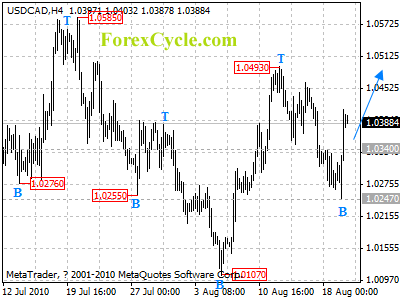
USDCAD broke above 1.0340 key resistance

USDCAD broke above 1.0340 key resistance, suggesting that a cycle bottom had been formed at 1.0247 level on 4-hour chart. Now the rise from 1.0247 is treated as resumption of uptrend from 1.0107, further rise could be seen in next several days and target would be at 1.0600 zone. Support is at 1.0340 and key support is at 1.0247, only break below these levels could trigger another fall to 1.0000 area.

usdcad

Daily Forex Signals

Efficient Market Hypothesis: R.I.P.

By Elliott Wave International

Of all the belief systems of Wall Street, few can claim the devoted following of the Efficient Market Hypothesis, the idea that stock prices adhere to the same laws of supply-and-demand that govern retail products. Once coined the theoretical “Parthenon” of economics, this notion has consistently endured the test of time —– until now. Academics and advisors across the globe are currently exposing crack after crack in the “Efficient” model so deep as to bring the entire theory crashing to the ground.

“The EMH is not only dead,” writes a July 29, 2010 news source. “It’s really, most sincerely dead.” (Minyanville)

As to what caused the theory’s collapse — one recent business journal offers this insight:

“Financial markets do not operate the same way as those for other goods and services. When the price of a television set or software package goes up, demand for it generally falls. When the prices of a financial asset rises, demand generally rises.” (The Economist)

Here’s the thing. SIX years ago, Elliott Wave International president Bob Prechter pronounced the exact same finding in his April 2004 Elliott Wave Theorist. (Read that full-length publication today, absolutely free by clicking on the hyperlink) In that groundbreaking report, Bob presented the compelling picture below that shows how investors increase their percentage of stock holdings as prices rise, and decrease them as prices fall:

The next question is why? Answer: Motivation: i.e. the purchase of goods and services is about need; while the purchase of stocks is about desire. Here, Bob Prechter’s 2004 Theorist takes the rein:

“The fact is that everyday in finance, investors are uncertain. So they look to the herd for guidance. Because herds are ruled by the majority — financial market trends are based on little more than the shared mood of investors — how they feel — which is the province of the emotional areas of the brain (limbic system), not the rational ones (neocortex)… Buyers, in a rising market appear unconsciously to think, ‘The herd must know where the food is. Run with the herd and you will prosper.’ Sellers in a falling market appear to unconsciously think, ‘The herd must know that there’s a lion racing toward us. Run with the herd or you will die.'”

Prechter and contributor Wayne Parker then expanded on his landmark observation in the 2007 Journal of Behavioral Finance. (Also available, absolutely free by clicking on the hyperlink)

In the end, it’s not enough to just tear down the long-standing EMH. One must build another, more accurate model up in its place. And in the 2004 Theorist, Bob Prechter does just that with the Wave Principle, which reconciles the technical and psychological sides of stock market behavior into this key point: Herding impulses, while not rational, are also NOT random. They unfold in clear and calculable wave patterns as reflected in the price action of financial markets.

As the mainstream media continues to jump on board Prechter’s Financial/Economic Dichotomy Theory, you can read both of Prechter’s original writings. Enjoy your complimentary access to the 2004 April 2004 Elliott Wave Theorist and the 2007 Journal of Behavioral Finance.

Read some of the latest nuggets directly from Robert Prechter’s desk — FREE. Click here to download a free report packed with recent quotes from Prechter’s Elliott Wave Theorist.

This article was syndicated by Elliott Wave International and was originally published under the headline Efficient Market Hypothesis: R.I.P.. EWI is the world’s largest market forecasting firm. Its staff of full-time analysts lead by Chartered Market Technician Robert Prechter provides 24-hour-a-day market analysis to institutional and private investors around the world.

Forex Update: US Dollar mixed, Stocks fall on risk aversion as jobless claims rise to highest since November

By CountingPips.com

The U.S. dollar has been mixed in forex market trading today against the other major currencies while the American stock markets have dropped following the worse than expected weekly jobless claims report. The dollar has gained ground versus the Australian dollar, New Zealand dollar and Canadian dollar while losing ground against the Swiss franc, Japanese yen and British pound sterling in today’s forex trading action. The dollar is trading close to unchanged against the euro as the EUR/USD hovers near the day’s opening exchange rate at 1.2795.

The U.S. stock markets, meanwhile, have had a negative day today with the Dow declining by approximately 160 points, the Nasdaq decreasing by over 30 points while the S&P 500 is down by over 18 points at time of writing. Oil has moved lower by $1.18 to $74.24 per barrel while gold has advanced by $3.70 to trade at the $1,233.40 per ounce level.

Economic News: Jobless Claims climb

Today’s economic news schedule was highlighted by the US Department of Labor’s weekly jobless claims report that showed jobless claims came in at their worst number in nine months. Jobless claims increased unexpectedly in the week that ended on August 14th by 12,000 workers to a total of 500,000 unemployed workers. This marked the first time jobless claims had risen to 500,000 workers since November of 2009.

The 4-week moving average of unemployed workers increased by 8,000 workers from the previous week to a total of 482,500. Market forecasts were expecting weekly jobless claims to fall to 478,000 workers following the previous week’s 488,000 number of claims.

Workers seeking continuing claims for unemployment benefits for the week ending August 7th decreased for the week by 13,000 workers to a total of 4,478,000 unemployed workers. The 4-week moving average of continuing claims dropped by 1,500 workers to a total of 4,526,750.

Manufacturing activity dips

Released in a separate report today was the Philadelphia Manufacturing Index by the Philadelphia Federal Reserve that showed an unexpected decline for August in its business outlook survey. The Philly general business diffusion index fell to -7.7 in August after July’s score of 5.1. August’s negative level marked the lowest level for the manufacturing index in over a year. A negative score is considered a contraction in that area or sector while a positive score signals growth. The score for August fell more than predicted as economic forecasts were expecting a 7.0 score for the month.

Leading Indicators edge higher

The U.S. Leading Indicators Index, published by the Conference Board today, edged higher in the month of July by 0.1 percent. The Leading Indicator Index, which measures future economic activity, had registered a decrease of 0.3 percent in June. The monthly rise for July was just below market forecasts that were expecting a 0.2 percent increase.


Forex Daily Market Commentary

By GCI Forex Research

Fundamental Outlook at 1400 GMT (EDT + 0400)

USD

On the Asian markets EUR-USD has been under slight pressure this morning trading at levels around 1.28. The currency pair seems to have been stuck in its range between 1.27 and 1.30 all week. Prices well above 1.30 seem to have felt excessive to some market participants while on the other hand the successful bond auctions in the Eurozone prevented a further depreciation of the euro. The data side is not providing any real momentum either. While no Eurozone data worth mentioning is due for publication today there is only second tier data due for publication from the US – the Philadelphia-Fed activity index as well as the Conference Board’s leading indicator. Weekly initial jobless claims are also unlikely to move markets notably.

EUR

The question remains which issues might provide stronger momentum for EUR-USD. The central banks are unlikely to provide anything much. Fed as well as ECB will leave rates unchanged well into 2011. Expected rate differentials are therefore unlikely to play a role for the FX markets. We would expect that US economic data might soon end fears of a double dip, which would eliminate one factor putting pressure on the dollar. In the Eurozone the subject of national finances might however become more virulent again. The consolidation efforts of the problem countries are considerable and in some cases even further advanced than originally expected, but the second phase of the savings efforts should begin soon. This phase is usually particularly painful. GDP data for Q2 illustrated that the economies of those countries which have to consolidate their national finances are under discernable pressure due to the savings efforts. Against this background internal pressures opposed to the savings measures are likely to rise. Increased protests and possible strikes are then going to illustrate once again that the European debt crisis is far from over. All these factors point towards lower prices in EUR-USD.

GBP

In fact the minutes of the BoE’s last meeting were rather unspectacular. As expected Andrew Sentance was once again the only member to vote in favour of a 25bp rate hike. A more expansionary monetary policy as well as a moderate tightening was discussed, but in the end the majority of members considered the current rate level to be appropriate. Sterling was nonetheless able to appreciate against euro and US dollar following the publication. Obviously some market participants had feared that the BoE might decide on further measures of quantitative easing. The minutes, however, once again confirmed that the BoE currently has a neutral monetary policy stance. Members were ready to response in either direction depending on how inflation and the economy develop. Against this background markets are likely to pay particular attention on economic data publications. July retail sales are due for publication today. Markets expect only a moderate rise in sales for July. We see potential for a positive surprise, which should support Sterling.

JPY

Japan’s Sankei newspaper reported that the BoJ is now thinking about easing monetary policy by extending its 3m fixed rate lending facility. The article suggested this could be done in one of two ways: either by raising the ceiling on the scheme from ¥20 trn to ¥30 trn, or by extending the maturity of the loans offered from 3m to 6m.

Speculation that the BoJ could call an emergency meeting today caused USDJPY to climb 25 pips, but most of the gains were relinquished when Reuters quoted unnamed sources saying that an emergency meeting was unlikely today. Finance Minister Noda repeated that he is watching FX moves.

TECHNICAL OUTLOOK

EURUSD NEUTRAL Sell-off from 1.3334 found support at 1.2734. Next support below the level lies at 1.2604. Initial resistance is at 1.2933

USDJPY BEARISH Focus is on 84.73 with next support lying at 79.75. Near-term resistance at 87.15 ahead of 88.12

GBPUSD NEUTRAL Model is neutral; while support holds at 1.5324, only a break above 1.5999 would confirm the resumption of bullish trend.

USDCHF BEARISH Sustained break of 1.0332 would open 1.0131 ahead of 0.9918 key support. Near-term resistance is defined at 1.0534 ahead of 1.0676

AUDUSD NEUTRAL Model is neutral; 0.9222 and 0.8860 mark the near-term directional triggers.

USDCAD NEUTRAL Remains constructive above 1.0108, resistance is defined at 1.0494 ahead of 1.0680

EURCHF BEARISH Clearance of 1.3272 would expose 1.3074. Near-term resistance at 1.3539 ahead of 1.3924

EURGBP BEARISH Focus is on the downside; expect loses to target 0.8167 with scope for 0.8068 next. Short-term resistance is defined at 0.8363

EURJPY BEARISH Trend is bearish; focus is on 107.32; move below the level would open 104.72. 111.57 defines the near-term resistance

Forex Daily Market Commentary provided by GCI Financial Ltd.

GCI Financial Ltd (”GCI”) is a regulated securities and commodities trading firm, specializing in online Foreign Exchange (”Forex”) brokerage. GCI executes billions of dollars per month in foreign exchange transactions alone. In addition to Forex, GCI is a primary market maker in Contracts for Difference (”CFDs”) on shares, indices and futures, and offers one of the fastest growing online CFD trading services. GCI has over 10,000 clients worldwide, including individual traders, institutions, and money managers. GCI provides an advanced, secure, and comprehensive online trading system. Client funds are insured and held in a separate customer account. In addition, GCI Financial Ltd maintains Net Capital in excess of minimum regulatory requirements.

DISCLAIMER: GCI’s Daily Market Commentary is provided for informational purposes only. The information contained in these reports is gathered from reputable news sources and is not intended to be U.S.ed as investment advice. GCI assumes no responsibility or liability from gains or losses incurred by the information herein contained.

US Dollar to Make a Comeback? – August 19, 2010

USDX august 2010, US dollar index, USD, US$, $, fx, fxmarket, fx trading, forex, forex market, forex trading, trading forex, currency trading, online trading, daily forex picks, daily fx picks, forex forecast, forex analysis

Hiyo forex peeps! In today’s FX feature is an update on the US dollar index (please see my my previous post here). As you can see from its daily chart, the index appears to be poised for a break to the upside. Why? Well, the index has recently broken above its downtrend line and at present it seems to be forming and inverted head and shoulders formation. As you know, such formation is a bullish reversal pattern. Hence, a move above its neckline could send it all the way to 86.000 (minimum upside target as gauged by projecting the height of the formation from the point of potential break out). A failure to move past the neckline, however, could cause it to just trade sideways or even to fall back to its previous low at 80.085.

Well, the recent tentativeness in the global markets have caused a lot of investors to flee back to the safety of the greenback. Economic 101 states that a price of an asset goes up as a result of an increase in the… wait for it… demand. For today, the notable US economic release will be the country’s Philadelphia Fed Manufacturing Index for the month of August. While the index is projected to rise to 7.1 from 5.1, if you look at the previous results, for three months now it had fallen short of the market’s consensus. The US’s weak retail sales for July could have carried over to August as a result of the waning confidence in the markets. If this is so then there could be another flight of risk aversion which could lead the market back to the open arms of the USD. Watch out for its release at 2:00 pm GMT today!

More on LaidTrades.com