Five things to look for when choosing your financial trading platform

By Jonathan Dayan – Finding the right financial trading platform isn’t simple. These days there are a lot of platforms on the market and they all seem to offer something different. Whether you’re an experienced trader or you’re just starting to explore financial trading for yourself it can be a time-consuming process to find the right trading platform. The quality of the platform you choose can have a huge impact upon your trading experience, which makes it worth your while to spend some time investigating the options which exist. In this article we’ll examine a few key features to look for when you’re trying to identify the platform that’s right for you.

1. A user-friendly platform

Not all trading platforms are equal. A good trading platform will make your trading experience much more comfortable and rewarding. In fact, choosing a trading platform is not altogether unlike choosing a car. Because you’re likely to spend many hours using both products you want something which will be reliable, enjoyable to use, safe and secure, fast and legal. Unfortunately an alarming proportion of all the trading platforms out there fall short across one or more of these key criteria.

Your trading platform should be as user friendly as possible, simple, intuitive, visual and rewarding. Too many trading platforms make the process of trading complicated and frustrating with complicated interfaces, compulsory downloads, slow loading times, outdated security protocols – the list is ongoing. Look for a trading platform which is widely used – there are few better stamps of approval than the trading community itself.

3. A free practice account

Your path to success should always start with practice trading. Practice trading means a free demo account where you can get to grips with the trading platform which you’ll be using without giving over your credit card – so beware of anyone offering a supposedly free account who immediately requests you hand over your card details. You should use your practice account to comprehensively test out the trading platform you’ve selected, prior to depositing money. As a result, the one or two day practice trial periods which some brokers will offer you aren’t sufficient for the purpose. Look for a broker who will offer you a trading period of between a week and a month. In addition, a very few brokers will offer you opportunities to earn rewards even from your practice account. You can use practice trading to develop the strategy which you’ll be using when you start trading the markets for real, but remember that practice really does have its limits: the style which you adopt in practice trades will differ markedly from the way you trade when your money is on the line for real.

3. Personal service

Personal service is extremely important when you’re financial trading. Whether you need to urgently withdraw or deposit funds or there’s a glitch in your system that you need remedied, fast, it’s good to know that there’s a specific someone at the other end of an email address or phone line who will handle your requirements personally. A lot of brokers say that they offer personal service but it is not always clear that their claims live up to the reality. Read the reviews and check the feedback of other traders you know rather than taking your broker on their word. In practice the majority of brokers will offer you a different service experience depending upon the service level they offer you. Brokers who offer Gold level and VIP level service will tend to extend the best service to those clients. Service is particularly important where withdrawals are concerned. Slow withdrawal times are one of the key complaints leveled against a lot of financial trading brokers so investigate this issue before you commit funds.

4. An easy to follow training course

Sooner or later, you’ll need to ramp up your trading knowledge to get serious as a trader. A simple, usable and preferably free e-learning course will help you progress as a trader and encounter new ways to analyze the financial markets. Many training courses are impossibly complex and seem to assume, and even require, an expert’s level of knowledge even prior to embarking on the course which is pretty self-defeating. Look for brokers who offer well respected trading courses and for this purpose review the internet and check the feedback from people who’ve used the products before. Don’t expect miracles. Improving as a trader is an ongoing process and any product or broker that promises to transform you into George Soros overnight is probably not to be trusted. That said, you can get a lot out of a good trading guide – particularly if it’s visual and does not require you to read through page after page on Elliot-Wave theory and stochastic oscillators.

5. A community of traders

An active and open trading community offers an incredible range of trading opportunities to traders at all levels of experience, like the ability to see, follow and copy the trades of other experienced traders. It’s an ideal opportunity for you to get ahead in your trading: fast. What makes community trading so exciting are the possibilities it offers for every trader to enrich their trading experience by cooperating with other traders to share hints and tips about the trading market. A large and active financial trading community can be the single most enriching feature offered by an individual trading platform. Because social trading communities enable you to interact directly with other traders, rather than going through brokers as an intermediary, they avoid the concern of possible conflict of interest which arises whenever a trader is in the position of relying directly upon their broker for accurate information about the market. The more dynamic a trading community is, the more opportunities it can potentially offer to a trader. To learn more about social trading communities visit the free to use eToro social trading network OpenBook, the largest and most active financial trading community in the world.

Article courtesy of eToro

Disclaimer: Trading in the Foreign Exchange market might carry potential rewards, but also potential risks. You must be aware of the risks and are willing to accept them in order to trade in the foreign exchange market. Don’t trade with money you can’t afford to lose.

Candlestick Bottom Reversal Patterns

By Sylvain Vervoort – With this article we have a look at the candlestick charts bottom reversal patterns. We will discuss a few strange names like bullish engulfing pattern, piercing line, bullish counter attack, bullish harami, morning star, hammer and inverted hammer, three white soldiers and more. If you need some basic clarification you can look for my articles “Introduction to candlestick charts” and “Candlestick charts basic patterns”.

Before looking at the bottom reversal patterns we have to define the rules for a bottom reversal to be a valid pattern.

– A bottom reversal is only possible AFTER a downtrend. – Most of the patterns need a confirmation. – A confirmation must appear one up to three candles after the pattern. – This confirmation is a big white candle, high volume with the new up-move, a rising window, or breaking a resistance. – A reversal pattern during price reaction must be considered a continuation pattern. – For the best result, you must combine candlestick patterns with Western technical analysis.

An unconfirmed pattern has no further meaning.

When in a downtrend, there is a small black body, not a doji, followed and enclosed by a bigger white body; you have a bullish engulfing pattern. Though not necessary, it is better when the white body also encloses the short shadows of the black candle. An exceptional occurrence at the end of a downtrend is a white body followed by a bigger black body; this is called a last engulfing pattern.

A piercing line is a bigger black body that is followed by a white body with a lower opening price than the low of the black body in a downtrend; however, the white candle closes above the midpoint of the black body. A confirmation is required.

A bullish counterattack is a bigger black candle in a downtrend, followed by a bigger white candle. Closing prices of both candles are at the same price level. Confirmation is needed.

A bullish harami in a downtrend, a white, but preferably a black body followed by a small white or black candle that is best completely covered by the first candle body. A bottom reversal signal after confirmation. Black-white and black-black, called homing pigeon, combinations are the most common.

A bullish harami cross in a downtrend is a white but preferably a black body that is followed by a doji that is ideally completely covered by the first candle body. A bullish harami cross pattern needs confirmation.

A morning star is a bigger black body, followed by one or more small black or white bodies below the closing price of the first black body. The white candle that follows ideally lays 50% or more within the first black body and has a rising window with the previous candle body.

A morning doji star is a bigger black body, followed by one or more dojis with a falling window below the closing price of the first black body. The white candle that follows ideally lays 50% or more within the first black body and has a rising window with the previous doji body. This is a stronger reversal signal than a morning star.

A bullish abandoned baby pattern is a morning doji star with a window between the doji and the black and white candle, resulting in an island reversal. The island can have more candles and more than one doji.

A hammer is a small white or black body close to the high price. It has a long shadow below with a minimum size of twice the height of the body. There is a very small shadow or no shadow at the top. A dragonfly doji is a specific version of the hammer pattern. Confirmation is required. A white body is more positive.

An inverted hammer is a small black but preferably a small white body near the low price. It has a long shadow above that is, at minimum, twice the size of the body. It only has a very small shadow or no shadow below. A gravestone doji is a specific version of the inverted hammer. A bottom reversal only after confirmation.

Three white soldiers are three white candlesticks with each bar having higher closing prices, close to the high of the bar. Opening prices of candles two and three are within the body of the previous candles. Many times, there will be a small reaction before the new uptrend is resumed.

This concludes my overview of the most important candlestick bottom reversal patterns. In the following article we will have a look at candlestick continuation patterns and we will also talk about some candlestick trading techniques.

About the Author

Want to learn more about candle bottom reversal patterns? You can find technical analysis articles for free at my website: http://stocata.org/. Sylvain Vervoort is a trader and the author of a new book “Capturing Profit with Technical Analysis” and a regular contributor to Stocks & Commodities.

Forex News: AUD/JPY in Pennant Formation; Bearish Move Ahead?

By Greg Holden – The ascendant Japanese yen has continued to pull the AUD/JPY pair higher, but we are beginning to see a long-term bearish formation building. Following the sharp drop from early May, the pair has continued to fluctuate within a steadily climbing, and consolidating range; known as a Pennant.

A Pennant formation occurs when a sharp movement is followed by a steady flattening out, in which the price of the pair tests ever-narrowing highs and lows. Connecting these highs and lows allows us to see a triangle attached to a long “flag pole” (see below).

Typically when a Pennant formation has finished consolidating at the tip – in the case of the AUD/JPY this would be near the 78.00 price mark – the previous direction, established by the flag pole, will continue.

Technical Analysis

– The chart below is the AUD/JPY daily chart provided by ForexYard.

Point 1: Here we can see our Pennant triangle drawn. The sharp downward movement you see occurring before this triangle is our flag pole.

Point 2: At the tip of the Pennant – the consolidation point – you can see the price target of 77.98. Not surprisingly, this also corresponds with a solid Fibonacci resistance line (at 38.2%).

Point 3: The Relative Strength Index (RSI) currently floats in neutral territory but, in support of the expected consolidation point being reached, the indicator points upwards. We should expect to see this indicator enter the over-bought territory prior to its continuation of the downtrend.

Point 4: The Stochastic (slow) shows us the same thing as the RSI, listed above. We should also expect to see a bearish cross just before this pair comes tumbling down.

– The expectation here is for a steady boost in value towards 78.00, but the technicals appear to imply that the pair will likely fail to breach this line, and wide sell-offs should complete the Pennant’s forecasted downward movements.

– On the upside, if the pair happens to break through the 78.00 price mark, an expected climb above 80.00 is to be expected.

– On the downside, the resistance, and possible sell-wave which will follow the downturn, could end up pushing this pair back towards 76.00 over the next few days.

AUD/JPY Daily Chart

Forex Market Analysis provided by ForexYard.

© 2006 by FxYard Ltd

Disclaimer: Trading Foreign Exchange carries a high level of risk and may not be suitable for all investors. There is a possibility that you could sustain a loss of all of your investment and therefore you should not invest money that you cannot afford to lose. You should be aware of all the risks associated with Foreign Exchange trading.

Forex Market Review: Daily Forex Analysis 2010-08-18

By Finexo – Today saw the largest rally in over two weeks with US and European equities taking a sharp climb. Amid reports of negative sentiments in Germany, European indexed closed at highs, and after rising earlier in the session over 1.7%, US stocks closed up 1%. The boost in equity markets was in part due the rejected buyout of Potash Corp by BHP Billton for $38.6 billion. Following the news, shares of the largest producer of fertilizer rallied above BHP’s valuation bid. As stocks have been under pressure recently, today’s rallying may have been a relief rally.

Despite a report tomorrow that is expected to show a four week low in crude oil, the commodity rallied in tandem with Wall Street rising from $75 to $76.60, up 2%, and falling back to its current price of $75.60. Tomorrow’s report may show nervous sentiments among oil traders resulting from weak worldwide economic data.

Agricultural commodities remained stable today with wheat around $650, while corn and soybean were for the most part unchanged.

Gold held its position today at 1226.50 from $1227.5 yesterday. Its relative stability is a sign that traders are watching the market for new developments before taking more positions on gold.

The global economic forecast has become increasingly gloomy as US bond yields indicate very weak growth in the short- and medium-term. This suggests that we are entering a period which could have serious outcomes on the direction of equities. Reports of market sentiments and growth projections will take their toll on the health of stocks and commodities. If growth is weaker than the most pessimistic estimates, we could be in for an extremely weak period in the stock and commodities markets. On the other hand, if economic data takes a turn for the better, traders may dump the low yield bond trade and take their chances with riskier assets such as equities, commodities and higher yielding currencies. If either extreme should come to be, prepare for a highly volatile market.

Forex Market Review & Analysis by Finexo.com

Disclaimer: Trading the foreign exchange (Forex) carries a high level of risk, and may not be suitable for all investors.

Spot Crude Oil Buy Signal

By Russell Glaser – Spot crude oil prices received a bounce in today’s trading. This is the first gain for the commodity in almost 10 days. The rise in the price coincided with both positive fundamental data along with a technical boundary that the commodity ran into due to the recent sharp decline in the price of spot crude oil. Today’s rise in the price helped keep the recent bullish trend intact while setting up a buying opportunity.

The price of spot crude oil rose today to a high of $77 before falling back to close up at $76.20. The gain of 0.8% came after an opening day price of $75.57.

As of recent crude oil prices have been closely tracking the movements of the equity markets. The near term trend for the Dow Jones Industrial Average has turned lower but today the widely followed stock index finished the day higher by 1.60%.

Positive fundamental data helped move both equities and spot crude oil prices higher. New building permits for the U.S climbed 0.57M over the previous month. The reading was largely in line with economists’ expectations of 0.58M.

The sharp decline in the price of spot crude oil has made for a potential opportunity for traders to enter into the market long on the commodity. After falling $7, the drop in the value of the commodity failed to breach below the trend line that began on May 25th.

Technical indicators show the price may be in line for further gains. The bearish correction stalled during Friday’s trading that ended with a doji candlestick. This candlestick pattern signals indecision on the part of traders to send prices in any particular direction.

The bearish correction also failed to breach below the short term rising trend line, signaling the bullish uptrend is still valid and serves to reinforce the importance of this trend line.

A buy signal is also shown on the daily chart. The Slow Stochastic oscillator displays a bullish cross, indicating the next move of the price may be to the upside. The last time a bullish cross appeared on the stochastic, the price of spot crude oil rose to close above the significant resistance level of $80.

Resistance for spot crude oil trading is found at $78 (R1), followed by 79.90 (R2), and the August high at $83. Support comes in at the low of this week’s trading at $74.85 (S1), just below the rising trend line. Should the price close below this support level, it would signal a shift in the trend to the downside.

Forex Market Analysis provided by ForexYard.

© 2006 by FxYard Ltd

Disclaimer: Trading Foreign Exchange carries a high level of risk and may not be suitable for all investors. There is a possibility that you could sustain a loss of all of your investment and therefore you should not invest money that you cannot afford to lose. You should be aware of all the risks associated with Foreign Exchange trading.

Euro Gains on Successful Spanish and Irish Debt Auctions

Source: ForexYard

The EUR rose against the US Dollar and came off 7-week lows against the Japanese Yen on Tuesday, helped by solid results of Irish and Spanish bond auctions which alleviated concerns about the heavily indebted Euro-Zone countries. The EUR rose 0.2% against the yen to 109.95 after an early fall as low as 109.10.

Economic News

USD – Dollar Trades Lower Against the EUR

The dollar fell against the EUR on Tuesday, as prospects of more weak economic data from the United States added to worries about a global slowdown and capped gains in stock markets. European shares followed most Asian stock markets slightly higher, although analysts said gains could prove to be fleeting given weak sentiment.

The major economic event that came out of the U.S yesterday was the Building Permits data release. Building permits, a leading indicator of housing construction, fell 3.1% to a seasonally adjusted annual rate of 565,000. This is the lowest level of permits since May 2009, underscoring the hazards to an economic recovery even as businesses appeared to be stepping up investment.

Another leading indicator released yesterday was U.S. Producer Price Index. This number handedly beat last month result but failed to provide strength to the Dollar as investors may be waiting for key data due to be released later this week to implement their trading strategies.
As for today, the calendar is lacking any major economic data releases for today’s trading. As such, traders will want to follow the movements of the major equity indices as the dollar has recently been trading in an inverse relationship to equities. Strength in stocks could propel the EUR/USD to its next resistance line which rests at 1.3000.

EUR – EUR Gains on Spanish and Irish Debt Auctions

The EUR rose against most of its major currency counterparts on Tuesday as solid results of Irish and Spanish bond auctions alleviated concerns about the heavily indebted Euro-Zone countries. By yesterday’s close, the EUR rose against the USD, pushing the oft-traded currency pair to 1.2890, and rebounded from a seven-week low against the yen and closed at around 109.95.

But the EUR struggled to hold above $1.29 on uneasiness about the economic outlook, with a key German survey sparking concerns about whether Europe’s largest economy can sustain a solid recovery. The German ZEW institute’s measure of investor and analyst sentiment dropped well below forecasts, though this was partly offset by an unexpectedly sharp jump in the current conditions index.

The single currency, which slid below $1.19 in June on Euro-Zone debt trouble, has since risen by more than 8% after smooth government debt auctions in Greece, Portugal, Spain and Ireland eased concerns.

JPY – Yen Sees Mixed Results vs. Majors

The Yen completed yesterday’s trading session with mixed results versus the other major currencies. The JPY was broadly unchanged versus the CHF yesterday and closed its trading session at around the 81.95. The yen did see bullishness as well as it gained over 50 pips against the GBP and closed at 133.30.
Some of the pressure came against the yen, as talk intensified that the Japanese government might put pressure on the Bank of Japan to loosen monetary stance even further in an effort to stop the yen from rising any more. The yen rose to a 15-year high this month against the U.S. currency, threatening to damage exports and derail Japan’s fragile economic recovery, with GDP growth slowing to a crawl at 0.1% in the April-June period.

Crude Oil – Crude Oil Rises Above $76 a Barrel

Oil snapped a five-day losing streak to rebound above $76 a barrel on Tuesday as firmer equity markets and a weaker dollar outweighed concerns about the pace of global economic recovery.
Oil and other commodities denominated in dollars for global trading tend to rise when the U.S. currency falls as they become cheaper for holders of other currencies. A move away from dollar-based pricing of the world’s leading commodity could further weaken the greenback.
As for today, traders should pay attention to the U.S Crude Oil Inventories report scheduled, as it tends to have a large impact on Crude Oil’s prices recently, especially for the short-term.

Technical News

EUR/USD

After yesterday’s rally the pair seems to have settled in to a range and is comfortably trading around the $1.2850 level. It seems, however, that there is some room for an upward trend today as a breach of the lower Bollinger Band is apparent on the hourly chart and with the RSI for the pair floating near the oversold territory on the daily chart. Going long with tight stops may be advised for today.

GBP/USD

The pair may be seeing some upward correction today as the RSI for the pair is floating in the oversold territory on the 2 hour and daily charts and a bullish cross is evident on the 4 hour and daily charts’ Slow Stochastic. Furthermore, the MACD for the pair is at the lower border on the hourly and 8 hour charts. Going long for today may be advised.

USD/JPY

The pair seems to be range trading between 85.20 and 85.60 with most indicators floating in neutral territory. Traders may be advised to wait on a clearer signal for the pair for today.

USD/CHF

The pair is currently range trading with most indicators floating in neutral territory while others show some mixed signals. A bearish cross is evident on the 4 hour chart’s Slow Stochastic while the RSI for the pair is floating near the oversold territory on the 4 hour and 8 hour charts. Waiting on a clearer direction for the pair may be advised for today.

The Wild Card

GBP/CAD

The RSI for the pair is floating in the oversold territory on the 2 hour and 8 hour charts while a bullish cross is evident on the 4 hour chart’s Slow Stochastic. Furthermore, a breach of the lower Bollinger Band is evident on the 8 hour chart. Forex traders may be advised to go long for the day.

Forex Market Analysis provided by ForexYard.

© 2006 by FxYard Ltd

Disclaimer: Trading Foreign Exchange carries a high level of risk and may not be suitable for all investors. There is a possibility that you could sustain a loss of all of your investment and therefore you should not invest money that you cannot afford to lose. You should be aware of all the risks associated with Foreign Exchange trading.

Forex Daily Market Review Aug 18, 2010

By eToro – The Euro moved higher as stronger than expected US data pushed riskier assets higher.  A positive outlook from Moody’s should also give list to the Euro and create some momentum for higher levels.

Click here to read the full review

Forex Market Analysis provided by eToro

Disclaimer: Trading in the Foreign Exchange market might carry potential rewards, but also potential risks. You must be aware of the risks and are willing to accept them in order to trade in the foreign exchange market. Don’t trade with money you can’t afford to lose.

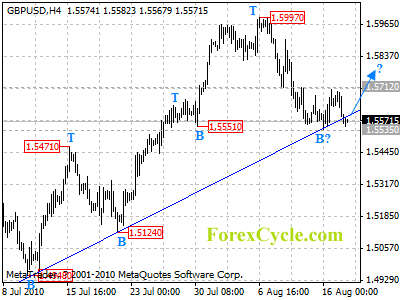
GBPUSD stays in a trading range between 1.5535 and 1.5712

GBPUSD stays in a trading range between 1.5535 and 1.5712. Another rise towards 1.5712 key resistance would more likely be seen later today, a break above this level will confirm that a cycle bottom has been formed at 1.5535 level on 4-hour chart, then another rise towards 1.5997 previous high could be seen. On the downside, below 1.5535 could resume the downward move from 1.5997, then next target would be at 1.5400 area.

gbpusd

Daily Forex Forecast

S&P500 Stock Trading: The bear is back!!

By Adam Hewison – The early market action on Monday, August 16th, triggered a key weekly “Trade Triangle” to the downside. Our weekly “Trade Triangle” turned red, indicating that all trends are negative and now pointing lower.

In this new 90 second video I show you some of the scenarios we can see playing out for the S&P 500. I think you’ll find this new video informative and educational. You will also come to understand the power of our “Trade Triangle” technology.

To see more of Adam’s Videos click here or sign up for Adam’s Free 10-part Professional Trading Course.

All the best,
Adam Hewison
President of INO.com
Co-founder of MarketClub

Forex Daily Market Commentary

By GCI Forex Research

Fundamental Outlook at 1400 GMT (EDT + 0400)

USD

The dollar weakened gradually during a quiet Asian session as investors looked ahead to today’s industrial production data out of the US. EURUSD traded 1.2804-1.2865 and USDJPY 85.12-85.44. Risk-seeking remained muted after US equities closed flat and Treasurys were bid, with lower yields across the curve. Disappointing Empire Manufacturing data and a surprise drop in the NAHB Housing Market Index did not help the dollar, though the Fed’s Senior Loan Officer Opinion Survey showed broad easing in lending standards. The survey noted that the easing in standards is still concentrated at large banks but there was improvement among smaller banks as well, which is important because small banks more often serve small businesses, where the credit crunch has been the worst.

Treasury TIC data showed foreign selling of US corporate debt and equities in June while Treasurys remained in demand. But Chinese holdings of Treasurys slid again in June, according to TIC data. That said, there has been decent US data as of late and industrial production and housing starts are up next. We could see some headline risk from the Treasury’s Housing Finance Conference, scheduled to begin at 1300 GMT, but chances of any follow-through could be limited right now given upcoming mid-term elections and with Congress out of session. Property market as well as industrial production data is due for publication today in the US. On the whole we are slightly more optimistic than consensus but it is questionable whether that will be sufficient to end the debate about a possible double dip. There is some indication that the sideways move in EUR-USD between 1.27 and 1.30 will continue today. The technical levels to look out for are 1.2730 at the lower end and 1.30 at the top end.

EUR

Peripheral sovereign spreads continued to widen ahead of Ireland’s EUR1.5bn auction of 2014 and 2020 bonds. That said, our fixed income strategists expect to see solid domestic demand given the small volume on offer, and the fact that an estimated 81% of Ireland’s 2010 issuance program is already complete. The latest ECB reports showed EUR10 mn in bond purchases in the last week despite speculation that the ECB had been buying a decent amount of Irish debt. The data includes purchases up to Tuesday of last week, for settlement on Aug 13, so investors will keep an eye on next week’s release to see if there was indeed any truth to the matter.

Eurozone CPI was slightly better than expected at -0.3% m/m, and 1.7% y/y. Core CPI came in at 1.0% y/y. The Eurozone and German ZEW surveys will be closely monitored for signs of softening as the recent Q2 GDP data likely marks the cyclical peak.

GBP

July CPI is expected to moderate again to +3.1% y/y (prev. +3.2%). Although the reading remains well above the BoE’s 2% medium-term target, Governor King has made it clear that near-term CPI strength would be looked through, and the recent Inflation Report confirms that inflation is expected to return to target in 2012.

We maintain our negative outlook on cable as the BoE will likely be forced to keep policy loose until well into next year to offset contractionary and disinflationary consequences of fiscal consolidation. Nevertheless there could be further gains versus the euro, as any escalation in Eurozone debt issues would lead to safe-haven Gilt inflows.

JPY

At USD-JPY prices around 85, possible interventions on the part of the Ministry of Finance and the central bank remain the main issue for the FX markets. Last week comments by Japanese officials explaining the effects of a strong yen on the Japanese economy had increased. According to the English language newspaper Nikkei there will be a meeting between Prime Minister Naoto Kan and BoJ governor Masaaki Shirakawa next week. Obviously the meeting will be about the yen. It seems to make little sense though that the Prime Minister and the governor of the central bank take one week to arrange a meeting. So this news item could be part of the increasing verbal interventions on the part of the government. Should verbal interventions not suffice to take the appreciation pressure of the yen we expect Tokyo to take action effectively. While yesterday’s GDP data suggested that foreign trade remained resilient there was not much good news from the inflation side of things. A further appreciation of the yen would aggravate this situation due to falling import prices. Due to the threat of interventions downward potential in USD-JPY therefore seems limited. Against this background we would advise against possible shorts.

TECHNICAL OUTLOOK

EURUSD BEARISH Momentum is negative; next support below 1.2604 lies at 1.2152 ahead of 1.1877 key low. Initial resistance at 1.2933 ahead of 1.3334

USDJPY BEARISH Next big support below 84.73 lies at 79.95. Near-term resistance at 87.15 ahead of 88.12

GBPUSD NEUTRAL Model is neutral; 1.5999 and 1.5324 mark key near-term directional triggers

USDCHF BEARISH Stalled above 1.0332; break of the level would open 1.0131 ahead of 0.9918 key support. Near-term resistance is defined at 1.0534 ahead of 1.0676

AUDUSD BEARISH Break of 0.8860 would expose next support lying at 0.8781 ahead of 0.8634. Near-term resistance comes in at 0.9035 ahead of 0.9389

USDCAD BULLISH While support at 1.0108 holds, expect the gains to target 1.0587 with scope for 1.0853 next.

EURCHF BEARISH Clearance of 1.3342 has opened up the way for another run towards 1.3074. Near-term resistance at 1.3451 ahead of 1.3665

EURGBP BEARISH Outlook is bearish; violation of 0.8068 would expose 0.7694 next. Short-term resistance is defined at 0.8266 ahead of 0.8363

EURJPY BEARISH Focus is on 107.32; move below the level would open 104.72. 111.57 defines the near-term resistance

Forex Daily Market Commentary provided by GCI Financial Ltd.

GCI Financial Ltd (”GCI”) is a regulated securities and commodities trading firm, specializing in online Foreign Exchange (”Forex”) brokerage. GCI executes billions of dollars per month in foreign exchange transactions alone. In addition to Forex, GCI is a primary market maker in Contracts for Difference (”CFDs”) on shares, indices and futures, and offers one of the fastest growing online CFD trading services. GCI has over 10,000 clients worldwide, including individual traders, institutions, and money managers. GCI provides an advanced, secure, and comprehensive online trading system. Client funds are insured and held in a separate customer account. In addition, GCI Financial Ltd maintains Net Capital in excess of minimum regulatory requirements.

DISCLAIMER: GCI’s Daily Market Commentary is provided for informational purposes only. The information contained in these reports is gathered from reputable news sources and is not intended to be U.S.ed as investment advice. GCI assumes no responsibility or liability from gains or losses incurred by the information herein contained.