Will the Bank of Japan Intervene in the Currency Market?

By Greg Holden – The US dollar’s resurgence in today’s early morning hours has led to a number of significant support levels on USD crosses being tested. The EUR/USD pair has dipped towards the 1.2790 support line, while the GBP/USD hit 1.5350 and seems to be holding steady at that mark. With today’s news focusing primarily on Australia and Japan, we should see thin trading conditions continue while USD crosses shift in response to this morning’s movements.

Today’s leading events:

04:30 GMT: AUD – Cash Rate

Taking place during the early morning hours before most of Europe awakens means that this announcement will likely see a latent result on the value of the AUD throughout the day’s trading and investors shouldn’t rule out the fluctuations in the Aussie follow this figure’s release.

The Cash Rate is the Reserve Bank of Australia’s (RBA) official short-term interest rate and therefore is one of the most important figures released regarding the direct value of a currency. The importance of interest rates in currency valuation makes today’s announcement vital to the future movement of the AUD over the next few weeks.

Tentative: BOJ – Press Conference

The Bank of Japan’s (BOJ) post-interest rate press conference is one of the most significant events for the Japanese yen. With all of the speculation surrounding possible bank intervention against the continuously rising JPY, this announcement will likely shed further light on the situation of the yen and give traders a better idea on how likely, or how close, Japan’s central bank is on attacking what they view as the over-strengthened JPY.

Hawkish statements could lead to a strong depreciation of the yen as this will likely signal future steps at weakening the currency to help boost Japanese exports.

Forex Market Analysis provided by ForexYard.

© 2006 by FxYard Ltd

Disclaimer: Trading Foreign Exchange carries a high level of risk and may not be suitable for all investors. There is a possibility that you could sustain a loss of all of your investment and therefore you should not invest money that you cannot afford to lose. You should be aware of all the risks associated with Foreign Exchange trading.

The Bank of Canada Could Hold Its Rate Unchanged

cadjpy september 2010, cad, jpy, canadian dollar, loonie, japanese yen, fx, fx market, fx trading, forex, forex market, forex trading, trading forex, currency trading, daily forex picks, forex forecast, forex analysis

Welcome to another week of forex trading! In today’s FX feature is the daily cast of the CADJPY. As you can see from the chart, the pair broke down from a descending triangle pattern. Since then, it has been trading between 78.60 and 81.70. Last Friday, we the Canadian dollar rallied against the Japanese yen to push the CADJPY pair closer to where the former support of the triangle. In my view, there is still some room for the pair to move higher although it could turn back when it hits a resistance at this former support. If it does, it could fall back to around 78.60.

The Bank of Canada will hold its monetary policy decision this coming Wednesday (September 8). The bank is expected to raise its interest rate to 1.00% from 0.75%. But like what I said in my title, there’s an outside chance that the BOC could surprise the markets by not hiking its benchmark interest rate.

Let’s us check Canada’s recent economic data to see why. First of all, the country’s unemployment rate unexpectedly rose to 8.-% from 7.9% with firms cutting about 9,300 jobs. Its Ivey PMI, which gauges the activity of both manufacturing and sercies industry through the eyes of purchasing managers, also dipped by several notches to 54.0 from 58.9.  More importantly, Canada’s wholesale and retail sales have continued to suffer with the former slipping by 0.3% and the core retail sales sliding again by another 0.5%. As a result, the country’s core CPI for the month has also slipped by 0.1%.

The above data shows that the situation as of the moment does not merit a rate hike as of yet especially with the unexpected slide in the latest month-ever-month CPI. The Loonie would almost surely take a hit if the BOC surprises the market by not raising its interest rates. But in case it does, the Canadian dollar could still trade on a range bound fashion or even fall since a rate hike is already forecasted and priced in by the market.

More on LaidTrades.com

Forex Daily Market Commentary

By GCI Forex Research

FUNDAMENTAL OUTLOOK at 0800 GMT (EDT +0400)

USD
As usual there is hardly any macro data in the week following the US labour market report which might give the markets new momentum. However, the resulting sideways move in EUR-USD does not mean no change, as the latest IMM data illustrates. During the latest side-ways move in EUR-USD the positioning of speculative investors has more or less neutralised. It is almost as if markets took a short brake and following the reduction of the pronounced USD shorts a further rise in EUR-USD seems quite possible again.

This fact might initially be counterbalanced by concerns that the Eurozone banks would have considerable capital requirements should the new equity requirements of the Basel Committee on Banking Supervision, which will present its findings today, come into force. Even if the im-plementation of Basel III would follow after a considerable transition period and would be posi-tive for the euro long term (let us remind ourselves: the US has not even implemented Basel II yet), financing concerns might dominate initially.

EUR

ECB Governing Council member Nowotny said that the ECB will wait until December before discussing how to implement the next phase of the ECB’s exit strategy. Nowotny was only referring to how ECB liquidity operations could be further normalised, and was not suggesting that policy rate hikes might be on the agenda.

The ECB remains in the market as a buyer of Eurozone sovereign debt. Last week, €173 mln worth of bonds were settled under the ECB’s Securities Market Program, marking a slight increase from the €142 mln reported the week before. According to press reports, discussions are continuing between the Irish Finance Ministry and the EU Commission over how best to wind down key parts of the Irish banking system that have been nationalised. A decision is expected over the coming weeks. The announcement, when it comes, could reawaken concerns over the health of the Eurozone banking system which have faded into the background since the release of stress test results in July

EU finance ministers met yesterday, chiefly to continue discussions on how macroeconomic surveillance should be implemented within the Eurozone, and how the terms of the Stability and Growth Pact could be better enforced. No final agreement was reached but EU Council President von Rompuy is due to provide a progress update at the EU Summit scheduled for September 16.

JPY
As expected, the BoJ decided to keep monetary policy unchanged after today’s policy meeting. Attention will now focus on Governor Shirakawa’s post-meeting press conference later today, and in particular whether he will keep the door open to further monetary easing. Any comments suggesting his opposition to accelerated JGB purchases is beginning to wane would likely be seen as yen-negative.

CHF
The seasonally-adjusted unemployment rate for August came in slightly higher than expected at 3.8% (cons. 3.7%).

AUD
In line with market consensus, the RBA decided to keep monetary policy unchanged at its latest policy decision today. Our economics team noted that the RBA retains its positive medium term view on Australia, and they see room for one more 25bp hike before year-end, and for the cash rate to reach 5.5% by mid-2011.
Three key independent lawmakers have announced which of the major parties they will support. This could pave the way for the formation of a government, putting an end to two weeks of uncertainty which began with the elections on August 21.

TECHNICAL OUTLOOK


EURUSD NEUTRAL Recovery held below 1.2933 thus bringing our focus back on 1.2588. Break of the level would expose next support lying at 1.2434 Fibonacci level.

USDJPY BEARISH Clearance of 83.60 trend low would confirm extension of bearish trend towards 79.75 key support. Short-term resistance is defined at 85.91.

GBPUSD BEARISH Stalled above 1.5324; break here would expose 1.5125. Near-term resistance lies at 1.5584 ahead of 1.5742.

USDCHF BEARISH Momentum is negative; expect extension of bearish trend towards 0.9918 ahead of 0.9786. On the upside resistance holds at 1.0265 ahead of 1.0466.

AUDUSD BULLISH The gains are expected to move towards 0.9222 with scope for 0.9389 next. Only a move below 0.8856 would hurt the positive tone.

USDCAD NEUTRAL Model has turned neutral with 1.0680 and 1.0108 defining the next bull and bear trigger respectively.

EURCHF BEARISH Focus is back on 1.2852 trend low with next support below the level lying at 1.2403. Resistance at 1.3163.

EURGBP NEUTRAL 0.8532 and 0.8142 define the key near-term directional triggers.

EURJPY NEUTRAL While resistance is at 111.19, break of 105.44 would expose 100.00, psychological round number support level.

Forex Daily Market Commentary provided by GCI Financial Ltd.

GCI Financial Ltd (”GCI”) is a regulated securities and commodities trading firm, specializing in online Foreign Exchange (”Forex”) brokerage. GCI executes billions of dollars per month in foreign exchange transactions alone. In addition to Forex, GCI is a primary market maker in Contracts for Difference (”CFDs”) on shares, indices and futures, and offers one of the fastest growing online CFD trading services. GCI has over 10,000 clients worldwide, including individual traders, institutions, and money managers. GCI provides an advanced, secure, and comprehensive online trading system. Client funds are insured and held in a separate customer account. In addition, GCI Financial Ltd maintains Net Capital in excess of minimum regulatory requirements.

DISCLAIMER: GCI’s Daily Market Commentary is provided for informational purposes only. The information contained in these reports is gathered from reputable news sources and is not intended to be U.S.ed as investment advice. GCI assumes no responsibility or liability from gains or losses incurred by the information herein contained.

Thin Trading on US Labor Day Dampens Risk Appetite, Boosts USD

Source: ForexYard

The EUR/USD tested a significant support line at 1.2790, while the GBP/USD reached as low as 1.5350 before correcting back upwards. Commodity prices seemed to level-out, however, indicating that the upward movement of the greenback may not have been caused by a surging dollar but rather by a decline in everything else. This suggests that risk appetite came under pressure during the thin trading conditions in the market.

Economic News

USD – USD Climbs from a Potential Decrease in Risk Appetite

The celebration of Labor Day in the United States and Canada yesterday led to thin trading conditions among many of the major currency pairs. The volatility experienced at the opening of the Asian trading session this morning witnessed some sharp spikes as North American positions began to come back online.

The EUR/USD tested a significant support line at 1.2790, while the GBP/USD reached as low as 1.5350 before correcting back upwards. Commodity prices seemed to level-out, however, indicating that the upward movement of the greenback may not have been caused by a surging dollar but rather by a decline in everything else. This suggests that risk appetite came under pressure during the thin trading conditions in the market.

Today’s session will see an expected increase in volume which may equalize many of this morning’s significant moves. Should news out of the other major economies reveal deeper weaknesses we may see continued risk aversion, leading to a modest bump to the USD.

EUR – Euro Declines against Currency Rivals

The euro took a dive in today’s opening trading sessions as investors took flight from riskier assets during the bank holidays in North America. Additionally, the Sentix Business Confidence report in the euro zone provided a slightly pessimistic outlook from business analysts.

The EUR/USD fell towards 1.2790 while the EUR/GBP dropped 40 pips to 0.8320. Against the Japanese yen, the 16-nation single currency sunk around 70 pips to currently trade at 107.70. If risk aversion continues to rule the market today, investors should see the euro continue to plummet against most of its currency rivals.

Looking forward to today, however, there is very little news which is scheduled to impact the euro zone. Britain will be releasing its Halifax housing price index (HPI) which could give the GBP a much-needed boost if figures turn out optimistic. Germany will also publish a report on factory orders. Any positive reading may help increase risk appetite following yesterday’s decline.

JPY – Will the BOJ Intervene on Behalf of the Yen Today?

The Japanese yen appears to be trading in a flat range against a number of its primary currency rivals lately. The explanation seems to lie with today’s interest rate figures and subsequent press statement by the Bank of Japan (BOJ). Speculators have been trying to gauge whether or not the BOJ will announce vigorous actions to counter the recently surging JPY, as it poses a threat to the island economy’s exports.

Should today’s statements prove to be hawkish regarding the possibility of a future monetary program to combat the rising yen, we should see speculators jump in to short the JPY. However, if the BOJ remains neutral on the issue, or doesn’t issue a strong enough statement regarding potential monetary programs, then the JPY may continue to surge against its primary rivals in today’s trading.

Crude Oil – Oil Prices Steady at $74 a Barrel

The price of Crude Oil appears to have flattened out since last Friday’s Non-Farm Payroll data. Many market participants were pricing in an expectation for a surge in the USD, and therefore a plummeting price of oil, following Friday’s NFP data. Since disappointing data wasn’t delivered, and risk appetite remained steady, commodity prices also seem to have remained stagnant following the release.

As of this morning, the price of a barrel of Light, Sweet Crude Oil sits at $74.00. As this level represents a significant psychological price level, a sudden price breakout in either direction will likely provide signs of the next trend. For the moment, however, most investors are waiting to see what the Bank of Japan (BOJ) will do with its currency valuation and interest rates since that appears to be today’s lead story.

Technical News

EUR/USD

The EUR/USD has gone increasingly bearish yesterday, and currently stands at the 1.2815 level. The daily chart’s Slow Stochastic supports this currency cross to fall further today. However, the 4-hour chart’s Stochastic Slow signals that a bullish reversal will take place today. Entering the pair when the signs are clearer seems to be the wise choice today.

GBP/USD

The pair has recorded much bearish behavior yesterday. However, the technical data indicates that this trend may reverse anytime soon. For example, the daily chart’s MACD signals that a bullish reversal is imminent. . Going long with tight stops might be a wise choice.

USD/JPY

The pair has been range-trading for a while now, with no specific direction. The Daily chart’s Slow Stochastic providing us with mixed signals. All oscillators on the 4 hour chart do not provide a clear direction as well. Waiting for a clearer sign on the hourlies might be a good strategy today.

USD/CHF

The price of this pair appears to be floating in the over-sold territory on the daily chart’s RSI indicating an upward correction may be imminent. The upward direction on the 4- hour chart’s Slow Stochastic also supports this notion. When the upwards breach occurs, going long with tight stops appears to be preferable strategy.

The Wild Card

AUD/USD

This pair’s sustained upward movement has finally pushed its price into the over-bought territory on the daily chart’s RSI. Not only that, but there actually appears to be a bearish cross on the Slow Stochastic pointing to an imminent downward correction. Forex traders have the opportunity to wait for the downward breach on the hourlies and go short in order to ride out the impending wave.

Forex Market Analysis provided by ForexYard.

© 2006 by FxYard Ltd

Disclaimer: Trading Foreign Exchange carries a high level of risk and may not be suitable for all investors. There is a possibility that you could sustain a loss of all of your investment and therefore you should not invest money that you cannot afford to lose. You should be aware of all the risks associated with Foreign Exchange trading.

Short Term Technical Analysis for Majors (08:20 GMT)

EUR/USD

Corrective attempt 1.2586/1.2625, 24/31 Aug lows, stalled at 1.2916 yesterday, just below key resistance area at 1.2920/31. This may signal a completion of the corrective phase, with break below 1.2775 to open 1.2741 first, ahead of 1.2700. Upside, regain of 1.2875 1.2871 firms the tone, but sustained break above 1.2931 resumes the recovery.

Res: 1.2875, 1.2893, 1.2916, 1.2931
Sup: 1.2775, 1.2741, 1.2728, 1.2700

GBP/USD

Yesterday’s failure to break above 1.5490 triggered immediate pullback, turning the focus lower. 1.5344 has been reached so far, just above 1.5325, key near-term support. Break here to fresh weakness towards 1.5250/40 zone, though, correction higher may precede the downmove. Only above 1.5490 improve the near-term outlook.

Res: 1.5465, 1.5490, 1.5543, 1.5573
Sup: 1.5344, 1.5336, 1.5325, 1.5296

USD/JPY

Returns to the negative tone, following an upside rejection at 85.21 on 03 Sep and today’s fresh attempt at the recent consolidation floor at 83.66/51. Potential break here to open the next phase lower and target 81.88, May 1995 low, short-term. Only regain of 84.65 would provide a near-term relief.

Res: 84.52, 84.65, 85.00, 85.19
Sup: 83.66, 83.51, 83.10, 82.30

USD/CHF

Last Friday’s upside rejection at 1.0237 confirms weakness, with market currently pressuring key longer-term bear flag support at 1.0065. Break here will suggest a significant medium-term weakness, with initial targets standing at 0.9980/16. Upside remains capped by 1.0141/86.

Res: 1.0141, 1.0186, 1.0224, 1.0237
Sup: 1.0065, 1.0027, 1.0000, 0.9980

Technical Analysis by WindsorBrokersLtd.com

Forex Daily Market Review Sep 07, 2010

By eToro – President Trichet said over the weekend that the probability of a double-dip back into recession had fallen though the central bank remained cautious. The Euro consolidated during the US Labor day holiday.

Click here to read the full daily Review

Forex Market Analysis provided by eToro

Disclaimer: Trading in the Foreign Exchange market might carry potential rewards, but also potential risks. You must be aware of the risks and are willing to accept them in order to trade in the foreign exchange market. Don’t trade with money you can’t afford to lose.


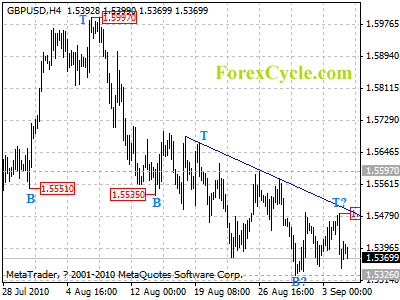
GBPUSD failed to break above the trend line resistance

GBPUSD failed to break above the trend line resistance and dropped from 1.5488. Now the fall from 1.5488 could possibly be resumption of downtrend from 1.5997, another fall towards 1.5200 would more likely be seen, and a breakdown below 1.5326 will signal resumption of downtrend. Resistance remains at the falling trend line (now at 1.5495), only a clear break above the trend line resistance will suggest that the downward movement from 1.5997 is complete.

gbpusd

Daily Forex Signals

EUR/USD Reaches 1.2900 Following Better Than Expected Non-Farm Payrolls Results

Source: ForexYard

The US Non-Farm Payrolls wasted no time bringing the greenback down on Friday. The EUR/USD pair, which seemed very steady around the 1.2800 level before the report, promptly jumped due to the better-than-expected figures, and is currently trading around the 1.2900 level. Can the pair cross the 1.30 level this week?

Economic News

USD – Non-Farm Payrolls Report Further Weakens the Dollar

The U.S dollar fell against most of the major currencies during last week’s trading session. The dollar dropped over 200 pips vs. the euro, and the EUR/USD pair is now trading around the 1.2900 level; the dollar fell against the Japanese yen as well.

The catalyst for the dollar’s depreciation was the positive economic data released last week. The dollar’s fall began on Tuesday, as a report showed that consumer confidence in the U.S. increased more than economists had forecast in August. The survey shot up to 53.5 from a five-month low of 51 in July. This has begun easing concerns that the economy might face yet another slowdown. As the week progressed additional positive economic reports were published; the Institute for Supply Management’s gauge of manufacturing unexpectedly rose to 56.3 in August from 55.5 a month earlier, beating expectations for 53.2, showing that U.S. manufacturing expanded at a faster pace than expected.

The dollar’s bearish trend was highly enhanced on Friday, as the Non-Farm Payrolls report showed that the payrolls in the U.S. have decreased in August by merely 54,000, well above expectations for a decline of over 100,000 jobs. While this is still a negative result, it points out that the employment situation may finally be stabilizing. The positive data has boosted demand for riskier assets, and thus weakened the dollar and strengthened the euro.

Looking ahead to this week, many interesting economic publications are expected from the U.S, such as the Trade Balance figure and Unemployment Claims. Traders should take under consideration that if data continues to provide positive results, this will probably boost risk appetite in the market, causing the dollar to weaken.

EUR – Euro Rises Despite Disappointing Data

The euro rallied against most of its major counterparts during last week’s trading. The currency gained over 200 pips against the U.S. dollar and about 150 pips vs. the British pound, and the EUR/GBP cross is now trading near the 0.8350 level.

The euro rose against most of the major currencies despite rather disappointing data released from the major economies in the euro-zone. The European unemployment rate remained at a 12-year high of 10.0% in July as companies continued to cut costs to help shore up earnings. In addition, retail sales in Germany, Europe’s largest economy, unexpectedly fell for a second month in July. The report showed that sales dropped by 0.3% in July, failing to reach expectations for a 0.6% rise.
However, the negative data failed to impact the euro’s trading. It appears that investors have placed much greater significance on the positive data from the U.S, especially the better than expected Non-Farm Payrolls. The positive data from the U.S. economy has led investors to believe that global economic recovery is well on its way, and as a result turned them to open long positions on the euro and the pound, despite the unsatisfying data from the euro-zone.

As for this week, a batch of data is expected from the euro-zone. Traders are advised to pay attention to the publications from the leading economies, such as Germany and France. If the news provides positive economic reports, the euro might strengthen further.

JPY – Yen Closes a Bullish Week with Bearish Signals

The Japanese yen strengthened against most of the major currencies during the beginning of last week’s trading session. The yen gained about 150 pips against the U.S. dollar and about 300 pips against the British pound. However, by midweek the yen corrected most of its gains, especially against the euro and the pound

The yen began last week with a bullish trend following positive data from the Japanese economy. The Preliminary Industrial Production report unexpectedly rose by 0.3% on July, beating expectations for a 0.3% drop, and rising for the first time in 3 months. In addition, Japanese retails sales rose by 3.9% in July, beating analysts’ forecast of a 3.6% rise.

However, the bullish trend reversed by midweek following positive economic reports from the U.S. A number of publications have shown that the U.S. economy will probably evade another slowdown, as several economic indicators have shown better-than-expected results. This has boosted optimism in the global economic recovery and as a result increased demand for higher yielding assets, such as the euro and pound.

As for the week ahead, the most significant publication from the Japanese economy looks to be the Overnight Call Rate. The Over Night Call Rate is in fact the Japanese interest rates announcement for September. Analysts expect that the Bank of Japan (BoJ) will leave rates at 0.10%, the lowest in the industrial world. However, if the BoJ will unexpectedly decide to hike rates, heavy volatility is likely to take place.

Crude Oil – Crude Oil Closes a Volatile Week near $74.50 A Barrel

Crude oil saw an extremely volatile session during last week’s trading. Crude began last week with a sharp fall to $71.50 a barrel. However by Tuesday crude saw a trend reversal that brought it up to $75.40 a barrel.

Crude oil fell during the beginning of last week due to concerns that the U.S. economy, the world’s largest oil consumer, might face another slowdown. However, as the week progressed, several positive reports were published from the U.S. economy, easing investor’s concerns. The reports showed that the American people have more confidence in their secure financial outlook, and that the manufacturing activity has expended at a faster pace than expected in August. In addition, the Non-Farm Payrolls report showed that the employment situation in the U.S. may finally begin to stabilize. This in turn created speculation that energy demand could rise, and as a result boosted crude oil prices.

As for the week ahead, traders are advised to follow the major publications from the U.S. and the euro-zone, as they tend to have the largest impact on crude oil trading. Traders are also advised to follow the U.S. Crude Oil Inventories figure, which is scheduled to be released on Thursday, as this report usually has an instant impact on crude oil.

Technical News

EUR/USD

Most technical indicators are showing this pair trading well in overbought territory, which typically means that a downward correction could take place in the near future. The Williams Percent Range on the daily chart is currently at the -5 mark. Anything above -20 is considered to be overbought. The Stochastic Slow on the 8-hour chart shows a cross forming above the upper resistance line, indicating that downward pressure could come soon. Traders are advised to go short with tight stops today.

GBP/USD

The Relative Strength Index on the 8-hour chart shows the pair approaching overbought territory. That being said, most other indicators are showing the pair in neutral territory. Traders may want to take a wait and see approach today to better determine a clear direction for this pair.

USD/JPY

After tumbling in last week’s trading session, it appears that the pair is finally in stable territory. Most technical are not showing a clear direction for this pair at the moment. The one exception is the MACD on the 8-hour chart, which is indicating a bullish correction could occur. Traders will want to watch out for any upward movement for this pair.

USD/CHF

The Williams Percent Range on the daily chart is showing the pair trading on the border of oversold territory, indicating an upward correction could occur today. The Relative Strength Index on the 8-hour chart is showing the pair close to being oversold. Traders are advised to go long in their positions today.

The Wild Card

AUD/USD

The Relative Strength Index on the daily chart is showing the pair trading well in overbought territory, indicating a downward correction could occur in the near future. This theory is supported by the Williams Percent Range, also on the daily chart, which is currently at the -5 mark. Forex traders may want to go short with tight stops in their positions today, as a downward correction will likely take place.

Forex Market Analysis provided by ForexYard.

© 2006 by FxYard Ltd

Disclaimer: Trading Foreign Exchange carries a high level of risk and may not be suitable for all investors. There is a possibility that you could sustain a loss of all of your investment and therefore you should not invest money that you cannot afford to lose. You should be aware of all the risks associated with Foreign Exchange trading.

Forex Weekly Market Review Sept 6, 2010

By eToroEquity markets moved higher during the week as the markets absorbed
numerous economic data points that lead to a market rally.
The combination of strong manufacturing data (ISM), robust housing
numbers (pending home sales), and a better than expected payroll
report from the Department of Labor pushed the US markets higher.
For the week, the S&P 500 index settled higher by 40 to 1104.

Click here for the full review

Forex Market Analysis provided by eToro

Disclaimer: Trading in the Foreign Exchange market might carry potential rewards, but also potential risks. You must be aware of the risks and are willing to accept them in order to trade in the foreign exchange market. Don’t trade with money you can’t afford to lose.

Australian Dollar’s Silent Rise

audusd, australian dollar, aussie, aud, usd, us dollar, forex, forex market, forex trading, daily forex picks, currency trading, forex forecast, forex analysis

Good day to you my fellow FX men and women! Today I present to you the daily chart of the AUDUSD. As you can see, the pair has been trading within an ascending channel since the middle of May 2010. Of course, the pair would more like trend higher as long as the channel’s support does not buckle. The Aussie, however, could meet some resistance at the pair’s previous high near the 0.9200 level. With the stochastics in the overbought area, it could rest for a while before making another move to the north. A move past the 0.9200 level could push it towards 0.9300. The Elliot Wave Principle (EWP) also seems to confirm this potential price action. If my wave counting is correct, the AUDUSD could already be in its fifth wave. This then suggests that the next short term up-move would more likely surpass the peak at 0.9200.

Recent economic data in Australia goes to support the positive sentiment towards the Aussie. For one, the corporate profits of Australian firms for the second quarter of the year have unexpectedly soared by 18.9% compared to the market’s 5.9% growth forecast. The firms’ 1Q scores were also positively revised to 4.3% from 3.9%. The country’s building approvals have also expanded for the first time in 5 months. The account surprisingly rose 2.3% in July after dipping by 3.4% during the previous month. Retail sales for the same period have also shown some good figures, expanding by 0.7% in July and 0.4% in June. More importantly, the country’s second quarter gross domestic product (GDP), has surpassed the market’s 0.9% forecast with a 1.2% growth. the first quarter’s overall output expansion was also revised upwards to 0.7% from 0.5%.

On Tuesday (September 7), the Reserve Bank of Australia will have its monetary policy decision. While the bank is still expected to hold its benchmark interest rates at 4.5%, the bank’s tone would more likely lie towards the hawkish end of the spectrum given the improvements economy. Any positive outlook regarding the country would of course be bullish on the Australian dollar as well.

More on LaidTrades.com