Forex and Some Important Facts about Bollinger Bands

By Sutikno Slamet – Forex trading is nowadays one of the most looked after occupation for many persons of all ages around the world. This is due to its great advantages over other capital markets and its high profitability potential; among these advantages you will find that is extremely easy to access a trading platform from the best forex broker firms thanks to the internet; and also you will notice that Forex has a high liquidity along with a high leverage.

But having a good broker firm and great trading platform is only one part of what you need in order to make your forex trading career a winning and profitable one. You need to have the right knowledge and techniques in order to forecast with the best accuracy what the market will do next. One of the techniques used to predict the Forex market behavior is that based on Bollinger Bands.

These Bollinger Bands are what is called a technical trading tool and they are widely used in the capital markets (including Forex) and were created by John Bollinger in the early 1980s. These bands technique was formulated based on the need for adaptive trading bands and the discovery that the volatility of the markets was a dynamic phenomena, not a static one as was widely believed at the time.

Bollinger Bands consist of a chart of three curves drawn in relation to currency pairs prices. The band situated in the middle is a measure of the intermediate-term trend and is usually a simple moving average, that serves as the base for the upper and lower bands. The interval between the upper, lower and the middle bands is determined by the volatility of the market, typically the standard deviation of the same data that were used for the moving average. The default parameter is 20 periods and two standard deviations above and below the middle band; of course this may be adjusted to suit your needs.

In short, the purpose of Bollinger Bands is to provide a relative definition of high and low price. By definition prices are considered high when touching the upper band and low when they touch the lower band. This relative definition can be used by the Forex trader to compare price actions and as a very useful indicator when the purpose of the trader is to arrive at rigorous buy and sell decisions.

About the Author

Forex Blog – FREE Forex Tips and Resources! Click Here To Get All You Need To Know About FOREX!

The Ultimate Technical Indicator

By Mr. Ahmad Hassam – There are so many technical indicators that you can use like the bollinger bands, the relative strength index (RSI), the stochastic, the simple moving averages, the exponential moving averages, the moving average convergence divergence (MACD), the channel commodity index (CCI) and so that you are not sure which is the best one among them. Rather, every day a new technical indicator is hitting the market with the technician who developed that indicator claiming it is the best one. So what is the best technical indicator that one can use in forex trading or for that matter in trading?

So what is the Ultimate Technical Indicator? Well, to tell you the truth, there is one indicator that will always stand above the rest. And that indicator is the price action. You see all these technical indicators are formulas that are applied to the price action to get a trading signal.

Now, in the currency market, there is no absolute price. However, currencies are priced relatively in terms of other currencies. So we may talk of USD priced relative to GBP or Euro priced relative to USD. Now this might be confusing for those traders and investors who have been trading other markets where prices are always absolute.

Now support is the price where buyers step in and start buying en masse. Think of the support as the floor. When you hit a rubber ball on the floor, it bounces back and returns to you. The price action bounces back from the support in the same way.

In the same way resistance is just like the ceiling of a room. When you throw a ball up, it will hit the ceiling and bounce back in your hands. Resistance works in the same way in the market and can be taken as a ceiling in the market where price action bounces back.

You need to understand this that large players like the big banks, hedge funds and the institutional investors trade in a totally different manner as compared to us the small traders. As a small trader, we want to enter and exit all at once since our order size is too small.

So instead of entering the market all at once, these large players enter the market gradually. This way they avoid moving the market all at once and driving the currency price up.

When the price reaches the support or the desired entry level of these big banks or hedge funds, they enter the buy order. Similarly in case of a large seller, a single order might drive the price still lower. So a large seller will always enter the market gradually. This way, you see the price bouncing back and forth between support and resistance.

About the Author

Mr. Ahmad Hassam has done Masters from Harvard. Learn this powerful Fibonacci Retracement Strike FREE that pulls 500+ pips per trade! Get this 1 Minute Forex Trading System FREE that makes money anytime instantly.

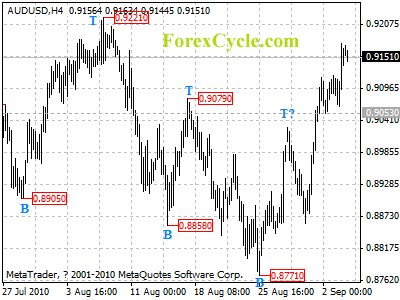
AUDUSD’s upward move extended to 0.9175

AUDUSD’s upward movement extended to as high as 0.9175 level. Further rise towards 0.9221 previous high is still possible later today, minor consolidation would more likely be seen before breaking above this level. Support is now at 0.9053, a breakdown below this level will indicate that consolidation of uptrend is underway, then deeper decline could be seen to 0.9000 area.

audusd

Daily Forex Forecast

Indicators enabling trader to achieve success at Forex

By Linda Green – Here are the few forex indicators that help the traders to achieve success in making trade position and attaining maturity in your trades at the Forex trading platform providing you the ability to optimize returns on your buying and selling deals.

The indicators are SMA, EMA, and Bollinger bands, RSI, Stochastic, Oscillators and Momentum. Few of them are explained here.

These indicators help to add momentum to the trade moves with respect to the market condition and traders can fetch returns under any kind of trading situation whether the currency pairs are loosing their strength at the Forex trading platform or the Forex accounts of certain traders are heading up.

Simple Moving Average (SMA) – This is the average price over a certain period of time, considering that equal weightage is given to each daily price move of the currency. The time span considered for tallying the trade is of 5 minutes, 10 minutes, 1 day, 1 month or more, where each of the preferred periods lugs the same weight for the average.

Exponential Moving Average (EMA) – In this, exponential moving average indicator the averages are calculated considering the current exchange rates of the currency pairs hauling more influence in the overall average; for exemplar: In a 10-day exponential moving average, the last 5 days will have more effect on the average than the first 5 days.

The layout behind this idea is to employ the latest data as an enhanced indication of Forex trend direction. This moving average responds closer to fresh price changes than a simple moving average.

The 12 and 26-day EMAs are the widely used short-term averages, and they are used to derive indicators like the moving average convergence divergence (MACD) and the percentage price oscillator (PPO). In general, the 50- and 200-day EMAs are considered as signals of Forex long-term trends.

Bollinger Bands – The basic construal of Bollinger Bands is that, the values of the currency pairs have a propensity to stay within the upper and lower bands. The Bollinger Bands have inimitable trait that the spacing between the bands contrasts based on the volatility of the currency pair value. During high volatility periods, the bands expand to become more forgiving. Similarly during periods of low volatility, the bands contract to enclose currency prices. The bands are drawn with two standard deviations above and below a SMA. They indicate a “sell” when above the moving average (or close to the upper band) and a “buy” when below it (or close to the lower band).

The bands are used by some Forex traders in conjunction with other analyses, including RSI, MACD, CCI, and Rate of Change.

About the Author

I am Linda Green and have keen interest in financial investments and matters related to Forex trade. I am working in Forex trading and financial investments for Finexo.com. The site gives relevant information on currency trading and provides regular updates of the changes in Forex currency pairs like USD/EUR.

Insider Thoughts on Forex Scalping

By James Oneil – If you were the type of cautious trader that was looking for a lower-risk strategy, in order to carry out your foreign exchange trading, forex scalping is almost certainly going to be a method that you may wish to consider.

Scalping allows for fast moving trading and will realize profit accumulation even when the market has only moved by a very small fraction.

What we mean is that you could literally make a profit, although relatively small, on a movement in the market of only around 2 to 3 pips.

One pip is equivalent to one thousandth of a currency unit, so as you can see, such a move in any currency trading market could definitely transpire within a matter of minutes, sometimes even seconds.

Forex scalping is a method of trading that is often done by forex traders whom have a limited amount of time to make any profits it’s a fast way to make money quick. They do not have endless hours in the day whereby they can sit in front of their computer and keep a very close eye on the market movements. So, forex scalping is ideal for them as they can open and close a trade very quickly, yet still register an amount of profit.

In order to make huge profits thru forex scalping, you must purchase a high number of units. To make a worthwhile profit between USD and EUR you would need to have around 100,000 units to register a profit of around $10.00USD for every favorable pip movement. This is an option that is simply not open to most forex traders, especially newbie.

With forex scalping, if you are interested in forex scalping, you should also be mindful of the fact that most brokers are wise to this method and they may very well take actions against you in order to mitigate any losses. You would generally tend to find that the slower the business processing platform is, the more likely the broker is to intervene on the orders that you have placed. Conversely, if you have access to a trading platform where the trade orders are processed instantaneously, this will be a far better site in order to practice forex scalping.

Most brokers do not like their traders to practice forex scalping. There may well be times where a broker requests for you to refrain from relying on such trading methods, or they may even ask you to find another broker altogether. Be aware of this. You need to remember that forex brokers are there to run their own business and to make money accordingly. Where a trader continually threatens their earning potential, they will look to get rid of that forex trader whenever possible.

Forex scalping is a fast and convenient way of making modest profits. However, it is only really suitable for forex traders that are able to purchase high volumes of units in the first place. Profits would be too minuscule on forex trades where there are not a lot of units at stake, therefore this practice really would not be worth the time or effort. Look for the fastest business processing platforms if you are adamant about forex scalping. These brokers are far less likely to take action against you in an attempt to prevent you from forex scalping.

For more information regarding this, visit Forex Scalping.

About the Author

Computer Programmer

How to Use the Bollinger Indicator for Trading

By Timothy McCready – Bollinger bands® (BB) are one of the most popular indicators available to the trading community. Ironically, even with that popularity, most traders remain fuzzy on how to best use the bands and other indicators derived from them.

A large part of the confusion surrounding the Bollinger indicators is directly related to the broad misunderstanding about the basis of all technical indicators. Much could (indeed, should) be said about the nature of technical indicators, but for now I’ll make two points:

1.Technical indicators do NOT predict the future. Technical indicators DESCRIBE current and past activity. They describe that activity in a way that simplifies the presentation of price data, making it easier for humans to understand a stock’s behavior. When you understand how a stock has been behaving, you can make an educated guess about what it will do in the near future.

2.As a result of their descriptive nature, the Bollinger indicator (and others) is useful in scanning large numbers of stocks, helping the trader narrow his/her list of trading candidates to a manageable number.

With that understanding in mind, how do Bollinger bands describe the market? How can we use them in our trading?

First, let’s recognize there are several different Bollinger indicators:

1.the basic Bollinger bands,

2.the %b indicator, and

3.the Bandwidth indicator

For this short article, we’ll focus on the use of the standard Bollinger bands since the %b and Bandwidth indicators are derived from the BB indicator, and are typically used in conjunction with the standard bands.

Graphically, Bollinger bands show on a chart as two lines which embrace the bulk of the price activity; there is an upper band, and a lower band, both of which center on a simple moving average. The math is a bit complex, and not necessary for the normal trader to deal with – just understand that the bands get wider as price activity becomes more volatile and narrower as things calm down.

The intent behind the Bollinger indicators is to capture most of the price action between the upper and lower boundary. In this way, we can quickly and visually identify when something extraordinary is happening – when price action extends above or below that ‘normal’ region.

One of the first ways traders may take advantage of Bollinger bands is to fade any move that bumps into one band or the other. Figuring that if the bulk of closing prices should be inside the bands, any move outside of the normal territory could be overstretched and ready for a snap back. For example: if ABC stock closed ABOVE the upper BB today, a trader might reason that the stock is overbought and so ready for a pullback. In that case, he might look for an opportunity to short ABC.

A second angle a trader could take in his use of the Bollinger band indicator is to look at closes outside of the normal area between bands as the initial thrust of a breakout. From this perspective, the trader could reason that a sharp move outside the bands indicates a significant change in market sentiment – buyers are suddenly much hungrier for the stock, OR stock owners have become desperate to get rid of their shares. Either way, if a substantial shift in market demand has occurred, the price could be making a big move and the trader who has been tipped off by a close outside the Bollinger bands can be positioned to profit nicely from the new imbalance.

Here’s a third angle: since the Bollinger indicator expands and contracts with market volatility, the alert (and patient) trader can identify stocks which are currently experiencing lower than normal price movement. Since price volatility tends to swing from high to low and back to high again, a period of lower than normal volatility (signaled by a narrow ‘bottle-neck’ in the bands) can point our attention to a stock which is about to make a big move. It’s outside the scope of this article to cover the ways we can set a trap for such an impending move, but suffice it to say these situations can be very profitable.

So you see there are multiple ways to use the Bollinger band indicator to take money out of the market. If you put this indicator into play with a solid trading plan, you can be one of the few traders who actually employ it successfully.

Good luck, and above all – stay timid!

Timothy McCready

About the Author

An avid trader of multiple financial markest, Timothy McCready (also known as Timorous on his website) is also very mindful of the dangers presented by trading without proper education or a definite plan. He shares his thoughts on the markets so that other traders can profit without putting their hard earned capital at risk. Readers can get access (without charge) to his workbook: “How to Make Your Own Trading Plan” at http://www.TimorousTrader.com/.

Most Commonly Used Daytrading Technique By Professional Forex Traders- Partial Close

By Warren Seah – The day trader opens and closes all his trades when the market is open during the trading period and does not hold positions overnight. Day trader usually use 1- minute to 15- minute charts.

Why would the partial close method be popular among the day traders?

Partial close method allows for short term trading and also the benefits of riding on longer term trends and profiting from them. This is how it is done:

Entering a trade with multiple contracts that provide the freedom to take a portion of the positions off when a predetermined price is reached based on market structure and short-term behaviour, allowing for the balance to profit in the short run and also capitalising on longer-term market behaviour.

Trading multiple contracts is one of the most misunderstood trading concept. When trading multiple contracts, there is a tendency for traders to take on excessive risk. Multiple contracts allow forex traders to cover part of his position and exit a portion of his contracts at pre-defined take profit level. Next, he will shift his initial stop loss to entry price.

The beauty about using partial close method is when market suddenly stop him out of the trade by hitting his stop loss, he would still make a profit. If his stop loss is never triggered, he will enjoy the rest of the trade participating in the trend for as long as it lasts with no risk, knowing that no matter what happens at the very least he has already bank in a small profit.

It is very important to only trade which 1-2% risk per trade or 5% maximum risk per day. Sound money management is what keeps the professional traders from making money consistently in the long term. Protect your investment equity like you would protect yourself from hazards.

Partial Close Example

Trading Eur/Usd as example, your account size is $25,000 and you choose to risk 2 percent on this trade. Two percent of $25,000 is $500. Your trade entry is buy Eur/Usd at $1.2300, and your stop loss is placed 50 pips away from entry price $1.2250. You will trade with 1.00 (1 standard lot or €100,000) and stay within your risk parameters.

If you get stopped out before having a chance to partial close, your loss would only be 2 percent, which is an acceptable and expected risk. Therefore, this potential risk should not create any trading stress. When your trade becomes profitable, partial close will come into play. After which, stop loss will shift to break-even price ($1.2300) and you will use trailing stop strategies to manage your trade and bank in profits based on price action.

The psychology of partial close method is to reduce stress by locking in profit which would help forex day-traders not only to profit from short market action but also stay in longer-term market behaviour with his remaining positions.

About the Author

By Warren Seah

“Introducing 11 Exit Strategies, What Every Disciplined Traders Need … Go Without It You Could End Up Being A PIP VICTIM Just Like Thousands Of Traders Out There.”

Download Your Partial Close EA Now

History of Foreign Exchange :5 Events That Changed the World

5 Economic Events When Currency Rocked The World

These are changes in the currency markets which caused substantial impact in the world economy. It is important that people learn about currency movements and how the occurrence of such events provide lucrative opportunities for currency investors to profit from the forex markets.

Free Market Capitalism is Born

On August 15 1971, this date marked the end of the Bretton Woods system, a system that used to fix the value of a currency to the value of gold. The United States pulled out of the Bretton Woods Accord and took the US off the established Gold exchange Standard.

US were running a balance of payments deficit and a trade deficit back in the early 1970s due to the costs of Vietnam War and increased domestic spending has accelerated inflation. The US government used up almost all of his reserves and gold reserves by that time. Hence it began to print more dollars to supplement its expenditure. In short, most countries lost faith in the dollar as it is overvalued against gold. The international community dumped their dollars in exchange for gold.

The fact is there was not enough gold in the US vault to pay back the international community. US government had printed too much dollar and they were broke.

Following that, President Nixon shocked the world. The event was informally named ‘Nixon Shock’ because President Nixon and 15 advisors removed US from the Gold Exchange System without consulting the members of the international monetary system.

US dollars was the first currency to be floated- that is, exchange rates were no longer the principal method used by governments to administer monetary policy but is solely determined by supply and demand market forces. By 1976, all the major currencies were floated. The forex markets were started.

Devaluation of U.S Dollar – Plaza Accord

In the early 1980s, the US Federal Reserve System under Paul Volcker had overvalued the dollar enough to make US exports in the global economy less competitive. The U.S government faced a large and growing current account deficit, while Japan and Germany were facing large and growing surpluses.

This imbalance could create a serious economic disequilibrium which would result in a distortion of the foreign exchange markets and thus the global economy. The result of current account imbalances and the possibility of foreign exchange distortion brought ministers of the world’s leading economies – France, Germany, Japan, the United Kingdom, and the United States together in New York City.

The Plaza Accord was signed on September 22, 1985 at the Plaza Hotel in New York City, agreeing to depreciate the US dollar in relation to the Japanese yen and German Deutsche Mark by intervening in currency markets.

The effects of the Plaza Accord agreement were seen immediately within 2 years. The dollar fell 46 percent and 50 percent against the deutsche mark and the Japanese Yen. Devaluation of the dollar stabilise the growing US trade deficit with its trading partners for a short period of time. As a result, U.S. economy became more export-oriented while Germany and Japan became more import-oriented.

The signing of the Plaza Accord was significant in that it reflected coordinated actions with respective governments were able to regulate the value of the dollar in the forex market. Values of floating currencies were determined by supply and demand, but such forces were insufficient, and it was the responsibility of the world’s central banks to intervene on behalf of the international community when necessary.

To date, we still see countries that continue to regulate value of its currency within a certain band in the forex market. Example of one country is Japan.

Black Wednesday – The Man Who Broke the Bank

Black Wednesday refers to the events on 16th September 1992 when George Soros placed a $10 billion speculative bet against the U.K. pound and won. He became the man who broke the Bank of England.

In 1990, U.K. joined the Exchange Rate Mechanism (ERM) at a rate of 2.95 deutsche marks to the pound and with a fluctuation band of +/- 6 percent. ERM gave each participatory currency a central exchange rage against a basket of currencies, the European Currency Unit (ECU). This system prevents the exchange rate of participatory currencies from too much fluctuation with the basket of currencies.

Until mid 1992, economy began to change in Germany. Following reunification of 1989, German government spending surged, forcing the Bundesbank to print more money. German economy experienced inflation and interest rates were raised to curb inflation.

Other participatory countries in the ERM were also forced to raise interest rates so as to maintain the pegged currency exchange rate. The rate hike led to severe repercussions in the United Kingdom. At that time, U.K. had a weak economy and high unemployment rate. Maintaining high interest rates is not sustainable for U.K. in the long term, and George Soros stepped into action.

George Soros was said to profit $2 billion from the Black Wednesday. This single event showed that with knowledge and experience, investors could profit from the forex market. No central banks can control the forex markets.

Asia Currency Crisis

Leading up to 1997, investors were attracted to Asian investments because of their high interest rates leading to a high rate of return. As a result, Asia received a large inflow of money. In particular, Thailand, Malaysia, Indonesia, Singapore and South Korea experienced unprecedented growth in the early 1990s.

These countries fell one after another like a set of dominos on July 2, 1997, showing the interdependence of the Asian 5 Tigers’ economies. Many economists believe that the Asian Financial Crisis was created not by market psychology but by shrouded lending practices and lack of respective government transparency.

In early 1997, Thailand current account deficit has grown consistently up to a level that is believed to be unsustainable. Shrouded lending practices oversupplied the country with credit and in turn drove up prices of assets. The same type of situation happened in Malaysia, and Indonesia.

Levels were reached where price of assets were overvalued and coupled with a sn unsustainable trade deficit, international investors and hedge fund managers began to sell Thai baht and neighboring countries’ currencies hoping to profit from the plunge.

Following mass short speculation and attempted intervention, the Asian economies were in shambles. Thai baht was sharply devalued by as much as 48 percent and Indonesian rupiah fell 228 percent from it previous high of 12,950 to the fixed U.S. dollar.

The financial crisis of 1997-1998 revealed the interconnectivity of economies and their effects on the global currency markets. The inability of central banks to intervene in currency markets provided yet another lucrative opportunity for currency investors to profit.

The Euro: Best Reserve Currency after Dollar

The name Euro was officially adopted on 16 December 1995. The Euro is the official currency of 16 of the 27 Member States of the European Union. Euro is the second largest reserve currency and the second most traded currency in the world after the U.S. dollar.

As of November 2008, with more than €751 billion in circulation, the euro is the currency with the highest combined value of cash in circulation in the world, having surpassed the U.S. dollar. Based on IMF estimates of 2008 GDP and purchasing power parity among the various currencies, the Eurozone is the second largest economy in the world.[1]

Value of Euro and the U.S. dollar are inversely correlated. Should the dollar fall, value of Euro currency will rise. Euro will be the best choice to shift money to, should the value of U.S. dollar continue to fall. This makes the Euro the best substitute currency for the dollar.

[1] Wikipeda

About the Author

By Warren Seah

Warren examines commercial trading systems. He analyses to uncover good systems which bring in consistent profits in the long term.

Click Here To Read More on Click Here To Read More On Fx Robot Reviews

http://www.FxEAReview.com
Money Management Strategies for FX Traders

Money Management Formulas

Survive First, Prosper Later

Money management has two goals: survival and prosperity. The first priority is to survive, then to make small gains consistently and finally to make spectacular gains. Beginners tend to have these priorities reversed. They aimed for spectacular gains over short time frame but never think about long term survival. Professional traders are always more focus on minimising losses than growing equity.

No one could have said it better than Warren Buffett, the world’s greatest investor,

“Be a Risk Averse Investors”

Trading is a business. Like any business, it will need the right amount of cash reserves at the right time in order to profit from the right opportunities. In trading, your equity in your investment account is your life. You lose it, you are out of business.

The market will always be there so long as you have available capital. One thing is guaranteed in trading, that is losses. We look at the different types of losses.

Businessman Risk’s Vs Loss

Businessman’s Risk

Businessman’s risks are risks that are anticipated by the businessman and losses to these kind of risks are expected. Since they would have anticipated to a certain degree the probability of the loss occurring, they could have taken a sound measure. Businessmen treat this particular risk as an expense of the business.

Losses

The difference between a businessman’s risk and a loss is its size relative to the size of your equity. These are losses that threaten your prosperity and survival. And this is the last thing a trader will want to experience.

A business operating in an office building will face the risk of fire occurrence. Any fire will disrupt the business for months. The potential of fire damaging your property and disruption of your business may just put you out of business. This is a loss that you will never want it to happen, don’t you? So businesses will buy insurance to protect themselves against such losses if it happens.

In trading, the insurance for protection against such losses is free. You do not pay premium for it. However, you owe it to yourself and be responsible for the degree of risk you take. You must draw a line between them and never cross it. Drawing that line is a key task of money management.

Over-trading

It is defined by taking on more trades than you are required to which are out of your system rules. This mistake will benefit your broker and not the trader.

Revenge Trading

It is also another form of over-trading. Traders will tend to make a trade immediately after a loss, seeking to recover the loss. This is done just after he made a bad decision, and wanted to remedy the situation by making a ‘reverse’ trade relative to his first trade. Often, he will see the market reverse against him causing a double loss.

Solution

Markets kill traders in one of two ways. If your equity is your life, a market can snap it with a disastrous loss that effectively takes you out of the game. Or it can also kill you slowly and strip your account to the bone.

These two money management rules are designed and served as an ‘insurance’ to protect you from going out of your trading business.

2% Risk Per Trade

It meant that you will never risk more than 2% of your equity in any trade. This is to protect you from a disastrous loss that may put you out of the business. If you adhere strictly to this rule, the most you will lose from any trade will be a maximum 2% of your account equity.

6% Risk Per Month

Whenever the value of your account dips 6% below its closing value at the end of last month, stop trading for the rest of this month. The 6% rule protects you from a series of losing streaks. If you took 2% risk per trade, assuming you have not had any winning trade for the month, you can only lose a maximum of 3 trades before you stop trading for the month.

6% rule encourages you to increase your size when you’re on a winning streak and stop trading early in a losing streak.

Position Sizing

Position sizing answers the question on how much to buy or how much to sell so that I risk a maximum of 2% in a single trade?

Contract Size =

Account Equity X Risk Per Trade / Stop loss in pips / 10

( Contract Size for 1.00 means trading 100,000 of base currency. Assume 4th digit broker )

Example

Buy at $1.5050

Account Size = $10, 000

Risk Per Trade = 1%

Stop Loss in pips = 50 pips

Calculation

Contract size = 10,000 X 0.01 / 50 / 10

= 0.20

You will Buy 0.20 contract size at $1.5050, and your stop loss will be at $1.5000. If this trade was to go against you, the maximum you will lose is $100.

About the Author

By Warren Seah

Warren examines commercial trading systems. He analyzes to uncover good systems which bring in consistent profits in the long term.

Click Here To Read More On EA Trading for a Living

http://www.FxEAReview.com

GBPUSD remains in downtrend from 1.5997

GBPUSD remains in downtrend from 1.5997 and the fall extended to as low as 1.5326. Resistance is at 1.5597, as long as this level holds, downward move is expected to continue and next target would be at 1.5200 area. However, a break above 1.5597 will indicate that a cycle bottom has been formed on daily chart and the fall from 1.5997 has completed at 1.5326 already, then the following upward movement could bring price back to 1.5700-1.5800 area.

For long term analysis, GBPUSD is in uptrend from 1.4230. Rise to 1.8000 area to reach next cycle top on weekly chart is expected in next several weeks.

gbpusd

Weekly Forex Analysis