EUR Gains on Successful Portugal and Poland Debt Auctions

Source: ForexYard

The EUR rose against the U.S. dollar on Wednesday, buoyed by successful bond auctions in Portugal and Poland that made the single currency’s fall the prior session look overdone. The EUR rose 0.4% against the USD after an early fall as low as 1.2660.

Economic News

USD – Dollar Drops against the Majors

The U.S. dollar fell against most of its major currencies on Wednesday after the Federal Reserve’s Beige Book cited a slowing economy and limited inflation pressure, though stayed lower amid better news out of Canada and the U.K. As a result, by yesterday’s close, the USD fell against the EUR, pushing the oft-traded currency pair to 1.2730. The dollar experienced similar behavior against the GBP and closed at 1.5470.

The greenback also remained under selling pressure on expectations that U.S. interest rates will stay at very low levels for some time. Low interest rates make the dollar less attractive to investors than higher-yielding currencies, stocks and commodities. In addition, economic recovery does not appear to be improving at the speed many investors were hoping for, and currencies appear to be tracing the movement of stocks as a result.

Looking ahead today, the two main news events that may have a very large impact on the greenback and its main currency pairs in today’s trading are the Trade Balance and Unemployment Claims around 12:30 GMT. These reports are very important and likely to impact the dollar’s volatility. Traders should pay close attention to the market as there is an opportunity for traders to capitalize on the fluctuations which are likely to follow this release.

EUR – EUR Gains on Successful Debt Auctions

The EUR rose against the dollar and Swiss franc on Wednesday, buoyed by successful bond auctions in Portugal and Poland that made the single currency’s fall the prior session look overdone. By yesterday’s close, the EUR rose against the USD, pushing the oft-traded currency pair to 1.2730. The 16-nation currency also rose against the CHF and closed around 1.2865.

The EUR also gained support after Ireland’s finance ministry said nationalized lender, Anglo Irish Bank, would be split to wind down its assets. Concerns about how Ireland dealt with the troubled bank had weighed on investors recently.

The single euro zone currency tumbled 1.5% versus the dollar on Tuesday after a news report that recent stress tests of European banks sector underestimated some lenders’ holdings of potentially risky government debt.

JPY – Yen Hits 15-Year High vs. the Dollar

The yen struck a fresh 15-year high against the dollar and edged closer to a 9-year peak against the EUR on early Wednesday on a flare-up in worries over euro zone banks, prompting market players to test the will of Japanese authorities to intervene. The USD/JPY fell as far as 83.35 before correcting itself. Currently the pair is trading around the 83.95 level.

Bank of Japan Governor Masaaki Shirakawa reiterated his reluctance to return to quantitative easing although he indicated the central bank was weighing its options on how to deal with the economic impact of the yen’s strength.

Investors worry over a recent rise in the JPY as it makes Japanese products less competitive abroad and hurts the value of overseas sales when translated back into the Japanese currency. With steady gains primarily against the dollar, much of the yen’s bullish movement could be contributed to the repatriation of overseas earnings by Japanese companies into the local economy. This has had a positive effect on major JPY currency pairings, as the rising turmoil in the market is leading to more investment in the Japanese currency.

Crude Oil – Crude Oil Inventories to be Released Today

Oil prices rose on Wednesday for the first time in three sessions to trade around $75 a barrel, bouncing with equities and supported by a weaker dollar as concerns over the European banking system eased and investors cautiously bought riskier assets.
A weaker U.S. dollar tends to boost the price of dollar-priced commodities as it lowers the price to holders of other currencies and reduces the value of the currency oil producers receive for their product.

Today, the release of crude oil inventories is likely to help determine the market’s next direction for crude oil. Moreover, a release of a string of positive economic figures from the U.S. could help its bullishness. Therefore, traders are advised now to make some profits as the price of Crude Oil is set to remain volatile in the short-medium term.

Technical News

EUR/USD

The range-trading pattern on the hourly chart continues. The daily chart’s Slow Stochastic is floating in neutral territory. However, the 4-hour chart’s RSI is already floating in the over-sold territory, suggesting an upward correction may be imminent. When the upwards breach occurs, going long with tight stops appears to be a preferable strategy.

GBP/USD

The pair has been range-trading for a while now, with no specific direction. The daily chart’s Slow Stochastic is providing us with mixed signals. The 4-hour chart does not provide a clear direction either. Waiting for a clearer sign on the hourlies chart might be a good strategy today.

USD/JPY

The pair has recorded much bearish behavior in the past several weeks. However, the technical data indicates that this trend may reverse anytime soon. For example, the weekly chart’s RSI signals that a bullish reversal is imminent. An upward trend is also supported by the daily chart’s RSI. Going long with tight stops may turn out to pay off today.

USD/CHF

The price of this pair appears to be floating in the over-sold territory on the daily chart’s RSI, indicating an upward correction may be imminent. The upward direction on the weekly chart’s Momentum oscillator also supports this notion. Going long might be a wise choice.

The Wild Card

Gold

Gold prices rose significantly yesterday and peaked at $1,261 an ounce. However, the daily chart’s RSI is floating in the over-bought territory suggesting that the recent upward trend is losing steam and a bearish correction may be impending. This might be a good opportunity for forex traders to enter a modest correction at a very early stage.

Forex Market Analysis provided by ForexYard.

© 2006 by FxYard Ltd

Disclaimer: Trading Foreign Exchange carries a high level of risk and may not be suitable for all investors. There is a possibility that you could sustain a loss of all of your investment and therefore you should not invest money that you cannot afford to lose. You should be aware of all the risks associated with Foreign Exchange trading.

Forex: Canadian Loonie gains versus US Dollar following BOC rate increase to 1.00%

By CountingPips.com

The Canadian dollar has advanced against the US dollar today in forex market trading following the interest rate increase by the Bank of Canada (BOC). The BOC raised its benchmark interest rate by 25 basis points earlier today to 1.00 percent from 0.75 percent as widely expected by market forecasts. This follows the July interest rate increase by 25 basis points as the BOC moves to bring the rate to normal levels after a prolonged period of ultralow rates following the financial crisis.

The Canadian currency has been charging higher against the other major currencies today on the news as the loonie has made gains against the euro, Japanese yen, Australian dollar, New Zealand dollar and the British pound.

The bank statement accompanying the rate decision said that the Canadian economy was “slightly softer in the second quarter than the Bank had expected, although consumption and investment have evolved largely as anticipated.  Going forward, consumption growth is expected to remain solid and business investment to rise strongly.”

The statement also said that Canadian economic recovery may not come as quickly as previously expected as the bank sees a “weaker profile” in economic activity in the U.S. , a major export destination for Canadian goods.

Other Canadian news releases today showed that Canadian building permits fell by 3.3 percent in the month of July following a 6.9 percent increase in June, according to Statistics Canada. Market forecasts were expecting building permits to fall by 4.9 percent. The Ivey purchasing managers index was also released today and showed an increase to 65.9 for the month of August. This follows a score of 54.0 in July and surpasses the market forecasts looking for a 55.5 score for the month.

Forex chart: USD/CAD Hourly – The US Dollar falling against the Canadian dollar today in forex trading following the bank to Canada’s interest rate increase to 1.00 percent. The USD/CAD pair is trading lower after increasing yesterday and fell through the 50-hour moving average in purple, looking to test the recent support level near 1.0330.

Forex Trading, USD/CAD, US Dollar, Canadian Dollar, currency

Singapore Dollar Trading At An All-Time High Versus the US Dollar!

usdsgd september 2010, usd, sgd, us dollar, singapore dollar, fx, fx market, fx trading, forex, forex market, forex trading, trading forex, currency trading, daily forex picks, forex analysis, forex forecast

Good day Forex friends! In today’s FX special, I present to you the monthly chart of the US Dollar versus the Singapore Dollar (USDSGD). As you can see, the USDSGD pair has been sloping downwards for quite some time now. Last Friday, however, it was able to cross below the psychological 1.3500 support, marking a new all-time high for the Singapore dollar. With an oversold condition (as indicated in the stochastics), the pair could still rally. Though the long term downtrend line should keep it from rising further. A potential descending triangle could be forming if that scenario occurs. In any case, a clear break below the 1.3500 support could send the USDSGD pair lower by about 4,000 pips! Long SGD anyone?

Last week’s better-than-expected employment and housing figures in the US have sparked some risk taking among investors, causing them to leave the safety of the greenback for the like of the SGD. Singapore is actually a highly developed economy in Asia despite its size which makes it a prime place of investment. Everyone knows about the double digit growth in China but Singapore is actually the fastest growing economy in the world, expanding by 17.9% for the first half of 2010! In any case, some analyst say that the Monetary Authority of Singapore (MAS) would intervene in the market to prevent the SGD’s rapid appreciation in order to protect the country’s export industry which is its main source of revenue. But if risk taking persists, a higher valuation of the Singapore dollar could be very well tolerated.

More on LaidTrades.com

Forex Daily Market Commentary

By GCI Forex Research

FUNDAMENTAL OUTLOOK at 0800 GMT (EDT +0400)

USD
Safe-haven currencies benefited from the pull-back in risk-seeking following the Wall Street Journal report on the Eurozone bank stress tests. US equities closed 1% lower and gold jumped to $1255.50 at the time of writing. EURUSD traded 1.2678-1.2878, USDJPY 83.51-84.26. Investors focused on the article amid no data releases in the US as it questioned the methodology of the recent Eurozone bank stress test and included a suggestion that some institutions understated holdings of government debt. The article dampened risk-seeking amid renewed concerns of a sovereign credit crisis, though credit indicators indicate the worries are isolated to the Eurozone as 3m TED and LIBOR-OIS remain below year-to-date averages. While the dollar benefited versus some of the higher beta currencies, concerns on the US outlook kept the safe haven rotation in favor of the Swiss franc and the yen in place. The Fed’s Beige Book is unlikely to provide many surprises and we are likely to see choppy dollar price action unless we get better clarity on the US recovery or should credit indicators signal growing contagion fears.

EUR

Financial sector woes depressed the euro following the Wall Street Journal article that questioned the methodology of the recent Eurozone bank stress tests. Peripheral spreads widened on the back of the news, continuing the widening trend we have seen since early August. Elevated spreads show that structural problems persist in the Eurozone but for now it looks like problems are isolated to the Eurozone rather than spreading globally. Ireland did manage to get EU approval to extend parts of the Irish bank guarantee but these issues will not be fixed overnight.

ECB Executive Board member Stark was on the wires as he discussed the euro and while he did not say anything particularly new, his tone seemed a touch more downbeat than ECB President Trichet’s comments last week. Stark reiterated that Eurozone growth will moderate in 2H 2010 and there are economic growth risks beyond 2010. ECB Governing Council member Nowotny said that the ECB will wait until December before discussing how to implement the next phase of the ECB’s exit strategy. Nowotny was only referring to how ECB liquidity operations could be further normalised, and was not suggesting that policy rate hikes might be on the agenda.

At -2.25 (cons. 0.5%, prev. 3.2%) German industrial orders for July came in well below expectations. In particular falling foreign demand drove industrial activity lower. According to the German Economy Ministry in particular below average volume of big orders dampened the overall result.

JPY
USDJPY dropped to a 15-year low of 83.54 but our team does not think intervention is likely yet. There is still more room before the 79.75 1995 low in USDJPY and until investors either get more clarity on the US outlook and potential Fed actions or Japanese officials ratchet up their rhetoric in concert with approval from other nations, we could see the pair continue to drift lower on global growth uncertainty.

GBP
At 1.0% y/y (prev. 0.5%) BRC retail sales rose in august, but retail sales growth remains well below a long run average of 2.6%. Upcoming data will provide further insight on housing and the recovery, with Halifax house prices and industrial production due. Recent data has begun to slow and that should keep BoE policy unchanged.

CAD Consensus estimate is for a 25bp hike from the BoC but it is not a clear consensus as only 13 out of 20 economists surveyed voted for 25bp. Investors seem split as well as they are only pricing in 17bp. Our economic team does not expect a rate hike and even if the BoC does hike it may issue a dovish policy statement, similar to its two previous ones issued during the June and July hikes. Should that occur, near-term CAD gains may be short-lived.

TECHNICAL OUTLOOK


EURUSD NEUTRAL Recovery held below 1.2933 thus bringing our focus back on 1.2588. Break of the level would expose next support lying at 1.2434 Fibonacci level.

USDJPY BEARISH Bearish pressures probe 83.60, move below the level would open 79.75 key support. Short-term resistance is defined at 85.91.

GBPUSD BEARISH Push below 1.5324 exposes 1.5125 next. Near-term resistance lies at 1.5584 ahead of 1.5742.

USDCHF BEARISH Momentum is negative; expect extension of bearish trend towards 0.9918 ahead of 0.9786. On the upside resistance holds at 1.0265 ahead of 1.0466.

AUDUSD BULLISH The gains are expected to move towards 0.9222 with scope for 0.9389 next. Only a move below 0.8856 would hurt the positive tone.

USDCAD NEUTRAL Model has turned neutral with 1.0680 and 1.0108 defining the next bull and bear trigger respectively.

EURCHF BEARISH The push below 1.2852 exposes 1.2501 and then 1.2403. Resistance at 1.3163.

EURGBP NEUTRAL 0.8532 and 0.8142 define the key near-term directional triggers.
EURJPY NEUTRAL As long as resistance at 111.19 holds, expect losses to target 105.44 with scope for 100.00, psychological round number support level next.

Forex Daily Market Commentary provided by GCI Financial Ltd.

GCI Financial Ltd (”GCI”) is a regulated securities and commodities trading firm, specializing in online Foreign Exchange (”Forex”) brokerage. GCI executes billions of dollars per month in foreign exchange transactions alone. In addition to Forex, GCI is a primary market maker in Contracts for Difference (”CFDs”) on shares, indices and futures, and offers one of the fastest growing online CFD trading services. GCI has over 10,000 clients worldwide, including individual traders, institutions, and money managers. GCI provides an advanced, secure, and comprehensive online trading system. Client funds are insured and held in a separate customer account. In addition, GCI Financial Ltd maintains Net Capital in excess of minimum regulatory requirements.

DISCLAIMER: GCI’s Daily Market Commentary is provided for informational purposes only. The information contained in these reports is gathered from reputable news sources and is not intended to be U.S.ed as investment advice. GCI assumes no responsibility or liability from gains or losses incurred by the information herein contained.

Yen Jumps to a 15-year High vs. the Dollar

By Rita Ruvinski – The USD/JPY cross fell to a fresh low of 83.34 as risk-averse investors piled into the “safe-haven” currency Wednesday pushing it to a new 15-year high against the greenback. The dollar also slid on speculation the Federal Reserve’s Beige Book business survey will add to evidence the U.S. economic recovery is stalling.

There are lingering worries the U.S. economic recovery may be tepid, analysts said, and that has a negative effect on the dollar. The yen is being bought, partly because Japan has a Current Account surplus (the difference between a nation’s exports of goods, services and transfers, and its imports). Japan’s surplus expanded 26% from a year earlier to 1.68 trillion yen ($20 billion), the Ministry of Finance said, surpassing the 1.53 trillion yen surplus forecast by economists.

Gains in the yen were tempered, however, after Japan’s Finance Minister said he is prepared to take bold steps on currencies if necessary. But there was still skepticism among market players as to whether intervention would actually happen. Japan has not intervened in the currency market since March 2004, after spending 35 trillion yen ($420 billion) over a 15-month period to support an economic recovery.

Since the euro looks unstable again, and the dollar might weaken further ahead of the mid-term election, it leaves the Japanese yen as the only currency to buy. And especially after the Bank of Japan’s (BOJ) governor made only vague comments about the yen, the USD/JPY should face a further weakness with 83.3 and 83.05 targets in sight.

Forex Market Analysis provided by ForexYard.

© 2006 by FxYard Ltd

Disclaimer: Trading Foreign Exchange carries a high level of risk and may not be suitable for all investors. There is a possibility that you could sustain a loss of all of your investment and therefore you should not invest money that you cannot afford to lose. You should be aware of all the risks associated with Foreign Exchange trading.

Dollar Rallies on Weak German Data

Source: ForexYard

Less than expected German factory orders and worries over the Irish fiscal situation ‎had traders bidding equities lower and buying into safe haven assets as USD/JPY and ‎the EUR/CHF fell to new lows.‎

Economic News

USD – Greenback Rises on Safe Haven Buying

The dollar put in a strong showing for a second day versus most of the major ‎currencies. Traders were quick to buy the dollar following a Wall Street Journal article ‎that highlighted European banks’ exposure to risky government bonds that were ‎previously not reported in this summer’s European banking stress tests. While the ‎article did not bring to light any new information that was not previously known in ‎the FX market, it did refocus the spotlight on weakness in the European financial ‎system.‎

Less than expected German factory orders hurt risk sentiment in the market. The ‎change in the in the total value of new purchase orders from manufactures fell by ‎‎2.2% over the previous month. Expectations were for an increase of 0.6%.‎

The lone data release from the US will be the Fed’s Beige Book, set to be released at ‎‎18:00 GMT. The Fed’s analysis of the markets helps the central bank set policy ‎decisions and interest rate levels. ‎

The EUR/USD has declined for the past two days, pulling back into the symmetrical ‎triangle pattern that had formed. Support is found at the rising lower leg of the ‎triangle pattern at a price of 1.2660 followed by 1.2580.‎

EUR – European Banking Fears Drops Euro

A lack of economic data from the US had traders looking to Europe for signals on the ‎direction of the major currencies. A Wall Street Journal article influenced traders and ‎reignited fears of the European fiscal crisis. Also weak German factory orders did ‎little to calm traders’ nerves about the state of the euro zone economy. ‎

Fiscal troubles in Ireland also hurt the euro. The Irish Finance Minister said he does ‎not expect Ireland to seek emergency loans from the EU and Ireland will resume its ‎regular capital raising activities from the public debt markets. However, the market ‎reaction did not emphasize this statement. The spread between Irish government debt ‎and safe haven German debt rose to an all-time high.‎

Further signs of traders’ aversion to risky assets were apparent as the DAX was down ‎‎0.6% and the euro was lower versus the major currencies. The EUR/USD fell to ‎‎1.2680, from an opening day price of 1.2806. The EUR/CHF fell to a fresh all-time ‎low at 1.2808. ‎

Significant data releases are on the British economic calendar for today. Traders will ‎be looking at the Halifax HPI and the monthly manufacturing production numbers. ‎Better than expected data may help support the weakening pound. Support and ‎resistance levels for the GBP/USD are found at 1.5320 and 1.5490.‎

JPY – Interest Rate Decisions from Japan and Australia

As expected, both the Bank of Japan (BOJ) and the Royal Bank of Australia (RBA) ‎left interest rates steady at 0.10% and 4.50% respectively. ‎

The BOJ stated the bank is continually monitoring the outlook for economic activity ‎and did not change its economic forecasts. The BOJ also sees a continued moderate ‎economic recovery in the Japanese economy.‎

The RBA also held its base rate steady while the accompanying rate statement ‎indicated that policy is appropriate for the time being but it did highlight some ‎uncertainty in the market. Also newly elected Prime Minister Julia Gillard successfully ‎formed a minority government. ‎

Continued European banking worries touched off a bout of safe haven buying. The ‎yen was one of the benefactors in yesterday’s trading. The USD/JPY dropped to a 15-‎year low at 83.50 before finally closing at 83.79. Should safe haven buying continue, ‎the USD/JPY could push its all-time low at 79.70.‎

OIL – Recovery Fears Weaken Spot Crude Oil

The price of spot crude oil fell during yesterday’s trading following renewed concerns ‎over the global economic recovery. This time around it was Europe that sparked fears ‎of a weakened banking system and fiscal concerns in Ireland. ‎

Spot crude oil prices fell to $73.80, after opening the day at $74.04.‎

Also affecting the price of spot crude oil was a strengthening dollar. As the dollar ‎appreciates, this makes it more expensive for holders of foreign currencies to by crude ‎oil. ‎

Traders may have been influenced by an explosion at a Mexican government owned ‎oil refinery near the US Mexico border. This sparked worries over short term supplies ‎and helped to reduce the overall drop in spot crude oil prices.‎

The weekly crude oil inventories release from the US Department of Energy ‎Administration is scheduled for Thursday due to the shortened holiday week in the ‎US. Expectations are for an increase of 300K barrels.‎

Support and resistance for spot crude oil prices come in at $71 and $75.70‎

Technical News

EUR/USD

The pair has recorded much bearish behavior in the last 2 days. However, the technical ‎data indicates that this trend may reverse anytime soon. For example, the daily chart’s ‎Stochastic Slow signals that a bullish reversal is imminent. An upward trend today is ‎also supported by the RSI. Going long with tight stops may turn out to pay off today. ‎

GBP/USD

The cross has been dropping for the past month now, as it now stands at the 1.5380 ‎level. However, the daily chart’s RSI is already floating in the oversold territory ‎indicating that a bullish correction might take place in the nearest future. Going long ‎with tight stops may turn out to be the right choice today

USD/JPY

The USD/JPY has gone increasingly bearish yesterday, and currently stands at the ‎‎83.47 level. The daily chart’s Slow Stochastic supports this currency cross to fall ‎further today. However, the hourly chart’s Stochastic Slow signals that a bullish ‎reversal will take place today. Entering the pair when the signs are clearer seems to be ‎the wise choice today.‎

USD/CHF

This pair’s sustained downward movement has finally pushed its price into the over-‎sold territory on the daily chart’s RSI. Not only that, but there actually appears to be a ‎bullish cross on the Slow Stochastic pointing to an imminent downward correction. ‎Forex traders have the opportunity to wait for the upwardward breach on the hourlies ‎and go long in order to ride out the impending wave‎

The Wild Card

Oil

Crude Oil is displaying significant bearish signals after yesterday’s failed breach of the ‎‎$75 price level. The hourly chart has the pair trading in the overbought zone on the ‎pair’s Relative Strength Index, indicating a possible move lower. The chart also shows ‎a bearish cross has formed on the Slow Stochastic Oscillator that may support this ‎downward move. Forex and commodity traders may want to be short on Crude Oil ‎today as a significant price move may be in the making. ‎

Forex Market Analysis provided by ForexYard.

© 2006 by FxYard Ltd

Disclaimer: Trading Foreign Exchange carries a high level of risk and may not be suitable for all investors. There is a possibility that you could sustain a loss of all of your investment and therefore you should not invest money that you cannot afford to lose. You should be aware of all the risks associated with Foreign Exchange trading.
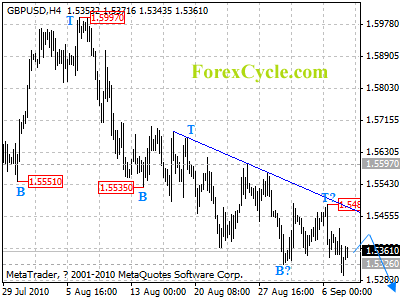
GBPUSD continues its bearish move

GBPUSD continues its downward movement from 1.5997 and the fall extended to as low as 1.5296 level. Key resistance is now at 1.5488, as long as this level holds, downtrend is expected to continue and next target would be at 1.5200 area. However, a break above 1.5488 key resistance will indicate that the downtrend from 1.5997 has terminated, then the following upward move could bring price to 1.5600-1.5700 area.

gbpusd

Daily Forex Forecast

Forex: Speculators add short Euro positions for a 3rd week in a row. Canadian loonie positions turn short

By CountingPips.com

The latest Commitments of Traders (COT) report, released on Friday by the Chicago Mercantile Exchange, showed that futures speculators increased their euro short positions for a third straight week. Non-commercial futures positions, those taken by hedge funds and large speculators, were net short the euro against the U.S. dollar by -25,569 contracts as of August 31st. This is an increase of almost 4,000 short contracts after speculators were net short the euro by -21,603 contracts on August 24th. Euro short positions have now declined for three straight weeks following a streak of six consecutive weeks of improvements.

The COT report is published every Friday by the Chicago Mercantile Exchange (CME) and shows futures positions as of the previous Tuesday. It can be a useful tool for traders to gauge investor sentiment and to look for potential changes in the direction of a currency or commodity. Each currency contract is a quote for that currency directly against the U.S. dollar, where as a net short amount of contracts means that more speculators are betting that currency to fall against the dollar and net long position expect that currency to rise versus the dollar.

The euro, British pound sterling and the Canadian dollar were the major currencies on the short side against the dollar last week in the CME futures market while the Australian dollar, New Zealand dollar, Japanese yen, Swiss franc and Mexican peso all continued to have a net long amount of contracts.  The Swiss franc was the only currency that saw net long positions increase as of August 31st and the Canadian dollar positions decreased to fall onto the short side.

The British pound sterling short positions increased to -15,266 as of August 31st after being short on August 24th by -4,365 positions. Pound sterling short positions have now increased for two straight weeks after showing improvement (declining shorts) for five straight weeks through August 10th.

The Canadian dollar positions fell for a third consecutive week and declined over to the short side for the first time in over a year to a net of -4,764 contracts after totaling 16,147 net longs last week.

The Japanese yen net long contracts edged lower last week to 49,904 from 51,069 net long contracts reported on August 24th. Yen positions have now continued to stay around the +50,000 level for the past five weeks after being short by -65,612 contracts on May 4th.

Swiss franc long positions increased for a third straight week to 14,281 long contracts as of August 31st after rising to 13,868 long contracts the week prior.

The Australian dollar futures positions declined to a net amount of 43,808 long contracts as of August 31st from 47,017 long contracts on August 24th. The Aussie long speculative positions have now fallen for two consecutive weeks following six straight weeks of increases through August 10th. New Zealand dollar futures positions fell lower for fourth straight week with 6, 957 long contracts after a total of 10,683 long contracts as of August 24th.

Mexican peso long contracts also dipped for a third week to 21,004 total long positions from 59,370 longs the week prior on August 24th.

COT Data Summary as of August 31st, 2010

Large Speculators Net Positions vs. the US Dollar

Euro: -25,569 short contracts from -21,603 shorts on August 24th
British pound sterling: -15,266 short contracts from -4,365 shorts
Australian dollar: 43,808 long contracts from 47,017 longs
Canadian dollar: -4,764 short contracts from 16,147 longs
Japanese yen: 49,904 long contracts from 51,069 longs
Mexican peso: 21,004 long contracts from 59,370 longs
New Zealand dollar: 6,957 long contracts from 10,683 longs
Swiss franc: 14,281 long contracts from 13,868 longs

Go to the Commitment of Traders CME raw futures data

British Pound Weakening Against the Swiss Franc

gbpchf september 2010, GBP, CHF, british pound, sterling pound, swiss franc, swissy, fx, fx market, fx trading, forex, forex market, forex trading, trading forex, currency trading, daily forex picks, forex analysis, forex forecast

Hiyo FX peeps! Here’s a weekly chart of the GBPCHF pair. As you can see, the pair has been trading sideways after hitting a low of 1.5118 back in December 29 back in 2008. Just recently, however, the Swiss franc was able to hurdle below the 1.5825 marker against the British pound. Given this price action, the next support that I see for the GBPCHF pair is the low that it marked in 2008 (1.5118). Hence, the pair could fall back to around the mentioned low unless it is able to climb over the support-now-turned-resistance at 1.5825.

The main event of this week for the UK will be the will be the monetary policy decision of the Bank of England (BOE) on Thusday (September 9). Last month, the bank’s MPC kept its monetary policies unchanged. It left its interest rate at 0.50% and its asset purchase facility at 200 billion. The UK’s economy began to grow during the last quarter of last year. It even expanded by 1.2% during the second half of this year. The bank, however, views that there is still a big chance that this recovery will not be sustained. It said that there are still a lot of uncertainties and risks surrounding the UK’s market.

From then until now, the UK’s economic environment remains mixed. While the country’s retail sales came out with a 1.1% growth against the 0.7% consensus, the country’s home prices remain subdued. In fact, the UK’s HPI is on a 3-month losing streak, dipping by another 0.9% during the last month. Both manufacturing and services PMI also showed weakness during the last couple of periods. Switzerland, on the other hand, showed surprising 4.8% jump in their retail sales, more than doubling the 2.3% market estimate. So between the UK and Switzerland, the later appears to be the less fragile.

More on LaidTrades.com