Crazy Forex Regulations by CFTC

By Danielle Franklin – In the past, compared to other investment options like stocks and options, forex trading had been rather unregulated. Recently, there have been lots of talks, rumors and opinions about the proposed changes to forex trading in US by Commodities Futures Trading Commissions (in other words CFTC). What does it all mean? How can this affect you? Is it a good time to change your broker?

Let us first look at what exactly is included in those panic-creating adjustments:

1. Forex Brokers would be required to register with CFTC as “retail foreign exchange dealers”.

2. Brokers would have to possess a certain capital to minimize the chance of broker bankruptcy.

3. Introducing brokers would be required to agree to exclusive contracts with the dealers.

4. Last, but not least, the worst case scenario – the minimization of the leverage option to 10:1.

Despite the fact that the potential regulation is likely to benefit the traders, since CFTC’s watchful eye over brokers will surely minimize fraud, based on the reaction from industry insiders and traders themselves, the majority are opposed to the new proposal. Most traders are planning to, if not already done so, switch to overseas brokers.

Why do US traders turn to off-shore brokers?

Let’s recall The NFA regulatory hammer in 2008, which lead to a serious drop in the number of forex brokers operating in US. The lack of choice and forceful unnecessary leverage minimization will force all US traders to move the account offshore. To make things worse, just like with online casinos, the government will most likely to figure out the way to stop US-based traders from trading offshore either.

What does the limit of margin actually mean?

The current leverage standard is 1:100, meaning that a trader borrows 100 times as much money as he/she actually invests in trading. Those who aren’t closely familiar with forex trading, link it directly gambling, however, US retail forex is not what it used to be few years ago.

If forex is a casino, what is next? Maybe we should add commodities and stock exchanges to gambling category as well! Forex is not gambling – it is trading one currency for another. There are economic, political and governmental factors that influence the market movements. Currencies are the basis that holds together the whole trading system – this is much more sophisticated than putting down chips on the random number and waiting for the roulette wheel to give you a random answer.

What can you possibly do with 10:1 leverage? Nothing! Seems like the attempt to drastically raise margin is a transparent effort to wipe off retail forex. After all, this is the only way an regular trader like you and I can stay in the game.

We all need 100:1 leverage accounts. This is the only way not only to trade and earn, but also to risk less, since the beginners can learn and practice with smaller accounts.

If government is so desperately hunting down gambling, how come they do not regulate Las Vegas instead? I mean, people lose much larger sums of money in one game of blackjack, for example.

As you can see, it has nothing to do with the gambling. It is all about who is getting the money. In case of Las Vegas, the money stays in States. In case of forex brokers (similar to online casinos), the money is floating out, which is, of course, uncomfortable for the country leaders.

The point is that irresponsible, impulsive traders will blow up their account no matter what margin they choose – 400:1, 100:1, 10:1 or even less. Leverage doesn’t matter when a trader doesn’t know how to minimize the risks and manage the money. The only way to become a professional trader is to learn the market, follow the plan, stay disciplined or otherwise invest in something else!

About the Author

Forex Brokers

Forex Alerts and Signals

Forex Links

Forex Trading Is Impossible If You Don’t Control These 3 Emotions

By James Woolley – Forex trading is a very emotional business. You can be up one minute and down the next. However I want to talk about three emotions in particular because each one of them can have a devastating impact on your overall profits if you’re not careful.

The first is basically boredom. The truth is that there are certain times when the major currency pairs are stuck in narrow trading ranges and are not really going anywhere. Therefore it is all too easy to become bored just staring at the markets, unable to trade.

Some traders have the discipline to stay out of the markets during these times, but others will be so desperate to be involved, that they will look for any half-decent trading opportunities. Unfortunately this is where the problems start because as soon as you start deviating from your trading method and start placing random trades based on gut instinct, you start making bad trading decisions, and will therefore inevitably lose money.

Another potentially damaging emotion arises after you have had several consecutive losing trades. During these times you feel really low because you’ve lost a large amount of money, and so it’s natural to want to make it back as quickly as possible.

The correct approach is to stick to your trading system (if it has proven itself over many months or years), but many people start using a new system or placing impulse trades using much higher stakes in order to try and recoup their losses. As you can imagine, this nearly always leads to disaster as well.

Finally you also need to be aware of your emotions when you have several winning trades back to back. This can often make you feel arrogant and cocky because you seem to have mastered the markets. As a result you may well start ramping up your stakes in order to make more and more money.

The problem is that everyone has losing trades at some point. Even the best trading system will have a few losing trades every so often. So by dramatically increasing your stakes, you are opening yourself up to the possibility that you will give most of these profits back as soon as you have a losing trade, or worse still a losing run of trades.

So the point I want to get across is that if you want to become a profitable forex trader in the long run, you have to recognize the different emotions that you may experience at various times, and make sure they don’t affect your trading in any way.

About the Author

Click here for more information about a forex trading course that will teach you all the basics of currency trading, and to read a full Forex Nitty Gritty review.

Dollar Tumbles against the Majors

The U.S. dollar fell against most of the major currencies during today’s morning session. The dollar erased most of yesterday’s profits vs. the euro, and the EUR/USD pair is now trading around the 1.2730 level. The dollar dropped about 100 pips against the British pound as well.

The dollar slipped today as recent economic data releases have managed to, at least temporarily ease concerns from a slowing global growth. In addition, analysts have recently released their forecast regarding the German investor confidence, claiming that it rose to its highest since January 2008 in August.

The positive data and expectations are boosting demand for riskier assets, such as the euro and the pound. The rise in stocks and equity markets also contributes to the dollar’s weakness, and it seems that as long as global economic data will indicate a global recovery, the dollar might drop further.

Forex Market Analysis provided by ForexYard.

© 2006 by FxYard Ltd

Disclaimer: Trading Foreign Exchange carries a high level of risk and may not be suitable for all investors. There is a possibility that you could sustain a loss of all of your investment and therefore you should not invest money that you cannot afford to lose. You should be aware of all the risks associated with Foreign Exchange trading.

Canadian Dollar Remains Weak Versus the Yen Despite BOC Rate Hike

cadjpy september 2010, canadian dollar, loonie, japanese yen, fx, fx market, fx trading, forex, forex market, forex trading, trading forex, currency trading, daily forex picks, forex forecast, forex analysis

Good day FX peeps! To cap the week I present to you an update of the CADJPY. You see, the pair has consolidated within a small symmetrical triangle after it broke down from a bigger descending triangle formation. As of the moment, the pair is already nearing the apex of symmetrical triangle. This suggests that a break out whether to the upside or to the downside is imminent. But given the pair’s general trend (downtrend) and its recent break down from a descending triangle formation, I can say that it has a higher chance of moving south than north. Even it breaks the resistance of the small triangle, a solid resistance is still present at the 82.00 marker which incidentally is also the former support of the previous descending triangle to push back down. In any case, a move below the support of the present triangle could send it back to the previous low at 78.41. A move above the 82.00 level, on the other hand, could change the pair’s course to at least sideways.

In my post last September 6 (please see it here), I mentioned that it’s possible for the Bank of Canada (BOC) to hold its interest rate unchanged rather than hiking it. However, I was proven wrong when the central bank actually raised its benchmark interest rate as expected by the market by 0.25% to 1.00% from 0.75%, making the interest rate differential between the Canadian dollar and the Japanese yen wider. This decision, though, was not enough for the CADJPY to break key resistances at its long term downtrend line and at 82.00 as it only increased from an opening of 79.93 to close at 80.96. Yesterday’s weaker-than-projected housing starts number (183k vs. 185k) and the worsening of Canada’s trade balance figure to -C$2.7 billion from -C$1.8 billion did not help as well.

Canada’s employment change and unemployment rate for the month of August are on deck today at 11:00 am GMT. Canadian firms are seen to have added about 30,800 jobs in August after laying about 9,300 during the previous month. The country’s jobless rate, though, is still projected to remain the same at 8.0%. Generally, an improvement in Canada’s labor market is bullish for the economy and the Loonie. But is the expected increase in employment or better enough for investors to push the CADJPY above 82.00? Let us see.

More on LaidTrades.com

Short Term Technical Analysis for Majors (08:00 GMT)

EUR/USD

Remains weak off 1.2916, key lower top, posted 06 Sep with the loss of trendline support confirming the underlying bear structure. Initial targets lie at 1.2625 and 1.2586. Only regain of 1.2765/75 would delay weakness.

Res: 1.2765, 1.2775, 1.2840, 1.2875

Sup: 1.2658, 1.2643, 1.2625, 1.2586

GBP/USD

Price has been largely confined to a falling hourly channel over the past couple of weeks. Sustained break below yesterday’s low at 1.5375 would open a test of 1.5295/70, 07 Sep low/channel support, while break above 1.5476 would delay short-term weakness.

Res: 1.5476, 1.5492, 1.5532, 1.5543

Sup: 1.5358, 1.5344, 1.5336, 1.5325

USD/JPY

Remains in a near-term corrective mode off 83.33, 08 Sep year-to-day low, following prior downleg from 85.21 03 Sep rejection high. Break below 83.60, trendline support, will resume the underlying bear move for 82.98 next, while 84.28/47 limits the upside..

Res: 84.28, 84.47, 84.82, 85.00

Sup:83.79, 83.60, 83.51, 83.33

USD/CHF

Attempts to break through the upper border of the recent 1.0059/1.0236 band, with renewed attempt on 1.0223, overnight’s rejection high, underway. Sustained break above 1.0236 will signal resumption of recovery and expose 1.0310 first. Failure under 1.0236, however, would risk lower top, ahead of fresh weakness and open 1.0100/1.0059, possibly 0.9960 on a break.

Res: 1.0223, 1.0237, 1.0261, 1.0275

Sup: 1.0099, 1.0059, 1.0027, 1.0000

Encouraging US News Leads to Renewal in Risk Taking

Source: ForexYard

Riskier currencies made significant jumps in overnight trading, as positive news from the US economy led to renewed optimism in the global economic recovery. The most recent US Trade Balance and Unemployment figure both came in better than expected, and led to gains for the Canadian and Australian dollars. Still, the news was not enough to help the euro, which took some losses against the US dollar.

Economic News

USD – Dollar Slowly Moving Away from Record Lows against JPY

The greenback has been slowly moving away from the 15-year low it recently hit against the Japanese yen. The USD/JPY pair has gone up over 65 pips since yesterday morning, and was largely helped by the positive US trade balance and unemployment figures. Currently the pair is trading around the 84.25 level. The positive news also helped the dollar gain on the euro. The EUR/USD pair has dropped close to 90 pips from yesterday’s high and is currently trading around the 1.2675 level.

As we close out the week, traders can expect heavy volatility from the GBP/USD and USD/CAD pairs. While there is no US news scheduled to be released today, the UK PPI Input figure and the most recent Canadian employment data is likely to affect their respective dollar pairs. The USD/CAD in particular could see heavy volatility, following yesterday’s trading. The pair dropped over 80 pips throughout the day, before bouncing back to its current level of 1.0326.

Next week, USD traders will want to prepare themselves for a batch of significant news that is likely to impact the dollar. This includes the latest retail sales report as well as the PPI and CPI figures. Whether or not the dollar can maintain its small gains on the euro and yen is yet to be seen, but significant market movements are assured.

EUR – EUR Fails to Gain From Positive US Data

The euro was not able to take advantage of the return to risk taking yesterday, following a batch of positive news from the US economy. Analysts attribute this to persistent concerns in the euro-zone banking sector. Still, it seemed odd that the return to risk taking did not help the ailing European currency.

EUR/USD has continued to drop in overnight trading, while EUR/JPY has remained relatively steady since yesterday afternoon. Furthermore, the EUR/AUD pair has dropped close to 160 pips since yesterday, and is currently trading around the 1.3710 level.

Today, traders will want to pay attention to the news coming out of the UK and Canada. Both are forecasted to show marked improvements in their respective economies, which may further fuel investor risk taking. This would typically lead to gains for the euro, but with pessimism in the euro-zone still dominating the market, that remains to be seen.

JPY – Yen Takes Losses against USD and GBP in Overnight Trading

The return to risk taking did not help the yen yesterday, as it decreased sharply against the UK pound and US dollar. USD/JPY has been slowly moving up from its record lows and is holding steady around the 84.25 level. GBP/JPY has gone up close to 100 pips in trading since yesterday afternoon, and is currently at the 129.70 level.

Today, in addition to the news being released from Canada and the UK, yen traders will want to pay attention to any indication that the Bank of Japan may be moving in to limit further yen growth in the forex marketplace. Recent yen gains have hurt Japan’s export based economy, leading to increased speculation that the government will move in to devalue the currency. Should this occur, traders can assume that the JPY will see heavy losses against its main currency rivals.

Crude Oil – Crude Oil Sees Correction after US Data Released

Crude oil started yesterday’s session by taking heavy losses, but following a report showing US oil stockpiles unexpectedly dropped last week, was able to rally in evening trading. The latest US Crude Oil Inventory figure showed that stockpiles dropped by 1.9 million barrels. Typically a drop in supplies is an indicator of increased demand among the world’s biggest energy consuming nation; the United States.

Crude prices have gone up some 86 pips since yesterday evening, and currently stand at around the 74.75 level. Today, traders will want to pay particular attention to the Canadian news set to be released. News from Canada typically impact commodity prices, in particular oil. Should the latest employment figure, set to be released at 11:00 GMT, come in as expected, oil prices could rally in afternoon trading.

Technical News

EUR/USD

The EUR/USD has gone increasingly bearish yesterday, and currently stands at the 1.2670 level. The daily chart’s Slow Stochastic supports this currency cross to fall further today. However, the 4-hour chart’s RSI signals that a bullish reversal will take place today. Entering the pair when the signs are clearer seems to be the wise choice today.

GBP/USD

The pair has recorded much bearish behavior. However, the technical data indicates that this trend may reverse anytime soon. For example, the daily chart’s MACD signals that a bullish reversal is imminent. An upward trend today is also supported by the hourly chart’s Slow Stochastic. Going long with tight stops may turn out to pay off today.

USD/JPY

The pair has been range-trading for a while now, with no specific direction. The Daily chart’s Slow Stochastic providing us with mixed signals. The 4 hour charts do not provide a clear direction as well. Waiting for a clearer sign on the hourlies chart might be a good strategy today.

USD/CHF

The typical range trading on the 4-hour chart continues. The 8-hour chart RSI is floating in neutral territory. However, the pair currently sits near the bottom border of the daily chart’s RSI, suggesting an upward correction may be imminent. Going long with tight stops may turn out to be a good strategy today.

The Wild Card

CAD/CHF

This pair’s sustained upward movement has finally pushed its price into the over-bought territory on the 4-hour chart’s RSI. Not only that, but there actually appears to be a bearish cross on the Slow Stochastic pointing to an imminent downward correction. Forex traders have the opportunity to wait for the downward breach on the hourlies and go short in order to ride out the impending wave.

Forex Market Analysis provided by ForexYard.

© 2006 by FxYard Ltd

Disclaimer: Trading Foreign Exchange carries a high level of risk and may not be suitable for all investors. There is a possibility that you could sustain a loss of all of your investment and therefore you should not invest money that you cannot afford to lose. You should be aware of all the risks associated with Foreign Exchange trading.

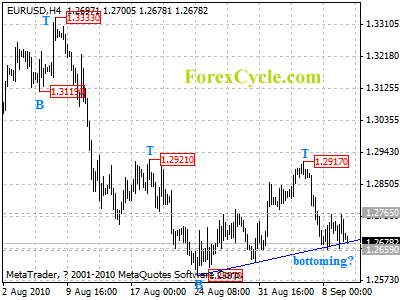
EURUSD trades in a narrow range above 1.2659

EURUSD trades in a narrow range above 1.2659, a breakdown below this level will indicate that the downtrend from 1.2917 has resumed, then another fall towards 1.2587 previous low could be seen. Resistance is at 1.2765, a break above this level will suggest that a cycle bottom had been formed at 1.2659 on 4-hour chart, then further rally towards 1.2917 resistance could be expected to follow.

eurusd

Daily Forex Signals

Forex Daily Market Commentary

By GCI Forex Research

FUNDAMENTAL OUTLOOK at 1400 GMT (EDT +0400)

The euro depreciated vis-à-vis the U.S. dollar today as the single currency tested bids around the US$ 1.2665 level and was capped around the $1.2740 level.  Many European Central Bank officials were on the tape today.  ECB member Stark reiterated some German banks require more capital and there is speculation some eurozone banks will struggle to raise additional capital.  German authorities are speculating Germany’s ten largest banks may require about €105 billion in additional capitalization.  ECB member Liikanen said global current account imbalances remain while ECB’s Mersch said stricter bank capital rules will benefit the eurozone.  Liikanen added inflation expectations are consistent with the ECB’s target.  Mersch also said the ECB will next deliberate the ECB’s emergency policy measures in December.  The European Central Bank’s monthly bulletin reported economic growth momentum is “moderating somewhat” and said inflation risks are “slightly tiled to the upside.”  The ECB also confirmed emergency bank lending will extend into 2011.  Greek finance minister Papaconstantinou reported the Greek economy will shrink less than 4% in 2010.  Data released in Germany today saw August consumer price inflation up 0.0% m/m and 1.0% y/y with the harmonized measure up the same amounts.  Also, French Q2 non-farm payrolls were up 0.2% q/q.  In U.S. news, data released today saw the July trade balance narrow to –US$ 42.8 billion from the revised prior reading of –US$ 49.8 billion.  Also, weekly initial jobless claims came in less-than-expected at 451,000 and continuing jobless claims printed at 4.478 million.  The U.S. labour market remains unable to gain much traction.  President Obama yesterday said he does not support tax breaks for wealthier U.S. taxpayers.  Traders are still digesting yesterday’s Fed Beige Book. Euro offers are cited around the US$ 1.3240 level.

¥/ CNY

The yen appreciated vis-à-vis the U.S. dollar today as the greenback tested bids around the ¥83.60 level and was capped around the ¥84.00 figure.  Bank of Japan Governor Shirakawa defended the central bank’s self-imposed limit on Japanese government bond purchases, citing “adverse effects” on economic growth.  DPJ officials today again called on the central bank to purchase more JGBs on top of the ¥1.8 trillion in bonds it purchases every month.  Shirakawa reiterated there are increasing downside risks to the Japanese economy.  Some traders are still anticipating yen-selling intervention from Japanese monetary authorities.  Finance minister Noda stepped up the verbal rhetoric today about, saying authorities “are conducting various simulations” to arrest the yen’s strength and pledged to take “decisive steps” in the exchange rate market when necessary.  Noda also said the government is closely monitoring China’s decision to increase its purchases of Japanese debt.  Data released in Japan overnight saw the Q3 BSI large all-industry index improve while the Q3 large manufacturing index also improved.  Also, August consumer confidence waned to 42.5 and August machine tool orders were up 170% y/y.  Q2 GDP data will be released tonight along with the August corporate goods price index.  The Nikkei 225 stock index gained 0.82% to close at ¥9,098.39. U.S. dollar bids are cited around the ¥84.60 level.   The euro moved lower vis-à-vis the yen as the single currency tested bids around the ¥105.95 level and was capped around the ¥106.95 level.  The British pound moved lower vis-à-vis the yen as sterling tested bids around the ¥128.65 level while the Swiss franc moved lower vis-à-vis the yen and tested bids around the ¥82.30 level. In Chinese news, the U.S. dollar depreciated vis-à-vis the Chinese yuan as the greenback closed at CNY 6.7837 in the over-the-counter market, down from CNY 6.7912.  U.S. Treasury Secretary Geithner called on China to allow the yuan to appreciate more quickly.  People’s Bank of China member Xia Bin warned economic growth will slow and said China’s 2010 loan policy should not change.  PBoC Governor Zhou warned zero per cent interest rates may discourage banks from lending.  PBoC’s Li said the central bank needs to better manage inflation expectations.  Chinese economic data will be released on Saturday instead of Monday and this has created rumours that PBoC could raise rates on or before Monday.  There is speculation inflation may have increased to 3.5%.

£

The British pound depreciated vis-à-vis the U.S. dollar today as cable tested bids around the US$ 1.5375 level and was capped around the US$ 1.5475 level.  As expected, Bank of England’s Monetary Policy Committee kept its benchmark Bank rate unchanged at 0.50% today and kept its asset purchase target unchanged at £200 billion. There is fresh speculation BoE may be forced to embark upon a new round of bond purchases following the recent pullback in housing, manufacturing, construction, and services.  Some BoE-watchers are speculating the new stimulus could emerge in February.  Deputy Prime Minister spoke today and sterling came off on his remarks that the U.K. economic recovery will be “choppy and uneven.” Data released in the U.K. today saw the July total trade balance worsen to -£4.916 billion.  Cable bids are cited around the US$ 1.5115 level.  The euro appreciated vis-à-vis the British pound as the single currency tested offers around the £0.8260 level and was supported around the £0.8210 level.

CHF

The Swiss franc depreciated vis-à-vis the U.S. dollar today as the greenback tested offers around the CHF 1.0165 level and was supported around the CHF 1.0100 figure.  Data released in Switzerland this week saw the August unemployment rate remain steady at 3.6%.  August producer and import prices will be released on 13 August.  This week, Swiss National Bank reported its foreign currency holdings fell to CHF 218.1 billion in August from CHF 219.5 billion in July, partially reflecting gains in the franc.  In June, the SNB reported it will intervene less in the markets by selling fewer francs after its currency holdings quadrupled.  The SNB has likely not officially intervened since June.  U.S. dollar offers are cited around the CHF 1.0980 level.  The euro appreciated vis-à-vis the Swiss franc as the single currency tested offers around the CHF 1.2920 level while the British pound moved lower vis-à-vis the Swiss franc and tested bids around the CHF 1.5580 level.

Forex Daily Market Commentary provided by GCI Financial Ltd.

GCI Financial Ltd (”GCI”) is a regulated securities and commodities trading firm, specializing in online Foreign Exchange (”Forex”) brokerage. GCI executes billions of dollars per month in foreign exchange transactions alone. In addition to Forex, GCI is a primary market maker in Contracts for Difference (”CFDs”) on shares, indices and futures, and offers one of the fastest growing online CFD trading services. GCI has over 10,000 clients worldwide, including individual traders, institutions, and money managers. GCI provides an advanced, secure, and comprehensive online trading system. Client funds are insured and held in a separate customer account. In addition, GCI Financial Ltd maintains Net Capital in excess of minimum regulatory requirements.

DISCLAIMER: GCI’s Daily Market Commentary is provided for informational purposes only. The information contained in these reports is gathered from reputable news sources and is not intended to be U.S.ed as investment advice. GCI assumes no responsibility or liability from gains or losses incurred by the information herein contained.

GBP in the Spotlight with Asset Purchase Facility and Official Bank Rate

By Greg Holden – The EUR has been falling against a number of its currency rivals over the past day-and-a-half due to a sudden rise in risk aversion. However, yesterday’s successful debt auction in Poland and Portugal helped add a minor boost to the 16-nation single currency. The US Federal Reserve’s Beige Book release also highlighted a growing stagnation in US economic growth, fueling a large number of concerns worldwide.

Today’s major economic releases:

11:00 GMT: GBP – Official Bank Rate

Great Britain is due to release its interest rate figure today, with high volatility being forecast as a result. Even though expectations are for interest rates to be held steady today, the announcement coincides with the Asset Purchase Facility update and a subsequent rate announcement which provides further details on the state of the British economy. This makes today an important day for GBP traders and many investors may want to be on the lookout for intense volatility.

12:30 GMT: USD and CAD – US and Canadian Trade Balance Reports

Both the US and Canada are scheduled to publish their trade balance figures today. These figures report on the difference between imports and exports in each nation’s economy, and have a direct correlation with supply versus demand. As a result, the USD and CAD will likely see high volatility, and potential growth if positive numbers are released.

Forex Market Analysis provided by ForexYard.

© 2006 by FxYard Ltd

Disclaimer: Trading Foreign Exchange carries a high level of risk and may not be suitable for all investors. There is a possibility that you could sustain a loss of all of your investment and therefore you should not invest money that you cannot afford to lose. You should be aware of all the risks associated with Foreign Exchange trading.

Short Term Technical Analysis for Majors

EUR/USD

Yesterday’s failure to sustain break below trendline support at 1.2672, with 1.2658 low reached, triggered a correction higher to leave a lower top at 1.2762, ahead of fresh weakness. Market currently attempting through 1.2658 and clear break here to open 1.2625/1.2586, with extension to 1.2522 not ruled out. To improve immediate bear tone and delay weakness, regain of 1.2762/75, is required.

Res: 1.2762, 1.2775, 1.2840, 1.2875
Sup: 1.2658, 1.2625, 1.2586, 1.2522

GBP/USD

Recovery off 1.5295, 07 Sep low, cleared 1.5490, an hourly trendline resistance, drawn off 1.5596, extending gains to 1.5532 yesterday, ahead of reversal. Fresh weakness is now underway, looking for possible retest of 1.5295, while 1.5532 caps. However, underlying bear trend remains intact as long as 1.5575/1.5617 zone holds.

Res: 1.5476, 1.5492, 1.5532, 1.5543
Sup: 1.5357, 1.5344, 1.5336, 1.5325
USD/JPY

Yesterday’s break below the recent 83.66/51 floor, reached 83.33, before bouncing to mark a likely lower top at 84.05. Potential break below 83.33 will open next target at 82.98. Upside, break above 84.05 would delay, risking 84.28/47 first.

Res: 84.05, 84.28, 84.47, 84.82
Sup: 83.51, 83.33, 82.98, 82.30

USD/CHF

Attempts to break higher, following bounce off 1.0059, yesterday’s low, with market currently breaking through 1.0138/45, previous highs. Sustained break here is needed to resume recovery and expose 1.0237/61, 03 Sep/31 Aug highs. Otherwise, fresh weakness and retest of 1.0059 would be the likely scenario.

Res: 1.0186, 1.0237, 1.0261, 1.0275
Sup: 1.0099, 1.0059, 1.0027, 1.0000

Forex Market Analysis by windsorbrokersltd.com