Safe Heaven Currencies Continue to Rise on High Risk Aversion

Source: ForexYard

Traders moving assets to safer, lower yielding currencies appear to be playing a factor in the correction of the major crosses. The USD and JPY, which are seen as a safer bet than other currencies in times of market stress, will likely keep drawing demand as investors stay away from riskier assets.

Economic News

USD – Dollar Recovery Continues

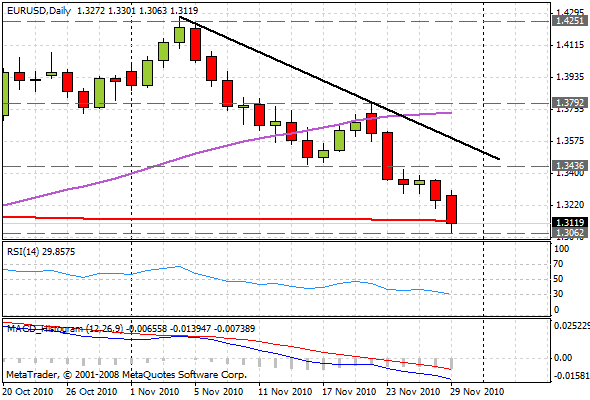
The dollar hit its highest level in two months against the EUR and JPY on Monday rising on safe haven demand as the euro zone debt crisis kept investors averse to risk. By yesterday’s close, the USD rose against the EUR, pushing the oft- traded currency pair to 1.3110. The dollar experienced similar behavior against the JPY and closed at 84.25.

As the U.S. economy stabilizes, currency traders have started to focus more on fundamentals such as economic growth and short-term interest rates. That shift, just getting underway, could take the shine off the soaring USD in the coming months. A stronger currency is important to the U.S. because it entices foreign investors to Treasury debt that finances the nation’s record budget deficit. The downside is that it may restrain profit growth at companies with international sales by making U.S. exports more expensive.

Looking ahead to today, the most important economic indicator scheduled to be released from the U.S. is the CB Consumer Confidence at 15:00 GMT. Traders will be paying close attention to today’s announcement as a stronger than expected result may continue to boost the USD in the short-term. Traders are also advised to follow the Fed Chairman Bernanke Speech around 20:00 GMT. This speech is very likely to impact the dollar volatility. Traders are advised to watch closely, as this is likely to set the pace of the dollar going into the rest of the day’s trading.

EUR – EUR Hits 2-Month Low against Dollar

The euro fell to a two-month low against the dollar on Monday and may face further losses after Ireland’s rescue did little to erase investors’ fears that another euro-zone economy may require a bailout. As a result, the EUR/USD fell as low as 1.3063, its lowest level since September. The 16 nation currency experienced similar behavior against the JPY and closed at 110.49.

European Union finance ministers endorsed an 85-billion-euro rescue package for Dublin and approved outlines of a permanent crisis-resolution system that could make private bondholders share the burden of restructuring sovereign debt after 2013.

Sentiment remained fragile, with a sale of Italian bonds meeting lukewarm demand and highlighting investors’ unease about euro-zone debt. Also, the cost of ensuring Portuguese and Spanish debt against default rose to a record high on Monday.

JPY – Yen Sees Mixed Results versus the Majors

The yen finished yesterday’s trading session with mixed results versus the major currencies. The Japanese yen extended gains versus the euro on Monday, to trade around 110.50 levels amid a broad sell off in the euro. The yen experienced similar behavior against the NZD as the pair fell from 63.19 to 62.75 by days end. The yen finished even versus the USD and closed at 84.07.

A strong yen puts Japanese exporters at a disadvantage by making their goods less competitive overseas and erodes their repatriated earnings, in turn threatening the main growth driver of Japan’s fragile economy. As a result, Japan’s export growth dropped to its slowest pace of the year in October, also hit by softening overseas demand.

However, the yen has weakened from a 15-year high against the dollar in recent weeks as worries over the euro zone and tensions on the divided Korean peninsula bolster demand greenback.

OIL – Crude Oil Trades Near $86 a Barrel

Crude oil prices rose to $85.89 on Monday as Europe’s cold weather and hopes for revived consumer demand lifted refined products futures despite a strong dollar and fears the rescue plan for Ireland might not contain Europe’s debt woes.

The front-month crude price has seesawed after reaching a 25-month peak at $88.62 on November 11. It has not dropped below $80 since October 20.

As for today, traders should pay attention to the U.S Consumer Confidence report scheduled at 15:00 GMT, as it tends to have a large impact on Crude Oil’s price recently, especially in the short-term.

Technical News

EUR/USD

The EUR/USD cross has experienced a bearish trend for the past 2 weeks. However, it seems that this trend may be coming to an end. The RSI of the daily chart shows the pair floating in the over-sold territory, indicating that an upward correction will happen anytime soon. Going long with tight stops might be a wise choice.

GBP/USD

The price of this pair appears to be floating in the over-sold territory on the daily chart’s RSI indicating an upward correction may be imminent. The upward direction on the 4-hour chart’s Momentum oscillator also supports this notion. When the breach occurs, going long with tight stops appears to be preferable strategy.

USD/JPY

The bullish trend is losing its steam and the pair seems to consolidate around the 84.10 level. The daily chart’s RSI is already floating in an overbought territory suggesting that a recent upwards trend is weakening and a bearish correction is impending. Going short with tight stops might be a wise choice.

USD/CHF

The USD/CHF cross has been experiencing much bullish behavior in the past week. However, there is technical data that supports a bearish move for today. The RSI of the daily chart indicates that the pair is floating in the overbought territory, leading to the conclusion that a downward correction is imminent. Going short with tight stops may turn out to pay off today.

The Wild Card

Oil

Oil prices rose significantly yesterday and peaked at $85.89 per barrel. However, the 8-hour charts’ RSI is floating in an overbought territory suggesting that a recent upwards trend is losing steam and a bearish correction is impending. This might be a good opportunity for forex traders to enter the trend at a very early stage.

Forex Market Analysis provided by ForexYard.

© 2006 by FxYard Ltd

Disclaimer: Trading Foreign Exchange carries a high level of risk and may not be suitable for all investors. There is a possibility that you could sustain a loss of all of your investment and therefore you should not invest money that you cannot afford to lose. You should be aware of all the risks associated with Foreign Exchange trading.

Investor Confidence in Euro Continues To Plummet

Finance Ministers across the EU must have been weeping yesterday.

Having spent nigh on two weeks negotiating a bailout package with the Irish government hoping to increase investor confidence in the EU and prevent panic spreading to Portugal and Spain, the markets momentarily rallied. Yes! The announcement of an €83 rescue deal with the Irish had assured the markets that Ireland could become solvent with its debt secured by the EU.

But no. Not long after the package was announced credit default swap rates (the insurance prices investors pay to protect them in case the EU banks collapse) rose not only in debt-laden nations such as Portugal and Italy but Germany too. The Irish bailout in fact had the opposite effect than intended by EU-IMF officials and increased pessimistic sentiment toward the euro.

So what happened yesterday?

The problem is this: Investors increasingly realise that nations including Portugal and Spain face near-identical problems to the Irish, making EU bailouts for these nations look more inevitable. Political leaders in Portugal and Spain can posture but the numbers don’t lie: Spain’s total debt is 220% of national GDP at the moment for instance.

Hence if bailout packages for these EU members are inevitable the question is no longer whether the EU-IMF can rescue them, but whether core members (particularly Germany) have the political commitment to the EU project to do so.

Germany for instance (the powerhouse of Europe) must take a decision: whether to secure billions of euros of debt for members of the EU or simply let the project collapse. The former option is unpopular within Germany (understandably German citizens don’t like the idea of taking on colossal debt because other nations can’t manage their finances.) However officials within Germany as well as France seem extremely committed to the EU project.

This means in consequence that investors have shifted their attention from EU periphery members to the EU as a whole. The debt crisis no longer concerns individual countries but has become a test of the commitment of the project’s founding members. Hence the rise in German credit default swap rates, though Germany is comparatively solvent.

So until the German government puts its cards on the table – perhaps by pre-emptively buying the debt of less solvent EU members before the crisis explodes – investors are nervous about the EU. In consequence sentiment toward the euro is less than optimistic at the moment.

By comparison the dollar is performing strongly at the moment against both sterling and the euro. This is because of reduced risk appetite in the short term: investors treat the dollar as a safe haven currency in times of political turmoil.

Coming up later? Today the latest German unemployment figures are released, and are expected to show improvement for the nineteenth consecutive month. This might traditionally improve sentiment toward the euro but the debt crisis could dominate the markets instead.

[Update: German unemployment figures have been released and shown a nine thousand person drop.]

In addition the latest consumer confidence numbers are released in the US. These are expected to show increased optimism among US consumers, and could further strengthen the dollar.

By Peter Lavelle with currency exchange specialists Pure FX.

“Real Forex” daily analysis for 30-11-2010

AUD/USD

Daily graph: http://www.real-forex.com/charts-daily/November2010/AUD_DAILY_301110.JPG

AUD/USD daily

After an uptrend who last for 3 weeks, the pair clearly broke down the support of 0.9662 during the last session. As mentioned, it is not recommended to enter any transaction immediately after a breakdown; it may be safer waiting for a small correction and then go “Short” (in our case) along with the trend.

As a result, a confirmation of the new trend is required through the identification of a decreasing configuration on 1H graph, unless the pair, during the correction process, would break back the Support of 0.9662. If it does, the previous opportunity is not relevant any more.

Actually, in order to catch the opportunity to go “Short”, the identification of a decreasing configuration on 1H is needed to confirm such an opportunity.

Potential trade

1H graph: http://www.real-forex.com/charts-daily/November2010/AUD_1H_301110.JPG

AUD/USD 1H

The required configuration should appear with the breakdown of the 1H support on 0.9567. In this case, a transaction may be ordered.

–        “Limit” order on “Short” position 10 pips below the mentioned 1h Support, which is: 0.9557

–        “Stop Loss” order on the last peak appeared: 0.9610

–        1st degree to place the “Take Profit”: 0.9524

USD/CHF

Daily Graph: http://www.real-forex.com/charts-daily/November2010/CHF_DAILY_301110.JPG

USD/CHF daily

After several weeks of sideways movement without any specific trend, a new uptrend started. Please notice the presence of a very important resistance on the daily graph situated around 1.0069.

Once that resistance will be reached, there are two possible outcomes resulting:

  1. The collapse of the resistance followed by a closing above that level. In this case, it would be safer waiting for a small technical correction to occur and after the previous trend will be restored, going “Long” with the trend, after the identification of an increasing configuration on 1H graph.  Since, for the last weeks, an important support was created, our intuition is that this outcome is the most likely to occur.
  2. Stop on the resistance, with test or without. In this case, waiting for the end of a “resting period” of at least a session and a half, to confirm the implementation on that resistance would minimize the risk. Then, waiting for the rebound to occur and going “Short” along with the new trend, until the closest support.

Have a nice day

Real forex team logo

Microsoft Reportedly in TV Talks

Microsoft (MSFT) is reportedly in talks with media companies to create a new online pay-television subscription service through devices like its Xbox. Reuters reported that Microsoft has proposed several possibilities such as creating a virtual cable operator via the internet, using the Xbox to authenticate existing cable customers to watch programs with enhanced interactivity, or creating content silos and selling individual channels.

FOREX Update: US Dollar gains on Euro, Major Currencies over Eurozone debt fears

By CountingPips.com

The US dollar has been gaining ground on the other major currencies in forex trading today as fears over European sovereign debt continued despite a Eurozone aid package for Ireland. The dollar has been trading higher against the euro, British pound sterling, Japanese yen, Australian dollar, New Zealand dollar and the Canadian dollar while losing ground to the Swiss franc, according to data by Oanda in the afternoon of the US trading session.

The US stock markets, meanwhile, were sharply lower earlier today before pulling back some with the Dow Jones industrial average currently down by over 40 points, the NASDAQ lower by over 10 points and the S&P 500 declining by more than 2 points at time of writing.

In commodites, oil has advanced by $1.95 to trade at the $85.73 per barrel level while gold has edged higher by approximately $5.00 to trade at the $1367.40 per ounce level.

The euro has declined by over 100 pips from the start of trading yesterday even after the European Union announced a rescue package worth approximately $90 billion for Ireland. Investors have set their eyes on the other EU countries with sovereign debt issues and whether more rescue packages will be forthcoming.

EUR/USD Daily Chart – The EUR/USD opened the week trading near the 1.3241 exchange rate and after a few attempts at a move higher, the currency was sold off sharply in the European session and into the American session to a two-month low point. The pair has come off the low for day at 1.3063 to trade back over 1.3100 and right at the 200-day moving average in red.

Reissue: My Top 10 Forex Resolutions for 2011

Who said that resolutions can only be made on New Year? Well, it’s still roughly a month from the first of January and I already made mine. I mean… the earlier I make the changes the better, right? So let me cut to the chase and tell you now what they are. Here are my top 10 forex decrees:

1)      Don’t hesitate to trade the breakouts!

  • Chart patterns are the bread and butter of technical analysis. There are five basic must-know chart formations – triangles, head and shoulder (inverted), double bottom (tops), cup and handle, triple bottom (top). If you spot a breakout.. trade it!

2)      Don’t forget the fundies!

  • Marry fundamentals with technicals like you’re marrying Jessica Alba. Okay, the latter does not make any sense. In any case, you should always try to execute trades that are both supported by technicals and fundamentals/sentiment as this would increase the chance of them winning.

3)      Don’t gamble!

  • Say no to rogue trading! Trading currencies is not like in a casino where you can just do a one-time big time trade. Of course you can do that but don’t fret if you find your account down to zero the following day. If you want to gamble.. go to a casino! It’s more fun there! If you want to profit… trade forex in a systematic way!

4)      Don’t revenge trade!

  • Did I say no rogue trading? Well, losing is part of the game. So if you do just relax, calm down, and move on. Don’t hit the entry button again and trade twice or thrice of the position that you lost in hopes of getting it back and even winning in one go. You’ll find yourself in a deeper ditch if you lose again.

5)      Manage your positions wisely

  • Manage your positions wisely like your managing your chicks… I mean your checks. Don’t risk more than 1% of your account balance in one trade. Enough said!

6)      Avoid trading in a highly volatile time

  • Trading during the releases of high profile reports like GDP and NFP is not my style. I got whipsawed the last time I tried to ride a sudden slide in prices from a GDP report. You cannot really gauge how much a currency will move given a report. You might get the tail end of the move if you decide to just jump in. If you miss it… then stay away.

7)      Trade on retracements

  • This one is related to number 6. If you miss a breakout or the initial strong move in prices then don’t just jump in. Wait for it to retrace (sounds fancy, eh?) so you can get a better price. Hit the limit order function… it’s there for a reason.

8)      Be flexible

  • The market acts like a girl… fickle minded. You just don’t know what she wants exactly. So sometimes it is best to just adjust and be flexible. To be profitable and likable you gotta do what the woman wants.

9)      Use a journal

  • Okay, journalizing sounds kinda gay-ish. But if you want to keep track of what’s working and what’s not in your trades then you better jot all of them down. Write down your trade ideas, what happened, what you did, what you felt… everything.

10)   Go out. Drink. Chix.

  • Yes. You read that correctly! Forex is a tough business with all the things that you have to read and analyze. We’re just humans. We get strained too. Sometimes we have to take a break as well. So for my tenth decree… Free yourself from stress. Clear your mind. Go out. Drink. Chix.

So there you go… my top 10 forex resolutions. Currently, I’m working on the tenth (Hey Babe!). Alright. Got to head out now. Peace!

More on LaidTrades.com

Euro Gives Back Early Gains; 50% Fib in Play

By Russell Glaser – London traders continued their assault on the euro following earlier gains in the 16-nation currency during the Asian hours. A key Fibonacci retracement may be reached before the end of today’s New York trading.

A weekend announcement signaling an agreement by Ireland to accept financial aid generated interest in the euro at the opening of the Japanese trading session. Ireland is set to receive a bailout package worth 85 billion euros from the EU and IMF.

This helped the EUR/USD climb to an intraday high of 1.3300. However, support for the euro quickly faded as the European markets opened and the pair fell to its lowest level in three months. The EUR/USD is currently trading at 1.3170. Weakness in the euro was felt against the Swiss franc with the EUR/CHF trading at 1.3180, down from an opening day price of 1.3280.

The Irish acceptance of bailout funds reduces some pressure on the indebted nation that stems of the government’s decision to guarantee failing Irish banks. But questions still remain how the Irish political landscape will look with the threat of a crumbling government coalition.

Other European nations also remain susceptible to rising national debts. The nations of Portugal, Spain and Italy are amongst the larger EU members with staunch fiscal problems. Recent headlines show EU institutions are attempting to convince Portugal to accept bailout funds before another financial crisis erupts in Europe.

A lack of economic data on the calendar should leave the European debt crisis firmly in the spotlight during today’s New York trading session. Further euro weakness may be seen as a breach below the support level from September 19th at 1.3160 could propel the EUR/USD lower to the 50% retracement level of the June to November move at 1.3080.

Forex Market Analysis provided by ForexYard.

© 2006 by FxYard Ltd

Disclaimer: Trading Foreign Exchange carries a high level of risk and may not be suitable for all investors. There is a possibility that you could sustain a loss of all of your investment and therefore you should not invest money that you cannot afford to lose. You should be aware of all the risks associated with Foreign Exchange trading.

Learn Forex: Forex Analysis – 28th November 2010

Hi, we can wait weeks sometimes for traders to line up & then (of course, everything then arrives at once!).

There are loads of potential trades arriving now from both weekly & intraday analysis. In fact there are probably TOO MANY! The $USA has had a steady drip, drip of positive news in recent weeks. That combined with the continuing saga of the Euros woes has seen some big $USA gains across all pairs. So how do we play this?

Cautiously is the answer. Everything looks so obvious now that there is a temptation to dive in and take lots of trades & there is the possibility that most could work, HOWEVER as we are cool, dispassionate, cold hearted forex professionals we are not going to be enticed by this forex temptress!

There is always the chance after such big moves that the $ could simply reverse back down again.

The best way to play this is only be in one trade for or against the $US at any one time OR if you take a number of trades in the same direction make sure that the trades combined do not exceed you usual risk limits.

For example I never risk more than 3% in total for my open trades. Therefore if I decided to short the Gbp/$, Euro/$ & $/Aud then I would only be able to risk 1% per trade.

Of course, once a trade has moved the stop to entry or locked in profit we CAN then open another trade even on a correlated pair.

Please watch the video below for my analysis for the week ahead.

Analysis by http://e-forextraining.net/free

Forex Daily Market Commentary

By GCI Forex Research

Fundamental Outlook at 0800 GMT (EDT + 0400)

USD

During the Asia session, risk appetite initially benefitted from the news that Eurozone finance ministers had approved a ?85 bn financial rescue package for Ireland. However, the dollar quickly re-asserted its authority, and the euro gave back all its gains. EURUSD traded 1.3182-1.3354 and USDJPY 83.83-84.20. The reaction of Eurozone sovereign bond markets when they open today will likely be a key determinant of short term euro performance, and the spread of Irish sovereign yields over bunds will clearly be in focus. However, our European rates strategists doubt that any spread tightening is justified on the back of the rescue package alone. For our part we note that the Eurozone sovereign debt crisis is far from resolved and we consequently remain bearish on the euro’s medium term prospects. Due to the Thanksgiving holiday, the weekly CFTC IMM positioning data which is normally released on a Friday, is scheduled to be released instead at 20:30GMT later today.
EUR

Eurozone finance ministers approved a €85 bn financial rescue package for Ireland, although €17.5bn of this will come from Ireland’s sovereign wealth fund and other domestic cash resources. The remaining cash is to be sourced from the EFSM (€22.5 bn), the IMF (€22.5 bn), and the EFSF and bilateral loans (€22.5 bn).
The cash is to be put to several uses: €10 bn has been earmarked for an immediate recapitalization of the banks, with a further €25 bn available as a contingency. The remaining €50bn is to be used to meet the funding needs of the State. The Irish Government estimates that the effective interest rate could be “of the order of 5.8%”.
Ireland will discontinue its participation in the Greece loan facility, and has been given until 2015 to reduce the budget deficit to 3%. This represents a one-year extension to the original timetable. Repayments on the IMF portion of any loans drawn down are not due to start for 4 and a half years, and are scheduled to end after 10 years.
ECB Governing Council Member Noyer said that the current crisis is not a euro crisis; rather it is a sovereign crisis. Last week’s by-election in Ireland was won by a candidate from one of the smaller opposition parties, effectively reducing the government’s majority to 2 seats. The crucial Budget 2011 parliamentary vote is scheduled for Dec. 7.
JPY

BoJ Governor Shirakawa observed that the yen had fallen somewhat since the Fed decided to launch another round of quantitative easing, although he remains on guard for how the economy could be affected by FX moves. He nevertheless expects the economy to resume its export-led recovery throughout 2011.
AUD

Australian inventory data was much weaker than expected in Q3, falling by -0.8% (cons. +0.4%, prev. -0.1%). Our Australian economics team note this implies a 0.3% q/q detraction from the Q3 GDP reading which is due for release on Wednesday. Consequently, our economists revised down their Q3 GDP forecast to +0.3% q/q, putting them significantly below the consensus of +0.5% q/q. RBA Governor Stevens is scheduled to speak at 0730GMT. The talk is entitled “The Challenge of Prosperity”.

TECHNICAL OUTLOOK

EURCHF 1.3072 support
EURUSD BEARISH Push below 1.3235 favours another bearish run towards 1.2988. Resistance at 1.3421
USDJPY BULLISH Recovery through 83.99 exposes 85.40 reaction high ahead of 85.93. Initial support at 83.57
GBPUSD BEARISH With the break of 1.5650, bear trend remains intact. Next support at 1.5297. Near-term resistance at 1.5773
USDCHF BULLISH Rise above 0.9998 exposes 1.0183. Near-term support at 0.9849
AUDUSD BEARISH Focus is on 0.9542 reaction low; a break here would expose 0.9477 Fibonacci support. Resistance at 0.9818
USDCAD BULLISH Sustained break of 1.0264 and 1.0374 required for confirmation of bull trend. Support holds at 1.0076
EURCHF BEARISH Push below 1.3229 exposes 1.3072. Near-term resistance at 1.3401 intraday high.
EURGBP BEARISH Break of 0.8421 and 0.8390 would expose 0.8311. Resistance at 0.8564
EURJPY BEARISH Break of 109.35 would expose 107.73 ahead of 105.44. Near-term resistance at 113.67.

Forex Daily Market Commentary provided by GCI Financial Ltd.

GCI Financial Ltd (”GCI”) is a regulated securities and commodities trading firm, specializing in online Foreign Exchange (”Forex”) brokerage. GCI executes billions of dollars per month in foreign exchange transactions alone. In addition to Forex, GCI is a primary market maker in Contracts for Difference (”CFDs”) on shares, indices and futures, and offers one of the fastest growing online CFD trading services. GCI has over 10,000 clients worldwide, including individual traders, institutions, and money managers. GCI provides an advanced, secure, and comprehensive online trading system. Client funds are insured and held in a separate customer account. In addition, GCI Financial Ltd maintains Net Capital in excess of minimum regulatory requirements.

DISCLAIMER: GCI’s Daily Market Commentary is provided for informational purposes only. The information contained in these reports is gathered from reputable news sources and is not intended to be U.S.ed as investment advice. GCI assumes no responsibility or liability from gains or losses incurred by the information herein contained.

Euro Stabilises As Irish Announce Bailout Details

The market unease concerning the euro came to a (temporary?) halt this morning following the Irish government’s announcement of the details of its €85 billion bailout package.

Investors commenting in newspapers noted that the package is austere: Ireland has effectively surrendered control of its economy to the EU and must pay a reported 8.5% interest rate on the bailout. However investors also noted that the package could conceivably help the Irish onto their feet in the long run.

In addition the German Chancellor Angela Merkel has moderated her comments about potential bondholder haircuts. This has reassured investors that Ireland and EU banks remain a feasible investment for the present. However a question mark remains: the EU Commissioner for Economic Affairs Olli Rehn has refused to rule out ‘collective action’ clauses for bonds in the future.

For now though the euro has stabilised.

In the near future attention in the euro zone must inevitably turn to Portugal and Spain. These nations face solvency problems similar to the Irish: for instance Spain like Ireland is suffering the after-effects of a burst housing bubble.

However the Irish bailout has set a precedent for EU response. EU officials and figures inside the French and German governments seem adamant that the euro project cannot fail. Hence it is likely that in the event of a Portuguese request for assistance the EU-IMF will support them.

This might reassure the markets in the event that more bailouts become necessary.

In the UK meanwhile the strong link between sterling and the euro means the British currency has suffered slightly during the euro zone crisis. This is because the markets have avoided risk throughout the Irish negotiations and treated the dollar as a safe haven currency. Hence at the moment sterling is relatively weak against the dollar.

This trend might continue into the near future. This morning the latest UK mortgage approval figures are released, and are expected to be disappointing. This indicates that high street banks remain unwilling to lend credit to consumers, and points to less than stellar growth in the UK economy.

In addition sterling might continue falling against the dollar because of increased optimism in the US this week.

In the short term the dollar has benefited from reduced risk appetite on the exchange market. However the Fed’s second program of quantitative easing is expected to begin yielding benefits in the US soon: the Fed is set to buy back $39 billion in assets this week for instance.

Hence the dollar could remain strong against sterling and the euro.

On the agenda this week? The situation in the euro zone might continue to dominate headlines, especially as attention turns to Portugal and other EU periphery nations. In addition tomorrow the latest EU consumer price index figures are released. If these numbers are strong – indicating that prices are high – the euro could experience a bounce.

In the US meanwhile the newest unemployment figure are released on Friday. These are expected to show that unemployment is dropping for the first time in six months, and could have a large impact on sentiment toward the dollar.

By Peter Lavelle with currency exchange specialist PureFX.co.uk.