Euro Tumbles and Yen Soars Amid Concern Sovereign-Debt Crisis Will Broaden

Source: ForexYard

The euro continued to weaken on all fronts during yesterday’s trading session amid concerns that Portugal and even Spain will eventually seek financial rescue as well. This has also boosted risk-aversion, and supported demand for safe-haven assets such as the yen. As a result the EUR/JPY cross is now trading near an 11-week low.

Economic News

USD – EUR/USD Drops to the 1.2970 Level

The U.S. dollar rallied against the euro on Tuesday’s trading session. The dollar gained over 170 pips vs. the euro, and the EUR/USD pair fell to the 1.2970 level. However, the dollar tumbled against the Japanese yen, and saw a volatile session against the British pound.

The dollar rallied today vs. the euro due to speculation Europe’s sovereign-debt crisis will broaden. The current concerns are that Portugal and Spain might be next in line to seek financial rescue from the euro-zone. Standard & Poor’s threatened to cut the credit rating of Portugal, boosting concerns for yet another debt crisis.

In addition, the U.S. Consumer confidence report was published yesterday. The report showed that confidence among U.S. consumers rose in November to the highest level in five months. The index advanced to 54.1 from a revised 49.9 in October, beating forecasts for 52.7. The positive data supports optimism that the American economy is recovering, and even at a faster pace than estimated by analysts.

As for today, the ADP will release its forecast for the U.S. Non-Farm Employment Change indicator. The ADP estimates that change in the number of employed people during the previous month, excluding the farming industry. Its forecast is considered to be quite reliable, and thus tends to have a large impact on the market. A positive data might boost the dollar further against the euro.

EUR – Euro’s Free-fall Continues amid Sovereign-Debt Concerns

The euro saw another bearish session during Tuesday’s trading. The euro fell over 170 pips against the U.S. dollar, and the EUR/USD pair reached its lowest level in two months. In addition, the euro fell about 100 pips against the British pound and about 200 pips vs. the Japanese yen.

The euro plunged yesterday on concerns that European nations will face difficulties to raise funds due to the region’s debt crisis. In addition, Standard & Poor’s said it may cut Portugal’s credit ratings on concern the government has made too little progress on initiating economic growth to offset the fiscal drag from scheduled 2011 budgetary cuts. It appears that the Ireland financial rescue plan has left the market a bit suspicious about other European economies, especially Portugal and Spain. It seems that until these economies will prove to have the abilities to handle their debts, the euro might face further bearishness. Traders should also take under consideration that if Standard&Poor’s will eventually decide to cut Portugal’s credit ratings, this might accelerate the euro’s free-fall.

Looking ahead to today, traders are advised to follow all updates regarding the sovereign debts crisis, as this seems to be the most urgent matter for the near future. In addition, traders are advised to follow the German Retails Sales release, which is scheduled for 07:00 GMT; positive data might help to correct some of the euro’s losses.

JPY – Yen Rallies against the Majors As Risk-Aversion Elevates

The Japanese yen rose against all its major counterparts during yesterday’s trading session. The yen gained about 100 pips vs. the U.S. dollar, and about 200 pips against the euro. The EUR/JPY cross fell to an 11-week low as a result. The yen also gained about 80 pips vs. the British pound.

The yen strengthened on Tuesday’s trading as risk-aversion surged due to concerns that Europe’s sovereign-debt crisis will broaden. It is now pretty clear that the Ireland financial bailout failed to reassure the market and yesterday, Portuguese, Italian and Spanish government bonds declined, signing that investors have concerns regarding the nations’ debts. This has increased demand for safe-have assets, and as a result boosted the yen. In addition, speculations that China will take more action to cool its economy have also supported the yen. Analysts estimate that China will have to hike interest rates soon in the attempt to reverse the excessive liquidity in the system.

As for today, traders are advised to follow the updates from Europe regarding the sovereign-debt crisis, as this issue seems to have the largest impact on the market at the moment. Traders are also advised to follow the leading economic releases from the U.S, especially the ADP’s Non-Farm Payrolls forecast.

Crude Oil – Crude Oil Falls Below $83.60 a Barrel

Crude oil fell for a second day and reached as low as $83.55 a barrel. Crude began yesterday’s trading session around $85.80 a barrel. Yet the commodity fell over 200 pips, and a barrel of oil is currently trading near $84.00.

Crude oil prices fell yesterday on concern Europe’s debt crisis may damage economic growth and as a result will decrease demand for fuel. In addition, the U.S. dollar gained to 10-week high against the euro, further weakening the dollar-dominated commodity. It currently seems that as long as the high uncertainty regarding European debts will remain, crude prices could drop lower, and might even reach $80 a barrel.

Looking ahead to today, traders are advised to follow the leading economic news from the U.S. and the euro-zone, especially regarding the European debt-crisis, as this is likely to have the largest effect on oil trading. In addition, traders should follow the U.S. Crude Oil Inventories report, which is scheduled for 15:30 GMT, as this release tends to have an instant impact on the market.

Technical News

EUR/USD

There is a very distinct bearish channel formed on the 4-hour chart, as the pair is now floating in its middle. In addition, as both the MACD and the RSI on the daily chart continue to provide bearish signals, the pair looks to drop further, with potential to reach the 1.2920 level.

GBP/USD

For the past couple of weeks the cable has been falling sharply, from the 1.6290 level to as low as the 1.5470 level. Nevertheless, a bullish cross on the daily chart’s Slow Stochastic suggests that a bullish correction might be impending. Going long with tight stops might be the preferable strategy today.

USD/JPY

The pair has recently peaked at the 84.35 level; however it is dropping ever since. Currently, a bearish cross of both the Slow Stochastic and the MACD on the 1-day chart indicate that the bearish momentum has more steam in it. Going short might be the right choice today.

USD/CHF

The pair has been trading within a restricted range over the past week, between the 0.9920 and 1.0050 levels. Currently, as the RSI has dropped below the 70-line, it appears that a bearish move might be impending, with a key-target level of 0.9920.

The Wild Card

Gold

After bottoming at $1,350 an ounce, gold prices are once again pushing up, and gold is now trading near $1,390 an ounce. In addition, as all oscillators on the 4-hour chart are pointing up, it appears that the bullish trend could prolong today. This might be a great opportunity for forex traders to join a very popular trend.

Forex Market Analysis provided by ForexYard.

© 2006 by FxYard Ltd

Disclaimer: Trading Foreign Exchange carries a high level of risk and may not be suitable for all investors. There is a possibility that you could sustain a loss of all of your investment and therefore you should not invest money that you cannot afford to lose. You should be aware of all the risks associated with Foreign Exchange trading.

“Real-Forex” daily market review

USD/JPY


Daily graph:  http://www.real-forex.com/charts-daily/DEC2010/JPY_DAILY_011210.JPG

USD/JPY daily

The pair stopped a 4 weeks uptrend after it reached, but did not cross, a resistance zone around 84.42. Later, during the last session, a bearish envelope template was created, indicator of very soon reversal – 1 or 2 sessions.

In order to catch the opportunity for a “Short” transaction, a confirmation, through the identification of a decreasing configuration on 1H graph, is required.

Potential trade


1H graph:  http://www.real-forex.com/charts-daily/DEC2010/JPY_1H_011210.JPG

USD/JPY 1H

The required configuration should appear with the breakdown of the support at 83.42 (1H scaled graph support). After the breakdown, since the decreasing configuration will be identified, a transaction may be ordered.

–        “Limit” order on “Short” position 10 pips below the mentioned support, i.e. 83.32

–        “Stop Loss”  order on the last high appeared: 83.79

–        1st level for a “Take Profit” on the following support: 83.19

NZD/USD


Daily graph:  http://www.real-forex.com/charts-daily/DEC2010/NZD_DAILY_011210.JPG

NZD/USD daily

The pair stopped a 3 weeks bearish trend after it reached, on the last session, the support of 0.7407. By looking at the daily graph on several months, we can see the pair stopped at this level several times already, for example: Beginning of September, end of July. At this time, this level was still a resistance.

If the pair is reaching today the support there are two possible outcomes:

  1. The collapse of the support followed by a closing below that level. In this case, it would be safer waiting for a small technical correction to occur and after the previous trend will be restored, going “Short” with the trend.
  2. Stop on the support, with test or without. In this case, waiting for the end of a “resting period” of at least a session and a half, to confirm the implementation of the support would minimize the risk. Then, waiting for the rebound to occur and going “Long” along with the new trend, until the closest resistance. The potential trade in this case, is a short term trade since the general trend of the pair is a downtrend.


Have a nice day!

Real-Forex team logo

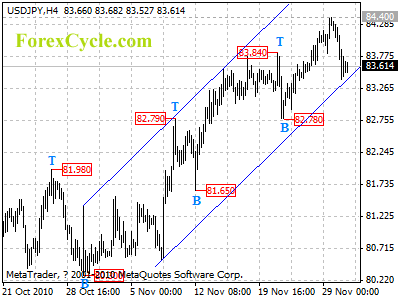
USDJPY pulled back from 84.40

USDJPY pulled back from 84.40 and is now facing the lower border of the price channel on 4-hour chart. As long a the channel support holds, the fall is treated as consolidation of uptrend, and another rise to 85.00 area is still possible. However, a clear break below the channel support will indicate that the upward move from 80.30 has completed at 84.40 already, then the following downward movement could bring price back to 81.00-82.00 area.

usdjpy

Daily Forex Signals

Google Under EU Investigation; Poised to Buy Groupon

Market News Video – Googles (GOOG) advertising business practices being investigated by the European Commission, the European Unions antitrust regulators announced today. The Commission will probe whether Google imposes exclusivity obligations on its advertising partners, including whether Google prohibited them from placing competitor ads on their sites, as well as whether its practices blocked computer and software vendors from competing search tools.

Where is Gold headed? The Video and Sign up for our Free Webinar

By Adam Hewison – The gold market has been pushing out its normal level of frustration and anxiety for the past several weeks.

So the question becomes, is the gold market pausing to move higher, and of course the Bulls would argue this, or is it forming the head and shoulders top that many technicians are looking for? Of course, this would be a bearish sign for gold if this technical formation is completed.

I’ve just finished a short video that shows you what we’re looking at right now in gold and how I think it is going to be resolved. The video is a little over 2 minutes. It’s quick and to the point while supplying you with what you need to take your place in or out of this market. (See Video Below)

You may also wish to attend our gold webinar which we are holding on the 2nd of December at 4 PM EST. The webinar is free of charge, but you need to register in order to attend. This is no hype, but we have limited space and it will be on a first-come first served basis. The important thing is that you register as soon as possible.

Here is the link to register for the webinar: Register for the Webinar

While you do need to register to attend our gold webinar, in order to watch today’s short video no registration is required nor is there any charge.

We hope to see you at this week’s Gold webinar so don’t forget to register.

All the best and enjoy today’s video.

Adam Hewison
President of INO.com
Co-founder of MarketClub

To see more of Adam’s Videos click here or sign up for Adam’s Free 10-part Professional Trading Course.


European Wrap: Market continues to savage the euro; By FastBrokers

Written by FastBrokers House
2010-11-30 00:00

Another morning of pain for the single currency, suffering across the board losses. EUR/USD down at 1.3015 from early 1.3100 havng been as low as 1.2982.

Russia and BIS both seen buying early and we traded in a narrow range either side of 1.3100 for some time.  Then all of a sudden the US investment house who does God’s work came in and hammered EUR/USD.  A series of rumours (see above) then circulated and we were heading lower and quickly.

Barrier interest  at 1.3050 gave out easily, not even a pause.  Reports kept coming that the US investment house was still selling and we soon had 1.3000 looming before us. Slight pause ahead of there before we pierced the level (1.2998 low) followed by bout of profit taking back up to around 1.3025/30.

But this was a brief reprieve before another wave of selling which then took us all the way to session low 1.2982. Model funds were notable buyers around the lows and we’ve recovered back above 1.3000.

Real money has reportedly been selling in recent trade.

USD/JPY down at 83.85 from early 84.05, having been as low as 83.73. The pairing has been pressured by lower US treasury yields, but Japanese importer buy orders lined up from 83.80 to 83.50 are providing a cushion.

Cable slightly lower at 1.5525 from early 1.5545, having been as low as 1.5509 so far.  Selling of the EUR/GBP cross, down at .8385 from early .8425, has provided cable with some support.  The cross has been as low as .8366, but buying by BUBA for month-end purposes lent some support in late morning trade.

Market Commentary provided by FastBrokers.

Disclaimer: FastBrokers’ market commentary is provided for information purposes only and under no circumstances should be regarded neither as an investment advice nor as a solicitation or an offer to sell/buy any financial product. FastBrokers assumes no responsibility or liability from gains or losses incurred by the information herein contained.

Risk Disclosure: There is a substantial risk of loss in trading futures and foreign exchange. Please carefully review all risk disclosure documents before opening an account as these financial instruments are not appropriate for all investors.

Forex: Currency Speculators trim positions vs US Dollar, turn short the Euro

By CountingPips.com

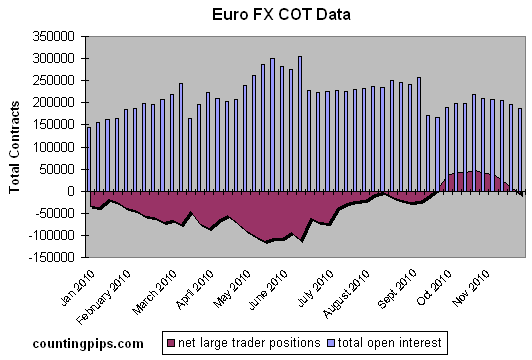
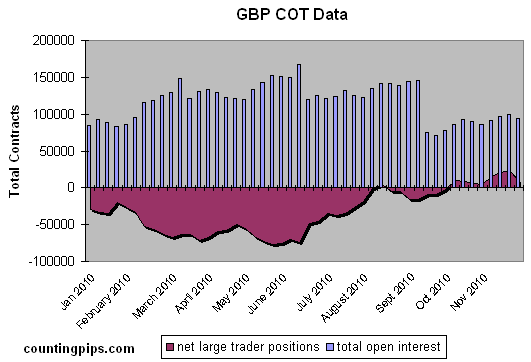
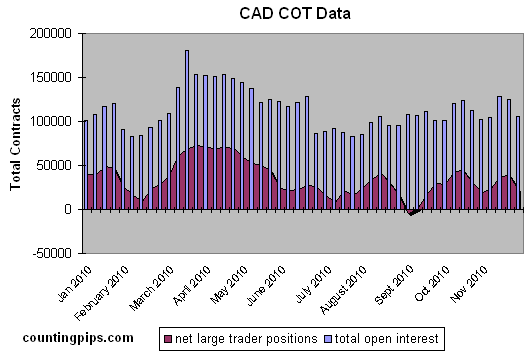
The latest Commitments of Traders (COT) report, released on Monday by the Chicago Mercantile Exchange, showed that futures speculators trimmed their short bets of the US dollar against the other major currencies and are now short the euro. Non-commercial futures positions, those taken by hedge funds and large speculators, were overall net short the US dollar by $9.74 billion against other major currencies as of November 23rd. This is down from a total short position of $15.52 billion on November 16th, according to data published by Reuters which calculates the dollar positions against the euro, British pound, Japanese yen, Australian dollar, Canadian dollar and the Swiss franc. Speculators have now raised their bets in favor of the dollar five out of the last six weeks.

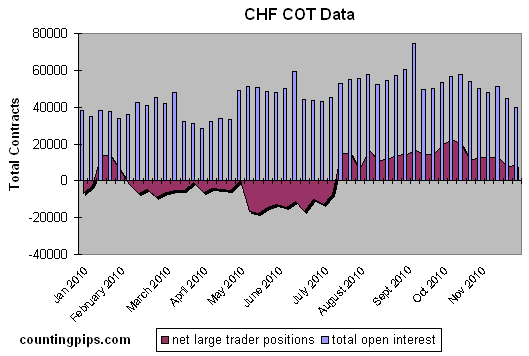
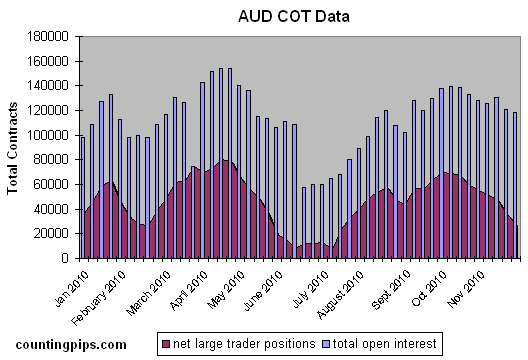
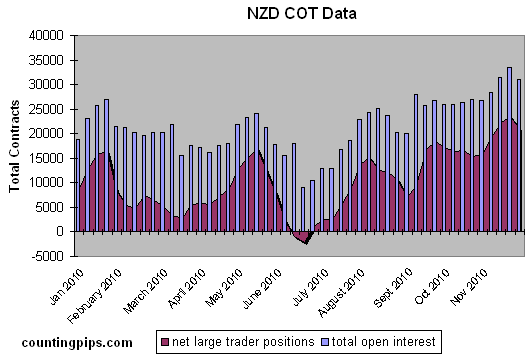
On an individual currency basis, speculators added to their long positions for the Japanese yen and the Swiss franc while decreasing long positions in the euro, British pound sterling, Canadian dollar, Mexican peso, New Zealand dollar and the Australian dollar compared to the week before.

EuroFx: Currency specs were now short the euro against the U.S. dollar by 8,293 contracts as of November 23rd. This is a decrease of over 16,000 contracts following net long positions of 8,606 contracts on November 16th and marks the fifth straight week of declining euro positions after touching a high of 48,243 on October 5th.

The COT report is published every Friday by the Chicago Mercantile Exchange (CME) and shows futures positions as of the previous Tuesday. It can be a useful tool for traders to gauge investor sentiment and to look for potential changes in the direction of a currency or commodity. Each currency contract is a quote for that currency directly against the U.S. dollar, where as a net short amount of contracts means that more speculators are betting that currency to fall against the dollar and net long position expect that currency to rise versus the dollar. Open interest is the number of open contracts that have not been closed by a transaction or by delivery.

GBP: The British pound sterling positions declined to a net of 10,197 long contracts after being long on November 16th by 23,771 positions. The latest data disrupts three straight weeks of increasing pound positions.

JPY: The Japanese yen net long contracts increased after two straight weeks of declines to 27,192 long contracts as of November 23rd from 22,858 net long contracts reported on November 16th.

CAD: The Canadian dollar positions dipped as of November 23rd after advancing for three straight weeks. CAD long positions registered 22,499 contracts after totaling 38,441 net longs on November 16th.

CHF: Swiss franc long positions edged higher to a total of 8,511 long contracts as of November 23rd after totaling a net of 7,803 long contracts on November 16th.

AUD: The Australian dollar positions decreased lower for the eighth straight week after reaching their highest level since April on September 28th. AUD contracts declined to a net amount of 28,471 long contracts as of November 23rd from 36,202 long contracts on November 16th.

NZD: New Zealand dollar futures positions declined as of November 23rd after four straight weeks of increases. NZD long positions fell to a total of 21,069 long contracts after a total of 23,445 long contracts the week before.

MXN: Mexican peso long contracts edged lower as of November 23rd to 87,246 net long positions from 93,217 longs the week prior. The latest data breaks up three straight weeks of increases for the Mexican peso speculative positions.

COT Data Summary as of November 23rd, 2010
Large Speculators Net Positions vs. the US Dollar

Euro: -8293 contracts
British pound sterling: +10,197 contracts
Australian dollar: +28,471 contracts
Canadian dollar: +22,499 contracts
Japanese yen: +27,192 contracts
Mexican peso: +87,246 contracts
New Zealand dollar: +21,069 contracts
Swiss franc: +8511 contracts

Go to the Commitment of Traders CME raw futures data

Further COT Resources from around the web:

Bearish Chart Pattern Hints at Reversal for Spot Gold

By Russell Glaser – The appearance of a head and shoulders reversal pattern provides technical evidence to sell. Other long tern technical indicators support this hypothesis.

The daily chart for spot gold trading displays the formation of a bearish head and shoulders pattern. This reversal pattern may signal a top in the intermediate uptrend that spans from a low in July to a high in November.

Going to the chart, the head and shoulders are clearly defined with the left shoulder taking shape on 10/14, the head is located at 11/9, and the right shoulder at 11/23. A break below the rising neck line would signal a completion of the chart pattern. By measuring the height of the neckline we can estimate a potential move of $100 from the breach below the neck line.

Further evidence of a bearish move in the price of spot gold can be found when looking to the long term time frame. The November candlestick on the monthly chart appears set to end on a doji candlestick. This is a bearish signal for spot gold and supports the hypothesis of a price reversal.

The monthly chart also shows technical divergence in the Momentum oscillator. In December 2009 the Momentum indicator registered a high of 151 on a new high in the price. However, the next peak in June 2010 fell to 140 despite a new record high in the price. We may expect the November number to also fall which would provide further evidence of divergence thus supporting a drop on the price.

Given the bearish chart pattern and the accompanying negative signals from the monthly chart the uptrend appears to be weakening on a technical basis.

A sell would be recommended upon a break below the neckline from the head and shoulders pattern with a take profit level near the rising trend line on the daily chart. The trend line rises off the lows of February, March, and July.

Forex Market Analysis provided by ForexYard.

© 2006 by FxYard Ltd

Disclaimer: Trading Foreign Exchange carries a high level of risk and may not be suitable for all investors. There is a possibility that you could sustain a loss of all of your investment and therefore you should not invest money that you cannot afford to lose. You should be aware of all the risks associated with Foreign Exchange trading.

Forex Daily Market Commentary

By GCI Forex Research

Fundamental Outlook at 0800 GMT (EDT + 0400)

USD

The dollar consolidated during the Asia session given the general lack of newsflow. EURUSD traded 1.3076-1.3150, USDJPY 83.83-84.41. Asian equities are broadly weaker at the time of writing, and the S&P 500 earlier finished fractionally in the red. Concern over Eurozone sovereign risk remains the primary driver of the dollar for now, and so any further widening of Eurozone bond spreads will likely continue to be dollar supportive. However, there are plenty of US data releases also due out this week and any positive surprises could further bolster the case of dollar bulls such as ourselves. We maintain our 3m EURUSD forecast of 1.25. Ahead in the US today, we have S&P/Case Shiller data, Chicago PMI, and the Conference Board consumer confidence index. Minneapolis Fed President Kocherlakota and Fed Chairman Bernanke are also scheduled to speak.
EUR

Eurozone sovereign spreads continued to widen despite the financial rescue of Ireland. The package did little to dissuade contagion fears and a poor Italian auction also put upward pressure on sovereign yields. Spanish and Italian 10y spreads over Germany reached euro-era record wides of 265bp and 191bp according to Bloomberg. And despite the Eurogroup’s statement regarding ‘private sector involvement’ post 2013, the market appears to be questioning the assurances for bonds issued before this date.
The fixed interest rate charged on Greece’s loan will be increased to 5.8%, to bring it into line with the terms of Ireland’s loan. The repayment schedule will also be extended out to 2021.
JPY

The jobless rate for October unexpectedly ticked higher to 5.1% from 5.0% previously. Economy Minister Kaieda said Japan’s economy is stalling, and the employment situation remains severe. He said the rise in JGB yields reflects a similar trend globally, and that he will continue to watch the impact of the BoJ’s latest easing efforts.
GBP

The UK’s Office for Budget Responsibility (OBR)released its latest forecast for the UK economy with GDP growth for 2010 unsurprisingly revised up from 1.2% to 1.8%. GDP growth for 2011 was revised down from 2.3% to 2.1% versus our economist’s forecast of 2.3%. The OBR also said the UK has more than a 50% chance of meeting its fiscal mandate and the budget deficit forecasts are in line with earlier forecasts.
CAD

Canada’s current account deficit widened by $4.6 bn to record $17.5 bn in the third quarter, well above consensus estimates. Up next is GDP for Q3 and September. Monthly GDP should show decreased growth and the quarterly GDP figure will also show a drop from the previous quarter, though it will still show positive growth.
AUD

The AUD got a boost from a strong bounce in October building approvals which came in at +9.3% m/m (cons. 1.4%, prev. -5.3%). The current account deficit was larger than expected. Our Australian economics team are below consensus on the Q3 GDP report due out tomorrow, expecting to see a headline print of +0.3% q/q (cons. 0.4% q/q).

TECHNICAL OUTLOOK

EURCHF testing 1.3072.
EURUSD BEARISH Momentum is negative; the pair targets 1.2988 with scope for 1.2588 next. Resistance at 1.3354.
USDJPY BULLISH Recovery through 83.99 exposes 85.40 reaction high ahead of 85.93. Initial support at 83.57.
GBPUSD BEARISH Break of 1.5650 exposes 1.5509 and 1.5297 next. Near-term resistance at 1.5773.
USDCHF BULLISH Upside potential held at 1.0054 ahead of 1.0183. Near-term support at 0.9849.
AUDUSD BEARISH Focus is on 0.9542 reaction low; a break here would expose 0.9477 Fibonacci support. Resistance at 0.9818.
USDCAD BULLISH Sustained break of 1.0264 and 1.0374 required for confirmation of bull trend. Support holds at 1.0076.
EURCHF BEARISH Following the sudden decline yesterday, the cross now eyes 1.3072. Near-term resistance at 1.3401.
EURGBP BEARISH Break of 0.8402 would expose 0.8311. Resistance at 0.8564.
EURJPY BEARISH Clearance of 109.35 would expose 107.73. Near-term resistance at 113.67.

Forex Daily Market Commentary provided by GCI Financial Ltd.

GCI Financial Ltd (”GCI”) is a regulated securities and commodities trading firm, specializing in online Foreign Exchange (”Forex”) brokerage. GCI executes billions of dollars per month in foreign exchange transactions alone. In addition to Forex, GCI is a primary market maker in Contracts for Difference (”CFDs”) on shares, indices and futures, and offers one of the fastest growing online CFD trading services. GCI has over 10,000 clients worldwide, including individual traders, institutions, and money managers. GCI provides an advanced, secure, and comprehensive online trading system. Client funds are insured and held in a separate customer account. In addition, GCI Financial Ltd maintains Net Capital in excess of minimum regulatory requirements.

DISCLAIMER: GCI’s Daily Market Commentary is provided for informational purposes only. The information contained in these reports is gathered from reputable news sources and is not intended to be U.S.ed as investment advice. GCI assumes no responsibility or liability from gains or losses incurred by the information herein contained.

Euro Continues to Tumble

By Russell Glaser – The EUR/USD fell below a significant Fibonacci level as the euro continues to be sold amid European debt fears.

In European trading hours the euro was weaker on the back of the European debt crisis. Contagion fears are rampant as economists and analysts attempt to identify the next European nation that may require financial assistance.

The release of an 85 billion euro bailout package for Ireland has not helped to ease situation. A potential split in the government coalition threatens to break up the ruling government and delay the passing of the next year’s budget which includes considerable belt tightening as required by the joint EU/IMF bailout package.

Irish bonds have also sold off as new European legislation threatens subordinate bank bond holders to take a haircut of 80% while senior bank bond holders remain guaranteed by the Irish government.

The EUR/USD fell to a low of 1.2979 before recovering to the 1.3040 level. The daily low coincides with a downward sloping channel line off the mid-November lows which should serve as a support. The drop also took the pair below the 50% Fibonacci retracement level for the June to November move at 1.3080. A close below this level will move the next target lower to the 61.8% retracement level at 1.2800.

The EUR/CHF is also down sharply at 1.2973 following an opening day price of 1.3095.

Dollar strength is less apparent today as traders appear to be focused on euro selling. The GBP/USD is slightly lower at 1.5520 from 1.5533. The USD/CHF is down at 0.9975 from 1.0002.

Euro weakness should continue into the New York trading session with US consumer confidence set to be released at 15:00 GMT. European Central Bank President Jean-Claude Trichet is due to testify at 15:30 GMT. His comments may offer a bit of respite for the euro. Federal Reserve Chairman Ben Bernanke is set to speak at The Ohio State University Fisher College of Business in Columbus, Ohio at 20:00 GMT.

Forex Market Analysis provided by ForexYard.

© 2006 by FxYard Ltd

Disclaimer: Trading Foreign Exchange carries a high level of risk and may not be suitable for all investors. There is a possibility that you could sustain a loss of all of your investment and therefore you should not invest money that you cannot afford to lose. You should be aware of all the risks associated with Foreign Exchange trading.