USD/JPY Looks to Correct Gains

By Yan Petters – The USD/JPY pair saw quite a consistent bullish trend during the past month. The pair gained about 400 pips during the last four weeks, rising from the 80.20 level up to the 84.20 level on Friday. However, after the pair failed to breach through the 84.20 level it began correcting gains, and is now trading near the 83.90 level. The bearish correction is likely to extend today, with potential to reach the 83.00 level.

• The chart below is the USD/JPY 4-hour chart by ForexYard.
• There is a very distinct bearish channel formed on the 4-hour chart, and the pair is now floating in its bottom.
• The pair recently reached as high as the 84.20 level, yet this appears to have initiated a mild bearish correction.
• The Slow Stochastic has just completed a bearish cross above the 80-line, indicating that a bearish correction might take place.
• In addition, the RSI is now pointing down, reaching towards the 70-line. If the RSI will cross the 70-line, it is likely to validate the bearish move.
• The next support levels are located at the 83.80, 83.50 and 83.00 levels.
• The next resistance levels are found at the 84.20, 84.90 and 85.30 levels.

Forex Market Analysis provided by ForexYard.

© 2006 by FxYard Ltd

Disclaimer: Trading Foreign Exchange carries a high level of risk and may not be suitable for all investors. There is a possibility that you could sustain a loss of all of your investment and therefore you should not invest money that you cannot afford to lose. You should be aware of all the risks associated with Foreign Exchange trading.

Safe-Haven USD Bullish from European and Korean Woes

Source: ForexYard

The euro zone continues to face debt concerns resulting in mass buy-ins for USD safe-haven positions against its European counterparts. The EUR/USD was down from a weekly high of 1.3790 to close Friday at 1.3241. The combination of euro zone weakness and rising aggression from North Korea against its southerly neighbor has resulted in a resurgent greenback, which appears to be gaining ground on safe-haven bets.

Economic News

USD – US Dollar Trading Higher from Korean Dispute

The US dollar has been trading higher since Friday against its primary currency counterparts. As tensions continue rising on the Korean peninsula, the Japanese yen appears to have turned downward against its safe-haven rival, the greenback. The USD/JPY was up at Friday’s close near the 84.10 price mark, up from 83.50 seen at the start of last week.

The euro zone continues to face debt concerns as well, resulting in mass buy-ins for USD safe-haven positions against its European counterparts. The EUR/USD was down from a weekly high of 1.3790 to close Friday at 1.3241. The combination of euro zone weakness and rising aggression from North Korea against its southerly neighbor has resulted in a resurgent greenback, which appears to be gaining ground on safe-haven bets.

With little news expected out of the United States today, the current trend of the greenback may hold for the time being. Traders should be on the lookout for the significant 1.3200 price mark on the EUR/USD as it tends to find significant support near this level. Likewise with the USD/JPY, the 84.50-60 price range historically puts significant pressure on the pair.

EUR – EUR Opens Higher, but Pares Gains as Debt Woes Persist

The news that Ireland has agreed to a bailout package sent the EUR for a ride in today’s early trading hours. The EUR/USD jumped at the opening of Asian trading with a 50 point bullish movement. The EUR/JPY experienced a similar movement of 40 pips in favor of the euro while against the British pound the 16-nation single currency moved only 30 pips upward.

However, concerns from the euro zone periphery continue as the details of the bailout have yet to be released and traders are still weary from the rising tensions between North and South Korea. The EUR appears to have rapidly pared its gains and is trading moderately lower than its opening price against the majority of its currency counterparts.

With few news events expected out of the euro zone today, the EUR may be sensitive to risk sentiment. Should China’s recent call for an emergency session on Korea falter, the region may undergo further volatility, pushing more investors into safe-havens, such as the US dollar. Traders may also want to pay attention to any releases which provide details regarding the Irish bailout as it will likely give further indications for broader measures throughout the region.

JPY – Korean Tensions Push Japanese Yen Lower vs. USD

Rising tensions between North and South Korea have pushed a number of Asian currencies lower as investors flee the assets of the region. The Japanese yen took a dive against its currency rivals in trading before last Friday’s close and appears to be continuing its bearishness as of this morning.

The USD/JPY was up over 60 pips on the week, opening near 83.50 and closing on Friday at the 84.10 price level. Against the British pound, however, the yen managed to pull weekly gains, dropping the pair to 131.12 from a high mark of 134.18. With some moderately significant reports emanating from Japan tonight, there is a possibility traders will see some volatility entering the forex market as Tuesday’s Asian session comes online.

Crude Oil – Oil Prices Expected to Range-Trade between $80-86 a Barrel

Oil prices continue to float between $80 and $86 a barrel. The commodity has been range-trading between these levels for the past two months and analysts are claiming that this behavior may remain unchanged this week. The reasons are due to the offsetting situation where the United States appears poised for growth whereas the euro zone continues to face debt concerns which will likely mute growth and decrease demand for oil.

The push and pull of these market forces is likely to hold oil prices within the current range. The latest trend of the US dollar may become a factor in today’s trading, however, since last Friday’s uptick in the USD may result in pushing oil prices down towards the $81.00 level later today. This is especially true as no significantly impactful news is expected from either the euro zone or the US today, which means current trends should continue.

Technical News

EUR/USD

After sustained downward movement the pair’s daily RSI and Stochastic (slow) appear to be showing strong indications of impending bullishness. The 1.3240 line represents a significant support level. A doji candlestick on the daily and weekly charts also supports the notion of an impending bullish correction. Traders may wish to go long today.

GBP/USD

The price of this pair appears to be floating in the over-sold region on the daily RSI, suggesting a growth in bullish pressure. A recent bullish cross on the daily Stochastic (slow) supports this notion. Going long with tight stops may be today’s preferable strategy.

USD/JPY

The daily RSI on this pair appears to be floating deep within the over-bought region, suggesting growing downward pressure. An impending bearish cross on the daily and weekly Stochastic (slow) support this notion strongly. Going short may be a wise decision today.

USD/CHF

The daily Stochastic (slow) on this pair appears to be showing an immediately impending bearish cross, while the daily RSI floats in the over-bought region and looks to be descending. Going short with tight stops appears to be preferable today.

The Wild Card

Silver

The price of silver appears to be floating deep within the over-bought region on the weekly RSI, suggesting high bearish pressure. A series of recent bearish crosses on the weekly and daily Stochastic (slow) supports the notion of an imminent bearish movement. Forex traders may want to capture this impending movement by entering their short positions now and riding the downward wave.

Forex Market Analysis provided by ForexYard.

© 2006 by FxYard Ltd

Disclaimer: Trading Foreign Exchange carries a high level of risk and may not be suitable for all investors. There is a possibility that you could sustain a loss of all of your investment and therefore you should not invest money that you cannot afford to lose. You should be aware of all the risks associated with Foreign Exchange trading.

Global Recession: A Paradigm Shift?

Waterbury Financial Strategies Inc CEO / Founder Rahim Thawer post this week “Global Recession: A Paradigm Shift?”

As we see challenges in the global economies, we must also simulate new models not only to get us through the survival mode but also to make our organizations stronger and more powerful than ever before. However, the question we must ask ourselves as the executives of our comprehensive domain, can we handle the growth? Are we ready for the paradigm shift?

With or without you, this shift is happening across various industries and sectors and it has never been as aggressive in the past. Paradigm shift is contributing and making its presence appreciative in the organizational structure of many creative companies and bring worlds together and making them smaller. It is now that we must embrace and accept it by formulating new strategies for not only growth but sustaining current state.

This recession brings abundance of opportunities for any business regardless of industry they are in. If you are an entrepreneur and can’t seem to find that gold nugget, I say you are not looking hard enough. You need to look harder and find the opportunity within your industry. We simply have to position ourselves to be on the receiving side and not on the giving side.

In the next few years will encounter a number of changes in the business world and many times these changes will affect us as well, but we have to be the judge of whether that impacts us in a positive manner and not negative. This shift needs to be initiated in every organization from the frontend such as business development and sales to the backend like the financials, etc.

My Thoughts: Create positive synergies amongst your partners and related industries; don’t wait for them to happen! Be creative and think logically before making a commitment, especially long term commitment. Are we ready for the Paradigm Shift? Or should I ask are you ready for the Shift?

Rahim Thawer / CEO of Waterbury Financial Strategies Inc http://www.waterburyfs.com

About the Author

CEO & Founder of Waterbury Financial Strategies Inc

Why invest in Forex vs. other investments?

Written by Emerging Market Capital FX (EMCFX.com)

There are many individuals who invest to make supplemental income or to grow their long-term retirement. All investors want to see a positive or consistent return in their investment vehicle and have someone to trust that can manage their assets or portfolio. There are a small percentage of sophisticated investors who do their research and know how to manage their risks in order to gain a larger return on their investments. However, over 90% of investors have no idea how to pick out an investment. The majority of them rely on friends or family for insight. Here we can compare the forex market to other popular investment vehicles such as stocks, commodities, mutual funds, and CD’s.

The stock market, Dow Jones, S&P, etc… are the most heard of and the most popular type of an investment. This is why these are all you hear about through out the day from CNBC, CNN, major newspapers, to local news. When you purchase a stock you receive a stock certificate. You then hope the value of the stock goes up in price and some individuals hold the stock for long term and it stays there. If the stock value falls it might take a few years for it to return to the original purchase price of the share. Until then you are cornered in the market till the price value rises again.

Commodities are futures and options contracts that can be traded at the Chicago Mercantile Exchange or other clearinghouses. The majority of traders use options by betting on the price, whether it will go higher or lower and hoping the strike price hits before the contract expires. The investment costs are more expensive such as margin calls. But in the long run, being on the right side of the market is a larger gain.

There are over hundreds of thousands of types of mutual funds and often it is confusing to know which one to invest in. These funds are a pooled investment with a fund manager in charge of the portfolio. Most of the mutual funds offer a range from low to high-risk returns. There are maintenance fees and early withdraw penalty fee. If the market goes down, the mutual fund goes down with it. The only drawback is you do nothing or take an early withdraw penalty to minimize your losses.

CD’s, certificate of deposits, have fixed rates and offer short to long terms. One advantage of a CD is peace of mind of receiving a fixed rate of return at the end of the term even though it may be low yield.

In comparison to all of these, the Forex Market trades $3.2 trillion dollars in volume each day. This fact alone shows the liquidity in this market and there are always buyers and sellers in the market 24 hours a day, 6 days a week. There are four major sessions in the U.S., Asian, European and London markets. In the spot market there are no expiration dates, no early withdraw penalties, no maintenance fees, no management fees or advertisement fees involved like many other investments have. The one true advantage of trading in the currency market is that you can enter or exit when the market is up or down and never get cornered.

In summary, stocks ownership is a long-term investment with ups and downs. Commodities can be rewarding but the downside is margin calls. With mutual funds the only drawback is that there are so many to choose from. Certificate of deposits offer a low yield in return. The forex can be rewarding with proper control risk management managed by a forex fund manager.

© 2010 EMCFX

About the Author

Mark Baker as one of the most dedicated and hard working independent providers of forex managed funds to individuals from low to high wealth portfolios. We offer transparent real time platforms for peace of mind. Emerging Market Capital FX (EMCFX) can be your alternative source for forex managed funds. Find out more about how to minimize your losses in your portfolio and regain your wealth at http://www.emcfx.com

USCBC Survey Reveals Top 10 Concerns for Foreign Investment into China

The U.S.-China Business Council (USCBC) released its “2010 Member Priorities Survey Results” for U.S. investors on November 17 after interviewing a cross section of leading American companies. The survey says while most U.S. companies still hold strong commitments to the Chinese market and stayed profitable in China over the past year, the market is in general less FDI friendly compared to three years ago.

The survey listed the top 10 investor concerns surrounding the Chinese market. Human resource issues, licensing and business approval, as well as competition with state-owned enterprises (SOEs) are considered the top three issues that hinder American investment in China from further growth. Other concerns that are ranked from fourth to tenth are related to China’s intellectual property rights (IPR) enforcement, cost increases, market access in services, transparency, protectionism risks, government procurement, and standards of conformity assessment.

The report shows that government policy is one of the major factors that lead to these concerns. In research on “the primary restraint on increased profitability in China,” 27 percent of companies consider PRC government policies as the top restraint, and 24 percent of them chose domestic competition as the biggest hindrance. The report gives the example of how China’s Anti-monopoly Law might complicate merger and acquisition procedures, which have become one of the major avenues most U.S. companies take for further expansion. It also mentions many of the current policies that favor Chinese companies for government procurement and indigenous innovation have greatly contributed to the increasingly fierce competition between foreign and Chinese enterprises.

Other concerns in the list show what improvements U.S. investors hope for in China’s future policy-making. The lack of IPR enforcement remains one of the top 10 issues investors are apprehensive of in the past five years. Of the interviewed companies, 59 percent think the IPR protection status in China remains unchanged in the past one year. Companies in the service sector also complain about the arduous market access in services due to the difficulty in licensing, special treatment to SOEs and a series of other specific barriers. More than that, all respondents say they look forward to a more transparent market system with a clearer interpretation of regulations and complete system of standards and conformity assessment procedures.

Another noticeable issue for U.S. investors is the availability and cost increase of China’s human resources. Recruiting and retaining talent ranked as one of the top concerns this year. Roughly 8 percent of companies consider “insufficient personnel” as the leading restraint on profit growth. Meanwhile, more than half respondents think they have received pressure from the increasing activities on labor issues due to China’s new labor regulations and mounting labor unions.

Increases in labor costs are also seen as the reason why business operations are becoming more expensive in China. While 90 percent of investors think China’s rising cost can slow down their business, 58 percent of them blame escalating labor costs as the top contributor to the overall cost augment. Other than the expense on labor force, companies consider the cost of taxes, materials, land and utilities as the four other major causes of the cost increase. Nearly 80 percent of respondents believe the ascending cost will impact on their future commitment to Chinese market.

About the Author

This article was written for China business site, China-Briefing.com. The site is contributed to by Chris Devonshire-Ellis. Vietnam Briefing and Asia Briefing were also founded by Chris Devonshire-Ellis.

Trading the Highs and Lows of the Stock Market

By Thomas Bainbridge

The markets are looking rather fidgety at the moment and there’s a lot of focus on the Irish debt problems. The knives will be out for any bank with exposure to the Emerald Isle and it is difficult to imagine that the European Central Bank will have much sympathy for any such institutions. There are obvious fears for further contagion with property debt in Spain still concerning investors.

The Dow Jones, German DAX 30 and UK FTSE 100 have all rallied strongly since August, and all bull runs will naturally run into profit taking periods. The difficult aspect for spread betting investors is distinguishing between a pull back and an overall market reversal. Traders are unlikely to worry just yet though as we appear to be reacting to isolated factors which are, hopefully, just installing a bit of caution.

In fact, according to a Paddypowertrader report, most stock markets have a rather large buffer before they will concern the technical investors. “The FTSE 100, on a trend basis, is still well within a bull trend and that will be the case even if that market drops 3-4% to 5500. For the FTSE there is near term price support at 5730/5735 and more solid support at 5665/5670” it read.

Of course, if you trade the markets you will expose yourself to some risks. Whether you invest in CFDs, stocks and shares, spread bets or Exchange Traded Funds, you can lose money.

So what should you do if you are considering trading the markets? What if you just want to risk a few hundred, rather than a few thousand, Euros, Dollars or Pounds? What should you do if you only want a small amount of exposure to the markets? In the UK, and increasingly in the international community, investors are turning to financial spread betting.

Whilst planning your financial investments though, there are, as stated above, risks when you trade. Any investment can lose money. Share trading, buying a house and Exchange Traded Funds can all lead to losses. With spread betting, these losses can be larger than your initial stake.

It is also important to realise that spread bets do carry a high level of risk. Before trading, ensure that spread betting matches your investment objectives. Make sure you familiarise yourself with the risks. Seek independent advice where necessary.

The real beauty of spread trading is the range of advantages. Here are a few:

1) One advantage is that financial spread trading provides a wide range of financial markets on which you can speculate, including commodities, currencies, stock market indices and equities markets.

2) Because you are dealing with a spread betting firm, your trades do not incur any brokers’ fees.

3) There is no exchange of any shares, assets or resources; you simply speculate on the future value of a given market. This means that there is no income tax or capital gains tax on spread bets*.

4) Unlike normal share trading, investors can take short positions; spread betting lets you trade in both directions. This means that, if your research leads you to think that a stock market like the Dow Jones or FTSE 100 is going to increase, you can spread bet on it to go up. If you think the Dow or FTSE will decrease then you can spread bet on them to go down.

Before you trade though, bear in mind that using smaller stakes and employing Stop Losses can help to reduce your risks.

* According to UK tax law. If you pay tax in a jurisdiction other than the UK then this may be different.

About the Author

A leading financial author based in the heart of London’s Canary Wharf. Thomas Bainbridge is a respected commentator on the financial markets including the Financial Spreads markets.

How do you analyze Forex News?

Written by Emerging Market Capital FX (EMCFX.com)

Forex news can be about the following: Economic indicators, monetary policy decisions, comments from financial leaders, elections, interventions, referendums, war etc…all these can cause an effect resulting in either a strong or weak dollar.

Economic indicators measure the strength or weakness of the economy. Prior to a news release the actual numbers will be compared with the previous numbers to see if there was an expansion or detraction in the indicators. Economists will forecast their projections based on their research and statistics and try to predict these indicators. When the forecasted number is compared to the previous number the market can either buy the rumor or sell the fact later. If the actual number being released is better than expected buying pressures immediately will fuel the market. If the number released is worse than the expected the market will have less buying pressures or profit taking.

Monetary policy meetings are decisions made by either raising, cutting or keeping interest rates neutral. Each country will have it’s own policy decision based on the countries economy. The country will either be in an inflationary or deflationary market pressure. Raising rates (Hawkish) during an inflationary period is a negative sentiment to slow down spending. In this case the market can anticipate these comments and can buy the rumor and sell the fact later.

Comments from central bank heads or financial leaders can be either neutral or positive. This also can be a leading indicator for interest rate decisions. If their comments come out and are interpreted negatively, then you could see short covering or liquidation.

Presidential or prime minister elections can push the parties view to either have a strong or weak dollar. Countries can be an exporting, commodity, or surplus nation and this will dictate for a weaker or stronger currency.

Interventions are normally used to strengthen or weaken a currency. For example, Japan is an exporting nation that would rather have a weaker currency, which is good for their exports to make them more competitive.

Referendums are a popular vote. Some countries would vote on key government issues which can also be a leading indicator by buying the rumor and selling the fact.

Wars will depend on who will be the safe haven. Normally the U.S. dollar is the safe haven currency to go into. In the past USD/CHF have been the safe haven since they are a neutral country.

In conclusion, anticipating the news and having an understanding of why you would want to buy or sell against the dollar will give you the edge in trading long term. Forex market news can be a strategy on trading the news.

© 2010 EMCFX

About the Author

Mark Baker as one of the most dedicated and hard working independent providers of forex managed funds to individuals from low to high wealth portfolios. We offer transparent real time platforms for peace of mind. Emerging Market Capital FX (EMCFX) can be your alternative source for forex managed funds. Find out more about how to minimize your losses in your portfolio and regain your wealth at http://www.emcfx.com

Quantitative Easing and Trading the Stock Markets

By Thomas Bainbridge

After the US Federal Reserve announced an extra $600bn in quantitative easing, stock markets around the world saw strong rallies. In Europe the fresh liquidity caused the FTSE 100 to reach a 52 week high.

Mining stocks had a particularly good time of it. As a FinancialSpreads.com report on quantitative easing stated: “However you look at it, and whatever your view of more quantitative easing, it equals a weaker Dollar. The result is that investors are looking elsewhere to put their money. This means putting it into the emerging markets and that in turn means stronger mining stocks. Of course, with this kind of action, the risk of more bubbles increases.”

Where next for the stock markets? Well, the FTSE 100 is taking on resistance levels and the bears are getting squeezed. This could produce a breakout, but it looks like spread betting account holders are continuing to sell into the strength as they believe that the 2010 highs will remain in tact.

This appears to be a dangerous way to trade given that we are now just above the yearly highs. Not only that but the FTSE 250 has been forging ahead since the beginning of October. Of course, this could just be the traditional end of year rally.

Whatever your view of the markets, with spread betting you can speculate on the markets to go up or down. All good investment news stories, blogs and articles will tell you that when speculating on the financial markets there are ever present risks, irrespective of the investment format. When share trading, using CFDs or ETFs, you are likely to lose some of your trades.

But where can you find a convenient, flexible investment option which also offers risk management tools, tax benefits and access to thousands of global markets? For many UK, European and Australian investors, spread trading is a solution.

Note that it is crucial to understand that investment does come with risks. As with all investments such as trading shares, funds, pensions, housing etc, you can lose money. With spread betting you can lose more than your initial investment.

There are a few other points which the following warning suggests you consider, ‘Spread betting does carry a high level of risk to your capital. Ensure that spread betting matches your investment objectives. Familiarise yourself with the risks that are involved. Where necessary, seek independent advice’.

There are many advantages with spread betting though, chiefly that it gives you access to a wide variety of global markets that you can speculate on including foreign exchange, indices, commodities and equities markets.

Also, spread trading can help keep your costs down. If you are trading stocks and shares then you will normally incur brokers’ fees or similar commissions. When spread trading, there aren’t any such fees.

Not only that but unlike normal share trading, investors can take short positions; spread betting lets you trade in both directions. This means that if your research leads you to think that the FTSE 100 is going to increase, you can spread bet on it to increase. On the other hand, if you think that the Dow Jones is likely to struggle, you can short the market, ie speculate on the market to drop.

Finally, there is no exchange of any shares, assets or resources; you simply speculate on the future value of a given market. Therefore, spread trading profits are not subject to income tax, capital gains or stamp duty. This is based on UK tax law, note that tax laws may vary if you live outside of the UK and can change from time to time.

About the Author

A leading financial author based in the heart of London’s Canary Wharf. Thomas Bainbridge is a respected commentator on the financial markets including the Financial Spreads markets.

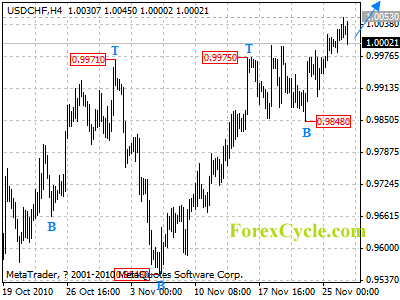
USDCHF remains in uptrend from 0.9548

USDCHF remains in uptrend from 0.9548 and the rise extended to as high as 1.0053 level. Key support is at 0.9848, as long as this level holds, uptrend is expected to continue and another rise to 1.0200 area is still possible. However, a breakdown below 0.9848 will indicate that the upward move from 1.9548 has completed at 1.0053 already, then the following downward move could bring price back to 0.9600-0.9700 zone.

usdchf

Daily Forex Reports

NZDUSD Continues Bearish Momentum

By Forex Signs, Inc.

From the yesterday’s session, the NZDUSD continued its bearish momentum, as price breached the previous day’s support line of 0.7557. For today’s session, the pair established a new resistance level of 0.7619 and new support level 0.7542. Price is now testing its support level, and any breach below this would likely continue throughout the session. MA (14) on one hour chart shows a strong downtrend momentum. While Bollinger bands on the same time frame, shows the bearish candlesticks breaching the bottom line and continues its downward trend, indicating a bearish momentum. RSI (14) for one hour chart shows the price is nearly overbought but is likely to maintain its position. In sum, expect this pair to be volatile as the holiday season approaches.

USDJPY Continues to Surge

During the previous session, the USD/JPY pair strengthened from the 83.45 level to 83.66 level before closing at 83.53, a gain of around 21 pips. As of the moment, at the M30 time frame the pair seems to move along the short term consolidation pattern with the SMA (65), and is looking to retest the immediate support level at 83.68. Apart from that, the MACD (10, 26, 9) at H1 time frame is about rise above the signal line, whereas the RSI (14) at the same time frame had already reached the oversold position, thus stimulating a continuous buying momentum for the upcoming trading, but anticipation for a continuous short term consolidation is still highly feasible. For the moment, a hold/buy position is still relevant for the current movement of the USDJPY, however overall bias may likewise turn into a buy proposal.

Australian and its Decline in the Investments

With the central bank Governor Glenn Steven announcement during the previous session that the nation’s interest rate setting is appropriate enough for the period ahead, Australian dollar in response had seen to move in volatility.

In Australia, as the RBA becoming pretty much comfortable with the current level of policy, any adjustments in this within this year may tend to be vague, thus intensifying the probability that Aussie may stay along the bearish trend.

So far, with the government reporting about the decline in the investments in new plant and equipments, which corresponds to the nation’s gross domestic product, the so- called Aussie may likely weaken further against 15 of its 16 major counterparts as stocks continuously drop, sapping demand for higher-yielding assets.

About the Author

Forex Signs, Inc., Founded in 2006 in Wall Street, New York City, FSI relentlessly strives to be the premier Forex brokerage company in the industry by providing exclusive and unmatched trading and investment related services while constantly developing innovative solutions that cater to the vast requirements of both individual and institutional market participants.