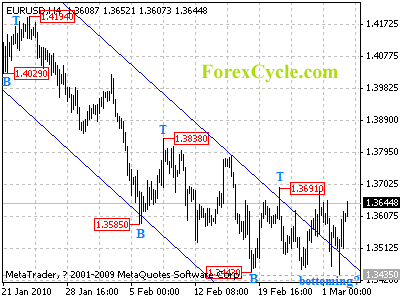
EURUSD bounced from 1.3435

After touching 1.3443 previous low, EURUSD bounced from 1.3435, suggesting that a short term cycle bottom is being formed on 4-hour chart. Further rise to test 1.3691 is expected later today, a break above this level will confirm the cycle bottom, then further rally could be seen to 1.3750-1.3800 area. However. The price action from 1.3443 is still treated as consolidation of downtrend from 1.4579, one more fall towards 1.3300 is still possible after consolidation.

eurusd

Written by ForexCycle.com

Forex Daily Market Commentary

By GCI Forex Research

Fundamental Outlook at 1500 GMT (EDT + 0500)

The euro appreciated vis-à-vis the U.S. dollar today as the single currency tested offers around the US$ 1.3620 level and was supported around the $1.3440 level.  Traders continue to express optimism that meetings between Greek officials and German officials this week will be productive and result in some sort of financial asssitance package for Greece.  Ahead of this week’s meeting, Greece announced today that it is pursuing another €6.5 billion in deficit cuts.  Greece is expected to float up to €5 billion in new 10-year bonds over the next week or two to help finance its massive budget deficit that topped out above 12% of gross domestic product in 2009.  One possible financial rescue scenario has some eurozone member countries purchasing Greek bonds to support the beleaguered country.  In addition to Greece, other eurozone countries continue to face difficult fiscal challenges including Spain, Portugal, and Ireland.  Data released in the eurozone today saw EMU-16 February producer prices climb 0.7% m/m and fall 1.0% y/y while February consumer prices were off 0.9% y/y.  Interest rates were back in focus today as Bank of Canada kept its main overnight rate unchanged at 0.25% and Reserve Bank of Australia lifted its main rate by 0.25%.  The European Central Bank is expected to keep its main refinancing rate unchanged at 1.00% for the foreseeable future.  The ECB will discuss on Thursday the idea of lending covered bonds to banks for a fee.  In U.S. news, Kansas City Fed President Hoenig made news today when he vociferously defended the need to maintain the Fed’s policymaking and supervisory independence.  Hoenig also said the Fed should begin to raise interest rates even with high unemployment.  Minneapolis Fed President Kocherlakota said there is a risk that smaller U.S. banks could precipitate the next financial crisis, adding their exposure to commercial real estate “may be exerting a significant drag on the overall economic recovery.”  Euro bids are cited around the US$ 1.3335 level.

¥/ CNY

The yen appreciated vis-à-vis the U.S. dollar today as the greenback tested bids around the ¥88.90 level and was capped around the ¥89.35 level. The verbal skirmish between Bank of Japan and the government continued with the latter saying it will not seek a change in law to permit the former to purchase new Japanese government bonds.  Yesterday, financial services minister Kamei called on the BoJ to directly purchase JGBs to financial stimulus spending.  Finance minister Kan today tempered Kamei’s remarks saying “We have to rebuild the economy, which requires spending, but we don’t have the financial reserves and if we issue bonds, that will push yields up. We have to tread a very narrow path.”  BoJ Governor Shirakawa has recently increased his anti-deflation rhetoric but has also suggested deflation is not purely a monetary phenomenon, adding a lack of final private demand is contributing to lower prices.  The central bank purchases ¥1.8 trillion if Japanese government securities every month and Kan continues to call on the central bank to take “appropriate action.”  Additionally, Kan yesterday indicated he hopes deflation will end by the end of the year whereas current BoJ forecasts have deflation continuing through at least the second half of 2011.  Data released in Japan today saw the January unemployment rate decline to 4.9%.  The Nikkei 225 stock index climbed 0.49% to close at ¥10,221.84.  U.S. dollar offers are cited around the ¥94.75 level.  The euro moved lower vis-à-vis the yen as the single currency tested bids around the ¥119.75 level and was capped around the ¥121.30 level.  The British pound moved lower vis-à-vis the yen as sterling tested bids around the ¥132.50 level while the Swiss franc moved lower vis-à-vis the yen and tested bids around the ¥81.85 level. In Chinese news, the U.S. dollar appreciated vis-à-vis the Chinese yuan as the greenback closed at CNY 6.8266 in the over-the-counter market, up from CNY 6.8263.  China is expected to continue raising its reserve ration as shorter-term bills expire.  One recent study published in the U.S. suggests China will face a significant debt crisis in 2012 on account of regional and local borrowing activities.  Data released in China yesterday saw February manufacturing PMI decline go 52.0 from 55.8, considerably weaker-than-expected.  Revised U.S. TICS data released on Friday confirmed China is the largest holder of U.S. Treasuries. Foreign holdings of U.S. debt now total US$ 2.7 trillion in aggregate.

The British pound weakened vis-à-vis the U.S. dollar today as cable tested bids around the US$ 1.4855 level and was capped around the $1.4995 level.  Cable again moved lower as traders reacted to strong-than-expected U.K. GDP data that were released on Friday.  One theory suggests Prime Minister Brown may take advantage of the stronger-than-expected GDP data by calling a general election earlier than previously expected.  Sterling is lower on the premise that the U.K. could have its first minority government in decades. The opposition Tory party is largely expected to assume more after more than one decade of Labour rule.  Data released in the U.K. today saw February PMI construction decrease slightly to 48.5 from 48.6 in January.  Cable bids are cited around the US$ 1.4455 level.  The euro moved higher vis-à-vis the British pound as the single currency tested offers around the ₤0.9090 level and was supported around the ₤0.9015 level.

Forex Daily Market Commentary provided by GCI Financial Ltd.

GCI Financial Ltd (”GCI”) is a regulated securities and commodities trading firm, specializing in online Foreign Exchange (”Forex”) brokerage. GCI executes billions of dollars per month in foreign exchange transactions alone. In addition to Forex, GCI is a primary market maker in Contracts for Difference (”CFDs”) on shares, indices and futures, and offers one of the fastest growing online CFD trading services. GCI has over 10,000 clients worldwide, including individual traders, institutions, and money managers. GCI provides an advanced, secure, and comprehensive online trading system. Client funds are insured and held in a separate customer account. In addition, GCI Financial Ltd maintains Net Capital in excess of minimum regulatory requirements.

DISCLAIMER: GCI’s Daily Market Commentary is provided for informational purposes only. The information contained in these reports is gathered from reputable news sources and is not intended to be U.S.ed as investment advice. GCI assumes no responsibility or liability from gains or losses incurred by the information herein contained.

Gold Logs Key Gains

Gold continues to exert a relative strength and has popped past our 3rd tier downtrend line.  Our 3rd tier downtrend line is key since it runs through February highs.  Hence, a test and movement beyond the $1130/oz area could be in the works.  Gold is moving higher once again without the Euro and Pound, which are both mired in fiscal and political uncertainties.  Therefore, it appears gold may become a safe haven in its own right and ignore its negative correlation with the Greenback.  However, we’ll have to continue to monitor the situation to determine whether this becomes a more lasting deviation.  Meanwhile, all is quiet on the data front today with a busy day on deck.  The UK will release HPI and Services PMI data tomorrow followed by U.S. Services PMI and ADP Non-Farm Employment Change figures.  Australia will kick off the day by printing its GDP during the Asia trading session.  Hence, volatility could reignite tomorrow considering all of these data points carry some weight.

Technically speaking, we left our trend lines as is today to give investors a clear picture of gold’s breakout.  That being said, Gold has no foreseeable downtrend lines from present price and faces technical barriers in the form of 2/22 and 1/20 highs.  As for the downside, gold has multiple potential uptrend lines serving as technical cushions along with 3/1 and 2/23 lows.  Additionally, the highly psychological $1100/oz level could serve as a strong technical cushion should it be tested.
Present Price: $1125.85/oz

Resistances: $1125.97/oz, $1128.16/oz, $1130.84/oz, $1134.13/ oz, $1135.82/oz, $1138.73/oz

Supports: $1123.30/oz, $1120.80/oz, $1119.11/oz, $1116.20/oz, $1114.26/oz, $1111.60/oz

Psychological: $1100/oz, $1125/oz, $1150/oz, February highs

(click to enlarge)

Market Commentary provided by Fast Brokers.

Disclaimer: FastBrokers’ market commentary is provided for information purposes only and under no circumstances should be regardedneither as an investment advice nor as a solicitation or an offer to sell/buy any financial product. FastBrokers assumes no responsibility or liability from gains or losses incurred by the information herein contained.

Risk Disclosure: There is a substantial risk of loss in trading futures and foreign exchange. Please carefully review all risk disclosure documents before opening an account as these financial instruments are not appropriate for all investors.

AUD/USD Heads Higher Following RBA Rate Hike

The RBA raised its benchmark rate by another 25 basis points today, signaling confidence in the performance of Australia’s economy despite fiscal uncertainties in Europe and liquidity tightening in China.  In fact, China just reported a sharp decline in bank lending during the month of February, and it will be interesting to see whether this has an impact on Pacific currencies tomorrow as the news sinks in.  Australia will keep the news flow going by printing GDP tomorrow morning.  Considering the RBA raised rates today and expressed confidence in the economy, a strong showing from GDP wouldn’t be surprising.  The Aussie hasn’t enjoyed too much topside momentum from the rate hike, meaning the currency pair could make a sizable move should GDP top estimates.  Meanwhile, it seems the Aussie’s .90 level is continuing to play a psychological role.  However, the currency pair is currently testing our 1st tier downtrend line, which runs through February highs.  Our downtrend lines above are also getting wider, meaning the Aussie has some nice room to the topside should fundamentals and psychological work in the currency’s favor.  Investors will also receive key data releases from the UK and U.S. tomorrow and all eyes will be focused on America’s ADP Non-Farm Employment Change figure.  Additionally, the BoE and ECB have monetary policy meetings on Thursday, implying that volatility could increases as the trading week progresses.

Technically speaking, the Aussie has multiple uptrend lines serving as technical cushions along with intraday, 3/1, and 2/19 lows.  As for the topside, the Aussie has multiple downtrend lines serving as technical barriers along with February highs and the highly psychological .90 level.

Price: .9033

Resistances: .9041, .9057, .9074, .9090, .9103, .9119

Supports: .9025, .9011, .8993, .8981, .8965, .8950

Psychological: .90, February highs and lows

(click to enlarge)

Market Commentary provided by Fast Brokers.

Disclaimer: FastBrokers’ market commentary is provided for information purposes only and under no circumstances should be regardedneither as an investment advice nor as a solicitation or an offer to sell/buy any financial product. FastBrokers assumes no responsibility or liability from gains or losses incurred by the information herein contained.

Risk Disclosure: There is a substantial risk of loss in trading futures and foreign exchange. Please carefully review all risk disclosure documents before opening an account as these financial instruments are not appropriate for all investors.

USD/JPY Continues Consolidation Around 89

The USD/JPY is continuing its consolidation pattern around 89 as the FX markets settle following yesterday’s high volatility in the Cable.  Japan’s Household Spending figure came in almost a full percentage point below analyst expectations and is likely helping buoy the USD/JPY with investors exerting a relative preference for the Dollar.  The U.S. has been quiet on the data front today and this is likely contributing to the FX cool down.  However, volatility could pick back up tomorrow with the U.S. and UK releasing their respective Services PMI data points.  Additionally, the U.S. will print ADP Non-Farm Employment Change data.  Hence, activity should pick up with key data points and central bank meetings on the way.  Japan will print Average Cash Earnings during tomorrow’s Asia trading session and analysts are expecting an improvement to -1.2%.  Australia will likely garner the spotlight by releasing GDP.  Furthermore, it will be interesting to see whether the large decrease in lending by China’s banks during the month of February has an impact on Pacific currencies.  It will be encouraging if the USD/JPY can continue to establish a new base from which to head north for another battle with its highly psychological 90 level.

Technically speaking, the USD/JPY has multiple uptrend lines serving as technical supports along with February lows.  As for the topside, the USD/JPY faces multiple downtrend lines along with March highs and the highly psychological 90 level should it be tested.

Present Price: 89.11

Resistances: 89.19, 89.28, 89.35, 89.41, 89.50

Supports: 89.10, 89.04, 88.93, 88.84, 88.78

Psychological: 90, February lows, March highs

(click to enlarge)

Market Commentary provided by Fast Brokers.

Disclaimer: FastBrokers’ market commentary is provided for information purposes only and under no circumstances should be regardedneither as an investment advice nor as a solicitation or an offer to sell/buy any financial product. FastBrokers assumes no responsibility or liability from gains or losses incurred by the information herein contained.

Risk Disclosure: There is a substantial risk of loss in trading futures and foreign exchange. Please carefully review all risk disclosure documents before opening an account as these financial instruments are not appropriate for all investors.

GBP/USD Stabilizes Around 1.50

The Cable has managed to get back around its psychological 1.50 area following yesterday’s large leg lower.  A confident rate raise from the RBA has helped buoy the risk trade as yesterday’s negative psychological forces cool.  However, yesterday’s downturn in the Cable was a loud statement and the UK’s election/debt uncertainties certainly haven’t disappeared.  Hence, investors should keep an active eye on the UK and EU news wires during the European trading session.  Today’s UK Construction PMI did print a tad below analyst expectations, though this release doesn’t seem to be having too much of an impact on the Cable.  The Pound is still at a comparative disadvantage, reflected by the EUR/GBP’s outbreak.  Although the U.S. data wire is relatively quiet today, activity could pick back up tomorrow with the UK releasing its Services PMI and Halifax HPI data.  The U.S. will also release its own Services PMI along with a much anticipated ADP Non-Farm Employment Change figure.  However, investors should keep in mind that more emphasis is normally placed on Friday’s headline number rather than tomorrow’s ADP due to its unreliability.  Regardless, volatility could kick back in, particularly with the BoE and ECB making their monetary policy decisions on Thursday.  Investors will enter the BoE’s meeting with a bit of uncertainty since the central bank’s governors have been erring on the dovish side lately.  Any surprise increase in QE could send the Cable reeling lower again since the Fed has maintained a neutral policy stance.  Meanwhile, it will be interesting to see whether the Cable can garner enough strength to continue its consolidation around 1.50.

Technically speaking, we’ve formed some new uptrend lines for the Cable to compensate for yesterday’s selloff.  Our uptrend lines run through 4/30/2009 levels, or the 1.47-1.48 area.  Hence, the Cable could continue to have support around this area over the near-term.  As for the topside, the Cable faces multiple downtrend lines and faces an uphill battle.

Present Price: 1.4974

Resistances: 1.4974, 1.4994, 1.5013, 1.5038, 1.5071, 1.5112

Supports: 1.4938, 1.4917, 1.4877, 1.4850, 1.4822, 1.4799

Psychological: 1.50, March lows

(click to enlarge)

Market Commentary provided by Fast Brokers.

Disclaimer: FastBrokers’ market commentary is provided for information purposes only and under no circumstances should be regardedneither as an investment advice nor as a solicitation or an offer to sell/buy any financial product. FastBrokers assumes no responsibility or liability from gains or losses incurred by the information herein contained.

Risk Disclosure: There is a substantial risk of loss in trading futures and foreign exchange. Please carefully review all risk disclosure documents before opening an account as these financial instruments are not appropriate for all investors.

EUR/USD Bounces Following Retracement Below Feb Lows

The EUR/USD is bouncing higher after falling beneath February lows.  We recognize positive price movement across the board, particularly in gold and the Aussie.  Such activity is likely due to a combination of oversold conditions and the 25 basis point hike by the RBA.  The RBA’s decision to pursue its hawkish monetary policy is a boost for the risk trade with Australia’s economic fundamentals on track.  However, uncertainty is still hanging over the EU and UK, meaning downward pressures could kick in at any moment should negative debt-associated events occur.  The ECB does have a monetary policy decision to make on Thursday.  It’s difficult to imagine the ECB exhibiting a tight monetary policy stance considering Greece’s fiscal problems.  Additionally, EU Flash CPI printed at 0.9%, a basis point below analyst expectations today.  Hence, lagging price growth gives the ECB some breathing room to exert a looser policy stance.  Meanwhile, it will be interesting to see whether the EUR/USD can continue to hold its ground and build a base around 1.35.  The EU will release Retail Sales data tomorrow.  However, attention will likely be centered on the U.S. and UK with UK HPI and Services PMI data along with U.S. Services PMI and ADP Non-Farm Employment Change releases.  U.S. employment data could prove to be the real market mover.  Although, investors should keep in mind that the ADP number has been known to be unreliable in the past, and more emphasis will likely be placed on the headline figure on Friday.  Regardless, activity could pick up with key data releases and monetary policy decisions on the way.

Technically speaking, the EUR/USD faces multiple downtrend lines along with 2/26, 2/23, and 2/17 highs.  As for the downside, the EUR/USD has several uptrend lines serving as technical cushions along with intraday lows.  Meanwhile, the psychological 1.35 area could continue to have an impact on price movements.

Present Price: 1.3588

Resistances: 1.3599, 1.3634, 1.3654, 1.3676, 1.3694, 1.3721

Supports:  1.3573, 1.3520, 1.3493, 1.3460, 1.3438, 1.3420

Psychological: March Lows, 1.35

(click chart to enlarge)

Market Commentary provided by Fast Brokers.

Disclaimer: FastBrokers’ market commentary is provided for information purposes only and under no circumstances should be regardedneither as an investment advice nor as a solicitation or an offer to sell/buy any financial product. FastBrokers assumes no responsibility or liability from gains or losses incurred by the information herein contained.

Risk Disclosure: There is a substantial risk of loss in trading futures and foreign exchange. Please carefully review all risk disclosure documents before opening an account as these financial instruments are not appropriate for all investors.

FOREX: Has the Euro Gone Too Far?

Euro/Dollar Cross Video Analysis

By Adam Hewison – We ended 2009 with the overriding consensus that the dollar was going to be under pressure and keep moving lower against the euro. Well guess what, the euro proved to be even weaker than the US dollar as it moved to levels not seen since May of 2009.

So what happened? Was conventional thinking wrong, or did the market get it right? We may be at a tipping point where conventional thinking could well be wrong again.

In my new video I share with you what I see in the euro/dollar cross right now.

All the best,

Adam Hewison
President, INO.com
Co-creator, MarketClub

To see more of Adam’s Videos click here or sign up for Adam’s Free 10-part Professional Trading Course.

USD/CAD Looks to Be On its Way towards the 1.0200 Level

By Yan Petters – Since the beginning of the year the USD/CAD pair saw a very strong bullish trend. However, after peaking at the 1.0770 level, a bearish correction was initiated. Currently, the pair seems to have potential to reach the 1.0200 level.

• The chart below is the USD/CAD 1-day chart by ForexYard.

• The technical indicators used are the Bollinger Bands, the Slow Stochastic, the MACD/OsMA and the Relative Strength Index (RSI). The Fibonacci Retracement lines were used as well.

• The Fibonacci Retracement lines show that the pair has reached the 23.6% lately, and looks to breach through it.

• This suggests that the pair is on its way towards the 1.0200 level, the bottom Fibonacci Retracement line.

• Bearish crosses of both the Slow Stochastic and the MACD also indicate that the bearish move has more room to go.

• If the pair USD/CAD pair will manage to breach through the 1.0200 level, it will indicate that a long-lasting bearish trend is in place.

USD/CAD Daily Chart


Forex Market Analysis provided by Forex Yard.

© 2006 by FxYard Ltd

Disclaimer: Trading Foreign Exchange carries a high level of risk and may not be suitable for all investors. There is a possibility that you could sustain a loss of all of your investment and therefore you should not invest money that you cannot afford to lose. You should be aware of all the risks associated with Foreign Exchange trading.
Safe Heaven Currencies Continue to Rise on High Risk Aversion

Source: ForexYard

The U.S. Dollar and Yen firmed against most major counterparts on Monday as investors trimmed stretched risk positions in higher-yielding currencies. The safe heaven currencies were bolstered by continuing investor concerns over mounting fiscal problems in Euro-zone countries and doubts over the pace of the worldwide economic recovery.

Economic News

USD – Dollar Rises on Manufacturing Data

The dollar has strengthened against most of its major counterparts on Monday after data showed the U.S. manufacturing sector grew in February, although at a slower rate than expected, and worries about Greece’s financial stability sent investors to the U.S currency safety. As a result, the USD finished yesterday trading session around 200 pips higher against the GBP at the1.4935 level. The greenback also saw bullishness against the EUR and closed at 1.3520.

U.S. manufacturing output expanded in February for a seventh straight month, as factory output has provided one of the few areas of strength for the economy. The Institute for Supply Management’s factory index fell to 56.5, lower than anticipated, from January’s 58.4, which was the highest since August 2004. The manufacturing revival may help lead to the job growth needed to propel consumer spending and the economy.

Sentiment in the U.S economy has brightened in the past month following better-than-expected news. The USD is showing signs of resilience even though there was volatility throughout non-USD crosses. It will be crucial for traders to identify how the preceding economic indicators from the U.S., European and Japanese economies will affect their positions.

Investors may look for the unusual price volatility to continue in the EUR/USD as the pair attempts to stabilize and find new support and resistance lines. Large price jumps such as these are not common place and present terrific opportunities to take advantage of the price swings for large profitable gains.

EUR – GBP/USD Hits 10-Month Low

The EUR fell more than 1% against the U.S. dollar on Monday, led by a selloff in sterling and as uncertainty remained over a bailout package for debt-strapped Greece. As a result, the EUR/USD fell more than 100 pips before rebounding to its current level of 1.3520.
T
he pound fell to a 10-month low versus the greenback and was on track for its biggest one-day drop in a year after a poll showed increased risk that no party will win a majority in this year’s general election, triggering fears decision-making would become stymied. Heavy selling pressure in sterling triggered a move lower in the EUR, which had been steady earlier in the global session on hopes Greece may be nearing a deal with EU governments to take more budget steps in exchange for some form of emergency aid.

Looking ahead to today, the most important economic indicator scheduled to be released from the Euro-Zone is the CPI Flash Estimate at 10:00 GMT. Analysts are forecasting this figure to be unchanged from previous reading. Traders will be paying close attention to today’s announcement as a stronger than expected result may boost the EUR in the short-term. Traders are also advised to follow the Construction PMI figures coming out of Britain at 9:30 GMT, as these results may set the GBP’s main currency crosses going into the rest of the week.

JPY – Yen Gains on Return to Risk Aversion

The yen rose against the GBP and EUR on Monday as investors trimmed stretched risk positions in higher-yielding currencies. The JPY was bolstered by continuing investor concerns over mounting fiscal problems in Euro-zone countries and doubts over the pace of the worldwide economic recovery. By yesterday’s close, the JPY rose against the GBP, pushing the oft- traded currency pair to 133.35. The yen also saw bullishness against the EUR and closed at 120.70

Further strengthening could be seen in the Yen if other nations begin to raise interest rates in order to ward off inflation. This could potentially wreak havoc on the Japanese economy by making Japanese exports relatively more expensive when compared to their foreign counterparts

Oil – Crude Oil Falls on Strong Dollar

Crude oil gave back earlier gains Monday and slid on a rising dollar and a manufacturing report that fell short of economists’ expectations. Oil prices got to $80.60 a barrel before falling back to settle at $78.72, down around $1.90. The $80 level has been tough for oil to crack.

A stronger dollar also was a drag on oil Monday. Oil is traded in dollars on global markets and becomes more expensive for international investors who hold other currencies.
For now it seems that Crude Oil prices will continue to drop for as long as the USD continues to appreciate. Traders are strongly advised to follow the USD against its major pairs and crosses in order to try to predict today’s developments.

Technical News

EUR/USD

The hourly chart is showing the potential for bearish trading today. The chart displays the Relative Strength Index is trading in the overbought zone, indicating the potential for a downward correction. Traders may prefer to be short on this pair today.

GBP/USD

The cross has been dropping for the last day now, as it now stands at the 1.4933 level. The Slow Stochastic of the hourly charts shows a bullish cross has recently formed, indicating that an upward correction is imminent. The RSI of the hourly charts shows the pair sitting in the oversold territory, indicating that the next move may be in an upward direction. Going long with tight stops may turn out to be the right choice today.

USD/JPY

The sharp bearish move that took place during the past couple of days seems to have more steam in it. The RSI on the hourly charts is crossed above the 40 line, suggesting that the pair may fall further. The bearish move on the 30min. chart Slow Stochastic also supports this notion. Next target could be 88.80

USD/CHF

The pair has experienced a bullish run for the past week-and-half now, and currently stands at the 1.0809 level. The RSI of the 30min. chart shows the pair floating in the overbought territory, signaling that a bearish correction is imminent. This view is also supported by the MACD of the weekly chart. Entering the trend at an early stage may turn out to bring high returns, as end-of-week trading kicks in

The Wild Card

GBP/AUD

It appears as if the Bollinger Bands on the hourly chart have begun to tighten in expectation of a volatile movement. Most indications show the pair floating in neutral territory, which is common before a large jump. Signals are strongly in favor of a downward movement in the coming days and forex traders can benefit by riding out this momentum by placing early sell positions.

Forex Market Analysis provided by Forex Yard.

© 2006 by FxYard Ltd

Disclaimer: Trading Foreign Exchange carries a high level of risk and may not be suitable for all investors. There is a possibility that you could sustain a loss of all of your investment and therefore you should not invest money that you cannot afford to lose. You should be aware of all the risks associated with Foreign Exchange trading.