EUR/GBP on Course for Bearish Correction

By Anton Eljwizat – The sustained upward movement of the EUR/GBP pair doesn’t seem to be receiving much resistance lately. As I will demonstrate below, the price of EUR/GBP may very well be heading for a correction, and it might have the potential of reaching towards 0.8995 in the coming days. Forex traders can take advantage of this imminent downward movement by entering short positions at an excellent entry price.

• The chart below is the daily EUR/GBP chart by ForexYard.

• The technical indicators that are used are the Relative Strength Index (RSI), Slow Stochastic and MACD.

• Point 1: There is a “doji” candlestick formed in the chart, indicating that a reversal should take place.

• Point 2: The Relative Strength Index (RSI) indicates that the price of this cross currently floats in the overbought territory, signaling downward pressure.

• Point 3: The Slow Stochastic indicates a bearish cross, signaling that the next move may be in a downward direction.

• Point 4: The MACD signals a bearish course for the pair is imminent, as the MACD oscillator is set to go reverse course anytime soon.

EUR/GBP Daily Chart

Forex Market Analysis provided by Forex Yard.

© 2006 by FxYard Ltd

Disclaimer: Trading Foreign Exchange carries a high level of risk and may not be suitable for all investors. There is a possibility that you could sustain a loss of all of your investment and therefore you should not invest money that you cannot afford to lose. You should be aware of all the risks associated with Foreign Exchange trading.

Australian Economy Grows at a Faster than Expected Rate in the 4th Quarter

By Ashley Smith – Australia’s economy grew at a faster than expected rate last quarter, climbing 0.9% from the 3rd quarter. The better than expected result help solidify the notion that the Australian economic recovery is sustainable, underscoring the central bank’s decision yesterday to boost interest rates for the 4th time to 4.00%.

The GDP figures lend support to the central bank’s decision to raise interest rate as evidence mount that the monetary stimulus is no longer required, boosting expectations that a continuation of tightening of the monetary policy is expected. Faster than anticipated growth was key reason policy makers increased the overnight cash rate target to 4 % yesterday while signaling for a possibility of further future hikes.

The Australian Dollar traded near its strongest level in a decade against the New Zealand Dollar as Australian economic growth proves to be much stronger than that of New Zealand. Australia’s currency traded at NZ$1.3037 from NZ$1.2980 yesterday. The Aussie rose to 90.58 U.S. cents after touching 90.84 cents, the highest since Feb. 23. The currency was little changed at 80.05 Yen.

Forex Market Analysis provided by Forex Yard.

© 2006 by FxYard Ltd

Disclaimer: Trading Foreign Exchange carries a high level of risk and may not be suitable for all investors. There is a possibility that you could sustain a loss of all of your investment and therefore you should not invest money that you cannot afford to lose. You should be aware of all the risks associated with Foreign Exchange trading.
Dollar Falls vs. EUR on Positive ISM Data

Source: ForexYard

The U.S. dollar traded lower Wednesday as investors moved to higher-yielding currencies and riskier assets after U.S. data was better than expected. ISM service data showed the U.S. services sector grew in February at its fastest pace in more than 2 years, reducing the appeal of the greenback as a relatively safe investment.

Economic News

USD – Dollar Pulls Back on Greek Cuts

The U.S. dollar dropped versus the EUR and other major currencies Wednesday as Greece outlined tax changes and budget cuts to help reduce its deficit, easing concerns about a debt-fueled crisis and reducing the relative appeal of the U.S. currency.

The Dollar also turned lower versus the Japanese currency, slipping 0.4% to buy 88.47 yen. The U.S dollar may fall for a 3rd day against the JPY on speculation job losses in the U.S. will encourage the Fed to keep borrowing costs unchanged.

The USD fell for a 2nd day against the EUR as traders increased bets the Federal Reserve will keep its target interest rate near zero to sustain a recovery in the world’s biggest economy. The U.S. currency weakened after Fed Bank of Dallas President Richard Fisher said borrowing costs should remain low until the economy picks up, which won’t happen for some time.

EUR – The EUR at 2 Week High as Greece Debt Concern Ease

The EUR was firmer on Thursday, as investors encouraged by Greece’s fresh austerity measures to reduce its deficit cut some of the record short positions in the single currency. Greece announced plans for a further $6.5 billion in pay cuts and tax hikes to reduce its deficit, easing worries about the country’s debt crisis.

The European currency traded near a 2 week high against the U.S dollar on easing concerns the European Union’s biggest budget gap will derail a regional recovery after Greece announced tax increases and deeper spending cuts. The EUR traded at $1.3703 from $1.3697 yesterday when it reached $1.3736, the strongest since Feb. 17

However, gains in the EUR were tempered on speculation the European Central Bank will maintain credit easing measures at a policy meeting today. Economists expect the ECB to keep the benchmark rate at 1% as in previous months.

JPY – Yen Advances to 2 Month High vs. Dollar

The Japanese yen climbed against the U.S dollar amid speculation Japanese companies were buying the currency. The yen strengthened to 88.48 versus the U.S. currency, the highest level since Dec. 14, from 88.85 yesterday.

The Japanese currency rose to its highest in more than 2 months against the greenback on Wednesday as investors cut long positions versus other currencies. Investors fret about a stronger yen because it eats into exporter profits when repatriated.

OIL – Oil Trades above $80 on Economic Hopes

Crude oil prices gained more than 1% to close above $80 a barrel Wednesday, taking direction from a dropping U.S. dollar and data showing fewer U.S. job losses, which overshadowed a surprisingly high increase in crude-oil stockpiles. Wednesday marked the first day since Jan. 12 that the most active contract has hit $81 intraday, and the first day in a week that the contract has closed at or above the $80 level.

For the past several weeks, Crude prices have been unable to get much past $80 a barrel, hemmed in by concerns over supplies outstripping fragile demand. Weekly inventory data from the Energy Information Administration (EIA) did little to assuage those concerns. In keeping with a trend reported by industry group American Petroleum Institute late Tuesday, the EIA showed a bigger increase in crude-oil stockpiles than expected. Analysts said that with the fundamentals weak and consistent resistance above the $80 level, Oil may start to trade lower over the next few days.

Technical News

EUR/USD

The daily chart is showing mixed signals with its RSI fluctuating at the neutral territory. However, there is an impending bearish cross forming on the 4-hour chart’s MACD indicating a bearish correction might take place in the nearest future. When the downwards breach occurs, going short with tight stops appears to be preferable strategy.

GBP/USD

The GBP/USD has gone increasingly bullish in the past 2 days, and currently stands at the 1.5070 level. The daily chart’s RSI supports this currency cross to rise further today. However, the 4-hour chart’s Stochastic Slow signals that a bearish reversal might take place today. Entering the pair when the signs are clearer seems to be the wise choice today.

USD/JPY

The price of this pair appears to be floating in the over-sold territory on the 4-hour chart’s RSI indicating a downward correction may be imminent. The downward direction on the daily chart RSI also supports this notion. Going long might be a wise choice.

USD/CHF

The pair has been range-trading for a while now, with no specific direction. The Daily chart’s Slow Stochastic providing us with mixed signals. The 4 hour charts do not provide a clear direction as well. Waiting for a clearer sign on the hourlies chart might be a good strategy today.

The Wild Card

Silver

Silver prices rose significantly in the last week and peaked at $17.10 an ounce. However, the 8- charts’ RSI is floating in an overbought territory suggesting that a recent upwards trend is loosing steam and a bearish correction is impending. This might be a good opportunity for forex traders to enter the trend at a very early stage.

Forex Market Analysis provided by Forex Yard.

© 2006 by FxYard Ltd

Disclaimer: Trading Foreign Exchange carries a high level of risk and may not be suitable for all investors. There is a possibility that you could sustain a loss of all of your investment and therefore you should not invest money that you cannot afford to lose. You should be aware of all the risks associated with Foreign Exchange trading.
USDCHF’s fall extends to 1.0648

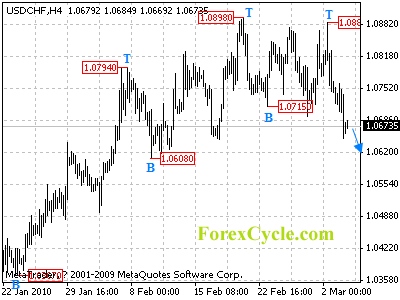
USDCHF’s fall from 1.0887 extends to as low as 1.0648. Deeper decline is expected later today and target is to test 1.0608 key support, a breakdown below this level could indicate that the uptrend from 1.0132 has completed at 1.0898 already. However, as long as 1.0608 support holds, the price action from 1.0898 is treated as consolidation of uptrend, another rise is still possible to 1.1000 area.

usdchf

Daily Forex Analysis

FOREX: US Dollar falls on risk. EUR/USD rises above 1.3700 today.

By CountingPips.com

The U.S. Dollar has fallen versus its global currency rivals so far today in forex trading as investor’s risk appetite has hit renewed levels. The dollar has been losing ground versus the euro, British pound, Swiss franc, Australian dollar, Canadian dollar and Japanese yen while gaining ground against the New Zealand dollar, according currency data by Oanda at 3:47 pm EST.

The euro has surged versus the dollar for the second straight day as the EUR/USD pair has extended to trading above the 1.3700 level. This pair touched a high of 1.3736 before pulling back and has traded at its highest exchange rate since February 17th. The euro has been helped out by news that Greece has pledged budget cuts and new taxes to help shore up some of its debt obligations.

The U.S. stock markets, meanwhile, have traded a bit lower today after a positive start with the Dow Jones down by 3 points, the Nasdaq decreasing over 1 point and the S&P 500 at about even at the time of writing.  Oil has climbed higher by $1.09 to trade at $80.77 while gold has gained by $5.80 to trade at the $1,142.70 per ounce level.

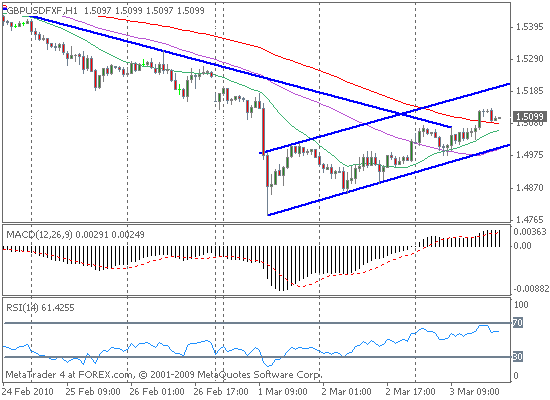
GBP/USD Chart – The British pound sterling has been gaining for a second consecutive day versus the American dollar as the GBP/USD has come off the 1.5000 psychological level to the upside to reach above 1.5100. The GBP/USD had fallen to a low point at 1.4784 on Monday due to concerns of a possible hung parliament emerging in the next election. This prompted speculation that a divided parliament could hamper Britain’s economic policy and growth.

Forex Trade, GBP/USD fx chart

U.S. Economic News: ADP Employment cuts 20k and ISM Service-Sector data rises

U.S. employment fell by 20,000 workers in January but marked the lowest monthly job decline in a year, according to the new ADP National Employment job report out today. U.S. nonfarm private employment fell by 20,000 workers in February following the revised decline of 60,000 jobs lost in January. The January jobs data was originally estimated to have fallen by 22,000 workers while February’s decline marks the 25th straight job declining month. Today’s data matched the 20,000 job decrease that market forecasters were expecting.

The employment data, despite the decrease, has improved in each of the last eleven months and today’s report marked the best monthly result since January of 2008 when the private sector added jobs.

The service-providing sector showed an increase of 17,000 jobs in February and increased for the second straight month. The goods-producing sector decreased by 37,000 jobs as construction jobs fell for the 37th straight month with a decline of 41,000 workers while the manufacturing sector had a gain of 3,000 jobs for the first rise since January 2008.

Medium sized businesses added jobs in February with an increase of 8,000 jobs. Large businesses lost 10,000 jobs in February and small businesses dropped 18,000 jobs.

The market-moving US Nonfarm Payrolls report for February is to be released Friday at 12:30 pm GMT with market forecasts predicting a decline of 30,000 jobs after January’s decrease of 20,000 jobs.

U.S. ISM Non-manufacturing Business expands

U.S. non-manufacturing business activity rose for the second straight month in February and increased to its highest level since December 2007, according to a report released today by the Institute for Supply Management.

The Non-manufacturing Index (NMI) registered a score of 53.0 percent in February from a score of 50.5 percent in January. Today’s data surpassed market forecasts which were expecting an index score of a 51.0 percent.

The NMI equally weights the index scores of business activity, new orders, supplier deliveries and employment and an index score below 50 is considered contracting or declining while a score above 50 is considered growth or expansion. Contributing positively to the report were increases in new orders, business activity/production, employment and supplier deliveries.

What Does NOT Move Markets? Examining 8 Claims of Market Efficiency

By Susan Walker

If everyone says that shocks from outside the financial system — so-called exogenous shocks — can affect it for better or worse, they must be right.

It just sounds so darned logical, right? Economists believe this trope to be true, mainly because they believe that investors are rational thinkers who re-evaluate their positions after every new bit of relevant information turns up.

Beginning to sound slightly impossible? Well, yes.

It turns out that logic is exactly what’s missing from this it-feels-so-right idea of rational reaction to exogenous shocks. Read an excerpt from Robert Prechter’s February 2010 Elliott Wave Theorist to see how Prechter deals with this widely held belief.

Find out what really moves markets — download the free 118-page Independent Investor eBook. The Independent Investor eBook shows you exactly what moves markets and what doesn’t. You might be surprised to discover it’s not the Fed or “surprise” news events. Learn more, and download your free ebook here.

* * * * *

Excerpted from Prechter’s February 2010 Elliott Wave Theorist, published Feb. 19, 2010

The Efficient Market Hypothesis (EMH) argues that as new information enters the marketplace, investors revalue stocks accordingly. … In such a world, the market would fluctuate narrowly around equilibrium as minor bits of news about individual companies mostly canceled each other out. Then important events, which would affect the valuation of the market as a whole, would serve as “shocks” causing investors to adjust prices to a new level, reflecting that new information. One would see these reactions in real time, and investigators of market history would face no difficulties in identifying precisely what new information caused the change in prices. …

This is a simple idea and simple to test. But almost no one ever bothers to test it. According to the mindset of conventional economists, no one needs to test it; it just feels right; it must be right. It’s the only model anyone can think of. But socionomists [those who use the Wave Principle to make social predictions] have tested this idea multiple ways. And the result is not pretty for the theories that rely upon it.

The tests that we will examine are not rigorous or statistical. Our time and resources are limited. But in refuting a theory, extreme rigor is unnecessary. If someone says, “All leaves are green,” all one need do is show him a red one to refute the claim. I hope when we are done with our brief survey, you will see that the ubiquitous claim we challenge is more akin to economists saying “All leaves are made of iron.” We will be unable to find a single example from nature that fits.

* * *

In his February 2010 Elliott Wave Theorist, Prechter then goes on to show charts that examine each of these claims that encompass both economic and political events:

Claim #1: “Interest rates drive stock prices.”
Claim #2: “Rising oil prices are bearish for stocks.”
Claim #3: “An expanding trade deficit is bad for a nation’s economy and therefore bearish for stock prices.”
Claim #4: “Earnings drive stock prices.”
Claim #5: “GDP drives stock prices.”
Claim #6: “Wars are bullish/bearish for stock prices.”
Claim #7: “Peace is bullish for stocks.”
Claim #8: “Terrorist attacks would cause the stock market to drop.”

To protect your personal finances, it’s important to think independently from the crowd, particularly when the crowd buys into what economists say.

Find out what really moves markets — download the free 118-page Independent Investor eBook. The Independent Investor eBook shows you exactly what moves markets and what doesn’t. You might be surprised to discover it’s not the Fed or “surprise” news events. Learn more, and download your free ebook here.


Susan C. Walker writes for Elliott Wave International, a market forecasting and technical analysis company.

GBP/JPY Reversal in the Works

By Anton Eljwizat – The GBP/JPY has recorded much bearish behavior in the past 2 weeks. However, the technical data indicates that this trend may reverse anytime soon. For example as described below, the daily chart’s signals that a bullish reversal is imminent. This might be a good opportunity for forex traders to enter the trend at a very early stage and at a great entry price.

• Below is the daily chart of the GBP/JPY currency pair.

• The technical indicators that are used are the William Percent Range, Relative Strength Index (RSI), and Slow Stochastic.

• Point 1: There is a “doji” candlestick that has formed on the chart, indicating that a reversal should take place.

• Point 2: The Relative Strength Index (RSI) indicates that the price of this cross currently floats in the oversold territory, signaling upward pressure.

• Point 3: The Williams Percent Range has peaked below the -80 marker, which means that there may actually be a strong level of upward pressure.

• Point 4: The Slow Stochastic indicates a bullish cross, signaling that the next move may be in an upward direction.

GBP/JPY Daily Chart

Forex Market Analysis provided by Forex Yard.

© 2006 by FxYard Ltd

Disclaimer: Trading Foreign Exchange carries a high level of risk and may not be suitable for all investors. There is a possibility that you could sustain a loss of all of your investment and therefore you should not invest money that you cannot afford to lose. You should be aware of all the risks associated with Foreign Exchange trading.

Swedish GDP Shows a Return to Recession in Q4

By Greg Holden – Following the release of Sweden’s recessionary data, the Swedish Krona (SEK) took a sharp dive against its primary counterparts. The data revealed that Sweden actually slipped back into recession during the fourth quarter of 2009.

A 0.6% decline in fourth quarter GDP put selling pressure on the Swedish Krona in this week’s trading. Expectations were for a 0.3% rise in GDP. As a result, the SEK now trades at the 7.1845 level against the USD, and the 9.7870 level versus the EUR.

The Norwegian Krone (NOK) has also been unable to hold its recent gains made against the Dollar and Euro. Paring gains this week, the NOK has recently entered a small downturn due to a downward price movement in Crude Oil.

The Norwegian Finance Ministry also published its decision to grant further flexibility in rulings on the ban of investment companies, helping more investment firms stay in positive standing before being decommissioned by government regulators.

Technical Analysis

– The chart below is the 4-hour USD/NOK chart by ForexYard.

– The indicators used are the Stochastic (slow) and the Williams Percent Range.

– This pair is currently forming a “Pennant” on the chart. This happens when a solid upward movement is halted by a narrowing range, as shown below.

– Typically, when a Pennant formation reaches the narrowest point, represented by the number 1 on the chart below, a continuation of the previous trend will likely continue. This means the pair may continue to range-trade towards Point 1, and then continue with its previous uptrend.

– Point 2: Since the price is currently at the lower border of the consolidation trend (Pennant formation), there is a bullish cross on the Stochastic (slow) which indicates an upward move should take place in the nearest future, and you can see on the chart that this is already taking place.

– Point 3: The Williams Percent Range shows that the price touched the over-sold mark and then bounced off and is currently heading up. This only highlights a level of bullish momentum that is already building in the price of this pair.

USD/NOK 4-Hour Chart

Forex Market Analysis provided by Forex Yard.

© 2006 by FxYard Ltd

Disclaimer: Trading Foreign Exchange carries a high level of risk and may not be suitable for all investors. There is a possibility that you could sustain a loss of all of your investment and therefore you should not invest money that you cannot afford to lose. You should be aware of all the risks associated with Foreign Exchange trading.

EUR Recovers Slightly as Greece’s Budget Woes Ease

Source: ForexYard

The USD fell Tuesday versus the EUR on comments from Greek officials regarding the government’s commitment to make major budget cuts necessary to reduce the deficit. Pressuring the Dollar further were hawkish statements regarding interest rate hikes from the Canadian and Australian central banks.

Economic News

USD – USD Declines on Interest Rate Hike Outlook

The USD came under pressure yesterday as Greece is expected to announce new budget cuts. The greenback was down most notably against the CAD and AUD on interest rate hike outlook for the two currencies. The Reserve Bank of Australia (RBA) raised its benchmark rate for the fourth time, as expected, by a quarter of a percentage point, to 4.0% and, while the Bank of Canada left the interest rate unchanged, an exceptionally hawkish statement boosted expectations of a sooner than expected rate hike.

The Dollar index fell to 80.512, from 80.753 in late North American trading Monday. The Aussie recently rose 0.4% to 90.36 U.S. cents. The Dollar slid 0.5% against the Japanese Yen, to buy 88.77 Yen.

Looking ahead to today traders are advised to follow the ISM Non-Manufacturing PMI report due to be released at 15:00 GMT as well as the ADP Non-Farm Employment Change estimate due to be released at 13:15 GMT. The Dollar’s level will be determined this week by Greek developments on the one hand and vital economic data from the U.S on the other.

EUR – EUR Rises on Expected Greek Budget Cuts

The EUR rose from a 9-month low against the Dollar as Greece prepared to unveil its new budget cuts, fueling optimism of an imminent solution to its debt crisis. The Greek government will announce as much as 4.8 billion Euros ($6.5 Billion) of additional spending cuts today ahead of a March 16 deadline.

The EUR climbed to $1.3633 in today’s early trading from $1.3615 in New York yesterday when it dropped to $1.3436, the weakest since May 18. The currency traded at 120.82 yen from 120.96 yen. The British pound recovered some losses yesterday to currently trade at 1.5052 USD. It had fallen sharply Monday amid concerns over potential changes in leadership.

Along with any development from Greece, traders are advised to follow the release of the British Services PMI at 9:30 GMT, a better than expected result might help push the Pound further up.

JPY – JPY at 11-Week High versus USD

The Yen climbed to an 11-week high against the Dollar on speculation Japanese companies will bring home earnings before the nation’s fiscal year that ends this month. Japan’s currency advanced versus 14 of its 16 major counterparts ahead of the end of Japan’s fiscal year March 31.

Under the new tax provisions Japanese companies are exempt from taxes on repatriated profits. The means that the JPY is expected to stay strong as Japanese investors will likely to continue buying the currency.

Crude Oil – Crude Oil Struggles to Stay above $80 a Barrel

Crude Oil traded near $80 a barrel, gaining 1.3% yesterday as equity markets gained on speculation that the European Union will bail out Greece while the nation is expected to unveil new budget cuts. Oil prices also increased as the Dollar weakened against the EUR, increasing demand for commodities as an alternative investment. Furthermore, a report form the American Petroleum Institute showed that stockpiles of distillate fuel dropped 4.07 million barrels last week.

Today traders should follow the release of the Crude Oil inventories data at 15:30 GMT. Stockpiles are expected to drop to 1.4M from 3.0M last week, a better than expected result might help solidify oil’s price above $80 a barrel.

Technical News

EUR/USD

After this morning’s upward movement, the EUR/USD pair now appears poised for a downward correction. The pair appears to be range trading between 1.3650 and 1.3450. The hourly RSI shows the price as over-bought and the 4-hour Stochastic (slow) has what appears to be a bearish cross. Going short may be today’s best tactic.

GBP/USD

The price of this pair appears to be floating in the over-bought territory on the hourly RSI, suggesting short-term downward pressure. However, the daily RSI has the pair floating deep within the over-sold territory, indicating that the pair may in fact be facing strong upward pressure. As a result, there is a chance this pair will correct downward slightly in the morning hours, but longer-term direction may in fact be upward.

USD/JPY

This pair has dropped to an 11-week low today and as a result a few indications are pointing to an upward correction. The daily Stochastic (slow) shows a fresh bullish cross and an upward moving indicator, suggesting that the price of this pair may see upward momentum gaining in today’s trading. Going long with tight stops might not be a bad idea.

USD/CHF

This pair seems to be fluctuating within a very distinct bullish channel on the 4-hour chart. As the last movement was in a downward direction, most indicators are now showing an impending bullish move. The 4-hour Stochastic (slow) shows a fresh bullish cross, which supports this notion. Going long appears to be today’s preferable strategy.

The Wild Card

AUD/NZD

This pair is showing very distinct indications for forex traders to take advantage of in today’s trading. The 4-hour Stochastic (slow) is showing 2 recent bearish crosses, and the price on the 4-hour RSI is floating deep within the over-bought territory. The daily chart also shows the price in the over-bought zone. There appears to be strong downward pressure on this pair. Going short and riding out this correction could prove to be very profitable today.

Forex Market Analysis provided by Forex Yard.

© 2006 by FxYard Ltd

Disclaimer: Trading Foreign Exchange carries a high level of risk and may not be suitable for all investors. There is a possibility that you could sustain a loss of all of your investment and therefore you should not invest money that you cannot afford to lose. You should be aware of all the risks associated with Foreign Exchange trading.

Forex Daily Market Review for 3rd Mar, 10

The U.S market continued to gain strength yesterday after Monday’s massive rally. The S&P500 finished the day with a 0.23% gain, while the Nasdaq finished higher by 0.32%.Even though it was a positive session, investors were reluctant to drive the markets significantly higher, as participants preferred to adjust their portfolios for Thursday and Friday’s sessions.

Although the U.S lacked major market moving data yesterday, individual stocks still had an influence on the session. Similar to Toyota, General Motors also joined the list of automakers that are forced to now recall their cars. According to the Toronto Star, General Motors said that more than 256000 Canadian vehicles are included in a fix in a recall to fix power steering motors for several compact models.

As mentioned in prior reports, from a technical point of view the indices seem to be heading towards their prior highs. The S&P500 broke major resistance and confirmed the break out during yesterday’s session. Even though a pull-back is due for this chart, one could expect prior resistance to act as support.

13

Forex

On the Forex market the Dollar index presented relative weakness and finished the session down by -0.3%. The index has recently formed a minor range, between 80.1-81.1 points. Even though indicators are pointing towards a minor correction, the pull-back could be short-lived, especially as the Dollar has recently shown a positive correlation with the U.S stock market. For further information see yesterday’s report.

On individual pairs the EUR/USD managed to hold its ground around 1.3570. Monday’s news had a positive effect on sentiment as the EU unemployment rate beat analyst’s double digit expectation and came out at 9.9%. According to the EU’S statistics office, around 15.7 million people were unemployed in the euro-zone, up 136,000 on the previous month. Spain was a major drag, this time round, coming out with an 18.8% unemployment rate. Yesterday’s fundamental data also from the Euro-zone also had an effect on sentiment as inflation figures showed that prices were lower than expected. This boosted confidence, regarding the ECB’s upcoming decision and should give the bank one less thing to worry about.

On the other side of the globe, Australia shocked the markets by raising its key rate to 4%. Governor Stevens addressed the markets Tuesday and stated that the rate hike was necessary to normalize Australia’s rate level and bring it “closer to average”. Market participants brushed of the news, causing only minor movement on the AUD/USD. From a technical point of view, the AUD/USD bounced higher but got stuck around resistance of $0.9043.

Canada also took the stage during the session releasing its interest rate decision. Unlike Australia, the BOC preferred to keep rates at a low of 0.25%, keeping its promise – holding rates at a low until the end of the second quarter. Even though bank members acknowledged a recent economic improvement, they were reluctant to tamper with the regaining confidence. The USD/CAD dropped during the session and now seems to be heading for its double bottom support level.

25

The Day Ahead

Things should start to pick up over the next couple of trading days as major data is scheduled to be released. Today the U.S will take the stage, releasing its ADP Non-farm Employment Change. The figure is normally scrutinized by investors as it can give clues as to the outcome of the NFP result, scheduled to be released on Friday. The market is expecting a -10k result compared to a prior -22k.

Daily Forex Market Analysis provided by eToro

Disclaimer: Trading in the Foreign Exchange market might carry potential rewards, but also potential risks. You must be aware of the risks and are willing to accept them in order to trade in the foreign exchange market. Don’t trade with money you can’t afford to lose.

© 2009 eToro Blog.