Forex Daily Market Commentary

By GCI Forex Research

Fundamental Outlook at 1500 GMT (EDT + 0500)

The euro depreciated vis-à-vis the U.S. dollar today as the single currency tested bids around the US$ 1.3460 level and was capped around the $1.3655 level. The common currency was pushed lower after a European Union official was quoted as saying Greece must meet its 2010 fiscal deficit target to regain credibility with the capital markets.  Greek Prime Minister Papandreou is scheduled to meet German Chancellor Merkel in Berlin this week and there is speculation a deal may be reached in which a multilateral financial aid package is reached.  There is speculation that multiple eurozone members may purchase part of Greece’s upcoming debt offerings to help the country reduce its budget deficit by at least 3%.  Data released in the eurozone today saw EMU-16 February manufacturing PMI improve to 54.2 from 52.4, a 30-month high, while German manufacturing PMI raced higher to 57.2 from 53.7.  Also, the German January import price index improved 1.7% m/m and 1.4% y/y.  In U.S. news, data released today saw February ISM manufacturing decline to 56.5 from 58.4 in January while January construction spending was off 0.6%.  The ISM prices paid sub-index fell back to 67.0 from the prior reading of 70.0.  Also, January personal income was up a weaker-than-expected 0.1%, down from a revised 0.3% in December, while January personal spending printed at +0.5%, up from a revised +0.3% in December.  Additionally, the January PCE deflator expanded 2.1% y/y while core PCE was up +0.0%, down from the prior reading of +0.1%.  U.S. Federal Reserve Vice Chairman Kohn announced he will step down in June after 40 years at the central bank.  His retirement paves the way for the Obama administration to appoint a Democrat at a time when it is trying to significantly reduce the Fed’s independence.  Euro bids are cited around the US$ 1.3335 level.

¥/ CNY

The yen appreciated vis-à-vis the U.S. dollar today as the greenback tested bids around the ¥88.80 level and was capped around the ¥89.45 level.  Financial services minister Kamei called on Bank of Japan to do more to help improve the economy, saying the “central bank should consider underwriting debt to help the government create funds for fiscal stimulus. It’s necessary to provide funds for bold fiscal spending.  Without fiscal stimulus funds, minister Kan can’t resolve the economy’s output gap. He’s not a magician.”  BoJ Governor Shirakawa and other Policy Board members have vehemently rejected additional calls for the central bank to monetize additional debt.  Finance minister Kan today said he wants Japan to be out of deflation by the end of 2010 even though BoJ said it expects there will be price declines for three additional years.  BoJ Governor Shirakawa, in turn, today reiterated the government needs to exercise more fiscal discipline.  The Nikkei 225 stock index climbed 0.45% to close at ¥10,172.06.  U.S. dollar offers are cited around the ¥94.75 level.  The euro moved lower vis-à-vis the yen as the single currency tested bids around the ¥120.05 level and was capped around the ¥121.90 level.  The British pound moved lower vis-à-vis the yen as sterling tested bids around the ¥132.00 figure while the Swiss franc moved lower vis-à-vis the yen and tested bids around the ¥82.05 level. In Chinese news, the U.S. dollar appreciated vis-à-vis the Chinese yuan as the greenback closed at CNY 6.8263 in the over-the-counter market, up from CNY 6.8260.  Data released in China today saw February manufacturing PMI decline go 52.0 from 55.8, considerably weaker-than-expected.  Revised U.S. TICS data released on Friday confirmed China is the largest holder of U.S. Treasuries. Foreign holdings of U.S. debt now totals US$ 2.7 trillion in aggregate.

The British pound weakened sharply vis-à-vis the U.S. dollar today as cable tested bids around the US$ 1.4780 level and was capped around the $1.5200 figure.  Cable moved lower as traders reacted to strong-than-expected U.K. GDP data that were released on Friday.  One theory suggests Prime Minister Brown may take advantage of the stronger-than-expected GDP data by calling a general election earlier than previously expected.  Sterling is lower on the premise that the U.K. could have its first minority government in decades. The opposition Tory power is largely expected to assume more after more than one decade of Labour rule.  Data released in the U.K. today saw January net lending to individuals increase to a total of ₤2.0 billion in January from ₤1.5 billion in December.  Also, February manufacturing PMI was unchanged at 56.6 and January mortgage approvals came in at 48,000, down from 58,000 in December.  Cable bids are cited around the US$ 1.4455 level.  The euro moved higher vis-à-vis the British pound as the single currency tested offers around the ₤0.9145 level and was supported around the ₤0.8965 level.

Forex Daily Market Commentary provided by GCI Financial Ltd.

GCI Financial Ltd (”GCI”) is a regulated securities and commodities trading firm, specializing in online Foreign Exchange (”Forex”) brokerage. GCI executes billions of dollars per month in foreign exchange transactions alone. In addition to Forex, GCI is a primary market maker in Contracts for Difference (”CFDs”) on shares, indices and futures, and offers one of the fastest growing online CFD trading services. GCI has over 10,000 clients worldwide, including individual traders, institutions, and money managers. GCI provides an advanced, secure, and comprehensive online trading system. Client funds are insured and held in a separate customer account. In addition, GCI Financial Ltd maintains Net Capital in excess of minimum regulatory requirements.

DISCLAIMER: GCI’s Daily Market Commentary is provided for informational purposes only. The information contained in these reports is gathered from reputable news sources and is not intended to be U.S.ed as investment advice. GCI assumes no responsibility or liability from gains or losses incurred by the information herein contained.

Forex: US Dollar mixed as GBP/USD drops below 1.5000

By CountingPips.com

The US Dollar has traded stronger versus its European currency rivals today in forex trading while being mixed overall against the other major currencies. The dollar has been gaining ground versus the euro, British pound, Swiss franc and Japanese yen while losing ground against the Australian dollar, New Zealand dollar and Canadian dollar, according currency data by Oanda.

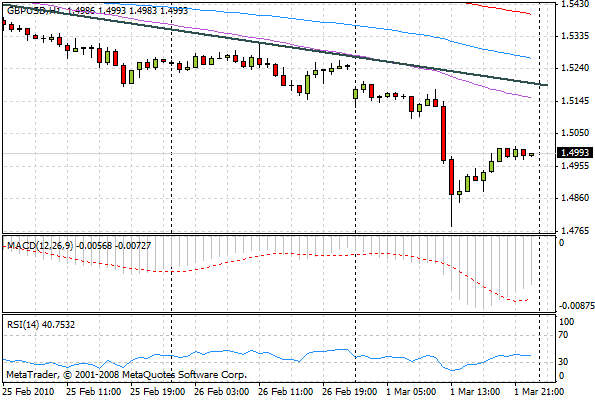
The British pound sterling plummeted versus the dollar earlier today in fx trading after an opinion poll was published showing that this year’s general election in Britain could produce a hung parliament and after news was reported that Prudential PLC would buy a part of AIG (Asian Operations).

Today’s action was an acceleration of the pound’s recent downtrend which has seen the pound fall for five out of the last six weeks to the dollar while also falling to the euro for three straight weeks.

A divided parliament may present a new challenge for Britain’s economy as the political uncertainty could hamper the navigation out of a fragile economic state. The news prompted heavy selling of the pound, dropping the currency to its lowest exchange rate versus the dollar in ten months.

GBP/USD 1-Hour Chart – The GBP/USD fell all the way to the 1.4784 level before paring some of the losses and climbing back to trading around the 1.5000 level.

Euro rises vs Pound

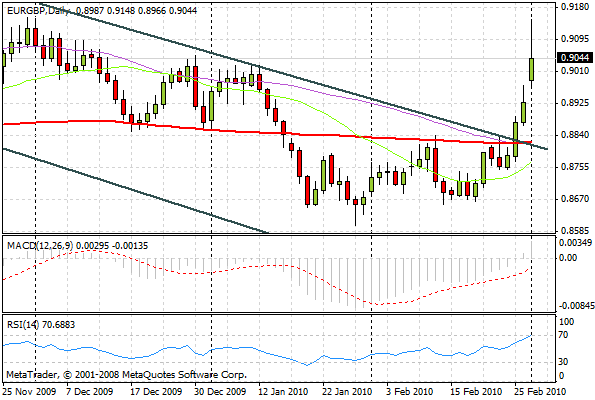
The Euro spiked against the pound today as the EUR/GBP touched a high of 0.9150 in trading before coming back to the 0.9050 level. The EUR/GBP has now surged from the 0.8682 level to the 0.9050 level in just over two weeks.

EUR/GBP Daily Chart – The Euro broke out of its downtrend on the daily chart versus the British Pound last week in forex trading and spiked higher today. The MACD indicator has now turned positive while this pair trades at just about the 70 level on the RSI.

AUD/USD Tests .90

The Aussie tested the psychological .90 level again, but to no avail.  However, the currency pair is holding up relatively well considering the large selloffs taking place in the EUR/USD and Cable.  Investors are on the fence in regards to whether the RBA will raise rates following tomorrow’s monetary policy meeting.  However, considering uncertainty in the EU hasn’t died down, and uncertainty in the UK is just flaying up, it wouldn’t be surprising if the RBA opts to maintain a neutral policy stance once again.  On the other hand, should the RBA surprise by raising or lowering its benchmark rate, the AUD/USD could experience sizable gains or losses, respectfully.  Meanwhile, debt issues in Greece and now worries in the UK are certainty developments to be concerned about.  Further deterioration of these currencies could eventually drag the Aussie lower should the global economy feel the weight of the impact.  Today’s Chinese Manufacturing PMI data printed lighter than anticipated.  Should China continue to press on the breaks and cool its economy, this could also place downward pressure in the AUD/USD due to lower anticipated demand for Australia’s commodities.  However, near-term focus will likely be on the RBA tomorrow’s along with Australian Building Approvals and Retail Sales data.  The UK and EU will release their own data sets tomorrow as well, not to mention Australia’s GDP figure due Wednesday.  Hence, activity could pick up in the AUD/USD over the next 24-48 hours.

Technically speaking, the Aussie has multiple uptrend lines serving as technical cushions along with intraday, 2/23, and 2/25 lows.  As for the topside, the Aussie has multiple downtrend lines serving as technical barriers along with February highs and the highly psychological .90 level should it be retested.

Price: .8963

Resistances: .8981, .8993, .9011, .9024, .9041, .9062

Supports: .8957, .8944, .8930, .8916, .8901, .8886

Psychological: .90, February highs and lows

(click to enlarge)

Market Commentary provided by Fast Brokers.

Disclaimer: FastBrokers’ market commentary is provided for information purposes only and under no circumstances should be regardedneither as an investment advice nor as a solicitation or an offer to sell/buy any financial product. FastBrokers assumes no responsibility or liability from gains or losses incurred by the information herein contained.
Risk Disclosure: There is a substantial risk of loss in trading futures and foreign exchange. Please carefully review all risk disclosure documents before opening an account as these financial instruments are not appropriate for all investors.

Gold Floats Around $1115/oz Despite Risk Aversion

Gold is holding around Friday’s highs despite an incredible selloff in the Cable and considerable weakness in the EUR/USD.  Hence, gold is continuing to deviate from its usual positive correlation with the Euro and Pound and is instead performing relative well amid increasing economic uncertainty in Europe.  However, the AUD/USD is performing rather well with investors speculating that the RBA may either raise rates tomorrow or keep the benchmark unchanged.  Therefore, gold may be deriving its correlative strength from selective sources at the moment.  That being said, it wouldn’t be surprising to see gold’s positive correlation with the Euro and Pound to kick back in over the medium-term despite recent unreliability.  Meanwhile, gold is has initially reacted positively to weaker than expected U.S. Manufacturing PMI and pricing data.  Disappointing U.S. data gives the economy a relative weakness and benefits the risk trade, hence a slight uptick in gold after the data flow.  Market activity will likely pick up as the market progresses, beginning with tomorrow’s RBA rate decision during tomorrow’s Asia trading session followed by UK HPI and EU CPI data.  For the time being, it will be interesting to see if gold can continue to hold above its highly psychological $1100/oz level while February highs wait around the corner.

Technically speaking, gold faces multiple downtrend lines along with 2/17 and 2/22 highs.  Our 3rd tier downtrend line could serve as a key near-term technical since it runs through February highs, or the $1130/oz area.  As for the downside, gold has multiple uptrend lines serving as technical cushions along with intraday, 2/26, and 2/25 lows.  Furthermore, the psychological $1100/oz level could continue to play an influential role over the near-term.

Present Price: $1116.30/oz

Resistances: $1118.92/oz, $1121.35/oz, $1123.30/oz, $1125.97/ oz, $1128.160/oz, $1130.84/oz

Supports: $1115.03/oz, $1112.60/oz, $1110.41/oz, $1108.22/oz, $1106.18/oz, $1103.10/oz

Psychological: $1100/oz, $1125/oz, February highs and lows

(click to enlarge)

Market Commentary provided by Fast Brokers.

Disclaimer: FastBrokers’ market commentary is provided for information purposes only and under no circumstances should be regardedneither as an investment advice nor as a solicitation or an offer to sell/buy any financial product. FastBrokers assumes no responsibility or liability from gains or losses incurred by the information herein contained.

Risk Disclosure: There is a substantial risk of loss in trading futures and foreign exchange. Please carefully review all risk disclosure documents before opening an account as these financial instruments are not appropriate for all investors.

USD/JPY Settles Around 89

The USD/JPY is bouncing around the 89 level despite today’s high volatility in the Pound and Euro.  Although Japan has been quiet on the wire today, it will reenter the fray tomorrow by releasing Household Spending and its headline Unemployment Rate.  Meanwhile, the USD/JPY has exhibited a muted reaction to China’s weaker than expected Manufacturing PMI data.  A slight cool down in China could have a negative impact on Japan’s manufacturing base.  Investors are currently awaiting America’s Manufacturing PMI due shortly.  It will be interesting to see whether the USD/JPY ends up reacting to today’s heavy volatility in the European currencies.  On a positive note, the USD/JPY is still trading above February lows.  However, the currency pair is also trading below its highly psychological 90 level.  Therefore, the USD/JPY appears to be jammed between two strong technical areas.  Investors should continue to keep an eye on the news wire for anymore statements from either the DPJ or the BoJ.  Disagreements between to the two led to the USD/JPY’s sizable selloff last week.

Technically speaking, the USD/JPY has multiple uptrend lines serving as technical supports along with February lows.  As for the topside, the USD/JPY faces multiple downtrend lines along with 2/26 highs and the highly psychological 90 level should it be tested.

Present Price: 89.23

Resistances: 89.28, 89.35, 89.41, 89.50, 89.50, 89.59

Supports: 89.19, 89.10, 89.04, 88.93, 88.84, 88.73

Psychological: 90, February lows

(click to enlarge)

Market Commentary provided by Fast Brokers.

Disclaimer: FastBrokers’ market commentary is provided for information purposes only and under no circumstances should be regardedneither as an investment advice nor as a solicitation or an offer to sell/buy any financial product. FastBrokers assumes no responsibility or liability from gains or losses incurred by the information herein contained.

Risk Disclosure: There is a substantial risk of loss in trading futures and foreign exchange. Please carefully review all risk disclosure documents before opening an account as these financial instruments are not appropriate for all investors.

GBP/USD Dives Lower After Election Poll

The Cable has crumbled below its highly psychological 1.50 level and has undergone a huge selloff after a poll this weekend showed that the UK election is nearly a dead heat.  Investors are worried that a balanced parliament may not be able to tackle the fiscal and economic situations facing the UK.  This uncertainty drove the Cable lower and the Pound is clearly experiencing a relative weakness due to a surge in the EUR/GBP.  The Cable is now recovering from intraday lows even though the psychological blow has been dealt.  Investors clearly fear that debt issues in the EU could show up in the UK and the Pound is getting punished in succession.  On the bright side, the UK’s Manufacturing PMI printed slightly above analyst expectations and Net Lending to Individuals registered a surprising pop.  The increase in net lending is a very welcome development since the BoE has been harping on the banks to lend out some of their cheap liquidity to individuals in order to jumpstart the UK economy.  Hence, today’s trading session does carry a silver lining.  Meanwhile, investors are waiting on America’s Manufacturing PMI.  Should the U.S. number print weaker than expected, investors may continue to keep the Cable above intraday lows due to relative economic weakness in America.  However, a strong data point could place further downward pressure on the Cable for the opposite reason.   Activity will only head up as the trading week progresses.  The RBA will make its rate decision tomorrow and the UK will release its Halifax HPI and Construction PMI data.  Should the RBA hike its benchmark rate, this could help the risk trade across the board in anticipation of an improving global economic landscape.  However, inaction or a cut by the RBA could yield the opposite.

Technically speaking, we’ve formed some new uptrend lines for the Cable to compensate for today’s selloff.  Our uptrend lines run through 4/30/2009 levels, or the 1.47-1.48 area.  Hence, the Cable could continue to have support around this area over the near-term.  Meanwhile, it will be interesting to see whether the currency pair can manage to climb back towards its highly psychological 1.50 level, now serving as a technical barrier.  As for the topside, the Cable faces multiple downtrend lines and has an uphill battle.

Present Price: 1.4931

Resistances: 1.4942, 1.4974, 1.4997, 1.5038, 1.5071, 1.5112

Supports: 1.4877, 1.4850, 1.4822, 1.4799, 1.4767

Psychological: 1.50

(click to enlarge)

Market Commentary provided by Fast Brokers.

Disclaimer: FastBrokers’ market commentary is provided for information purposes only and under no circumstances should be regardedneither as an investment advice nor as a solicitation or an offer to sell/buy any financial product. FastBrokers assumes no responsibility or liability from gains or losses incurred by the information herein contained.

Risk Disclosure: There is a substantial risk of loss in trading futures and foreign exchange. Please carefully review all risk disclosure documents before opening an account as these financial instruments are not appropriate for all investors.

EUR/USD Drops with Pound Selloff

The EUR/USD has experienced a sizable down bar on the 4-hour amid a vicious sell-off in the Pound.  A poll released yesterday revealed that the UK election is a dead heat, drawing skepticism about whether the government will be able to tackle its fiscal woes with a hung parliament.  Uncertainty has now bled over into the UK, drawing the EUR/USD lower since there are still major problems in the EU.  Merkel is sticking to her guns by stating that Greece needs to take care of its own problems, reigniting uncertainty regarding whether Germany would in fact help bail out Greece should the situation call.  However, the EUR/USD is holding up relatively well considering today’s pandemonium in the Pound.  The Euro’s relative strength is reflected by a huge move higher in the EUR/GBP.  Additionally, the EU’s headline Unemployment Rate printed at 9.9%, two basis points below analyst expectations.  Solid EU employment data coupled with weak U.S. pricing data has allowed the EUR/USD to hold above its psychological 1.35 level and 2/25 lows.  Meanwhile, investors are waiting on America’s ISM Manufacturing PMI data.  Should the PMI number come in below analyst expectations investors may lift the EUR/USD.  However, a strong figure could weigh the EUR/USD lower amid excitement over an improving U.S. economy.  We’ve got a slew of central bank meetings this week, beginning with the RBA during tomorrow’s Asia trading session.  The EU will follow with its CPI Flash Estimate later in the session.  Should the RBA tighten, this could help buoy the risk trade across the board in anticipation of an improving global economic environment.

Technically speaking, the EUR/USD still faces multiple downtrend lines along with 2/26, 2/23, and 2/17 highs.  As for the downside, the EUR/USD has several uptrend lines (off chart) serving as technical cushions along with 2/19 lows.  Furthermore, the psychological 1.35 area could continue to have an impact on price movements.

Present Price: 1.3534

Resistances: 1.3546, 1.3572, 1.3599, 1.3634, 1.3654, 1.3676

Supports:  1.3516, 1.3493, 1.3460, 1.3440, 1.3420, 1.3394, 1.3377

Psychological: February lows, 1.35

(click to enlarge)

Market Commentary provided by Fast Brokers.

Disclaimer: FastBrokers’ market commentary is provided for information purposes only and under no circumstances should be regardedneither as an investment advice nor as a solicitation or an offer to sell/buy any financial product. FastBrokers assumes no responsibility or liability from gains or losses incurred by the information herein contained.

Risk Disclosure: There is a substantial risk of loss in trading futures and foreign exchange. Please carefully review all risk disclosure documents before opening an account as these financial instruments are not appropriate for all investors.

Surviving Deflation: First, Understand It

Deflation is more than just “falling prices.” Robert Prechter explains why.

By Editorial Staff

The following article is an excerpt from Elliott Wave International’s free Club EWI resource, “The Guide to Understanding Deflation. Robert Prechter’s Most Important Writings on Deflation.”

The Primary Precondition of Deflation
Deflation requires a precondition: a major societal buildup in the extension of credit. Bank credit and Elliott wave expert Hamilton Bolton, in a 1957 letter, summarized his observations this way: “In reading a history of major depressions in the U.S. from 1830 on, I was impressed with the following: (a) All were set off by a deflation of excess credit. This was the one factor in common.”

“The Fed Will Stop Deflation”
I am tired of hearing people insist that the Fed can expand credit all it wants. Sometimes an analogy clarifies a subject, so let’s try one.

It may sound crazy, but suppose the government were to decide that the health of the nation depends upon producing Jaguar automobiles and providing them to as many people as possible. To facilitate that goal, it begins operating Jaguar plants all over the country, subsidizing production with tax money. To everyone’s delight, it offers these luxury cars for sale at 50 percent off the old price. People flock to the showrooms and buy. Later, sales slow down, so the government cuts the price in half again. More people rush in and buy. Sales again slow, so it lowers the price to $900 each. People return to the stores to buy two or three, or half a dozen. Why not? Look how cheap they are! Buyers give Jaguars to their kids and park an extra one on the lawn. Finally, the country is awash in Jaguars. Alas, sales slow again, and the government panics. It must move more Jaguars, or, according to its theory — ironically now made fact — the economy will recede. People are working three days a week just to pay their taxes so the government can keep producing more Jaguars. If Jaguars stop moving, the economy will stop. So the government begins giving Jaguars away. A few more cars move out of the showrooms, but then it ends. Nobody wants any more Jaguars. They don’t care if they’re free. They can’t find a use for them. Production of Jaguars ceases. It takes years to work through the overhanging supply of Jaguars. Tax collections collapse, the factories close, and unemployment soars. The economy is wrecked. People can’t afford to buy gasoline, so many of the Jaguars rust away to worthlessness. The number of Jaguars — at best — returns to the level it was before the program began.

The same thing can happen with credit.

It may sound crazy, but suppose the government were to decide that the health of the nation depends upon producing credit and providing it to as many people as possible. To facilitate that goal, it begins operating credit-production plants all over the country, called Federal Reserve Banks. To everyone’s delight, these banks offer the credit for sale at below market rates. People flock to the banks and buy. Later, sales slow down, so the banks cut the price again. More people rush in and buy. Sales again slow, so they lower the price to one percent. People return to the banks to buy even more credit. Why not? Look how cheap it is! Borrowers use credit to buy houses, boats and an extra Jaguar to park out on the lawn. Finally, the country is awash in credit. Alas, sales slow again, and the banks panic. They must move more credit, or, according to its theory — ironically now made fact — the economy will recede. People are working three days a week just to pay the interest on their debt to the banks so the banks can keep offering more credit. If credit stops moving, the economy will stop. So the banks begin giving credit away, at zero percent interest. A few more loans move through the tellers’ windows, but then it ends. Nobody wants any more credit. They don’t care if it’s free. They can’t find a use for it. Production of credit ceases. It takes years to work through the overhanging supply of credit. Interest payments collapse, banks close, and unemployment soars. The economy is wrecked. People can’t afford to pay interest on their debts, so many bonds deteriorate to worthlessness. The value of credit — at best — returns to the level it was before the program began.

Jaguars, anyone?

Read the rest of this important 63-page deflation study now, free! Here’s what you’ll learn:What Triggers the Change to Deflation
Why Deflationary Crashes and Depressions Go Together
Financial Values Can Disappear
Deflation is a Global Story
What Makes Deflation Likely Today?
How Big a Deflation?
More


Elliott Wave International (EWI) is the world’s largest market forecasting firm. EWI’s 20-plus analysts provide around-the-clock forecasts of every major market in the world via the internet and proprietary web systems like Reuters and Bloomberg. EWI’s educational services include conferences, workshops, webinars, video tapes, special reports, books and one of the internet’s richest free content programs, Club EWI.

Forex Technical Analysis – Bearish Channel – EUR/USD – 4-Hour Chart

By Russell Glaser – A technical analysis of the 4-hour EUR/USD shows that over the past 28 hours, the pair has been trading in a bearish channel.

We can use the new high from Friday’s trading session as the upper limit of the channel and the old trend line that has been broken as the lower border of the channel. Both lines begin on January 26th (not shown).

We can see the price made contact with the upper line twice; once at the origination and the second time today at near 8:00am GMT. The price has also made contact with the previous trend line twice, failing to significantly breach this support level.

Previously broken trend lines should not be forgotten. They can be used in the future as support and resistance lines in the new trend.

We can also see a declining slope on the MACD histogram, indicating a weakening short term uptrend.

Traders may want to initiate buy positions from sell positions from the upper border of the channel with limit orders to take profit at the lower border of the channel.

Major resistance and support lines have been marked at 1.3680 (Feb 26th high) and 1.3470 (Feb 25th low).

Forex Market Analysis provided by Forex Yard.

© 2006 by FxYard Ltd

Disclaimer: Trading Foreign Exchange carries a high level of risk and may not be suitable for all investors. There is a possibility that you could sustain a loss of all of your investment and therefore you should not invest money that you cannot afford to lose. You should be aware of all the risks associated with Foreign Exchange trading.

Non-Farm Payrolls Week Begins

Source: ForexYard

After a week which was mostly characterized with the halt of the Dollar’s bullish trend, a hefty news week is impending. Australia, Canada, Great Britain and the Euro-Zone will all publish their monthly Interest Rates desiccations. And on top of it all, the U.S. Non-Farm Payrolls is expected on Friday. This means that an extremely volatile week is expected that holds plenty of unique opportunities to make irregular profits.

Economic News

USD – Dollar’s Bullishness is halted

The Dollar dropped against most of the major currencies during last week’s trading session. After several weeks of bullish trends, the Dollar saw a bearish correction against the Euro and the Yen.

The Dollar’s fall from last week came as a result of several disappointing economic publications. The U.S. Consumer Confidence dropped from 56.5 on January to 46.0 on February, expressing a decline in U.S. citizens regarding their financial security. In addition, both the New Home Sales and the Existing Home Sales have unexpectedly dropped in January. This has proved that the housing sector in the U.S. is not fully recovered yet. Considering that the U.S. housing sector was the trigger for the global crisis, investors tend to take this data very seriously, and when a batch of disappointing indicators are being published, it usually weakens the Dollar.
For conclusion, after several weeks of positive economic data from the American economy, a less fortunate week has halted the Dollar’s bullish trend. However, if the economy will deliver recovery signals again, the Dollar is likely to recover as well.

Looking ahead to next week, the U.S. Non-Farm Employment Change report is expected on Friday. This is one of the most impacting publications in the market that tends to create heavy volatility. Traders should also follow the ADP forecast for this report, which is published on Wednesday. This forecast is considered to be quite reliable, and thus has a large impact on the market as well.

EUR – Interest Rates Announcement Expected on Wednesday

The Euro rose against most of the major currencies last week. The Euro’s most notable rise was against the Pound, as the pair gained over 200 pips. The Euro also halted its drop against the Dollar, and the EUR/USD pair is currently traded around the 1.3630 level.

The Euro’s rising trend came mostly due to speculations regarding a Greece bail-out plan by the Euro-Zone. The Euro was boosted following a statement by the French Finance Minister Christine Lagarde, who said that European governments are studying ways to assist Greece. This has increased risk appetite, and as a result boosted the Euro. Another reason for the Euro’s appreciation was the positive data from the German economy. The unemployment in Germany rose by 7,000 people in February, beating expectations for an 18,000 rise. In addition, the German Consumer Climate report showed that German citizens have more confidence in their financial outlook. Germany has the strongest economy in the Euro-Zone, and thus positive data from the German economy usually support the Euro.

As for the week ahead, the most interesting data from the Euro-Zone looks to be the Minimum Bid Rate on Thursday. The Minimum Bid Rate is in fact the European Interest Rates announcement for March. Current expectations are that the European Central Bank (ECB) will leave rates at 1.00%. However, if the ECB will surprise and hike rates, this has the potential to boost the Euro further

JPY – Yen Rises on All Fronts

The Yen rose against all the major currencies during last week’s trading session. The Yen gained about 300 pips against the Dollar, about 400 pips against the Euro and over 700 pips against the Pound!

A series of positive data from the Japanese economy have led to the Yen’s bullish trend. The Japanese Trade Balance showed that difference between imported and exported in Japan rose to 0.73T. This has an immense impact on the Yen, especially because the Japanese economy relies greatly on its exports. Investors have saw this publication as a strong indication that the Japanese economy is recovering, and thus boosted the Yen. In addition, the Japanese Retails Sales rose by 2.6% during January, beating expectations for a 0.1% drop. This is another indication that the Japanese economy has pulled out of recession, and creating speculations that an interest rates hike might be impending. Currently it seems that for as long as the Japanese economy continues to deliver positive data, the Yen is likely to strengthen further.

As for this week, traders are advised to follow the significant news publications from the Japanese economy such as the Household Spending, the Unemployment Rate, the Average Cash Earning and the Capital Spending, as they are likely to determine the Yen’s direction for this week.

Oil – Crude Oil is trading above $80 a Barrel

Crude oil continued to rose during last week’s trading. As the trading week began, crude oil was traded for about $78.00 a barrel and after a jumpy session, crude oil was boosted, and by Friday oil was traded for over $80 a barrel.

Crude oil rose on threats by Iran, claiming that it could cut off energy supplies to the Euro-Zone. The threats were given due to Iran’s controversial nuclear program. The tension in the Middle-East is usually a catalyst for rising energy prices, and news headlines regarding the Iranian nuclear plan conflict are likely to boost prices of crude oil. Another reason for the rising oil is the drop of the Dollar. The Dollar fell against most of the major currencies during last week. Oil is traded in Dollars, and thus when the USD drops, crude oil usually rises in response.

Looking ahead to this week, traders are advised to continue following the major publications from the U.S. and the Euro-Zone, as they are likely to impact the prices of crude oil the most. Traders should also follow the U.S. Crude Oil Inventories report on Wednesday, as this usually has an immediate impact on the market.

Technical News

EUR/USD

The 4-hour chart is showing mixed signals with its RSI fluctuating in neutral territory. However, the daily chart’s RSI is already floating in the over-sold territory indicating that a bullish correction might take place in the nearest future. When the upward breach occurs, going long with tight stops appears to be the preferable strategy

GBP/USD

There is a very accurate bearish channel forming on the daily chart as the pair is now floating in the middle. However, the pair currently sits near the bottom border of the hourly chart’s RSI, suggesting an upward correction may be imminent. If an upwards breach occurs, going long might be a good choice.

USD/JPY

The hourly chart is showing mixed signals with its RSI fluctuating at the neutral territory. However, there is a fresh bullish cross on the daily chart’s Slow Stochastic indicates that an uptrend correction might take place in the nearest future. When the upwards breach occurs, going long with tight stops appears to be preferable strategy

USD/CHF

The bullish trend is losing steam and the pair seems to be consolidating around the 1.0748 level. The daily chart’s RSI is already floating in the over-bought territory suggesting that the recent upwards trend is losing steam and a bearish correction is impending. Going short with tight stops appears to be a preferable strategy.

The Wild Card

Oil

Oil prices rose significantly in the last week and peaked near $80 a barrel. However, the daily chart’s RSI is floating in the over-bought territory, suggesting that the recent upwards trend is losing steam and a bearish correction is impending. This might be a good opportunity for forex traders to enter the trend at a very early stage.

Forex Market Analysis provided by Forex Yard.

© 2006 by FxYard Ltd

Disclaimer: Trading Foreign Exchange carries a high level of risk and may not be suitable for all investors. There is a possibility that you could sustain a loss of all of your investment and therefore you should not invest money that you cannot afford to lose. You should be aware of all the risks associated with Foreign Exchange trading.