US Retail Sales rise more than unexpected in February.

By CountingPips.com

U.S. Retail Sales rose more than unexpected in the month of February as consumer spending on retail goods edged higher following an increase in sales for January. Advance estimates of retail sales showed that sales increased by 0.3 percent to a total of $355.5 billion in February, according to the report by the U.S. Commerce Department released today. January’s retail sales data was revised lower to show an increase of 0.1 percent after the original report registered a 0.5 percent increase.

The February retail sales data was better than the market forecasts which were expecting retail sales to decline by approximately 0.2 percent. Increased retail sales data bodes well for the domestic economic recovery as consumer spending accounts for roughly two-thirds of economic activity in the U.S.

On an annual basis, February’s retail sales level was 3.9 percent higher than the February 2009 sales level following an annual increase of 4.1 percent in January.

Core retail sales, excluding automobile sales and parts, advanced by 0.8 percent in February after the revised data showed that core sales fell by 0.5 percent in January. The core sales data surpassed market forecasts which were expecting a rise of 0.3 percent. On an annual basis, core sales rose by 4.2 percent in February from the February 2009 level following an annual gain of 4.3 percent in January.

Contributing to the advancement in retail sales numbers for January was a 3.7 percent jump in electronics & appliance stores sales and a 2.5 percent increase in miscellaneous stores retailers. Food and beverage store sales gained by 1.3 percent while general merchandise store sales advanced by 1.0 percent.

Contributing negatively to the retail data was a decrease in motor vehicle & parts dealer sales by 2.0 percent in February while health & personal care stores sales declined by 0.7 percent.

Paper Trading Is NOT What Will Teach You To Trade

Paper trading is only useful for the testing of your methodology.

By EWI Editorial Staff

This is an excerpt from Elliott Wave International’s free Club EWI resource, “What a Trader Really Needs to be Successful” — a classic Special Report by EWI’s president Robert Prechter.

3. Experience. Some people advocate “paper trading” as a learning tool. Paper trading is useful for the testing of methodology, but it is of no value in learning about trading. In fact, it can be detrimental, by imbuing the novice with a false sense of security in “knowing” that he has successfully paper traded the past six months, thus believing that the next six months with real money will be no different. In fact, nothing could be further from the truth. Why?

Because the markets are not merely an intellectual exercise. They are an emotional (and in extreme cases, even physical) one as well. If you buy a computer baseball game and become a hitting expert with the joystick while sitting quietly alone on the floor of your living room, you may conclude that you are one talented baseball player. Now let the Mean Green Giant reach in, pick you up, and place you in the batter’s box at the bottom of the ninth inning in the final game of the World Series with your team behind by one run, the third base coach flashing signals one after another, a fastball heading toward your face at 90 m.p.h., and sixty beer soaked fans in the front row screaming, “Yer a bum! Yer a bum!” Guess what? You feel different!

To put it mildly, you will find it impossible to approach your task with the same cool detachment you displayed in your living room. This new situation is real, it matters, it is physical, it is dangerous, other people are watching, and you are being bombarded with stimuli. This is what your life is like when you are actually speculating. You know it is real, you know it matters, you must physically place orders, you perform under the scrutiny of your broker or clients, your spouse and business acquaintances, and you must operate while thousands of conflicting messages are thrown at you from the financial media, the brokerage industry, analysts, and the market itself.

In short, you must conquer a host of problems, most of them related to battling powerful human emotions, in order to trade real money successfully. The School of Hard Knocks is the only school that will teach it to you, and the tuition is expensive.

There is only one shortcut to obtaining experience, and that is to find a mentor. Locate someone who has proved himself over the years to be a successful trader or investor, and go visit him. You will undoubtedly find that he is very friendly since his runaway ego of yesteryear, which undoubtedly got him involved in the markets in the first place, has long since been humbled. Observe not only what he does, but far more important, what he does not allow himself to do. This person does exist, but it is hard to find him. He will usually welcome the opportunity to tell you what he knows.

Read the rest of this important report, “What a Trader Really Needs to be Successful“, now, free! Here’s what you’ll learn:4 more items on Prechter’s list of requirements for successful trading
Why “You can’t go broke taking a profit” is not a universal rule
Why other trading adages are often completely contradictory to each other
More

Learn more, and download this free report here


Elliott Wave International (EWI) is the world’s largest market forecasting firm. EWI’s 20-plus analysts provide around-the-clock forecasts of every major market in the world via the internet and proprietary web systems like Reuters and Bloomberg. EWI’s educational services include conferences, workshops, webinars, video tapes, special reports, books and one of the internet’s richest free content programs, Club EWI.

Forex Technical Analysis – EUR/USD Tests Resistance Level

By Russell Glaser – The range trading that the EUR/USD has experienced over the past month may continue. The price is approaching a significant resistance level and the 4-hour chart is showing technical resistance building, hinting at potential drop in the price.

Below is the EUR/USD 4-hour chart. We can see the short term bullish trend that has developed recently as the pair has been consolidating between the price levels of 1.3535 and 1.3735. The price is approaching the resistance line of 1.3735. A break of this price level could propel the pair to its next resistance level at 1.3835.

However, the forex technical analysis of the EUR/USD shows technical resistance is building on the chart. The Stochastic Slow Oscillator shows a potential bullish cross has formed, indicating the possibility for the price to fall. The 7-day Relative Strength Indicator is also floating in the oversold region. This is a warning to traders that the pair may be overbought.

If the price fails to break the 1.3735 resistance level, we could see a reversal back down to the 1.3535 support line. From there the range trading and consolidation of the pair could continue.

Forex Market Analysis provided by Forex Yard.

© 2006 by FxYard Ltd

Disclaimer: Trading Foreign Exchange carries a high level of risk and may not be suitable for all investors. There is a possibility that you could sustain a loss of all of your investment and therefore you should not invest money that you cannot afford to lose. You should be aware of all the risks associated with Foreign Exchange trading.

Dollar Lower on Mixed Data

Source: ForexYard

The Dollar remained lower against higher yielding currencies today, after mixed economic data published yesterday. Crude Oil prices remained mainly unchanged on concerns of Chinese monetary policy tightening which might dampen the country’s demand for commodities.

Economic News

USD – Dollar Down Slightly on Mixed U.S Data

The Dollar weakened slightly against the EUR yesterday after the release of mixed U.S. data and better than expected Chinese data. First time unemployment claims fell to a seasonally adjusted 462K, down from a revised 468K in the prior week; however, the result was higher than the expected 456K. Also released Thursday, the U.S. trade deficit shrank to $37.29 billion from $39.90 billion in December. Analysts had anticipated a slight increase.

The Dollar index which measures the U.S. unit against a trade-weighted basket of six major currencies rose to 80.542 after the data, up from 80.484 late Wednesday.

Looking ahead to today, traders are advised to follow the release of the Retail Sales at 13:30 GMT and the Prelim UoM Consumer Sentiment at 14:55 GMT. If the results are better than expected we might see a stronger Dollar going into next week.

EUR – Pound Gains on Higher Inflation Expectations

The EUR gained versus the Dollar on signs Greece’s deficit crisis has been contained. The EUR received a slight boost today from a better than expected Trade Deficit data. However, the EUR declined as investors learned the decline was due to a drop in both imports and exports. By late afternoon in New York, the EUR had strengthened to $1.3685 from $1.3651 late Wednesday and was at 123.88 Yen from 123.59 Yen.

The U.K. Pound strengthened versus the Dollar Thursday after the Bank of England’s quarterly inflation expectations survey showed the public expects annual inflation of 2.5%, up from 2.4% in the previous survey. The report helped boost the Pound slightly as it boosted investors’ expectations the BoE will start tightening monetary policy sooner that expected. The Pound pushed back above the $1.50 level to $1.5063 recently, up from $1.4964 late Wednesday.

While the major news today is expected from the U.S, investors should pay attention to the release of Euro-Zone Industrial Production data, due to be released at 10:00 GMT. Better than expected result may help strengthen the EUR further.

JPY – JPY Continues to Decline on Expectation of Further Monetary Easing

The Yen declined against 15 of its 16 major counterparts as U.S. stock gained and concerns over Greek debt eased, dampening demand for the safe heaven currency. The Yen is down ahead of the Bank of Japan’s Policy meeting next week on speculation the Bank of Japan will monetary easing steps as the world’s second-largest economy struggles with deflation. The Yen dropped to 124.09 per EUR from 123.82 in New York yesterday. Japan’s currency traded at 90.69 per dollar from 90.51.

OIL – Crude Remains Mainly Unchanged On Chinese, U.S data

Light, sweet crude for April delivery settled unchanged Thursday at $82.11 a barrel on the New York Mercantile Exchange and is currently trading at $80.20. Oil Prices remained stagnant as data from China showed higher than expected inflation, prompting expectation the country could start tightening monetary policy and raise interest rates; a move that might dampen it demand for commodities. China is the biggest driver of global Oil demand growth. Positive Oil data reports from China and the U.S this week had sent oil over $83 a barrel Wednesday.

Looking ahead to today, investors should keep an eye for U.S data, as continued improvement in U.S economic conditions will likely provide further support to Oil prices.

Technical News

EUR/USD

The pair has experienced a period of consolidation over the past three weeks, As such; the daily chart shows a triangle pattern has formed. The price has moved back up to the 1.3700 price level, approaching a significant downward sloping trend line that began on December 3rd. Traders may want to go short when the price arrives at the trend line. Selling near a downward sloping trend line is can be an excellent entry point into the market.

GBP/USD

The 4-hour chart presents a good selling opportunity. The price has failed to break the significant downward sloping trend line that began at the swing high on January 19th. The chart’s Slow Stochastic Oscillator shows a bearish cross has formed, indicating at a potential downward price movement. Aggressive traders may want to enter short now, while those that are more conservative may want to wait for 7-day RSI to breach below the 70 mark to provide further support of a downward price move.

USD/JPY

The recent upward correction the pair has made over the past 7 days may be coming to an end. The daily chart shows some technical resistance to the price move, so traders may want to begin to scale back any long positions they may have. The 7-day Relative Strength Indicator has breached below the 70 mark, indicating a sell signal. The price of the pair could rise until 91.25 and then reverse back down in the direction of the long term trend.

USD/CHF

The downward price trend for the pair is showing little technical resistance on the daily chart. The currency is trading well below the 10-day simple moving average and the 10-day Momentum indicator shows a steady downtrend. Traders may want to stay short on the pair until the support line of 1.0610.

The Wild Card

EUR/JPY

Yesterday the pair made a modest correction to the upward sloping price trend that began on February 25th. The price failed to breach this trend line, indicating the uptrend is still intact. The 7-day RSI has also maintained its rising trend line and continues to move higher. The pair could rise to its short term resistance level of 0.9150. Forex traders may want to be long on this pair as a breach of this price could propel the pair to its next resistance level of 0.9410.

Forex Market Analysis provided by Forex Yard.

© 2006 by FxYard Ltd

Disclaimer: Trading Foreign Exchange carries a high level of risk and may not be suitable for all investors. There is a possibility that you could sustain a loss of all of your investment and therefore you should not invest money that you cannot afford to lose. You should be aware of all the risks associated with Foreign Exchange trading.

Will Retail sales lift risk appetite?

Today the retail sales figure is due with investors eyeing a fall of -0.2% MoM. Although the figure expected is negative investors bet on a March rebound in sales as snow storms and harsh winter conditions are considered to be the factors behind the dented February sales. Since the credit crisis has erupted consumer spending once the main driver of growth for the US has remained rather subdued. However with the current stabilization of unemployment settling at 9.7% and the Nonfarm figure falling less than expected, investors hope consumer spending is on the rise and will return gradually to be the catalyst of growth in the US economy.

How is the figure expected to affect the FX market? Although a good retail sales figure is bullish for the US economy and bullish for the Dollar, the recent price action in the FX market where the risk currencies such as the Euro and the Sterling rebounded suggest risk appetite is resuming. In such a scenario a positive surprise in the figure could actually boost risk appetite and place additional bearish pressure on the Dollar. A worse than expected figure will not necessarily curb risk appetite as investors might attribute it to the harsh weather conditions.

Daily Forex Market Analysis provided by eToro

Disclaimer: Trading in the Foreign Exchange market might carry potential rewards, but also potential risks. You must be aware of the risks and are willing to accept them in order to trade in the foreign exchange market. Don’t trade with money you can’t afford to lose.

© 2009 eToro Blog.

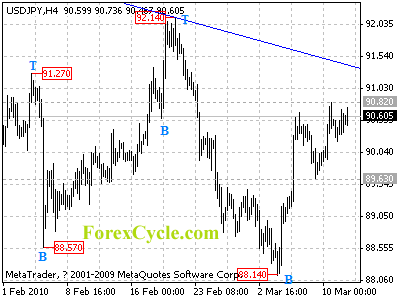
USDJPY’s bounce extended to 90.82

USDJPY’s bounce from 88.14 extended further to as high as 90.82. However, another fall towards 89.63 key support is still possible later today, a breakdown below this level will indicate that the downtrend from 93.75 (Jan 7 high) has resumed, then deeper decline could be seen to 87.00-87.50 area. Resistance is now at the falling trend line from 93.75 to 92.14, only a clear break above the trend line resistance could indicate that the fall from 93.75 has completed at 88.14 already.

usdjpy

Daily Forex Signals

Forex Daily Market Commentary

By GCI Fx Research

Fundamental Outlook at 1500 GMT (EDT + 0500)

The euro depreciated vis-à-vis the U.S. dollar today as the single currency tested bids around the US$ 1.3620 level and was capped around the $1.3685 level.  There are ongoing themes that are driving trading flows now.  First, Greece’s fiscal problems continue to plague the common currency.  Greece continues to assert that it will not require financial assistance to manage its mountain of maturing debts.  If a bailout is required, the most likely candidates include Germany, the European Union, and the International Monetary Fund.  Second, there is a concern that sovereign credit risks could intensify and spread to other highly indebted eurozone countries including Portugal, Italy, and Spain.  The prospect of a widerning problem has kept the single currency on the defensive for weeks.  Third, there is a general sense that the Federal Reserve will be more proactive about unwinding emergency credit measures than the European Central Bank.  This perception has also kept the euro on the defensive. Fourth, economic data continue to be mixed.  Economists note that there really is not an evident trend in the U.S. labour market yet.  Data released in the U.S. today saw weekly initial jobless claims decline 6,000 to 462,000 while continuing jobless claims came in at 4.588 million, up from 4.521 million.  Some private sector forecasts suggest there could be jobs growth this month as high as 300,000.  The general sense is that the unemployment rate will gradually decrease, possibly falling below 9% later this year.  Other data released in the U.S. today saw the January trade balance print at –US$ 37.3 billion, down from an upwardly revised US$ -39.9 billion in December.  Most economists expect the mammoth U.S. trade deficit to continue widening.  Tomorrow’s U.S. data will include February retail sales, mid-March University of Michigan consumer sentiment, and January business inventories.  Many important data including industrial production, TICS flows, and housing numbers will be released early next week.  In eurozone news, European Central Bank member Mersch said that if a European Monetary Fund is created to help address fiscal problems in the eurozone, the entity will not receive financial asssitance from the ECB.  Germany’s Kiel Institute reduced its eurozone growth forecast to +0.7% for 2010 and +1.8% for 2011.  Data released in the eurozone today saw the Q4 current account surplus print at €4.8 billion compared with a €32.2 billion deficit one year ago.  Euro bids are cited around the US$ 1.3335 level.

¥/ CNY

The yen depreciated vis-à-vis the U.S. dollar today as the greenback tested offers around the ¥90.70 level and was supported around the ¥90.20 level.  Many traders are concluding an additional quantitative easing measure by Bank of Japan next week seems like a foregone conclusion.  Central bankers are known to be concerned that deflationary pressures are likely to remain in Japan through at least fiscal year 2012 and the Japanese government continues to pressure the BoJ into loosening policy further.  Deputy finance minister Noda today said the BoJ and government “share the view that the economy is in a mild deflationary state.”  Data released in Japan overnight saw Q4 gross domestic product rise at an annual 3.8% rate, notably less than the preliminary 4.6% figure reported last month.  Also, the GDP deflation tumbled a record 3.8%, underscoring the seriousness of deflation in the Japanese economy.  Demand across Asia is improving, however, and this may allow Japanese companies to increase capital expenditures. Capital spending was up 0.9% q/q in Q4 but approximately one-third of factory capacity is idle now in Japan.  Japan’s fiscal situation remains critical and the government’s ability to increase fiscal spending through supplementary budgets to counter deflationary pressures is limited.  Dealers continue to cite strong repatriation flows during the Australasian sessions.  The Nikkei 225 stock index gained 0.96% to close at ¥10,664.95.  U.S. dollar offers are cited around the ¥94.75 level.  The euro moved higher vis-à-vis the yen as the single currency tested offers around the ¥123.85 level and was supported around the ¥123.00 figure.  The British pound moved higher vis-à-vis the yen as sterling tested offers around the ¥136.45 level while the Swiss franc moved higher vis-à-vis the yen and tested offers around the ¥84.80 level. In Chinese news, the U.S. dollar appreciated vis-à-vis the Chinese yuan as the greenback closed at CNY 6.8266 in the over-the-counter market, up from CNY 6.8260.  Data released in China overnight saw inflation increase a significant 2.7% y/y and this has led to speculation that People’s Bank of China could hike rates or tighten policy further as early as tomorrow.  The M2 money supply measure has increase more than 25% over the previous twelve months and this will invariably lead to inflationary pressures.  It was also reported that Chinese banks provided CNY 700 billion in new loans last month.

The British pound appreciated vis-à-vis the U.S. dollar today as cable tested offers around the US$ 1.5065 level and was supported around the $1.4945 level.  A Bank of England quarterly inflation survey was released today in which U.K. inflation expectations climbed to their highest level since November 2008. This increase in expectations has added to speculation that interest rates could rise.  Consumers now expect inflation to be 2.5% higher one year from now, up from the previous reading of 2.4%. The other big factor in the U.K. now remains the general election.  Concerns that Tory leader Cameron could win the election but fail to form a majority government are weighing heavily on sterling.  BoE member Posen said the U.K. economy has successfully avoided deflation and added the economy would have been considerably worse absent quantitative easing policies.  Cable bids are cited around the US$ 1.4455 level.  The euro moved lower vis-à-vis the British pound as the single currency tested bids around the US$ 0.9060 level and was capped around the $0.9120 level.

CHF

The Swiss franc appreciated vis-à-vis the U.S. dollar today as the greenback tested bids around the CHF 1.0690 level and was capped around the CHF 1.0725 level.  As expected, Swiss National Bank kept its three-month Swiss franc Libor target rate unchanged at 0.2% today.  SNB reported ‘The Swiss National Bank is maintaining its expansionary monetary policy. It will act decisively to prevent an excessive appreciation of the Swiss franc against the euro.”  SNB is forecasting the Swiss economy will expand about 1.5% this year.  U.S. dollar offers are cited around the CHF 1.1045 level.  The euro moved higher vis-à-vis the Swiss franc as the single currency tested offers around the CHF 1.4630 level while the British pound moved higher and tested offers around the CHF 1.6120 level.

Forex Daily Market Commentary provided by GCI Financial Ltd.

GCI Financial Ltd (”GCI”) is a regulated securities and commodities trading firm, specializing in online Foreign Exchange (”Forex”) brokerage. GCI executes billions of dollars per month in foreign exchange transactions alone. In addition to Forex, GCI is a primary market maker in Contracts for Difference (”CFDs”) on shares, indices and futures, and offers one of the fastest growing online CFD trading services. GCI has over 10,000 clients worldwide, including individual traders, institutions, and money managers. GCI provides an advanced, secure, and comprehensive online trading system. Client funds are insured and held in a separate customer account. In addition, GCI Financial Ltd maintains Net Capital in excess of minimum regulatory requirements.

DISCLAIMER: GCI’s Daily Market Commentary is provided for informational purposes only. The information contained in these reports is gathered from reputable news sources and is not intended to be U.S.ed as investment advice. GCI assumes no responsibility or liability from gains or losses incurred by the information herein contained.

AUD/USD Weakens Following Moderate Employment Data

By Fast Brokers – The Aussie has weakened from weekly highs and its psychological .92 level after Australia’s Employment Change figure printed below analyst expectations.  This couples with the pullback in Housing Loans data earlier this week and reveals the RBA’s rate hikes are having their desired impact.  Hence, there’s a possibility the central bank could stand pat at its next meeting.  However, China’s Industrial Production did print below analyst expectations while pricing data was relatively tame despite the cautionary headlines.  As a result, China may not be as aggressive in tightening as some analysts anticipated, meaning Australia could continue to enjoy healthy demand from Asia for its commodities.  Meanwhile, attention will focus in on the West with the U.S. releasing key retail sales and consumer sentiment data tomorrow.  Strong U.S. consumption data could favor the risk trade and help the Aussie move higher. The Aussie did peak above our 2nd tier downtrend line, which runs through 1/18 highs, or the .9275 level.  Therefore, the Aussie could have a bit more topside mobility left in the tank.  The Aussie also has an apparently strong support structure for the time being considering its climb this month has been somewhat gradual.

Technically speaking, the Aussie has multiple uptrend lines serving as technical cushions along with intraday, 3/9lows, and the psychological .90 area.  As for the topside, the Aussie has multiple downtrend lines serving as technical barriers along with the psychological .92 area.  Additionally, previous 2010 highs could serve as a hefty technical barrier should they be tested.

Price: .9135

Resistances: .9143, .9160, .9171, .9194, .9213, .9227

Supports: .9120, .9104, .9090, .9073, .9052

Psychological: .92, 2010 highs

(click chart to enlarge)

Market Commentary provided by Fast Brokers.

Disclaimer: FastBrokers’ market commentary is provided for information purposes only and under no circumstances should be regardedneither as an investment advice nor as a solicitation or an offer to sell/buy any financial product. FastBrokers assumes no responsibility or liability from gains or losses incurred by the information herein contained.

Risk Disclosure: There is a substantial risk of loss in trading futures and foreign exchange. Please carefully review all risk disclosure documents before opening an account as these financial instruments are not appropriate for all investors.

USD/JPY Trades Off Wednesday’s Highs

By Fast Brokers – The USD/JPY has pulled back from Wednesday’s highs and is gravitating towards the psychological 90 level as we anticipated.  The USD/JPY has managed to avoid a retest in the process, a somewhat positive development.  China’s economic data had a limited impact on the USD/JPY despite the rise in consumer prices and weakness in industrial production.  Additionally, today’s U.S. data has also had a muted influence on the USD/JPY today.  Therefore, it seems investors are more focused on the currency pair’s technical levels than global fundamental developments for the time being.  However, that could change tomorrow with the release of America’s retail sales and consumer sentiment data.  We’ve really seen the USD/JPY react to U.S. data lately.  Considering U.S. consumption has a direct impact on Japan’s manufacturing base, we could see the USD/JPY come back to life tomorrow.  Strong U.S. consumption could send the USD/JPY higher in anticipation that the Fed will tighten before the BoJ, whereas negative data releases could send the USD/JPY back towards its psychological 90 level.  Therefore, investors should keep a sharp eye on tomorrow’s data wire.

Technically speaking, the USD/JPY faces our new downtrend lines along with intraday and 2/7 highs.  Meanwhile, the highly psychological 90 area could have an influence over the USD/JPY’s movements for the near-term.  As for the downside, the USD/JPY has multiple uptrend lines serving as technical cushions along with intraday and 3/9 lows.

Present Price: 90.44

Resistances: 90.49, 90.54, 90.63, 90.69, 90.81, 90.89

Supports: 90.35, 90.29, 90.17, 90.11, 90.02, 89.95

Psychological: 90, March highs

(click chart to enlarge)

Market Commentary provided by Fast Brokers.

Disclaimer: FastBrokers’ market commentary is provided for information purposes only and under no circumstances should be regardedneither as an investment advice nor as a solicitation or an offer to sell/buy any financial product. FastBrokers assumes no responsibility or liability from gains or losses incurred by the information herein contained.

Risk Disclosure: There is a substantial risk of loss in trading futures and foreign exchange. Please carefully review all risk disclosure documents before opening an account as these financial instruments are not appropriate for all investors.