Gold Retests $1100/oz

By Fast Brokers – Gold is retesting its highly psychological $1100/oz area after Friday’s pullback.  Gold experienced another leg down despite pops in the EUR/USD and GBP/USD.  These two currency pairs are normally positively correlated with gold, so it’s interesting that gold isn’t behaving according to its usual Dollar correlation.  Meanwhile, gold is fighting to hold $1100/oz.  Gold did drop below our 2nd tier uptrend line on Friday, a negative development technically since the 2nd tier runs through 2/12 lows, or the $1075/oz . zone.  Hence, gold could be in for further weakness over the near-term should the precious metal not overcome some topside technicals quickly.  While gold sank below key technical cushions on Friday, the EUR/USD and GBP/USD popped above some important technical barriers.  Therefore, it will be interesting to see whether we are witnessed a more lasting shift in correlation.  The U.S. will be in focus again today with a thorough data set on the way.  However, tomorrow’s Fed meeting will likely capture the spotlight since investors will be watching to see whether the central bank shifts its loose monetary policy stance.  The EU will also release its ZEW Economic Sentiment data tomorrow, meaning volatility could pick up in the FX markets over the next 24 hours.

Technically speaking, gold faces multiple downtrend lines along with 3/11and 3/12 highs.  As for the downside, gold still has multiple uptrend lines serving as technical cushions, highlighted by our 2nd tier which runs through 2/12 lows.  Furthermore, the psychological $1100/oz area could continue to have an influence on gold over the near-term.

Present Price: $1104.50/oz

Resistances: $1105.05, $1106.26, $1108.17/oz, $1109.58/oz, $1110.98/oz, $1112.29/ oz

Supports: $1105.05/oz, $1102.82/oz, $1101.73/oz, $1100.35/oz, $1099.05/oz, $1097.74/oz

Psychological: $1100/oz, $1150/oz, March highs and Lows

(click chart to enlarge)

Market Commentary provided by Fast Brokers.

Disclaimer: FastBrokers’ market commentary is provided for information purposes only and under no circumstances should be regardedneither as an investment advice nor as a solicitation or an offer to sell/buy any financial product. FastBrokers assumes no responsibility or liability from gains or losses incurred by the information herein contained.

Risk Disclosure: There is a substantial risk of loss in trading futures and foreign exchange. Please carefully review all risk disclosure documents before opening an account as these financial instruments are not appropriate for all investors.

Potential Reversal for AUD/JPY

By Anton Eljwizat – The volatility of the AUD/JPY pair continues to be affected by the action in the forex market. The last three weeks has seen much bullish strength in the AUD/JPY pair. However, as I demonstrate below, it seems that the pair’s bullish run may have run out of steam, and a bearish correction could be underway soon. This might be a good opportunity for forex traders to enter the trend at a very early stage and at a great entry price.

• Below is the daily chart of AUD/JPY currency pair.

• The technical indicators that are used are the Relative Strength Index (RSI), Slow Stochastic and MACD.

• Point 1: There is a “doji” candlestick that has formed on the chart, indicating that a reversal should take place.

• Point 2: The Relative Strength Index (RSI) indicates that the price of this cross currently floats in the overbought territory, signaling downward pressure.

• Point 3: The Slow Stochastic indicates a bearish cross, signaling that the next move may be in a downward direction.

• Point 4: The MACD indicates an impending bearish cross, which may signal a downward movement is going to occur in the near future.

AUD/JPY Daily Chart

Forex Market Analysis provided by Forex Yard.

© 2006 by FxYard Ltd

Disclaimer: Trading Foreign Exchange carries a high level of risk and may not be suitable for all investors. There is a possibility that you could sustain a loss of all of your investment and therefore you should not invest money that you cannot afford to lose. You should be aware of all the risks associated with Foreign Exchange trading.

USD/JPY Consolidates Above 90

By Fast Brokers – The USD/JPY is consolidating above its psychological 90 level after Friday’s wild fluctuations in the wake of U.S. consumption data.  Although the USD/JPY popped after stronger than expected Retail Sales figures, the currency pair’s upward momentum was stifled by a disappointing UoM Consumer Sentiment figure.  However, the USD/JPY has managed to avoid a retest of 90 in the process and its upward momentum stemming from March lows is still intact.  The USD/JPY peaked above our 3rd tier downtrend line on Friday, a development worth mentioning since it runs through 2/22 highs, or the 91.70 level.  Hence, the USD/JPY could be in for more near-term gains should U.S. economic data print favorably.  Since the BoJ has been more dovish than the Fed, positive U.S. data benefits the USD/JPY due to speculation that the Fed will tighten before the BoJ.  That being said, there’s an FOMC meeting on Tuesday and it will be interesting to see whether the central bank makes any adjustments to its monetary policy language.  If the Fed should exert a more hawkish stance this could also benefit the USD/JPY.  Meanwhile, the U.S. will release a data set today, including the Empire Index, Industrial Production, TIC Long-Term Purchases and the Capacity Utilization Rate.  Hence, volatility could pick up as the trading session progresses.

Technically speaking, the USD/JPY faces our new downtrend lines along with 3/12 and 2/17 highs.  Meanwhile, the highly psychological 90 area could have an influence over the USD/JPY’s movements for the near-term.  As for the downside, the USD/JPY has multiple uptrend lines serving as technical cushions along with 3/15 and 3/9 lows.

Present Price: 90.68

Resistances: 90.69, 90.81, 90.89, 90.95, 91.04, 91.11

Supports: 90.61, 90.54, 90.45, 90.35, 90.29, 90.17

Psychological: 90, March highs

(click chart to enlarge)

Market Commentary provided by Fast Brokers.

Disclaimer: FastBrokers’ market commentary is provided for information purposes only and under no circumstances should be regardedneither as an investment advice nor as a solicitation or an offer to sell/buy any financial product. FastBrokers assumes no responsibility or liability from gains or losses incurred by the information herein contained.

Risk Disclosure: There is a substantial risk of loss in trading futures and foreign exchange. Please carefully review all risk disclosure documents before opening an account as these financial instruments are not appropriate for all investors.

GBP/USD Battles with March Highs

By Fast Brokers – The Cable is battling previous March highs set during Friday’s topside breakout.  The Cable logged encouraging gains on Friday in the wake of stronger than expected U.S. retail sales data.  The improvement in retail sales gave investor more confidence in the global economic recovery and this favored the risk trade.  The Cable popped past our previous 1st tier downtrend line in the process, which could prove to be a key movement since our 1st tier ran through 2/23 highs, or the 1.5550 area.  We recognized a similar technical breakout in the EUR/USD on Friday, and it will be interesting to see whether these two currency pairs can maintain their upward momentum, though a period of profit taking would not be surprising.  Meanwhile, the Cable is distancing itself further from its psychological 1.50 level with near-term topside technical barriers wearing thin.  The data wires will heat up as the week progresses, highlighted by the FOMC meeting in Tuesday.  The UK will be relatively quiet until Wednesday’s release of the Claimant Count Change along with the BoE’s meeting minutes.  Focus could remain on the U.S. today with the release of a data set including, Industrial Production, Capacity Utilization, TIC Long-Term Purchases, and the Empire Index.  Investors should continue to keep an eye out for headlines concerning the parliamentary election or cautioning against UK debt levels, since these statements have rocked the Cable in the past.  Therefore, potential for another negative shock for the Cable remains regardless of the currency pair’s present upward momentum.

Technically speaking, the Cable has multiple uptrend lines serving as technical cushions along with intraday and 3/12 lows.  As for the topside, the Cable faces multiple downtrend lines along with 3/15 and 2/26 highs. Our 1st-3rd downtrend lines gain importance since they run through 2/17 levels, or the 1.58 zone.   Meanwhile, the psychological 1.50 area becomes a technical cushion should it be tested.

Present Price: 1.5180

Resistances: 1.5184, 1.5195, 1.5205, 1.5215, 1.5233, 1.5236

Supports: 1.5174, 1.5165, 1.5152, 1.5143, 1.5132, 1.5125

Psychological: 1.50 and March highs

(click chart to enlarge)

Market Commentary provided by Fast Brokers.

Disclaimer: FastBrokers’ market commentary is provided for information purposes only and under no circumstances should be regardedneither as an investment advice nor as a solicitation or an offer to sell/buy any financial product. FastBrokers assumes no responsibility or liability from gains or losses incurred by the information herein contained.

Risk Disclosure: There is a substantial risk of loss in trading futures and foreign exchange. Please carefully review all risk disclosure documents before opening an account as these financial instruments are not appropriate for all investors.

EUR/USD Consolidates Following Friday’s Pop

By Fast Brokers – The EUR/USD is consolidating after logging key gains on Friday.  Although the movement wasn’t large pip-wise, the EUR/USD peaked through our 1st-3rd downtrend lines and briefly traded above 12/17 highs.  As we mentioned in our previous analysis, our medium-term downtrend line (now our 1st tier) runs through January highs, or the 1.4575 area.  Hence, Friday’s gains could signal a more lasting uptrend taking shape.  Additionally, our 2nd and 3rd tier downtrend lines run through the 1.39 zone.  Therefore, both near-term and medium-term technicals are beginning to work in favor of the EUR/USD.  The currency pair has built up a solid base over the past month, creating what could be a solid support system should things go awry.  The Cable is in the midst of similar trend setting movements, meaning the risk trade could be a confirmation away from establishing a new near-term uptrend.  However, there are some key economic events on deck, so we will have to see whether fundamentals support Friday’s technical breakout.  The U.S. will remain in focus today with the Empire Index, Capacity Utilization, Industrial Production, and TIC Long-Term Purchases.  If today’s data tacks onto Friday’s encouraging Retail Sales data then the risk trade could receive another top-side boost.  Tomorrow the EU will release ZEW Economic Sentiment and CPI.  It will be interesting to see whether the recent uptrend in CPI continues.  If so this could benefit the Euro since investors may find it hard to rationalize additional liquidity injects from the ECB.  The Fed is on deck Tuesday, meaning volatility could really heat up.  Investors will be looking to see if there is a change in the central bank’s language regarding its loose monetary policy for the foreseeable future.

Technically speaking, the EUR/USD faces multiple downtrend lines along with 3/12 and 2/9 highs.  As for the downside, the EUR/USD has several uptrend lines serving as technical cushions along with 3/12 and 3/10 lows.  Meanwhile, the psychological 1.35 area becomes a technical cushion while 1.40 serves as a key psychological barrier.

Present Price: 1.3750

Resistances: 1.3756, 1.3775, 1.3796, 1.3813, 1.3834, 1.3857

Supports:  1.3728, 1.3713, 1.3691, 1.3672, 1.3654, 1.3637

Psychological: March and February Lows, 1.35, 1.40, February highs

(click chart to enlarge)

Market Commentary provided by Fast Brokers.

Disclaimer: FastBrokers’ market commentary is provided for information purposes only and under no circumstances should be regardedneither as an investment advice nor as a solicitation or an offer to sell/buy any financial product. FastBrokers assumes no responsibility or liability from gains or losses incurred by the information herein contained.

Risk Disclosure: There is a substantial risk of loss in trading futures and foreign exchange. Please carefully review all risk disclosure documents before opening an account as these financial instruments are not appropriate for all investors.

Will the Dollar Continue To Slide Against the Euro?

Source: ForexYard

During last week’s trading, the Dollar saw a bearish correction against the Euro, following several weeks of a consistent bullish trend. This week’s most interesting question is whether the Dollar will resume the bullish trend, or might the Euro’s recovery proceed? This could be answered on Tuesday when the U.S. Interest Rate decision will be announced. If the Fed will surprise and hike rates, it has potential to create mayhem in the market.

Economic News

USD – U.S. Interest Rate Announcement Expected Later On This Week

The Dollar saw mixed results against the major currencies during last week’s trading session. The Dollar dropped about 100 pips against the Euro, and the EUR/USD pair saw a weekly high at the rate of 1.3793. The Dollar saw volatile sessions against the Yen and the Pound, and the two pairs didn’t see a significant trend.

The Dollar failed to rise during last week’s trading as several economic indicators delivered worse than expected figures. The Federal Budget Balance reflected a 220.9B deficit in the government’s spending during February, failing to reach results for 207.5B deficit. The weekly Unemployment Claims showed that 462,000 individuals have filed for unemployment insurance for the first time during the past week, failing to reach expectations for a 456,000 result. Currently it seems that even though the Dollar is generally strengthening, for as long that the economic data from the U.S. won’t show a recovery – the Dollar could drop on the short-term.

As for the week ahead, the main news event that is expected looks to be the Federal Funds Rate on Tuesday. The Federal Funds Rate is in fact the U.S. interest rates announcement for the next month. Current expectations are that the Fed will leave rates at their current low levels of less than 0.25%. However, if the Fed will surprise and hike rates, this has the potential to erase the Dollar’s losses from last week.

EUR – Greece Bailout Speculations to Boost the Euro

The Euro managed to erase some of its losses against the major currencies during last week’s trading. The Euro gained about 100 pips against the Dollar and the Pound, and rose close to 200 pips against the Yen, having the EUR/JPY reach above the 125.00 level.

The main reason for the Euro’s uptrend seems to be the speculations regarding the Greece rescue plan by the Euro-Zone. It is expected that the Euro-Zone finance ministers will agree on Monday on a mechanism for helping Greece financially. Such a plan, if will indeed be announced this week, has potential to boost the Euro further. Every publication of potential rescue plan has strengthened the Euro so far, and a final solution to the Greek debt crisis is likely to be received as a strong signal that the Euro-Zone has healthy economies that can aid Greece.

Looking ahead to this week, a batch of data is expected from the Euro-Zone. The main publication looks to be the German ZEW Economic Sentiment. This is a survey of about 350 German institutional investors and analysts that are asked to rate the next 6-month outlook for Germany. Traders should also keep close attention to any development regarding the Greece bailout plan. This seems to be the most urgent matter at the moment, and any publication on the subject is likely to create harsh volatility in the market.

JPY – The Yen Continues To Drop against the Majors

The Yen continued to drop against most of the major currencies during last week. The Yen saw a relatively peaceful session against the Dollar, yet it underwent a bearish trend vs. the Euro and the Pound.

Several economic publications from the Japanese economy have contributed to the Yen’s weakness during last week’s trading session. The Final Gross Domestic Product showed that value of all goods and services produced by the economy during the first quarter rose by merely 0.9%, failing to reach expectations for a 1.0% rise. In addition, the Core Machinery Orders, which measures the value of new private-sector purchase orders placed with manufacturers for machines, has dropped by 3.7% during January. Currently it seems that until a series of positive data will be published from the Japanese economy, the Yen might continue tumbling.

As for this week, the most interesting publication from the Japanese economy looks to be the Overnight Call Rate, which is in fact the Japanese interest rates announcement for the next month. Japan currently holds the lowest rates within the industrial world, and analysts have forecasted that the Bank of Japan (BoJ) is likely to leave rates at their current low levels. However, if the BoJ will surprise and hike rates, this is likely to boost the Yen.

Oil – Will Crude Oil Drop Below $80 a Barrel?

Crude oil saw a relatively bullish session during the beginning of last week, and reached a weekly high of $83.05 a barrel. However, close to the weekend, crude oil dropped significantly and is currently traded around $80.80 a barrel.

The decline of crude oil seems to be the result of the drop in the U.S. Consumer Sentiment survey from Friday. The survey fell from 73.6 points on February to 72.5 on March, renewing concerns about energy demand in the world’s largest oil consumer. If the following data from the U.S. economy will continue to disappoint, it seems that crude oil might drop below $80 a barrel.

Looking ahead to this week, traders are advised to follow the main publications from the U.S and the Euro-Zone. Special attention should be given to the U.S. Interest Rate announcement on Tuesday and the Crude Oil Inventories report on Wednesday, as these seem to be the news events that will impact crude oil the most this week.

Technical News

EUR/USD

The pair has been moving higher the past two weeks. However, this correction could be coming to an end and the bearish trend may resume. The recent price appreciation has failed to make a significant breach of the daily chart’s downward sloping trend line that began on December 3rd. The pair is currently being traded at the resistance level of 1.3790. Going short at a downward sloping trend line can be a great entry point into the market. A bearish cross has also formed on the Slow Stochastic Oscillator, providing another signal for a potential downward movement in the price.

GBP/USD

The Cable is showing signs for a continuation of the bearish trend. Currently the daily chart displays the Relative Strength Indicator floating in the oversold region, indicating the recent price appreciation may have gotten ahead of itself. It also appears that a bearish cross is forming on the chart’s Slow Stochastic Oscillator, indicating the potential for a downward price movement. Traders may want to be aggressive today by shorting the pair prior to the breakout and the continuation of the bearish trend.

USD/JPY

The daily chart shows very little technical resistance to the pair’s recent price rise. The 7-day Relative Strength Index has moved into the oversold level but is showing a sharp up trend, indicating the pair may have more momentum behind it to rise. The pair could continue to rise to its downward sloping trend line, close to the resistance level of 91.25. From there the pair could reverse direction and head lower in line with the long term downward trend.

USD/CHF

The sharp drop in the value of the cross may have gotten ahead of itself and could be due for a short term correction. The daily chart shows a bullish cross has formed on the pair’s Slow Stochastic Oscillator, indicating the potential for a rise in the price. The 7-day Relative Strength Index is also floating in the oversold zone, further strengthening the oversold theory. The price could correct today to the resistance level of 1.0645.

The Wild Card

Oil

Spot crude oil prices have fallen below the daily chart’s upward sloping trend line. The price move lower began at the resistance level of $83.05 and is approaching the 20-day moving average line of the Bollinger Bands. Forex and commodity traders may want to enter into the market with this downward momentum at their backs. An entry strategy may be to wait for the price to break the 20-day moving average line and go short, with a price target at the lower Bollinger Band line, near $78.50.

Forex Market Analysis provided by Forex Yard.

© 2006 by FxYard Ltd

Disclaimer: Trading Foreign Exchange carries a high level of risk and may not be suitable for all investors. There is a possibility that you could sustain a loss of all of your investment and therefore you should not invest money that you cannot afford to lose. You should be aware of all the risks associated with Foreign Exchange trading.

Weekly Market Report 15th Mar , 10

Riskier assets soared higher during the week as equities and petroleum surged forward and the dollar retraced.  The Euro, the Aussie dollar, the loonie and the pound all presented solid returns.

119

On Monday, the markets focused on economic news out of Asia.  A record rise in exports helped Japan’s current-account balance swing back to surplus in January, according to the government, adding to hopes that overseas demand will continue to support the nation’s economic recovery.  January’s current account surplus or Japan’s net earnings from international trade and investment, stood at ¥899.8 billion ($9.95 billion) compared with a ¥132.7 billion deficit a year earlier, according to the Finance Ministry. The result represents the 12th straight month of surplus, while the rebound from the previous year ¥1.033 trillion is the largest since a ¥1.222 trillion recovery in March 1992.

Meanwhile, the nation’s bank lending in February, excluding that by Shinkin, or credit-union banks dropped 1.6% from a year earlier, according to the BOJ.  Bank lending fell for the third month in a row in February as businesses continued to shy away from making new investments.  The figure improved on a 1.7% fall in January, but still marks the third-straight month of decline. Weak lending from banks shows that Japan’s economic recovery lacks the necessary strength to prompt companies to borrow more capital to expand their operations.  Firms have also reduced their reliance on bank lending as improving financial market conditions make it easier for them to raise money through selling bonds or issuing stocks if needed.  The BOJ also said Japan’s money stock increased 2.7% on year in February, compared with a revised 3.0% rise in January. M2 includes cash currency in circulation and deposits held by the BOJ and other financial firms in Japan, excluding Japan Post Bank.

On Tuesday even as the equity markets continued to rally, market participants focused on the weakening UK economy.  The economic data in the UK does not paint a pretty picture. The RICS February house prices (with the main index falling to a much weaker than expected 17% from 31%) was very disappointing. The January trade balance data was also a disaster for UK bulls, with the main deficit widening to a much worse than expected £7.98bn (vs. -£7billion previously and vs. -£7bn expected) while the non-EU trade gap widened to -£3.8billion (from -£2.6billion). This was the worse trade performance since August 2008 and resulted from a 6.7% monthly drop in exports while imports were down 1.6%. The slump in exports is disappointing at a time of sterling weakness but one should not forget that the UK main trading partner (the euro zone) recovery is extremely sluggish and a weaker currency will do little in the near-term if external demand is very weak to start with. Coupled with the negative adverse effects that the poor weather recorded in Q1 will have on GDP growth, the highly disappointing trade figures underline a further drag on economic activity.

On Wednesday, market participants were happy to see better than expected US inventory news.  U.S. wholesalers’ inventories unexpectedly fell 0.2% in January, according to the Commerce Department, as surging demand pulled goods off shelves in the first month of the year.  Wall Street analysts had expected inventories to rise by 0.2% in January. The unexpected decline followed a downward revision in December’s inventory level showing December inventories contracted by 1.0%, rather than the 0.8% drop originally reported.  Sales by U.S. wholesalers in the first month of 2010 were up 1.3% to a seasonally adjusted $346.7 billion, the latest data showed. It was the tenth straight monthly increase in sales, according to the Commerce Department. Sales were particularly strong for cars and groceries.  The decline in inventories is good news for the U.S. economy. As inventories are reduced, they will need to be replaced which creates more employment. The amount of wholesale goods on hand relative to sales was 1.10 in January, a record low. The inventory-to-sales ratio measures how many months it would take for a firm to deplete its current inventory. The ratio in December was 1.12.

In Asia, China reported stronger export and import figures for February than expected, with the net result of a smaller than expected trade surplus.  In fact, February’s trade surplus of $7.6 billion is the smallest in a year and a bit more than half of the January surplus.  In terms of global imbalances, the US trade deficit and the Chinese trade surplus have been roughly halved as a percentage of GDP over the last couple of years.  In the US case, it seems largely cyclical and the growth differentials that we expected to close the output gap in the US before Europe and Japan will likely see the US trade deficit grow again, though from a lower base.  In China’s case, the possibility of a structural shift is greater, though too early to tell.  China’s exports rose 45.7% in February from the depressed year-ago levels. Yet this is more than twice the pace in January and may also have been distorted by the earlier lunar New Year.  Imports jumped almost 45%, better than the 39.7% expectations, but well off the mind-boggling 85.5% pace reported in January.

Furthermore, Japan’s economy may be benefiting from the revival in its neighboring Asian economies, but domestic demand remains very sluggish and deflationary forces continue.  February machinery orders were softer than expected at down 3.7% m/m (vs. +20.1% in December.) That put the yearly rate at -1.1% (vs. -0.6% expected). Machinery orders are a good proxy for business investment, so this disappointing January performance is not particularly promising for Q1GDP.

On Thursday, riskier assets continued to climb, help a quarterly Federal Reserve report that said U.S. households’ total net worth climbed 1.3% in the fourth quarter, to $54.18 trillion from the third quarter’s $53.49 trillion. For 2009 as a whole, net worth rose 5.4%. Household net worth is assets, such as home equity, minus liabilities, such as mortgage debt.  A large chunk of the increase in net worth came from a drop in household debt, as an increasing number of financially stretched consumers defaulted on mortgage and credit-card debts. While the defaults are painful for families and costly to banks and investors, economists say they are also speeding the financial rehabilitation necessary for a return to robust growth.

The buoyant state of China’s economy was in the limelight Thursday in Asia. China is not just an externally driven economy, the strong February retail sales captured a very strong consumer sector, with a yearly growth rate beating expectations, at 17.9% y/y. February industrial production also impressed, with a 20.7% yearly rate, beating expectations. However, it is the February CPI that has caught most headlines, with a yearly inflation rate firming to a stronger than expected 2.7%, up from 1.5% previously. The data highlights overheating economic conditions, with the Jan/Feb reserve requirement hikes not filtering through to the economy just yet.

In Japan, the economic environment is not all that rosy and the final Q4GDP was revised down, to 0.9% (from 1.0%), with the deflationary forces yet again in the limelight as the GDP deflator stood at -2.8% y/y.

On Friday there was a plethora of data in the US for the market to absorb.  Retail sales rose last month by 0.3%, according to the Commerce Department. With the Super Bowl early in the month, electronic store sales soared.  Economists surveyed had forecast a 0.3% decrease. January retail sales were adjusted downward, to a 0.1% increase from a previously reported 0.5% gain.  Excluding the car sector, all other retail sales rose 0.8%. Economists had forecast a 0.1% increase. Ex-auto sales in January rose 0.5%, revised from a previously estimated 0.6% gain.  Retail sales data are an important indicator of consumer spending. Consumer spending represents some 70% of demand in the U.S. economy.

220

Unfortunately, Business inventories were on the soft side.  Not only was the January reading flat, but the December series was revised to -0.3% from -0.2%.  January wholesale and factory inventories had previously been released so the new information Friday was largely the 0.1% decline in retail inventories.   Inventories added mightily to Q4 09 5.9% annualized GDP and some analysts dismiss the growth because of this phenomenon.  However, a large part of the contraction was also due to inventories.  The inventory cycle is still unfolding.  The large swing in Q4 still is about the pace of inventory liquidation. It is a gradual process that can be stretched out for the next couple of quarters at least.   As sales are increasing, the inventory to sales ratio is tightening.

Currencies:

In Japan, both the prime minister and the finance minister made a none-too-thinly veiled threat of foreign exchange intervention.  One investment house was quoted on the wires late
Thursday suggesting the odds of intervention stood at 47%.  The MOF is insistent on providing a deflationary fighting measure for the Yen.

The RBNZ left rates on hold (at 2.5%) and reiterated that rates would remain on hold until around mid-year but also signaled that the pace of tightening would be gradual.  Governor Bollard stated that rate hikes may be less than in previous cycles and that growth is likely to be subdued relative to past recoveries including the RBNZ’s forecast for 4.4% y/y growth.  Inflation is expected to remain within target and Bollard noted that financial conditions are tighter than the ODR would imply reinforcing his point that the ODR is likely to be hiked by less than in previous cycles.

Canada’s unemployment rate edged down 0.1 percent to 8.2 percent in February as 21,000 people started new jobs, Statistics Canada reported on Friday.  The agency said there were 60,000 new full-time jobs filled in February, but 39,000 part-time jobs were lost.  Analyst had expected an increase of 15,000 jobs and an unchanged unemployment rate at 8.3 percent.  The Canadian dollar is breaking through support and now could make a run at par.

311

Commodities:

Crude Oil edged higher this week, rallying a little more than a dollar per barrel driven by dollar weakness, a strong equity markets.  During the middle of the week, the Organization of Petroleum Exporting Countries predicted members will need to produce 28.94 million barrels a day to satisfy demand in 2010. OPEC projection is an increase of about 190,000 barrels a day more than last month’s projection.  “Even taking into account the uncertainty regarding demand for OPEC crude, current OPEC production is likely to exceed market needs,” the Vienna-based secretariat said in the report.

OPEC increased its forecast for worldwide oil consumption in 2010 by 120,000 barrels a day to 85.24 million barrels a day. That represents growth of 880,000 barrels a day from 2009, 80,000 barrels a day more than it forecast last month. Consumption growth is driven entirely by developing economies and will remain sensitive to the pace of global economic recovery, according to OPEC.

Daily Forex Market Analysis provided by eToro

Disclaimer: Trading in the Foreign Exchange market might carry potential rewards, but also potential risks. You must be aware of the risks and are willing to accept them in order to trade in the foreign exchange market. Don’t trade with money you can’t afford to lose.

© 2009 eToro Blog.

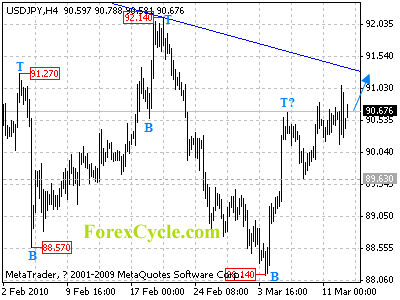
USDJPY’s bounce extended to 91.08

USDJPY’s bounce from 88.14 extended to as high as 91.08 last week. Further rally to test the resistance of the falling trend line from 93.75 (Jan 7 high) to 92.14 is expected later today, a clear break above the trend line resistance will target 92.00 area. Key support is located at 89.63, only fall below this level will indicate that the bounce from 88.14 has completed, then another fall towards 87.00 could be seen.

usdjpy

Daily Forex Reports

USD/CHF Is Testing the 1.0640 Level

By Yan Petters – The USD/CHF pair is testing its first support level for today – at the 1.0640 price. As several technical indicators suggest that the pair is likely to drop today, trader should pay attention to the three significant support levels that might be expected today.

• The chart below is the 4-hours USD/CHF chart by ForexYard.
• The technical indicators used are the Bollinger Bands, the Slow Stochastic, the MACD/OsMA and the Relative Strength Index (RSI).
• The Slow Stochastic is located under the 20 line at the moment – indicating that the bearish momentum has more steam in it.
• The MACD continues with the bearish channel, further strengthening the notion that a drop is likely to be expected.
• The RSI has failed to reach above the ‘over-sold’ zone, which means that a bullish correction is not likely to take place soon.
• The USD/CHF pair is currently testing the 1.0640 level. If it will manage to breach this level, it has potential to reach to the 1.0600 level – and then to the 1.0500.

Forex Market Analysis provided by Forex Yard.

© 2006 by FxYard Ltd

Disclaimer: Trading Foreign Exchange carries a high level of risk and may not be suitable for all investors. There is a possibility that you could sustain a loss of all of your investment and therefore you should not invest money that you cannot afford to lose. You should be aware of all the risks associated with Foreign Exchange trading.