EUR Falls on Risk Aversion; Rebound Expected?

Source: ForexYard

With a sharp reduction in domestic and foreign investment in the United States, and a decline in the US stock market, the USD and JPY appear to have made more than moderate gains against most of their rivals, and the EUR may be on the short end of the market as a result. However, given today’s ZEW economic sentiment reports, there is a chance that the EUR could experience a modest rebound if the figures come out in favor of the Euro-Zone’s regional economy.

Economic News

USD – Dollar Up on Risk Aversion; Fed Funds Rate on Tap

The US Dollar surged versus the majority of its currency counterparts during yesterday’s trading. Against the EUR, the greenback reached towards 1.3640 up from yesterday opening price of 1.3775. A significant price shift in the market yesterday was also the sudden surge in the value of the Canadian Dollar (CAD) against the buck. The USD/CAD began to reach towards parity with a current price of 1.0185.

Two important economic indicators came in at levels unforeseen by economists yesterday. The TIC Long-Term Purchases report, which is a measure of investment in the local US market, was published significantly lower than was expected. Additionally, the NAHB Housing Market Index dropped this past month, highlighting weakness in the American housing sector.

Most investors would normally expect a sudden sell-off in USD, but the opposite in fact took place. The Dollar and Yen each shot up following the above reports due to a dramatic rise in risk aversion. US stocks plummeted following the news but the greenback has gained from risk flight.

These price movements also seem to have come at the start of a volatile trading week. Today’s release of the US Building Permits report could help verify whether yesterday’s NAHB report was accurate and give more direction for the strength of the local economy in the US. The Federal Reserve Board will also be publishing its decision on US short-term interest rates. The latest string of data from the United States suggests that a rate hike would be premature at this point, so investors shouldn’t expect much change from this event, but volatility, as always, should be anticipated.

EUR – EUR Facing Sell Pressure from Risk Flight

The EUR appears to have taken modest losses in yesterday’s trading. Starting with a high near 1.3775 versus the USD, the 16-nation single currency is now trading near the 1.3690 price level. The Euro has also taken similar losses against the Swiss Franc, and currently trades at 1.4505, down from 1.4550.

With a sharp reduction in domestic and foreign investment in the United States, and a decline in the US stock market, the USD and JPY appear to have made more than moderate gains against most of their rivals, and the EUR may be on the short end of the market as a result. The sudden return of risk aversion has the Euro-Zone currency bearing the brunt of this sell-off.

Should today’s releases of the ZEW Economic Sentiment reports come lower than forecasted, there is a strong chance the EUR will continue to face selling pressure, especially if the report from Germany, the Euro-Zone’s largest economy, fails to meet expectations. In other news, however, the US Federal Reserve Board is due to release their decision on short-term interest rates and although no major changes are expected, there is typically a lot of pressure built into the opening of the American market prior to this event.

JPY – Yen Sees Modest Gains; BOJ Concerned over European Spill-Over

The Yen appears to be on the winning side of a recent return of risk aversion in the forex market. US stocks dropped after less-than-stellar investment data was published in the US. However, the JPY did gain from a positive manufacturing report from New York. The USD/JPY currently trades at a 2-week low of 90.02, from yesterday’s opening price near 90.55.

No matter how much strength the Yen gained in recent trading, the truth remains that the JPY continues to trade within steady ranges against its primary crosses. The mixed movements of the EUR and CHF have resulted in somewhat volatile conditions for the Yen, but it seems to be to the advantage of Japan in both cases. The only concern the Bank of Japan (BOJ) seems to be carrying is regarding the status of Europe considering their recent debt woes. BOJ governors are rightfully concerned about spillover into East Asia, but no real effect has been priced in yet.

Crude Oil – Crude Falls on USD Surge and Market Uncertainty

The price of Crude Oil has begun to waver in light of economic uncertainty. The TIC Long-Term Purchases report published from the US yesterday helped shake business sentiment, and stocks are trading lower as a result. The surging US Dollar has helped to put a damper on oil prices, but few economists see prices dropping further. Demand concerns appear to have risen out of yesterday’s economic data.

On the upside, Crude Oil has failed to breach out of its range-trading pattern and many analysts are expecting a rebound in today’s trading. The Federal Reserve Board is due to release their decision on short-term interest rates, and other monetary policies, later today. In light of recent data, rates will not likely be raised, but a hawkish statement could help to return some of the risk which was pulled out of the market yesterday. Such a result would pull the USD back down and help spot Crude Oil prices rebound.

Technical News

EUR/USD

While most of the pair’s indicators are floating in neutral territory, the hourly chart’s Slow Stochastic is exhibiting a fresh bearish cross while the RSI is floating in the overbought territory. Going short with tight stops might be advised for today.

GBP/USD

An upward correction may take place for the pair today as the 2 hour chart RSI is floating in the oversold territory and a bullish cross is evident on the 4 hour chart’s Slow Stochastic. Going long for the day may be a good option.

USD/JPY

The hourly and 2 hour charts’ RSI are floating in the oversold territory while a bullish cross is evident on the 2 hour and 4 hour charts’ Slow Stochastic. Furthermore, a breach of the lower Bollinger Band is evident on the 2 hour and 4 hour charts. Going long for the day may be advised.

USD/CHF

The pair may see an upward correction today as a bullish cross is evident on the hourly and daily charts’ Slow Stochastic, while the hourly and 8 hour charts’ RSI is floating in the oversold territory indicating an imminent upward movement. Going long for the day may be a good option.

The Wild Card

GBP/NZD

The pair’s hourly and 2 hour chart’s RSI is floating in the oversold territory with a bullish cross evident on the hourly, 2 hour and 4 hour charts’ Slow Stochastic. Furthermore, a breach of the lower Bollinger Band is evident on the hourly chart. Forex traders are advised to go long for the day.

Forex Market Analysis provided by Forex Yard.

© 2006 by FxYard Ltd

Disclaimer: Trading Foreign Exchange carries a high level of risk and may not be suitable for all investors. There is a possibility that you could sustain a loss of all of your investment and therefore you should not invest money that you cannot afford to lose. You should be aware of all the risks associated with Foreign Exchange trading.

Forex Trading Opportunities

Dear Trader,

The U.S Interest Rate will be released today, March 16th at 6:15pm GMT. Due to the expected influence of the announcement on the Forex market, we have collected for you a few trading ideas, which you might consider to take advantage of prior to the rate announcement –

EUR.USD, Hourly

124

Trading Advise- Although the Pair opened on a negative note this week the weekly outlook still remains bullish. Use the 1.36 to place your stop loss under it and ride a bullish trend close to the 1.4 level. Trim you bet slightly below 1.4 as the 1.4-1.42 is a heavy bids zone where we suggesting cautiousness.

EUR.USD, Daily

225

EUR.JPY, Hourly

319

Trading Advise- The Pair is expected to have a volatile journey north with the 124.85 as the first resistance. Although downside risk for the pair is still considerable we still see good upside potential with good risk reward ratio. Place your stop loss under 123 and ride a rebound to the 125 area.

EUR.JPY, Daily

412

Special Attention- If you are a long term player watch for a daily close above the 125 level. A close above that level could ignite a strong rally for the pair. Place your stop loss under 120 and ride the pair to our long term target of 130.The pair’s move to 130 is expected to be volatile moreover a failure to close above 125 on a daily interval would invalidate our long term scenario.

Daily Forex Market Analysis provided by eToro

Disclaimer: Trading in the Foreign Exchange market might carry potential rewards, but also potential risks. You must be aware of the risks and are willing to accept them in order to trade in the foreign exchange market. Don’t trade with money you can’t afford to lose.

© 2009 eToro Blog.

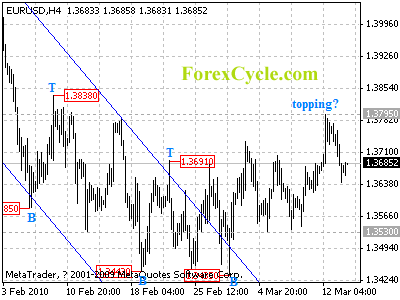
EURUSD’s bounce extended to 1.3795 only

EURUSD’s bounce extended to 1.3795 only. The following pullback suggests that a cycle top is being formed on 4-hour chart. Now the fall from 1.0154 could possibly be resumption of downtrend from 15144 (Nov 25, 2009 high), another fall to 1.3200-1.3300 area may be expected and a breakdown below 1.3530 could confirm such case. However, above 1.3795 will indicate that the pair remains in upward movement from 1.3435, then further rally could be seen to 1.3850 or even 1.3935.

eurusd

Daily Forex Analysis

Forex Daily Market Commentary

By GCI Fx Research

The euro depreciated vis-à-vis the U.S. dollar today as the single currency tested bisa around the US$ 1.3685 level and was capped around the $1.3775 level.  The Federal Open Market Committee is not expected to make any significant changes to monetary policy tomorrow when its interest rate decision is announced.  The Obama administration is said to favour San Francisco Fed President Yellen to replace retiring Vice Chairman Kohn.  It is believed Obama may stack the Fed Board with so-called monetary doves to retain a downward bias on interest rates.  Data released in the U.S. today saw February capacity utilization rise to 72.7% from 72.5% while February industrial production fell to +0.1% from the prior reading of +0.9%.  Also, January total net Treasury International Capital flows printed at –US$ 33.4 billion, down from a revised +US 53.6 billion for December.  Net long-term TIC flows tumbled to US$ 19.1 billion from the prior reading of US$ 63.3 billion.  These data mean the U.S. did not cover its trade deficit in January through foreign investment inflows.  Other data released today saw the March Empire State manufacturing index decline to +22.86 from the previous reading of +24.91.  Dealers await the March NAHB housing market index later in the day and details about new financial services regulation legislation making its way through Congress.  In eurozone news, EMU-16 Q4 unemployment was off 0.2% q/q and 2.0% y/y.  Eurozone CPI data will be released tomorrow along with German ZEW data.  Traders remain fixated on Greece, especially as French finance minister Lagarde and other eurozone officials have intimated Greece may be able to resolve its massive fiscal deficit without external financial assistance.  European Union officials are said to have a “contingency” plan in place that they can implement “with the push of a button.”  Euro bids are cited around the US$ 1.3335 level.

¥/ CNY

The yen depreciated vis-à-vis the U.S. dollar today as the greenback tested offers around the ¥90.85 level and was supported around the ¥90.55 level.  Traders await Bank of Japan Policy Board’s interest rate decision tomorrow night with strong expectations of additional monetary easing.  The central bank may expand a ¥10 trillion fund that provides funding to banks when policymakers convene on 16-17 March and this is important because an unlimited uncollateralized loan facility expires on 31 March.  The central bank remains under significant pressure to do more to combat the deflation problem further.  BoJ Governor Shirakawa and other Policy Board members have recently indicated deflationary pressures are persisting because there is insufficient final private demand.  Shirakawa overnight said he is “not against inflation targeting” and said the central bank should not make policy based on short term price movements.  He also said that additional Japanese government bond purchases would mean the central bank will sell them eventually. Concerning the yen, Shirakawa said the central bank’s accommodative policy is impacting the yen and “proper action needs to be taken.”  It appears the Hatoyama government is becoming increasingly concerned with the yen’s strength and there is growing speculation the government may begin to officially intervene in the market, especially as the government increased the size of the funding it has available for intervention in its draft budget.  Data released in Japan overnight saw February consumer confidence improve to 40.0 while February Tokyo-area condominium sales climb 10.7% y/y.  Machine tool orders and tertiary index data will be released tomorrow.  The Nikkei 225 stock index climbed 0.01% to close at ¥10,751.98.  U.S. dollar offers are cited around the ¥94.75 level.  The euro moved lower vis-à-vis the yen as the single currency tested bids around the ¥124.25 level and was capped around the ¥125.15 level.  The British pound moved lower vis-à-vis the yen as sterling tested bids around the ¥136.10 level while the Swiss franc moved higher vis-à-vis the yen and tested offers around the ¥85.85 level. In Chinese news, the U.S. dollar depreciated vis-à-vis the Chinese yuan as the greenback closed at CNY 6.8262 in the over-the-counter market, up from CNY 6.8256.  Data released in China overnight saw February actual foreign direct investment decrease to +1.08% from the prior reading of +7.80%.  Premier Wen Jinbao reported the yuan is “not undervalued.”  Chinese and U.S. tensions are definitely increasing and it remains to be seen how quickly China may liberalize its yuan exchange rate policy.

The British pound depreciated sharply vis-à-vis the U.S. dollar today as cable tested bids around the US$ 1.5020 level and was capped around the $1.5205 level. Sterling moved lower on remarks from Bank of England Monetary Policy Committee member Barker who reported the U.K. economy could recede again, adding the economic recovery will continue to be “bumpy and fragile.”  Cable continues to suffer from political uncertainty ahead of the upcoming mandatory General Election.  Prime Minister Brown is expected to lose to Tory leader Cameron but Cameron may not be able to form a majority government if he wins, and this could lead to a weaker pound.  U.K. DCLG house prices data will be released tomorrow.  On Friday, Bank of England Chief Economist and Monetary Policy Committee member Dale reported that from the time quantitative easing was implemented last year, “the economy has stabilized, household and business confidence have recovered, and financial market conditions have improved.”  Dale noted the BoE is poised to make additional purchases of assets if required but noted the central bank could also withdraw monetary stimulus at any time.   Cable bids are cited around the US$ 1.4455 level.  The euro moved higher vis-à-vis the British pound as the single currency tested offers around the US$ 0.9130 level and was supported around the $0.9045 level.

CHF

The Swiss franc depreciated vis-à-vis the U.S. dollar today as the greenback tested offers around the CHF 1.0615 level and was supported around the CHF 1.0575 level.  Data released in Switzerland today saw February producer and import prices decline 0.3% m/m and fall 1.0% y/y.  SECO March 2010 economic forecasts will be released tomorrow.  As expected, Swiss National Bank last week kept its three-month Swiss franc Libor target rate unchanged at 0.2% today.  SNB reported ‘The Swiss National Bank is maintaining its expansionary monetary policy. It will act decisively to prevent an excessive appreciation of the Swiss franc against the euro.”  SNB is forecasting the Swiss economy will expand about 1.5% this year.  SNB Chairman Hildebrand said the main risks to Swiss economic growth are “external” and reiterated foreign exchange intervention remains one of its tools.  January M2 money supply growth was an annualized 16.5%.  U.S. dollar offers are cited around the CHF 1.1045 level.  The euro moved lower vis-à-vis the Swiss franc as the single currency tested bids around the CHF 1.4525 level while the British pound moved lower and tested bids around the CHF 1.5915 level.

Daily Market Commentary provided by GCI Financial Ltd.

GCI Financial Ltd (”GCI”) is a regulated securities and commodities trading firm, specializing in online Foreign Exchange (”Forex”) brokerage. GCI executes billions of dollars per month in foreign exchange transactions alone. In addition to Forex, GCI is a primary market maker in Contracts for Difference (”CFDs”) on shares, indices and futures, and offers one of the fastest growing online CFD trading services. GCI has over 10,000 clients worldwide, including individual traders, institutions, and money managers. GCI provides an advanced, secure, and comprehensive online trading system. Client funds are insured and held in a separate customer account. In addition, GCI Financial Ltd maintains Net Capital in excess of minimum regulatory requirements.

DISCLAIMER: GCI’s Daily Market Commentary is provided for informational purposes only. The information contained in these reports is gathered from reputable news sources and is not intended to be U.S.ed as investment advice. GCI assumes no responsibility or liability from gains or losses incurred by the information herein contained.

FOREX: US Dollar starts week strong. EUR/USD falls below 1.3700

By CountingPips.com

The U.S. Dollar has been trading stronger in the forex markets today against most of the major currencies and has started off the week in the black after a decline last week. The dollar has made gains on Monday against the euro, British pound, Swiss franc, Canadian dollar, Australian dollar and the New Zealand dollar while the American currency has been declining versus the Japanese yen, according currency data by Oanda.

The euro has fallen versus the dollar by approximately 100 pips today as the EUR/USD currency pair has declined to trade near the 1.3660 level after opening the day at 1.3773. The EUR/USD rose last week by 144 pips to break out of its trading range and touched its highest level since February 11th after ending the prior three weeks almost unchanged.

The British pound has fallen by 150 pips today after gaining a total of 67 pips last week against the dollar and the GBP/USD is trading right above the psychological level at 1.5000.

The dollar has gained versus the Canadian dollar by approximately 30 pips today as the USD/CAD trades around the 1.0200 level. The dollar had fallen by 95 pips last week to the Canadian dollar to mark a second straight weekly decline. Rounding out the dollars gains today shows increases of approximately 40 pips versus the Swiss franc, the New Zealand dollar and Australian dollar while the USD has fallen against the Japanese yen by over 20 pips.

The dollar had fallen last week versus the Australian dollar (-76 pips), New Zealand dollar (-49 pips) and against the Swiss franc (-161 pips) while the USD gained 23 pips versus the Japanese yen.

The US stock markets today have had a mixed session today with the Dow gaining by approximately 17 points, the Nasdaq decreasing over 5 points and the S&P 500 up by less than 1 point. Oil has fallen lower by $1.33 to $79.91 while gold has risen by $3.60 at $1,105.10 per ounce.

NY Manufacturing expands and Investors pull back US investments

Economic news releases today showed that New York manufacturing activity dipped a bit in March but showed expanding levels while new orders increased. The business activity index showed its eight straight month of positive readings, according to the NY Federal Reserve. New orders rose sharply by 17 points in March while shipments, inventories and the employment indexes also increased in the month.

Also released today was the Treasury Department report on foreign investment for United States securities and it showed foreign investors scaled back on US investments in January. The net outflows by foreign investors in January was $33.4 billion following a net inflow of $53.6 billion in December. This important data, which measures capital flows in and out of the US, showed that foreign investors bought a total of $19.1 billion in long-term US securities in January after spending $63.3 billion in December.

EUR/USD Chart – The Euro falling back below the 1.3700 level versus the dollar in forex trading today. The EUR/USD climbed over 140 pips last week before retreating today and dropping down to the 100-hour moving average in red.

Commodities Trading: A Sneak Peek At Gold

By Adam Hewison – This week could be shaping up to be an extraordinary week in the markets. I strongly recommend that traders everywhere take precautionary measure measures to protect capital.

Last week we gave you a Trade Triangle alert to exit the gold market on the long side. Since that alert was issued gold has dropped significantly.

In today’s short video I bring you up to date with our thoughts on what we think is going to happen next to gold.

As always our videos are free to watch and there are no registration requirements. I would really like to hear back from you in regards to your thoughts on this video.

Watch the New Video Now…

All the best,

Adam Hewison
President, INO.com
Co-creator, MarketClub

FOREX: Is The US Dollar Reversing Again?

By Adam Hewison – It’s been a while since we did a video on the euro/dollar relationship. This relationship may be reversing again based on recent price action. In today’s short video I point out some of the changes we see happening in this market.

This week could be shaping up to be an extraordinary week in the markets. I strongly recommend that traders everywhere take precautionary measure measures to protect capital.

As always our videos are free to watch and there are no registration requirements. I would really like to hear back from you with regards to your thoughts on this video.

Watch the New Video Now…

All the best,

Adam Hewison
President, INO.com
Co-creator, MarketClub

A Sneak Peek At The S&P 500

By Adam Hewison – This week could be shaping up to be an extraordinary week in the markets. I strongly recommend that traders everywhere take precautionary measure measures to protect capital.

While the S&P 500 made new highs for the year last week, it did not do so in a very convincing manner. In today’s short video I show you some of the elements that I think should be cause for concern.

As always our videos are free to watch and there are no registration requirements. I would really like to hear back from you with regards to your thoughts on this video.

Watch the New Video now…

All the best,

Adam Hewison
President, INO.com
Co-creator, MarketClub

How Safe Is Your Bank, Really?

Our FREE report reveals why the FDIC guarantee is just an “illusion”

By Nico Issac

  • So far in 2010, the number of US bank failures has reached 25, a rate of two per week. This compares to 25 total bank failures for ALL of 2008, and three for 2007.
  • The benchmark KBW Bank Index still stands 60% below its 2007 peak, while one-third of all US banks reported a net loss for 2009.
  • The FDIC’s list of “problem” institutions rose from 552 to 702 from Q3 to Q4 of 2009.
  • And each new day could bring a new, personally addressed letter to announce the name change of your financial institution.

Yet — no matter how grave the data gets, few people imagine the corporate banking crisis trickling down to average Joe or Jane and their lollipop-dispensing drive-through bank tellers.

It’s not naive to think that, either. The agreement is understood: Money goes into the bank as liquid capital, and comes out as a loan certificate. Practically speaking, your account balance is only as secure as the loans the bank makes with its depositors’ money. The trust in that exchange reflects two main beliefs:

1) Banks know best how to allocate their clients’ money so as to ensure the greatest risk-to-reward ratio.
2) Banks are guaranteed by the Federal government, via the Federal Deposit Insurance Corporation.

Well, as the latest report from our complimentary Club EWI service reveals — neither one is as it seems. This 15-page exclusive compiles the most groundbreaking insights from various collected works of EWI president Bob Prechter himself, including: the best-selling book Conquer the Crash and previous Elliott Wave Theorist publications. Off the top are these riveting thought-burners:

How are banks using your money? Not wisely. “At latest count, US banks report $6.942 Trillion in deposits, and $6.945 Trillion in loans. In other words, the average bank in the US has lent out 100% of its deposits.”

Where is your money going? For the most part, it’s tied up in mortgage-backed securities. Last count: One in every 418 U.S. homes have filed for foreclosure, while the rate of default on commercial mortgages doubled in Q4 of 2009. See the problem?

What about the trusted sticker in the front window of US banks assuring that the FDIC guarantees to refund depositor’s losses of up to $100,000? Well, as the Club EWI report reveals, this sticker is merely a “symbol of confidence,” NOT a certainty of it. The piece goes on to add:

“Did you know that most of the FDIC’s money comes from other banks? When the FDIC rescues weak banks by charging healthier ones higher ‘premiums,’ overall bank deposits are depleted, causing the net loan-to-deposit ratio to rise. Ultimately the federal government backs the FDIC, which sounds like a sure thing. But if tax receipts fall, the government will be hard pressed to save a large number of banks with its own diminishing supply of capital. Huge illusions can melt away in a flash if the system fails.”

Where then is a bank I can trust? Here, the Club EWI report provides a list of the Top 100 highest-rated banks in America by state based on third-quarter 2009 data. The publication also reveals the global jurisdictions that “provide wealth preservation service as opposed to interest income and daily transaction conveniences.”

Inside the revealing free report, you’ll discover:

  • The 100 Safest U.S. Banks (2 for each state)
  • Where your money goes after you make a deposit
  • How your fractional-reserve bank works
  • What risks you might be taking by relying on the FDIC’s guarantee

Please protect your money. Download the free 10-page “Safe Banks” report now.

Learn more about the “Safe Banks” report, and download it for free here.


Nico Isaac writes for Elliott Wave International, a market forecasting and technical analysis firm.

AUD/USD Drifts Lower as Risk Trade Pulls Back

By Fast Brokers – The AUD/USD is drifting lower today as the EUR/USD and Cable pull back following Friday’s topside breakout.  While the Aussie’s interest rate differential continues to work in the currency pair’s favor, recent employment and housing related data was disappointing, meaning the RBA could hold off on another rate hike at its next policy meeting unless fundamentals take a turn for the positive soon.  With Australia quiet on the data wire this week, investors will likely hone in on upcoming U.S. numbers and the FOMC meeting on Tuesday.  Should the Fed make a hawkish alteration to its monetary policy statement this could place some downward pressure on the Aussie over speculation that the Fed could tighten liquidity in the near future.  However, should the Fed maintain its loose monetary policy stance for the foreseeable future, the Aussie’s upward momentum could remain intact.  Meanwhile, investors will receive a U.S. data set, including the Empire Index, Capacity Utilization, Industrial Production, and TIC long-Term Purchases.

Technically speaking, the Aussie has multiple uptrend lines serving as technical cushions along with 3/11 lows, 3/9lows, and the psychological .90 area.  As for the topside, the Aussie has multiple downtrend lines serving as technical barriers along with the psychological .92 area.  Additionally, previous 2010 highs could serve as a hefty technical barrier should they be tested.

Price: .9145

Resistances: .9160, .9171, .9186, .9194, .9213, .9227

Supports: .9120, .9104, .9090, .9073, .9052

Psychological: .92, 2010 highs

(click chart to enlarge)

Market Commentary provided by Fast Brokers.

Disclaimer: FastBrokers’ market commentary is provided for information purposes only and under no circumstances should be regardedneither as an investment advice nor as a solicitation or an offer to sell/buy any financial product. FastBrokers assumes no responsibility or liability from gains or losses incurred by the information herein contained.

Risk Disclosure: There is a substantial risk of loss in trading futures and foreign exchange. Please carefully review all risk disclosure documents before opening an account as these financial instruments are not appropriate for all investors.