GBP/USD Hit with EU Uncertainty and RBI Hike

By Fast Brokers – The Cable has been clobbered today despite a lack of pertinent news and/or data from the UK.  EU anxiety remains at a heightened state after Sarkozy reiterated Frances support for Greece and objection to IMF involvement.  Hence, Sarkozy is pitting France against Germany, which is becoming a heated showdown between the EU’s two economic powerhouses.  Meanwhile, Greece has set a one week timeline for and EU plan before opting to head to the IMF for help.  All of the EU uncertainty has finally bled over into the Pound, and the Cable has taken a drubbing despite this week’s surprisingly positive UK employment data.  Additionally, the Reserve Bank of India raised rates by 25 basis points, surprising FX markets and accelerating risk-averse cash flows.  With the data-wire quiet today, psychological forces will likely remain at the steering wheel.  Meanwhile, it will be interesting to see whether the Cable and the risk trade in general can manage to stabilize from present levels amidst this wave of uncertainty.  The UK will kick off next week with CPI and CBI Realized Sales data points, meaning Monday could be an active session as well.  If UK CPI should come in hot again, this could keep the BoE at bay and discourage the central bank from injecting liquidity.

Technically speaking, the Cable still has multiple uptrend lines serving as technical cushions along with 3/15 and 3/16 lows.  Additionally, the psychological 1.50 could serve as a solid technical cushion should it be tested.  As for the topside, the Cable faces multiple downtrend lines along with intraday and 3/16 highs.

Present Price: 1.5074
Resistances: 1.5086, 1.5101, 1.5112, 1.5124, 1.5143, 1.5161
Supports: 1.5042, 1.5026, 1.5016, 1.5002, 1.4989
Psychological: 1.50, March lows

(click chart to enlarge)

Market Commentary provided by Fast Brokers.

Disclaimer: FastBrokers’ market commentary is provided for information purposes only and under no circumstances should be regarded neither as an investment advice nor as a solicitation or an offer to sell/buy any financial product. FastBrokers assumes no responsibility or liability from gains or losses incurred by the information herein contained.

Risk Disclosure: There is a substantial risk of loss in trading futures and foreign exchange. Please carefully review all risk disclosure documents before opening an account as these financial instruments are not appropriate for all investors.

EUR/USD Downturn Continues with EU Divided

By Fast Brokers – The EUR/USD’s slide has continued and the currency pair has been driven below our key medium-term downtrend again, throwing March’s uptrend into question.  The EUR/USD is currently trading above some important supports and the currency needs a topside boost soon to avoid a more protracted selloff.  The EUR/USD came under further selling pressure yesterday after Merkel implied that the IMF may be the best route for Greece.  Additionally, rumors spread that the Fed may raise the rate again at its emergency window.  The concept of monetary ordering in the U.S. combined with division in the EU has resulted in a swift and hefty pullback in the EUR/USD.  Sarkozy made the waters even murkier today by reiterating France’s opposition to IMF intervention and confirmed the EU’s support for Greece.  Hence, the two largest economies are squaring off, making next week very interesting since Greece provided a one week timeline for a solution.  Psychological pressures have come to the forefront due to the lack of economic data today, though the EU will re-enter the fray on Tuesday with the release of its Flash PMI set along with Germany’s Business Ifo Business Climate figure.  Meanwhiel, it will be interesting to see whether the EUR/USD can hold its psychological 1.35 level land March lows.

Technically speaking, the EUR/USD faces multiple downtrend lines along with intraday 2/26, and 3/3 highs.  As for the downside, the EUR/USD has several uptrend lines serving as technical cushions along with 3/5 and 2/23 lows.  Meanwhile, the psychological 1.35 area could serve as a solid technical cushion should it be tested.

Present Price: 1.3543
Resistances: 1.3552, 1.3571, 1.3591, 1.3610, 1.3626, 1.3643
Supports:  1.3527, 1.3513, 1.3498, 1.3483, 1.3471, 1.3457
Psychological: March and February Lows, 1.35

(click chart to enlarge)

Market Commentary provided by Fast Brokers.

Disclaimer: FastBrokers’ market commentary is provided for information purposes only and under no circumstances should be regarded neither as an investment advice nor as a solicitation or an offer to sell/buy any financial product. FastBrokers assumes no responsibility or liability from gains or losses incurred by the information herein contained.

Risk Disclosure: There is a substantial risk of loss in trading futures and foreign exchange. Please carefully review all risk disclosure documents before opening an account as these financial instruments are not appropriate for all investors.

FOREX: Canadian Retail Sales, CPI rise. Loonie seesaws vs US Dollar in trading

By CountingPips.com

Economic news out of Canada today showed that retail sales and consumer prices both increased by more than expected, according to separate data releases by Statistics Canada. Canadian retail sales increased by 0.7 percent to a C$35.7 billion total in January after a revised increase of 0.5 percent in December. The rise in retail sales was more than expected as economic forecasts were predicting a 0.6 percent increase for the month. On an annual basis, January’s retail sales level was 6.0 percent higher than the January 2009 level.

Core retail sales, excluding automobile sales, climbed by 1.8 percent in January following a revised gain of 0.7 percent in December. The rise in core sales also sharply surpassed forecasts that were expecting a 0.5 percent increase for the month.

Contributing to the gain in the retail sales numbers was an increase in building & outdoor home supplies stores by 7.4 percent in January. This sector was boosted by the government’s Home Renovation Tax Credit which was set to expire in January. Also contributing positively to the report were notable gains in food & beverage stores (+1.9%), furniture, home furnishings & electronics stores (+2.5%) and miscellaneous retailers (+1.1%).

Canadian Consumer Prices rise in February

Consumer prices in the Canada increased in February, according to a separate report released today by Statistics Canada. The Consumer Price Index, a measure of inflation, rose by 0.4 percent in February after gaining by 0.3 percent in January.

On an annual basis, consumer prices registered a 1.6 percent increase over the February 2009 level following a 1.9 percent annual increase in January. February’s data surpassed economic forecasts that were expecting a 0.3 percent monthly increase and a 1.4 percent annual advancement.

Rising energy prices contributed significantly to the higher cpi levels in February. Gasoline prices increased by 15.3 percent on an annual basis in February following a 23.9 percent increase in January on an annual basis.

Consumer prices, excluding energy prices, increased by 1.3 percent on an annual basis in February following a 1.3 percent gain in January.

The Bank of Canada’s core index, released in the report, showed that core consumer prices rose by 2.1 percent on an annual basis in February compared with an annual rise of 2.0 percent in January. This data beat market estimates that were predicing a 1.7 percent core index increase for February. On a monthly basis, the BOC core index saw prices rise by 0.7 percent from January to February.

Canadian Loonie stronger in Forex Trading

The Canadian loonie dollar has been stronger today in the currency markets versus most of the major currencies after the retail sales and inflation data. The Canadian currency has increased sharply versus the euro, British pound and Australian dollar while trading slightly lower versus the Japanese yen and U.S. dollar after paring early gains, according to currency data from Oanda.

USD/CAD 1-Hour Chart – The U.S. dollar has fought back today against the Canadian loonie as the USD/CAD pair trades around the 1.0150 level at about noon of the US session. The USD/CAD opened the day trading around 1.0136 at 00:00GMT and fell all the way to the 1.0061 exchange rate on the Canadian news releases before a turnaround amid US dollar strength.

FOREX: USD/CAD Currency Chart

Forex Market Review 19/03/2010

Forex Market Review by Finexo.com

Past Events
• USD Core CPI, out at 0.1% as expected, prior -0.1%
• USD Unemployment Claims, out at 457K versus expected 456K, prior 462K
• USD Philadelphia Fed Manufacturing Index, out at 18.9 versus expected17.6, prior 17.6
• CAD Foreign Securities Purchases, out at 11.83bn versus expected 7.75bn, prior 11.11bn
• GBP Public Sector Net Borrowing, out at 12.4bn versus expected 14.6bn, prior 43 million (revised)
• EUR Current Account Balance, out at -8.1bn versus expected 2.9bn, prior 2.3bn (revised)

Upcoming Events
• EUR President of ECB Trichet addressing Internal Market and Services Directorate of the European Commission, in Brussels (0745 GMT)
• EUR German PPI m/m (0700 GMT)
• CAD Core CPI  m/m (1100GMT)
• CAD CPI m/m (1100 GMT)
• CAD Core Retail Sales m/m (1230 GMT)
• CAD Retail Sales m/m (1230 GMT)

Saturday
• USD Fed Chairman Bernanke Speaks (1300 GMT)

Market Commentary

The cost of living in the US was unchanged in February, underlining the Federal Reserve’s prediction that inflation will remain low as the economy continues to recover. It is the first time the consumer price index did not rise since it decreased in March 2009 and followed a 0.2% gain in January according to figures released by the Labor Department in Washington yesterday. Excluding food and energy costs the core index rose by 0.1% in line with forecasts, capping the smallest year on year gain since 2004. Markets have remained very competitive with big retailers such as Wal-Mart keeping prices low as unemployment nears 10% and foreclosures mount. The lack of inflation is one of the reasons why the Federal Reserve maintained the benchmark interest close to zero earlier this week.

Another Labor Department report yesterday showed fewer Americans filed first time claims for jobless benefits last week, for the third consecutive time, a sign that the labor market is improving. The number of first time jobless applications dropped by 5,000 to 457,000 in line with expectations.

Growth in the manufacturing sector is continuing, manufacturing in the Philadelphia region expanded in March at the fastest pace so far this year. The Federal Reserve Bank of Philadelphia’s general economic index rose to 18.9%, in line with expectations. Earlier this week figures from the New York Fed showed business activity in that region expanded for an eight straight month in March. Another central bank report showed industrial production increased in February for an eighth month and capacity utilization rose to the highest level in more than a year. Fed policy makers this week said the economic recovery is still constrained by unemployment and persistent weakness in real estate and pledged to keep the benchmark interest rate near zero for an “extended period.”

The USD gained 0.9% on the Euro yesterday fuelled by renewed uncertainty surrounding the proposed bailout for Greece. It closed trading at EUR 1.3607. Tomorrow US Fed Chair Ben Bernanke is due to deliver a speech to the Independent Community Bankers of America National Convention. It is expected that he will continue to defend the position of the Federal Reserve in relation to the bank’s supervisory role.

In the UK, government borrowing could be less than forecast this financial year after better than expected figures for February. The UK government borrowed £12.4bn in February, less than economists had expected, according to figures released by the National Statistics Office yesterday. The figure for January was also revised sharply downwards, to £43m from £4.3bn. Borrowing in the current financial year has now reached £131.9bn, but analysts say the full-year total may be less than the government’s £178bn forecast. Until recently, most analysts thought the government’s borrowing forecast was too optimistic.

The borrowing figure for February was not as bad as some had feared, partly because of the rise in VAT at the beginning of this year and new taxes on bankers’ bonuses. The government is also paying out slightly less in benefits because unemployment is falling. The figures will give a boost to Gordon Browns Labor government ahead of next Wednesday’s budget.
Sterling gained 1.1% on the US Dollar yesterday ending the session at USD 1.5245. It rose 0.31% against the Euro closing trading at EUR 0.8931.

In Canada foreign investment rose more than expected in January to CAD 11.83bn (USD 11.71bn) from CAD 11.4bn in December. But the Canadian Dollar depreciated against its American counterpart for the first time in thirteen days as crude oil prices, the nation’s biggest export fell. On Wednesday and early yesterday the Loonie traded within one cent parity with the US Dollar before dropping 0.23% from its opening to close the day at USD 1.0131.
However yesterday’s setback looks set to be temporary as the Canadian Dollar has gained 6% against the US Dollar over the past three months, in part because of the oil-rich nation’s plans to erase its budget deficit by 2015 and the prospects of a quick recovery that may prompt the Bank of Canada to raise interest rates. Later today Canadian monthly retail sales figures as well as the consumer price index numbers are due to be released.

Finally in Europe Greek Prime Minister George Papendreou has given EU leaders a one week deadline to come up with a concrete rescue plan for Greece and he has challenged Germany to abandon its doubts about any such rescue package. Papandreou said he may turn to the International Monetary Fund to overcome Greece’s debt crisis unless leaders agree to set up a lending facility at a summit due to be held on March 25th and 26th. The IMF option has already been dismissed by European Central Bank President Jean-Claude Trichet and French President Nicolas Sarkozy, who say it would only demonstrate that the EU can’t solve its own crises. Signs that the uncertainty in the Euro Zone is far from over caused the Euro to tumble 0.85% against the US Dollar yesterday; it closed trading at $1.3617. It slid against 15 of its 16 major peers this week and looks set to have made its biggest weekly loss since the start of February by close of trade today.

Later this morning the German Purchase Price index is due to be released. After an unexpectedly strong rise of 0.8% last month, double the expectations, it is expected to gain 0.1% this month. Also this morning, President of the European Central Bank, Jean-Claude Trichet is addressing the European Commission in Brussels. His comments will be closely watched for any indications that European leaders are getting closer to a unified resolution on an assistance package for Greece.

Forex Market Review & Analysis by Finexo.com

Disclaimer: Trading the foreign exchange (Forex) carries a high level of risk, and may not be suitable for all investors.

Technical Indicators Show: GBP/JPY About To Tumble

By Yan Petters – For the past 6 months, the GBP/JPY cross has dropped constantly, eventually reaching a year low at the rate of 132.02. However, promptly after falling so far, the pair began to correct upwards, and has reached the 139.35 level two days ago. Could the bullish correction proceed? Not according to several technical indicators which claim otherwise.

• The chart below is the GBP/JPY 4-hour chart by ForexYard.
• The technical indicators used are the Bollinger Bands, the Slow Stochastic, the MACD/OsMA and the Relative Strength Index (RSI).
• For those of you who’re not sure how to use technical analysis – this is a unique example that displays how technical analysis should be used correctly.
• Take a look at the different lens – they all reflect the motion of 3 different technical indicators. See how they all move towards the same directions over and over again. This has provided you an excellent opportunity to rely on 3 different leading technical signals at the same time. This increases dramatically the chances that the cross will follow the same path, and indeed as can be seen on the chart – the cross has moved in the exact same direction.
• Currently, the Slow Stochastic, the MACD and the RSI all point down, suggesting that the bullish correction has reached its limit and a downward movement should take place.
• The next potential support levels are: 135.00, 133.80 and 132.00.
• If the cross will fail to breach the next support level, the resistant levels are: 138.60 and 139.40.

Forex Market Analysis provided by Forex Yard.

© 2006 by FxYard Ltd

Disclaimer: Trading Foreign Exchange carries a high level of risk and may not be suitable for all investors. There is a possibility that you could sustain a loss of all of your investment and therefore you should not invest money that you cannot afford to lose. You should be aware of all the risks associated with Foreign Exchange trading.

Dollar Wins Amid Greek Debt Concerns

Source: ForexYard

The U.S dollar rose on Thursday amid signs of increasing tensions within Europe over an aid plan for the debt-strapped Greek government. The Dollar also received support from some discussion in the market about the possibility that the Federal Reserve will raise the discount rate sooner than previously slated.

Economic News

USD – Dollar Rises to a 1 Week High vs. the EUR

The U.S currency was near a one-week high against the EUR as a report showed that manufacturing in the Philadelphia region expanded in March at the fastest pace this year. The improved U.S. economic outlook and very modest policy tightening outlook continue to highlight the U.S.’s relative economic growth, providing support for the U.S currency.

The currency was also bolstered as economists said the Federal Reserve may raise the discount rate, charged on direct loans to banks, before the start of the next two-day meeting on April 27.

The greenback also got a boost versus the EUR Thursday after a spokeswoman for the International Monetary Fund said Greece hadn’t approached the IMF for financing, prompting some USD buying.

EUR – EUR Down to 17-mth low vs. Swiss franc on SNB comments

The EUR stabilized but remained under pressure on Friday on renewed concern about Greece after Athens said it may not be able to achieve its promised deficit cuts if its borrowing costs remain so high. The European currency was set for its biggest weekly loss since the start of February on concern Greece will fail to secure financial assistance from the European Union. The EUR declined to $1.3620 from $1.3735 and slipped 0.9% versus the Japanese currency to 122.95 yen.

The European single currency also hovered around a 17-month low against the Swiss franc after Swiss National Bank officials said on Thursday that Swiss firms and consumers should prepare for rising borrowing costs as interest rates cannot stay low forever. The EUR edged down 0.1% against the Swiss franc to 1.4390 after falling as far as 1.4355 francs Thursday,, its weakest level since October 2008.

The EUR remains on a downward trend as the market has been redirected to worries over Greece. Uncertainties over the prospects for a Greek debt bailout have not been wiped away, analysts said. As for today, without major economic events the market will likely be driven mostly by supply and demand. Near term support for the EUR is seen around $1.3500 as the currency stayed above that level last week.

JPY – Yen Gains as Uncertainty over Greece Persists

The Japanese yen gained broadly after investors found no new reason to sell the currency further after a flurry of media reports that the Bank of Japan is leaning towards monetary policy easing this week, prompting traders to trim short yen positions. The Yen inched up as investors locked in profits against the EUR due to a lack of progress on a financial aid package for debt-laden Greece. The currency rose to 123.80 per euro from 124.06 yesterday and 0.3% against the USD.

The JPY may fall to as low as 100 per U.S. dollar as the Federal Reserve raises interest rates faster than the Bank of Japan, according to analysts. The Fed may increase its benchmark as early as the fourth quarter while higher rates in Japan are still some time away, they said. The BOJ will not begin to increase rates until the latter half of the fiscal year, thus weakening the Yen as higher yields in the U.S. lure away investors.

OIL – Crude Declines on Firmer Dollar

Crude oil traded lower on Thursday, down 73 cents, or 0.9% as hesitations over European plans to help Greece pressured the EUR, lifted the U.S dollar and weighed on commodities.

Crude oil dropped for a 2nd day amid low fuel demand in the U.S., the world’s biggest energy consumer. The commodity’s price was slipping and as a firmer dollar damped the investment appeal of commodities. Oil traded around $82 a barrel after the dollar gained against the euro on speculation Greece may fail to secure financial assistance from the European Union. Adding pressure to Crude was a report showing seaborne oil exports by OPEC, excluding Angola and Ecuador, will rise by 70,000 barrels per day in the four weeks to April 3.

Technical News

EUR/USD

The daily chart shows the price has made a significant downward move back inline with its long term downward trend. The breakout that began at the upper border of the Bollinger Band has crossed below the 20-day moving average line, indicating a price move to the lower Bollinger Band is possible. The MACD histogram is also sloping downwards, indicating strong momentum for the pair. Traders may want to go short with a price target of the lower Bollinger Band.

GBP/USD

The pair has made a move lower as the daily chart’s upward sloping trend line on the 7-day Relative Strength Indicator has been broken. However, the pair has stalled repeatedly at the support level of 1.5010. Traders should watch for a break below this support line and enter short with a price target of 1.4850.

USD/JPY

Traders can see from the daily chart’s Bollinger Bands that the pair has been consistently trading above the 20-day moving average for the past 2 weeks. This indicates a strong up trend. But the pair faces a staunch resistance line at the price of 90.80. Traders may want to wait for the price to rise to this resistance level and go short with a take profit level at the 20-day moving average line of the Bollinger Bands.

USD/CHF

While the pair is currently range trading between 1.0560 and 1.0590 and with most indicators floating in neutral territory, an upward correction may take place later today as the RSI on the daily chart is floating near the oversold territory, indicating an imminent upward movement. Going long for today may be advised.

The Wild Card

NZD/JPY

The pair may experience some downward correction today as the 8 hour and daily chart’s RSI is floating in the overbought territory, signaling an imminent downward movement. Forex traders may be advised to go short on the pair.

Forex Market Analysis provided by Forex Yard.

© 2006 by FxYard Ltd

Disclaimer: Trading Foreign Exchange carries a high level of risk and may not be suitable for all investors. There is a possibility that you could sustain a loss of all of your investment and therefore you should not invest money that you cannot afford to lose. You should be aware of all the risks associated with Foreign Exchange trading.

Swiss Central Bank surprises market

Comments from SNB board member that rates will not be able to stay low indefinitely caught investors by  surprise. Lately some positive signs have emerged from Switzerland showing private consumption rose  2.05% and unemployment topped out at 4.5%. In the SNB meeting last week the SNB reiterated it is  committed to keep the CHF stable against the Euro to tackle the weak exports and support the Swiss  industry. In addition the Central Bank also pointed some signs of economic recovery  are emerging signaling  Swiss benchmark rates could rise from their record low of 0.25%.Neverthless with the Swiss economic  recovery still threatened by the strengthening CHF and inflation figures still within rage investors were  betting rate hikes in Switzerland are not imminent.  However the comments made yesterday from the SNB member that the market should get used to higher rates in the future spurred bets that higher rates in Switzerland might be closer then previously assessed. Investors reacted rather swiftly to the comments and curbed long Dollar bets against the CHF and crowded heavy bids on EUR/CHF pushing it below 1.44. Click for CHF technical analysis

Rate hikes in Switzerland still look limited

Although the Swiss central bank is keen to show the SNB will not allow any bubbles to take place, folding back emergency measures and now suggesting higher rates, the SNB cannot yet afford a long term tightening move. The Swiss economy is highly dependent on the EU as the EU posses the largest trading partner of Switzerland. Swiss EU trading partners such as Germany are experiencing flat growth and weak job market a continuous tightening move could dent Swiss recovery very rapidly, weighing on Swiss exporters and pushing down consumer spending.

Daily Forex Market Analysis provided by eToro

Disclaimer: Trading in the Foreign Exchange market might carry potential rewards, but also potential risks. You must be aware of the risks and are willing to accept them in order to trade in the foreign exchange market. Don’t trade with money you can’t afford to lose.

© 2009 eToro Blog.

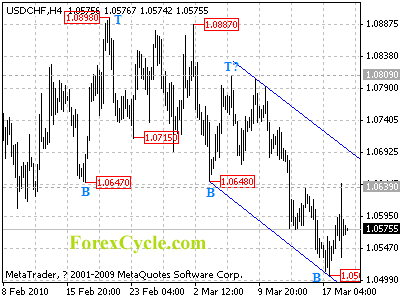
USDCHF broke above 1.0639 resistance

USDCHF broke above 1.0639 resistance, suggesting that a cycle bottom has been formed at 1.0506 level on 4-hour chart. Sideways movement above 1.0506 is expected in a couple of days. Key resistance is now at the falling price channel on 4-hour chart. As long as the channel resistance holds, one more fall towards 1.0450 is possible. However, a clear break above the channel resistance will indicate that the fall from 1.0898 has completed, then the following uptrend could take price back to re-test 1.0898 resistance.

usdchf

Daily Forex Forecast

Forex Daily Market Commentary

By GCI Fx Research

The euro depreciated vis-à-vis the U.S. dollar today as the single currency tested bids around the US$ 1.3585 level and was capped around the $1.3740 level.  The common currency came off significantly amid rumours the Federal Reserve planned an intermeeting increase in the discount rate later today.  While a move in the discount rate would probably not have a major impact on market liquidity – such a move would be largely symbolic – it would be the latest indication that policymakers are looking to normalize policy as much as possible without lifting the federal funds target rate.  The Fed’s balance sheet increase US$ 25.5 billion last week to US$ 2.31 trillion.  Also weighing heavily on the common currency was a report that Greek Prime Minister Papandreou called on the European Union to indicate how much and what type of financial assistance would be available if Greek requires help in addressing its mammoth fiscal imbalances.  Germany apparently backtracked on the issue and instead of suggesting aid some could from a European Union partner or bilateral credit facility, Berlin is said to now support assistance from the International Monetary Fund.  Some believe the IMF may not be able to provide enough financial assistance to Greece.  European Union officials are planning to convene at a summit next week and this topic will be prominent.  Earlier in the week, the European Union signaled it was ready to provide financial assistance to Greece if required.  Data released in the eurozone today saw the EMU-16 January current account balance print at -€8.1 billion compared with the revised prior reading of +€ 2.3 billion.  Also, the eurozone trade balance worsened to -€8.9 billion from the revised reading of +€ 4.4 billion.  In U.S. news, the February consumer price index was up 0.0% m/m and 2.1% y/y while the ex-food and energy core rate was up 0.1% y/y and 1.3% y/y.  Additionally, weekly initial jobless claims fell 5,000 to 457,000 while continuing jobless claims grew to 4.579 million.  The Q4 current account deficit worsened to –US$ 115.6 billion, the Philadelphia Fed March index rallied, and February leading indicators fell back to +0.1%.  Overall, U.S. economic data continue to be mixed-to-better but there does not appear to be any traction evident in the U.S. labour market yet.  Federal Reserve Chairman Bernanke criticized the so-called Dodd plan for regulatory oversight that seeks to limit the Fed’s regulatory and supervisory powers.  Euro bids are cited around the US$ 1.3335 level.

¥/ CNY

The yen appreciated vis-à-vis the U.S. dollar today as the greenback tested bids around the ¥89.75 level and was capped around the ¥90.80 level.  Bank of Japan kept its economic assessment unchanged for a fourth consecutive month, reporting the economy is “picking up.” The central bank also upped its assessment of business investment, adding it is “leveling out on the whole.”  Reuters released its quarterly corporate sentiment survey ahead of the release of next month’s quarterly Tankan survey and it evidenced a significant increase in business confidence.  Yesterday, Bank of Japan expanded its quantitative easing program. The central bank doubled its three-month lending facility to ¥20 trillion.  The move is not likely to have a significant impact on the real economy and may marginally increase liquidity.  The Policy Board vote in favour of the expansion was split and this suggests it may be difficult for BoJ policymakers to ease policy further, no matter how much pressure the government applies on the central bank.  Data released in Japan overnight saw the January leading index decline to 96.7 from 97.1 while the January coincident index improved to 100.1.  Data to be released overnight include February Tokyo-area department store sales, February nationwide department store sales, and the January all-industry activity index.  “Mr Yen” Sakakibara reported the U.S. dollar is still the global dominant reserve currency and said the U.S. appears to be moving away from its long-standing U.S. “strong dollar policy.”  The Nikkei 225 stock index lost 0.95% to close at ¥10,744.03. U.S. dollar offers are cited around the ¥94.75 level.  The euro moved lower vis-à-vis the yen as the single currency tested bids around the ¥122.65 level and was capped around the ¥124.25 level.  The British pound moved lower vis-à-vis the yen as sterling tested bids around the ¥137.00 figure while the Swiss franc moved lower vis-à-vis the yen and tested bids around the ¥84.75 level. In Chinese news, the U.S. dollar appreciated vis-à-vis the Chinese yuan as the greenback closed at CNY 6.8264 in the over-the-counter market, up from CNY 6.8259.  People’s Bank of China reported the first quarter business climate index rose 2.2% q/q, the fourth quarterly expansion.  U.S. Ambassador to China Huntsman verbally intervened today, saying the U.S. “hopes to see more flexibility on the exchange rate. I would be misleading you if I left you with the impression that this wasn’t a very, very important issue in the United States, and will continue to be. We’ll see how the next few weeks play out.”  The central bank is expected to tighten monetary policy further imminently and there is talk that final private demand in China is increasing.

The British pound depreciated vis-à-vis the U.S. dollar today as cable tested bids around the US$ 1.5215 level and was capped around the $1.5325 level.  Data released in the U.K. today saw the March CBI quarterly industrial trends survey improve to -37 from the prior reading of -39.  February public sector net borrowing rocketed higher to £12.0 billion with the public sector net cash requirement at £7.7 billion.  Also, February mortgage approvals came in at 48,000.  Bank of England yesterday reported it is considering an extension of the eligible collateral at its discount window.  Cable bids are cited around the US$ 1.4455 level.  The euro moved lower vis-à-vis the British pound as the single currency tested bids around the US$ 0.8915 level and was capped around the £0.8970 level.

CHF

The Swiss franc weakened vis-à-vis the U.S. dollar today as the greenback tested offers around the CHF 1.0645 level and was supported around the CHF 1.0530 level. Data released in Switzerland overnight saw Q4 industrial production rise 6.4% q/q and decline 1.1% y/y while the February trade surplus declined to CHF 1.29 billion from CHF 2.42 billion.  The euro/ Swiss franc cross came off to a fresh sixteen-month low amid declining expectations of additional Swiss National Bank intervention.  Also, the March ZEW expectations index climbed to 53.8 from 52.5 in February.  The euro came off vis-à-vis the Swiss franc as the single currency tested bids around the CHF 1.4355 level while the British pound moved lower vis-à-vis the Swiss franc.

Daily Market Commentary provided by GCI Financial Ltd.

GCI Financial Ltd (”GCI”) is a regulated securities and commodities trading firm, specializing in online Foreign Exchange (”Forex”) brokerage. GCI executes billions of dollars per month in foreign exchange transactions alone. In addition to Forex, GCI is a primary market maker in Contracts for Difference (”CFDs”) on shares, indices and futures, and offers one of the fastest growing online CFD trading services. GCI has over 10,000 clients worldwide, including individual traders, institutions, and money managers. GCI provides an advanced, secure, and comprehensive online trading system. Client funds are insured and held in a separate customer account. In addition, GCI Financial Ltd maintains Net Capital in excess of minimum regulatory requirements.

DISCLAIMER: GCI’s Daily Market Commentary is provided for informational purposes only. The information contained in these reports is gathered from reputable news sources and is not intended to be U.S.ed as investment advice. GCI assumes no responsibility or liability from gains or losses incurred by the information herein contained.

AUD/USD Dips with EU Uncertainty

By Fast Brokers – The AUD/USD has dipped back below its psychological .92 level, giving back some of its weekly gains in the process.  The Euro is undergoing a heavy selloff in reaction to another psychological flare taking off in the EU.  Greece has set the stage for a showdown with Germany by giving the EU one week to come up with sufficient measures for financial assistance before Greece heads to the IMF for help.  Uncertainty in the EU and resulted in a broad based Dollar rally, dragging the Aussie and the Cable lower with it.  However, losses in the Aussie have been relatively minimal thus far compared to the EUR/USD.  The Aussie has been performing comparatively well in general due to the RBA’s tight monetary policy stance amid continual strength in Australia’s economy.  However, it remains to be seen whether the Euro’s downturn will spill over further into other major Dollar pairs.  Therefore, investors should keep a sharp eye on the Aussie and its interaction with present technical levels.  Australia has been quiet on the data front this week, leaving its movements up to broad-based activity in the risk trade.  Hence, it will be interesting to see if the Euro can manage to stabilize after today’s hefty selloff and allow the Aussie to remain locked into its uptrend.

Technically speaking, the Aussie multiple downtrend lines serving as technical barriers along with previous March highs.  Our 4th tier runs through previous 2010 highs and is our last foreseeable downtrend line.  Hence, a breakout beyond our 4th tier could signal more substantial topside movements over the near-term.  As for the downside, the Aussie has multiple uptrend lines serving as technical cushions along with intraday, 3/17, and 3/16 lows.

Price: .9192

Resistances: .9196, .9207, .9215, .9229, .9239, .9250

Supports: .9184, .9177, .9171, .9161, .9153, .9139

Psychological: .92, .93, 2010 highs

(click chart to enlarge)

Market Commentary provided by Fast Brokers.

Disclaimer: FastBrokers’ market commentary is provided for information purposes only and under no circumstances should be regarded neither as an investment advice nor as a solicitation or an offer to sell/buy any financial product. FastBrokers assumes no responsibility or liability from gains or losses incurred by the information herein contained.

Risk Disclosure: There is a substantial risk of loss in trading futures and foreign exchange. Please carefully review all risk disclosure documents before opening an account as these financial instruments are not appropriate for all investors.