USD/JPY Recovers From Sizable Intraday Pullback

By Fast Brokers – The USD/JPY is recovering from a hefty intraday pullback which sent the currency pair tumbling below its highly psychological 90 level.  There isn’t much news to infer why the USD/JPY experienced such a sizable intraday decline, which leads us to believe the movement could be purely technical.  Regardless, the currency pair is back above 90and is strengthening in reaction to the U.S. data set.  Today’s U.S. data had a positive bias with the Current Account and Philly Index both topping expectations while Unemployment Claims and CPI remained relatively unchanged.  As we mentioned in our previous post, positive U.S. data has the potential to impact the USD/JPY considerably since it gives reason for investors to speculate that the Fed will tighten before the BoJ.  The BoJ is still under pressure from the DPJ in regards to fighting deflationary pressures.  Hence, positive U.S. data leads investors to favor the Dollar over the Yen due to the Fed’s inclination to have a tighter monetary policy stance down the road.  The data wire will be relatively quiet tomorrow, meaning the USD/JPY could opt to stick around its present trading range barring any key psychological developments.

Technically speaking, the USD/JPY faces multiple downtrend lines along with intraday, 3/17, and 3/12 highs.  Meanwhile, the highly psychological 90 area could continue to have an influence over the USD/JPY’s movements for the near-term.  As for the downside, the USD/JPY has multiple uptrend lines serving as technical cushions along with intraday and 3/17 lows.  .

Present Price: 90.40

Resistances: 90.45, 90.52, 90.58, 90.63, 90.69, 90.75

Supports: 90.36, 90.29, 90.21, 90.14, 90.08, 90.01

Psychological: 90, March highs and lows

(click chart to enlarge)

Market Commentary provided by Fast Brokers.

Disclaimer: FastBrokers’ market commentary is provided for information purposes only and under no circumstances should be regarded neither as an investment advice nor as a solicitation or an offer to sell/buy any financial product. FastBrokers assumes no responsibility or liability from gains or losses incurred by the information herein contained.

Risk Disclosure: There is a substantial risk of loss in trading futures and foreign exchange. Please carefully review all risk disclosure documents before opening an account as these financial instruments are not appropriate for all investors.

GBP/USD Drifts Lower with Risk Trade

By Fast Brokers – The Cable is drifting lower today as the currency pair continues to cool from this week’s impressive topside run.  More uncertainty in the EU has had a negative psychological impact on the risk trade as the whole with the Aussie and gold also being dragged lower.  However, the Pound is continuing to exert a relative strength, highlighted by further weakness in the EUR/GBP.  Yesterday’s surprisingly strong employment data along with slight inflation concerns from the BoE has given investors a reason to be positive about the Pound again despite a dead heat in the parliamentary elections.  That being said, the UK does have the potential for negative psychological events of its own, particularly concerning elections and the upcoming budget announcement.  Today’s net borrowing data revealed a slight decline, a positive development for a UK government which has accumulated considerable debt.  Meanwhile, CBI Industrial Orders declined, reflected the setback we saw in Manufacturing Production last week.  Today’s U.S. data was positive mixed with the Philly Index and Current Account data topping expectations while Unemployment Claims and CPI remained relatively flat.  The Dollar has shown a mixed reaction thus far, and it will be interesting to see whether the Cable can continue to consolidate regardless of weakness in the Euro.  Meanwhile, the Cable is still trading well above our previous downtrend lines, a positive development for the currency pair’s medium-term outlook.  However, the Cable must now deal with what is our 3rd tier downtrend line, which runs through 1/28 highs, or the 1.625 area.  Tomorrow’s data wire is relatively quiet, meaning currency pairs could follow their respective weekly momentums unless there is another psychological development.

Technically speaking, the Cable has multiple uptrend lines serving as technical cushions along with intraday and 3/17 lows.  As for the topside, the Cable faces multiple downtrend lines along with intraday and 3/17 highs.  Our new 3rd tier downtrend line could prove to be a key barometer since it runs through 1/28 highs, or the 1.6275 area.

Present Price: 1.5279

Resistances: 1.5288, 1.5318, 1.5334, 1.5354, 1.5377, 1.5397

Supports:15272, 1.5252, 1.5236, 1.5218, 1.5205, 1.5184

Psychological: 1.53, 1.54, March highs

(click chart to enlarge)

Market Commentary provided by Fast Brokers.

Disclaimer: FastBrokers’ market commentary is provided for information purposes only and under no circumstances should be regarded neither as an investment advice nor as a solicitation or an offer to sell/buy any financial product. FastBrokers assumes no responsibility or liability from gains or losses incurred by the information herein contained.

Risk Disclosure: There is a substantial risk of loss in trading futures and foreign exchange. Please carefully review all risk disclosure documents before opening an account as these financial instruments are not appropriate for all investors.

EUR/USD Fights To Stay Above 3/15 Lows

By Fast Brokers – The EUR/USD has undergone a hefty selloff today amid a rise in uncertainty in the EU region.  Word has spread that Germany is reconsidering the option of Greece going to the IMF for financial assistance.  Hence, it seems Germany is trying to call Greece’s bluff since the government recently stated that it will head to the IMF if the EU cannot produce an attractive rescue package.  Therefore, despite adamant support from France, Germany is still not on board with helping out Greece.  The reappearance of uncertainty has delivered a negative psychological blow to the EUR/USD and is resulting in further relative weakness in the Euro, as highlighted by a pullback in the EUR/GBP.  That being said, the EUR/USD has managed to stay above 3/15 lows for the time being and the currency pair is still quite a distance away from our key 1st tier downtrend line.  However, we will have to monitor how the remainder of the trading session plays out to determine whether the recent uptrend has been snapped.  Investors should keep an eye out for our 1st tier downtrend line since it runs through 2010 highs, or the 1.4575 area.  The Dollar is showing a mixed reaction to today’s U.S. economic data thus far.  Unemployment Claims and CPI printed about in line with analyst expectations while the Current Account and Philly Fed index each came in solid.  Hence, today’s data set does have a positive U.S. bias.  The EU released Current Account data of its own, which printed far below analyst expectations, signaling that export demand may have stalled.  Germany will release its PPI tomorrow along with a public address from Trichet.  However, investors will likely be focusing on any new developments regarding Greece’s fiscal situation.

Technically speaking, the EUR/USD faces multiple downtrend lines along with intraday, 3/3, and 3/12 highs.  As for the downside, the EUR/USD has several uptrend lines serving as technical cushions along with 3/15 and 3/10 lows.  Meanwhile, the psychological 1.35 area is still serving a technical cushion while 1.40 serves as a key psychological barrier.
Present Price: 1.3665

Resistances: 1.3684, 1.3693, 1.3704, 1.3713, 1.3725, 1.3740

Supports:  1.3667, 1.3653, 1.3637, 1.3620, 1.3603, 1.3586

Psychological: March and February Lows, 1.35, 1.40, February highs

(click chart to enlarge)

Market Commentary provided by Fast Brokers.

Disclaimer: FastBrokers’ market commentary is provided for information purposes only and under no circumstances should be regarded neither as an investment advice nor as a solicitation or an offer to sell/buy any financial product. FastBrokers assumes no responsibility or liability from gains or losses incurred by the information herein contained.

Risk Disclosure: There is a substantial risk of loss in trading futures and foreign exchange. Please carefully review all risk disclosure documents before opening an account as these financial instruments are not appropriate for all investors.

FOREX: US Dollar on the rise. Leading Indicators, Manufacturing rise. Jobless Claims edge down

By CountingPips.com

The U.S. Dollar has been on the rise in the forex markets on a day filled with U.S. economic data while the American stock markets have traded close to unchanged today. The dollar has advanced versus the euro, British pound, Canadian dollar, Swiss franc, Australian dollar and the Japanese yen while trading virtually unchanged against the New Zealand dollar, according to currency data from Oanda at 11:34 am EST.

The U.S. stock markets are having a mixed session today with the Dow gaining over 5 points, the Nasdaq decreasing by over 1 point while the S&P 500 is down by a couple of points. Oil has edged lower to $81.96 while gold has been unchanged at the $1,124.00 per ounce level.

Leading Indicators continue to rise

U.S. economic news releases out of the U.S. today showed that the U.S. Leading Indicators Index published by the Conference Board today increased for the eleventh straight month in February. The Leading Indicator Index, which measures future economic activity, rose by 0.1 percent in February following a 0.3 percent gain in January and a 1.2 percent rise in December. February’s advance matched the market forecasts which were predicting the gain of 0.1 percent for the month.

The coincident index, which is viewed as a measure of the current economic activity, increased by 0.1 percent in February while the lagging index rose by 0.3 percent after declining by 0.2 percent in January.

An economist at the Conference Board, Ken Goldstein commented on the report saying, “The indicators point to a slow recovery this summer. Going forward, the big question remains the strength of demand. Without increased consumer demand, job growth will likely be minimal over the next few months.”

Weekly Jobless Claims edge down by 5,000

A separate government release by the U.S. Labor Department showed that weekly U.S. jobless claims decreased in the week that ended on March 13th. New jobless claims fell to a total of 457,000 unemployed workers, a decrease over the prior week by 5,000 workers. The 4-week moving average of unemployed workers fell by 4,250 from the prior week to a total of 471,250.

Meanwhile, workers seeking continuing claims for unemployment benefits for the week ending March 6th increased for the week. Continuing claims rose by 12,000 workers to a total of 4,579,000 unemployed workers. The four week moving average of continuing claims dropped by 8,000 to 4,575,250.

US Consumer Prices unchanged

U.S. Consumer Prices were unchanged in February as the energy index decreased for the first time in over six months, according to a report released today by the U.S. Department of Labor. The Consumer Price Index, a key measurement of inflation, had increased by 0.2 percent in each of the last five straight months dating back to September 2009 before February’s flat data. Market forecasts were predicting that consumer prices would edge up by 0.1 percent for the month.

The annual rate of increase in consumer prices in February was 2.1 percent higher than the February 2009 level following January’s annual increase of 2.6 percent. The energy index declined by 0.5 percent in February after increasing by 2.8 percent in January. Food prices rose by 0.1 percent in February after a 0.2 percent increase in January and have gained for fours straight months.

The core inflation reading, excluding food and energy prices, increased by 0.1 percent for the month, matching market forecasts expecting a 0.1 percent gain. The annual rate of core inflation increased by 1.3 percent for February following up an increase of 1.6 percent in January.

Philly Fed Manufacturing Business Survey improves in March

The Philadelphia Manufacturing Business Index released today by the Philadelphia Federal Reserve Bank showed that its survey increased in March and has remained in positive territory for the seventh straight month. The Philly general business diffusion index increased to 18.9 in March after February’s score of 17.6. A positive score is considered growth in that business sector while a negative score is considered a contraction.

Continuing to show positive manufacturing levels this month in the business survey were the indexes for general activity, employment, unfilled orders, delivery times and inventories while new orders, future shipments and planned capital spending all fell in March.

EUR/USD Chart – The euro dropping today versus the US dollar in forex trading and breaking through the rising support trendline on the hourly chart. The EUR/USD has touched below the 1.3600 level for the first time in over a week. This pair had advanced to over a one-month high at 1.3818 in yesterday’s early trading, a level not touched since February 9th.

FOREX: EUR/USD EURO US Dollar Trading

Forex Technical Analysis – EUR/USD Daily Chart

By Russell Glaser – After consolidating just above the 50% retracement level of the previous uptrend, the EUR/USD has begun to fall back inline with its long term downward trend line. A Forex technical analysis indicates further downward movement in the pair could be possible with a short term target the S3 support level.

The dollar strengthened this morning during the early hours of the European trading session and has left the EUR/USD in a position to make a larger move lower. The price has dropped below the S2 level of 1.3667.

The daily chart shows the long term trend line that began in early December at the height of the previous bullish run. The pair has maintained this trend line after consolidating for the past 3 weeks, arriving at the 50% retracement level. Since then the pair has made a breakout lower.

The 7-day Relative Strength Indicator shows the pair has broken below the 70 level, indicating a sell signal. We can also see the RSI line has breached an upward sloping trend line, providing further evidence of a significant downward move in the price.

Also supporting a price move lower is the downward sloping MACD histogram. This shows the downward move may be gaining momentum for a further run lower.

A target for Forex technical analysis traders may be the S3 support level of 1.3575.

Forex Market Analysis provided by Forex Yard.

© 2006 by FxYard Ltd

Disclaimer: Trading Foreign Exchange carries a high level of risk and may not be suitable for all investors. There is a possibility that you could sustain a loss of all of your investment and therefore you should not invest money that you cannot afford to lose. You should be aware of all the risks associated with Foreign Exchange trading.

Forex Market Review 18/03/2010

Forex Market Review by Finexo.com

Past Events

• USD Ben Bernanke testimony to House Financial Services Committee
• USD PPI m/m, out at -0.6 versus expected -0.2%, prior 1.4%
• GBP Claimant Count Change, out at -32.3k versus expected 8.4k, prior 23.5k
• GBP MPC Meeting Minutes
• CAD Wholesale Sales, out at 3.0% versus expected 0.6%, prior 0.7%
Upcoming Events

• GBP Public Sector Net Borrowing (1030 GMT)
• USD Core CPI m/m (1330 GMT)
• USD Unemployment Claims (1330 GMT)
• USD Philadelphia Fed Manufacturing Index (1500 GMT)
• CAD Foreign Securities Purchases (1330 GMT)

Market Commentary

The Chairman of the US Federal Reserve Ben Bernarke has said the central bank is best qualified to oversee the largest financial institutions and should retain its oversight of smaller banks as well. The Fed’s “wide range of expertise” makes it “uniquely suited to supervise large, complex financial organizations and to address both safety and soundness risks and risks to the stability of the financial system as a whole,” Bernanke said in testimony yesterday to the House Financial Services Committee. The hearing is assessing the merits of proposed legislation to overhaul financial regulation in order to prevent a repeat of the crisis that prompted taxpayer-funded bailouts of firms including CitiGroup Inc and American International Group Inc.

Bernanke and regional Fed bank presidents are opposing efforts by Congress to remove much of the central bank’s supervisory role, saying such authority complements monetary policy. Bernanke said the Fed’s role as a supervisor of smaller banks “provides useful information about the economy and financial conditions throughout the nation.”
Wholesale prices in the US plunged in February by the largest amount in seven months as a large drop in energy prices offset higher food costs. According to figures released by the Labor Department yesterday wholesale inflation dropped 0.6% in February, much larger than the 0.2% decline economists had expected. Excluding food and energy, prices edged up a slight 0.1%, in line with expectations.

The deep recession and weak economic rebound are keeping inflation at bay and giving the Federal Reserve leeway to maintain record low interest rates in an effort to build momentum towards stronger economic growth. While overall wholesale prices have risen 4.4% over the past 12 months, core inflation, which excludes energy and food, has risen by a much more modest 1% during the past year. Updated monthly core CPI data is due out later today. As food and energy prices which are quite volatile are removed from the core figure it a much better gauge of overall inflation and a better way to judge the overall change in the price of goods and services purchased by consumers. The figure is expected to come out at 0.1%, from -0.1% last month.

Paul Dales, an economist at Capital Economics, said much of the downward pressure on prices stemming from the nation’s steep recession has yet to be felt. For that reason, Dales said the Fed will be able to keep interest rates low for many more months.

Other releases due in the US today are the unemployment figures showing the number of people who filed for unemployment assistance for the first time in the past week and the Philadelphia Manufacturing Index. Unemployment figures are expected to be relatively unchanged from the previous figure 456k.

North of the border, sales at wholesale level in Canada had their biggest jump in three years in January, adding to evidence inflation may be building as the economic recovery there gains momentum. Wholesale sales surged 3% to $44.4 billion, Statistics Canada said. In volume terms, sales rose 2.9%. The increases were across all sectors and all provinces of the country, except for Nova Scotia, the report said. Automotive parts, building materials, machinery and electronic equipment and “other products,” accounted for 80% of the growth, StatsCan said. Economists had forecast a sales gain of 0.5%.

The data follows figures for manufacturing sales, released on Tuesday, which also exceeded forecasts, giving a further push to the Canadian dollar on expectations for an early interest rate increase. Later today foreign securities purchases are due to be announced. In the past two months, foreign investors have shown growing confidence in the Canadian economy and a net purchase of over 10 billion CAD was reported. This time, the net figure is expected to be less than 10 billion CAD.

The Canadian Dollar is gradually edging closer to parity with its American counterpart. Yesterday gained a total of 0.33% against the US Dollar, to close trading at 1.0105 USD.

In the UK yesterday, the Pound rallied after it was announced that Bank of England policy makers had unanimously voted to keep their 200 billion-pound ($304 bn) bond purchasing program on hold for a second month. The nine-member Monetary Policy Committee, headed up by Governor Mervyn King voted 9-0 to maintain the current plan as there was “little evidence to suggest” a change in the economic outlook. The committee also unanimously voted to keep the key interest rate at 0.5%. The minutes of the March 4th meeting were published yesterday.
The Sterling rally was further boosted by the news that UK jobless claims fell unexpectedly in February, dropping at the fastest rate since 19997. The number of people receiving unemployment benefits dropped 32,300 from January to 1.59 million according to the Office for National Statistics in London. It suggests that the economic recovery is strengthening as Britain prepares for a General Election which is due to be held by June.

Sterling gained 0.56% against the US Dollar over the course of the day closing at USD 1.5317. It appreciated 0.35% against the Euro, closing trading at 0.9065 EUR.

Later today UK Public Sector Net Borrowing figures will be announced. Last month a drop in borrowing was expected but failed to materialize. This time borrowing is expected to rise from 4.3 to 14.5 billion pounds as a result of the UK budget deficit which is estimated to be in excess of 12% of GDP.

Finally, the European Union has criticized the UK and other European nations for having “optimistic” growth assumptions and bloated deficits. The UK must tackle “uncertainty” in plans to cut its deficit, the EU said. EU rules say government deficits must be below 3% of GDP, but the UK’s deficit is expected to hit £178bn this year. Germany, France, Spain and Italy were also warned they were over-reliant on economic recovery to meet debt targets. Brussels was commenting on plans by some of the biggest EU countries to bring down public spending.
Yesterday did not see the Euro move much against the USD, the Euro fell 0.2% to close trading at 1.3734 USD.

Forex Market Review & Analysis by Finexo.com

Disclaimer: Trading the foreign exchange (Forex) carries a high level of risk, and may not be suitable for all investors.

Unemployment Claims in Focus Today

Source: ForexYard

The U.S. Unemployment Claims is the primary publication today that is set to determine the level of the USD when it is released at 12:30 GMT. The other main releases that will dominate forex trading, especially for currencies such as the Dollar, EUR and GBP is the publication of Europe’s Current Account Balance and British Public Sector Net Borrowing at 9:00 GMT and 9:30 GMT respectively. Traders may find good opportunities to enter the market following these vital announcements.

Economic News

USD – USD Drops on Renewed Risk Appetite

The dollar declined against higher-yielding currencies Wednesday afternoon, after data showed producer prices in February posted their biggest fall in seven months, raising doubts about the U.S. economy and causing investors to reduce exposure to risk. As a result, the Australian dollar hit a nearly two-month high against the greenback, while the Canadian currency moved closer to parity against the dollar, which dipped as low as C$1.0070, a 20-month low. The New Zealand dollar jumped as much as 1%, before relinquishing some of the gains.

The greenback also remained under selling pressure on Wednesday after the U.S. Federal Reserve held its pledge to keep interest rates low for an extended period, prompting investors to snap up growth-sensitive assets. Low interest rates make the dollar less attractive to investors than higher-yielding currencies, stocks and commodities. In addition, the economic recovery does not appear to be improving at the speed many investors were hoping for, and currencies appear to be tracing the movement of stocks as a result.

Looking ahead to today, there are several news releases coming out of the U.S. These include the Core CPI, Unemployment Claims and Philly Fed Manufacturing Index. Better-than-expected results may help the Dollar recover some of yesterday’s losses against some of its crosses such as the AUD and CAD. On the other hand, if the results turn out to be lower than forecast, then the Dollar may record a fairly bearish session in today’s trading. Traders should pay close attention to the market as there is an opportunity for traders to capitalize on the fluctuations which are likely to follow these releases.

EUR – Pound Gains on Unemployment Data

The EUR saw a bearish trading session on Wednesday, losing ground against most the major currencies. The EUR fell sharply against the CHF, pushing the oft-traded currency pair to 1.4475. The 16 nation currency experienced similar behavior against the AUD and closed at 1.4875.

However, the Pound was the best performer during Wednesday’s European session, soaring across the board and reaching the highest levels of the last two weeks against its main rivals after UK unemployment data beat expectations, with its largest decline in the last 12 years. As a result, the GBP/USD rally from 1.4975 low on Tuesday has extended around 345 pips higher after the release of unemployment data, and the pair hit a fresh 2-weeks high at 1.5320.

Looking ahead today, the news event that may have a very large impact on the EUR and its main currency pairs in today’s trading is the Current Account Balance around 9:00 GMT. This report is very important and is likely to impact the EUR’s volatility. Traders will be paying close attention to today’s announcement as a stronger than expected result may boost the EUR in the short-term.

JPY – Yen Experiences Mixed Result against Major Currencies

The Japanese Yen completed yesterday’s trading session with mixed results versus the major currencies after the bank of Japan eased its monetary policy. The JPY fell against the GBP yesterday, pushing the oft-traded currency pair to 138.05. The JPY did see some bullishness as well as it gained 50 pips against the EUR and closed at 1.2380.

BOJ Governor Masaaki Shirakawa told a news conference the move to double its fund supply operation was not aimed at influencing currency rates. The BOJ’s move was widely flagged, although it left the duration of fixed-rate loans to banks unchanged at three months and two of its seven board member dissented.

The JPY’s trends will be affected by the rallies of its primary currency pairs today. It seems that the USD, EUR and GBP are expected to continue a volatile trading session today, especially against the Japanese currency. Traders should keep a close look on the news coming from the U.S. and Europe as these economies will be the deciding factors in the JPY’s movement today, especially the U.S Unemployment Claims at 13:30. It is also advisable for traders to follow any unexpected comments coming from key Japanese governmental figures, as this is also likely to lead to further JPY volatility.

OIL – Oil Prices Rise Based on Increased Demands

Oil rose more than 1% to trade near $83 a barrel on Wednesday after a U.S. government report showed increased oil product demand and as OPEC decided to leave output targets unchanged. Data from the U.S. Energy Information Administration (EIA) on Wednesday showed oil product demand in the world’s largest energy consumer was up 3.5% last week from a year ago.

A weaker U.S. dollar against a basket of currencies also provided support, following Tuesday’s U.S. Federal Reserve decision to keep low interest rates steady. Crude oil prices, which are denominated in U.S. dollars, tend to rise when the dollar weakens.

Technical News

EUR/USD

The currency has reversed course the past two trading days after consolidating all the way to the price level of 1.3817. This mark is just above the 50% retracement level from the pair’s peak price on the daily chart in December. Since then the pair has fallen sharply and now sits near the support level of 1.3680. Traders should also note the 4-hour chart upward sloping trend line that began on March 2nd. The pair has yet to break this short term trend. A breach of this trend line could send the pair lower to its 1.3625 support.

GBP/USD

The Cable has climbed to a recent high of 1.5380 and has begun to fall. The 4-hour chart shows the 7-day RSI indicator has breached below the 70 level, triggering a sell signal, indicating the price may head lower today. The MACD histogram is also downward sloping, providing further support for a bearish price move. Traders may want to go short and target the 1.5210 support level.

USD/JPY

The 4-hour chart shows the pair has been consolidating for the past 4 days, trading in a range with support and resistance levels of 90.00 and 90.75. Identifying a price channel with consistent price moves can be advantageous and should be taken advantage of by going long at the support and selling at the resistance.

USD/CHF

The daily chart displays a bullish cross formed yesterday, indicating the potential for an upward price movement while correcting the downward sloping trend of the past 2 weeks. Traders may want further technical verification of a price reversal. Traders can look to the 7-day RSI by drawing a trend line from the high point down to the current price level. A break of this trend line and a breach of the 30 level should be a signal to buy.

The Wild Card

Oil

The price of spot crude oil continues to push towards its yearly high of $83.90. and yesterday the price climbed as high as 83.31. However, the price of the commodity may be overextended. The price is falling as the 4-hour chart shows the 7-day Relative Strength Indicator has breached below the 70 line, indicating the potential for a price decline. The MACD histogram is also trending lower, providing further support for a bearish price move. Forex and commodity traders may want to cover any long positions they may have as the price of spot crude oil could fall today.

Forex Market Analysis provided by Forex Yard.

© 2006 by FxYard Ltd

Disclaimer: Trading Foreign Exchange carries a high level of risk and may not be suitable for all investors. There is a possibility that you could sustain a loss of all of your investment and therefore you should not invest money that you cannot afford to lose. You should be aware of all the risks associated with Foreign Exchange trading.

Forex Trading Opportunities, Mar 18

Long Term Analysis

USD.CHF, Daily

125

General Overview- The Pair is getting close to the 200 day moving average at 1.047 which posses a strong support. Since we see the major long term trend we see a good potential of the pair to resume the major bullish trend at that area.

Trading Advice- Place your stop loss under 1.04-1.045 and ride the bullish trend to 1.089.

We recommend opening with a leverage of no more than X50.

1110

AUD.JPY, Daily

226

General Overview- Although the pair is still not in a bearish trend the current price structure suggests a bearish move is gradually forming.

Trading Advice- The current risk reward ratio is rather high, wait for the pair to reach to the 84 area to open your trade. Place your stop loss at 87 above the 86 major resistance, as the pair is slightly volatile and could surpass the 86 level slightly before retreating. Ride the bearish trend to 78.We recommend opening with a leverage of no more than X25.

Special Attention! – A weekly close below 76 would move our long term target to 72

229

Daily Forex Market Analysis provided by eToro

Disclaimer: Trading in the Foreign Exchange market might carry potential rewards, but also potential risks. You must be aware of the risks and are willing to accept them in order to trade in the foreign exchange market. Don’t trade with money you can’t afford to lose.

© 2009 eToro Blog.

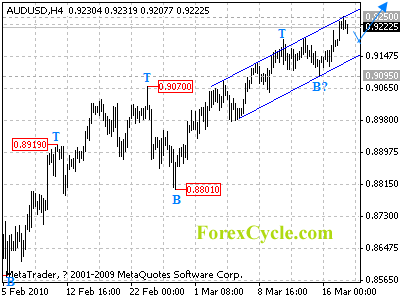
AUDUSD’s upward movement extends to 0.9250

AUDUSD’s upward movement extends to as high as 0.9250 and remains in uptrend. However, now the pair is facing the upper border of the price channel on 4-hour chart, minor consolidation is expected later today. As long as the channel support holds, another rise to 93.00 could be seen after consolidation, a break above 0.9250 could signal resumption of uptrend.

audusd

Daily Forex Reports

Forex Daily Market Commentary

By GCI Fx Research

The euro depreciated vis-à-vis the U.S. dollar today as the single currency tested bids around the US$ 1.3725 level and was capped around the $1.3815 level.  As expected, the Federal Open Market Committee yesterday kept its benchmark federal funds target rate unchanged at 0.25% and global equity markets received the news well under the premise that inflation will not be a problem for some time.  The markets are largely speculating the Fed will not begin to raise interest rates until Q4 at the earliest with many economists expecting no change until 2011.  Kansas City Fed President Hoenig dissented again, reporting that continuing to express the expectation of exceptionally low levels of the federal funds rate for an extended period was no longer warranted because it could lead to the buildup of financial imbalances and increase risks to longer-run macroeconomic and financial stability.” Fed Chairman Bernanke is expected to testify before Congress soon and tell legislators that the Fed is the ideal oversight regulator for large and small banks alike.  Traders are also awaiting to see if the Obama health care initiative can be passed by Congress before the Easter break and how financial regulatory regulation materializes, possibly encompassing the so-called “Volcker Rule.”  Comptroller of the Currency Dugan said he has “significant concerns” with Senator Dodd’s proposed financial regulation overhaul.  Data released in the U.S. today saw MBA mortgage applications decline 1.5% while headline February producer price inflation was off 0.6% m/m and up 4.4% y/y.  The ex-food and energy core index was up 0.1% m/m and 1.0% y/y.  In eurozone news, EMU-16 construction output fell 2.2% m/m in January, down from +0.5% growth in December, and was off 12.5% y/y compared with a 3.1% y/y decline in December.  Eurozone finance ministers this week reiterated their plan to “take coordinated action” but did not provide much additional information other than to suggest any assistance would take the form of bilateral loans rather than loan guarantees.  Euro bids are cited around the US$ 1.3335 level.

¥/ CNY

The yen depreciated vis-à-vis the U.S. dollar today as the greenback tested offers around the ¥90.70 level and was supported around the ¥90.00 figure.  Bank of Japan expanded its quantitative easing program overnight, as expected. The central bank doubled its three-month lending facility to ¥20 trillion.  The move is not likely to have a significant impact on the real economy and may marginally increase liquidity.  By and large, the central bank made the move to satisfy ongoing calls from the Japanese government to ease policy further.  The government’s ability to enact more fiscal spending to stimulate final private demand is limited on account of Japan’s massive indebtedness.  BoJ Governor Shirakawa said the economy is “improving a bit more than we expected” but warned “The Bank of Japan’s policy alone can’t beat deflation.  I wish there was a miracle, but all we can do is persist with our efforts.”  There were two dissenters on the BoJ Policy Board.  The central bank seems to be suffering from a “liquidity trap” whereby there is little discernible benefit no matter how much liquidity the central bank infuses.  Data released in Japan overnight saw the January tertiary industry index improve to +2.9% from -0.9%.  The Nikkei 225 stock index climbed 1.17% to close at ¥10,846.98. U.S. dollar offers are cited around the ¥94.75 level.  The euro moved higher vis-à-vis the yen as the single currency tested offers around the ¥125.05 level and was supported around the ¥124.05 level.  The British pound moved higher vis-à-vis the yen as sterling tested offers around the ¥139.35 level while the Swiss franc moved higher vis-à-vis the yen and tested offers around the ¥86.15 level. In Chinese news, the U.S. dollar depreciated vis-à-vis the Chinese yuan as the greenback closed at CNY 6.8259 in the over-the-counter market, down from CNY 6.8260.  People’s Bank of China yesterday reported inflation expectations are rising in a quarterly survey released today and this could render it difficult for the government to meet its 3% annual inflation target.  Higher inflation expectations will likely propel interest rates higher.  The World Bank today called on China to reduce its stimuli programs so that it does cause new asset bubbles.

The British pound appreciated vis-à-vis the U.S. dollar today as cable tested offers around the US$ 1.5380 level and was supported around the $1.5205 level.  Bank of England reported it is considering an extension of the eligible collateral at its discount window.  BoE MPC Fisher said the move would “enhance facilities.”  Minutes from the March MPC meeting were released today in which policymakers voted unanimously to keep its asset-purchase program unchanged at ₤200 billion. Data released in the U.K. today saw the February claimant count decrease to 4.9% from 5.0% in January while the ILO three-month unemployment rate was unchanged at 7.8%.  Bank of England Monetary Policy Committee member Barker this week reported the U.K. economy could recede again, adding the economic recovery will continue to be “bumpy and fragile.”  Cable bids are cited around the US$ 1.4455 level.  The euro moved lower vis-à-vis the British pound as the single currency tested bids around the US$ 0.8950 level and was capped around the $0.9065 level.

Daily Market Commentary provided by GCI Financial Ltd.

GCI Financial Ltd (”GCI”) is a regulated securities and commodities trading firm, specializing in online Foreign Exchange (”Forex”) brokerage. GCI executes billions of dollars per month in foreign exchange transactions alone. In addition to Forex, GCI is a primary market maker in Contracts for Difference (”CFDs”) on shares, indices and futures, and offers one of the fastest growing online CFD trading services. GCI has over 10,000 clients worldwide, including individual traders, institutions, and money managers. GCI provides an advanced, secure, and comprehensive online trading system. Client funds are insured and held in a separate customer account. In addition, GCI Financial Ltd maintains Net Capital in excess of minimum regulatory requirements.

DISCLAIMER: GCI’s Daily Market Commentary is provided for informational purposes only. The information contained in these reports is gathered from reputable news sources and is not intended to be U.S.ed as investment advice. GCI assumes no responsibility or liability from gains or losses incurred by the information herein contained.