GBP/USD Climbs as Risk Trade Stabilizes

By Fast Brokers – The Cable has recovered nicely from intraday lows and is presently climbing higher with the broad-based risk trade.  The Cable has foregone a retest of Tuesday lows thus far while its psychological 1.50 area has proven resilient.  The Cable has locked backed into its March trading range in the process with the UK budget coming tomorrow.  Though investors aren’t expecting anything earth shattering tomorrow due to upcoming parliamentary elections, if Darling should manage to trim the UK budget this could boost the Cable since investors have become increasingly anxious concerning rising debt levels.  Meanwhile, investors continue to focus on the EU as leaders jostle for position in regards to whether the union should offer Greece financial assistance.  Greece could set an example for how the EU deals with other debt-laden European nations, so the debate has becomes heated as most investors know.  What happens in the EU could influence the risk trade as a whole, so investors should keep a close eye on what comes out of this week’s EU meeting.  Data wise, UK CPI printed a hair below analyst expectations, yet remains at elevated levels.  Hence, the BoE will likely remain somewhat concerned about inflationary pressures in the UK, a positive for the Cable.  BBA Mortgage Approvals improved while CBI Realized Sales disappointed.  Therefore, today’s UK data paints a mixed picture.  The U.S. and EU will print key data tomorrow along with the UK’s budget release.  Hence, tomorrow could prove to be an active trading session.

Technically speaking, the Cable still has multiple uptrend lines serving as technical cushions along with intraday, 3/22, and  3/10 lows.  Additionally, the psychological 1.50 could continue to serve as a solid technical cushion should it be retested.  As for the topside, the Cable faces multiple downtrend lines along with 3/22 and 3/12 highs.

Present Price: 1.5074
Resistances: 1.5087, 1.5105, 1.5130, 1.5147, 1.5169, 1.5193
Supports: 1.5040, 1.5022, 1.5006, 1.4994, 1.4977, 1.4957
Psychological: 1.50, March lows

(click chart to enlarge)

Market Commentary provided by Fast Brokers.

Disclaimer: FastBrokers’ market commentary is provided for information purposes only and under no circumstances should be regarded neither as an investment advice nor as a solicitation or an offer to sell/buy any financial product. FastBrokers assumes no responsibility or liability from gains or losses incurred by the information herein contained.

Risk Disclosure: There is a substantial risk of loss in trading futures and foreign exchange. Please carefully review all risk disclosure documents before opening an account as these financial instruments are not appropriate for all investors.

EUR/USD Pops Higher, Avoiding Retest of Tuesday Lows

By Fast Brokers – The EUR/USD is registering a solid pop as the risk trade heads higher in reaction to the U.S. data set.  Existing Home Sales printed about in line with expectations, leading to slight speculation that the Fed will have to keep its monetary policy loose, a positive for many major Dollar pairs.  Belgium’s Business Climate figure also topped expectations, a positive data figure much in need for a reeling currency pair.  The EUR/USD is still being weighed down by the battle of words taking place in the EU.  Everybody has been taking sides the last couple weeks with Greece stuck in the crossfire.  Although a financial assistance resolution for Greece seems is becoming less likely this week, if the EU should bring something to the table this could cause a short-squeeze and benefit the risk trade as a whole.  Divergence among EU leaders has taken a psychological toll on the Euro with even the relevance of the EU being thrown into question by some.  However, we suggest investors not get too carried away and take a wait and see approach in regards to the EU’s plan for Greece and the rest of the union’s debt-laden nations.  In the end it seems every nation is jockeying for position to get what they desire out of any pending resolution, as we witnessed between the U.S. Congress during healthcare negotiations.  However, Greece does have some debt issuance coming in a month so a decision will have to be made sooner rather than later.  Meanwhile, the UK will release its fiscal budget tomorrow and this could have an impact on the risk trade as a whole.  Though nothing drastic is expecting with parliamentary elections on the way, should the UK present a lighter than expected budget this could aid the risk trade and abate concern about the UK’s ballooning deficit.  The EU will also release Germany’s Ifo Business Climate figure tomorrow along with the closely watched Flash PMI data set.  Positive EU data could help cool some of the flames emitting from Greece, whereas negative data could drag the EUR/USD lower.  The U.S. will also print DGO and New Home Sales data, meaning tomorrow could prove to be an active trading session.  For the time being the EUR/USD seems to be finding comfort in its psychological 1.35 area.

Technically speaking, the EUR/USD faces multiple downtrend lines along with intraday 2/23, and 3/19 highs.  As for the downside, the EUR/USD has several uptrend lines serving as technical cushions along with 3/22 and 3/5 lows.  Meanwhile, the psychological 1.35 area could continue to serve as a solid technical cushion should it be tested.

Present Price: 1.3535
Resistances: 1.3568, 1.3605, 1.3626, 1.3654, 1.3628
Supports:  1.3534, 1.3504, 1.3484, 1.3467, 1.3476, 1.3440
Psychological: March and February Lows, 1.35

(click chart to enlarge)

Market Commentary provided by Fast Brokers.

Disclaimer: FastBrokers’ market commentary is provided for information purposes only and under no circumstances should be regarded neither as an investment advice nor as a solicitation or an offer to sell/buy any financial product. FastBrokers assumes no responsibility or liability from gains or losses incurred by the information herein contained.

Risk Disclosure: There is a substantial risk of loss in trading futures and foreign exchange. Please carefully review all risk disclosure documents before opening an account as these financial instruments are not appropriate for all investors.

FOREX: Canada’s Leading Indicators rise for 9th straight month. USD/CAD trades under 1.0200

By CountingPips.com

Canada’s Leading Indicators rose for the ninth straight month in February, according to a  report from Statistics Canada today. The Leading Indicator Index, which measures future economic activity, increased by 0.8 percent in February following an increase of 0.7 percent in January. The February rise was just below market forecasts looking for an USDCAD - Forex Currency Tradingincrease of 0.9 percent. The index has now increased every month going back to June 2009.

Nine out of ten of the measured sectors that make up the leading indicator index showed increases for the month. Durable goods orders and the housing index index were leading sectors for the month with gains of 6.2 percent and 1.7 percent, respectively. The stock market index rose by 0.4 percent in February while furniture and appliance sales sales gained by 1.2 percent.

Other notable gains were the US Conference Board indicator which rose by 0.8 percent and business & personal services employment which advanced by 0.5 percent for the month. The lone declining indicator for the month was the average workweek index which fell by 0.8 percent.

FOREX: Canadian Loonie mixed in Trading

The Canadian loonie dollar has been mixed today in the currency markets versus most of the major currencies. The Canadian currency has been increasing versus the euro and British pound  while trading lower versus the Japanese yen, U.S. dollar and Australian dollar after paring some earlier gains, according to currency data from Oanda. The loonie is trading virtually unchanged against the New Zealand dollar.

USD/CAD 1-Hour Chart
– The U.S. dollar has been gaining slightly so far today against the Canadian loonie in some up-and-down trading action. The USD/CAD pair currently trades under the 1.0200 level after rising above this threshold in trading yesterday and earlier today, but both times being rejected lower. The pair trades right at the 200-hour moving average (in black) and in the short-term, the USD/CAD looks to make a move higher if the pair can maintain its position above the 200-hour moving average.

Forex Market Review: 23/03/2010

Forex Market Review by Finexo.com

Past Events
• ECB President Trichet Spoke
• GBP Bank of England Governor King Spoke

Upcoming Events
• USD Existing Home Sales (1400 GMT)
• GBP Consumer Price Index (0930 GMT)
• GBP Budget Announcement Tomorrow (1230 GMT)

Market Commentary

Yesterday saw the U.S. Dollar gain against all of its major counterparts except for the Japanese Yen as German Chancellor Angela Merkel told investors they shouldn’t expect a European Union summit due to be held in Brussels on Thursday and Friday of this week to agree on assistance for Greece.

The US Dollar gained 0.40% against the Euro overall yesterday, with the Euro closing at $1.3566. Against the Pound the US Dollar rose by 0.76% with Sterling closing at $1.5109. The US report on existing home sales is due to be announced later today. Economists are predicting that the figure will fall for the third month in a row as unemployment remains close to 10%. Existing homes account for almost 90% of the housing market. It is believed that the extension and expansion of a federal tax credit for housing has not yet had the desired effect as the labor market remains depressed.

Across the water in Europe European Central Bank President Jean-Claude Trichet said yesterday that aid should only be given to Greece if it will include an element of stabilization for the 16-country Euro Zone as a whole. He also said it was of the upmost importance for other Euro Zone members to maintain fiscal discipline.

The the Greek Central Bank said yesterday that Greece’s economy is in a “vicious circle” and this year it will contract more severely than the government says. The Bank of Greece said economic output in 2010 will fall by 2%, worse than the government’s prediction of between 1.2% and 1.7%. The bank says the recession will be worse due to planned public spending cuts. The bank said that it approves of the government’s strategy to bring down the country’s budget deficit, but that the impact will be worse than first thought.

“The Greek economy has fallen into a vicious circle with only one way out: the drastic reduction of the deficit and debt,” the Bank’s annual monetary policy report says. The report warned that the Euro Zone’s economic recovery remains fragile, having relied to a large extent on fiscal stimulus, which must gradually be reversed as it is leading to large budget deficits.

Greece’s budget deficit last year was 12.9% of GDP, more than four times greater than the EU allows. Germany has irritated some of its European partners with its opposition to a financial aid package to help Greece overcome its debt crisis, believing that Greece can solve the problem itself.

Elsewhere in the Euro Zone, Germany’s coalition government is reportedly planning a banking levy to protect taxpayers from the costs of bank bail-outs. Leading conservative politician Volker Kauder said the money would stop banks from relying on state-funded rescues.
The levy would raise “billions of Euros” from the financial sector, he has predicted. The German government dug deep into its treasury coffers to provide a €500 billion ($679 billion) rescue package to shore up the banking system late in 2008. The new proposal seems to be designed to dissuade banks from taking risks in future which would see them begging for more government hand-outs.

The International Monetary Fund (IMF) has been asked by the G20 group of wealthiest countries to examine how banks can best contribute to the costs of insuring themselves against failure. But so far countries have adopted a piecemeal approach to the issue.

In the UK yesterday economists warned of a “sluggish” recovery in the economy this year, ahead of tomorrow’s Budget. The Confederation of British Industry said it expected the economy to grow by 1% in 2010, with the recovery remaining subdued until the middle of next year. The government forecasts growth of 1.25% this year and 3.5% for 2011. However the Chancellor, Alistair Darling, may revise those predictions in the Budget tomorrow.

After the report was released the Pound weakened further against both the US Dollar and the Euro, it closed trading down 0.36% against the Euro at EUR 0.8978.

British Consumer Price Index data is due to be released later today. Governor King from the Bank of England said yesterday that first quarter inflation was likely to be in line with the Banks forecast of 3.1%

Chancellor Alaistair Darling has reiterated there will be “no giveaways” ahead of the general election. The budget is expected to focus on encouraging private sector investment and securing long term economic growth. The government plans to halve the budget deficit – which is one of the highest in Europe and is expected to hit about 12.6% of GDP this financial year, well above the European Union threshold of 3% – over the next four years.

The Pound has had its worst annual start in the currency market in 13 years, dropping 7% against the US Dollar since January. The currency has been weakened by uncertainty regarding the outcome of the general election which Prime Minister Gordon Brown must call by June. The government was forced to borrow heavily during the recession resulting in one of the highest deficits in Europe. Mr. Darling has said that while there had been signs recently that the economy was improving, with unemployment falling and government borrowing lower than forecast there was still a lot of uncertainty.

He said “the mood of the times is not for giveaways. People are not daft, they know perfectly well we need to get borrowing down and secure (economic) recovery”.

The uncertainty about who will win the election and whether there will be a hung parliament has resulted in a bearish trend in Sterling. A minority government is looking increasingly probable according to recent UK opinion polls and sentiments are sharply divided between the Labor and Conservative parties on how to achieve the necessary spending cuts.

Elsewhere the Canadian Dollar fell for a third day, the longest losing streak since January as crude oil prices continued to fall. The loonie rose in 12 of the last 16 sessions to reach C$1.0062 last week, the closest to parity with the U.S. dollar since 2008. It has risen 3% this month for the second best performance among the 16 most traded counterparts against the US Dollar. South Africa’s Rand which also relies on commodities for export revenue preformed best.

Forex Market Review & Analysis by Finexo.com

Disclaimer: Trading the foreign exchange (Forex) carries a high level of risk, and may not be suitable for all investors.

EUR/USD Looks to Reach a Yearly Low

By Yan Petters – Over the past 6 weeks, the EUR/USD pair had 3 failed attempts to drop below the 1.3430 level. However today seems to be the day that we will see a 1-year low as several technical indicators provide clear bearish signs.

• The chart below is the EUR/USD 4-hour chart by ForexYard
• The technical indicators used are the Bollinger Bands, the Slow Stochastic, the MACD and the Relative Strength Index (RSI).
• There is a very distinct bearish channel formed on the chart.
• A bearish cross of the Slow Stochastic suggests that the bearish channel is likely to be extended.
• The MACD and the RSI are both pointing down, indicating that the bearish momentum is still very strong.
• The next support level is located at the 1.3450 price.
• If the pair will manage to cross this level, it is likely to reach the 1.3430 level – which will mark a year low.
• Traders should notice that if the pair will reach below the 1.3420 level, this has potential to initiate a sharp slide.

Forex Market Analysis provided by Forex Yard.

© 2006 by FxYard Ltd

Disclaimer: Trading Foreign Exchange carries a high level of risk and may not be suitable for all investors. There is a possibility that you could sustain a loss of all of your investment and therefore you should not invest money that you cannot afford to lose. You should be aware of all the risks associated with Foreign Exchange trading.

USD/SEK May Go Bearish

By Anton Eljwizat – The USD/SEK cross has been experiencing much bullish behavior in the last few days. However, there is much technical data that supports a bearish move for today. As I demonstrate below, that the USD/SEK may very well be heading for a reversal, and it might have the potential of reaching towards 7.1000 in the coming days. Forex traders can take advantage of this imminent downward movement by entering short positions at an excellent entry price.

• The technical indicators used are the Relative Strength Index (RSI), MACD and Williams Percent Range.

• Point 1: The RSI signals that the price of this pair currently floats in the over-bought territory, indicating downward pressure.

• Point 2: The MACD indicates an impending bearish cross, which may signal a downward movement is going to occur in the near future.

• Point 3: The Williams Percent Range has peaked near at the 0 marker, which means that there may actually be a strong level of downward pressure.

USD/SEK 8-Hour Chart

Forex Market Analysis provided by Forex Yard.

© 2006 by FxYard Ltd

Disclaimer: Trading Foreign Exchange carries a high level of risk and may not be suitable for all investors. There is a possibility that you could sustain a loss of all of your investment and therefore you should not invest money that you cannot afford to lose. You should be aware of all the risks associated with Foreign Exchange trading.

EUR/GBP Looks to Drop towards the 0.8900 Level

By Yan Petters – The EUR/GBP pair saw a bullish trend for the past several weeks, however currently it seems that a bearish correction might take place. The pair has failed to breach through the 0.9050 level lately, and as a result the pair slightly dropped and is trading near the 0.8980 level.

• The chart below is the EUR/GBP 4-hour chart by ForexYard.
• The technical indicators used are the Bollinger Bands, the Slow Stochastic, the MACD/OsMA and the Relative Strength Index (RSI).
• It can be seen that the pair is trading within a restricted range of 150 pips for quite some time now.
• The pair has recently failed to breach the 0.9050 level, which has initiated a bearish correction.
• Both the Slow Stochastic and the RSI are pointing down at the moment, suggesting that the bearish momentum has more steam in it.
• The MACD seems to be on the verge to complete a bearish cross. If the cross will indeed take place, this will further indicate that the current trend is bearish.
• The next support levels are located at the 0.8900, 0.8860 and the 0.8750 prices.
• The next resistant levels are located at the 0.9050, 0.9125 and the 0.9150 prices.
• If the pair will manage to breach through 3 consecutive levels, this will ensure that the pair is in the midst of a long-lasting trend.

Forex Market Analysis provided by Forex Yard.

© 2006 by FxYard Ltd

Disclaimer: Trading Foreign Exchange carries a high level of risk and may not be suitable for all investors. There is a possibility that you could sustain a loss of all of your investment and therefore you should not invest money that you cannot afford to lose. You should be aware of all the risks associated with Foreign Exchange trading.

Dollar Down after Touching 10-Month High vs EUR

Source: Forex Yard

The U.S. Dollar turned slightly lower versus the EUR as traders positioned for a big European Union (EU) meeting this week amid signs of a deepening divide among policy-makers over aid to Greece.

Economic News

USD – USD Weakens as Risk Sentiment Improves

The U.S Dollar pulled back from a 3-week high against the EUR yesterday pressured by an improvement in risk appetite following gains in U.S. stocks. U.S. stocks rose on Monday as the passage of a bill overhauling healthcare ended uncertainty about the reform.

However, traders said the rebound will be short-lived because of the failure in a quick resolution over Greece during this week’s summit. A Greek fiscal crisis has helped make investors more cautious of risky assets in recent weeks, boosting the greenback against the EUR.

The Dollar also turned lower against the British pound and Japanese yen, pushing down an index of the greenback’s performance against a basket of currencies. The USD fell 0.5% to buy 90.11 yen, and 0.4% against the GBP to $1.5066.

The currency market will look ahead this week to U.S. economic data releases including reports on housing due on Tuesday and Wednesday and to a testimony by Federal Reserve Board Chairman Ben Bernanke on Thursday.

EUR – Euro Rises Ahead of EU meeting

The European currency rose from a 3-week low against the U.S Dollar as European leaders tried to allay concerns that they were unprepared to aid Greece, easing pressure on higher-yielding assets. The EUR rose 0.2% to $1.3558 from $1.3530 on March 19. It earlier fell to $1.3464, the weakest level since March 2.

The spotlight this week turns to a summit of European Union (EU) leaders Thursday. The EUR may fall lower if European leaders don’t decide quickly on helping Greece in financing the region’s biggest budget deficit. Analysts said the EUR may remain vulnerable to further weakness and volatility before and during the summit.

The British Pound weakened for a 3rd day against the U.S Dollar. The GBP was also driven lower amid speculation that Dubai World will prolong the repayment of its loans, hurting earnings at U.K. banks that serviced the state-owned Emirati company. The key event for the week will be the release of the government’s budget for the 2010-11 fiscal year on Wednesday.

JPY – The Yen Weakens Broadly

Japan’s currency declined against all of its 16 major counterparts as an advance in Asian stocks encouraged investors to buy for higher-yielding assets. The Japanese yen fell for the first time in 5 days against the EUR on speculation European Union (EU) leaders meeting this week will agree on an aid package for Greece, dampening demand for the safety of Japan’s currency. The JPY dropped to 122.43 per EUR from 122.21 yesterday when it climbed to 121.06, the highest since March 5.

OIL – Spot Crude Oil Rises Above $81 as Dollar Dips

Oil prices turned higher and above the $80-a-barrel mark on Monday as confidence on Wall Street and easing concerns over Greece pressured the U.S. Dollar downwards and lifted commodities.

Oil prices slumped 1.8% on Friday, pressured by the USD’s strength and the decision of India’s central bank to raise interest rates. A stronger Dollar tends to hamper commodities, as it makes them more expensive for holders of other currencies and reduces their value as an investment hedge.

In the absence of major economic data Tuesday, oil traders will be taking most of their cues from currency and equity markets.

Technical News

EUR/USD

The price of this pair appears to be floating in the over-sold territory on the weekly chart’s RSI indicating an upward correction may be imminent. The upward direction on the daily chart’s Slow Stochastic also supports this notion. When the upwards breach occurs, going long with tight stops appears to be preferable strategy.

GBP/USD

The GBP/USD has gone bullish yesterday, and currently stands at the 1.5085 level. The daily chart’s Slow Stochastic supports this currency cross to rise further today. However, the 4-hour chart’s Stochastic Slow signals that a bearish reversal will take place today. Entering the pair when the signs are clearer seems to be the wise choice today.

USD/JPY

The pair has been range-trading for a while now, with no specific direction. The Daily chart’s Slow Stochastic providing us with mixed signals. All oscillators on the 4 hour chart do not provide a clear direction as well. Waiting for a clearer sign on the hourlies might be a good strategy today.

USD/CHF

The typical range trading on the hourly chart continues. The 4-hour chart RSI is floating in neutral territory. However, there is an impending bullish cross forming on the daily chart’s MACD indicating a bullish correction might take place in the nearest future. Going long with tight stops might be the right strategy today.

The Wild Card

USD/SEK

This pair’s sustained upward movement has finally pushed its price into the over-bought territory on the 8-hour chart’s RSI. Not only that, but there actually appears to be a bearish cross on the Slow Stochastic pointing to an imminent downward correction. Forex traders have the opportunity to wait for the downward breach on the hourlies and go short in order to ride out the impending wave.

Forex Market Analysis provided by Forex Yard.

© 2006 by FxYard Ltd

Disclaimer: Trading Foreign Exchange carries a high level of risk and may not be suitable for all investors. There is a possibility that you could sustain a loss of all of your investment and therefore you should not invest money that you cannot afford to lose. You should be aware of all the risks associated with Foreign Exchange trading.

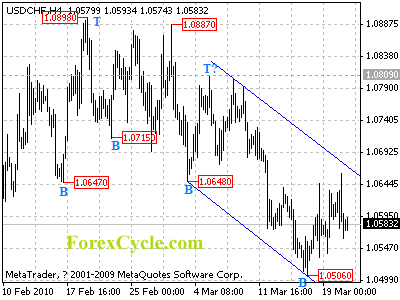
USDCHF stays in a falling price channel

USDCHF stays in a falling price channel on 4-hour chart. As long as the channel resistance holds, another fall towards 1.0400 is still possible and a break below 1.0506 could signal resumption of downtrend. However, a clear break above the channel resistance could indicate that the fall from 1.0898 has completed at 1.0506 already, then the following uptrend could bring price to 1.0800-1.0900 area.

usdchf

Forex Reports

Forex Daily Market Commentary

By GCI Forex Research

Fundamental Outlook at 1500 GMT (EDT + 0500)

The euro depreciated vis-à-vis the U.S. dollar today as the single currency tested bids around the US$ 1.3495 level and was capped around the $1.3545 level.  The common currency came off on fresh fireworks regarding Greece’s acute fiscal situation.  German Chancellor Merkel said policymakers must not create “illusions” this week regarding a possible agreement regarding financial assistance for Greece.  Greek Prime Minister Papandreou and European Commission President Barroso said this week’s summit of European Union leaders on 25-26 March should provide details about what type of assistance may be available to Greece.  Many dealers believe the International Monetary Fund will end up providing financial assistance to Greece if required while others believe Greece will have to obtain additional assistance from elsewhere.  Ecofin head Juncker said Greece “will not be abandoned if aid is needed.”  Germany’s Bundesbank reported financial deficits is not part of the IMF’s mandate with one Bundesbank official suggesting Greece should just consider itself insolvent.  European Central Bank member Weber warned Germany will need to rely on domestic demand more for economic growth, warning recent export performance is not sustainable.  Data to be released in the eurozone tomorrow include EMU-16 March industrial confidence followed by PMI data later this week.  In U.S. news, data released in the U.S. today saw the February Chicago Fed National Activity Index decline to -0.64 from the downwardly revised prior reading of -0.04.  Traders and economists alike are still discussing the Obama administration’s success in passing some initial health care reform overnight through the U.S. Congress.  Two major questions concern how this will impact the U.S. politically – particularly in November’s mid-term elections – and what impact a health care deal will have on U.S. debt levels, credit ratings, and market sentiment.  There is renewed talk the U.S. may lose its ‘AAA’ credit rating on account of concerns the sustainability of the U.S.’s massive debt.  The U.S. Treasury has sold some US$ 2.59 trillion in debt since the beginning of 2009 and the U.S. budget deficit now exceeds 10% of U.S. gross domestic product.  In recent weeks, some U.S. corporate debt has become more highly-valued than U.S. Treasuries.  About 7% of U.S. tax revenue this year will be spent on servicing the U.S.’s massive debt load.  St. Louis Fed President Bullard today said the U.S. is “about to turn the corner” in the U.S. labour market with some “good months of jobs data coming up very, very soon.”  Bullard speculated March will provide a good tally of non-farm payrolls data and said he expects a “reasonable” economic recovery.  Fed Chairman Bernanke on Friday said the U.S. needs a mechanism where financial firms can be unwound without having to resort to taxpayer money. Euro bids are cited around the US$ 1.3335 level.

¥/ CNY

The yen appreciated vis-à-vis the U.S. dollar today as the greenback tested bids around the ¥90.40 level and was capped around the ¥90.75 level.  Japanese financial markets were closed overnight and will reopen tonight.  Dealers cited lingering repatriation flows back into Japan ahead of the fiscal year end next week.  It was reported overnight that Bank of Japan’s Japanese government bond holdings now total ¥51.6 trillion, a fresh two-year high.  National Strategy Minister Sengoku last week reported Japan has “extremely little” room for additional fiscal stimulus.  In contrast, Financial Services Minister Kamei last week reported the government should compile a stimulus package.  Bank of Japan last week expanded monetary policy further, doubling a three-month lending facility to ¥20 trillion.  Data to be released in Japan overnight include February merchandise trade and February convenience and supermarket store sales.  The Nikkei 225 stock index climbed 0.75% on Friday to close at ¥10,824.72. U.S. dollar offers are cited around the ¥94.75 level.  The euro moved lower vis-à-vis the yen as the single currency tested bids around the ¥122.15 level and was capped around the ¥122.60 level.  The British pound moved lower vis-à-vis the yen as sterling tested bids around the ¥135.85 level while the Swiss franc moved lower vis-à-vis the yen and tested bids around the ¥85.05 level. In Chinese news, the U.S. dollar appreciated vis-à-vis the Chinese yuan as the greenback closed at CNY 6.8267 in the over-the-counter market, up from CNY 6.8266.  Traders are starting to focus on a U.S. government report due 15 April that could potentially identify China as a “currency manipulator.”  Chinese-U.S. relations remain quite embittered at the moment with China suggesting most of the U.S.’s economic and financial problems are of its own making.  U.S. Ambassador to China Huntsman verbally intervened last week, saying the U.S. “hopes to see more flexibility on the exchange rate. I would be misleading you if I left you with the impression that this wasn’t a very, very important issue in the United States, and will continue to be. We’ll see how the next few weeks play out.”  The central bank is expected to tighten monetary policy further imminently. February industrial profits data will be released this week.

The British pound depreciated vis-à-vis the U.S. dollar today as cable tested bids around the US$ 1.4930 level and was capped around the $1.5025 level.  Bank of England Monetary Policy Committee member Sentance last week reported he’s “been relatively encouraged by the turnaround we’ve seen in the last year, both in the UK and in the global economy.  You have to recognize there is some risk of a double dip, but that’s not the central forecast. You’d have to see some factors bring that about: we’ve seen big shocks in the international economy over the last couple of years, so you couldn’t rule out some new shocks emerging on the financial front which could set back the economy. But that’s not my central expectation.”  It was reported last week that Bank of England reported net business lending fell 9.3% m/m, the sharpest decline since record-keeping began in 1999.    Cable bids are cited around the US$ 1.4455 level.  The euro moved lower vis-à-vis the British pound as the single currency tested bids around the US$ 0.9000 figure and was capped around the £0.9045 level.

CHF

The Swiss franc weakened vis-à-vis the U.S. dollar today as the greenback tested offers around the CHF 1.0635 level and was supported around the CHF 1.0575 level.  Swiss National Bank published its quarterly economic report today and noted it will continue to “act decisively” to prevent an “excessive” appreciation of the franc.  In recent days, many dealers speculated the SNB would be less likely to sell francs for euro given the recent improvement in the U.S. economy and the cross has fallen to fresh multi-month lows as a result. SNB today indicated it expects the Swiss recovery to be “moderate and fragile.”  Data released in Switzerland last week saw Q4 industrial production rise 6.4% q/q and decline 1.1% y/y while the February trade surplus declined to CHF 1.29 billion from CHF 2.42 billion.  The euro came off vis-à-vis the Swiss franc as the single currency tested bids around the CHF 1.4325 level while the British pound moved higher vis-à-vis the Swiss franc and tested offers around the CHF 1.5950 level.

Forex Daily Market Commentary provided by GCI Financial Ltd.

GCI Financial Ltd (”GCI”) is a regulated securities and commodities trading firm, specializing in online Foreign Exchange (”Forex”) brokerage. GCI executes billions of dollars per month in foreign exchange transactions alone. In addition to Forex, GCI is a primary market maker in Contracts for Difference (”CFDs”) on shares, indices and futures, and offers one of the fastest growing online CFD trading services. GCI has over 10,000 clients worldwide, including individual traders, institutions, and money managers. GCI provides an advanced, secure, and comprehensive online trading system. Client funds are insured and held in a separate customer account. In addition, GCI Financial Ltd maintains Net Capital in excess of minimum regulatory requirements.

DISCLAIMER: GCI’s Daily Market Commentary is provided for informational purposes only. The information contained in these reports is gathered from reputable news sources and is not intended to be U.S.ed as investment advice. GCI assumes no responsibility or liability from gains or losses incurred by the information herein contained.