FOREX: US Dollar mixed on little data. EUR/USD rises to 1.3550

By CountingPips.com

The US Dollar has been mixed in forex trading today against most of the major currencies on a very light news day. The dollar has been losing ground to the euro, British pound, Japanese yen, Australian dollar and the Swiss franc while gaining ground today versus the Canadian dollar. Against the New Zealand dollar, the USD has been virtually Forex-EURO Dollarunchanged around the day’s opening exchange rate of 0.7064, according to according currency data by Oanda.

The US stock markets, meanwhile, had a winning session today with the Dow Jones gaining by approximately 44 points, the Nasdaq increasing approximately 21 points and the S&P 500 up by just about 6 points.  Oil traded slightly higher to $81.29 while gold lost $8.10 to level at $1,099.30 per ounce.

Economic news released in the Asian session today showed that Australian motor vehicles sales fell by 1.9 percent in February while on an annual basis vehicle sales increased 17.1 percent higher than the February 2009 level. This data follows a decline by 3.5 percent in January and an annual decline of 15.5 percent from January 2009.

The only notable news release out of the U.S. today was the Chicago Fed National Activity Index. The results showed that the measure of national economic activity declined in February to a -0.64 score following a revised -0.04 score in January, according to the Chicago Federal Reserve. The three-month moving average decreased to a -0.39 score following the -0.13 three-month moving average in January. Despite the decline, the report said that the three month moving average is still “higher than at any point since December 2007.” The Chicago Fed Index measures the national economy by calculating a weighted average of 85 indicators of national economic activity. A score above zero is considered above-average growth, below zero is below-average growth and at zero is considered growth at the historical trend.

EUR/USD Hourly Chart – Today, the Euro has turned around last week’s decline versus the dollar after risk aversion brought the EUR/USD back to the 1.3500 area on Friday.  The EUR/USD pair has increased by about 30+ pips today and trades right at the 50-hour moving average (Purple).  Overall, the key driver of the Euro still looks to be the Greece debt situation. Uncertainty and disagreement over the possible bailout of Greece will continue to press on the common currency heading into the European Union leaders summit that takes place on March 25th and 26th in Brussels. Although, German Chancellor Angela Merkel has said that the summit won’t lead to a decision on Greece’s situation, others, including Greece, have pointed to the summit as the time to provide a unified solution.

forex - euro usdollar

Weekly Spot Crude Oil Price Forecast

By Russell Glaser – India put the breaks on the market today, sending equities and commodities lower. Spot crude oil was trading lower during the afternoon hours of the European trading session. Driving the price of the commodity lower was a surprise rate increase by the Reserve Bank of India. This sparked worries of tighter monetary policy across other central banks. Falling spot crude oil prices could continue through the week.

The rate hike came as a surprise to the market as most economists had expected the Reserve Bank of India to increase rates in April. The bank hiked the key lending rating rate 0.25%, surprising the market. Worries over the interest rate increase could begin to slow the global economic recovery, stymieing future crude oil demand. European equities were also trading lower after the interest rate increase

This sent spot crude oil prices lower during todays trading. The price of spot crude oil dropped below the psychological price level of $80 to $79.60, after opening the trading week at $80.85.

Spot crude oil prices could be under further pressure this week on a stronger dollar. The greenback is forecasted to post more gains against the euro after European leaders have been unable to find a fitting solution to the Greek debt crisis. The issue could be resolved on Thursday as European leaders are scheduled to meet to discuss a possible bailout package for the struggling European Union nation. Until an agreement is reached, the dollar could continue to rise against the euro, pressuring spot crude oil prices. A stronger dollar could send spot crude oil prices lower to the next support level of $78.

Forex Market Analysis provided by Forex Yard.

© 2006 by FxYard Ltd

Disclaimer: Trading Foreign Exchange carries a high level of risk and may not be suitable for all investors. There is a possibility that you could sustain a loss of all of your investment and therefore you should not invest money that you cannot afford to lose. You should be aware of all the risks associated with Foreign Exchange trading.

Forex Market Review: Daily Forex Analysis 22/03/2010

Forex Market Review by Finexo.com

Past Events
• German PPI m/m, out at 0.8% versus expected 0.1%, prior 0.8%
• CAD  Core CPI m/m, out at 0.7% versus expected 0.3%, prior 0.1%
• CAD CPI m/m, out at 0.4% as expected, prior 0.3%
• CAD Core Retail Sales m/m, out at 1.8% versus expected 0.5%, prior 0.7% (revised)
• CAD Retail Sales m/m, out at 0.7% versus expected 0.6%, prior 0.5% (revised)

Upcoming Events
• GBP Bank of England Governor King to Speak (1530 GMT)
• EUR ECB President Trichet to Speak (1530 GMT)

Tuesday
• USD Existing Home Sales (1400 GMT)
• GBP CPI y/y  (0930 GMT)
• GBP Realized Sales (1100 GMT)

Market Commentary

Last week the Euro fell against 15 of its 16 major peers as EU leaders appeared unable to agree a cohesive plan to bailout Greece. On Friday it tumbled 0.60% against the US Dollar closing trading at $1.3528. The previous day it had fallen as much as 0.93% against the USD.

Late last week Greek Prime Minister George Papandreou issued EU leaders with a one week deadline to come up with a concrete rescue plan for Greece and challenged Germany to abandon its doubts about rescue plans. Papandreou said he may turn to the IMF to overcome Greece’s debt crisis unless leaders agree to set up a lending facility before an EU summit due to be held in Brussels on March 25th and 26th. The EU commission President Jose Manuel Barrosa has urged immediate action on the matter and said the EU should spell out its rescue plan at the summit later this week.

Friday saw the release of Germany’s producer price index which remained unchanged in February after increasing by 0.8% in January. Market expectations had been for a 0.1% increase. Year-on-year Germany’s PPI fell 2.9% in February, versus a 3.4% decline in January.

Canada’s core inflation rate unexpectedly rose last month on higher costs for automobile insurance and accommodation during the Vancouver Winter Olympics. The increase will pressure the central bank to raise interest rates and drive the value of the Loonie higher. The Canadian economy is accelerating out of last year’s recession with retail sales also rising more than expected. Recent manufacturing reports also indicated rapid economic growth.
The speed of the rebound may change how fast Governor Mark Carney decides to raise the benchmark interest rate from its current record low level of 0.25%. He had pledged to keep the interest rate in place through June unless the inflationary outlook changed. The banks next interest rate decision is scheduled for April 20th.

On a monthly basis, core consumer prices rose 0.7%, the fastest since November 2008 and overall inflation was up 0.4%. Economists had predicted the monthly rates would be 0.3% for both total and core inflation. Retail sales rose 0.7% in January, as consumers stocked up on home improvement supplies before a federal tax credit expired. Wholesale sales rose at the fastest pace in three years in January and factory sales gained four times what economists had predicted.

During the middle of last week the Loonie traded within one cent parity with its American counterpart before dropping back 0.23% on Thursday as crude oil prices, the country’s largest export fell. On Friday the Loonie opened at USD $1.0137 and fell back a further 0.31% to close trading at USD $1.0169.

Over the weekend in the US Federal Reserve Chairman Ben Bernanke said government bailouts of large financial firms are ‘unconscionable’ and must be ended as part of a regulatory overhaul following the worst global financial crisis in decades. He also defended the central banks structure as a useful network to monitor the financial system and economy but he did not comment directly on the economy or outlook for monetary policy in his remarks. Last week the Fed pledged to keep the benchmark interest rate at near zero for “an extended period” to stimulate economic recovery.

The US report on existing home sales is due for release tomorrow. The housing sector played a major part in the global economic downturn and last week data showed that construction in the US is dropping as foreclosures continue to mount. The question for tomorrow will be whether the expanded and extended homebuyer tax credit program will help boost sales figures as the end of April deadline for contract signing gets closer.

In Britain the consumer price index is due to be released tomorrow ahead of the annual budget announcement on Wednesday. The government plans to halve the budget deficit, one of the highest in Europe, which is expected to hit 12.6% of GDP this financial year. Figures released on Thursday showed that government borrowing for the year to the end of March is running at 132bn pounds, suggesting that full-year borrowing forecasts could come in well below the government’s forecast of 178bn pounds. Also last week figures showed that 2.45 million people in the UK are unemployed, 33,000 fewer than Februarys figure. But despite the recent signs that the economy was improving the budget is expected to focus on securing economic growth.
On Friday the Pound fell sharply against the US Dollar and the Euro after a Bank of England policymaker said the UK could still fall back into a recession. The Pound fell 2.4 cents or 1.5% against the US Dollar to $1.5013. Against the Euro it fell 1 cent, or 0.9%, to EUR 0.90094. The Pound has been on a bearish trend in the run up to the general election.

Uncertainty about who will win the election and whether there might be hung parliament has increased concerns about plans to cut debt levels. This uncertainty has weighed heavily on the Pound.

Forex Market Review & Analysis by Finexo.com

Disclaimer: Trading the foreign exchange (Forex) carries a high level of risk, and may not be suitable for all investors.

Take Time from March Madness for 2010’s Most Important Investment Report

By EWI Editorial Staff

You got your brackets filled out before the NCAA Men’s Basketball Tournament’s opening game on Thursday afternoon. Good — now sit back and enjoy the games. But if you’re looking for a good read during the numerous and lengthy time outs, we’ve got just the thing. It’s the most important investment report you will read in 2010. Forget the theoretical and hypothetical sorts of analysis that occupy so much space online. Bob Prechter gives 22 real-life examples of how deflation is beginning to spread in the U.S. economy — along with 13 charts that make the examples even clearer.

You want to know whether to prepare for inflation or deflation? This report will answer your questions. Read this excerpt to see what we mean. Oh, and try to forget that a No. 2 seed (Villanova) almost got upset in the first round and that Georgetown, a No. 3 seed, got beat by Ohio University, a 14 seed.

* * * * *

States Are Broke and Approaching Insolvency
While state “regulators” clamp down on profligate banks, the same states’ legislatures continue to blow money. For years, state governments have been spending every dime they could squeeze out of taxpayers plus all they could borrow. (The lone exception is Nebraska, which prohibits state indebtedness over $100k. Whatever Nebraska’s official position on any other issue, by this action alone it is the most enlightened state government in the union.)

But now even states’ borrowing ability has run into a brick wall, because the basis of their ability to pay interest—namely, tax receipts—is evaporating. The goose—the poor, overdriven taxpayer—is dying, and the production of golden eggs, which allowed state governments to binge for the past 40 years, is falling. The only reason that states did not either default on their loans or drastically cut their spending over the past year is that the federal government sucked a trillion dollars out of the loan market and handed it to countless undeserving entities, including state governments.

“It’s hard to imagine what happens when stimulus money runs out,” says a budget expert. (USA, 10/29/09) But it is not at all hard to imagine what will happen. Conquer the Crash imagined state insolvency seven years ago. The breezy transfer of money from innocent savers to state spenders is going to end, and when it does, states will cut spending and “services” drastically. They will also default on their debts, which will be deflationary.

Elliott Wave International’s latest free report puts 2010 into perspective like no other. The Most Important Investment Report You’ll Read in 2010 is a must-read for all independent-minded investors. The 13-page report is available for free download now. Learn more here.


Elliott Wave International (EWI) is the world’s largest market forecasting firm. EWI’s 20-plus analysts provide around-the-clock forecasts of every major market in the world via the internet and proprietary web systems like Reuters and Bloomberg. EWI’s educational services include conferences, workshops, webinars, video tapes, special reports, books and one of the internet’s richest free content programs, Club EWI.

EUR Expecting to Rebound Versus CHF

By Anton Eljwizat – The EUR has dropped significantly versus the CHF in the last two weeks, and it is currently trading around 1.4330. And now as evident in the data below, the daily chart is giving bullish signals, indicating that the EUR/CHF pair might go up. Forex traders can take advantage of this impending movement by having their Entry Orders in place to capture this reversal.

• Below is the daily EUR/CHF chart by ForexYard.

• The technical indicators used are the Relative Strength Index (RSI), Slow Stochastic, and Williams Percent Range.

• Point 1: There is a “doji” candlestick that has formed on the chart, indicating that a reversal should take place.

• Point 2: The Relative Strength Index (RSI) signals that the price of this pair currently floats in the over-sold territory, indicating upward pressure.

• Point 3: The Slow Stochastic indicates a bullish cross, signaling that the next move may be in an upward direction.

• Point 4: The Williams Percent Range is testing the lower border at the -100 mark, which merely highlights some added upward pressure.

EUR/CHF Daily Chart

Forex Market Analysis provided by Forex Yard.

© 2006 by FxYard Ltd

Disclaimer: Trading Foreign Exchange carries a high level of risk and may not be suitable for all investors. There is a possibility that you could sustain a loss of all of your investment and therefore you should not invest money that you cannot afford to lose. You should be aware of all the risks associated with Foreign Exchange trading.

Is the EUR/USD on its Way Towards a New Low?

Source: Forex Yard

After two weeks in which the Euro saw a bullish correction against the Dollar, the EUR/USD pair seems on its way downwards. The pair is currently trading around the 1.3515 level, and a drop of 100 pips will mark a year low. Will it take place later on in the week?

Economic News

USD – Recovery Indications from the U.S. Economy Strengthen the Dollar

The Dollar continued to strengthen during last week’s trading session. The Dollar soared against the Euro, and the EUR/USD pair has reached the 1.3502 level. The Dollar saw a rising trend against the Pound as well.

The bullish trend of the Dollar came in a week on which several economic indicators proved that the U.S. economy is stabilizing. The Building Permits report showed that 0.61M new residential building permits were issued during the month of February. This has been the third month in a raw that at least 0.60M permits were issued. In addition, the Core Consumer Price Index (CPI), the leading inflation gauge rose by 0.1% during February. The latest CPI results showed that there are no worries of either inflation or deflation, which is a very reassuring notification for a recovering economy. The unemployment condition also seems to be stabilizing as the weekly Unemployment Claims decreased by 5,000 to 457,000 during last week. At the current timeline, when global economies still struggle to pull out of recession, investors understand that it is often better to see solid data from the economy. This shows that the economy is truly recovering and is likely to continue to provide recovery indications.

As for the week ahead, many interesting news events are expected from the U.S. economy. Traders are advised to pay special attention to the Existing Home Sales, the Durable Goods Orders index, the New Home Sales and the weekly Unemployment Claims. Traders should also follow Fed Chairman Ben Bernanke’s speech which is expected on Thursday as he is expected to discuss potential interest rate changes.

EUR – Euro Continues To Tumble Vs. The Majors

The Euro saw a bearish trend against most of its major counterparts during last week’s trading session. The Euro dropped about 250 pips against the Dollar, about 100 pips against the Pound and over 200 pips against the Yen.

Two main reasons continue to push the Euro lower against the major currencies. The first reason is the Greece debt crises. The Euro-Zone seems to be reluctant to offer a final rescue plan at the moment, and investors respond with less and less faith in the European currency. It appears that the Euro will continue to slide until the problematic Greek financial issues will be resolved. The second reason of the Euro’s freefall is the disappointing economic data from the Euro-Zone. The European Economic Sentiment failed to reach expectations for 40.1 points and has dropped from 40.2 on February to 37.9 points on March. This has been the sixth consecutive drop in this survey. This further indicates the fragile condition of the Euro-Zone that still seems as if the economic recession is not completely over.

Looking ahead to this week, a batch of data is expected from the Euro-Zone. Special attention should be given to publications from the German economy such as the German Business Climate and the German Consumer Climate. In addition, the European Central Bank President Trichet is expected to deliver two speeches this week and traders are advised to pay attention as harsh volatility usually takes place during his speech.

JPY – Yen Corrects Losses against the Major Currencies

The Yen rose against most of the major currencies during last week’s trading session. The Yen gained about 200 pips against the Euro and the EUR/JPY pair is trading at the 122.20 level. The Yen gained about 200 pips against the Pound as well.

The most significant reason for the Yen’s bullish trend is the pessimism regarding the Euro-Zone which takes place mostly due to the Greece debt crises. This has lowered risk appetite in the market, and led investors to look for safe-haven assets such as the Dollar and the Yen. Another catalyst for the Yen’s appreciation is the positive data that was published from the Japanese economy. The Tertiary Industry Activity, which measures the change in the total value of services purchased by businesses during January, rose by 2.9%, beating expectations for a 1.3% rise. In addition, the All Industries Activity report showed that the total value of goods and services purchased by businesses has grown by 3.8% during January. These two indicators further strengthen the notion that the Japanese economy is recovering, and thus supporting the Yen.

As for this week, traders are advised to follow two leading indicators: the Japanese Trade Balance on Tuesday and the Tokyo Core Consumer Price Index (CPI) on Thursday. These publications tend to have a large impact on the Yen, and traders should take under consideration that positive result are likely to further boost the Yen.

OIL – Harsh Volatility Drives Crude Oil towards $80 a Barrel

Last week’s trading session was mostly characterized with ups and downs for crude oil trading. Crude began the past week with a drop to $79 a barrel, which was followed with a sharp rise to $83 a barrel. However close to the weekend crude oil dropped again and is currently trading around $80.00 a barrel.

Crude oil saw a bullish trend during the beginning of last week mainly due to speculations that the Euro-Zone will declare a final bailout plan for Greece. However, as the week progressed it seemed quite certain that the Euro-Zone leaders would fail to agree on such rescue plan. This has reduced risk appetite and drove investors to look for safer haven assets such as the Dollar and the Yen. In addition, the appreciation of the Dollar also contributed to the weakening crude oil. Crude is traded in Dollars and thus when the Dollar rises, crude oil’s value tend to drop.

As for the week ahead, traders are advised to follow the main publications from the U.S. economy and the Euro-Zone as these seem to have the largest impact on crude oil. Traders should also follow the U.S. Crude Oil Inventories report on Wednesday, as its publication tends to have an instant impact on the market.

Technical News

EUR/USD

During Friday’s trading the pair broke out of the bearish flag consolidation pattern that had formed over the past two weeks. However the pair may have become oversold during this continuation of the bearish trend. The daily chart shows a bullish cross may be forming on the Slow Stochastic Oscillator, indicating the potential for an upward price movement. This is supported by the 4-hour chart that also shows a bullish cross on the Slow Stochastic. The 7-day Relative Strength Indicator has broken its downward sloping trend line and is moving higher. Traders may want to liquidate long positions as the pair could begin to move higher.

GBP/USD

The bearish streak continues and the daily chart shows signs that the downward price movement could accelerate. The MACD histogram is downward sloping and a bearish cross appears to be forming, indicating a downward price trend and the potential for the price to head lower. The price has also crossed below the 20-day moving average line on the Bollinger Bands, indicating the pair could extend as far as the lower Bollinger Band line. Traders should use this level as a take profit target of 1.4870.

USD/JPY

A consolidation pattern has been forming on both the daily chart and the 4-hour chart with a majority of the price action taking place above the 20-day moving average of the Bollinger Bands. This shows a tight trading range for traders to enter the market. For those that go long, a limit order should be placed near the resistance level of 90.70. Traders going short will want to target the 90.30 support.

USD/CHF

The pair has been range-trading for a while now, with no specific direction. The Daily chart’s Slow Stochastic providing us with mixed signals. All oscillators on the 4 hour chart do not provide a clear direction as well. Waiting for a stronger sign on the hourlies might be a good strategy today.

The Wild Card

Oil

Oil prices are once again dropping, and are currently traded around $80.50 per barrel. And now, the 4-hour chart’s RSI is giving bullish signals, indicating that Oil prices might go up. This might give forex traders a great opportunity to enter a very popular trend.

Forex Market Analysis provided by Forex Yard.

© 2006 by FxYard Ltd

Disclaimer: Trading Foreign Exchange carries a high level of risk and may not be suitable for all investors. There is a possibility that you could sustain a loss of all of your investment and therefore you should not invest money that you cannot afford to lose. You should be aware of all the risks associated with Foreign Exchange trading.

Forex Weekly Market Review for 22nd Mar, 10

The dollar, the equity market and most commodities notched up gains last week as a lack of economic data failed to cause any negative volatility. The only surprise of the week came when the Indian Central Bank raise interest rates, which was really more a surprise of timing than action.  The S&P 500 Index rallied 9.5 points or .85% and the Dow Jones was the last of the major indexes (in the US) to make a new 52 week high.  The dollar index retraced last week’s loses and gained .5%

On Monday in the US, Industrial Production increased by 0.1% in February to an index value of 101.0 (2002=100), better than the expected decrease of 0.1% following a 0.9% increase in January. Over the year, the industrial production index is up by 1.7%. Capacity Utilization was reported at 72.7%, an increase from the revised level of 72.5% for January, but 7.9 percentage points below its average for the period from 1972 through 2009. In February 2009, Capacity Utilization was measured at 70.6%. The biggest gain in the report showed output in the mining industry rose 2.0% after climbing 1.1% in January. Mining capacity use rose to 88.2% from 86.4%.

On Tuesday the Federal Reserve Bank left interest rates unchanged.  The Fed’s statement following the March meeting was nearly identical to January’s remarks. The central bank continues to see economic improvement and expects to scale back emergency programs, but makes no signal that rates are going to rise in the near term.  The Federal Reserve said it will end one of its main support programs for the U.S. economy, the purchases of $1.25 trillion of mortgage backed securities.

In economic news in the US, Housing starts decreased by 5.9% to a seasonally adjusted 575,000 annual rate compared to the prior month, according to the Commerce Department.  While this was the biggest decline in four months, it followed an upward revision in the previous month’s data, when starts staged a 6.6% gain. January starts were originally reported up 2.8%.  February’s homebuilding activity remained above the level of 573,000 registered in December. Economists surveyed forecast a 4.7% drop in February housing starts, to an annual rate of 563,000.  Building permits, an indication of future construction, fell 1.6% to a 612,000 annual rate.  Economists had expected permits to decline 3.1% to a rate of 603,000. January permits fell 4.7% to 622,000.

In Europe, Greece avoided a downgrade to its credit rating by Standard & Poor’s Ratings Services, which had warned last month that it was considering such a move, although the ratings firm slapped on a negative outlook.  S&P credit analyst Marko Mrsnik said the Greek government’s plans to reduce its deficit was supportive of the nation’s current triple-B-plus long-term credit rating, which is three notches into investment-grade territory.

Over in Japan, the BoJ left its key target rate unchanged at 10 basis points, but appeared to bow to government pressure and increased the size of the three-month loan facility arranged last December to JPY20 trillion from JPY10 trillion.  Tweaking this facility was widely tipped as a likely compromise formation between the BOJ who has argued that monetary policy was already extraordinarily easy and interest rates were extremely low, while the government wants more efforts to combat deflation.  Nevertheless, the compromise was not satisfactory and two BOJ members (Noda and Suda) dissented.

On Thursday, U.S. wholesale prices in February posted their biggest drop in seven months as gasoline costs fell sharply, leaving scope for the Federal Reserve to keep short-term interest rates at a record low. The producer price index for finished goods dropped by a seasonally adjusted 0.6% m/m in February, according to the Labor Department, following an unrevised 1.4% increase in January.  The core PPI, which excludes volatile energy and food prices and is more closely watched by the Fed, rose 0.1% last month after increasing by 0.3% in January.

The seasonally-adjusted consumer price index was unchanged last month, the Labor Department said Thursday, after increasing an unrevised 0.2% in January. The last time inflation looked so tame was in March 2009, when consumer prices fell by 0.1%.  Core consumer prices, which strip out volatile energy and food items and are more closely watched by the Fed, were up by a monthly 0.1% in February. In January, core prices fell by 0.1%.  Economists surveyed were expecting an increase of 0.1% in both the headline consumer price figure and the core consumer price index number.  On an annual basis, which is not adjusted for seasonal factors, consumer prices rose by 2.1% in February. Core consumer prices rose by 1.3% from 12 months ago, the lowest increase since Feb. 2004.

320

The Philly Fed said its index of regional manufacturing activity rose to 18.9 in March from 17.6 in February, with a positive reading indicating growth in the sector. Economists had been expecting a more modest increase by the index to a reading of 18.0.

The Labor Department said in its weekly report Thursday that initial claims for jobless benefits fell by 5,000 to 457,000 in the week ended Mar. 13. The previous week’s level was left unrevised at 462,000. Total claims lasting more than one week, meanwhile, increased moderately. The decrease in initial claims was just below economists’ expectations. Economists surveyed expected initial claims to decrease by 7,000. The four-week moving average, which aims to smooth volatility in the data, also went down for the week ending Mar. 13. The Labor Department said the four-week moving average decreased by 4,250 to 471,250 from the previous week’s unrevised average of 475,500.

On Friday, India surprised the market by announcing a 25 basis point hike in key rates.  The surprise was only in the timing.  This brings the repo rate to 5% and the reverse repo rate to 3.5%.  To the extent there was speculation of a rate hike, it was more about China than India.  That said, India had raised reserve requirement earlier this quarter and many understood a rate hike was a question of time.

Forex

Canadian retail sales in January rose a robust 0.7%, which was slightly stronger than the 0.6% rise expected by analyst, according to Canstat. This small upward surprise occurred despite new car sales being much weaker than expected by dropping 2.3%. The offset was an unexpectedly large surge of 1.8% in ex-auto sales that was more than triple the 0.5% gain expected going into the report.  The jump in ex-auto sales was attributable to sales at building and outdoor home supplies stores rising an impressive 7.4%. This strength was attributed to households making purchases before the expiration of the federal government’s Home Renovation Tax Credit. This factor may also have boosted sales at furniture, home furnishings and electronic stores, which rose 2.5% boosted by surge in sales of floor coverings.  From a technical point of view the Canadian Dollar broke major support and seems to be heading lower.

127

The combination of mixed political signals in the Euro zone and technical resistance created the failure in the upward movement of the Euro.  In general, a bottom will be tested multiple times prior before support is created.  The Euro again felt pressure from the 50 day moving average which has held the Euro in a down trend for the past 4 months.  Additionally, the RSI 50 level has created resistance where technical traders have become sellers.

Daily Forex Market Analysis provided by eToro

Disclaimer: Trading in the Foreign Exchange market might carry potential rewards, but also potential risks. You must be aware of the risks and are willing to accept them in order to trade in the foreign exchange market. Don’t trade with money you can’t afford to lose.

© 2009 eToro Blog.

EURUSD broke below lower border of price channel

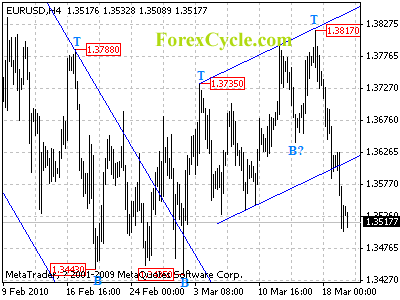
EURUSD broke below the lower border of the price channel on 4-hour chart, suggesting that a cycle top has been formed at 1.3817 level on 4-hour chart and the bounce from 1.3435 has completed. Deeper decline to test 1.3435 support could be expected later today, a breakdown below this level will signal resumption of long term downtrend from 1.5144 (Nov 25, 2009 high), then another fall towards 1.3200 could be seen.

eurusd

Daily Forex Reports

How to Develop Your Personal Forex Trading System

By Andrew Daigle – The best Forex trading system is a combination of currency trading strategies that fit your style, temperament, and risk management. There is no one “best” Forex trading strategy in making profits in the currency markets. However, there are many excellent systems that have been developed and are being used every trading day. Each one was custom tailored by the person who is enjoying the profitable results it produces.

Take the Time

To make money in the Forex markets, you need to develop your own Forex trading system. This means taking the time to get Forex training available throughout the Internet, as well as through brokers and other educational sources. There’s a gold mine of Forex courses available. But as the saying goes “no pain, no gain.” You have to take the time to study all the technical and fundamental factors that affect Forex trading in order to develop the currency trading strategies that will make you money.

Forex Trading Essentials

Limiting your losses, allowing your profits to run, and properly identifying your entry and exit points, are essential to any system. A proper forex education will allow you to develop a system that takes your emotions out of your trading, minimizing your mistakes. A proper background in chart analysis, moving averages, and other technical trading indicators, is what’s needed to produce successful results. You must have the discipline to use these tools to become a successful trader.

Valuable Information

Information is king in Forex trading. The uninformed always lose. You need to have a good trading platform together with the proper trading software to obtain the information that will help you make your decisions with accuracy and speed. Your success will entirely be dependent on how effectively you recognize and exploit trading signals. One must be able to expect and determine what will happen in the future. Through your analysis of the available information, you’ll be able to calculate the probabilities of profit and loss on any individual trade. With proper risk management, forex currency trading strategies can be developed to produce exceptional results.

Managing your Forex Trading Risk

All trading entails risk, and as such, risk management is essential. Developing a Forex trading system and standing by your strategy will yield greater results; decisions based on fear rather than a predetermined Forex trading strategy will always result in failure. Keeping your emotions out, will help minimize your Forex trading risks. You should always limit the major risks, and never risk more than a few percent of the money you have available on any single trade. If you risk too much at any one time, you will rapidly lose your capital and be unable to trade. You must have funds to participate in the market to generate profits, and thus, preservation is as important as profit. Always have the intention to trade for a long period of time with consistently limited risks.

About the Author:

Andrew Daigle is the owner and author of many successful websites including ForexBoost, a free Forex educational site to learn Forex trading strategies and a website for learning profitable online home business opportunities.

Choosing A Forex Strategy

By Giles Windholm – Technical analysis and fundamental analysis are the two basic areas of strategy in the FOREX market which is the exact same as in the equity markets. However, technical analysis is by far the most common strategy that is used by individual FOREX traders. Here is a brief overview of both forms of analysis and how they directly apply to forex trading:

Fundamental Analysis

If you think it’s hard enough to value one company, you should try valuing a whole country instead. Fundamental analysis in the forex market is often an extremely difficult one, and it’s usually used only as a means to predict long-term trends. However it is important to mention that some traders do trade short term strictly on news releases. There are a lot of different fundamental indicators of the currency values released at many different times. Here are a few of them to get you started:

* Non-farm Payrolls
* Purchasing Managers Index (PMI)
* Consumer Price Index (CPI)
* Retail Sales
* Durable Goods

You need to know that these reports are not the only fundamental factors that you have to watch. There are also quite a variety of meetings where you can get some quotes and commentary that can affect markets just as much as any report. These meetings are often brought out to discuss any interest rates, inflation, and other issues that have the ability to affect currency values.

Even changes in how things are worded when addressing certain issues such as the Federal Reserve chairman’s comments on interest rates; can cause a volatile market. Two important meetings that you have to watch out for are the Federal Open Market Committee and Humphrey Hawkins Hearings.

Just by reading the reports and examining the commentary, it can help FOREX fundamental analysts to get a better understanding of any and all long-term market trends and also to allow short-term traders to be able to profit from extraordinary happenings. If you do decide to follow a fundamental strategy, you will want to be sure to keep an economic calendar handy at all times so you know when these reports are released. Your broker may also be able to provide you with real-time access to this kind of information.

Technical Analysis

Just like their counterparts in the equity markets, technical analysts of the FOREX trading market analyze price trends. The only real difference between technical analysis in FOREX and technical analysis in equities is the time frame that is involved in that FOREX markets are open 24 hours a day.

Because of this, some forms of technical analysis that factor in time have to be modified so that they can work with the 24 hour FOREX market. Some of the most common forms of technical analysis used in FOREX are:

* The Elliott Waves
* Fibonacci studies
* Parabolic SAR
* Pivot points

A lot of technical analysts have a tendency to combine technical studies to make more accurate predictions on your behalf. (The most common method for them is combining the Fibonacci studies with Elliott Waves.) Others prefer to create trading systems in an effort to repeatedly locate similar buying and selling conditions.

Choosing Your Strategy

Most successful traders will develop a strategy and perfect it over a specific period of time. Some people will focus on one particular study or calculation, while still some others use broad spectrum analysis as a means of determining their trades. Most experts would likely suggest that you try using a combination of both fundamental and technical analysis, with which you can make long-term projections and also determine entry and exit points. Of course, in the end, it is the individual trader who has to decide what works best for him.

When you are ready to get started in the FOREX market, you should open a demo account and paper trade so that you can practice until you can make a consistent profit. Many people who fail have a tendency to jump into the FOREX market and quickly lose a lot of money because of a lack of experience. It is important to take your time and learn to trade properly before you start committing capital.

You also need to be ale to trade without emotion. You can’t keep track of all stop-loss points if you don’t have the ability to execute them on time. You must always set your stop-loss and take-profit points to execute automatically, and don’t change them unless you absolutely have to. Make your decisions and stick to them. Otherwise you will drive yourself and your brokers crazy.

You should also realize that you need to follow the trends. If you go against the trend, you are just messing with your money because the FOREX market tends to trend more often than anything else and you will have a higher chance of success in trading with the trend.

The FOREX market is the largest market in the world, and every day people are becoming increasingly interested in it. But before you begin trading, make sure your broker meets certain criteria, and take the time to find a trading strategy that works for you.

About The Author

Giles Windholm is a trader, and a forex strategist. He writes for http://www.ForexMachine.com.