Forex Market Review by Finexo.com


Forex Market Review & Analysis by Finexo.com
Disclaimer: Trading the foreign exchange (Forex) carries a high level of risk, and may not be suitable for all investors.
Forex Market Review by Finexo.com
Forex Market Review & Analysis by Finexo.com
Disclaimer: Trading the foreign exchange (Forex) carries a high level of risk, and may not be suitable for all investors.
Forex Market Review by Finexo.com
Past Events
• USD Existing Home Sales, out at 5.02M versus expected 5.01M, prior 5.05M
• GBP Consumer Price Index, out at 3.0% versus expected 3.1%, prior 3.5%
• GBP Confederation of British Industry Realized Sales, out at 13 versus expected 18, prior 23
Upcoming Events
• GBP Annual Budget Release (1230 GMT)
• USD Core Durable Goods Orders m/m (1230 GMT)
• USD New Home Sales (1400 GMT)
• EUR German Ifo Business Climate (0900 GMT)
Market Commentary
In the US figures for sales of existing homes fell in February for the third month indicating that the high unemployment level is hindering demand in the housing sector. Sales dropped 0.6% to a 5.02 million annual rate, the lowest level in eight months. The expansion and extension of a federal tax credit that helped to stabilize the housing market in 2009 hasn’t taken effect so far this year due to continuing high unemployment levels.
Existing home sales were forecast to fall to a 5 million annual rate from a 5.05 million rate in January. Data on existing home sales, which accounts for more than 90% of the market, is compiled from contract closings and may reflect purchases agreed weeks or even months earlier. This is why many economists consider new home sales figures, recorded when a contract is signed a more accurate and timely reflection of the market.
 Data on new home sales is due to be published later today. The Commerce Department is expected to report that the figure rose last month after slumping in January to the lowest level since records began in 1963.
While borrowing costs are low and prices are down, sustained jobs gains are the missing ingredient in promoting a rebound in the housing market. The unemployment rate which reached a 26 year high of 10.15% in October is projected to end the year at 9.5%.
Also out in the US today are reports for core durable goods orders. The figure is expected to climb for the third month in a row adding to evidence of a recovery in the manufacturing sector. The projected rise in durable goods orders would follow a 2.6% jump in January that was the biggest since July 2009.
The US Dollar continued to gain on both the Pound and the Euro in yesterday’s trading. The USD rose 0.58% against the Pound to close at GBP 1.5020. It appreciated 0.71% against the Euro which closed at EUR 1.3468.
In Britain yesterday figures revealed that the UK’s inflation rate dropped more than forecast in February. Consumer prices rose 3% from a year earlier, after increasing 3.5% in January according to the Office for National Statistics. On the month, prices rose by 0.4%.
The Pound rose against the Euro yesterday, gaining 0.14% to close trading at GBP 0.8964.
The inflation rate fell because of large downward movements on prices from items like toys, books and gas bills. UK gas prices have been cut three times in the last 12 months with the last cut seeing prices fall by 7%, saving the average household 55 Pounds or $83 per year.
UK retail sales slowed more than expected in February though retailers are expecting a small recovery next month according to the Confederation of British Industry’s report yesterday. Monthly distributive sales fell to 13 in March from 23 in February. Economists had predicted a reading of 15.
“Despite not matching the strength seen in February, it is encouraging that high street sales have continued to grow this month,” said Andy Clarke, chairman of the survey panel. However, Clarke warned that trading was unlikely to be easy over the coming months.”The outlook for Easter may still be positive, but with a weak economy and pay freezes for many, consumers are likely to remain cautious for some time,” he said.
All eyes will be on the UK later today as Prime Minister Gordon Brown’s government unveils the annual budget. Chancellor Alistair Darling has reiterated there will be “no giveaways” ahead of the general election. The Pound has had its worst annual start in the currency market in 13 years, dropping 7% against the US Dollar since January. The currency has been weakened by uncertainty regarding the outcome of the general election which Prime Minister Gordon Brown must call by June. The government was forced to borrow heavily during the recession resulting in one of the highest deficits in Europe.
Mr. Darling has said that while there had been signs recently that the economy was improving, with unemployment falling and government borrowing lower than forecast there was still a lot of uncertainty. The budget is expected to focus on encouraging private sector investment and securing long term economic growth. The government plans to halve the budget deficit – which at 12.6% is one of the highest in Europe- over the next four years.
He said “the mood of the times is not for giveaways. People are not daft, they know perfectly well we need to get borrowing down and secure (economic) recovery”.
In the Euro Zone the weaker Euro is predicted to have boosted German exports ahead of the German Ifo Business Climate survey today. The index is expected to have increased to 95.8 from 95.2 in February. Warmer weather is also expected to have led to a resumption in consumer spending and construction.
Greece’s fiscal crisis has contributed to the Euro’s 10% drop against the US Dollar in the last four months making German exports more competitive outside the Euro Zone. Bundesbank President Axel Weber has said that the EU’s largest economy may contract in the first quarter before rebounding in the second.
The EU summit to be held in Brussels tomorrow and Friday is expected to center around finding a resolution to the Greek debt crisis. Yesterday a German Finance Ministry official told reporters in Berlin that Germany and France agreed to back an IMF role in any aid for Greece. The shift, made before start of the summit, came a week after Euro-area finance ministers had agreed to a European framework for a bailout.
Forex Market Review & Analysis by Finexo.com
Disclaimer: Trading the foreign exchange (Forex) carries a high level of risk, and may not be suitable for all investors.
Source: Forex Yard
Investors saw mixed signals regarding the Greece bailout plan. However, the European Union (EU) meeting on Thursday may end the uncertainty surrounding the aid program. Meanwhile the EUR has hit an all time low against the Swiss Franc, down more than 100 pips yesterday; currently the pair is trading at 1.4230, down from 1.4614 less than two weeks ago, and marking a record low point for the pair.
The greenback ended stronger yesterday against the EUR, after the EUR made an attempt to rebound a day before yesterday and the EUR/USD pair is now currently trading at 1.3451.
The support to the USD against other currencies came as a result of approving the health reform and putting and end to political uncertainty which was driving investors out of the market. The USD was slightly up against the Yen; currently the pair is trading at 90.54. The USD was almost unchanged against the AUD, ending the trading day at 0.9173.
The strength of the greenback came in contrast to the decline in the Existing Home Sales report. After falling for the third month, the report has put doubts over economic recovery. Therefore, investors will be looking closely on the New Home Sales report, due later today at 14:00 GMT for an indication of the housing market’s recent direction. Lower than expected results may cause the USD to decline against other major currencies.
The uncertainty surrounding the Greece bailout program has continued to influence traders’ willingness to hold the EUR. Remarks made by Germany, regarding the best way to help Greece, sent the EUR down against the USD earlier yesterday. Other posts made by France helped lift it up from a daily low. The volatile pattern of the EUR/USD will remain at least until Thursday’s European Union (EU) summit.
The EUR/CHF fell yesterday to 1.4230, which is an all time record low for the pair. It would be interesting to follow the Swiss National Bank (SNB) response, after previously making remarks that it would act to prevent further appreciation of its currency against the EUR. A strong CHF may hurt the Swiss economy by increasing the operating costs of Swiss companies.
Later today France (at 08:00 GMT) and Germany (at 08:30 GMT) should release Manufacturing and Services PMI reports. Better than expected results should lift the EUR against other major currencies, especially the USD. A positive German Business Climate report, published at 09:00 GMT, should also support the EUR.
The Japanese Yen traded calmly for most of yesterday’s trading, almost unchanged against the other major currencies. The main currency to decline against the JPY was the EUR, which came as a result of the Euro’s recent volatility against all major currencies, rather than any economic news. The EUR/JPY is currently trading at 121.87, 60 pips down from the day’s opening, after trading even lower during yesterday’s trade.
Just before the end of yesterday’s trading, at 23:50 GMT, Japan published its trade balance figures, which came out better than expected. Japanese exports grew in February at their fastest pace in 30 years. After the report was published, the JPY climbed against the USD. The report is showing an increase in exports both to the U.S. and Asia. This is a healthy signal about the global economy, pointing to the fact that consumers are slowly picking up demand around the globe.
Spot Crude Oil is currently trading just over $81 a barrel, after visiting higher prices during yesterday’s trading. The US Existing Home Sales report helped lift oil prices, after analysts were pleased that the report showed only a slight decline in home sales. However, during after-hours, the price pared a portion of its gains.
Crude Oil’s price, recently, is moving within a very narrow range of $77-$83 a barrel. Investors appear nervous about the recovery of the global economy. Ending the uncertainty about Greece may also lift oil prices. Today, however, traders will pay attention to this week’s U.S. oil inventory data, due at 14:30 GMT. The forecast is for an increase of 1.3M barrels, any figure below the forecast should influence the price higher.
The cross has been dropping for the 2 days now, as it now stands at the 1.3410 level. The Slow Stochastic of the daily chart shows a bullish cross has recently formed, indicating that an upward correction is imminent. This view is also supported by the RSI of the hourly chart. Going long might be a wise choice
The pair is continuing its bearish trend with the daily chart’s Slow Stochastic providing us with mixed signals. The oscillators on the 4-hour chart do not provide a clear direction either. Waiting for a clearer sign on the hourlies might be a good strategy today.
The hourly chart displays a price move that has originated at the lower border of the Bollinger Bands and has the potential to appreciate all the way to its upper border. Going long with tight stops may be the popular choice today
The bullish trend is loosing its steam and the pair seems to consolidate around the 1.0615 level. The 4-hour Chart’s RSI is already floating in the overbought territory indicating that downwards correction might take place in the nearest time frame. When the downwards breach occurs, going short with tight stops appears to be preferable strategy.
After a sustained downward movement, this pair is now testing the significant resistance level of 121.00. With the price floating in the over-sold territory on the 4-hour RSI, and a fresh bullish cross on the daily Slow Stochastic, this pair is facing an impending upward correction which may turn out to be a reversal. Forex traders can benefit from this movement by going long on this pair and at a great entry price!
Forex Market Analysis provided by Forex Yard.
© 2006 by FxYard Ltd
Disclaimer: Trading Foreign Exchange carries a high level of risk and may not be suitable for all investors. There is a possibility that you could sustain a loss of all of your investment and therefore you should not invest money that you cannot afford to lose. You should be aware of all the risks associated with Foreign Exchange trading.
By eToro – As a result of Portugal’s economic vulnerabilities and persistently low growth, Fitch Ratings has downgraded the country’s long-term credit rating from “AA” to “AA-“.
Tue to this downgrade, it will become significantly more difficult for Portugal to secure loans and investments to finance its chronic current account and budget deficits.
The Portuguese economy is now in a very fragile position trying to balance a rapidly growing public debt against a shrinking GDP growth rate.
How does it impact on you?
The downgrading of Portugal’s long term rating is crucial to you as traders, as it signals further pressures for an already distressed Euro. Fitch’s downgrade of the country’s rating will immediately divert investments away from the Euro to healthier markets, and the herd mentality that follows will force additional downward pressure on the European currency.
Daily Forex Market Analysis provided by eToro
Disclaimer: Trading in the Foreign Exchange market might carry potential rewards, but also potential risks. You must be aware of the risks and are willing to accept them in order to trade in the foreign exchange market. Don’t trade with money you can’t afford to lose.
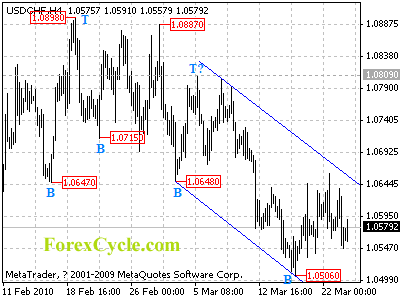
USDCHF stays in a falling price channel and remains in downward movement from 1.0898. As long as the channel resistance holds, one more fall towards 1.0400 is still possible, and a breakdown below 1.0506 could signal resumption of downtrend. However, a clear break above the channel resistance could indicate that the fall from 1.0898 has completed at 1.0506 already, then the following uptrend could bring price to 1.0800-1.0900 area.
By GCI Forex Research
Fundamental Outlook at 1500 GMT (EDT + 0500)
€
The euro depreciated vis-à-vis the U.S. dollar today as the single currency tested bids around the US$ 1.3475 level and was capped around the $1.3570 level. The common currency came off on renewed fears regarding Greece’s fiscal crisis amid worries there may be insufficient political agreement to implement a financial aid package for the country. A German finance ministry official reported Germany and France agree on supporting an International Monetary Fund rescue package of Greece, a contrast with other reports that officials are far from an agreement about financial assistance. Greece needs to sell about €10 billion in new bonds in coming weeks to refinance maturing debt. Germany is also said to favour a proposal that would stiffen the penalties for European Union members that do not maintain fiscal discipline. Data to be released in the eurozone tomorrow include March PMI and January industrial new orders. EMU-16 leaders will convene this week to discuss the Greeek situation and the common currency could get a boost if a comprehensive solution is announced for Greece. Incoming ECB Vice President Constancio said a package for Greece will be a “normal” loan and not a bailout. In U.S. news, Chicago Fed Evans last night indicated he would not be surprised if the Fed’s accommodative monetary policy remained in place through 2011, clearly putting him in the “dovish” camp. Atlanta Fed President Lockhart noted the U.S. has a “privileged” position because the dollar is the global reserve currency but warned the U.S. should not assume that will remain permanent. Many data were released in the U.S. today. February existing home sales were off 0.6% m/m to 5.02 million annualized units, a significant improvement from the prior print of -7.2%. The house price index also improved to -0.6% m/m from the revised tally of -2.0% m/m. Additionally, the March Richmond Fed manufacturing index improved to +6 from the prior reading of +2. Durable goods and new home sales data will be released tomorrow. Philadelphia Fed President Plosser called on the Fed to adopt a less discretionary rate-setting framework. Euro bids are cited around the US$ 1.3335 level.
¥/ CNY
The yen depreciated vis-à-vis the U.S. dollar today as the greenback tested offers around the ¥90.45 level and was supported around the ¥90.05 level. Japanese financial markets reopened overnight and the yen was mixed across the board. Minutes from Bank of Japan Policy Board’s were released overnight and they indicated “Some members were of the view that upside and downside risks were becoming balanced” whereas others observed “considerable downside risks to the economy.” Bank of Japan last week expanded monetary policy further, doubling a three-month lending facility to ¥20 trillion amid strong political pressure to ease policy further. The move is expected to have a limited impact on liquidity and was probably implemented to try and improve market sentiment. Policymakers in February also expressed concern with escalating deflationary pressures and the perception that China may be experiencing an asset bubble. Data released in Japan overnight saw Q4 financial household assets climb 2.5% y/y. Deflationary pressures are expected to remain strong through at least 2011. Dealers continue to cite repatriation flows back into Japan ahead of the fiscal year end next week. The Nikkei 225 stock index lost 0.47% to close at ¥10,774.15. U.S. dollar offers are cited around the ¥94.75 level. The euro moved higher vis-à-vis the yen as the single currency tested offers around the ¥122.60 level and was supported around the ¥121.75 level. The British pound moved lower vis-à-vis the yen as sterling tested bids around the ¥135.20 level while the Swiss franc moved higher vis-à-vis the yen and tested offers around the ¥85.45 level. In Chinese news, the U.S. dollar depreciated vis-à-vis the Chinese yuan as the greenback closed at CNY 6.8264 in the over-the-counter market, down from CNY 6.8267. People’s Bank of China Governor Zhou reported the U.S. and China may have hold bilateral talks to discuss exchange rates, adding political “very high profile noise” isn’t “helpful.” Zhou added “For China, we also have a tremendous task to create more jobs.” Traders are starting to focus on a U.S. government report due 15 April that could potentially identify China as a “currency manipulator.” February industrial profits data will be released this week.
₤
The British pound depreciated vis-à-vis the U.S. dollar today as cable tested bids around the US$ 1.4970 level and was capped around the $1.5110 level. Bank of England announced new plans today involving long-term repo transactions designed to increase the provision of liquidity through accepting a wider range of collateral. Data released in the U.K. today saw the March CBI distributive trades survey decline to +13 from +23. Also, BBA mortgage approvals came in stronger-than-expected at 35,200 while February core consumer price index increased 2.9% y/y, down from January’s print of +3.1% y/y. At the headline level, CPI was up 0.4% m/m and 3.0% y/y. Cable bids are cited around the US$ 1.4455 level. The euro moved higher vis-à-vis the British pound as the single currency tested offers around the £0.9015 level and was supported around the £0.8965 level.
CHF
The Swiss franc weakened vis-à-vis the U.S. dollar today as the greenback tested offers around the CHF 1.0635 level and was supported around the CHF 1.0575 level. Swiss National Bank President Hildebrand reported the central bank will “decisively” act against “excessive” franc strength, noting the central bank can intervene to a “very large extent.” Swiss National Bank yesterday published its quarterly economic report today and noted it will continue to “act decisively” to prevent an “excessive” appreciation of the franc. In recent days, many dealers speculated the SNB would be less likely to sell francs for euro given the recent improvement in the U.S. economy and the cross has fallen to fresh multi-month lows as a result. SNB today indicated it expects the Swiss recovery to be “moderate and fragile.” Data released in Switzerland last week saw Q4 industrial production rise 6.4% q/q and decline 1.1% y/y while the February trade surplus declined to CHF 1.29 billion from CHF 2.42 billion. The euro came off vis-à-vis the Swiss franc as the single currency tested bids around the CHF 1.4325 level while the British pound moved higher vis-à-vis the Swiss franc and tested offers around the CHF 1.5950 level.
Forex Daily Market Commentary provided by GCI Financial Ltd.
GCI Financial Ltd (”GCI”) is a regulated securities and commodities trading firm, specializing in online Foreign Exchange (”Forex”) brokerage. GCI executes billions of dollars per month in foreign exchange transactions alone. In addition to Forex, GCI is a primary market maker in Contracts for Difference (”CFDs”) on shares, indices and futures, and offers one of the fastest growing online CFD trading services. GCI has over 10,000 clients worldwide, including individual traders, institutions, and money managers. GCI provides an advanced, secure, and comprehensive online trading system. Client funds are insured and held in a separate customer account. In addition, GCI Financial Ltd maintains Net Capital in excess of minimum regulatory requirements.
DISCLAIMER: GCI’s Daily Market Commentary is provided for informational purposes only. The information contained in these reports is gathered from reputable news sources and is not intended to be U.S.ed as investment advice. GCI assumes no responsibility or liability from gains or losses incurred by the information herein contained.
By CountingPips.com
U.S. existing-homes sales data declined for the third straight month of February, according to the monthly report produced by the National Association of Realtors (NAR). The NAR report showed that existing-home sales including single family homes, co-ops and townhouses fell by 0.6 percent in February to a seasonally adjusted annual rate of 5.02 million units. January’s existing-homes sales data had decreased by 7.2 percent to a 5.05 million home rate while December sales dropped by over 16 percent. Despite the monthly decline, February’s existing-home sales have increased by 7.0 percent an annual basis over the February 2009 level.
Market forecasters had predicted the sales data would rise by 1.1 percent in February to a 5.00 million unit sales pace.
NAR chief economist Lawrence Yun commented in the report about the lower sales figures, “Some closings were simply postponed by winter storms, but buyers couldn’t get out to look at homes in some areas and that should negatively impact near-term contract activity.”
“Although sales have been higher than year-ago levels for eight straight months and home prices are much more stable compared to the past few years, the housing recovery is fragile at the moment.”
Sales in the Northeast increased by 2.4 percent in February while the Midwest sales rose by 2.8 percent. The West saw its existing-home sales fall by 4.7 percent and sales dipped 1.1 percent in the South. On an annual basis, the Northeast leads the increases above the February 2009 level with an increase of 12.0 percent with the South (6.9%), West (3.4%) and Midwest (8.8%) all showing rises on an annual basis.
The median sales price for existing homes declined to $165,100 on an annual basis in February, a decline of 1.8 percent from the February 2009 level. Total housing inventory increased in February by 9.5 percent to a total of 3.59 million homes, a 8.6-month supply.
FOREX: US Dollar trades mixed in fx markets, Stocks gain
The US Dollar has been mixed in forex trading today while the U.S. stock markets have advanced higher. The American currency has increased today versus the euro, British pound, and Japanese yen while falling against the Canadian dollar and Australian dollar, according to currency data by Oanda at 4:28 pm EST in the U.S. session. The New Zealand dollar and Swiss franc are trading close to unchanged against the USD at time of writing.
The US stock markets, meanwhile, climbed higher today with the Dow Jones advancing by 102.94 points, the Nasdaq increasing 19.84 points and the S&P 500 up by 8.36 points. Oil has edged higher by $0.30 to trade at $81.90 while gold has advanced by $4.20 to trade at the $1,103.50 per ounce level.
AUD/USD 1-Hour Chart – The Australian dollar gaining slightly versus the US dollar in forex trading today. The AUD/USD has bounced back from yesterday’s dip to the 0.9084 level and now trades above the 61.8 fibonacci retracement level on the move from 0.9251 to 0.9084.

By Fast Brokers – The Aussie is moving higher right now in reaction to today’s U.S. data set. U.S. Existing Home Sales printed about in line with analyst expectations, yet remain well below desired levels to establish a lasting economic recovery. The expected figure is proving positive for the risk trade across the board since this implies that the Fed may need to keep its monetary policy loose. An extension of dovish monetary policy in the U.S. bodes well for the Aussie due to the RBA’s comparatively hawkish monetary stance. China is standing firm on its bid to keep the Yuan pegged, also a positive development for the Aussie since a weak Yuan helps fuel China’s recovery while boosting the nation’s demand for Australia’s commodities. Meanwhile, all eyes remain fixated on the EU as European leaders play tug of war in regards of how to deal with Greece. Although a resolution is looking less likely as this week’s EU meeting approaches, if a solution does emerge this could be a boon for the Aussie and the risk trade as a whole. Britain will also release its budget and investors will be looking for a conservative plan to keep the UK’s deficit from ballooning further. Australia will be quiet on the data wire for the remainder of the week, possibly leaving the Aussie’s performance correlated with the risk trade. Meaning investors should keep their eyes on headlines out of Europe along with upcoming EU and U.S. data points, including tomorrow’s EU Flash PMI data set along with U.S. New Home Sales and DGO.
Technically speaking, the Aussie is knocking on the door of our downtrend line and an eclipse could yield a retest of March 18th highs. That being said, the Aussie still has some medium-term downtrend lines hanging above along with 3/17 highs. As for the downside, The Aussie has our uptrend line serving as a technical cushion along with intraday and March 22nd lows. Additionally, the psychological .91 and .90 level could serve as solid technical cushions should they be tested.
Price: .9182
Resistances: .9191, .9209, .9224, .9234, .9251
Supports: .9157, .9136, .9127, .9120, .9106, .9091
Psychological: .91, .90, 2010 highs

(click chart to enlarge)
Market Commentary provided by Fast Brokers.
Disclaimer: FastBrokers’ market commentary is provided for information purposes only and under no circumstances should be regarded neither as an investment advice nor as a solicitation or an offer to sell/buy any financial product. FastBrokers assumes no responsibility or liability from gains or losses incurred by the information herein contained.
Risk Disclosure: There is a substantial risk of loss in trading futures and foreign exchange. Please carefully review all risk disclosure documents before opening an account as these financial instruments are not appropriate for all investors.
By Fast Brokers – The USD/JPY is continuing its sideways action while floating around the highly psychological 90 area. Uncertainty in the EU hasn’t had much of an impact on the USD/JPY thus far as loose monetary policies from both the BoJ and Fed offset one another. While investors may expect the USD/JPY to decline with pullbacks in the risk trade, the currency pair has held firm since the BoJ maintains its loose monetary policy stance while the Fed tightens a tad. Underperformance in Japan’s economy coupled with a dovish stance has given investors little reason to buy up the Yen over the Dollar for safety. Meanwhile, weakness in the risk trade seems to be capping upward movements in the USD/JPY since they tend to have a positive correlation. Although consolidation in the USD/JPY has carried on for quite some time, investors shouldn’t become complacent since the currency pair is prone to periods of accelerated activity. Japan will release Trade Balance data during tomorrow’s trading session followed by the UK’s budget and key data from the EU and U.S. Investors will likely pay particular attention to U.S. durable goods data since consumption of lasting products can give us a barometer in regards to the health of Japan’s manufacturing industry.
Technically speaking, the USD/JPY faces multiple downtrend lines along with intraday, 3/18, and 3/12 highs. Meanwhile, the highly psychological 90 area could continue to have an influence over the USD/JPY’s movements for the near-term. As for the downside, the USD/JPY has multiple uptrend lines serving as technical cushions along with intraday and 3/18 lows. .
Present Price: 90.26
Resistances: 90.37, 90.47, 90.57, 90.71, 90.79
Supports: 90.16, 90.12, 90.06, 89.99, 89.94, 89.84
Psychological: 90, March highs and lows

(click chart to enlarge)
Market Commentary provided by Fast Brokers.
Disclaimer: FastBrokers’ market commentary is provided for information purposes only and under no circumstances should be regardedneither as an investment advice nor as a solicitation or an offer to sell/buy any financial product. FastBrokers assumes no responsibility or liability from gains or losses incurred by the information herein contained.
Risk Disclosure: There is a substantial risk of loss in trading futures and foreign exchange. Please carefully review all risk disclosure documents before opening an account as these financial instruments are not appropriate for all investors.
By Fast Brokers – Gold has recovered from intraday lows, avoiding a retest of Tuesday lows and climbing back to its highly psychological $1100/oz level in the process. With gold hovering around $1100/oz, the precious metal is sending a message that the markets could be at a critical juncture. The EUR/USD is also trading around 1.35 and the Cable 1.50. Hence, psychological forces are in play across the board with key EU and U.S. economic data on the way. Additionally, the UK will release its long-awaited budget tomorrow followed by the EU’s highly anticipated meeting at the end of the week. Therefore, there are plenty of potential psychological influences in the mix, with Greece in focus. Although a plan for financial assistance is becoming less likely by the day, should the EU surprising by production a solution this could be a boon for the risk trade, gold included. However, weak economic data coupled with a disappointing EU meeting could weigh down on gold and favor the Dollar further. Hence, investors should pay close attention to headlines and the data wire for upcoming developments. Meanwhile, the highly psychological $1100/oz level could continue to have an influence on the precious metal until the markets send a new directional message.
Technically speaking, gold has intraday and Tuesday lows serving as technical cushions along with the highly psychological $1100/oz area. As for the topside, gold faces multiple downtrend lines along with intraday, March 22nd and March 3rd highs.
Present Price: $1099.70/oz
Resistances: $1101.50/oz, $1103/oz, $1104.90/oz, $1106.20/oz, $1108.50/oz
Supports: $1098.30/oz, $1096.30/oz, $1094.90/oz, $1094.10/oz, $1092.30/oz
Psychological: $1100/oz, March highs and lows

(click chart to enlarge)
Market Commentary provided by Fast Brokers.
Disclaimer: FastBrokers’ market commentary is provided for information purposes only and under no circumstances should be regarded neither as an investment advice nor as a solicitation or an offer to sell/buy any financial product. FastBrokers assumes no responsibility or liability from gains or losses incurred by the information herein contained.
Risk Disclosure: There is a substantial risk of loss in trading futures and foreign exchange. Please carefully review all risk disclosure documents before opening an account as these financial instruments are not appropriate for all investors.
