AUD/USD Hops Back Above .91

By Fast Brokers – The Aussie has hopped back above .91 and is staging a modest recovery after participating in yesterday’s heavy pullback in the risk trade.  The Aussie dove beneath 3/22 lows before bouncing off our 1st tier uptrend line and climbing back towards a respectable level.  Australia has been quiet on the data wire this weekend, leaving its movements up to broad-based developments in the risk trade.  That being said, the Aussie is still flexing a relative strength since the RBA has exhibited a tighter monetary stance than other developed nations.  However, should uncertainty in the EU persist and Australia’s data cool, then the RBA could choose to keep its rates in check.  Investors to keep in mind that recent employment and housing data from Australia was a bit disappointing, hinting that the RBA’s rate hikes could be having their intended impact.  Steven’s will speak tomorrow and should he make an inference to the RBA’s rate plans this could have an impact on the Aussie.  Speaking of which, Bernanke will testify today regarding the Fed’s exit plans.  However, with the data wire quiet investors will likely be focusing on the EU summit taking place over the next two days.  Hence, investors should keep an eye on broad-based Dollar reaction to incoming headlines from the summit.

Technically speaking, the Aussie has 3/22, intraday, and 3/9 lows serving as technical cushions along with the .91 and .90 levels should they be retested.  As for the topside, the Aussie now faces multiple downtrend lines along with 3/23 and 3/17 highs.

Price: .9124
Resistances: .9137, .9145, .9156, .9162, .9168, .9177
Supports: .9121, .9116, .9110, .9101, .9087, .9073, .9061
Psychological: .91, .90, 2010 highs

(click chart to enlarge)

Market Commentary provided by Fast Brokers.

Disclaimer: FastBrokers’ market commentary is provided for information purposes only and under no circumstances should be regarded neither as an investment advice nor as a solicitation or an offer to sell/buy any financial product. FastBrokers assumes no responsibility or liability from gains or losses incurred by the information herein contained.

Risk Disclosure: There is a substantial risk of loss in trading futures and foreign exchange. Please carefully review all risk disclosure documents before opening an account as these financial instruments are not appropriate for all investors.

Gold Stabilizes from 3/24 Lows

By Fast Brokers – Gold has managed to gain back some ground from its 3/24 lows, yet is declining again after failing to reach $1100/oz.  Gold understandably logged heavy losses yesterday as the Dollar soared across the board.  Uncertainty in Greece and now Portugal sent risk traders towards the exit, a negative development for gold since it tends to be negatively correlated with the Greenback.  However, it will be interesting to see if the precious metal can managed to climb back above its key $1100/oz level as the risk trade battles for stabilization.  The EU summit is kicking off and will conclude tomorrow, meaning volatility could pick up as the week comes to a close.  Although there has been a muted response from the Euro, the summit certainly carries the firepower to ignite volatility should investors approve/disapprove of the outcome.  Hence, investors should keep an eye on the Dollar’s reaction to incoming headlines on the news wire concerning the EU.  Gold dropped below a key uptrend line yesterday which runs through 2/5 levels, or the $1050/oz area.  Hence, if gold can’t lock back into its uptrend soon more losses could be in store over the medium-term.

Technically speaking, gold has intraday and 3/24 lows serving as technical cushions along with the psychological $1075/oz area should it be tested.  As for the topside, gold faces multiple downtrend lines along with intraday highs and the highly psychological $1100/oz level.  Hence, it seems gold has an uphill battle ahead of it.

Present Price: $1091.90/oz
Resistances: $1092.23/oz, $1093.37/oz, $1094.92/oz, $1096.18/oz, $1097.26/oz, $1098.10/oz
Supports: $1089.78/oz, $1088.72/oz, $1088.01/oz, $1087.21/oz, $1085.21/oz, $1084.93/oz
Psychological: $1100/oz, March lows

(click chart to enlarge)

Market Commentary provided by Fast Brokers.

Disclaimer: FastBrokers’ market commentary is provided for information purposes only and under no circumstances should be regarded neither as an investment advice nor as a solicitation or an offer to sell/buy any financial product. FastBrokers assumes no responsibility or liability from gains or losses incurred by the information herein contained.

Risk Disclosure: There is a substantial risk of loss in trading futures and foreign exchange. Please carefully review all risk disclosure documents before opening an account as these financial instruments are not appropriate for all investors.

FOREX: US Dollar mixed. Weekly Jobless Claims fall by 28,000.

By CountingPips.com

The U.S. Dollar has been mixed in the forex markets on a day with little U.S. economic data released while the American stock markets have traded higher today. The dollar has advanced versus the British pound and the Japanese yen while declining against the Canadian dollar and New Zealand dollar in forex trading as of 1:14 pm EST in the afternoon of the US trading session. The euro, Swiss franc, and Australian dollar are all trading virtually unchanged against the American currency from their opening day exchange rates.

The U.S. stock markets are having a positive session today with the Dow gaining around 100 points, the Nasdaq increasing by over 25 points while the S&P 500 is up by over 10 points at time of writing. Oil has edged higher to $81.43 per barrel while gold has been unchanged at the $1,088.60 per ounce level.

Weekly Jobless Claims at six week low

U.S. weekly jobless claims decreased by more than expected in the week that ended on March 20th, according to a release by the U.S. Labor Department today. New jobless claims fell by 14,000 workers to a total of 442,000 unemployed workers, marking the lowest jobless claims total in six weeks. The 4-week moving average of unemployed workers decreased by 11,000 workers from the previous week to a total of 453,750.

Market forecasts were expecting jobless claims to edge down to 450,000 workers following the prior week’s 456,000 claims.

Meanwhile, workers seeking continuing claims for unemployment benefits for the week ending March 13th also decreased for the week. Continuing claims fell by 54,000 workers to a total of 4,648,000 unemployed workers. The four week moving average of continuing claims dropped by 36,500 workers to a total of 4,689,000.

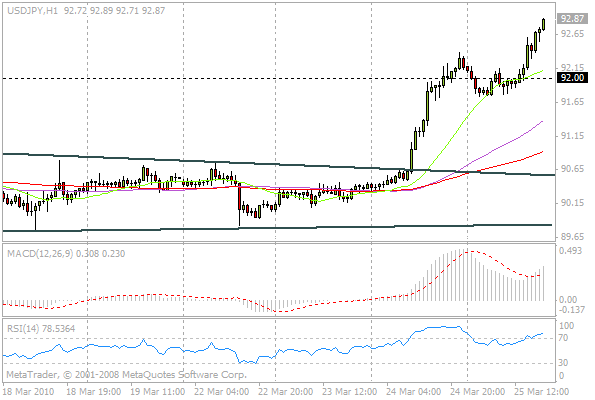
FOREX: USD/JPY Hourly Chart – The US Dollar continues to fly high against the Japanese Yen today in forex trading after breaking out of its recent trading range yesterday. The USD/JPY is gaining for a third straight day and now trading at its highest level since January 8, 2010 when the pair traded as high as 93.47.

FOREX - USD/JPY - US Dollar

Forex Market Review 25/03/2010

Forex Market Review by Finexo.com

Past Events
• GBP Annual Budget Release
• USD Core Durable Goods Orders, out at 0.9% versus expected 0.6%, prior -0.6% (revised)
• USD New Home Sales, out at 308K versus expected 318K, prior 315K (revised)
• EUR German Ifo Business Climate, out at 98.1 versus expected 95.8, prior 95.2

Upcoming Events
• USD Unemployment Claims (1230 GMT)
• USD Fed Chairman Bernanke Testifies (1400 GMT)
• GBP Retail Sales m/m (0930 GMT)
• EUR Economic Summit, Day One

Market Commentary

In a highly political UK budget Chancellor of the Exchequer Alistair Darling has cut his growth forecast for next year to between 3% and 3.5%. He had earlier predicted growth would reach 3.75%. He stuck to his prediction the economy will expand by 1.5% this year.

The Chancellor also revealed that Britain’s budget deficit will be smaller than the £178bn expected in the pre-Budget report. The UK will borrow £167bn this financial year and £163bn next year. The central issue in the Budget has been the deficit, which standing at 12% of GDP is one of the largest in Europe. It has made the handling of the nation’s finances by Prime Minister Gordon Brown and Chancellor Darling a key election issue.

Uncertainty about the possible outcome of the General Election, due to be held on May 6th has weakened the Pound the international currency market. Polls have indicated that the Conservatives lead is narrowing, raising the risk of a hung parliament. This would make any proposed spending cuts more difficult to implement. Yesterday’s budget postponed measures to curb the deficit until after the election is held.

Investors reckon that only after the election the next Government – whether Labor, Conservative or a coalition – will spell out in detail the scale of the cuts in public spending and rises in tax required to return the public finances to health. Credit rating agencies have indicated they will wait until this time to judge whether Britain deserves to keep its much-prized ‘AAA’ rating, a measure of a borrower’s creditworthiness.

Out later today are UK retail sales figures. Last month figures were disappointing with a fall of 1.8% in sales volume. A rise of 0.6% is predicted this time.

The Pound dropped 0.81% against the US Dollar in trading yesterday to close at GBP 1.4896. It also dropped against the Euro by 0.22% to close at GBP 0.8945.

Across the Atlantic, US orders for durable goods rose in February for a third month, while inventories and backlogs climbed by the most in more than a year, indicating the manufacturing rebound will keep propelling the U.S. recovery.

The 0.5% increase in bookings for durable goods was in line with expectations and followed a 3.9% gain the prior month, the Commerce Department said today in Washington. Excluding transportation equipment orders rose 0.9%, more than anticipated.

Business spending on new equipment, inventory restocking and a pickup in global demand mean companies like Boeing can look forward to sustained sales gains. A pickup in employment is still needed to broaden the expansion as the economy heals from the worst recession since the 1930s.

“Manufacturing has and will continue to drive this recovery,” David Semmens, an economist at Standard Chartered Bank in New York, said before the report. “Export demand will continue to grow, domestic orders continue to rise and the inventory liquidation cycle has stopped dragging on growth.”

Elsewhere in the US, new home sales fell unexpectedly in February to a record low as blizzards, unemployment and foreclosures depressed the market. Purchases decreased 2.2 % to an annual pace of 308,000, according to figures from the Commerce Department. The average sales price climbed by the most in more than two years.

The new-home market is vying with foreclosure-induced declines in prices for existing homes in an economy where unemployment is forecast to average 9.6% this year, close to a 26-year high. Treasury Secretary Timothy F. Geithner said on Tuesday that it would take a “long time” to repair the housing market as the administration takes steps to overhaul real-estate financing and regulation.

The US Dollar gained 1.03% against the Euro yesterday, closing at EUR 1.3328.
Later today the unemployment claims for the past week are due to be published. A steady drop in unemployment figures has been seen since they touched 496K about a month ago. Another small drop is predicted this time, from 457K to 453K.

Also in the US today Federal Reserve chairman Ben Bernanke is due before the House Financial Services Committee for the second part of his testimony that will focus on the exit strategy for the economic stimulus package put in place after the global economic downturn. The testimony will take the form of a questions and answers session. The questions and the reactions are unknown, so this may easily lead to remarks that can move the markets, even if Bernanke doesn’t bring any real news.

In Europe German business confidence rose more than economists forecast in March as a weaker Euro boosted export prospects and warmer weather paved the way for a resumption of consumer spending and construction.

The Ifo institute in Munich said its business climate index, based on a survey of 7,000 executives, jumped to 98.1 from 95.2 in February, the highest reading since June 2008. Economists had expected a gain to 95.8. The index reached a 26-year low of 82.2 in March last year.

Greece’s fiscal crisis has contributed to the Euro’s 11% drop against the US Dollar in the past four months, making German exports more competitive outside the 16-nation bloc.
Today is the first day of a two day EU economic summit in Brussels. EU leaders are meeting to discuss ways the 16 nation bloc can recovery from slow economic growth and high unemployment and also how it should address the worsening fiscal crisis in Greece.

European Commission President Jose Manuel Barroso circulated a briefing paper ahead of the summit stressing the urgency of the tasks ahead.

“By taking bold action we can … avoid the trap of a decade of ‘sluggish’ growth and high unemployment, which would reduce our standard of living, put enormous strain on our social systems and diminish Europe’s role in the world,” he wrote.

A Greek rescue plan is not on the official summit agenda, but leaders will discuss the issue over lunch with European Central Bank President Jean-Claude Trichet. The meeting is expected to reach a political agreement on how to help Greece, while EU finance ministers will work out the financial details at a meeting Monday.

Forex Market Review & Analysis by Finexo.com

Disclaimer: Trading the foreign exchange (Forex) carries a high level of risk, and may not be suitable for all investors.

USD/JPY Looks to Correct Yesterday’s Gains

By Yan Petters – During yesterday’s trading session the USD/JPY pair gained over 200 pips, reaching a 3-month high. This came after 3 weeks of relatively peaceful trading that did not include any sharp movements. However, at the moment it seems that a mild bearish correction is likely to take place in response to yesterday’s rising trend.

• The chart below is the USD/JPY 4-hour chart by ForexYard.
• The technical indicators used are the Bollinger Bands, the Slow Stochastic, the MACD and the Relative Strength Index (RSI).
• The pair reached a 3-month high at the rate of 92.50 yesterday, yet it has dropped ever since.
• A bearish cross of the Slow Stochastic suggests that the bearish correction is likely to proceed.
• The MACD has reached the 0.425 level recently, also suggesting that the bullish move has been limited.
• The bearish correction has potential to reach the 91.50 level. If the pair will manage to breach through this level, its next target will be the 90.50 level.

Forex Market Analysis provided by Forex Yard.

© 2006 by FxYard Ltd

Disclaimer: Trading Foreign Exchange carries a high level of risk and may not be suitable for all investors. There is a possibility that you could sustain a loss of all of your investment and therefore you should not invest money that you cannot afford to lose. You should be aware of all the risks associated with Foreign Exchange trading.

Forex Technical Analysis – EUR/USD – RSI Reversal

By Russell Glaser – A sign that the bearish streak of the EUR/USD may begin to slow is appearing on the daily chart from the Relative Strength Index.

Below the Forex Technical Analysis shows the daily chart using the 10-day RSI. The RSI can be used to show a shift in the direction of the price trend. The 10 day setting is used as it takes into account 2 full weeks of trading data (5 days in a trading week).

By drawing a trend line underneath the rising RSI line, we can see that a break of the rising RSI line provided a good signal for previous price breakout that occurred on March 17th. By drawing a tend line above the downward sloping RSI line, we can see a possible end to the downward sloping price trend as the trend line on the RSI is on the verge of being broken.

While a break of the trend line may not present a signal to buy as when the RSI breaks above the 30 line (as the RSI is typically used) this can be a signal to close any short positions and take profits.

Forex Market Analysis provided by Forex Yard.

© 2006 by FxYard Ltd

Disclaimer: Trading Foreign Exchange carries a high level of risk and may not be suitable for all investors. There is a possibility that you could sustain a loss of all of your investment and therefore you should not invest money that you cannot afford to lose. You should be aware of all the risks associated with Foreign Exchange trading.
EUR/USD Falls on European Fiscal Concerns

Source: Forex Yard

The Dollar rallied broadly, while the EUR fell to 10-month lows on Wednesday, as a ratings firm downgraded Portugal, adding to worries over debt sustainability and growth in some of euro zone’s smaller countries. That supported some safe-haven flows into the U.S. dollar.

Economic News

USD – Dollar’s Rally Continues

The Dollar extended gains against most of its major counterparts after a report showed new orders for long-lasting U.S. manufactured goods rose for the third straight month in February. As a result, the USD finished yesterday’s trading session 100 pips higher against the GBP at the 1.4890 level. The greenback also saw bullishness against the EUR and closed at 1.3330.

Yesterday, government reports showed that the U.S orders for long-lasting goods rose in February for a third month, while inventories and backlogs climbed by the most in more than a year, indicating the manufacturing rebound will keep on propelling the U.S. recovery. Analysts said portions of the durable goods report were positive and helped support strong demand for the U.S. dollar, which started earlier in the session.

The other factor that led to the bullish Dollar yesterday was that U.S stocks fell on mounting concerns about spiraling debt in some developed economies, which boosted demand for the USD as a safe-haven currency.

Looking ahead to today, the most important American economic indicator scheduled to be released is the Unemployment Claims at 12:30 GMT. Traders will be paying close attention to today’s announcement as a stronger than expected result may boost the USD in the short-term. Traders are also advised to follow Fed Chairman Ben Bernanke’s testimony at around 14:00 GMT. The testimony is very important as it will very likely lead to Dollar volatility, and may set the pace for the greenback for the rest of the week.

EUR – EUR Falls to a 10-Month Low Versus the Dollar

The EUR extended its losses to a 10-month low against the Dollar on Wednesday as investors doubted that euro zone leaders would come up with a quick rescue package for debt-laden Greece at a summit this week. By yesterday’s close, the EUR fell sharply against the USD, pushing the oft-traded currency pair to 1.3330. The 16 nation currency experienced similar behavior against the GBP and closed at 0.8950.

Fears that the Greek debt crisis will spread have been the main focus of attention in the markets. Fitch Ratings downgraded its view on Portugal’s debt amid growing concerns about the government’s ability to service its borrowings. There are also concerns that the Washington D.C. based IMF will play a substantial role in helping Greece get a grip on its public finances, underlining the difficulty of European governments to deal with the Greek debt crisis on their own.

For weeks, it seemed that the countries that use the Euro were adamant that they would not look for outside help in addressing Greece’s debt crisis. But the German government’s increasing reluctance to bail out Greece amid domestic opposition has increased the likelihood that the IMF would be called in.

JPY – Yen Drops on All Fronts

The JPY saw a bearish trading session yesterday, losing ground against most of its currency crosses. The JPY fell sharply against the USD, pushing the oft-traded currency pair to 91.95. The Yen experienced similar behavior against the EUR and closed at 122.50.

The JPY’s future trends will be affected by the rallies of its primary currency pairs today. It seems that the USD and EUR are expected to continue a volatile trading session today, especially against the Japanese currency. Traders should pay attention to the news coming from the U.S. and Europe as these economies will be the deciding factors for the JPY’s movement today. This is especially true for the U.S Unemployment Claims at 12:30 GMT. It is also advisable for traders to follow any unexpected comments coming from key Japanese governmental figures, as this will also likely to lead to further JPY volatility.

Crude Oil – Oil Drops as Inventories Rise

The price of crude oil fell 1.5% to $80.20 during yesterday’s trading session. This drop came after a U.S. government report showed Crude Oil inventories rose more than expected in the world’s top energy consumer. The Energy Department reported that crude inventories rose by 7.3 million barrels to 351.3 million barrels last week. Analyst’s expected an increase of 1.67 million barrels.
Oil prices also tracked lower stock prices, which fell after Fitch Ratings said Portugal’s recovery will be slower than other countries in the euro-zone, hurting its ability to repay debt.

Looking ahead, traders are advised to watch the global stock markets and the major economic indicators which will be published from the U.S. and Euro-Zone. They will likely serve as solid indicators for the next movement in oil prices.

Technical News

EUR/USD

The Stochastic Slow on the 4-hour chart indicates that a bullish correction is long overdue for the pair. This sentiment is supported by the Relative Strength Index (RSI), which shows that the pair is deep in oversold territory. Going long may be a good strategy today.

GBP/USD

The Relative Strength Index (RSI) on the 2-hour chart indicates that the pair is currently in oversold territory, indicating an upward correction may be imminent. This view is supported by the Stochastic Slow on the daily chart. Traders may want to go long with this pair today.

USD/JPY

The Stochastic Slow on the 8-hour chart shows that a bearish correction may be forming for this pair. The Relative Strength Index (RSI) also indicates that the pair is deep in overbought territory. Going short may be a wise strategy today.

USD/CHF

Yesterday the pair made a significant breach of the 1.0640 resistance line, rising 100 pips above this level. The pair could continue its recent bullish streak as the daily chart shows the 7-day Relative Strength Indicator trending higher. The 10-day Momentum Indicator also shows the pair moving higher along a sharp up sloping trend line. Traders are advised to stay long on the pair until the trend line is broken.

The Wild Card

Crude Oil

A head and shoulders pattern may have formed on the 4-hour crude oil chart with the downward sloping neck line drawn underneath the price levels of $79.93 and $78.83. The future price move could be estimated by measuring the distance from the head of the pattern down to the neckline, for a price move of roughly 430 pips. Forex and commodity traders may want to place an entry stop sell order below the neckline for the possible breakout.

Forex Market Analysis provided by Forex Yard.

© 2006 by FxYard Ltd

Disclaimer: Trading Foreign Exchange carries a high level of risk and may not be suitable for all investors. There is a possibility that you could sustain a loss of all of your investment and therefore you should not invest money that you cannot afford to lose. You should be aware of all the risks associated with Foreign Exchange trading.

Euro under Pressure

By eToro – Euro fell under major support levels amid failure of EU members to conclude a rescue plan for Greece. Germany the largest economy in the EU is strongly opposing any sort of a Greek bailout. Latest polls show a large portion of Germans not only opposes any sort of a Greek bailout but actually think Germany is better off without Greece in the Euro zone. With the EU strongly divided ahead of the EU summit on Thursday and Portugal’s credit downgraded by Fitch to AA- , investors crowded heavy bids on the Euro pushing it below the 1.34 support against the Dollar and to an historic low of 1.423 against the Swiss Franc. Many other members of the EU are under debt watch such as Spain Portugal and even Italy, and investors’ willingness to pay a premium for the Euro against the Dollar is starting to fade.

Lack of a safety net, a long term risk for Euro zone growth –The failure of EU members to create a funding safety net not only poses a risk for the Euro exchange rate but for Euro zone economic growth. Since investors have a lack of clarity and feel the Euro zone is unable to be flexible enough to address its debt problem in an orderly manner, spreads on various bonds of EU members are widening. This brings borrowing costs for governments in the Euro zone to surge. For example the spread between Greece’s 10y borrowing costs and Germany’s 10y borrowing costs is 3%, meaning Greece’s borrowing costs are close to two times that of Germany, as German 10y bunds are yielding 3.25%. Now with Portugal credit downgraded and Greece possibly forced to get an IMF load, many EU members that need to rollover vast amounts of debt could suffer the same surging borrowing costs. What is the effect of such a process? Inflation could spike in the Euro zone which could cause the ECB to prematurely raise rates and bring EU growth practically to a standstill. Moreover since investors in the future will not be confident on EU stability, EU members will have to earn investors’ trust by curbing deficits too rapidly and this is of course also negative for growth and risk a double dip recession in the Euro zone. Unless EU members will be able to create a long term solution and a safety net for the EU high debt nations, investors’ belief in the Euro Zone will fade and with it any chance for the EU to gain a stable economy and exchange rate.

Daily Forex Market Analysis provided by eToro

Disclaimer: Trading in the Foreign Exchange market might carry potential rewards, but also potential risks. You must be aware of the risks and are willing to accept them in order to trade in the foreign exchange market. Don’t trade with money you can’t afford to lose.

© 2009 eToro Blog.

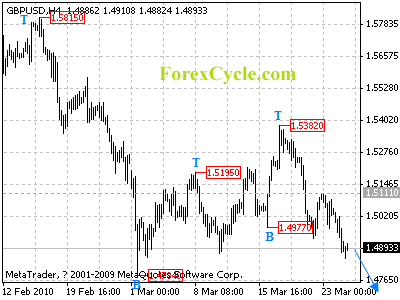
GBPUSD continues its downward movement from 1.5382

GBPUSD continues its downward movement from 1.5382 and the fall extended to as low as 1.4852 level. Deeper decline to test 1.4784 previous low support is expected later today. A breakdown below this level will indicate that the long term downtrend from 1.6875 (Nov 16, 2009 high) has resumed, then next target would be at 1.4500 area. Resistance is now at 1.5111, as long as this level holds, downtrend will continue.

gbpusd

Written by ForexCycle.com

The Stock Market Is Patterned — Here’s Proof

You don’t have to sift through the latest economic data as if they were tea leaves.

By Editorial Staff

This is an excerpt from Elliott Wave International’s free Club EWI resource, “What Can a Fractal Teach Me About the Stock Market?” by EWI’s president Robert Prechter.

In the 1930s, Ralph Nelson Elliott described the stock market as a fractal — an object that is similarly shaped at different scales. Scientists today recognize financial markets’ price records as fractals, but they presume them to be of the indefinite variety. Elliott found something different:

You see that each “wave” within the overall structure subdivides in a specific way. If the wave is heading in the same direction as the wave of one larger degree, then it subdivides into five waves. If the wave is heading in the opposite direction as the wave of one larger degree, then it subdivides into three waves (or a variation).

Understanding how the market progresses at all degrees of trend gives you an invaluable perspective. No longer do you have to sift through the latest economic data as if they were tea leaves. You gain a condensed view of the whole panorama of essential trends in human social mood and activity, as far back as the data can take you.

OK, now you try it. Figure 3-7 shows an actual price record. Does this record depict two, three, four or five completed waves? Based on your answer, what would you call for next?

Let’s compare your answer with mine. From the simple idea that a bull market comprises five waves, The Elliott Wave Theorist in September 1982 called for the Dow to quintuple to nearly 4000 and on October 6 announced, “Super bull market underway!” The November 8 issue then graphed the forecast for the expected fifth wave up, as you can see in Figure 3-8.


As you can see, Elliott waves are clear not only in retrospect. They are often — particularly at turning points — quite clear in prospect.

Read the rest of this important report now, free! All you need is to create a free Club EWI profile. Here’s what you’ll learn:

  • How Is the Stock Market Patterned?
  • The Necessity and Efficiency of .5-3.
  • Examples of Real-World Long-Term Waves: DJIA, Gold, CRB
  • The Fibonacci Sequence in the Wave Principle
  • Why Is the Stock Market Patterned? Investors’ Herding Impulse
  • More

Visit Elliott Wave International to learn more about the free “What Can a Fractal Teach Me About the Stock Market?” report.


Elliott Wave International (EWI) is the world’s largest market forecasting firm. EWI’s 20-plus analysts provide around-the-clock forecasts of every major market in the world via the internet and proprietary web systems like Reuters and Bloomberg. EWI’s educational services include conferences, workshops, webinars, video tapes, special reports, books and one of the internet’s richest free content programs, Club EWI.