Gold Negated by $1100/oz

By Fast Brokers – Gold’s intraday bounce has been negated by the psychological $1100/oz area as risk aversion persists around the FX markets.  The Dollar is currently appreciating across the board, most notably against the Yen and Aussie.  A resolution in the EU regarding Greece hasn’t managed to quell uncertainty thus far with a limited impact in the EUR/USD.  Hence, the Dollar continues to have upward momentum working in its favor, a negative for gold due to their usual negative correlation.  Meanwhile, U.S. Final GDP came in 3 basis points below analyst expectations.  This discouraging figure seems to be having a positive influence on the Greenback since it has become the preferred safe haven as of late.  That being said, it appears the Dollar is in a win-win situation at the moment due to fiscal worries in the EU along with electoral uncertainty in the UK.  Hence, gold seems to face an uphill battle for the time being.  The data wire will be relatively quiet on Monday, meaning present momentums could persist into Tuesday barring a key psychological development.

Technically speaking, despite gold’s inability to break through $1100/oz, the precious metal does have uptrend line serving as a technical cushion along with 3/25 and 3/24 lows.  As for the topside, gold faces multiple downtrend lines due to the extent of its recent pullback.  Gold must also overcome its highly psychological $1100/oz area once again, no easy task.

Present Price: $1095.65/oz
Resistances: $1095.72/oz, $1097.26/oz, $1099.73/oz, $1101.23/oz, $1102.64/oz, $1104.34/oz
Supports: $1094.92/oz, $1093.37/oz, $1092.23/oz, $1091.40/oz, $1089.78/oz, $1088.72/oz
Psychological: $1100/oz, March lows

(click chart to enlarge)

Market Commentary provided by Fast Brokers.

Disclaimer: FastBrokers’ market commentary is provided for information purposes only and under no circumstances should be regarded neither as an investment advice nor as a solicitation or an offer to sell/buy any financial product. FastBrokers assumes no responsibility or liability from gains or losses incurred by the information herein contained.

Risk Disclosure: There is a substantial risk of loss in trading futures and foreign exchange. Please carefully review all risk disclosure documents before opening an account as these financial instruments are not appropriate for all investors.

FOREX: US Dollar mixed as Euro rebounds. 4th Quarter GDP revised lower

By CountingPips.com

The US Dollar has been mixed across the board in forex trading today as the European common currency has rebounded after three straight days of decline on the new plan for Greece. The American currency has been advancing versus the  Japanese yen, Canadian dollar and Australian dollar while falling against the euro, British pound and Swiss franc, according to currency data by Oanda. The New Zealand dollar is virtually unchanged versus the US dollar from the days opening exchange rate.

The euro has mounted a comeback today against the dollar after spending the week under heavy selling pressure due to the Greek debt crisis and Portugal’s credit downgrade. The EU leaders summit has produced a safety-net agreement for Greece that includes bilateral loans from EU countries and backup loans from the International Monetary Fund (IMF) if needed. The news has spurred the euro to bounce back from yesterday’s 10-month low level to trading near the 1.3400 level today.

US GDP revised lower

Economic news out of the U.S. showed that the economy expanded by less than estimated in the fourth quarter of 2009 but still at the fastest pace in over 6 years, according to a release by the U.S. Commerce Department. The third government estimate showed that the real Gross Domestic Product grew on an annualized basis by 5.6 percent in the October to December quarter following a real 2.2 percent growth rate in the third quarter. The previous estimate put the GDP advance at 5.9 percent.

A significant contributor to the gain in GDP for the fourth quarter was a slowdown in the cutbacks of business inventories. Inventories fell by just $19.7 billion in the fourth quarter after a decrease of $139.2 billion in the third quarter and a decrease of $160.2 billion in the second quarter. This slowdown in the slashing of inventories accounted for adding approximately 3.79 percent to the GDP increase.

The fourth quarter GDP numbers advanced by the highest growth rate since 2003 and GDP has now increased for two straight quarters after contracting for four quarters in a row. The economy declined by 6.4 percent in the first quarter of 2009 and by 0.7 percent in the second quarter before the third quarter’s 2.2 percent rise. Overall for the calendar year of 2009, GDP decreased by 2.4 percent following a 0.4 percent increase for 2008 and a 2.1 percent growth rate in 2007.

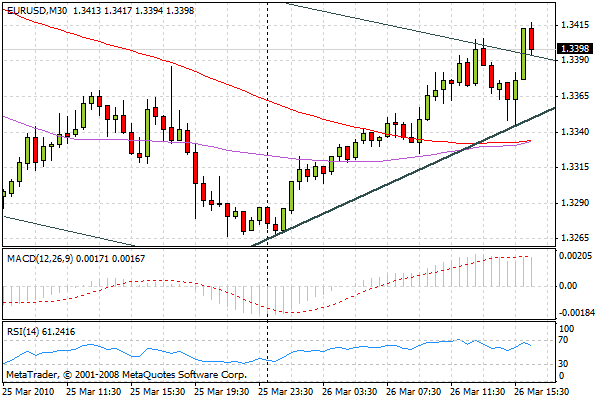
EUR/USD Forex Chart -The Euro reversing course today versus the US Dollar in forex trading. The Eurozone reached an agreement on a rescue package for Greece and helped bring the Euro off of a 10-month low versus the dollar. The EUR/USD had fallen three straight days and touched a low at 1.3266 yesterday before climbing back to the 1.3400 area today.

eurusd-forex

Greek Safety Net News Gives EUR A Bullish Session

Source: Forex Yard

The Euro began showing bullish signs last night, and has slowly continued its upward trend throughout today. This is largely due to the European Central Bank’s, (ECB), decision to create a safety net for Greece. This safety net, a combination of IMF and Euro-zone loans in case of emergency, while not quite the bailout package investors were hoping for, is clearly a step in the right direction. Since 23:00 GMT last night, EUR/USD has increased over 100 pips to its current level of 1.3376. EUR/CHF, coming off of record lows reached earlier this week, shot up over 50 pips in the same amount of time. The pair is currently trading at 1.4302.

A relatively slow news day, will likely lead to low liquidity in the market place as we close out for the weekend. That being said, with the ECB President scheduled to speak at 16:00 GMT, the Euro may further extend its bullish session. Whether the latest news indicates a prolonged trend for the European currency is yet to be seen. What can be said with certainty though is that the closer the Greek deficit crisis is to being over, the better the Euro will perform in the forex marketplace.

Forex Market Analysis provided by Forex Yard.

© 2006 by FxYard Ltd

Disclaimer: Trading Foreign Exchange carries a high level of risk and may not be suitable for all investors. There is a possibility that you could sustain a loss of all of your investment and therefore you should not invest money that you cannot afford to lose. You should be aware of all the risks associated with Foreign Exchange trading.

GBP/USD Continues To Drop

By Yan Petters – The GBP/USD pair has dropped quite severely over the past couple of months. The pair fell over 1,500 pips in two months, providing unique opportunities to gain high profits. At the moment it seems that the bearish trend isn’t over yet.

• The chart below is the GBP/USD daily chart by ForexYard.
• The technical indicators used are the Bollinger Bands, the Slow Stochastic, the MACD and the Relative Strength Index (RSI).
• A very distinct bearish channel has formed on the chart, and the pair is currently trading in the middle of it.
• The pair is very close to the next support level which is located at the 1.4780 price.
• If the pair will manage to breach the support level, this will likely boost the bearish momentum, with potential to reach towards the 1.4300 level within several days.
• The next support levels are located at: 1.4100 and 1.3650.
• However, if the pair will fail to breach through the 1.4780 level, a bullish correction might take place, with the potential to reach the 1.5360 level.

Forex Market Analysis provided by Forex Yard.

© 2006 by FxYard Ltd

Disclaimer: Trading Foreign Exchange carries a high level of risk and may not be suitable for all investors. There is a possibility that you could sustain a loss of all of your investment and therefore you should not invest money that you cannot afford to lose. You should be aware of all the risks associated with Foreign Exchange trading.

Forex Market Review 26/03/2010

Forex Market Review by Finexo.com

Past Events
• USD Unemployment Claims, out at 442K versus expected 452K, prior 456K (revised)
• USD Fed Chair Ben Bernanke Testified
• GBP Retail Sales, out at 2.1% versus expected 0.8%, prior -3.0% (revised)
• EUR EU Economic Summit, Day One

Upcoming Events
• EUR EU Economic Summit Day Two

Market Commentary

In the US first time jobless claims fell to the lowest level in six weeks as the rebound in the U.S. economy encourages companies to make fewer cuts in payrolls.

First-time jobless applications declined 14,000 in the week ended March 20 to 442,000, lower than anticipated according to Labor Department figures published yesterday. The number of people receiving unemployment insurance decreased, and those getting extended benefits also fell.

Employers are slowing the pace of payroll reductions, indicating budding optimism in an economy that’s been lifted by a pickup in manufacturing and expansion overseas. Companies now need to move beyond jobs cuts and start hiring to ensure the recovery from the deepest recession since the 1930s is sustained.

President Barack Obama signed an $18 billion jobs bill into law on March 18th that provides a tax break to companies hiring unemployed workers, saying additional steps are needed to drive down unemployment. “There’s a lot more that we’re going to need to do to spur hiring in the private sector and bring about a full economic recovery,” Obama said.
The US Dollar which had reached a ten month high against the Euro on Wednesday fell back slightly yesterday as the Euro gained 0.43% to close at EUR 1.3329.

Elsewhere in the US, Federal Reserve Chairman Ben Bernanke yesterday said the U.S. economy still needs low interest rates and that the central bank will be ready to tighten credit “at the appropriate time.”

“The economy continues to require the support of accommodative monetary policies,” Bernanke said today in prepared testimony to the House Financial Services Committee, repeating parts of a statement to the panel from last month. “However, we have been working to ensure that we have the tools to reverse, at the appropriate time, the currently very high degree of monetary stimulus.”

The central bank chief and his colleagues have been outlining their strategy for tightening credit in time to prevent the recovery from stoking inflation. Officials are concerned that the federal funds rate, their main policy tool for 20 years, isn’t as effective as before in influencing borrowing costs.

“As the expansion matures, the Federal Reserve will need to begin to tighten monetary conditions to prevent the development of inflationary pressures,” Bernanke said in the text of remarks. “We have full confidence that, when the time comes, we will be ready to do so.”
Responding to questions, Bernanke said the “unemployment situation is very weak,” with 40% of those without jobs being out of work for a long time, and the housing market is “still quite weak.”

When Bernanke convened the Federal Open Market Committee for its March 16 meeting, policy makers left the benchmark federal funds rate in a range of zero to 0.25% and repeated a pledge to keep rates low for an “extended period.”

In the UK retail sales rebounded more than economists forecast in February with the biggest jump since May 2008 as Britons raised spending on goods from electrical items to auto fuel. Sales rose 2.1% from January, when they slumped by a more-than-previously-expected 3% in the longest cold snap for three decades. Excluding fuel, sales rose 1.6%, the most since June.

The increase in sales for February was led by an 11.2% jump at household goods stores, the statistics office said. Auto fuel sales rose by 9.1% and textile, clothing and footwear shops had a 1.1% gain. Food stores showed a 1.2% drop, the most since June 2008.

The January sales drop was revised down from a decline of 1.8% previously reported because of late returns of data from retailers, the statistics office said.

Next, the U.K.’s second-biggest clothing retailer said today full-year earnings rose 20% as it expanded Internet and catalog sales and sold more goods at full price in stores.

UK Chancellor of the Exchequer Alistair Darling, presenting his budget report to Parliament Wednesday said that to start cuts in public spending before the recovery was assured “would be both wrong and dangerous.” The ruling Labor Party’s resistance to faster spending cuts have helped it narrow the lead of the opposition Conservatives ahead of a general election due by June.

Jobless claims fell last month at the fastest pace since 1997, though the number of people in work in the three months through January dropped to a four-year low of 28.9 million.

The Pound continued to decline against the US Dollar yesterday. It fell 0.50% to close at GBP 1.4811. At also dropped 0.10% against the Euro closing the day at GBP 0.8960.

Yesterday was day one of the two day EU economic summit being held in Brussels. News has emerged that all 16 Euro Zone countries have backed a financing plan to help debt-laden Greece. The plan will also include assistance from the International Monetary Fund.

The safety net would total up to 22bn Euros. It would apply only if market lending to Greece dried up. Euro Zone nations would grant co-ordinated bilateral loans, totaling some two-thirds of the funding, French President Nicolas Sarkozy said.

Greek PM George Papandreou called it “a very satisfactory” move. The president of the European Council, Herman Van Rompuy, said the deal was significant “not just for Greece, but for the stability of the Euro Zone”. He added that the deal should tell markets to “have confidence that the Euro Zone will never abandon Greece”.

European Commission President Jose Manuel Barroso said he was “extremely happy that we’ve reached this deal”, calling it “a right decision”. The deal still needs to be backed by the rest of the 27-member EU. The Euro Zone had avoided seeking an IMF loan for Greece, preferring a European solution and anxious to maintain global confidence in the euro.
Chancellor Merkel has stressed the need to learn lessons from the crisis, saying that she wants a treaty change to allow sanctions to come into force should a Euro Zone country ever default on its debts. Mr. Papandreou urged EU leaders to act to stabilize the Euro.

The single currency hit a 10-month low against the US Dollar on Wednesday after a credit downgrade for Portugal, which is also struggling with heavy debts. The Euro reversed a three day slide against the US Dollar in trading yesterday, gaining 0.43% to close at EUR 1.3329.

Forex Market Review & Analysis by Finexo.com

Disclaimer: Trading the foreign exchange (Forex) carries a high level of risk, and may not be suitable for all investors.


Forex Technical Analysis – Spot Gold –Triangle Pattern

By Russell Glaser – A triangle pattern has formed on the daily chart for spot gold. Traders may be able to take advantage of this pattern by trading in a predictable price range in anticipation for the breakout in spot gold prices.

The lower line of the triangle begins at the start of the previous bullish trend on March 6th. The downward sloping line of the triangle begins at the swing high of daily chart at a price of $1224.70, extending lower to form the vertex of the triangle. Forex and commodity traders may want to go long with a price target at the descending trend line above the price action.

It is also possible to find other patterns here on the chart. One can see a channel pattern that has formed, a descending triangle, along with a reverse head and shoulders pattern. The reverse head and shoulders could signal break of the downward trend and a significant future price appreciation. This price pattern will be presented next week in a future forex technical analysis.

Forex Market Analysis provided by Forex Yard.

© 2006 by FxYard Ltd

Disclaimer: Trading Foreign Exchange carries a high level of risk and may not be suitable for all investors. There is a possibility that you could sustain a loss of all of your investment and therefore you should not invest money that you cannot afford to lose. You should be aware of all the risks associated with Foreign Exchange trading.
EUR Drops to 10 Month Low over Trichet’s Criticism of IMF Involvement

Source: Forex Yard

The EU economic summit will likely be the focus today, as the final Greek rescue plan is expected to be delivered today. A satisfactory plan may provide the much needed push to the EUR which was plagued by the debt issues in the region.

Economic News

USD – USD at a 10 Month High versus the EUR

The Dollar reached a 10-month high versus the EUR yesterday after European Central Bank President Jean-Claude Trichet said any involvement of the International Monetary Fund in a rescue plan for the region is, “very, very bad.” The Dollar was further boosted by positive economic data from the U.S, stoking investors’ expectations of a sooner than expected interest rate hike by the Federal Reserve.

First time unemployment claims declined by 14,000 to 442,000 last week, beating investors’ expectations of a drop to 452,000. The mood was also elevated ahead of today’s release of the UoM final index of Consumer Sentiment which is expected to rise to 73 from a preliminary reading of 72.5.

The USD, however, was down versus commodity backed currencies such as the Australian, New Zealand and Canadian Dollars.

EUR – EUR Declines on ECB President Trichet’s Comments

The common currency declined to a 10 month low versus the USD yesterday following a discouraging speech by European Central Bank President Jean-Claude Trichet regarding the possible solutions to the issues of Greek sovereign debt. The EUR fell below the key $1.33 level after Mr. Trichet cautioned against International Monetary Fund involvement in the Greek bailout, reaching $1.3272 late Thursday.

In today’s early Asian trading , however, the EUR was able to recover slightly, advancing to $1.3319 from $1.3273 in New York yesterday, after earlier falling to $1.3268, the weakest since May 7. The EUR is currently at 123.10 Yen from 123.08 Yen. The Pound is at $1.4866.

JPY – Yen Advances versus USD

The JPY rose against the Dollar on speculation Japanese exporters bought the currency to bring home overseas earnings, taking advantage of the large weekly loss to purchase the currency before the end of the Japanese fiscal year next week. The Yen is currently at 92.48 per USD from 92.73 yesterday, when it fell to 92.96, the lowest level since Jan. 8. With no news from the region today, the Yen’s movement will likely be determined by news from Europe and the U.S, particularly any developments regarding the Greece sovereign debt recovery plans.

OIL – Crude Continues its Decline for 3rd Day

Crude oil for May delivery fell as much as 48 cents, or 0.6%, to $80.05 a barrel on the New York Mercantile Exchange yesterday. Oil prices fell for a 3rd day on week global equities and a strong U.S. Dollar. A stronger Dollar tends to weigh on commodities as it makes them more expensive for holders of other currencies. Continued discord among European leaders over the Greek rescue plan further pressured oil prices.

Supply of Oil remains high as Crude stockpiles increased 7.25 million barrels last week, according to an Energy Department report. Demand remains lagging which also pressures Oil prices.

In today’s early trading, Oil levels have recovered slightly, to currently trade around the $80.70 level, consistent with the recovery in the EUR/USD pair. The developments in the Euro-Zone will likely determine Oil’s movements for today.

Technical News

EUR/USD

The price action of the latest bearish move on the 4-hour chart has been taking place below the 20-day moving average line of the pair’s Bollinger Bands. This line runs just underneath the downward sloping trend line on the 4-hour chart. Traders may want to wait for the price to appreciate to the 20-day moving average line as the 7-day RSI is sloping upward, then go short at the 20-day line or as the RSI line turns lower.

GBP/USD

The daily chart shows the pair may have more room to run as a bearish cross has formed on the MACD Oscillator, indicating the downward price moving could continue. This may be confirmed by the 7-day Relative Strength Indicator. The RSI line has turned up and is snug against its downward sloping trend line. If the RSI line fails to break this trend line and turns lower, traders will want to enter into the market short, with a price target of the support line at 1.4782.

USD/JPY

The pair has made a significant breach of the downward sloping trend line on the daily chart, rising as high as 92.95. The bullish streak could continue as it appears to have a bit of momentum behind the breakout. The MACD histogram is sloping up, indicating a strong uptrend. A first target for the pair may be the swing high of 93.75.

USD/CHF

Yesterday’s rally in the currency stalled at the resistance level of 1.0750, but the rally could continue today. The daily chart shows the MACD histogram is sloping higher, indicating the pair could be in for another move higher. The price has also crossed above the 20-day moving average line of the Bollinger Bands. This signals the pair could climb to the upper line of the Bollinger Bands. Traders may want to use the upper Bollinger Band line as a price target.

The Wild Card

Gold

After a previous head and shoulders pattern failed to capitalize, a descending triangle pattern has formed on the daily chart for spot gold. The lower line of the triangle begins at the reaction low of the previous bullish trend on February 24th. The downward sloping hypotenuse of the triangle begins at the swing high of daily chart at a price of $1224.70, extending lower to form the vertex of the triangle. Forex and commodity traders may want to go long with a price target at the descending hypotenuse line above the price action.

Forex Market Analysis provided by Forex Yard.

© 2006 by FxYard Ltd

Disclaimer: Trading Foreign Exchange carries a high level of risk and may not be suitable for all investors. There is a possibility that you could sustain a loss of all of your investment and therefore you should not invest money that you cannot afford to lose. You should be aware of all the risks associated with Foreign Exchange trading.

USD/JPY, The bullish trend is heating up

By eToro – Japanese CPI figures published this morning continued to point on subdued customer demand. Core CPI continued to fall for the 12 month in a row, falling by -1.2% YoY in February and raising speculations that the BoJ will be forced to extend its liquidity facilities .Investors’ speculations over a BoJ stimulus which looms the Yen for several month have intensified recently as investors bet the Government will place pressure on the BoJ to act amid the upcoming upper house elections. Such circling speculations were largely confirmed by the Japanese finance minister who was quoted saying “more has to be done”. Not so long ago investors assumptions were that the US will suffer the same low growth low inflation environment as Japan causing the Yen to dip the 85 level and gain strongly against the Dollar. However with the US GDP rising by 5.9% YoY and the Fed action to end mortgage paper purchases and squeeze excess liquidity out of the system, fundamentals for the USD/JPY trade are changing. It seems that with the Fed ending stimulus and BoJ the about to give stimulus Yen traders are more than willing to price the 85 zone as a firm bottom for the USD/JPY. Yesterday’s daily close above the 91.5 key resistance only confirmed the pair’s journey to the 100 is well in place.

USD.JPY, Daily Chart

138

Daily Forex Market Analysis provided by eToro

Disclaimer: Trading in the Foreign Exchange market might carry potential rewards, but also potential risks. You must be aware of the risks and are willing to accept them in order to trade in the foreign exchange market. Don’t trade with money you can’t afford to lose.

© 2009 eToro Blog.

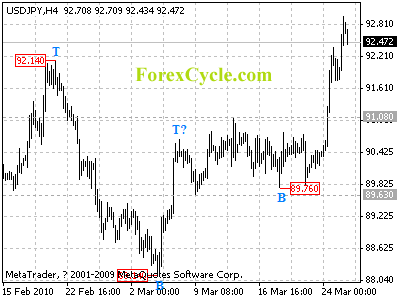
USDJPY continues its upward movement

USDJPY continues its upward movement from 89.76. One more rise towards 93.75 January high is still possible later today, however, minor consolidation would more likely be seen before breaking above this level. Support is now at 91.75, below this level will suggest that a cycle top has been formed on 4-hour chart, then sideways movement could be expected to follow.

usdjpy

Written by ForexCycle.com

Forex Daily Market Commentary

By GCI Forex Research

Fundamental Outlook at 1500 GMT (EDT + 0500)

The euro appreciated vis-à-vis the U.S. dollar today as the single currency tested offers around the US$ 1.3370 level and was supported around the $1.3285 level.  The common currency clawed back some of yesterday’s sizable losses with late Australasian activity lifting the pair from intraday lows.  People’s Bank of China Vice Governor Zhu warned “I don’t think Greece will go bankrupt because it’s still relatively small, but we don’t see decisive action that tells the market, ‘We can solve it, we can close it.”  Zhu added Spain and Italy are the “main concern today.”  European Union officials are convening today at a summit to try and shore up support for financial assistance for Greece.  Data released in the eurozone today saw the German GfK consumer confidence survey remain flat at 3.2 for April while the EMU-16 M3 money supply was off 0.4%, more-than-expected.  German Chancellor Merkel reported she will recommend a combination of International Monetary Fund assistance and bilateral aid “as a last resort” for Greece.  European Central Bank member Wellink said Portugal needs to do “additional things” to be credible while Ecofin Chairman Juncker said the markets will come to see Greece’s budget plans as “credible.” Bank of England Monetary Policy Committee member Posen said the inflation rate in the eurozone will “keep going down.”  ECB President Trichet reported the central bank will maintain its emergency collateral rules “beyond the end of 2010.”  Trichet reported Greece’s efforts to restore fiscal soundness are “convincing” and “courageous.”  The ECB’s move to maintain an easy and flexible collateral eligibility into 2011 give the central bank room to accept the debt of fiscally-troubled eurozone states as collateral.  ECB’s Nowotny reported the euro will remain an important international currency.  In U.S. news, data released today saw weekly initial jobless claims decline to 442,000 from a revised 456,000 while continuing jobless claims fell to 4.648 million from a revised 4.702 million.  Data to be released in the U.S. tomorrow include Q4 GDP and final March University of Michigan consumer sentiment.  Fed Chairman Bernanke testified today and said the “economy continues to require the support of accommodative monetary policies…However, we have been working to ensure that we have the tools to reverse, at the appropriate time, the currently very high degree of monetary stimulus…As the expansion matures, the Federal Reserve will need to begin to tighten monetary conditions to prevent the development of inflationary pressures. We have full confidence that, when the time comes, we will be ready to do so.”  The Fed will end one of its emergency mortgaged-backed securities purchase programs at the end of this month and Bernanke said the Fed does not anticipate the Fed to sell the US$ 1.43 trillion in housing debt it picked up “in the near term,” noting the Fed will likely wait “at least until after policy tightening has gotten under way and the economy is clearly in a sustainable recovery.”  The initial jobless claims data may be pointing to an improving labour sector and many economists expect the March non-farm payrolls report will evidence decent jobs growth for the first time in several months.  Euro bids are cited around the US$ 1.3335 level.

¥/ CNY

The yen appreciated vis-à-vis the U.S. dollar today as the greenback tested bids around the ¥91.75 level and was capped around the ¥92.35 level.  Bank of Japan Policy Board member Kamezaki dovishly reported “The central bank will implement policy proactively if necessary, and last week’s monetary easing was based on such a stance,” adding the BoJ will maintain an “extremely accommodative” policy.  Many dealers believe the government will continue to pressure the central bank into easing policy further to counter significant deflationary pressures.  Such moves are basically intended to boost consumer and investor sentiment and do not have an appreciable impact on the provision of liquidity.  Data released in Japan overnight saw the February corporate service price index decline 1.3% y/y.  The Nikkei 225 stock index climbed 0.13% to close at ¥10,828.85.  U.S. dollar offers are cited around the ¥94.75 level.  The euro moved higher vis-à-vis the yen as the single currency tested offers around the ¥123.20 level and was supported around the ¥122.25 level.  The British pound moved higher vis-à-vis the yen as sterling tested offers around the ¥138.00 figure while the Swiss franc moved higher vis-à-vis the yen and tested offers around the ¥86.25 level. In Chinese news, the U.S. dollar appreciated vis-à-vis the Chinese yuan as the greenback closed at CNY 6.8271 in the over-the-counter market, up from CNY 6.8267.  People’s Bank of China Deputy Governor Zhu Min reported interest rates are a “heavy-duty weapon,” adding there are other tools the central bank can use to “manage liquidity.”  Zhu also added China will wait to confirm economic growth is steady before raising rates.  Additionally, Zhu reported the yuan’s real exchange rate “has actually appreciated.”

The British pound appreciated vis-à-vis the U.S. dollar today as cable tested offers around the US$ 1.5005 level and was supported around the $1.4855 level.  Cable briefly popped above the psychologically-important US$ 1.50 figure during European dealing but traders pushed the pair back below the $1.49 figure during the North American session.  Data released in the U.K. today saw February retail sales record their largest jump since May 2008, up 2.1% m/m and 3.5% y/y.  Chancellor of the Exchequer Darling reported his latest economic growth forecast is “in line with the Bank of England forecast.”  Darling yesterday reported he plans to “reduce borrowing further.”  Darling yesterday reduced his budget deficit forecast for the next five fiscal years by £44 billion.  On the whole, Darling’s fiscal report was more proactive than expected about addressing the U.K.’s fiscal problems.  The U.K.’s 2009-2010 budget deficit is expected to total around £167 billion and be slightly less in the 2010-2011 fiscal year.  Cable bids are cited around the US$ 1.4455 level.  The euro moved lower vis-à-vis the British pound as the single currency tested bids around the £0.8895 level and was capped around the £0.8955 level.

CHF

The Swiss franc appreciated vis-à-vis the U.S. dollar today as the greenback tested bids around the CHF 1.0675 level and was capped around the CHF 1.0740 level.  The KOF Institute’s March economic forecast will be released tomorrow.  Swiss President Leuthard said the franc is “at a quite crucial level” and said it is up to the Swiss National Bank to decide whether to intervene.  Swiss National Bank Vice Chairman Jordan reiterated yesterday the central bank will work to prevent excessive franc appreciation.  Swiss National Bank President Hildebrand yesterday reported the central bank will “decisively” act against “excessive” franc strength, noting the central bank can intervene to a “very large extent.”  Swiss National Bank on Monday published its quarterly economic report today and noted it will continue to “act decisively” to prevent an “excessive” appreciation of the franc.  U.S. dollar offers are cited around the CHF 1.1180 level. The euro came off vis-à-vis the Swiss franc as the single currency tested bids around the CHF 1.4250 level while the British pound moved higher vis-à-vis the Swiss franc and tested offers around the CHF 1.6040 level.

Forex Daily Market Commentary provided by GCI Financial Ltd.

GCI Financial Ltd (”GCI”) is a regulated securities and commodities trading firm, specializing in online Foreign Exchange (”Forex”) brokerage. GCI executes billions of dollars per month in foreign exchange transactions alone. In addition to Forex, GCI is a primary market maker in Contracts for Difference (”CFDs”) on shares, indices and futures, and offers one of the fastest growing online CFD trading services. GCI has over 10,000 clients worldwide, including individual traders, institutions, and money managers. GCI provides an advanced, secure, and comprehensive online trading system. Client funds are insured and held in a separate customer account. In addition, GCI Financial Ltd maintains Net Capital in excess of minimum regulatory requirements.

DISCLAIMER: GCI’s Daily Market Commentary is provided for informational purposes only. The information contained in these reports is gathered from reputable news sources and is not intended to be U.S.ed as investment advice. GCI assumes no responsibility or liability from gains or losses incurred by the information herein contained.

People’s Bank of China Vice Governor Zhu warned “I don’t think Greece will go bankrupt because it’s still relatively small, but we don’t see decisive action that tells the market,