AUD Breaks 4 day Loss, Rises on RBA Governor’s Remarks

By Ashley Smith – The Australian Dollar ended its recent downward trend in today’s Asian and European trading, ahead of Wednesday’s Retail Sales report which is expected to shows February sales rose. The AUD was further boosted be comments made by Reserve Bank of Australia Governor Glenn Stevens hinting at further interest rate hikes. The bank has raised rates at four of its past five meetings.

Benchmark interest rates are 4%in Australia and 2.5% in New Zealand, compared with 0.1% in Japan and as low as zero in the U.S. Higher yields attract investors to the south pacific currency, along with strong economic fundamentals that support tighter monetary policy and higher interest rates. Australia’s currency rose to 91.45 U.S. cents from 90.41 cents last week in New York. It also climbed to 84.54 yen. While the U.S, U.K and Euro-Zone nations continue to exhibit mixed economic data, raising doubts as to the strength and stability of their economic recovery, Australia continues to perform consistently in par or above expectations thus providing strong ground to continued monetary tightening.

The New Zealand Dollar also gained in today’s trading, boosted by equity gains in Asia and Europe and ahead of a report that is expected to show that home building permits rose in February. New Zealand’s Dollar gained to 71.00 U.S. cents from last week and advanced to 65.53 Yen from 65.11 Yen.

Forex Market Analysis provided by Forex Yard.

© 2006 by FxYard Ltd

Disclaimer: Trading Foreign Exchange carries a high level of risk and may not be suitable for all investors. There is a possibility that you could sustain a loss of all of your investment and therefore you should not invest money that you cannot afford to lose. You should be aware of all the risks associated with Foreign Exchange trading.

Non-Farm Payrolls Week Begins

Source: Forex Yard

Last week ended with a recovery for the Euro, mainly due to speculations that the Euro-Zone will offer a bailout plan for Greece. This week’s trading will continue to be affected by the Greece debt crisis, yet the big move of the week is expected on Friday when the U.S. Non-Farm Payrolls will be released.

Economic News

USD – Dollar Continues To Strengthen Against the Majors

The Dollar’s rally vs. the majors continued on last week trading session. The Dollar reached a 10-month high against the Euro last week as the EUR/USD pair dropped to the 1.3266 level. The Dollar continued to strengthen against the Pound and Yen as well.

The Dollar rises as the U.S. economy provides more and more positive data. The Existing Home Sales report, which measures the number of residential buildings that were sold during February, rose by 5.02M. This has been the 8th month in a row that over 5 million buildings were sold. In addition, the Core Durable Goods Orders showed that the total value of new purchase orders placed with manufacturers for durable goods rose by 0.9%, beating expectations for a 0.6% rise. Yet the most significant data from last week was the weekly Unemployment Claims. The report showed that merely 442,000 individuals have filed for unemployment insurance for the first time during the past week. This has been the best result in 6 weeks, and one of the lowest amount of weekly jobless claims since the recession began.

As for the week ahead, the main news event of next week is the U.S. Non-Farm Payrolls on Friday. This report provides a very up to date data regarding the employment condition, and tends to have an immense impact on the market. Traders are also advised to follow the ADP forecast which is scheduled for Wednesday. Investors usually rely on the authenticity of this forecast, and thus this release often has a large impact on the market as well.

EUR – Euro Sees Mixed Results

The Euro began last week’s trading session with a falling trend against most of the major currencies. The Euro even reached a 10-month low against the Dollar on Thursday. However, during last Friday, the Euro managed to rebound and erased most of its losses.

Last week’s trading was once again mostly impacted by the Greece debt crisis. As the week began, it seemed that the European leaders will not agree on a rescue plan for Greece. This has reduced the already low risk appetite, and turned investors to look for safer assets. However, since Thursday concrete reports have claimed that an aid plan for Greece is about to be declared. This has boosted confidence in the region’s assets, and as a result supported the Euro as well. In addition, the German Business Climate survey has delivered a better than expected figures, mostly as a result of the weak Euro that boosted export prospects. The combination of the Greece bailout notification and the positive economic data has strengthened the Euro promptly.

Looking ahead to this week, a batch of data is expected from the Euro-Zone. Traders should first and for most follow any development regarding the Greece debt crisis. This issue is likely to continue affecting the Euro for the near future. In addition, traders should take under consideration that a final bailout plan is likely to boost the Euro.

JPY – Yen Looks to Bounce Back after Last Week’s fall

The Japanese Yen lost ground against its major rivals last week. The loss was uncharacteristic, as concern throughout global markets, which generally boosts the Yen did the exact opposite. Local economic news also failed to inspire a rise in the JPY as it gave up roughly 3% against the USD, EUR and GBP. Though not a significant loss, the lack of correlation to risk aversion could force traders to hesitate with JPY investments.

The JPY was static as it returned to trading early Monday morning. Positive retail sales numbers did not have much affect as the currency stayed close to closing prices at 92.60 to the dollar and 138.25 to the pound.

This week, should provide some movement throughout the major pairs, as the market gears up for Non-Farm Payrolls, and another week of heated debate over the US Healthcare reform and its effect on all markets. Local news from Japan should provide some movement for the JPY after the release of Wednesday’s Tankan Manufacturing Index. Forecasts look for growing improvement in the figure, as last months score of -24 was the highest in over two and a half years.

Oil – Oil Consolidates Around $80 a Barrel

Last week’s trading proved one thing, $80 a barrel is a stabile price for crude oil. Crude began last week with a rising trend that peaked at $82.15 a barrel. However as the week progressed, crude oil saw several ups and downs, which took oil back to around $80 a barrel.

It seems that the reduction in the fourth quarter U.S. Gross Domestic Product has added to concerns that growth in fuel demand could slow. There are currently worries regarding the strength of the U.S. economy, which turns investors to look for safer assets than crude oil. It currently seems that crude oil will fail to reach above $83 a barrel unless concrete data will prove that the U.S. recovery pace is steady.

As for the following week, traders are advised to follow the main publication from the U.S. economy, especially the Non-Farm Payrolls on Friday, as they tend to impact crude oil the most. Traders should also follow the U.S. Crude Oil Inventories as this report has proven to have an imminent impact over the market.

Technical News

EUR/USD

The pair may be experiencing a downward trend today as the 2 hour and 4 hour RSI are heading into the overbought territory and with a bearish cross evident on the 8 hour chart’s Slow Stochastic. The daily RSI, however, is floating near the oversold territory. Going short with tight stops might be advised for today.

GBP/USD

The indicator’s for the pair are floating in neutral territory as the pair seems to be range trading between 1.4900 and 1.4960. Waiting on a clearer direction for the pair may be advised for today.

USD/JPY

The pair may be experiencing a downward correction today as the 4 hour, 8 hour and daily RSI are floating in the overbought territory while a bearish cross is evident on the hourly and daily charts’ Slow Stochastic. Furthermore, there is a breach of the upper Bollinger Band evident on the daily chart. Going short for today may be a good option.

USD/CHF

The pair may experience a slight downward movement today as a bearish cross is evident on the hourly chart’s Slow Stochastic, indicating an imminent downward movement. Going short with tight stops may be advised for today.

The Wild Card

USD/MXN

The hourly and 2 hour charts’ RSI is floating in the oversold territory, indicating an expected an expected upward movement. Furthermore, a bullish cross is evident on the 4 hour chart’s Slow Stochastic. Forex traders may be advised to go long for the day.

Forex Market Analysis provided by Forex Yard.

© 2006 by FxYard Ltd

Disclaimer: Trading Foreign Exchange carries a high level of risk and may not be suitable for all investors. There is a possibility that you could sustain a loss of all of your investment and therefore you should not invest money that you cannot afford to lose. You should be aware of all the risks associated with Foreign Exchange trading.

Forex Weekly Market Review March 29th, 2010

By eToro – The slow grinding increase in the equity markets continued this week as did the strength of the US dollar.  Over the past few weeks the strong correlation that seem to grip the currency and equity markets has now dissipated as the dollar has now become the currency of choice give the fiscal issues that have plagued the European Monetary Union.  For the week, the S&P 500 Index closed up higher by 1% at 1166.  For the past 4 weeks the Dow Jones Industrials, the S&P500 Index and the NASDAQ have all closed higher.

EU – The Bailout of Greece and Euro Weakness

The divergence of opinions with regards to Greece, has created strife in the marketplace as the ECB President Jean-Claude Trichet has made public comment as late as Thursday, that the IMF has no place in deciding how any European country should handle its fiscal issues.  This news came right before the EU agreed to a plan that would set up a safety net for Greece.  Trichet’s comments are directly opposite to the current opinion of Germany and France who have made the IMF involvement a condition of their participation in so called bailout of Greece.  Trichet also flip flopped on the issue of collateral.  The extension of the relaxed collateral rules is an important issue, even if lower quality paper gets a bigger haircut.  The size of the haircuts will be the main market focus of the next ECB meeting on April 8th.   These relaxed collateral rules, some argue, is tantamount to some easing of monetary policy.  The uncertainty comes on the back of a downgrade by Fitch which lowered Portugal’s sovereign credit rating one notch to AA- and warned of further cuts unless the government changes its fiscal course.  The cumulative effect on the currency has been dramatic.  Volatility in the Euro market has been relatively high with multiple day ranges.  During the course of the week, the Euro currency vs. the US dollar broke through support levels at 1.3400, and touched a low of 1.3267, before retracing some of the losses for the week (which opened near 1.36).  After the news that the EU would create a backstop for Greece, the Euro began to rally. Technically, the breakthrough along with the uncertainty created by multiple debt issues within the EU has formed a resistance level for the Euro, which could lead to additional selling near 1.3450.

1

Deflation in Japan

Meanwhile, the deflationary grip on Japan continues.  Headline CPI in February was 1.1% below year ago levels, the same pace as recorded in January.  The Core CPI (ex food and energy) figure was slightly higher than expected but still negative for a year in a row.  This follows Thursday’s report of a slightly larger than expected decline in corporate service prices.  The corporate service price index fell 1.3% year over year in February and the January series was revised down to -1.2% from -1.0%.  The Bank of Japan expects deflation to persist through the next fiscal year.  Of the 525 items tracked by the CPI basket, 335 fell in February compared with January when prices for 342 items fell.   The Japanese finance ministry has been persistent in pushing the BOJ to enhance its quantitative easing measures in an effort to stem further deflation.  Eventually, this will spill over into growth and create further downward pressure on the Japanese economy.

UK – Inflation Easing

In the UK, inflation data is beginning to ease after a couple of months of upward pressure.  The pace of inflation for February released this week was slightly lower than expected and BOE Governor King did not have to write an explanatory letter to the government as he was obliged to do in December and January.  The headline CPI rose 0.4%, slightly less than the market expected.  The year-over-year rate slipped for the first time since last September (3.0% vs. 3.5% in January).  Core inflation, which in the UK excludes energy, food, alcohol and tobacco, slowed to 2.9% from 3.1%.  Core measures of inflation have been generally tame in developed countries with the UK being the exception recently.  The ease in inflation will only help the BOE and allow for further quantitative easing if the economy stumbles.  Additionally, the easing of inflation expectations shifted bids pressure on the pound.  Technically, the pound faces a moving average crossover which is relatively bearish for the currency.

2

US – Bernanke speech, Housing prices, GDP

In a speech at a House hearing, Federal Reserve Chairman Ben Bernanke acknowledged that the Federal Reserve is closer to selling some of its $1.25 trillion portfolio of mortgage securities.  Chairman Bernanke has resisted this idea in the past because millions of U.S. homeowners and many investors would be affected by Federal Reserve sales which would push down prices and increase Mortgage rates.  This is Bernanke’s way of preparing the market for a normalization process.  “I anticipate that at some point we will, in fact, have a gradual sales process,” Chairman Bernanke said at a House hearing. The Fed has been purchasing mortgage-backed securities in an effort to stimulate the housing market with lower mortgage rates.

In US housing economic news, Sales of existing homes fell a third time in a row during February, but the decline was less than expected, spurring hope for a turnaround in the spring. Home re-sales tumbled by 0.6%, to a 5.02 million annual rate from an unadjusted 5.05 million in January, according to the National Association of Realtors.  Economists surveyed expected sales last month to decrease 2.0%, to a rate of 4.95 million.  The median price for an existing home was $165,100 in February, down 1.8% from February 2009.  The housing market has continued to show conflicting signals but the majority of the economic news has shown a market that is slow to recover.

Growth in the U.S. economy at the end of 2009 was slightly less than earlier estimates, according to the Commerce Department, mainly due to downward revision to consumer and business spending.  Gross domestic product rose at a 5.6% annual rate October through December, the Commerce Department reported Friday in its third GDP estimate for the final quarter of 2009.  Corporate profits climbed 8.2% in the fourth quarter, lower than the 13.8% surge in the third quarter. Year-over-year, earnings were up 51.8%.

321

Next week that market will be focusing on a plethora of economic data.  On Monday the EMU will release consumer confidence, expectations are for an index level of -17 compare to last month’s -17.  Later on Monday the US will release Personal Income and Consumption.  On Tuesday, market participants will focus on the UK GDP, US Consumer Confidence and Japanese PMI Manufacturing.  On Wednesday, Australian Retail Sales and EMU Employment take the headlines, along with the ADP Employment number.  Thursday is purchasing manager’s day, with the UK, EMU and US ISM all being released.  The big number for the week is Friday’s US Employment number.  Analysts expect a positive reading of 187 thousand jobs, which would be the first increase in more than a year.

Daily Forex Market Analysis provided by eToro

Disclaimer: Trading in the Foreign Exchange market might carry potential rewards, but also potential risks. You must be aware of the risks and are willing to accept them in order to trade in the foreign exchange market. Don’t trade with money you can’t afford to lose.

© 2009 eToro Blog.

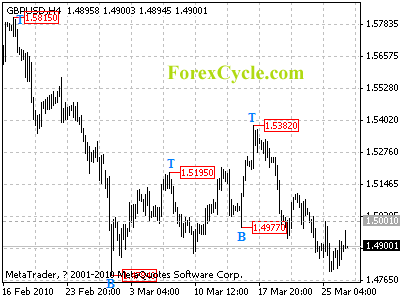
GBPUSD bounced from 1.4798

Being contained by 1.4784 previous low support, GBPUSD bounced from 1.4798. suggesting range trading between 1.4784 and 1.5001 is underway. However, the price action in the trading range is more likely consolidation of downtrend from 1.5382, another fall towards 1.4500 is possible after consolidation. On the other side, above 1.5001 resistance may suggest that a cycle bottom has been formed on 4-hour chart, then further rally could be seen to 1.5080 or even higher.

gbpusd

Daily Forex Signals

USDJPY bounced sharply to 92.95

After breaking above the trading range between 89.63 and 91.08, USDJPY bounced sharply to as high as 92.95 level, suggesting that the rise from 88.14 could possibly be resumption of uptrend. Further rally to test 93.75 key resistance is expected next week, a break above this level will indicate that the pair is in a longer term uptrend from 84.82, then another rise towards 100.00 could be seen.

For long term analysis, USDJPY formed a cycle top at 93.75 level on weekly chart. However, the fall from 93.75 is more likely consolidation of uptrend, another rise towards 100.00 area would more likely be seen in next several weeks.

usdjpy

usdjpy

Weekly Forex Forecast

Forex Trading Analysis – US Dollar Index Going Higher?

By Adam Hewison – It has been a while since we looked at the dollar index, so today we decided to dissect this market and look at it step-by-step.

What is happening in this market is very interesting and I think you will see in this short video just what we have in mind.

As always, our videos are free to watch and there are no registration requirements. Do you agree with my analysis of the dollar index? Leave a comment and let us know what you see

Watch the New Video Here…

All the best,

Adam Hewison
President, INO.com
Co-creator, MarketClub

To see more of Adam’s Videos click here or sign up for Adam’s Free 10-part Professional Trading Course.

Forex Daily Market Commentary

By GCI Forex Research

Fundamental Outlook at 1500 GMT (EDT + 0500)

The euro appreciated vis-à-vis the U.S. dollar today as the single currency tested offers around the US$ 1.3405 level and was supported around the $1.3265 level.  The common currency has been quite volatile for weeks on account of uncertainty regarding financial assistance for Greece.  Ecofin ministers convened last night and today and an aid package for Greece was formally agreed to involving both financial assistance from the European Union via bilateral loans and the International Monetary Fund.  Late last night, European Central Bank President Trichet said IMF involvement would be “very, very bad” whereas today he indicated he was “happy” with the results.  Greek Prime Minister Papandreou reported Greece will sell more debt at an “opportune time.”  The Greek aid package was structured so that Greece can tap the credit facilities if required but it is possible that Greece may never need to utilize these facilities.  Achieving a European  consensus on this issue was difficult but was facilitated by agreement between Germany and France.  Attention will now shift to fiscal woes in Portugal, Spain, and Italy.  Data released in France today saw March consumer confidence worsen to -34 from the prior reading of -33.  In U.S. news, data released today saw revised Q4 gross domestic product print at +5.6% from the prior reading of +5.9% while the GDP price index ticked higher to +0.5% from +0.4%.  Also, the Q4 core personal consumption expenditures index increased 1.8% q/q from the prior reading of +1.6% q/q.  Final March University of Michigan consumer sentiment printed at 73.6, up from the prior reading of 72.5.  Personal income and spending data and PCE numbers will be released on Monday.  Traders are paying very close attention to rising U.S. Treasury yields.  The 10-year Note is now yielding right around the 3.90% level and some economists believe the rate will move significantly higher to the 4.30% level.  The Federal Reserve will continue to normalize monetary policy in the coming quarters.  Fed Chairman Bernanke yesterday reported “restoring the size and composition” of the Fed’s record US$ 2.32 trillion balance sheet to a “more normal configuration” is a long-term policy goal.  Similarly, St. Louis Fed President Bullard added “We want to someday get back to a pre-crisis balance sheet – both the size of it and the fact that it would be an all-Treasuries balance sheet.” Euro bids are cited around the US$ 1.3335 level.

¥/ CNY

The yen depreciated vis-à-vis the U.S. dollar today as the greenback tested offers around the ¥92.80 level and was supported around the ¥92.30 level.  Data released in Japan overnight reinforced the view that deflation remains a serious problem in Japan.  First, Tokyo-area headline consumer price inflation was off 1.8% y/y with the ex-food and energy component off 1.2% y/y.  Second, nationwide consumer price inflation at the headline level was off 1.1% y/y and off 1.1% y/y at the ex-food and energy core level.  These data suggest deflation will remain a problem in Japan through 2011.  Bank of Japan’s Policy Board is likely to keep a very accommodative monetary policy for several more business quarters.  New Policy Board member Miyao reported “Lowering interest rates even a little bit, or keeping interest rates at very low levels amid a recovery, may be able to provide more stimulus and help sustain economic growth…it is important for the central bank to maintain its accommodative policy stance and provide monetary support for companies and households…the economy has been picking up recently, but incomes and employment remain in a severe state, and there are various risks and uncertainties to the outlook.”  The three-month euroyen futures rate is trading around 0.439% with the December 2010 rate currently trading at 0.380%, evidencing a lower market bias on interest rates through the end of the year.  The Nikkei 225 stock index climbed 1.55% to close at ¥10,996.37.  U.S. dollar offers are cited around the ¥94.75 level.  The euro moved higher vis-à-vis the yen as the single currency tested offers around the ¥124.15 level and was supported around the ¥122.95 level.  The British pound moved higher vis-à-vis the yen as sterling tested offers around the ¥137.95 level while the Swiss franc moved higher vis-à-vis the yen and tested offers around the ¥86.80 level. In Chinese news, the U.S. dollar depreciated vis-à-vis the Chinese yuan as the greenback closed at CNY 6.8270 in the over-the-counter market, down from CNY 6.8271. China announced it will launch stock index futures trading from 16 April on the CSI 300 Index.  Traders are focusing on a report from the U.S. due on 15 April that may possibly label China as a currency manipulator.  Some observers suggest a major trade war might develop if China is labeled a currency manipulator by the Obama administration.  People’s Bank of China advisor Fan Gang said the central bank may adopt a managed float of the yuan currency.

The British pound appreciated vis-à-vis the U.S. dollar today as cable tested offers around the US$ 1.4890 level and was supported around the $1.4805 level.  Data released in the U.K. today saw Q4 total business investment off 4.3% q/q and 23.5% y/y.  Chancellor of the Exchequer Darling this week reported his latest economic growth forecast is “in line with the Bank of England forecast.”  Darling said he plans to “reduce borrowing further” and reduced his budget deficit forecast for the next five fiscal years by £44 billion.  On the whole, Darling’s fiscal report was more proactive than expected about addressing the U.K.’s fiscal problems.  The U.K.’s 2009-2010 budget deficit is expected to total around £167 billion and be slightly less in the 2010-2011 fiscal year.  Cable bids are cited around the US$ 1.4455 level.  The euro moved higher vis-à-vis the British pound as the single currency tested offers around the £0.9025 level and was supported around the £0.8955 level.

CHF

The Swiss franc appreciated vis-à-vis the U.S. dollar today as the greenback tested bids around the CHF 1.0675 level and was capped around the CHF 1.0745 level.  The Swiss KOF Research Institute upgraded its 2010 and 2011 economic growth forecasts for the Swiss economy today to 1.7% and 2.2%, respectively. Consumer price inflation is expected to be around 0.9% and 1.0%, respectively – also an upgrade from previous forecasts.  Swiss President Leuthard yesterday said the franc is “at a quite crucial level” and said it is up to the Swiss National Bank to decide whether to intervene.  Swiss National Bank Vice Chairman Jordan reiterated this week that the central bank will work to prevent excessive franc appreciation.  Swiss National Bank President Hildebrand this week reported the central bank will “decisively” act against “excessive” franc strength, noting the central bank can intervene to a “very large extent.”  Swiss National Bank on Monday published its quarterly economic report this week and noted it will continue to “act decisively” to prevent an “excessive” appreciation of the franc.  U.S. dollar offers are cited around the CHF 1.1180 level. The euro moved higher vis-à-vis the Swiss franc as the single currency tested offers around the CHF 1.4310 level while the British pound moved lower vis-à-vis the Swiss franc and tested bids around the CHF 1.5825 level.

Forex Daily Market Commentary provided by GCI Financial Ltd.

GCI Financial Ltd (”GCI”) is a regulated securities and commodities trading firm, specializing in online Foreign Exchange (”Forex”) brokerage. GCI executes billions of dollars per month in foreign exchange transactions alone. In addition to Forex, GCI is a primary market maker in Contracts for Difference (”CFDs”) on shares, indices and futures, and offers one of the fastest growing online CFD trading services. GCI has over 10,000 clients worldwide, including individual traders, institutions, and money managers. GCI provides an advanced, secure, and comprehensive online trading system. Client funds are insured and held in a separate customer account. In addition, GCI Financial Ltd maintains Net Capital in excess of minimum regulatory requirements.

DISCLAIMER: GCI’s Daily Market Commentary is provided for informational purposes only. The information contained in these reports is gathered from reputable news sources and is not intended to be U.S.ed as investment advice. GCI assumes no responsibility or liability from gains or losses incurred by the information herein contained.

Forex Free Video Lesson – Tips From a Pro: How To Trade Fx With Elliott Wave

Watch Jim Martens, Senior Currency Strategist at Elliott Wave International, the world’s largest market forecasting firm, give tips on how to trade forex with Elliott wave analysis – free.

By EWI – The U.S. dollar is the current center of the global financial community’s attention, and it will likely stay in the spotlight for a while. That could be good for the forex market – and you, a forex trader.

Already the largest and most liquid market on the planet – with the daily volume ten times larger than the combined daily turnover on all of the world’s stock exchanges – recent focus on the dollar is likely to attract even more currency speculators. And that means even more volume and liquidity – a nimble trader’s paradise.

Winning in forex is not easy. You need skill, discipline – and sometimes, just pure luck. You also need a method. You may have heard that Elliott wave analysis is something many forex traders use. It’s true; wave analysis is not a crystal ball, but it helps you accomplish three crucial goals: Identify the trend, stay with it, and get out when the trend is likely over.

Elliott Wave International’s website gives you multiple resources that teach you Elliott. Of course, nothing helps you learn faster than watching a good teacher. That’s why you don’t want to miss this free opportunity to learn from one of the best forex Elliotticians out there.*

Your FREE Video Lesson: How To Trade Forex With Elliott Wave
What you are about to see is a condensed, 20-plus-minute version of Jim Martens’ live course on trading with Elliott to an audience of independent investors in Denver, CO, recorded in early November 2007. Here’s what you’ll learn:

  • At its core, Elliott wave analysis is simple. Watch Jim explain why.
  • What Elliott waves are best for trading forex?
  • How do I identify trade setups?
  • At what point in a wave pattern do I enter a trade?
  • How do I manage risk with Elliott? Etc.

Your FREE Report: Take Advantage of News Using Elliott Wave Analysis
If you’ve ever felt you could be better at trading forex around economic report releases, this is a must-read. The Forex Journal, one of the premiere forex trading magazines, recently selected this report by Jim Martens as the main feature and cover page.

Join Club EWI to gain access to your Forex video and report, FREE! It takes just 30 seconds. Club EWI is the world’s largest Elliott Wave Community with more than 125,000 members. It only takes a minute to sign up and it’s absolutely free.

*Who is Jim Martens?
Jim Martens was first introduced to the Wave Principle in 1985. Since then, he’s built an impressive resume, having worked for such firms as Bank of New York and Nexus Capital Limited, a George Soros-affiliated hedge fund. Since 2005, Jim has been Elliott Wave International’s senior forex analyst – and one of the best teachers of the method.

S&P Futures Fluctuate as Markets Digest EU News

By Fast Brokers – The S&P futures are fluctuating within yesterday’s trading range as investors digest the EU’s resolution for Greece.  As implied earlier this week, the EU decided to offer Greece financial assistance in cooperation with the IMF should Greece be unable to raise funds in the open market.  Unfortunately, FX markets seem unimpressed thus far with the EUR/USD currently relinquishing a predominant portion of its intraday gains.  Additionally, intraday highs don’t appear to be a tide turner, meaning momentum remains to the downside.  Meanwhile, the Aussie is experiencing a hefty pullback, and the once resilient currency pair appears to be finally joining in on the risk averse flows.  However, we will need to see how the session plays out and whether the Euro is able to recover and piece together some meaningful gains.  As for the U.S., Final GDP printed 3 basis points below analyst expectations, overcastting yesterday’s encouraging decline in Unemployment Claims.  Revised UoM Consumer Sentiment came in a hair above analyst expectations, creating an overall mixed picture today data-wise.  Speaking of data, the wire is finished for the week and next Monday will be relatively quiet.  Hence, markets may continue their present momentums as trading kicks off on Monday, barring any significant psychological developments.  That being said, investors should continue to monitor the news wire for any important headlines that could have a psychological impact on equities or the Dollar.

Technically speaking, the S&P futures face topside technical barriers in the form of 3/25 highs and the psychological 1075 level.  Additionally, the psychological 1200 level could serve as a solid technical barrier should it be tested.   As for the downside, the S&P futures have multiple uptrend lines serving as technical cushions along with 3/24 and 3/22 lows.  Additionally, the psychological 1150 level could serve as a solid technical cushion should it be tested.

Price: 1165.50
Resistances: 1168.73, 1170.46, 1172.19, 1174.72, 1176.45
Supports: 1163.39, 1162.17, 1160.87, 1158.99, 1157.48
Psychological: 2010 highs, 1150, 1175, 1200

(click chart to enlarge)

Market Commentary provided by Fast Brokers.

Disclaimer: FastBrokers’ market commentary is provided for information purposes only and under no circumstances should be regarded neither as an investment advice nor as a solicitation or an offer to sell/buy any financial product. FastBrokers assumes no responsibility or liability from gains or losses incurred by the information herein contained.

Risk Disclosure: There is a substantial risk of loss in trading futures and foreign exchange. Please carefully review all risk disclosure documents before opening an account as these financial instruments are not appropriate for all investors.

AUD/USD Drops Below Key Uptrend Line

By Fast Brokers – The Aussie has dropped below its uptrend line running through 2/26 lows, or the .89 area.  Hence, the Aussie appears to have finally made a key retracement after holding strong for so long despite large risk-averse flows resulting from fiscal issues in the EU.  The currency pair is quickly dropping towards its highly psychological .90 level, which could prove to be a solid technical cushion for the near-term.    Investors are reacting negatively to RBA Governor Stevens’ public address today.  Although Stevens didn’t make comments directly pertaining to the RBA’s policy in particular, his outlook regarding Western developed countries was far from picturesque.  Governor Stevens warned that risk premiums could continue to rise as nations struggle to reduce their respective fiscal deficits.  Hence, it appears Stevens is bothered by recent deteriorations in the EU, implying that the RBA could keep its interests rates unchanged at the next RBA meeting.   Govern Stevens’ somber outlook is dragging the Aussie lower, meaning the currency pair could participate more fully in broad-based moves in the risk trade over the near-term.  That being said, the data wire is relatively quiet on Monday, suggesting that current momentums could continue to play out barring a key psychological development.

Technically speaking, the Aussie has 3/3 and 3/ 4 lows serving as technical cushions along with the highly psychological .90 level should it be tested.  As for the topside, the Aussie faces multiple downtrend lines along with intraday and 3/25 highs.  Additionally, the psychological .91 level could serve as a technical barrier should it be tested.

Price: .9040
Resistances: .9045, .9053, .9073, .9087, .9101, .9110
Supports: .9032, .9023, .9011, .8994, .8981, .8974
Psychological: .90, .91, March Lows

(click chart to enlarge)

Market Commentary provided by Fast Brokers.

Disclaimer: FastBrokers’ market commentary is provided for information purposes only and under no circumstances should be regarded neither as an investment advice nor as a solicitation or an offer to sell/buy any financial product. FastBrokers assumes no responsibility or liability from gains or losses incurred by the information herein contained.

Risk Disclosure: There is a substantial risk of loss in trading futures and foreign exchange. Please carefully review all risk disclosure documents before opening an account as these financial instruments are not appropriate for all investors.