Consumer Confidence increases in March Survey. US House Prices edge higher.

By CountingPips.com

Consumer confidence rose more than expected in March after decrease in February, according to a report released today by the Conference Board, which produces the Consumer Confidence Index. In a survey of 5,000 households, the index showed that consumer confidence increased by 6.1 points from 46.4 in February to a standing at 52.5 in March. The Expectations index also rose in March to 70.2 from 62.9 in February while the Present Situation index advanced from 21.7 in February to 26.0 in March.

Market forecasts were expecting consumer confidence to rise to a 51.0 score for the month.

The Director of the Conference Board Consumer Research Center Lynn Franco talked about the newest survey saying, “Consumer confidence, which had declined sharply in February, managed to recoup most of the loss in March. However, despite this month’s increase, consumers continue to express concern about current business and labor market conditions. And, their outlook for the next six months is still rather pessimistic. Overall, consumer confidence levels have not changed significantly since last spring.”

U.S. house prices see small gain in January

Home prices in the U.S. improved in January to show a small increase for the eighth straight month, according to the Standard & Poors/Case-Shiller Home Price Index released today. The S & P’s/Case-Shiller Index measures sales prices of existing single-family homes in major cities nationally. The report showed that the 20-city composite index increased by 0.3 percent in January on seasonally adjusted basis after a similar 0.3 percent increase in December. On an annual basis, the 20-city composite fell by 0.7 percent in January from the January 2009 level.

David M. Blitzer, Chairman of the Index Committee at Standard & Poor’s, commented on the report saying, “The report is mixed. While we continue to see improvements in the year-over-year data for all 20 cities, the rebound in housing prices seen last fall is fading. Fewer cities experienced month-to-month gains in January than in December 2009, on both a seasonally adjusted and unadjusted basis.”

Los Angeles and San Diege led the unadjusted price gains in January with rise of 0.9 percent and 0.4 percent, respectively. Portland (-1.8%), Seattle (-1.7%) and Chicago (-1.7%) saw the largest price declines in January.

On an annual basis, San Francisco house prices have increased the most since January 2009 with a 9.0 percent advance with San Diego coming in next with a 5.9 percent rise. On the downside, Las Vegas remained the only area with a double digit annual decline at -17.9 percent annually while Detroit and Tampa were next in line with declines of 7.4 percent each.

Gold Trading: Why gold will not make new highs or lows this year

By Adam Hewison – Gold has had some dramatic moves in the last eighteen months and we expect it will have some equally dramatic moves in the future, but not right now.

Watch the New Video Now…

While I recognize that gold is one of the few commodity markets that people are really passionate about; the purpose of this article is not to take sides either with the gold bugs or those who reject the argument that gold is forever.  Rather, I want to discuss my interpretation of the markets cycle.

After spot gold made an all-time high against the dollar on December 2 at $1,226.37, gold has been in retreat mode. For the for the past several months gold has been in a broad trading range, seemingly unable to move one way or another. This process has created frustration from bulls and bears alike.

Here is the dirty little secret about the gold market. It can be a horrible investment and here’s why:

Gold first started trading in the 80s while I was on the floor of the Chicago Mercantile Exchange in Chicago as a member of the International Monetary Market, (IMM) which was at that time a division of the CME now the CME Group.  When gold opened up the public clamored to buy into the gold futures market and guess who sold it to them? Thats right it was the pros- the guys who made their living trading. As a result, gold hit an all-time high of around $850 an ounce back then and it took almost 25 years for gold to move over that level, at least in dollar terms. I dont know what your timeline is, but 25 to 30 years is an awful long time to get even again.

So what is really happening in this market?

Everyone is aware of the problems in Europe with Greece, Portugal and a host of yet to be named countries. We all know that the huge amount of money being printed, coupled with the bank failures abroad contribute to the dollars declining value. These events, in conjunction with the American governments actions, also contribute to the devaluation of the dollar. The government claims that this is beneficial to exports, but the bottom line is that the purchasing power of the American dollar continues to erode in world markets.

Based on the declining value of world currency against gold you might ask- why isnt gold trading at $2,000 or even $3,000 an ounce? What is wrong with this market? This is because a great deal of what goes into the gold market is psychological and reacts to cyclic trends driven by both psychological and economic factors.

So what does all this have to do with the price of gold now? It has everything to do with gold and nothing to do with gold.

Here is what I’ve been able to observe in the last several years in gold and seems to be holding true.  It is something that you should pay attention to if you’re interested in the next big move in the gold market.

Before gold can move higher it needs to create what I call an “energy field”.  The most recent energy fields in gold were between May 12, 2006 and September 20, 2007. This 17 month energy field saw gold prices oscillate between a broad trading range bound by $730.08 (upside) and $541.80 (downside).  That energy field produced enough power to propel gold to the new high of $1,012.40 on March 17, 2008. This marked the first time gold exceeded, in dollar terms, the highs set in the early 80s mentioned earlier.

The energy fields I have observed for gold are taking somewhere between 17 and 18 months to complete. If the energy field holds, then the December 3rd 2009 high of $1,226.37 should remain in place for quite some time. If the same cycle remains true then the recent lows that we witnessed, at $1,050, should also remain intact as they represent the 15 to 16 month cycle low.

With the lows in place the next question becomes when is the next cyclical high in gold? Based on the existing cycle, we can expect the next major gold high in 2011.

To summarize: I expect gold to be locked in a broad trading range for the next 12 months bounded by the December 09 highs of 1,226.37 and the lows of $1,050.00. If the gold cycle holds true, we expect that gold tops the $1,226.37 marker by April or May of 2011.

On the on the upside we will also be looking for gold to make a nature cyclic high in October or November of 2011. It’s impossible to predict the future with any degree of accuracy; however when we look at the cycles in gold this reads as a pretty good bet.

No matter what happens we expect gold will offer some great trading opportunities that investors and traders should be able to take advantage of.

Watch the New Gold Video Here…

As I always discuss- in trading one should approach gold or any other market with a game plan and proper money management stops. The key to success in this decade will be an investors willingness to move in and out of asset classes such as gold and be well diversified into more than one asset class. That way you wont be left holding the bag for the next 25 years. Our World Commodity Portfolio is a good example of this approach and one I believe will serve investors well in the coming years.

All the best,
Adam Hewison
President, INO.com
Co-creator, MarketClub

Volatility for Sterling Forecasted Following UK Indicators

Source: Forex Yard

Sterling traders can expect a busy trading day today as the U.K Nationwide HPI and Current Account reports are likely to shake up the market. The reports, scheduled for 06:00 GMT and 08:30 GMT respectively, may provide the Pound with the necessary momentum to make gains on both the U.S. Dollar and Euro.

Economic News

USD – Consumer Confidence Report May Lead to USD Gains

The CB Consumer Confidence Survey, set to be released at 14:00 GMT today, will likely lead to heavy trading among USD pairs. The survey asks 5000 respondents to rate how they perceive the current and future economic climate in the United States. This month’s survey may prove to be more important than others, largely due to the fact that the American unemployment levels are forecasted to improve in the near future. An increase in consumer confidence combined with solid employment figures will likely lead to significant Dollar gains.

Analysts are forecasting a figure of around 50.2 for the Consumer Confidence report. This would mark a pronounced increase over last month’s figure of 46.0, and may signal a real turning point in the U.S. economy. Traders can expect USD to rise against its major counterparts, providing the predictions come true. That being said, an unexpected drop in consumer confidence would likely hurt the Dollar, and could signal a bearish trend for the rest of the week.

Looking further ahead, traders are reminded to pay careful attention to the U.S. Non-Farm Employment Change figure set to be released on Friday. This is one of the most critical U.S. economic indicators, and it consistently creates heavy market volatility.

EUR – European Market Set For Volatile Day

Several British economic indicators are likely to lead to heavy trading in the European Market today. The Nationwide Housing Price Index, (HPI), is a leading indicator of the health of the U.K. housing industry. With the British economy largely sagging over the last few months, a positive result from this report may signal the turning point traders are looking for. Additionally, the Current Accounts report, which indicates the difference in value for imported and exported goods and services, is widely seen as a leading market indicator.

While the HPI is forecasted to show positive gains in the British housing market, the Current Accounts will likely be unchanged from last month. Traders will want to pay attention to both reports, as any positive news out of Europe will likely lead to risk taking among investors. This would likely lead to gains for both the Euro and Pound against the safe haven currencies.

JPY – Number of Indicators Set to Impact Yen Today

While the Yen has been trading with mixed results against its major counterparts as of late, today’s British and American economic reports will likely lead to a more stable direction for the Japanese currency. Providing the British Current Accounts report remains unchanged from last month as forecasted, investors will likely shy away from risk taking. This could boost the safe haven Yen in afternoon trading. This sentiment could be reinforced if the U.S. Consumer Confidence survey comes in line with expectations.

That being said, traders should be warned that any unexpected results from either indicator may cause risk taking, likely leading to the Yen falling. With no significant JPY news events scheduled for today, it appears the Yen will have to rely on external indicators for its direction in trading.

Crude Oil – Crude Prices May Drop Following British Reports

While Crude Oil prices have been fluctuating quite heavily as of late, a decrease in risk sentiment among investors may lead to a prolonged downtrend. Investors are likely to be turned off from risk taking depending on the outcomes of both British reports set to be released today. Additionally, if USD receives a boost due to the Consumer Confidence report, traders are warned that the price of oil may drop.

Of course, any trend that oil takes today may change drastically after Wednesday’s U.S. Crude Oil Inventories report. Traders should be aware that if the inventory comes in below expectations, the price of crude will likely rise in afternoon trading.

Forex Market Analysis provided by Forex Yard.

© 2006 by FxYard Ltd

Disclaimer: Trading Foreign Exchange carries a high level of risk and may not be suitable for all investors. There is a possibility that you could sustain a loss of all of your investment and therefore you should not invest money that you cannot afford to lose. You should be aware of all the risks associated with Foreign Exchange trading.

Fibonacci Techniques for Math Geeks — and Everyone Else, Too

By Editorial Staff

The word Fibonacci (pronounced fib-oh-notch-ee) can draw either blank stares or an enthusiastic response. There’s hardly any in-between ground. But for those who ask how an esoteric mathematical relationship can apply to price charts and trading, here’s a quick lesson. Everyone who uses Elliott wave analysis will sooner or later want to try using Fibo techniques, and Elliott Wave International’s Jeff Kennedy has written about five of them in a Trader’s Classroom column. For an example of why people are so fascinated by Fibonacci, read part of Kennedy’s article here:

* * * * *

How to Apply Fibonacci Math to Real-World Trading
Have you ever given an expensive toy to a small child and watched while the child had less fun playing with the toy than with the box that it came in? In fact, I can remember some of the boxes I played with as a child that became spaceships, time machines or vehicles to use on dinosaur safaris.

In many ways, Fibonacci math is just like the box kids enjoy playing with imaginatively for hours on end. It’s hard to imagine a wrong way to apply Fibonacci ratios or multiples to financial markets, and new ways are being tested every day. Let’s look at just some of the ways I apply Fibonacci math in my own analysis.

Fibonacci Retracements
Financial markets demonstrate an uncanny propensity to reverse at certain Fibonacci levels. The most common Fibonacci ratios I use to forecast retracements are .382, .500 and .618. On occasion, I find .236 and .786 useful, but I prefer to stick with the big three. You can imagine how helpful these can be: Knowing where a corrective move is likely to end often identifies high-probability trade setups (Figures 7-1 and 7-2).

figure 7-1

figure 7-2

Kennedy then goes on to explain Fibonacci extensions, circles, fans and time, using 11 charts to show what he means. Whether or not you are a math geek, you can learn a lot from this six-page introduction to Fibonacci math.

Get Your Fibonacci Techniques Right Here. Jeffrey Kennedy has been using and teaching these techniques for years, and he has written a quick description of five Fibonacci techniques in his Trader’s Classroom column — now available to you for free by signing up as a Club EWI member. Read more about the 6-page report here.

Elliott Wave International (EWI) is the worlds largest market forecasting firm. EWIs 20-plus analysts provide around-the-clock forecasts of every major market in the world via the internet and proprietary web systems like Reuters and Bloomberg. EWIs educational services include conferences, workshops, webinars, video tapes, special reports, books and one of the internets richest free content programs, Club EWI.

FOREX: AUD/USD climbs back over 0.9150

By CountingPips.com

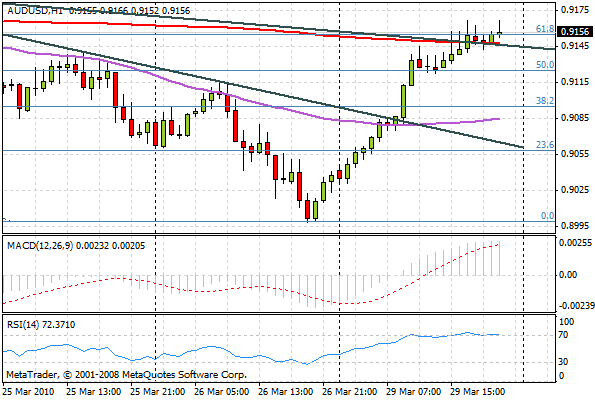
The Australian dollar has climbed back against the US dollar today in forex trading after a down week last week. The Aussie-dollar pair (AUD/USD) has advanced by over 1 percent and approximately 100 pips today in trading to rebound above the 0.9150 level in the U.S. session after opening the day (00:00GMT) at the 0.9048 level. Last week, the AUD/USD decreased by approximately 150 pips as the risk averse trading environment surrounding the Greece Debt situation and concern surrounding the euro helped bring the Aussie lower.

Today’s Aussie increase was supported by comments out of Australia by Reserve Bank of Australia governor Glenn Stevens on interest rates.  Stevens, in a television appearance (comments published in The Australian), said that interest rates shouldn’t be left “down at rock bottom any longer than you need” and that it would not be wise to “assume they will stay that way”. The hawkish tone has prompted immediate speculation of a possible RBA rate hike at the RBA’s April policy meeting.

AUD/USD 1-Hour Chart – The Aussie today accelerating higher against the US dollar from last week’s low of 0.9001 to trading above 0.9150 today. The pair has broken through a couple of recent downward trendlines (in black) and fibonacci retracement levels to trade currently at the 61.8 fibonacci retracement level of the decline from 0.9251 to 0.9001 that started on March 17th.

AUD/USD Outperforms After Hawkish Comments from Stevens

By Fast Brokers – The Aussie has posted a considerable rally today in reaction to comments from RBA Governor Stevens implying that he feels uncomfortable with price levels right now, a hint that the central bank could continue its hawkish monetary stance.   This contrasts quotes from Stevens on Friday when he suggested that global economic uncertainty, particularly in the EU, is unsettling.  Hence, Stevens is sending a muddy message, casting a shadow of uncertainty upon the RBA’s next monetary policy meeting.  Regardless, today’s hawkish comments are in the foreground, taking precedence and driving the Aussie higher.  Meanwhile, investors have dipped their toes back into the Euro and Cable in the wake of the EU’s agreement to help Greece should conditions deteriorate further.  The broad-based pop in the risk trade stemming from Friday’s announcement has also benefitted the Aussie.  However, Fitch’s Portugal downgrade lingers while the EUR/USD and Cable battle their psychological 1.35 and 1.50 levels, respectively.  The Aussie also faces its share of technical barriers, though the currency pair still flexes its comparative strength.  Though the data wire is quiet today, news will pick up again tomorrow the Final GDP from the U.K. followed by U.S. CB Consumer Confidence.  However, Aussie investors will likely place more emphasis on Wednesday’s Building Approvals and Retail Sales data from Australia.  Should these two data points outperform, this would confirm Stevens’ concern about inflation and stoke speculation that the RBA may raise rates again, a positive for the Aussie.  However, if the data disappoints while the overall risk trade drags the Aussie may not have the momentum to break free of its near-term topside technicals.

Technically speaking, the Aussie has 3/23 and 3/27 highs serving as technical barriers along with multiple downtrend lines.  As for the downside, the Aussie has multiple uptrend lines serving as technical cushions along with 3/25 and 3/26 lows.  Additionally, the highly psychological .90 level could serve as a solid technical cushion once again should it be tested.

Price: .9153
Resistances: .9163, .9176, .9185, .9199, .9214, .9230
Supports: .9130, .9118, .9106, .9087, .9073, .9054, .9031
Psychological: .90, .91, March Lows and Highs

(click chart to enlarge)

Market Commentary provided by Fast Brokers.

Disclaimer: FastBrokers’ market commentary is provided for information purposes only and under no circumstances should be regarded neither as an investment advice nor as a solicitation or an offer to sell/buy any financial product. FastBrokers assumes no responsibility or liability from gains or losses incurred by the information herein contained.

Risk Disclosure: There is a substantial risk of loss in trading futures and foreign exchange. Please carefully review all risk disclosure documents before opening an account as these financial instruments are not appropriate for all investors.

S&P Futures Fluctuate with Quiet Data

By Fast Brokers – The S&P futures are continuing their fluctuation above the psychological 1150 level as investors prop up the risk trade in the wake of an EU agreement concerning future financial assistance for Greece.  The FX markets saw solid pops in the EUR/USD, Cable and Aussie as investors felt comfortable dipping into the risk trade amid oversold conditions.  However, these major Dollar pairs have met some solid technical barriers as they pursue their respective recoveries.  Hence, it seems the risk trade will need more confirmations, likely in the form of economic data, to knock the Dollar out of its downtrend and send the risk trade higher.   Although the data wire is quiet today, the U.S. will release CB Consumer Confidence following UK Final GDP and Nationwide HPI.  Hence, activity could pick up tomorrow as we head into Wednesday’s highly anticipated ADP Non-Farm Payrolls report.  This week’s focus will likely center on U.S. employment.  If U.S. employment doesn’t improve as quickly as anticipated, investors could head back towards the Dollar for safety and drag U.S. equities lower.  On the other hand, weak employment data could also yield speculation that the Fed will need to keep liquidity loose, a positive for equities and the S&P futures.  On the flipside, strong U.S. employment data may help seal confidence in the economic recovery.  While this could prove to be a positive for U.S. equities, should employment improve too quickly this could lead to speculation that the Fed will tighten sooner than anticipated, a negative for U.S. equities.  Regardless, it will be interesting to see how the S&P futures react to this week’s data for the movements could prove to be counterintuitive to the usual relationship between macro data and equities.  Meanwhile, it will be interesting to see if the S&P futures can hold above their psychological 1150 level while maintaining their upward momentum.

Technically speaking, the S&P futures face topside technical barriers in the form of 3/25 highs and the psychological 1075 level.  Additionally, the psychological 1200 level could serve as a solid technical barrier should it be tested.   As for the downside, the S&P futures have multiple uptrend lines serving as technical cushions along with 3/24 and 3/22 lows.  Additionally, the psychological 1150 level could serve as a solid technical cushion should it be tested.

Price: 1165.50
Resistances: 1168.73, 1170.46, 1172.19, 1174.72, 1176.45
Supports: 1163.39, 1162.17, 1160.87, 1158.99, 1157.48
Psychological: 2010 highs, 1150, 1175, 1200

(click chart to enlarge)

Market Commentary provided by Fast Brokers.

Disclaimer: FastBrokers’ market commentary is provided for information purposes only and under no circumstances should be regarded neither as an investment advice nor as a solicitation or an offer to sell/buy any financial product. FastBrokers assumes no responsibility or liability from gains or losses incurred by the information herein contained.

Risk Disclosure: There is a substantial risk of loss in trading futures and foreign exchange. Please carefully review all risk disclosure documents before opening an account as these financial instruments are not appropriate for all investors.

Gold Pops Back Above $1110/oz

By Fast Brokers – Gold is adding onto Friday’s gains after the precious metal popped back above its highly psychological $1100/oz level in the wake of an EU agreement concerning potential financial aid for Greece.  Gold followed positive risk trade money flows, indicating the precious metal’s negative correlation with the Dollar is in full-effect.  That being said, investors should remain on the cautious side since both the EUR/USD and Cable still face key technical barriers, mostly notably their psychological 1.35 and 1.50 levels, respectively.  Hence, investors should keep tabs on the major Dollar pairs along with their interactions with important technical levels.  Although the data wire is quiet today, the flow will pick up tomorrow with Final GDP and HPI data from the UK followed by U.S. CB Consumer Confidence.  However, attention is focused on Wednesdays ADP employment number followed by Friday’s headline employment change figure.  That being said, activity in gold and the FX markets could pick up as the week progresses.  Meanwhile, it will be interesting to see gold can continue to build off of last week’s bottom and hold above its highly psychological $1100/oz level.

Technically speaking, gold has multiple downtrend lines serving as technical barriers along with intraday and 3/19 highs.  As for the downside, gold now has multiple uptrend line serving as technical cushions intraday and 3/23 lows.  Additionally, the $1100/oz level could continue to have an influence on price over the near-term.

Present Price: $1110.40/oz
Resistances: $1111.28/oz, $1112.31/oz, $1113.75/oz, $1114.66/oz, $1115.46/oz, $1117.07/oz
Supports: $1109.95/oz, $1109.25/oz, $1108.13/oz, $1106.84/oz, $1105.24/oz, $1103.64/oz
Psychological: $1100/oz, March lows

(click chart to enlarge)

Market Commentary provided by Fast Brokers.

Disclaimer: FastBrokers’ market commentary is provided for information purposes only and under no circumstances should be regarded neither as an investment advice nor as a solicitation or an offer to sell/buy any financial product. FastBrokers assumes no responsibility or liability from gains or losses incurred by the information herein contained.

Risk Disclosure: There is a substantial risk of loss in trading futures and foreign exchange. Please carefully review all risk disclosure documents before opening an account as these financial instruments are not appropriate for all investors.

Yen Dollar Decline on European News

Source: Forex YardThe U.S Dollar and JPY edged lower against major counterparts in Asian and European trading Monday, as the European currency continued its recovery from Friday after the European Union enlisted the assistance of the International Monetary Fund to help with Greece’s recovery plan.

The Yen continued its decline against the EUR on signs the global economic recovery is substantiating, boosted demand for higher-yielding assets. The JPY declined against its 16 major counterparts ahead of the U.S Non Farm Employment report Friday that is expected to show the U.S. job market is improving, further supporting market optimism.

The EUR is currently at $1.3471, from $1.3410, after climbing as high as $1.3527. The Yen fell to 124.64 per EUR from 124.06 in New York last week. Japan’s currency is relatively unchanged at 92.50 per USD, from 92.52 Friday. The Pound is currently at $1.4982 after earlier rising to $1.5018.

Forex Market Analysis provided by Forex Yard.

© 2006 by FxYard Ltd

Disclaimer: Trading Foreign Exchange carries a high level of risk and may not be suitable for all investors. There is a possibility that you could sustain a loss of all of your investment and therefore you should not invest money that you cannot afford to lose. You should be aware of all the risks associated with Foreign Exchange trading.

Investors eye US data


This week the US economy will gather most of investors’ attention as the week will be loaded with highly significant market moving figures. The Week will open with the US PCE price index one of the Fed’s leading indicators for inflation and a known factor in the Fed’s inflationary outlook. The PCE is expected to point on a balanced inflationary picture with consensus bets pointing on a 2% gain for the PCE index yy in line with the Fed target of 2% annual inflation. Consumer confidence will follow alongside US manufacturing and housing data. The Consumer confidence is expected to still point on subdued consumer spending with investors eyeing a reading of 50 which is considered the minimal reading for consumer expansion. In the Housing sector the Case Shiller index is expected to show dented housing prices alongside the mortgage market index which is expect to be dented as well amid tight credit conditions which continue to pressure on households. The ADP figure will gather the center of attention as investors see the ADP figure as a good barometer for the Nonfarm and unemployment figures which follow after.ADP employment is expected to rise by 40k after falling by -20K the month before, thus confirming investors’ assessments that the US Job market is slowly stabilizing and possibly recovering.

FX trade to be in rage ahead of the Data- Overall after the Dollar sentiment eased towards the end of last week in reaction to the news on an EU consensus to aid Greece. The agreement on a combined guarantee of financial aid to Greece together with the IMF will allow investors to shift their attention back towards pure economic data .Investors trimmed their Dollar bets ahead of this week’s data and are now waiting to see wither the US economy will continue to recover faster than its European peers. Investors will focus mainly on the ADP employment figure as the US job market is known to affect strongly on the Fed rate policy. The housing market will also gather some attention amid the expected exit of the Fed from its 1.4$ Trillion mortgage backed securities program aimed to stimulate the housing market with lower lending rates.

Daily Forex Market Analysis provided by eToro

Disclaimer: Trading in the Foreign Exchange market might carry potential rewards, but also potential risks. You must be aware of the risks and are willing to accept them in order to trade in the foreign exchange market. Don’t trade with money you can’t afford to lose.

© 2009 eToro Blog.