USD/JPY Consolidates After Eclipsing 93.50

By Fast Brokers – The USD/JPY nearly hit the 93.75 level we have been pointing out for the past couple weeks, and it will be interesting to see whether the currency pair can keep the winning streak alive.  The Dollar is being hit today after a disappointing U.S. economic data set.  Both the ADP and Chicago PMI numbers disappointing, denting confidence in America’s economic recovery while effectively calming the USD/JPY’s rally.  The USD/JPY has been thriving off of a combination of strong U.S. data and a BoJ keen on fighting deflation.  Therefore, today’s setback in the U.S. is having a negative impact on the currency pair.  Japan also released negative Average Cash Earning data during the Asia session, and this doesn’t help matters either.  Speaking of data, Japan will print the Tankan Manufacturing Index tomorrow followed by Australia’s Trade Balance and China’s Manufacturing PMI.  Hence, tomorrow will give investors a good picture of how the demand for Asia’s goods is faring.  The UK and U.S. will also release their manufacturing PMIs during the Western session, meaning tomorrow could prove to be an active trading day.  Meanwhile, it will be interesting to see if the USD/JPY can continue to stabilize around its psychological 93 area despite present weakness in the Dollar across the board.

Technically speaking, the USD/JPY faces technical resistance in the form of intraday, 1/ 4 and 1/ 8 highs.  As for the downside, the USD/JPY has multiple uptrend lines serving as technical cushions along with 3/30 and 3/25 lows.  Additionally, the psychological 92 level could serve as a solid technical cushion should it be retested.

Present Price: 93.01
Resistances: 93.05, 93.14, 93.23, 93.32, 93.43, 93.57
Supports: 92.96, 92.86, 92.75, 92.63, 92.50, 92.42
Psychological: .92, .93, 2010 highs

(click chart to enlarge)

Market Commentary provided by Fast Brokers.

Disclaimer: FastBrokers’ market commentary is provided for information purposes only and under no circumstances should be regarded neither as an investment advice nor as a solicitation or an offer to sell/buy any financial product. FastBrokers assumes no responsibility or liability from gains or losses incurred by the information herein contained.

Risk Disclosure: There is a substantial risk of loss in trading futures and foreign exchange. Please carefully review all risk disclosure documents before opening an account as these financial instruments are not appropriate for all investors.

EUR/USD Shoots Higher as EU Outperforms U.S.

By Fast Brokers – The EUR/USD is logging large intraday while attempting a test of yesterday’s highs.  The EUR/USD has climbed back above its highly psychological 1.35 level and it will be interesting if this momentum holds.  The Euro is outperforming in reaction to a pop in Flash CPI coupled with a larger than expected decline in the German Unemployment Change.  An improvement in employment and rising prices supports the ECB’s decision to keep its monetary in check.  Additionally, good fundamentals from the EU are very welcome considering the psychological toll fiscal troubles in Greece and now Portugal have taken on the Euro.  Positive data from the EU contrasts disappointing numbers from the U.S.  The ADP and Chicago PMI both missed estimates, striking a blow to confidence surrounding America’s economic recovery.  However, the ADP has been known to deviate from the headline, meaning more emphasis will likely be placed on Friday’s employment data.  Regardless, the EU outperforming the U.S. has helped the EUR/USD move higher, in effect squeezing some of the countless short sellers.  Although the EU will be quiet tomorrow, investors will receive a wealth of data from around the globe.  Beginning in Asia, Japan will print the Tankan along with Australia’s Trade Balance and China’s Manufacturing PMI.  During the Western session the UK and U.S. will also print their Manufacturing Production figures along with other key data points.  Hence, tomorrow could prove to be a very active session in the FX markets throughout the day.

Technically speaking, the EUR/USD is testing the patience of its highly psychological 1.35 level with multiple downtrend lines hanging overhead.  The EUR/USD also faces technical barriers in the form of 3/30, 3/23, and 3/19 highs.  As for the downside, the EUR/USD has multiple uptrend lines serving as technical cushions along with intraday and 3/25 lows.

Present Price: 1.3519
Resistances: 1.3521, 1.3537, 1.3546, 1.3562, 1.3569, 1.3589
Supports:  1.3509, 1.3494, 1.3481, 1.3469, 1.3459, 1.3446
Psychological: March lows, 1.35, 1.34

(click chart to enlarge)

Market Commentary provided by Fast Brokers.

Disclaimer: FastBrokers’ market commentary is provided for information purposes only and under no circumstances should be regarded neither as an investment advice nor as a solicitation or an offer to sell/buy any financial product. FastBrokers assumes no responsibility or liability from gains or losses incurred by the information herein contained.

Risk Disclosure: There is a substantial risk of loss in trading futures and foreign exchange. Please carefully review all risk disclosure documents before opening an account as these financial instruments are not appropriate for all investors.

Forex News: ADP Employment falls unexpectedly in February. Canada’s GDP rises for 5th month

Forex News Update: (By CountingPips.com) – U.S. employment data released today in the form of the ADP National Employment Report showed that U.S. private employment declined unexpectedly in the month of February. The nonfarm private employment fell by 23,000 workers in February following the revised decline of 24,000 jobs in January. The January jobs data was revised slightly downwards from the original release of 20,000 jobs lost.

February’s decline was a surprise to market forecasters that were expecting an approximate increase of 40,000 jobs. Despite the decrease, the employment data marked the smallest monthly job loss since February 2008, according to the report.

The service-providing sector showed an increase of 28,000 jobs in February while the goods-producing sector fell by 51,000 jobs. Manufacturing had a loss of 9,000 jobs while construction jobs fell by 43,000 workers. All size of businesses cut jobs in February as large businesses lost 7,000 jobs, medium sized businesses shed 4,000 jobs and employment by small businesses dropped by 12,000.

The market-moving US Nonfarm Payrolls report for February is to be released Friday at 12:30 pm GMT with different market forecasts predicting a range anywhere from a gain of 10,000 jobs to a gain of 187,000 jobs.

Canadian GDP increases for a fifth month in a row.

The Canadian Gross Domestic Product rose for a fifth straight month in January, according to a report by Statistics Canada released today. The Canadian GDP increased in January by 0.6 percent following a revised rise of 0.5 percent in December. January’s GDP growth was better than market forecasts predicting a 0.5 percent advance for the month.

Contributing to the GDP gain was an increase in goods-producing industries by 1.3 percent. Within this sector, manufacturing activity rose by 1.9 percent in January while construction activity increased by 1.7 percent. Also contributing positively to the GDP report were gains in wholesale trade, finance & insurance, retail trade and mining and oil and gas extraction.

Negative contributors to the GDP numbers for January were real estate agents and brokers, agriculture and forestry and accommodation and food services.

U.S Non-Farm Payrolls on Tap

By Rita Ruvinski – The U.S currency hit a 3 month high against the Japanese yen on Wednesday as strong dollar demand from Japanese importers for financial year-end book closing triggered widespread buying. Analysts said that USD/JPY may extend its rising momentum if it manages to rise above 93 yen, which would make charts look attractive for market players to chase the dollar higher.

Against the European currency the greenback weakened to $1.3460 but still remained near 10-month high on concerns over euro zone fiscal and economic health. Signs of improvement in the U.S. economy and continuing fiscal problems in the euro zone are likely to keep the EUR subdued in the near term against the greenback.

Ahead of the highly anticipated U.S. nonfarm payrolls data due out on Friday, traders will watch the private sector ADP jobs report for March due at 12:15 GMT, with forecasts 40,000 jobs were created against 20,000 lost in February. If the forecasts prove accurate traders should start readying themselves for some strong gains as the U.S dollar may continue rising in the coming days.

Forex Market Analysis provided by Forex Yard.

© 2006 by FxYard Ltd

Disclaimer: Trading Foreign Exchange carries a high level of risk and may not be suitable for all investors. There is a possibility that you could sustain a loss of all of your investment and therefore you should not invest money that you cannot afford to lose. You should be aware of all the risks associated with Foreign Exchange trading.

Crude Oil Nears the $83 Level

By Anton Eljwizat – Crude Oil has been experiencing much bullish behavior in the last few days. However, there is much technical data that supports a bearish move for today. I will illustrate below that the oil may very well be heading for a reversal, and it might have the potential of reaching towards $80 in the coming days. Forex traders involved with commodities like this can take advantage of this knowledge by going short on Crude Oil now, and at a great entry price!

• Below is the 4-hour chart for crude oil by ForexYard.

• The technical indicators used are the Relative Strength Index (RSI), MACD and Williams Percent Range.

• Point 1: The Relative Strength Index (RSI) indicates that the price of this cross currently floats in the overbought territory, signaling upward pressure.

• Point 2: The MACD indicates an impending bearish cross, which may signal a downward movement is going to occur in the near future.

• Point 3: The Williams Percent Range has peaked near at the 0 marker, which means that there may actually be a strong level of downward pressure.

Crude Oil 4- Hour Chart

Forex Market Analysis provided by Forex Yard.

© 2006 by FxYard Ltd

Disclaimer: Trading Foreign Exchange carries a high level of risk and may not be suitable for all investors. There is a possibility that you could sustain a loss of all of your investment and therefore you should not invest money that you cannot afford to lose. You should be aware of all the risks associated with Foreign Exchange trading.

Forex Market Review: Daily Forex Analysis 31/03/2010

Forex Market Review by Finexo.com

MAJOR HEADLINES – PREVIOUS SESSION
• US Jan. S&P/Case-Shiller House Prices out at -0.7% y/y, as expected, vs. -3.1% prior
• US Mar. Consumer Confidence out at 52.5 vs. 51.0 expected and revised 46.4 prior
• US Weekly ABC Consumer Confidence out at -45 vs. -44 prior
• UK Mar. GfK Consumer Confidence out at -15 vs. -13 expected and -14 prior
• AU Feb. Retail Sales out at -1.4% m/m vs. +0.3% expected and revised 1.1% prior
• AU Feb. Private Sector Credit out at 0.4% m/m, as expected and unchanged from prior
• AU Feb Building Approvals out at -3.3% m/m, +34.2% y/y vs. 2.1%/38.1% expected and revised -5.5%/52.7% prior resp.
• JP Feb. Labour Cash Earnings out at -0.6% y/y vs. -0.1% expected and revised -0.2% prior
• NZ NBNZ Business Confidence out at 42.5 vs. 50.1 prior
• JP Mar. Small Business Confidence out at 45.8 vs. 42.3 prior
• JP Feb. Housing Starts out at -9.3% y/y vs. -1.0% expected and -8.1% prior
• JP Feb. Construction Orders out at -20.3% y/y vs. +15.7% prior
________________________________________

THEMES TO WATCH – UPCOMING SESSION
(All times GMT)
• GE Unemployment (0755)
• EU ECB’s Trichet to speak (0845)
• EU Euro-zone Unemployment (0900)
• Swiss KOF Leading Indicator (0930)
• US MBA Mortgage Applications (1100)
• US ADP Employment Change (1215)
• CA Jan GDP (1230)
• US Chicago PMI (1345)
• US Factory Orders (1400)
• US NAPM – Milwaukee (1400)

Market Comments:

The EUR gave back most of the gains made during the Asian session yesterday with pressure coming from worsening news out of Europe – Ireland’s “Bad Bank” indicating it will apply a discount of 47% vs. 30% initial estimate on blocks of bad loans, Greek bonds trading poorly with tepid demand for the 12-year auction, an IMF downgrade to German growth and a rumoured French ratings downgrade (subsequently denied with Fitch affirming the AAA rating). GBP on the other hand was buoyed by some positive data – Q4 GDP revised higher to 0.4% q/q, current account balance narrowed and Nationwide house prices were a touch firmer. For US markets, data was also on the firm side with US consumer confidence jumping to 52.5 from a revised 46.4 and beating consensus estimates of a rise to 51.0.

The month-/quarter- and Japanese financial year-end were expected to induce some volatility into currency markets on the last trading day of March, but this was only partly evident in the Asian session. The Tokyo morning fix saw heavy demand for the greenback and USDJPY rose to its highest since January 8th. Expect more volatility at the respective fixing times in Europe and the US and most analysts suggesting portfolio-rebalancing trades would be predominantly to sell dollars.
The Australian data was a disappointment and poured some cold water on the hawkish sentiment that had been building since the start of the week. Retail sales fell a surprising 1.4% in February from a month earlier versus consensus estimates of 0.3% growth and could indicate that the recent RBA rate hikes are starting to bite and the Ozzie consumer is adopting a more cautious stance. Building approvals were also softer than expected, falling for the second straight month contrary to market expectations of s rebound. Naturally, AUD fell off its perch above 0.92, though losses in Asia were limited to 50 pips or so. Given that market expectations for an RBA rate hike next week have been scaled back to 60+% from 75% previously, and possibly with more to come, it would appear a tall task for the AUD to regain the heady heights above 0.92.

Fed’s Fisher was on the wires saying that he doubts the current recovery will reverse course and instead sees it gathering momentum into 2010 and predicts growth of 3% this year. That said, he acknowledges that the economy is afflicted by excess capacity, high unemployment and an absence of price pressures.
Looking ahead, data releases in Europe focus on German and Euro-zone unemployment and Swiss KOF leading indicators. The US session sees the US ADP employment change released, the prelude to Friday’s non-farm payroll data, along with Chicago PMI and factory orders. Canada GDP for Jan is the only other release.

Forex Market Review & Analysis by Finexo.com

Disclaimer: Trading the foreign exchange (Forex) carries a high level of risk, and may not be suitable for all investors.

Today’s Forex Market Commentary

By Russell Glaser

The dollar strengthened following positive consumer confidence numbers in the U.S. and negative news for the European financial system.

• Standard & Poor’s sent a warning concerning the Greek banking and its struggles since the outbreak of the Greek financial crisis. Troubles may persist for Greek banks as high borrowing costs weigh on the Greek government.

• Ireland effectively nationalized its banking system by taking over two financial institutions and injecting cash into others.

• The IMF reduced its yearly economic growth estimate for Germany to 1.2% from 1.5%.

• U.S. Consumer Confidence rose to 52.5 on expectations of 50.1.
The EUR/USD could fall today to the support level of 1.3280 if the ADP Non-Farm Employment Change is inline or better than expectations of +40K jobs.

• Australian retail sales fell unexpectedly 1.1% on expectations of a 0.3% increase.

• Weekly crude oil inventory data is due to be released today at 15:30. Expectations are for a rise of 2.4M. The price target for spot crude oil is $83.00.

Forex Market Analysis provided by Forex Yard.

© 2006 by FxYard Ltd

Disclaimer: Trading Foreign Exchange carries a high level of risk and may not be suitable for all investors. There is a possibility that you could sustain a loss of all of your investment and therefore you should not invest money that you cannot afford to lose. You should be aware of all the risks associated with Foreign Exchange trading.

Euro Trading Lower on Financial System Worries, Positive U.S. Consumer Confidence

Source: Forex Yard

The Dollar rose versus the EUR, but was mixed in the other major crosses after renewed concerns over the European banking system weighed on the EUR and other riskier, higher yielding currencies.

Economic News

USD – Higher U.S. Consumer Confidence Boosts the Dollar

The greenback rose versus the EUR but was mixed against the majors during the New York trading session, reclaiming most of the ground it lost to the EUR after the release of the Greek bailout package. Triggering the rising Dollar was a warning by Standard & Poor’s that the weak Greek banking system has been damaged by the fiscal crisis the country is experiencing.

The EUR/USD is currently trading lower at 1.3400 after opening the day at 1.3487, while the GBP/USD was higher at 1.5070, following an opening day price of 1.4997. The USD/JPY was at 93.25 from 92.17.

The Dollar was also supported by better than expected consumer confidence numbers. U.S. CB Consumer Confidence was released with an output of 52.5, far above economists’ expectations of 50.1. This leads economists and traders to believe that the U.S. economy may begin to pick up steam in the near term, recovering faster than its European counterpart.

Today’s trading should be largely driven by economic data set to be released. The highlight will be the release of the ADP Non-Farm Employment Change. The report is set to be released at 13:15 GMT with expectations of an additional 40K jobs to the U.S. economy. A release on par with market expectations or one that exceeds the forecast could push the EUR/USD lower to its previous low at 1.3266.

EUR – Banking Fears Weigh on the Euro

The EUR slumped following a brief recovery in the 16-nation currency. Weakening the EUR was not only the warning from S&P concerning the health of the Greek banking system, but also a decision by Ireland to inject billions of euros into the ailing Irish banking system and a reduced growth forecast by the International Monetary Fund (IMF) for Germany.

The plan to aid the struggling Irish banking system, dubbed by the Irish press as Bailout Tuesday, the Irish government would seize two banking institutions, inject funds into struggling banks and take control of troubled assets at other lenders. Irish finance experts have called this the nationalization of the Irish banking system. In total, 8B euros will be used to support Irish banks. This does not include another 2.7B euro private investment that will be needed to bring Irish banks up to their needed capitalization standards.

Adding to Europe’s woes was a reduced forecast for German economic growth by the IMF. The forecast was dropped to 1.2% from 1.5%.

Interestingly enough, it appears the U.S. is putting more distance between itself and Europe as the major U.S. banking institutions are recovering and returning to profitability while European financial institutions continue to require fresh government aid. This may be reflected in the recent loss of value in the EUR.

JPY – Australian Retail Sales Disappoint, dropping the AUD/USD

The Australian Dollar weakened in the early morning hours of the trading day after the release of Australian economic data failed to meet market expectations. Retail sales for the month of February disappointed traders with numbers coming in at -1.4% on expectations of a rise of 0.3%. This sent the AUD/USD to a low of 0.9144 from an opening day price of 0.9187.

The unexpected drop in retail sales may be a signal that the recent interest rate increases by the Reserve Bank of Australia are beginning to cool the Australian economy. The overnight cash rate was increased by 25 basis points to 4% this past month.

Consumer spending makes up roughly one half of the Australian economy. Therefore, the sudden plunge in retail sales may be enough to convince the Reserve Bank of Australia to keep interest rates at their current level when the policy board meets next week. This should have a weakening affect on the Australian Dollar. The next major support level for the AUD/USD rests at 0.9000.

Crude Oil – Spot Crude Oil Trading Rises

Spot Crude Oil traded higher for the second consecutive day after better than expected consumer confidence numbers, though the gains in spot Crude Oil prices were held in check by a stronger Dollar. The rising prices are prior to the release of the weekly Crude Oil inventory reports.

Spot Crud Oil prices finished the day higher at $82.36 following an opening day price of 82.18. This follows the 3% price rise during Monday’s trading.

Traders were being cautious after Monday’s $1.70 jump in the price of spot Crude Oil, wondering if the price move was based only on technical movements or a shift in the fundamentals of the commodity. The price broke a short term resistance line of $81.50, though the $83 price level still holds for the long term resistance.

Today the market will be expecting the weekly Crude Oil inventories report from the U.S. Energy Information Agency and could either extend the gains in the commodity or drop the price towards its lower support levels. Economists are expecting Crude Oil inventories to rise 2.4M barrels following last week’s 7.3M barrel increase. An output below the 2.4M estimate could be a positive for spot Crude Oil prices and may help extend the bullish rally to the $83 resistance level by the end of the trading day.

Technical News

EUR/USD

The 2 hour and daily RSI are floating near the oversold territory indicating an impending upward movement. A bullish cross is evident on the 4 hour chart’s Slow Stochastic. Going long for the day may be advised.

GBP/USD

The 2 hour and 4 hour RSI is floating in the overbought territory indicating an imminent downward movement. Furthermore, a bearish cross is evident on the 8 hour chart. Going short for the day may be a good option.

USD/JPY

The 2 hour, 4 hour and daily RSI are floating in the overbought territory, while a bearish cross is evident on the hourly, 4 hour and daily charts’ Slow Stochastic. Furthermore a breach of the upper Bollinger Band is evident on the 2 hour, 4 hour and daily charts. Going short for the day may be advised.

USD/CHF

The pair’s indicators seem to be floating in neutral territory with the pair range trading between 1.0650 and 1.0690, however, a bearish cross is evident on the 4 hour chart’s Slow Stochastic and the 2 hour chart’s RSI is floating near the overbought territory. Going short with tight stops may be advised for today.

The Wild Card

AUD/JPY

A breach of the upper Bollinger Band is evident on the daily chart with the 2 hour, 4 hour, 8 hour and daily RSI are floating in the overbought territory. A bearish cross is evident on the 8 hour and daily charts’ Slow Stochastic. Forex traders may be advised to go short for today.

Forex Market Analysis provided by Forex Yard.

© 2006 by FxYard Ltd

Disclaimer: Trading Foreign Exchange carries a high level of risk and may not be suitable for all investors. There is a possibility that you could sustain a loss of all of your investment and therefore you should not invest money that you cannot afford to lose. You should be aware of all the risks associated with Foreign Exchange trading.

Your Cheatin’ Chart Will Tell On You

How the Dow Has Really Performed When Measured in Real Money (Gold)

By Elliott Wave International

“Your cheating chart will tell on you.”

Hank Williams may not have known about Elliott waves, but he did know when a story doesn’t add up.

Such is the case with the nominal rise of the Dow Jones Industrials from 2000 to 2007. In the language of country music, this stock index has a “Cheatin’ Chart” — it doesn’t tell the real story.

Download Robert Prechter’s FREE 40-Page Gold and Silver eBook. This valuable ebook explores the role of gold in today’s markets like no other resource has attempted. You will get more than Prechter’s long-term outlook on gold and silver; you’ll also learn how gold still plays an important role in determining the real value behind nominal share prices. Learn more, and download your Gold and Silver eBook here.

You don’t have to tell Bob Prechter this: He knows. A simple price chart of the Dow is, well, a bit too simple. First Bob explains that pricing via fiat currency is not the same as pricing the Dow in terms of real money (namely gold). Then he shows the difference.

For six long years, we’ve had declining real values in stocks. Since the 2002 bottom, we’ve had rising values in nominal terms. This is the same set-up that we saw in the early ’70s except for one thing: it’s bigger. . .Ultimately, real prices are leading dollar prices, and we’re going to see a tremendous drop in the dollar price of the Dow as well, because I’m making a case that this is a much bigger top.
Elliott Wave Theorist, December 2006

nominal dow follows the lead of real dow

If gold were our money, the major stock market indexes would have declined relentlessly from 2000 to the present, with a muted bounce in 2003. There would be no arguing the point of whether a bull or bear market was in force.
Elliott Wave Theorist, March 2006

This “oh-so-true” chart of the DJIA priced in gold showed the path that the “cheatin'” nominal Dow would eventually follow. Our forecast was that it’s just a matter of time. This analysis has played out as expected several times since the 1999 high in the Dow Jones Industrials.

The July 1999 top in the real Dow was the first in a long succession of rolling blow-offs that (The Elliott Wave Financial Forecast) successfully identified From the DJIA’s orthodox top in 2000 to the NASDAQ’s all-time high several weeks later to the top in residential real estate prices in 2005 to the nominal peaks in major stock indexes in 2007 to the wild commodity spikes in 2008, EWFF managed to anticipate many of the markets major trend changes. . .We owe these forecasting successes to the Wave Principle and its reflection of market psychology and its foreshadowing of larger social forces.
Elliott Wave Financial Forecast, July 2009

The monthly Elliott Wave Financial Forecast keeps a tireless eye on stocks, real estate, commodities and much more. We also keep track of the precious metals and the dollar — and even keep our finger on the pulse of developing social trends.

The quotes above confirm the power of Elliott wave analysis in identifying market turns in various asset classes.

Download Robert Prechter’s FREE 40-Page Gold and Silver eBook. This valuable ebook explores the role of gold in today’s markets like no other resource has attempted. You will get more than Prechter’s long-term outlook on gold and silver; you’ll also learn how gold still plays an important role in determining the real value behind nominal share prices. Learn more, and download your Gold and Silver eBook here.

Elliott Wave International (EWI) is the world’s largest market forecasting firm. EWI’s 20-plus analysts provide around-the-clock forecasts of every major market in the world via the internet and proprietary web systems like Reuters and Bloomberg. EWI’s educational services include conferences, workshops, webinars, video tapes, special reports, books and one of the internet’s richest free content programs, Club EWI.

FOREX: Euro-Dollar declines to trade near 1.3420

By CountingPips.com

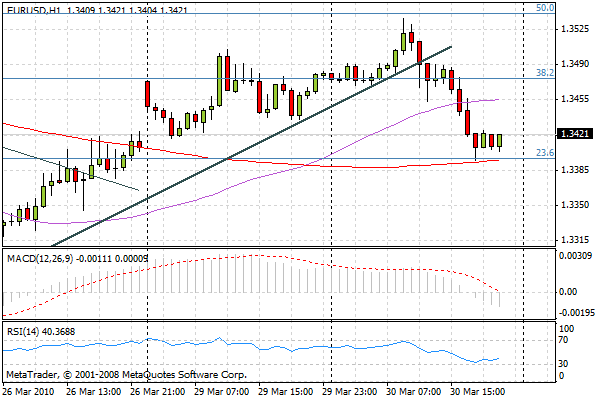
The U.S. dollar has traded higher against the euro today in forex trading after starting the day in the red against the European common currency. The Euro (EUR/USD pair) has fallen by approximately 65 pips today versus the dollar to FOREX: Euro Dollarfall below the 1.3450 level in the U.S. session after opening the day (00:00GMT) at the 1.3489 level. Earlier today, the EUR/USD advanced to an intraday high of 1.3537 at 06:00 GMT before reversing course. The EUR/USD had been on a bullish path since Friday after the European Union agreed on a plan to provide monetary support for Greece through EU and IMF loans.

EUR/USD Chart – The Euro today falling lower against the US dollar on the 1-hour chart. The pair reversed course today near the 50.0 fibonacci retracement level (on the down move from 1.3817 to 1.3267 that started on March 17th) and broke through the supportive trendline of the past few days near 1.3490. The pair found support around the 23.6 retracement level at 1.3394 and currently trades around 1.3420.

Forex EUR/USD