Forex Daily Market Review: 01/04/2010

Forex Market Review by Finexo.com

Past Events
• USD ADP Non-Farm Employment Change, out at -23K versus expected 40K, prior -24K (revised)
• CAD GDP m/m, out at 0.6% versus expected 0.5%, prior 0.5% (revised)
• EUR Unemployment Rate, out at  10% as expected, prior 9.9% (revised)
• EUR German Change, out at -31K versus expected 10K, prior -1K (revised)
• EUR CPI Flash Estimate, out at 1.5% versus expected 1.1%, prior 0.9%

Upcoming Events
• USD Unemployment Claims (1230 GMT)
• USD ISM Manufacturing PMI (1400 GMT)
• EUR German Retail Sales (0600 GMT)
• GBP Manufacturing PMI (0830 GMT)
• GBP Halifax HPI (Tentative)

Market Commentary

In the US the ADP Non-Farm Payroll has shown that companies there unexpectedly cut payrolls in March. The 23,000 decline was the smallest in two years and followed a revised 24,000 drop the prior month, data from ADP Employer Services showed today. Over the previous six months, ADP’s initial figures have overstated the Labor Department’s first estimate of private payroll losses by as little as 2,000 in February to as much as 151,000 in November.

A March payroll gain in line with the median estimate is due to the fact that the ADP’s figures aren’t influenced by weather and don’t include government payrolls which will reflect the hiring of temporary workers to conduct the census. The government has been hiring thousands of workers to conduct the regular 10-year U.S. Census, but those jobs are temporary. ADP includes only private employment and doesn’t take into account hiring by government agencies.

Analysts feel that companies are still hesitant to add workers until they are convinced that the economic recovery has taken hold. Joel Prakken, chairman of Macroeconomic Advisers LLC in St. Louis, which produces the figures with ADP said “the economic recovery has not been long enough or strong enough along the way yet to produce the kind of rapid employment that people are hoping for.”

Tomorrow’s release of Non-Farm Payrolls is expected to show growth of 200,000 nonfarm jobs for March. Some economists are even predicting gains of up to 250,000. If the forecasts prove accurate, it would be the largest expansion since November 2007 and only the second advance in the past 27 months.

Although government statisticians try to account for season factors, severe snowstorms throughout the country skewed the data in February. In fields such as retail, construction and transportation, workers missed time and companies delayed hiring decisions. As a result, some of the increase in hiring that should have taken place in February got pushed into March.

Before Non-Farm Payroll data is released tomorrow American unemployment claims are due to be published later today. The figures have been improving in recent weeks dropping from 496K to 442K. Another drop in claims would raise expectations ahead of tomorrow’s release however the figures are expected to remain almost unchanged.
Also due out later today is the manufacturing report issued by the Institute for Supply Management. The ISM report for March is projected to rise to 57.4% from 56.5%, according to a MarketWatch survey. Readings above 56% are viewed as consistent with strong growth in manufacturing.

In trading yesterday the US Dollar fell 0.62% against the Euro to close at EUR 1.3507. It gained 0.73% on the Pound to close at GBP 1.5182.

North of the border, Canada’s economy expanded at the fastest pace in three years in January, led by manufacturing, wholesaling and construction, adding to evidence that the country is recovering more quickly than policy makers expected.

Gross domestic product increased 0.6% from December, the fifth straight gain and the biggest since December 2006, according to data from Statistics Canada. The report suggests first-quarter economic growth is still coming in faster than the Bank of Canada predicted, after output expanded at the highest quarterly rate since 2000 in the October-December period. Investors have raised bets that Governor Mark Carney will increase his key interest rate in the next few months on signs of quicker inflation and growth.

Carney has pledged to keep his key lending rate at a record low 0.25% through June unless the inflation outlook shifts. He also said March 24 the commitment is “expressly conditional” on inflation, and said that a key measure of inflation has increased faster than expected.

The central bank predicted the economy will grow at a 3.5 % pace this quarter and a 4.3% rate in the April- June period before slowing through next year. Canada’s 5% growth in the fourth quarter exceeded the Bank of Canada’s 3.3 % estimate. Gross domestic product was 1.3% greater in January than in the same month a year ago. The country’s first recession since 1992 ended in the third quarter of last year.

In a separate report, Statistics Canada said that non-farm payrolls were unchanged at 14.53 million in January from December, and down 1.1% from the year-earlier month. Prime Minister Stephen Harper has said job creation is a top priority for his government this year.

The Loonie climbed up 0.39% against its American counterpart yesterday to close trading at CAD 1.0157.

In Europe the unemployment rate across the 16-nation Euro Zone hit 10% in February, the first time it has reached double figures since the euro was introduced. The jobless figures, from the Eurostat agency, showed large variations between nations in the Euro Zone. The unemployment rate was 19% in Spain, whereas in the Netherlands, the rate was just 4%.

Separate figures showed Euro Zone inflation hit a 15-month high in March, rising to 1.5% from 0.9% in February. The inflation figure was higher than expected, with analysts blaming recent rises in energy prices for the increase. However, inflation still remains below the European Central Bank’s inflation target of just below 2%, and analysts do not expect the bank to change its key interest rate from 1% for several months.

The rise in the unemployment rate is being seen as a further sign that the Euro Zone’s recovery from recession remains slow. The Eurostat figures showed that 15.749 million people were unemployed in the Euro Zone during February, up 61,000 from the month before. Across the 27-nation European Union, the unemployment rate rose to 9.6% in February, from 9.5% in January.

Separate figures from Germany on Wednesday indicated that unemployment there was falling. Federal Labor Office figures showed the jobless total fell by 31,000 in March to a seasonally adjusted total of 3.382 million, with the unemployment rate dropping to 8% from 8.1%. “This… brings some hope that the much-needed recovery in German consumer spending could yet materialize,” said Jennifer McKeown, senior European economist at Capital Economics.

In trading yesterday the Euro gained 0.62% on the US Dollar closing at EUR 1. 3507. Against Sterling it dropped 0.12% closing the day at GBP 0.8894.

In the UK the monthly manufacturing PMI is due to be released later today. In the past five months it has been above the crucial 50 point mark, indicating economic expansion. This time it is expected to edge up from 56.6 points to 56.8 points. This will be a big market mover for the Pound.

Forex Market Review & Analysis by Finexo.com

Disclaimer: Trading the foreign exchange (Forex) carries a high level of risk, and may not be suitable for all investors.

USD/CAD May Continue Downtrend

By Greg Holden – It appears that an opportunity has presented itself on the USD/CAD currency pair. Given that most banks are closing for the Easter holiday tomorrow, we should experience very high volatility as a result of the low liquidity which we should be seeing. This makes the power of the US Non-Farm Payroll data all the more important.

Now, for some strange reason, the US is forecasting a sharp jump in employment data, despite there being little evidence of such a strong rebound. Even yesterday’s ADP figures showed that the market should be preparing for a minor decline in employment, not a boost. This is the perfect recipe for a disappointment, leading to a sharp decline in the USD against every major currency pair.

I’ve highlighted the USD/CAD pair because it seems to be presenting solid evidence that a major support line is going to be breached, followed by a jump beyond parity.

– The chart below is the weekly USD/CAD chart by ForexYard.

– The indicator provided here is the Relative Strength Index (RSI).

– What this chart shows us is 2 things:

– First: the USD/CAD is clearly in a solid downtrend. The RSI supports this and does not show that it has entered the over-sold territory yet, giving it more room to run.

– Second: the pair is rapidly approaching a significant support line at parity (a 1:1 price, also known as a price of 1.0000). This means we may see some hesitation at this price, and perhaps even a rebound with a target near 1.0400, indicated on the graph below.

– However, given that the US is the only Western bank open tomorrow and is due to disappoint with unrealistic expectations for the NFP, a strong USD downturn may be getting priced in today and tomorrow. This means it may be a good time to jump in on this trend.

– If the pair does breach past the parity mark (1.0000), there is a solid chance that it will continue to drop in a much more rapid manner than it has over the past few months. Meaning that now may be a great entry point for a sell position on the USD/CAD.

– Traders should also manage their risk with proper Stop and Limit orders, on the other hand. As mentioned above, there is a possibility that the pair will bounce back towards 1.0400 before descending to parity so traders should be prepared for this price movement.

USD/CAD Weekly Chart


Forex Market Analysis provided by Forex Yard.

© 2006 by FxYard Ltd

Disclaimer: Trading Foreign Exchange carries a high level of risk and may not be suitable for all investors. There is a possibility that you could sustain a loss of all of your investment and therefore you should not invest money that you cannot afford to lose. You should be aware of all the risks associated with Foreign Exchange trading.
Potential Reversal for GBP/JPY

By Anton Eljwizat – The sustained upward movement of the GBP/JPY pair doesn’t seem to be receiving much resistance lately. As I will demonstrate below, the price of GBP/JPY may very well be heading for a correction, and it might have the potential of reaching towards 1.4000 in the coming days. Forex traders can take advantage of this imminent downward movement by entering short positions at an excellent entry price.

• The chart below is the 8-hour GBP/JPY chart by ForexYard.

• The technical indicators that are used are the Relative Strength Index (RSI), Slow Stochastic and Williams Percent Range.

• Point 1: The Relative Strength Index (RSI) indicates that the price of this cross currently floats in the overbought territory, signaling downward pressure.

• Point 2: The Slow Stochastic indicates a bearish cross, signaling that the next move may be in a downward direction.

• Point 3: The Williams Percent Ranges is showing that this pair is heavily over-bought and may be experiencing strong downward pressure.

GBP/JPY 8-Hour Chart

Forex Market Analysis provided by Forex Yard.

© 2006 by FxYard Ltd

Disclaimer: Trading Foreign Exchange carries a high level of risk and may not be suitable for all investors. There is a possibility that you could sustain a loss of all of your investment and therefore you should not invest money that you cannot afford to lose. You should be aware of all the risks associated with Foreign Exchange trading.

Dollar Looks to Extend Bullish Trend Against Yen

Source: Forex Yard – Coming off its recent 3-month high against the Japanese Yen, the U.S. Dollar is looking to continue its bullish run in trading today. Risk appetite seems to be returning, especially as predictions are coming in that Fridays U.S. Non-Farm Payrolls Data will show the U.S. added jobs last month. If this remains the case, the Yen will likely fall against its major counterparts today.

Economic News

USD – Dollar Capitalizes on Employment Forecasts

The Dollar has largely held onto the significant gains made yesterday against the Yen that took the pair to a 3-month high. That being said, as risk taking clearly returned to the marketplace, the greenback took some losses against its European counterparts in recent trading. GBP/USD has increased well over 100 pips in the last 24 hours, and is currently trading around the 1.5195 level. EUR/USD has similarly increased about 100 pips since this time yesterday, and is currently trading around the 1.3505 level.

With investors eagerly awaiting Friday’s U.S. Non-Farm Payrolls report volatility will likely remain high today, especially ahead of the weekly American Unemployment Claims report set to be released at 12:30 GMT. Analysts are predicting that today’s report will show a drop in unemployment for the week. If true, the Dollar should receive a boost as a result. Additionally, the ISM Manufacturing PMI, set to be released at 14:00 GMT, is forecasted to show an increase in the quality of a number of business conditions in the U.S. This could all signal a very strong day for the USD.

Traders will also want to pay careful attention to predictions for the Non-Farm Payrolls Report on Friday. As of now, analysts are saying that the U.S. added a substantial number of jobs in March. This could lead to a prolonged bullish trend for the Dollar, especially as confidence continues to return to the American economy.

EUR – Euro Tries to Maintain Yesterday’s Gains

With no significant European publications expected today, the Euro will attempt to hold onto gains made against the Yen and Dollar yesterday. Recent news regarding Greece’s plan to combat its severe deficit problem caused the single currency to move upward against most of its counterparts yesterday. That being said, if predictions regarding the U.S. unemployment claims come true, the Euro will have a hard time maintaining its current bullish position.

With the British Manufacturing PMI set to be released at 08:30 GMT today, Sterling may have a volatile trading day today. Most analysts are predicting a positive figure for the upcoming report, which if true, could help boost the U.K. currency against the Dollar and Yen. On the other hand, with positive U.S. news forecasted today, any gains made by the Pound could be short lived.

JPY – Yen Takes Losses as Risk Taking Returns

The Yen sunk to a 3-month low against the Dollar yesterday. According to some analysts the bearish trend could be prolonged, especially if Japanese investors continue to send their money abroad, as has been recently reported. Despite the improved business conditions in Japan, as evidenced by the most recent Tankan Manufacturing Index, JPY is still having a hard time translating the news into positive gains.

Currently USD/JPY is trading around the 93.40 level. While the pair seems to have leveled out at the moment, any positive U.S. news will likely send it to new highs in afternoon trading.

Crude Oil – Crude Records Gains Due to Falling Dollar

Crude Oil saw a fairly bullish trading day on Wednesday, capitalizing on the Dollar’s losses against its European counterparts. In the last 24 hours, the price of crude has shot up to its current level of 83.31. The price increase was also largely fueled by the latest U.S. inventory report, which showed that stockpiles for the world’s largest energy consumer dropped in the last week.

Today, crude oil traders will want to pay careful attention to what direction the Dollar goes. With U.S. unemployment claims set to be released today, the price of crude could see some volatility. If the unemployment continues to fall, the Dollar will likely go up, and the price of crude may drop as a result. On the other hand, if U.S. unemployment unexpectedly increases, the price of oil could see some gains in afternoon trading.

Technical News

EUR/USD

The daily chart is showing mixed signals with its RSI fluctuating at the neutral territory. However, there is a fresh bearish cross forming on the 4-hour chart’s Slow Stochastic indicating a bearish correction might take place in the nearest future. When the downwards breach occurs, going short with tight stops appears to be preferable strategy.

GBP/USD

The GBP/USD cross has experienced a bullish trend for the past several days. However, it seems that this trend may be coming to an end. The RSI of the 4-hour chart shows the pair floating in the overbought territory, indicating that a downward correction will happen anytime soon. Going short with tight stops might be a wise choice.

USD/JPY

The price of this pair appears to be floating in the over-bought territory on the daily chart’s RSI indicating a downward correction may be imminent. The downward direction on the 4-hour chart’s Momentum oscillator also supports this notion. Going short might be a wise choice.

USD/CHF

The pair has been range-trading for a while now, with no specific direction. The Daily chart’s Slow Stochastic providing us with mixed signals. All oscillators on the 4 hour chart do not provide a clear direction as well. Waiting for a clearer sign on the hourlies might be a good strategy today.

The Wild Card

Crude oil

Crude oil prices rose significantly in the last week and peaked at $83.50 per barrel. However, the 4-hour chart’s RSI is floating in an overbought territory suggesting that a recent upwards trend is loosing steam and a bearish correction is impending. This might be a good opportunity for forex traders to enter the trend at a very early stage.

Forex Market Analysis provided by Forex Yard.

© 2006 by FxYard Ltd

Disclaimer: Trading Foreign Exchange carries a high level of risk and may not be suitable for all investors. There is a possibility that you could sustain a loss of all of your investment and therefore you should not invest money that you cannot afford to lose. You should be aware of all the risks associated with Foreign Exchange trading.
Weak US data cools Dollar strength

By eToro – After firm gains on Tuesday a disappointing US job figure pushed the Dollar to weekly lows. The ADP employment figure monitoring private hiring has shed 23k jobs against market consensus of a 40k rise. The highly regarded figure which is considered to be a good indicator for the key Nonfarm payroll which follows has shaken investors’ confidence on the US job market recovery with market players fearing Friday’s nonfarm figure could majorly disappoint. Investors are eyeing the US job market very closely for 2 major reasons, the health of the US job market is the main factor affecting the Fed’s rate policy moreover since around 2/3 of the US economy is consumer spending, only an improving job market can support a recovery in customer spending.

Dollar selling accelerated on upbeat EU inflation- Meanwhile in the EU the inflation figures released showed EU inflation rose to 1.5% yy up from 0.9% yy in February mainly attributed to the recovery in energy prices. Although rate hikes in the EU and the US still look remote with FX traders targeting the end of 2010 for the first tightening step, the FX sentiment is fluctuating alongside investors’ bets which side will raise rate first. With the weak US jobs figure denting US tightening bets and the EU upbeat inflation heating up speculations on rate hikes in the Euro zone by the end of 2010. The EUR/USD gain was well supported with Euro rising strongly from as low as 1.3414 to its weekly high at 1.3548.

Ahead of the NFP figure in Friday- Market is eyeing a 200k gain in the Nonfarm figure and any figure below will be considered a disappointment. Although the Dollar was sold heavily after the US ADP employment figure the consensus is still that the US recovery is to outpace that of the Euro zone. If the Nonfarm figure will be in line with expectations the Dollar which currently trades close to its support levels could rebound very quickly. The effect on Friday might be diluted as the US stock markets will be close for a holiday, but the gap is expected to be closed on the following Monday. A disappointment from the figure will move the Dollar to retest its support levels as investors’ confidence in a US job market recovery could be shaken.

Daily Forex Market Analysis provided by eToro

Disclaimer: Trading in the Foreign Exchange market might carry potential rewards, but also potential risks. You must be aware of the risks and are willing to accept them in order to trade in the foreign exchange market. Don’t trade with money you can’t afford to lose.

© 2009 eToro Blog.

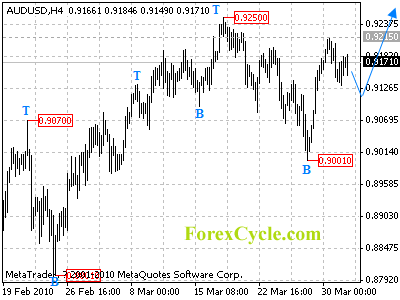
AUDUSD is forming a cycle top at 0.9215

AUDUSD is forming a cycle top at 0.9215 level on 4-hour chart. Range trading between 0.9100 and 0.9215 would more likely be seen in a couple of days. However, the price action from 1.9215 is treated as consolidation of uptrend from 0.9001, another rise towards 0.9300 would more likely be seen after consolidation, and a break above 0.9215 will signal resumption of uptrend.

audusd

Daily Forex Forecast

Forex Daily Market Commentary

By GCI Forex Research

Fundamental Outlook at 1500 GMT (EDT + 0500)

The euro appreciated vis-à-vis the U.S. dollar today as the single currency tested offers around the US$ 1.3540 level and was supported around the $1.3385 level.  The common currency tested a key short-term retracement level today, representing 50% of the March range.  The pair gained ground even though there are significant doubts concerning the viability of Greece’s plans to improve its massive fiscal deficits.  The Greek government today indicated its May debt servicing needs will be around €11.6 billion.  Greece’s new bond issue this week was not entirely well-received by investors and dealers are concerned that a significant amount of more supply of sovereign eurozone debt with deteriorating credit quality could imperil the euro further.  The yield on Greek ten-year debt has increased about 25bps since European leaders agreed to a financial aid package for Greece on 25 March and this evidences the market’s discomfort with the country’s severe problems. Data released in the eurozone today saw the EMU-16 February unemployment rate tick higher to 10.0% from 9.9%, as expected, while the March flash consumer price inflation estimate was up 1.5% y/y – its highest level in ten months.  Germany posted its largest decline in jobless claims since August 2008 and the March unemployment rate fell to 8.0%.  German February retail sales will be released tomorrow. French data released today saw February producer prices climb 0.1% m/m and 1.0% y/y.  Despite today’s increase in headline eurozone inflation, the rate is still below the European Central Bank’s perceived comfort zone of 2.0% and given the backdrop of the sovereign credit crunch, a move higher in official interest rates is very unlikely for quite some time.  ECB President Trichet said it is “extremely important to anchor inflation expectations.” In U.S. news, data released today saw MBA mortgage applications climb 4.3% in the latest week while February factory orders fell to +0.6% from a revised +2.5% in January.  Also, March Chicago PMI fell back to 58.8 from the prior reading of 62.6.  The most important data released today saw March ADP employment off 23,000, a slight improvement from the revised prior reading of -24,000.  These data represent private sector job losses and some economists may scale back their forecasts for Friday’s non-farm payrolls report with many forecasts currently focusing on job gains around 185,000.  Atlanta Fed President Lockhart said he is watching for “durable” job gains while Dallas Fed President Fisher said the U.S. cannot ignore the impact of its massive deficit of yields.  Fed Governor Duke reported U.S. banks remain weak and noted the decrease in bank lending is very troubling.  Euro bids are cited around the US$ 1.3335 level.

¥/ CNY

The yen depreciated vis-à-vis the U.S. dollar today as the greenback tested offers around the ¥93.60 level and was supported around the ¥92.75 level.  Traders await the release of the all-important Bank of Japan Tankan survey of corporate sentiment tonight with most forecasts focusing on an improvement in the main large manufacturers’ confidence index to -14 from the prior reading of -24.  Other components include the large manufacturing outlook, large non-manufacturing outlook, and capex numbers with large all-industry capex expected to improve to -0.4% in Q1 from -13.8% in Q4.  Even though the Tankan is expected to evidence improvement across the board, the survey does little to address the weak final private demand in the country and the deflationary problems evident in the economy.  Data released in Japan overnight saw March small business confidence improve to 45.8 from the prior reading of 42.3while February housing starts were off 9.3% y/y to an annualized 794,000.   Additionally, February construction orders were off 20.3% y/y and February total cash earnings data were off 0.6% y/y.  Today is the final day of Japan’s fiscal year-end and most dealers believe the yen will continue to depreciate early in the new fiscal year.  The government will boost Japanese government bond issuance to a record ¥144.3 trillion in the fiscal year beginning tomorrow.  The Nikkei 225 stock index lost 0.06% to close at ¥11,089.94. U.S. dollar offers are cited around the ¥94.75 level.  The euro moved higher vis-à-vis the yen as the single currency tested offers around the ¥126.45 level and was supported around the ¥124.40 level.  The British pound moved higher vis-à-vis the yen as sterling tested offers around the ¥141.80 level while the Swiss franc moved higher vis-à-vis the yen and tested offers around the ¥88.80 level. In Chinese news, the U.S. dollar appreciated vis-à-vis the Chinese yuan as the greenback closed at CNY 6.8259 in the over-the-counter market, up from CNY 6.8257.  It was reported that Chinese banks purchased US$ 978 billion in foreign currency for their clients in 2009, selling yuan in the process.  People’s Bank of China reported the economic recovery has been “further cemented” and added the management of liquidity following the record credit expansion has become “arduous.”  PBoC called on China to urgently adjust its economic model and said it must utilize multiple monetary tools “flexibly.”  Some traders believe China may widen the yuan’s trading band in the second quarter.

The British pound appreciated vis-à-vis the U.S. dollar today as cable tested offers around the US$ 1.5185 level and was supported around the $1.5040 level.  Data released in the U.K. today saw GfK March consumer confidence tick lower to -15 from -14 in February.  March PMI manufacturing data will be released tomorrow and liquidity will be light early next week on account of the U.K. Easter Monday market holiday.  Cable bids are cited around the US$ 1.4455 level.  The euro moved higher vis-à-vis the British pound as the single currency tested offers around the £0.8945 level and was supported around the £0.8870 level.

CHF

The Swiss franc appreciated vis-à-vis the U.S. dollar today as the greenback tested bids around the CHF 1.0520 level and was capped around the CHF 1.0685 level.  SNB Board member Danthine said the central bank will prevent “any excessive appreciation of the Swiss franc” and added it has “the means to achieve that objective, without dispute.”  Data released in Switzerland today saw the March KOF indicator rise to 1.93 from an upwardly-revised 1.70 in February.  Swiss National Bank Vice Chairman Jordan reiterated last week that the central bank will work to prevent excessive franc appreciation.  Swiss National Bank President Hildebrand last week reported the central bank will “decisively” act against “excessive” franc strength, noting the central bank can intervene to a “very large extent.”  U.S. dollar offers are cited around the CHF 1.1180 level. The euro moved lower vis-à-vis the Swiss franc as the single currency tested bids around the CHF 1.4240 level while the British pound moved lower vis-à-vis the Swiss franc and tested bids around the CHF 1.5925 level.

Forex Daily Market Commentary provided by GCI Financial Ltd.

GCI Financial Ltd (”GCI”) is a regulated securities and commodities trading firm, specializing in online Foreign Exchange (”Forex”) brokerage. GCI executes billions of dollars per month in foreign exchange transactions alone. In addition to Forex, GCI is a primary market maker in Contracts for Difference (”CFDs”) on shares, indices and futures, and offers one of the fastest growing online CFD trading services. GCI has over 10,000 clients worldwide, including individual traders, institutions, and money managers. GCI provides an advanced, secure, and comprehensive online trading system. Client funds are insured and held in a separate customer account. In addition, GCI Financial Ltd maintains Net Capital in excess of minimum regulatory requirements.

DISCLAIMER: GCI’s Daily Market Commentary is provided for informational purposes only. The information contained in these reports is gathered from reputable news sources and is not intended to be U.S.ed as investment advice. GCI assumes no responsibility or liability from gains or losses incurred by the information herein contained.

FOREX: Euro-Dollar advances to trade above 1.3500

By CountingPips.com

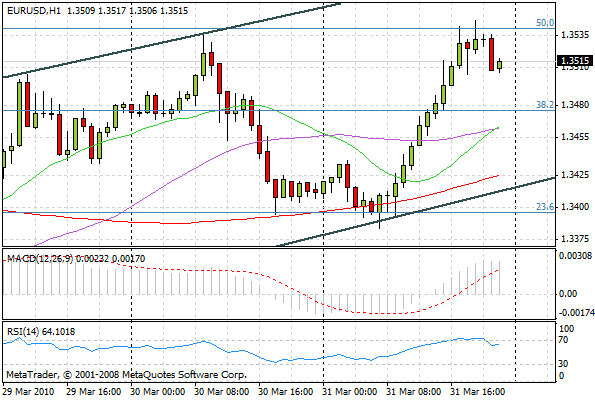
The euro has reversed yesterday’s decline against the U.S. dollar in forex trading to rise on the last day of the first quarter of 2010. The Euro (EUR/USD pair) has increased by approximately 75 pips today versus the dollar to climb above the 1.3500 level in the U.S. session after opening the day around the 1.3434 level. Earlier today, the FOREX: EURO US DollarEUR/USD fell to an intraday low of 1.3384 before reversing course. The EUR/USD had been on a bullish path since Friday before yesterday’s turnaround and has advanced three out of the last four days since touching a low of 1.3266 last Thursday.

EUR/USD Chart – The Euro today rising higher against the US dollar on the 1-hour chart. The pair turned around from yesterday, finding early support near the 23.6 fibonacci retracement level (on the down move from 1.3817 to 1.3267 that started on March 17th). Later today, the pair ran into resistance near the 50.0 fibonacci retracement level at 1.3540 and after moving into overbought territory on the RSI. The pair has come down off of the day’s highs and currently trades around the 1.3515 exchange rate in the afternoon of the U.S. session.

forex-eurodollar

Gold Logs Solid Gains as Conditions Improve in EU

By Fast Brokers – Gold has logged solid gains today, popping above weekly highs in the process.  Gold appears to be following today’s large leg up in the EUR/USD in reaction to positive EU economic data.  Germany’s employment picture improved while Flash CPI climbed to 1.5%.  Rising prices and improving employment creates a more favorable environment for the ECB considering recent instability brought on by Greece.  Hence, investors are beginning to gain more confidence with the EU, a positive for the risk trade and gold considering its usual negative correlation with the Greenback.  However, the EUR/USD and Cable still face their fair share of near-term topside barriers.  Meanwhile, gold has reacted positively to the disappointing U.S. economic data thus far.  Chicago PMI and the ADP figure both came in below analyst expectations, reminding us of the fact that America’s economic recovery is occurring at a sluggish pace.  Investors have sold the Dollar in reaction, a positive for gold during correlative forces.  However, we will have to see how the remainder of the trading session plays out.  Investors will receive a stream of key data throughout tomorrow’s trading session, highlight by Manufacturing PMIs from Japan, China, the UK, and the U.S.  Hence, tomorrow could prove to be an active day.

Technically speaking, gold has multiple downtrend lines serving as technical barriers along with intraday and 3/18 highs.  As for the downside, gold now has multiple uptrend line serving as technical cushions along with 3/29 and 3/30 lows.  Additionally, the $1100/oz level could continue to have an influence on price over the near-term.

Present Price: $1114.60/oz
Resistances: $1115.96/oz, $1117.18/oz, $1119.10/oz, $1120.33/oz, $1121.47/oz
Supports: $1114.55/oz, $1112.71/oz, $111.39/oz, $1110.25/oz, $1109.02/oz, $1108.15/oz
Psychological: $1100/oz, March highs and lows

(click chart to enlarge)

Market Commentary provided by Fast Brokers.

Disclaimer: FastBrokers’ market commentary is provided for information purposes only and under no circumstances should be regarded neither as an investment advice nor as a solicitation or an offer to sell/buy any financial product. FastBrokers assumes no responsibility or liability from gains or losses incurred by the information herein contained.

Risk Disclosure: There is a substantial risk of loss in trading futures and foreign exchange. Please carefully review all risk disclosure documents before opening an account as these financial instruments are not appropriate for all investors.

AUD/USD Drags Following Disappointing Data

By Fast Brokers – The Aussie took a step backwards during the Asia trading session after Australia’s Building Approvals and Retail Sales releases both printed weaker than analyst expectations.  These figures couple with the disappointing employment number we saw not so long ago, implying that the RBA’s rate hikes could be having their intended impact.  Hence, despite mixed comments from Stevens as of late, the RBA could opt to keep its monetary policy unchanged at the next meeting.  However, analysts have the odds pegged at 50/50, meaning upcoming economic data from Australia and around the global could shift the RBA’s stance between now and their monetary policy meeting.  Australia will keep the data train rolling tomorrow by releasing Trade Balance data.  Should the Trade Balance print weaker than anticipated, this could drag on the Aussie.  China and Japan will also print manufacturing production data.  Investors will likely pay close attention to China’s number to see whether its economic recovery is on track.  A strong figure from China could counter today’s disappointing data and push the Aussie higher in anticipation of more demand for Australia’s commodities.  The UK and U.S. will also release their own manufacturing data tomorrow during the Western session, meaning activity could pick up as the session progresses.  Meanwhile, the Aussie could remain range bound in anticipation of tomorrow’s action-packed schedule.

Technically speaking, the Aussie has intraday and 3/17 highs serving as technical barriers along with multiple downtrend lines.  As for the downside, the Aussie has multiple uptrend lines serving as technical cushions along with intraday, 3/22 and 3/25 lows.  Additionally, the highly psychological .90 level could serve as a solid technical cushion once again should it be tested.

Price: .9163
Resistances: .9176, .9185, .9199, .9214, .9230, .9247
Supports: .9152, .9141, .9130, .9118, .9106, .9093
Psychological: .90, .91, .92 March Lows and Highs

(click chart to enlarge)

Market Commentary provided by Fast Brokers.

Disclaimer: FastBrokers’ market commentary is provided for information purposes only and under no circumstances should be regarded neither as an investment advice nor as a solicitation or an offer to sell/buy any financial product. FastBrokers assumes no responsibility or liability from gains or losses incurred by the information herein contained.

Risk Disclosure: There is a substantial risk of loss in trading futures and foreign exchange. Please carefully review all risk disclosure documents before opening an account as these financial instruments are not appropriate for all investors.