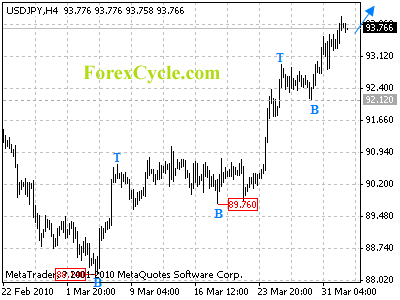
USDJPY broke above 93.75

USDJPY broke above 93.75 (Jan 7 high), suggesting that the longer term uptrend from 84.82 (Nov 27, 2009 low) has resumed. Further rally is still in favor and next target would be at 95.00-96.00 area. Initial support is now at 93.45 followed by 93.25, and key support is at 92.12, as long as this level holds, uptrend from 89.76 could be expected to continue.

usdjpy

Daily Forex Signals

Forex Daily Market Commentary

By GCI Forex Research

Fundamental Outlook at 1500 GMT (EDT + 0500)

The euro appreciated vis-à-vis the U.S. dollar today as the single currency tested offers around the US$ 1.3585 level and was supported around the $1.3460 level.  The common currency extended recent gains and reached its highest level since 19 March as traders continued to cover shorts that were put on following heightened sovereign credit woes in the eurozone in the first quarter.  Data released in the eurozone today saw German March PMI improve to 60.2 while EMU-16 PMI improved to 56.6.  Today’s data are consistent with other recent economic data that confirm Germany – the eurozone’s largest economy – continues to drive economic growth in the bloc.  On a negative note, German retail sales fell 0.4% m/m and were off 0.9% y/y.  Liquidity is expected to remain quite thin tomorrow and Monday in the eurozone and the United Kingdom for the Easter and Passover holidays.  Traders remain fixated on Greece’s debt woes with a new wave of skepticism regarding the country’s ability to successfully reduce its fiscal deficits and refinance its maturing debt in the second quarter.  European Central Bank member Kranjec reported the European Union “won’t do anything special” to support Greece.  In U.S. news, March Challenger jobs cuts were off 55.0% y/y and weekly initial jobless claims fell to 439,000 from the revised print of 445,000.  Continuing jobless claims were narrowly lower at 4.662 million.  Other data released today saw the March ISM manufacturing index improve more-than-expected to 59.6 from the prior reading of 56.5.  Also, the March prices paid index was up significantly at 75.0 from the prior reading of 67.0.  Tomorrow’s March non-farm payrolls data will cap an abbreviated trading week.  Many economists are calling for job growth around the +185,000 area and upward revisions to recent months’ data but some are questioning how many job gains could be due to temporary factors such as the U.S. census.  U.S. Treasury Secretary Geithner warned it will be some time before large sustainable increases in jobs growth will be seen.  New York Fed President Dudley reported “near term” inflation will remain low and said muted U.S. economic growth will warrant low rates.  Euro bids are cited around the US$ 1.3335 level.

¥/ CNY

The yen depreciated vis-à-vis the U.S. dollar today as the greenback tested offers around the ¥94.05 level and was supported around the ¥93.25 level.  As expected, Bank of Japan’s Q1 Tankan survey of corporate sentiment improved q/q with the large manufacturers’ index up to -14 from -24 in Q4 and the non-manufacturer’s index higher at -14 from -22.  Also, the large manufacturers’ outlook improve to -8 from -21 in Q4 and Q1 all-industry capital expenditures improved to -0.4% from -10.8%.  Today’s improvement represented the Tankan’s highest levels in eighteen months but they do not necessarily mean Japan’s economy will evidence a marked improvement, especially as final private demand remains tepid and deflation remains a significant problem.  There is market chatter that Bank of Japan will lift its assessment of the economy at the BoJ Policy Board meeting on 6-7 April, possibly on account of greater export activity.  BoJ’s 30 April Policy Board meeting will include its semi-annual economic projections and could be the meeting when Policy Board members adjust policy further following last month’s additional easing steps.  There will be an Upper House election in July and politicians will likely pressure the central bank to make policy easier far in advance of that election.  The Nikkei 225 stock index gained 1.39% to close at ¥11,244.40. U.S. dollar offers are cited around the ¥94.75 level.  The euro moved higher vis-à-vis the yen as the single currency tested offers around the ¥127.50 level and was supported around the ¥125.95 level.  The British pound moved higher vis-à-vis the yen as sterling tested offers around the ¥143.60 level while the Swiss franc moved higher vis-à-vis the yen and tested offers around the ¥90.00 figure. In Chinese news, the U.S. dollar appreciated vis-à-vis the Chinese yuan as the greenback closed at CNY 6.8264 in the over-the-counter market, up from CNY 6.8259. Data released in China overnight saw March manufacturing PMI improve to 55.1 from 52.0 in February.  People’s Bank of China reported yesterday it will continue its moderately loose monetary policy.

The British pound appreciated vis-à-vis the U.S. dollar today as cable tested offers around the US$ 1.5295 level and was supported around the $1.5170 level.  Bank of England issued its first quarter credit conditions survey today in which it reported U.K. mortgage demand may rise in the second quarter.  Data released in the U.K. today saw March PMI manufacturing print at 57.2, up from the revised prior reading of 56.5.  Cable bids are cited around the US$ 1.4455 level.  The euro moved lower vis-à-vis the British pound as the single currency tested bids around the £0.8840 level and was capped around the £0.8900 figure.

CHF

The Swiss franc appreciated vis-à-vis the U.S. dollar today as the greenback tested bids around the CHF 1.0435 level and was capped around the CHF 1.0610 level.  Swiss National Bank is said to have intervened in the market today by selling Swiss francs in what is estimated to have been a massive operation.  Swiss monetary, financial, and government officials have been warning that they will not tolerate a further increase in the franc in recent weeks but many traders speculated the central bank would not intervene to weaken the franc.  Data released in Switzerland today saw the March PMI manufacturing survey improve to 65.5 from the prior reading of 57.4.  U.S. dollar offers are cited around the CHF 1.1180 level. The euro moved higher vis-à-vis the Swiss franc as the single currency tested offers around the CHF 1.4410 level while the British pound moved higher vis-à-vis the Swiss franc and tested offers around the CHF 1.6215 level.

Forex Daily Market Commentary provided by GCI Financial Ltd.

GCI Financial Ltd (”GCI”) is a regulated securities and commodities trading firm, specializing in online Foreign Exchange (”Forex”) brokerage. GCI executes billions of dollars per month in foreign exchange transactions alone. In addition to Forex, GCI is a primary market maker in Contracts for Difference (”CFDs”) on shares, indices and futures, and offers one of the fastest growing online CFD trading services. GCI has over 10,000 clients worldwide, including individual traders, institutions, and money managers. GCI provides an advanced, secure, and comprehensive online trading system. Client funds are insured and held in a separate customer account. In addition, GCI Financial Ltd maintains Net Capital in excess of minimum regulatory requirements.

DISCLAIMER: GCI’s Daily Market Commentary is provided for informational purposes only. The information contained in these reports is gathered from reputable news sources and is not intended to be U.S.ed as investment advice. GCI assumes no responsibility or liability from gains or losses incurred by the information herein contained.

The Wave Principle: Where The Rubber Hits The Road

Elliott wave analysis saw corn’s biggest moves coming

By Nico Isaac

You could be to technical analysis what tweens are to texting, and it wouldn’t make a lick of difference: You still wouldn’t necessarily be trading at your fullest potential. The reason being: Without Elliott wave in your technical analysis toolbox, it’s like looking at the world of opportunity through a narrow keyhole and ultimately missing the big picture.

The Wave Principle can help you unlock that door. Teaching you how to do it is the goal of the latest free educational report from our Club EWI resource center, titled How the Wave Principle Can Improve Your Trading. In this six-page article, our editorial staff reveals these (and many more) ways in which the wave model makes up for the ways ordinary technical methods fall short:

  • Technical studies can get you on board a trend, but the Wave Principe can say specifically at which point that trend has failed — namely, when prices violate critical support or resistance levels in your price charts.
  • Technical studies can identify the direction of a trend, but the Wave Principle can determine how high prices will rally or how low they will fall.
  • Technical studies can recognize the strength of a trend, but the Wave Principle can discern the maturity of one; when it’s time to take profits or raise protective stops.
  • Technical studies can recognize the strength of a trend, but the Wave Principle can discern the maturity of one; when it’s time to take profits or raise protective stops.

Now for the fun part: Putting the Wave Principle to use in the real-time action of a well known market. For this, we turn to EWI’s chief commodity analyst and long-time Futures Junctures Service editor Jeffrey Kennedy. (Note: Futures Junctures Service is a two-part package that includes Daily Futures Junctures and its long-term sister publication Monthly Futures Junctures.)

Over the last year, Jeffrey’s timely navigation of the Corn market showcases the ability of Wave analysis to identify high-probability trade set-ups. To illustrate, we’ll start with this price chart of corn since March 2009 (courtesy of ino.com) — punctuated with brief excerpts from Jeffrey’s Monthly Futures Junctures.

CBOT Corn May 2010

Below are the expanded versions of Jeffrey’s analysis:

June 2009 Monthly Futures Junctures:

“The Party’s Over In Grains: The corrective advance in corn that began in December 2008 is complete at 450 (basis July). This means that the stage is set for renewed selling that should push corn prices to below the 2008 low of 325 1/4. Moreover, considering the manner and extent of the decline since the early June top, wave patterns argue strongly that this is an intermediate tradable top.”

September 2009 Monthly Futures Junctures: Presented an updated chart that showed prices set to embark on a powerful uptrend above $4 and wrote: “After a Rally, More Decline.”

January 2010 Monthly Futures Junctures: Price chart showed wave c of a zigzag coming to an end and wrote: Wave c = .618 times wave a + wave a at $4.26.

When applied skillfully, no method gets you into a trend earlier and out of a failed move faster than the Wave Principle. Read the entire free 6-page report How the Wave Principle Can Improve Your Trading today.

Here’s what you’ll learn:

  • How the Wave Principle provides you with price targets
  • How it gives you specific “points of ruin”: At what point does a trade fail?
  • What specific trading opportunities the Wave Principle offers you
  • How to use the Wave Principle to set protective stops
  • Keep reading this free lesson now.

Nico Isaac writes for Elliott Wave International, a market forecasting and technical analysis firm.

FOREX: Dollar mostly lower on risk taking. ISM Manufacturing rises, Jobless Claims fall

By CountingPips.com

The U.S. Dollar has been mostly on the defensive today versus its global currency rivals in forex trading as investor’s risk appetite has continued its flow on positive data releases. The dollar has been losing ground versus the euro, British pound, Australian dollar and the Canadian dollar while gaining ground against the New Zealand dollar, Swiss franc, and Japanese yen, according currency data by Oanda.

The euro has gained versus the dollar for the second straight day as the EUR/USD pair has extended to trading above the 1.3550 level. This pair touched an intraday low of 1.3460 before turning higher to trade at its highest exchange rate since March 19th.

The U.S. stock markets, meanwhile, advanced today with the Dow Jones up by 70.44 points, the Nasdaq increasing 4.62 points and the S&P 500 gaining by 8.67 points. Oil has climbed higher by $1.34 to trade at $85.10 while gold has gained by $11.90 to trade at the $1,125.20 per ounce level.

ISM Manufacturing data increases for 8th month

U.S. Manufacturing data activity rose for the eighth straight month in March and increased to its highest level in six years, according to the Institute for Supply Management. The ISM Report On Business index reading for economic activity was at a 59.6 score in March following February’s reading of 56.5, touching the highest level since July 2004. A score above 50 is considered to be growth and less than 50 is considered to be contraction in that sector.

Market forecasts were predicting a reading of 57.0 for the month of March.

Norbert J. Ore, chairman of the ISM Business Survey Committee, stated in the report that, “The manufacturing sector grew for the eighth consecutive month during March. The rate of growth as indicated by the PMI is the fastest since July 2004. Both new orders and production rose above 60 percent this month, closing the first quarter with significant momentum going forward. Although the Employment Index decreased 1 percentage point to 55.1 percent from February’s reading of 56.1 percent, signs for employment in the sector continue to improve as the index registered a 10 percent month-over-month improvement, indicating that manufacturers are continuing to fill vacancies.”

Just about all indexes for March had increased levels led by inventories and prices that rose by 8.0 percentage points each. Exports grew by 5.0 percent while imports edged higher by 1.0 percent. Employment and backlog of orders were the only sectors showing contracting levels for the month.

Weekly Jobless Claims

U.S. weekly jobless claims decreased by a bit more than expected in the week that ended on March 27th, according to a release by the U.S. Labor Department today. New jobless claims fell by 6,000 workers to a total of 439,000 unemployed workers from the previous week’s revised total of 445,000. The 4-week moving average of unemployed workers decreased by 6,750 workers from the previous week to a total of 447,250.

Market forecasts were expecting jobless claims to edge down to 440,000 workers from the prior week.

Meanwhile, workers seeking continuing claims for unemployment benefits for the week ending March 20th also decreased for the week. Continuing claims fell by 6,000 workers to a total of 4,662,000 unemployed workers. The four week moving average of continuing claims dropped by 12,500 workers to a total of 4,679,500.

Tomorrow is Nonfarm Payrolls Friday as the important government employment report is released at 12:30pm GMT with market forecasts expecting a positive number in the vicinity of 184,000 jobs added for February.
You Still Believe The Fed Can Stop Deflation?

Recent history proves that the Fed’s “control” is just an illusion.

By Editorial Staff

Think back to the fall of 2007. The deflationary “liquidity crunch” that over the next year-and-a-half cuts the DJIA in half, decimates commodities, real estate and world markets is only starting. Almost no one believes that the crash is coming — to a large degree, because everyone is convinced that the U.S. Federal Reserve Bank, with Ben Bernanke at the helm, will never allow deflation to happen: It can just print money!

The excerpt you are about to read is from EWI president Robert Prechter’s October 19, 2007, Elliott Wave Theorist. If you find it insightful, read more of Bob’s writings in the free Club EWI resource, “Robert Prechter’s Most Important Writings on Deflation.” (Details below.)

You cannot pick up a newspaper, turn on financial TV or read an economist’s report without hearing that the Fed’s latest discount-rate cut is bullish because it indicates the Fed’s decision to “pump liquidity” into the system. This opinion is so completely wrong that it is hard to believe its ubiquity.

First of all, the Fed does not “decide” where it wants interest rates. All it does is follow the market. Figure 17 proves it. Wherever the T-bill rate goes, the Fed’s “target rate” for federal funds immediately follows. That’s all there is to it.

The FED Follows the Market

If you refuse to believe your eyes, then listen to the chairman; Alan Greenspan is very clear on this point. On September 17, a commentator on CNBC asked, “Did you keep the interest rates too low for too long in 2002-2003?” Greenspan immediately responded, “The market did.” Rates were not “too low” or the period “too long,” either, because the market, not the Fed, made the decision on the level and the time, and the market is never wrong; it is what it is. If investors in trillions of dollars worth of U.S. Treasury debt worldwide had demanded higher interest, they would have gotten it, period.

Second, falling interest rates are almost never bullish. All you have to do to understand this point is look at Figure 18.

Falling Rates are not Bullish

Interest rates fell persistently through three of the greatest bear markets in history: 1929-1932 in the Dow, 1990-2003 in the Japanese Nikkei, and 2000-2002 in the NASDAQ. The only comparably deep bear market in the past 80 years in which interest rates rose took place in the 1970s when the Value Line index dropped 74%. Economists all draw upon this experience, but they ignore the others. Today’s environment of extensive investment leverage and an Everest of debt in the banking system is far more like 1929 in the U.S. and 1989 in Japan than it is like the 1970s. Why is a decline in interest rates bearish in such an environment? Because it means a decline in the demand for credit. When people want less of something, the price goes down.

The recent drop in rates indicates less borrowing, which means that the primary prop under investment prices — the expansion of credit — is weakening. That’s one reason why stock prices fell in 2000-2002 and why they are vulnerable now. This is the opposite of “pumping liquidity”; it’s a slackening in liquidity.

Read the rest of this important 63-page report, “Robert Prechter’s Most Important Writings on Deflation” online now, free! All you need is to create a free Club EWI profile. You’ll learn:

  • When Does Deflation Occur?
  • What Triggers the Change to Deflation
  • What Makes Deflation Likely Today?
  • How Big a Deflation?
  • Why Bernanke Has Been Powerless Against Deflation
  • The Big Bailout Bluff
  • MORE

Read more about the Deflation Survival Guide here.

Elliott Wave International (EWI) is the world’s largest market forecasting firm. EWI’s 20-plus analysts provide around-the-clock forecasts of every major market in the world via the internet and proprietary web systems like Reuters and Bloomberg. EWI’s educational services include conferences, workshops, webinars, video tapes, special reports, books and one of the internet’s richest free content programs, Club EWI.

AUD/USD Heads Higher with Risk Trade

By Fast Brokers – The Aussie is heading higher and testing weekly highs as the risk trade rallies in reaction to strong Manufacturing PMI data from around the globe.  Both China and Japan’s manufacturing data met estimates, a positive development for the Aussie since China is driving demand for Australia’s commodities.  In fact, Australia’s trade deficit came in higher than anticipated today amid an increase in imports, particularly heavy machinery for mining operations.  Hence, demand for Australia’s commodities remains plentiful, a positive for the Aussie when the RBA makes it next monetary policy decision.  However, recent data from Australia has been somewhat disappointing, including yesterday’s Retail Sales and Building Approvals data.  Hence, the RBA could be hesitant in raising rates further, which is likely keeping the Aussie in check thus far today.  All eyes will be on the U.S. tomorrow with Non-Farm Employment Change and headline Unemployment Rate figures on deck.  Many investors will take off for the holiday weekend, meaning volatility could increase due to the combination of light volume and key fundamental data.  Hence, investors should keep a close eye on the Dollar’s reaction to tomorrow’s U.S. data set.

Technically speaking, despite today’s upward movement in the Aussie the currency pair still faces technical barriers in the form of 3/19 and 3/17 highs.  Additionally, the psychological .92 area could influence the Aussie over the near-term.  As for the downside, the Aussie has multiple uptrend lines serving as technical cushions along with intraday and 3/31 lows.

Price: .9202
Resistances: .9214, .9230, .9247, .9264, .9278
Supports: .9194, .9185, .9173, .9161, .9143, .9130
Psychological: .91, .92 March Lows and Highs

(click chart to enlarge)

Market Commentary provided by Fast Brokers.

Disclaimer: FastBrokers’ market commentary is provided for information purposes only and under no circumstances should be regarded neither as an investment advice nor as a solicitation or an offer to sell/buy any financial product. FastBrokers assumes no responsibility or liability from gains or losses incurred by the information herein contained.

Risk Disclosure: There is a substantial risk of loss in trading futures and foreign exchange. Please carefully review all risk disclosure documents before opening an account as these financial instruments are not appropriate for all investors.

Gold Surges with Global Manufacturing Growth

By Fast Brokers – Gold has surged past its downtrend line running through March 17 highs, or the 1133/oz area.  Hence, the precious metal could have some more near-term topside momentum left in it.  Although, gold must now deal with 3/18 highs.  Gold is reacting positively to encouraging manufacturing PMI data from around the globe.  While China, Japan, and the UK all met expectations, the U.S. impressed.  Hence, the risk trade has received a boost, a positive development for Gold due to its usual negative correlation with the Greenback.  The Cable, Aussie and EUR/USD are all logging solid gains, creating a conductive environment for Gold’s new uptrend.  Now attention will turn to tomorrow’s key U.S. employment data.  The U.S. will release Non-Farm Employment Change and headline Unemployment Rate figures tomorrow despite a banking holiday.  Hence, tomorrow prove to be a volatile trading session due to the combination of key fundamental data and light volume as many investors take off for a 3-day weekend.

Technically speaking, gold faces topside technical barriers in the form of intraday, 3/18, and 3/17 highs.  As for the downside, gold has fresh uptrend lines serving as technical cushions along with 3/18 and intraday lows.

Present Price: $1126.50/oz
Resistances: $1127.28/oz, $1128.49/oz, $1129.19/oz, $1130.19/oz, $1130.99/oz
Supports: $1126.28/oz, $1125.18/oz, $1124.28/oz, $1123.08/oz, $1121.67/oz, $1120.77/oz
Psychological: $1100/oz, March highs and lows

(click chart to enlarge)

Market Commentary provided by Fast Brokers.

Disclaimer: FastBrokers’ market commentary is provided for information purposes only and under no circumstances should be regarded neither as an investment advice nor as a solicitation or an offer to sell/buy any financial product. FastBrokers assumes no responsibility or liability from gains or losses incurred by the information herein contained.

Risk Disclosure: There is a substantial risk of loss in trading futures and foreign exchange. Please carefully review all risk disclosure documents before opening an account as these financial instruments are not appropriate for all investors.

USD/JPY Sets New 2010 Highs

By Fast Brokers – The USD/JPY is continuing its incredible run, peaking above its psychological 94 level as investors digest a wealth of manufacturing data from around the globe.  Japan’s Tankan Manufacturing Index printed in line with analyst expectations while the non-manufacturing came in a bit above estimates.  Additionally, Manufacturing PMI data from China and the UK met expectations while America’s outperformed.  Hence, today’s data wire shows us manufacturing is running full steam ahead around the globe, a positive sign for the risk trade.  Hence, investors are feeling comfortable dipping back into the USD/JPY.  Additionally, positive U.S. data brings the Fed one step closer to raising rates, which is looking likely to occur before the BoJ.  Despite today’s solid Tankan data, the BoJ is still under pressure from the DPJ to fight deflation with elections coming up in a few months.  That being said, it will be interesting to see how tomorrow’s U.S. employment data fares.  Even though the ADP came in negative on Wednesday, the advanced number has a reputation for being unreliable.  With many investors on holiday, volatility could pick up around the FX markets as key economic data coincides with what could be a light volume session.

Technically speaking, the USD/JPY is currently testing the resilience of January highs.  The USD/JPY has set new 2010 highs in the process, a key technical move regarding the longevity of the currency pair’s uptrend.  The USD/JPY faces technical barriers in the form of its psychological 94 level, 8/28, and 8/26 highs.  As for the downside, the USD/JPY has multiple uptrend lines serving as technical cushions along with intraday lows and the psychological 93 level.

Present Price: 93.86
Resistances: 93.91, 94.06, 94.26, 94.40, 94.56, 94.74
Supports: 93.67, 93.57, 93.40, 93.32, 93.25, 93.08
Psychological: .94, .93, 2010 highs

(click chart to enlarge)

Market Commentary provided by Fast Brokers.

Disclaimer: FastBrokers’ market commentary is provided for information purposes only and under no circumstances should be regarded neither as an investment advice nor as a solicitation or an offer to sell/buy any financial product. FastBrokers assumes no responsibility or liability from gains or losses incurred by the information herein contained.

Risk Disclosure: There is a substantial risk of loss in trading futures and foreign exchange. Please carefully review all risk disclosure documents before opening an account as these financial instruments are not appropriate for all investors.

GBP/USD Continues Surge in Wake of Positive UK Manufacturing PMI

By Fast Brokers – The Cable has logged more impressive gains today, climbing towards 1.53 after UK PMI data printed a bit above analyst expectations.  The moderate rise in Manufacturing PMI shows that a weakened Pound is likely driving demand for the UK’s manufactured goods.  Manufacturing PMIs from China and Japan also met estimates, bringing renewed confidence to the risk trade and the Cable is benefitting in the process.  However, the Cable is edging lower in reaction to stronger than expected U.S. Manufacturing PMI data, leading investors to favor the Dollar over the Pound.  It will be interesting to see how this trading session pans out, whether investors favor the Cable for the risk trade of the Dollar due to relative economic strength.  The UK will be quiet on the data wire tomorrow along with everybody else but the U.S.  Many investors will be taking a 3-day holiday weekend, meaning activity should be subdued during tomorrow’s trading session.  However, the U.S. will release key employment data, including Non-Farm Employment Change and headline Unemployment Rate figures.  Hence, tomorrow’s session could involve high volatility due to limited volume combined with key fundamental news.  That being said, investors should monitor how today’s strong U.S. PMI data impacts the Cable since it could be a hint as to how the currency pair will react to tomorrow’s U.S. data set.

Technically speaking, the Cable has separated itself further from the psychological 1.50 level and has popped past its downtrend running through 3/17 highs, or the 1.5380 level.  Hence, the Cable could have some more room to go on the topside over the near-term.  As for the downside, the Cable has multiple uptrend lines serving as technical cushions along with intraday and 3/30 lows.  Additionally, the psychological 1.51 area could serve as a solid technical cushion should it be tested.

Present Price: 1.5238
Resistances: 1.5245, 1.5254, 1.5263, 1.5276, 1.5288, 1.5301
Supports: 1.5215, 1.5205, 1.5191, 1.5179, 1.5169
Psychological: 1.51, 1.50, March highs and lows

(click chart to enlarge)

Market Commentary provided by Fast Brokers.

Disclaimer: FastBrokers’ market commentary is provided for information purposes only and under no circumstances should be regarded neither as an investment advice nor as a solicitation or an offer to sell/buy any financial product. FastBrokers assumes no responsibility or liability from gains or losses incurred by the information herein contained.

Risk Disclosure: There is a substantial risk of loss in trading futures and foreign exchange. Please carefully review all risk disclosure documents before opening an account as these financial instruments are not appropriate for all investors.

EUR/USD Hovers Around 1.35 Ahead of U.S. Manufacturing PMI

By Fast Brokers – The EUR/USD is hovering around its psychological 1.35 area as investors await America’s Manufacturing PMI data.  Despite this being a session filled with data releases, the EU only printed German Retail Sales, which came in 4 basis points below analyst expectations.  Hence, the EUR/USD seems to be following its broad-based Dollar correlation.  However, the Euro is presently being outperformed by the Pound, highlighted by the continual slide of the EUR/GBP.  Part of the Euro’s relative weakness likely stems from recent declines in Greek bonds.  Yields on Greek bonds have risen since the EU’s pact, placing some downward pressure on the Euro since the EU may be forced to act on its agreement should Greek bonds continue their decline.  Meanwhile, it will be interesting to see how the EUR/USD reacts to upcoming U.S. data.  Should U.S. data outperform, this could place downward pressure on the EUR/USD with investors favoring the U.S. economy due to fiscal uncertainties in the EU.  Although volume will likely be on the light side tomorrow due to banking holidays, the U.S. will release its highly anticipated Non-Farm Employment Change and headline Unemployment Rate data.  If U.S. employment data impresses, this could also lead investors towards the Dollar, and vice versa.  Due to the anticipation of light volume, investors may want to prepare for high volatility.

Technically speaking, the EUR/USD is testing the patience of its highly psychological 1.35 level with multiple downtrend lines hanging overhead.  The EUR/USD also faces technical barriers in the form of 3/30, 3/23, and 3/19 highs.  As for the downside, the EUR/USD has multiple uptrend lines serving as technical cushions along with intraday and 3/25 lows.

Present Price: 1.3511
Resistances: 1.3512, 1.3521, 1.3534, 1.3547, 1.3562, 1.3569
Supports:  1.3496, 1.3486, 1.3477, 1.3469, 1.3459, 1.3446
Psychological: March lows, 1.35, 1.34

(click chart to enlarge)

Market Commentary provided by Fast Brokers.

Disclaimer: FastBrokers’ market commentary is provided for information purposes only and under no circumstances should be regarded neither as an investment advice nor as a solicitation or an offer to sell/buy any financial product. FastBrokers assumes no responsibility or liability from gains or losses incurred by the information herein contained.

Risk Disclosure: There is a substantial risk of loss in trading futures and foreign exchange. Please carefully review all risk disclosure documents before opening an account as these financial instruments are not appropriate for all investors.