Forex Technical Analysis – EUR/USD – Fibonacci Retracement

By Russell Glaser – The long term downward sloping trend line is being tested after the euro appreciated versus the dollar. The rise in the pair coincides with the release of the EU rescue package for Greece. The daily chart below shows to what price the pair could appreciate to following the euro positive news.

The EUR/USD daily chart below shows the current long term downward sloping trend line for the pair. This trend line is being tested after last nights sharp appreciation in the pair.

There are a number of ways to detect a shift in the trend. Besides a breach of the trend line, traders can use retracement levels. The Fibonacci retracement level of 50% has already established itself as a significant resistance line in May, June and July of last year during the uptrend, as well as mid March during the downtrend.

While I remain bearish on the euro in general, the price target of 1.3800 for the correction seems probable in the near term.

Forex Market Analysis provided by Forex Yard.

© 2006 by FxYard Ltd

Disclaimer: Trading Foreign Exchange carries a high level of risk and may not be suitable for all investors. There is a possibility that you could sustain a loss of all of your investment and therefore you should not invest money that you cannot afford to lose. You should be aware of all the risks associated with Foreign Exchange trading.

Forex Market Review 12/04/2010

Forex Market Review by Finexo.com

Past events:
• GBP PPI Input m/m out at 3.6% versus expected 1.3%, prior 0.6% (revised)
• GBP PPI Output m/m out at 0.9%, versus expected 0.4%, prior 0.3%
• CAD Employment Change out at 17.9K versus expected 25.9K, prior 20.9K
• CAD Unemployment Rate out at 8.2% versus expected 8.1%, prior 8.2%
• AUD Home Loans m/m out at -1/8% versus expected -0.9%, prior -7.3% (revised)

Upcoming Events:
• CAD Housing Starts (1215GMT)
• CAD BOC Business Outlook Survey (1430GMT)

Tomorrow:
• USD Trade Balance (1230GMT)
• CAD Trade Balance (1230GMT)

Market Commentary:
The Euro surged to the highest level in more than three weeks against the U.S Dollar after European governments offered Greece a rescue package worth as much as €45Bn ($61bn) at below-market interest rates.
Finance Ministers of the 16-nation single currency bloc have agreed to offer as much as €30bn in three year loans, at around 5% interest. This is much lower than current borrowing costs facing the debt-stricken nation, with the yield on Greek government debt rising to a record high of 7.5% last Thursday. The aid package also involves the International Monetary Fund, which will provide an additional €15bn.  “The Eurogroup is confident that the determined efforts of the Greek authorities and of its European partners will allow to overcome the fiscal and structural challenges of the Greek economy,” an E.U. statement said.

Following the release of the news, the EUR rose 1.2% to strike a high of $1.36906, the highest price for the single currency since March 18th.  This unexpected jump comes a few days after the single European currency dropped to within one cent of an 11-month low against the greenback, last Thursday. It rose 1.1%, the most since March 31, to 127.19 yen. The Euro also managed to regain all of last week’s losses against the British Pound. Following the news of a “Greek Bailout”, the EUR/GBP appreciated 0.50%- jumping from last Friday’s closing price of 0.87802 to a high of 0.88241, this morning.


The E.U. decision follows a nightmare week for the Greek administration, which saw borrowing costs soaring to a record high, while international ratings agency Fitch lowered the country’s credit rating on Friday to ‘BBB-‘ from ‘BBB+’ with a negative outlook.

For a second straight week, the British Pound climbed against the U.S dollar, as U.K producer prices jumped in March by more than the market has predicted, in the largest increase for since November 2008. PPI Input soared a record 3.6% between February and March, versus an expected increase of 0.6%, boosted by the rising cost of petroleum products. Britain’s Office of National Statistics also reported that the PPI Output increased above expectations, rising 0.9% for the previous month, and 5% from a year earlier. This monthly rise was more than double the market forecasted increase of 0.4%, adding signs that Britain’s economic recovery is gathering speed. The GBP closed on Friday at $1.53692, up 0.598% from the day’s opening price of 1.52778, and up 0.68% from the week’s opening price of $1.52654. In this morning Asian session, the GBP/USD extended above the 1.54000 mark, to hit a 7-week high of 1.54833, before pulling back to the 1.5435 area.

Across the Atlantic, Canada added 17,900 jobs in March, fewer than the 25,900 economists had predicted, as construction and natural resources companies hired while the service industry shrank. Statistics Canada reported last Friday that the unemployment rate remained unchanged at 8.2%, despite a predicted decrease of 0.1%.  While not as strong as expected, this smaller than predicted increase represents the third straight gain in Canada’s employment level, further adding evidence of a rebound in the early part of the year.

The Canadian dollar fell as low as C$1.0084, or 99.17 U.S. cents following the release of the report, before partially retracing its steps to close at C$1.00139. It was near parity with the U.S. dollar just before the data. While over the course the day, the Loonie fell 0.113% from its opening price of C$1.00252, the CAD managed to hold on to its prior week gains- closing the week up 0.567% from Monday’s opening price.

However, this weaker than expected employment data may grant the Bank of Canada some extra time as it ponders when to withdraw the extraordinary stimulus measures from the economy. The central bank has signaled that it won’t raise its benchmark interest rate from a record low level of 0.25% before July, unless inflation becomes a threat. With inflation already hovering near the bank’s 2% target and stronger than expected data pointing to a second straight quarter of 5% annualized growth, markets had begun to price in a chance of monetary tightening in June. But most analysts believe the central bank will keep its pledge to hold rates at least until the end of the second quarter.
Later today (1215GMT), the CMHC will release the number of Housing Starts for the month of March. The data is expected to report 201K new residential buildings that began construction during the previous month, up from 197K reported in February. Also out today (230GMT) is the Bank of Canada’s Business Outlook Survey – this report is highly respected given its source and timing in relation to interest rate decisions.

Tomorrow, both the US and Canada will simultaneously announce their trade balances. Last month, Canada reported a 0.8B surplus; however, the Canadian positive economic data was outshone by an unexpected decrease in the US trade deficit – which narrowed to 37.3B. This time around, the US expects its trade deficit to widen to 38.4B, which north of the border, Canada predicts that their trade surplus will remain consistent at 0.8B. This double hitter usual causes much volatility movement in the USD/CAD pair.

Down under in Australia, home-loan approvals fell in February for the fifth straight month following Governor Glenn Stevens continuous rate hikes along with the government decision cut grants top first time buyers. Waning demand for approvals adds to evidence that Governor Stevens’ decision to boost the benchmark interest rate five times in six meetings is cooling domestic demand. Just last week (April 6th), the RBA increased Australia’s overnight cash rate target by a quarter percentage point to 4.25%, adding to similar moves in March, December, November and October amid a rebound in consumer and business confidence, plus surging house prices. The Australian dollar traded at 93.41 U.S. cents as of 12:17 p.m. in Sydney from 93.45 cents just before the report was released.

Forex Market Review & Analysis by Finexo.com

Disclaimer: Trading the foreign exchange (Forex) carries a high level of risk, and may not be suitable for all investors. All information and opinions contained on this website are to be used for general informational purposes only and do not consitute investment advice.

Euro Rises on All Fronts Following Greece Rescue Plan

By Yan Petters – Are we on the verge of a new trend in the market? For the past 5 months, traders that went short on the Euro saw high profits. On these 5 months the EUR/USD pair dropped close to 2,000 pips! Furthermore, due to the Greek debt crisis it seems that this trend is likely to proceed as the Euro-Zone leadership seemed reluctant to aid the Greek economy. However, as the European governments have offered a $61 Billion rescue plan for Greece, the EUR/USD pair has gained over 300 pips since Friday. Currently it seems that the critical level is at 1.3820. If the pair will manage to breach through this level, we might actually see the beginning of a long-lasting bullish correction.

As for now, traders should first and foremost look for any update regarding the Greek bailout package. This is the most significant issue at the moment, and every data regards it is likely to have an immediate impact on the market.

In addition, here are today leading publications that could influence the market:

• 12:15 GMT, Canadian Housing Starts – This indicator measures the number of new residential buildings that began construction during March. Analysts have forecasted that 201,000 buildings have begun construction during March. This could mark the best result since November 2008, and if the end result will be similar it is likely to support the CAD.

• 18:00 GMT, U.S. Federal Budget Balance – This report measures the difference between the federal government’s income and spending during March. If the actual result will be better than expected (-101.0B), then the USD is likely to rise as a result.

GBP/USD Currently Overvalued

By Anton Eljwizat – The sustained upward movement of the GBP/USD pair doesn’t seem to be receiving much resistance lately. As I will demonstrate below, the price of GBP/USD may very well be heading for a correction, and it might have the potential of reaching towards 1.5250 in the coming days.

• The technical indicators that are used are the Relative Strength Index (RSI), and Slow Stochastic and Williams Percent Range.

• Point 1: There is a “doji” candlestick formed in the chart, indicating that a reversal should take place.

• Point 2: The Relative Strength Index (RSI) indicates that the price of this cross currently floats in the overbought territory, signaling downward pressure.

• Point 3: The Slow Stochastic signals a bearish course for the pair is imminent, as the Slow Stochastic oscillator is set to go reverse course anytime soon.

• Point 4: The William’s Percent Range also supports the downward direction.

• Forex traders can take advantage of this imminent downward movement by entering short positions at an excellent entry price.

GBP/USD Daily Chart

Forex Market Analysis provided by Forex Yard.

© 2006 by FxYard Ltd

Disclaimer: Trading Foreign Exchange carries a high level of risk and may not be suitable for all investors. There is a possibility that you could sustain a loss of all of your investment and therefore you should not invest money that you cannot afford to lose. You should be aware of all the risks associated with Foreign Exchange trading.

Greece Aid Package to Boost the Euro

Source: Forex Yard

After a relatively calm trading week, on which it seemed that the Dollar and the Yen would continue to rise, European governments have offered an aid package to Greece and have immediately created mayhem in the market. Currently the Euro and the Pound are ascending on all fronts, did you take advantage?

Economic News

USD – Dollar Erases Gains vs. the Majors

The Dollar dropped against most of the major currencies during last week’s trading session. The Dollar actually began last week’s trading with a bullish trend, continuing the general trend of the American currency, however as the week progressed, the Dollar erased all gains against the majors.

The Dollar’s bullish run which took place at the beginning of last week came mostly as the result of the positive data that was published from the U.S. economy. The U.S. housing sector continued to provide growth signals as the Pending Home Sales report delivered better-than-expected figures. The report showed that the pending sales of existing homes rose by 8.2% during February, beating expectations for a 0.5% drop. Considering that the housing sector was the trigger for the recent economic crisis, every positive data on this matter tends to boost the Dollar. However later in the week, the Dollar saw a sharp downtrend against the major currencies. This was due to two reasons. The first one was a disappointing employment data which showed that 460,000 individuals have filed for unemployment insurance for the first time during the past week. The second was the European governments’ rescue package which was offered to the Greece economy. This has promptly boosted the Euro, and as a result weakened the Dollar.

As for the week ahead, there are many of interesting economic publication expected from the U.S. Traders are advised to pay special attention to the Trade Balance, the Consumer Price Index, the Retails Sales reports and the weekly Unemployment Claims. Traders are also advised to follow any development regarding the Greek aid plan, as this issue is likely to further dominate market movements for this week.

EUR – Euro Soars as European Governments Offer $61 Billion Aid Package to Greece

The Euro is rising against all the major currencies at the moment. After a week that began with sharp drops against the majors, the Euro is now correcting its losses and the EUR/USD pair has reached above the 1.3650 level.

After the European Central Bank (ECB) declared that the Euro-Zone’s Interest Rates will remain at 1.00% it seemed that the Euro will continue to trample vs. the Dollar. This came after a week that continued the past month’s trend. It seemed that investors were looking for safer assets such as the Dollar and the Yen. However it now appears that investors were simply waiting for developments in the Greek frontier.

European governments have recently offered a $61 Billion rescue package for the Greek economy. This has eased concerns regarding a potential crisis in the Euro-Zone following high Greek borrowing costs, which surged to an 11-year high. The immediate reaction has boosted the Euro against all the major currencies, boosting the Euro by almost 400 pips against the Dollar since Friday. It currently seems that the preliminary impact has yet to be completed, and that the Euro has potential to strengthen even more.

Looking ahead to this week, traders should first and foremost follow any development regarding the Greek bailout package. This is by far the most significant issue at the moment, and the market is likely to respond to every notification about it. In addition, traders should also follow the major news publications from the Euro-Zone, especially from Germany, as this is also likely to impact the Euro.

JPY – Yen Sees Mixed Results against the Majors

The Yen saw volatile trading during last week’s trading session. The Yen rose significantly against the Dollar, and the USD/JPY pair dropped below the 93.00 level. The Yen rose against the Euro and the Pound as well as the week began, only to erase its gains.

The main reason for the Yen’s bullish trend fromm the beginning of the past week seems to be the high uncertainty in the market. Investors have concrete doubts regarding the Euro-Zone’s willingness to bail out the Greek economy. This has turned investors to look for safer assets such as the Dollar and the Yen. The Yen as a result rose against all the major currencies.

However, once the European governments declared a rescue plan for Greece, the momentum has rapidly switched directions. Investors have regained confidence that the Euro-Zone will sustain this crisis, and traders promptly opened long positions on riskier investments such as the Euro and the Pound. Whenever risk-aversion is reduced in the market, the Yen is likely to weaken, and at the moment, the Yen’s bearishness has potential to proceed further.

As for this week, a batch of data is expected from the Japanese economy. Traders are advised to follow the leading publications and also to pay attention to the speech by Bank of Japan Governor on Wednesday. In addition, the Greek bailout plan is likely to impact the market this week as well, and traders should remain updated on this issue.

OIL – Crude Oil Remains At $85 a Barrel

Crude oil saw mixed results during last week’s trading session. Crude oil began last week with a sharp uptrend and a barrel of crude oil was traded around $87.00 a barrel. However, the bullish momentum was diminished by Wednesday and crude oil dropped back to $85 a barrel.

Crude oil rose last week due to the continuation of the positive data from the U.S. economy. The U.S. economy is the largest consumer of oil, and thus every indication regarding a possible growth in the U.S. which should contribute to higher demand for oil, is likely to support oil prices. However it appears that the market is currently satisfied with the $85 a barrel price. It merely took little disappointing U.S. weekly employment data to drop crude oil prices back to $85 a barrel.

Looking ahead to this week, traders should follow every update regarding the Greece rescue plan. If investors will have more confidence that the Euro-Zone economies will recover from this crisis, this is likely to boost oil prices. In addition, traders should also follow the major publications from the U.S. economy as they tend to have a large impact on crude oil.

Technical News

EUR/USD

The pair has broken all short term resistance levels due to this morning’s sharp appreciation in the pair. The price is approaching the key 61.8% Fibonacci retracement level on the monthly chart. This price rests near the 1.3750 level. Traders should be aware of this resistance level as it may be a good opportunity to go short after the price correction.

GBP/USD

A breach of the 1.5380 resistance level has completed the double bottom reversal pattern. This shows the recent bullish move is not a simple continuation of the long term downward trend but actually a shift in the long term trend. Traders should be long on the pair, with key resistance levels at the prices of 1.5560 and 1.5815.

USD/JPY

The downward movement in the pair continues and shows signs of a potential larger move lower. The daily chart’s 14-day Relative Strength Index has broken below both the 70 level and the indicator’s uptrend line, indicating the pair could fall further, perhaps to the 92.15 support level.

USD/CHF

This morning’s price move has broken the daily chart’s long term positive sloping trend line. Before traders start drawing a new trend line, they may want to wait for further confirmation that the uptrend has ceased. This can be confirmed using a number of technical tools. One such may be the breach of the daily chart’s 38.2% Fibonacci level. A breach of this retracement level which rests at the price of 1.0520 could signal a new trend.

The Wild Card

Dow Jones Industrials

The stock index shot up past its resistance level of 10928. The key resistance level on the 4-hour chart contained the index’s price for the previous week. Forex traders may want to go long on the breach of this resistance level.

Forex Market Analysis provided by Forex Yard.

© 2006 by FxYard Ltd

Disclaimer: Trading Foreign Exchange carries a high level of risk and may not be suitable for all investors. There is a possibility that you could sustain a loss of all of your investment and therefore you should not invest money that you cannot afford to lose. You should be aware of all the risks associated with Foreign Exchange trading.

Forex Weekly Market Review April 12, 2010

By eToro – Default concerns hit the financial markets half way through the trading week, which put traders and their heels and pushed capital into safe haven investments.  Gold, Treasuries and the dollar saw inflows and where the beneficiaries of the recent market trepidation.  Despite the fear in the markets, the S&P 500 rose by 1.38% to close at 1194.37 points.

Europe is a mess

Greece’s debt insolvency moved to the forefront mid week, creating trepidation throughout the financial markets.  At the heart of the issue is whether Greece will meet is fiscal targets and be able to repay its current debts.  Greek 10-year bonds, hit is high of 7.6% on Thursday up to 30 basis points prior to retracing.  Yields across Europe are all under pressure (with the exception of German Bunds), and the spreads across the continent will make borrowing a difficult tasks for most of the governments.  The fiscal situation in Greece is headed for an IMF bailout.  Not only has the long end of the interest rate curve moved out dramatically, but 2 year yields on Greece’s debt have back up nearly 80 basis points.  In fact, the Greek yield curve became inverted mid week which means that it cost more to borrow in the near term (2 years) then it does to borrow for 10 years. This is a sign that investor wants out of Greek assets, and a run on the country might be in the cards.  Greek debt stabilized at the end of the day on Thursday.  Part of this recovery could have been the news that Greece’s first quarter budget deficit fell 40% to 4.3 billion Euros.  This would suggest that thus far they are on target.

17

Additionally, the economic data out of Euro Zone is not helping the currency or the European equity markets, which are plagued by Greek debt issues.  Germany’s February Industrial output was expected to rise 1%, but instead came in unchanged, the January increase was cut to 0.1% from 0.6%.    The euro-zone also reported a 0.6% drop in February Retail Sales, the consensus had expected a flat reading.  Retail sales are a solid measure of consumer demand. Consumer demand (spending) makes up the majority (in some countries 66% of GDP) and retail sales make up approximately 33% of consumer spending.  GDP was also revised down to 0.00 from the initial .1% estimate of fourth quarter 2009 growth according to Eurostat, the European Union’s statistic agency.   The EUR/USD has taken a beating this week, after testing resistance at the 20-day moving average late last week (near 1.36).  The currency pair tested support at 1.3275, before rebounding to 1.3387.

25

Will the Chinese Currency Move?

Many news outlets are reporting that China could adjust its currency in the coming days.  The market does suspect something is possible.  Within days of postponing the Treasury’s assessment of currency market manipulation, Treasury Secretary Geithner, who was visiting India, was invited to Beijing.  The 12-month NDFS are edging higher and are now near 3%.  If China does not want to give the appearance of capitulating to US pressure, it seems that expectations for an imminent announcement may be misplaced.   Additionally, a newly appointed adviser to the People’s Bank of China, Xia Bin, said China should resume a managed-float foreign-exchange system soon because the impact of the global financial crisis has faded.  If and when China does make a small move, it will probably be inconsequential for trade and capital flows.  Most of the EM countries surrounding China will potentially have a negative export effect if the Chinese currency increases in value.   China will also probably continue to purchase Treasuries at the same rate.  In the 12 months after the July 2005 revaluation, China’s holdings of US Treasuries still rose $74.3 billion in comparison to $103.7 billion for the 12 months before the revaluation.  The next 12 months saw China’s US Treasury holdings rise by $105 billion and then the next 12 months by $58 billion.

Japan is treading water

The economic news out of Japan was fairly disappointing and failed to show improvement similar to the Tankan survey which was released last week.  Japanese machinery orders fell a sharp 5.4% in February.  The consensus estimates missed this by a wide margin, having expected an increase that would have offsetted the 3.7% decline in January.  On a year-over-year basis, orders were off 7.1%, compared with expectations for a 2.1% increase.  This report is understood as a leading indicator for capital investment and that coupled with exports were the two main supports for the economy.  The risk is that the report points to a larger problem of over-capacity in Japan.   Overcapacity creates downward pressure on prices, which in turn has led to the deflationary pressures that exist in Japan today.  After falling early in the week, the USD/JPY has rebounded and is poised to test the 95 area.

37

The US Looking Solid

The Institute for Supply Management’s purchasing managers’ index for nonmanufacturing (service) increased to 55.4 in March. The March number was better than 53.0 in February and 53.5 that were expected. The business activity jumped to 60.0 from 54.8. The employment sub-index rose to 49.8 from 48.6, but remains in contraction territory.  This service sector data follows the very strong manufacturing survey (59.6) released in the first week of the month.  On the housing front, which has been a lager somewhat like employment, Pending Home Sales surprised to the upside.  The National Association of Realtors’ index for pending sales of used homes rose by 8.2% to 97.6, according to the NAR.  Economists surveyed had expected pending home sales would decline in February by 0.5%.  January pending home sales was revised slightly down, to 90.2 from an originally reported level of 90.4.   Home resale had fallen three consecutive times, including a 0.6% drop in February.  In the retail sector, same store sales were reported at levels that were much better than the street had expected.  U.S. retailers on Thursday reported strong sales gains for March, adding to evidence that consumers are feeling more confident as the economy stabilizes.  Sales at stores open at least a year rose 9.1% last month, the best monthly showing since figures have been reported a decade ago.

47

The only thorn in the side of the US economic movement is campaign by Thomas Hoenig, president of the Kansas City Federal Reserve.  In a statement during the week, Hoenig said the central bank could raise its benchmark rate target from near zero toward 1% without hampering a U.S. recovery.  Mr. Hoenig has been the lone dissenter in the recent FOMC meetings, and believes that the FOMC needs to move rates to a normal level sooner rather than later.

Central Banks

During the week, the BOE, the ECB and the RBA met to determine the fate of interest rates in the UK, Europe and Australia.  As expected, the BOE and ECB left interest rates unchanged.  The RBA increased the benchmark Australian interest rate by 25 basis points to 4.25, citing increasing growth, and a tightening labor market.  To this point, Australia created 30 thousand full time jobs, in March.  The February data was revised lower, but the unemployment rate remained steady at 5.3%.

Next Week

The week begins with Housing Data out of Canada.  As the Canadian economy continues to heat up, housing, which has been a lager, will be important to watch.  On Tuesday, the Australia Nation Bank Business Conditions will play a big role on determining the director of AUD during the course of the week.  On Wednesday, US Retail Sales and Consumer prices will take the headlines.  The Beige book, released by the Federal Reserve will follow later in the day.  On Thursday, Japanese Industrial Production will lead off, followed by Jobless Claims in the US and US industrial Production.  On Friday, the EMU CPI and the US Consumer Sentiment could be the market movers.

Daily Forex Market Analysis provided by eToro

Disclaimer: Trading in the Foreign Exchange market might carry potential rewards, but also potential risks. You must be aware of the risks and are willing to accept them in order to trade in the foreign exchange market. Don’t trade with money you can’t afford to lose.

© 2009 eToro Blog.

Euro Rises on All Fronts Following Greece Rescue Plan

printprofile

Are we on the verge of a new trend in the market? For the past 5 months, traders that went short on the Euro saw high profits. On these 5 months the EUR/USD pair dropped close to 2,000 pips! Furthermore, due to the Greek debt crisis it seems that this trend is likely to proceed as the Euro-Zone leadership seemed reluctant to aid the Greek economy. However, as the European governments have offered a $61 Billion rescue plan for Greece, the EUR/USD pair has gained over 300 pips since Friday. Currently it seems that the critical level is at 1.3820. If the pair will manage to breach through this level, we might actually see the beginning of a long-lasting bullish correction.

As for now, traders should first and foremost look for any update regarding the Greek bailout package. This is the most significant issue at the moment, and every data regards it is likely to have an immediate impact on the market.

In addition, here are today leading publications that could influence the market:

• 12:15 GMT, Canadian Housing Starts – This indicator measures the number of new residential buildings that began construction during March. Analysts have forecasted that 201,000 buildings have begun construction during March. This could mark the best result since November 2008, and if the end result will be similar it is likely to support the CAD.

• 18:00 GMT, U.S. Federal Budget Balance – This report measures the difference between the federal government’s income and spending during March. If the actual result will be better than expected (-101.0B), then the USD is likely to rise as a result.

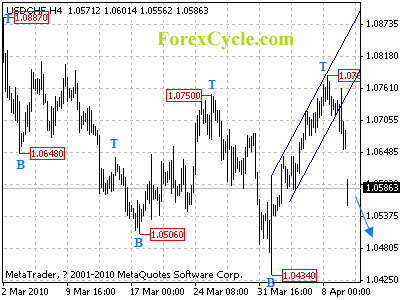
USDCHF dropped sharply from 1.0785

After breaking below the lower border of the price channel on 4-hour chart, USDCHF dropped sharply from 1.0785, suggesting that a cycle top had been formed. Now the fall from 1.0785 is treated as resumption of downtrend, deeper decline towards 1.0434 previous low could be seen in next several days. Resistance is at 1.0610 followed by 1.0645.

usdchf

Daily Forex Signals

GBPUSD broke above 1.5382

GBPUSD broke above 1.5382 key resistance, suggesting that the downtrend from 1.6875 has completed at 1.4784 already. Further rally would more likely be seen in next several weeks, and target would be at the upper border of the price channel. Support is at 1.4784, only fall below this level could take price back to downward movement.

For long term analysis, GBPUSD is in bearish movement from 1.7042. Move to 1.4500 area is expected in next several weeks.

gbpusd

Written by ForexCycle.com