Forex Daily Market Commentary

By GCI Forex Research

Fundamental Outlook at 1500 GMT (EDT + 0500)

The euro appreciated vis-à-vis the U.S. dollar today as the single currency tested offers around the US$ 1.3490 level and was supported around the $1.3340 level.  The common currency rocketed higher on news that the European Union may be more supportive of a financial aid package for Greece than previously believed by the markets.  Fitch downgraded Greece’s credit rating to the lowest investment grade possible but European officials announced plans to support Greece if needed, pushing the yield on 10-year Greek debt down by 29 bps from yesterday’s eleven-year highs.  The financial package is said to include an arrangement between the International Monetary Fund, the eurozone, and other European Union institutions whereby Greece would have to apply to both the EU and the IMF jointly to avail of as much as €20 billion in funding.  The European Union’s credits to Greece would incorporate bilateral loans at a rate higher than the IMF’s credit facility but would be more attractive than prevailing rates in the market.  European Central Bank President Trichet called on governments to reduce spending soon and added Europe’s economic recovery may be a “bumpy road.”  Data released in Germany today saw the February trade balance print at €12.6 billion while the February current account printed at €9.1 billion.  In U.S. news, February wholesale inventories printed at +0.6%, up from the upwardly revised prior reading of +0.1%.  Federal Reserve Chairman Bernanke last night reported “policymakers must respond forcefully, creatively, and decisively to severe financial crises.”  Euro bids are cited around the US$ 1.3175 level.

¥/ CNY

The yen appreciated vis-à-vis the U.S. dollar today as the greenback tested bids around the ¥93.10 level and was capped around the ¥93.80 level.  Bank of Japan Governor Shirakawa met Prime Minister Hatoyama today in the first of a series of quarterly meetings where the central bank will likely be pressured by the government to enact new easing measures.  Shirakawa reported the central bank’s monthly purchase of ¥1.8 trillion in Japanese government bonds was not discussed during the meeting.  Hatoyama reported both the government and central bank will take measures to counter deflation.  Bank of Japan this week maintained its assessment of the economy, reporting “Japan’s economy has been picking up mainly due to improvement in overseas economic conditions and to various policy measures.”  BoJ reiterated the economy still lacks “momentum to support a self-sustained recovery in domestic private demand.”  The central bank also reported corporate sentiment is improving, capital spending is leveling out, and the deceleration in consumer prices will moderate.  Data released in Japan yesterday saw the February current account total print at ¥1.47 trillion while February machine orders were off 5.4% m/m and 7.1% y/y.  Also, March bankruptcies were off 14.5% y/y and March machine tool orders were up 262.1% y/y.  Additionally, the March economy watchers’ survey improved at the both the current and outlook levels.  The Nikkei 225 stock index climbed 0.32% to close at ¥11,204.34.  U.S. dollar offers are cited around the ¥96.85 level.  The euro moved higher vis-à-vis the yen as the single currency tested offers around the ¥125.80 level and was supported around the ¥124.65 level.  The British pound moved higher vis-à-vis the yen as sterling tested offers around the ¥144.30 level while the Swiss franc moved higher vis-à-vis the yen and tested offers around the ¥87.70 level. In Chinese news, the U.S. dollar depreciated vis-à-vis the Chinese yuan as the greenback closed at CNY 6.8236 in the over-the-counter market, down from CNY 6.8243.  The government plans to sell about CNY 200 billion of bonds on behalf of local governments this quarter.  The move higher in the yuan was expected by most dealers as simmering tensions between the U.S. and China have thawed a little bit in the run-up to next week’s meeting in Washington, D.C. between leadership from the two countries.  Treasury Secretary Geithner met with Chinese leadership in Beijing yesterday to stress the importance of bilateral relations.  People’s Bank of China sold about CNY 15 billion in three-year bills this week, its first sale since June 2008 and the central bank’s latest attempt to drain liquidity and manage money supply growth.  There is a growing sense that China is close to announcing an important shift in its currency policy, possibly including a further liberalization of the yuan’s exchange rate.

The British pound appreciated vis-à-vis the U.S. dollar today as cable tested offers around the US$ 1.5390 level and was supported around the $1.5265 level.  As expected, Bank of England’s Monetary Policy Committee kept its main Bank rate unchanged at 0.50% yesterday and kept its asset purchase program unchanged at £200 billion.  Bank for International Settlements yesterday issued a stern warning about the size of U.K. sovereign debt.  Many data were released in the U.K. this week. First, March Halifax house prices were up 1.1% m/m and 5.2% y/y for the most recent three-month period.  Second, February industrial production was up 1.0% m/m and off 0.1% y/y.  Third, February manufacturing production was up 1.3% m/m and 1.4% y/y.  Fourth, the March NIESR GDP estimate came in at +0.4%, unchanged from the revised prior reading.  Cable bids are cited around the US$ 1.4455 level.  The euro moved higher vis-à-vis the British pound as the single currency tested offers around the £0.8775 level and was supported around the £0.8705 level.

CHF

The Swiss franc appreciated vis-à-vis the U.S. dollar today as the greenback tested bids around the CHF 1.0655 level and was capped around the CHF 1.0760 level.  Swiss National Bank Governing Board member Danthine said “avoiding inflation” is a “medium-term” challenge.  Data released in Switzerland this week  saw the March unemployment rate decline to 4.2% from 4.4% in February.  Swiss National Bank’s 2009 Annual Report was released this week in which the central bank indicated it expects GDP growth around 1% this year, down from the prior forecast of 1.5%.  Swiss National Bank is thought to have intervened again this week by selling the franc but this will remain unconfirmed and is far from certain because while the pair appreciated quickly, it did not appreciate by more than 35 pips.  U.S. dollar offers are cited around the CHF 1.0920 level.  The euro moved higher vis-à-vis the Swiss franc as the single currency tested offers around the CHF 1.4395 level while the British pound moved higher vis-à-vis the Swiss franc and tested offers around the CHF 1.6510 level.

Forex Daily Market Commentary provided by GCI Financial Ltd.

GCI Financial Ltd (”GCI”) is a regulated securities and commodities trading firm, specializing in online Foreign Exchange (”Forex”) brokerage. GCI executes billions of dollars per month in foreign exchange transactions alone. In addition to Forex, GCI is a primary market maker in Contracts for Difference (”CFDs”) on shares, indices and futures, and offers one of the fastest growing online CFD trading services. GCI has over 10,000 clients worldwide, including individual traders, institutions, and money managers. GCI provides an advanced, secure, and comprehensive online trading system. Client funds are insured and held in a separate customer account. In addition, GCI Financial Ltd maintains Net Capital in excess of minimum regulatory requirements.

DISCLAIMER: GCI’s Daily Market Commentary is provided for informational purposes only. The information contained in these reports is gathered from reputable news sources and is not intended to be U.S.ed as investment advice. GCI assumes no responsibility or liability from gains or losses incurred by the information herein contained.

How Might Gold, Silver and T-bonds Behave in a Bear Market?

By Editorial Staff

Can precious metals and U.S. Treasury bonds fall together? You bet.

Enjoy this excerpt from Elliott Wave International’s free Club EWI resource, Independent Investor eBook (Now With 6 New Chapters!). Please see details on how to read the entire eBook below.

Gold, Silver and T-bonds
(Robert Prechter, February 2009)

This section will offer a novel viewpoint. Can you imagine a scenario under which precious metal and Treasury bond prices would fall together? Most people would think such an event would be impossible. After all, as we showed in our study of March 2008, bonds do well during deflationary recessions, and gold goes up during inflationary booms. Shouldnt they be contra-cyclical?

Look at Figure 3 and realize that gold and T-bonds have been going up together for an entire decade.

major-tops-in-two-major-mkts

This is completely normal behavior according to our liquidity theory of market movement at the end of credit bubbles and their aftermath, as proposed in Conquer the Crash back in 2002. If gold and T-bonds can go up together for ten years, they certainly can go down together as well.

[Here is a scenario that] is likely to occur later, but since it could happen now, let’s review it. …U.S. Treasuries cannot hold up forever, particularly given the drunken-sailor approach to fiscal management that Congress has practiced over the past century and which has accelerated madly in the past eight years and even more outrageously since last September. At some point, Uncle Sam’s credit rating will begin to slip. According to the price of credit-default swaps on U.S. Treasury debt, it is already slipping.

When the monopoly issuing agent of dollar-denominated debt — the Federal government — begins to lose credibility as a debtor, the U.S.’s great experiment in fiat money will end. Read it here first: The U.S. government is the borrower of last resort. When it can’t borrow any more, the game will be up, because the government’s T-bonds are the basis of our “monetary” “system.”

What will happen when creditors begin to smell default? They will demand more interest. At first, it might not be much: 4%, 6%. But as the depression spreads, spending accelerates, deficits climb and tax receipts fall, the rate that creditors demand might soar to 10, 20, 40 or even 80%. In 1998, annual bond yields in Russia reached over 200% before the government finally threw in the towel and defaulted.

Prices of outstanding bonds, of course, collapse when yields surge. As rates rise, many people will sell other investments to lend at these “attractive” rates. In such a situation, T-bonds would be the primary engine of falling prices, as they suck value from other investments. So, this is another way that gold and bond prices can go down at the same time. …

Finish reading this groundbreaking and powerful 118-page eBook now, free! Here’s what else you’ll learn:

  • Why Buy and Hold Doesn’t Work Now
  • How To Invest During a Long-Term Bear Market
  • The Biggest Threat to the “Economic Recovery” is …
  • The Errors in “Efficient Market Hypothesis”
  • How To Be One of the Few the Government Hasn’t Fooled
  • MUCH More!

Keep reading this free 118-page eBook now — all you need to do is create a free Club EWI profile.

Elliott Wave International (EWI) is the world’s largest market forecasting firm. EWI’s 20-plus analysts provide around-the-clock forecasts of every major market in the world via the internet and proprietary web systems like Reuters and Bloomberg. EWI’s educational services include conferences, workshops, webinars, video tapes, special reports, books and one of the internet’s richest free content programs, Club EWI.

Canada’s employment rises by 18,000. Unemployment rate steady at 8.2%.

By CountingPips.com

Canadian employment data released today showed that jobs rose for a third straight month in March, according to the monthly report by Statistics Canada. Today’s jobs report showed that employment rose by 18,000 workers in March following a gain of approximately 21,000 jobs in February and 43,000 jobs in January. The jobs data did not match the market forecasts which were predicting an increase by approximately 25,000 workers for the month.

The unemployment rate remained steady at 8.2 percent as Canadian employment registered its best three-month rise since the financial crisis. Since July 2009 through March 2010, Canadian employment has now increased by 176,000 workers or 1.1 percent.

Part-time employment was the main driver for jobs in March with an increase by 32,000 hires while full-time employment fell by 14,000 workers for the month. The goods-producing sector saw jobs gain by 40,000 workers in March as construction added 21,000 jobs and employment in natural resources rose by 13,000 workers. Manufacturing hires were about flat for the month.

The service-providing sector shed approximately 22,000 jobs in March as the other services category saw a loss of 30,000 jobs while business, building & other support services jobs fell by 26,000 and transportation & warehousing lost 20,000 jobs. The largest contributor to jobs in the service sector was the professional, scientific & technical services category which produced a gain of 38,000 jobs in March.

The province of Ontario led the way in job growth for March with a gain of 10,000 jobs while Quebec added 6,000 workers and Saskatchewan added 3,300 workers. The provinces of Alberta and British Columbia saw job losses for the month totaling 3,400 workers and 500 workers, respectively.

Ontario employment has now increased by 102,000 workers since May 2009 while Quebec has increased its job growth by 56,000 workers since July 2009.

Forex Technical Analysis – S&P 500 – Trend Analysis

By Russell Glaser – The S&P daily chart shows a strong trending environment that is supported by numerous technical indicators. This presents traders with an opportunity to trade in a trending environment, utilizing appropriate strategies to enter and exit the market.

The Forex Technical Analysis below shows the daily chart for the S&P 500. The daily displays a strong upward sloping trend line that began in early February. Using a few technical tools to profile, a trending environment will be apparent.

The strong trending environment is shown by the ADX 14. The indicator currently reads 53. Any reading above 40 indicates a strong trending environment.

Also shown is the 14-day Relative Strength Indicator. By drawing a trend line underneath this indicator, it can help to identify the trend and eventually serve as a signal as to when the trend is broken. One signal of a broken trend occurs when the RSI breaks below its positive sloping trend line.

This trend is also supported by simple moving averages that are in a perfect order, meaning the price action is above the 20-day, 50-day, 100-day, and 200-day in that order.

Now that the trending environment has been identified, traders can enter the market on a break of a key resistance line or wait for a retracement to a Fibonacci level.

Forex Market Analysis provided by Forex Yard.

© 2006 by FxYard Ltd

Disclaimer: Trading Foreign Exchange carries a high level of risk and may not be suitable for all investors. There is a possibility that you could sustain a loss of all of your investment and therefore you should not invest money that you cannot afford to lose. You should be aware of all the risks associated with Foreign Exchange trading.

Forex Daily Market Review: 09/04/2010

Forex Market Review by Finexo.com

Past Events
• USD Unemployment Claims, out at 460K versus expected 434K, prior 442K (revised)
• GBP Halifax PMI, out at 1.1% versus expected 0.6%, prior -1.6% (revised)
• GBP Manufacturing Production, out at 1.3% versus expected 0.7%, prior -1.0% (revised)
• GBP Asset Purchase Facility, out at 200B as expected, prior 200B
• GBP Official Bank Rate, out at 0.5% as expected, prior 0.5%
• EUR Retail Sales, out at -0.6% versus expected 0.0%, prior -0.2% (revised)
• EUR Minimum Bid Rate, out at 1.0% as expected, prior 1.0%
• EUR ECB Press Conference

Upcoming Events
• USD Fed Chairman Ben Bernanke to speak in Washington (1230 GMT)
• CAD Employment Change (1100 GMT)
• CAD Unemployment Rate (1100 GMT)
• EUR ECB President Trichet to speak in Milan (1530 GMT)

Market Commentary
More Americans unexpectedly filed first time claims for jobless benefits last week, in part reflecting difficulty in seasonally adjusting the data ahead of the Easter holiday. Initial jobless applications increased by 18,000 to 460,000 in the week ended April 3rd, Labor Department figures showed yesterday. The week leading up to Easter and the two weeks that follow are traditionally a “volatile time” for claims, a Labor Department analyst said.

Last week the US Labor Department reported that payrolls rose by 162,000 in March, the biggest gain in three years. The unemployment rate was 9.7% for a third month. It has not increased since reaching a 26-year high of 10.1% in October.

Some companies may be reluctant to expand payrolls until they see sustained increases in sales as the US emerges from recession. Federal Reserve Chairman Ben Bernanke said yesterday that joblessness, home foreclosures and weak lending to small businesses pose challenges to the economy.

Yesterday the US Dollar fell 0.14% against the Euro to close at USD 1.3359. The US Dollar had climbed against the Euro during the previous four days. Against Sterling the US Dollar also dropped for the first time in three days, sliding 0.26% to close at USD 1.5273.

In the UK yesterday the Bank of England kept interest rates at a record low of 0.5% for the 13th consecutive month in its last decision before the upcoming general election. It also left its 200 billion-Pound asset purchasing program on hold.

The decision had been widely anticipated amid concerns that Britain’s recovery from a punishing 18-month long downturn remains fragile. The perilous state of the economy is expected to be a major factor in the general election scheduled for May 6th.
Both the ruling Labour Party and the main opposition Conservative Party are trying to convince voters that they have a clear plan to reduce the country’s massive budget deficit — but both also warn that Britons face a new age of austerity regardless of the election outcome.

Also in the UK yesterday, results of the latest Halifax survey showed that house prices rebounded in March after falling sharply in February. March house prices were up 1.1% on the month to stand up 5.2% on the year, following a revised 1.6% fall on the month in February. The 1.1% increase was the eighth monthly rise in house prices in the past nine months and the largest since November last year.
The 5.2% year-on-year rise was the largest since December 2007. House prices in the first quarter were up 0.6% on the fourth quarter. UK house prices were up 9.1% in March from their April 2009 trough, having fallen 23% from peak to trough.

Martin Ellis, Halifax’s housing economist, said increasing supply should curb house price inflation. “There are signs that an increase in the number of properties available for sale is beginning to reduce the imbalance between supply and demand. This should help to contain the upward pressure on house prices,” he said.
UK figures for manufacturing output bounced back sharply in February, taking annual growth to its highest level for two years, according to figures released by the National Statistics Office yesterday. Manufacturing output rose 1.3% on the month in February to stand 1.4% above levels a year earlier, the highest annual rise since February 2008.

Analysts had forecast a more moderate increase of 0.5% on the month and of 0.9% on the year. The National Statistics Office said that there was some evidence that strength in the February data represented a rebound from the fall in output seen in January due to the poor weather. In the three months to February, manufacturing output was up a healthy 0.8% compared with the previous three months, suggesting output is likely to add positively to GDP growth in the first quarter.

Yesterday saw Sterling post its ninth consecutive day of gains against the Euro. The Pound appreciated 0.15% to close the day’s trading at GBP 0.8745 to the Euro.

In Europe yesterday the European Central Bank announced that it would keep the Euro Zone interest rate at its record-low level of 1% for the eleventh month in a row. The decision was expected and comes as the ECB is scaling back its lending to banks aimed at stimulating the economy.

Speaking at the monthly press conference following the rate announcement ECB President Jean-Claude Trichet said the bank expected growth to be moderate for the rest of the year. Mr. Trichet said the bank’s interest rates were “appropriate” given moderate inflation and economic growth in the early months of the year. But he warned of a continued “environment of uncertainty”.
When asked for his views on the outlook for crisis-hit Greece, he insisted that the ECB supported the package of measures agreed by EU leaders at last month’s summit in Brussels. However he stressed that what was important was that the austerity program announced by the Greek government was implemented. “I have no reason to think it will not be”, he told reporters, but added: “We remain alert.”

Asked whether he thought Greece might default on its debt he said: “Taking all the information I have, a default is not an issue for Greece.” Concern has been growing in the markets about Greece’s situation and the level of support it will need, pushing its borrowing costs to record levels.

In other European news, Euro area retail sales unexpectedly fell 0.6% in February, more than had been expected by analysts and down 1.1% compared with the same time last year. The fall is being attributed to a lack of confidence by consumers following news that unemployment in the 16-nation Euro Zone had reached 10%. Consumer spending has failed to pick up despite low interest rates.

Forex Market Review & Analysis by Finexo.com

Disclaimer: Trading the foreign exchange (Forex) carries a high level of risk, and may not be suitable for all investors. All information and opinions contained on this website are to be used for general informational purposes only and do not consitute investment advice.

Gold Hits Three Month High

By Anton Eljwizat – Gold prices rose significantly in the last two weeks and peaked at $1156.30 an ounce. Gold reached its highest level in almost three months. However, the daily chart is suggesting that a recent upwards trend is loosing steam and a bearish correction is impending. Forex traders involved with commodities like this can take advantage of this knowledge by going short on gold now, and at a great entry price!

• Below is the daily chart for gold by ForexYard.

• The technical indicators used are the Slow Stochastic, RSI and Williams Percent Range.

• Point 1: The RSI signals that the price of this pair currently floats in the over-bought territory, suggesting downward pressure.

• Point 2: The Slow Stochastic indicates a bearish cross, which may signal a downward movement is going to occur in the near future.

• Point 3: The Williams Percent Ranges is showing that this pair is heavily over-bought and may be experiencing strong downward pressure.

Gold- Daily Chart

Forex Market Analysis provided by Forex Yard.

© 2006 by FxYard Ltd

Disclaimer: Trading Foreign Exchange carries a high level of risk and may not be suitable for all investors. There is a possibility that you could sustain a loss of all of your investment and therefore you should not invest money that you cannot afford to lose. You should be aware of all the risks associated with Foreign Exchange trading.

USD/CAD in Focus for Today’s Forex Trading

By Greg Holden – Going into this week’s closing there are 2 pieces of vital information traders can focus on. The first are the news releases outlined below. The second is the recent upswing by the EUR, which some analysts consider hollow.

The Canadian news releases detailed below are much more important in today’s trading than they otherwise would be simply because the other major world economies will be relatively silent. The economic calendar is moderately empty today and this makes Canadian employment data the largest market-mover we’ll see.

The EUR’s recent upswing, which has helped it to exit out of its downtrend with the USD, is considered hollow due to the fact that currencies such as the GBP have already pared the EUR’s gains. It stands to show that this support may not sustain itself despite the surge in optimism following Jean-Claude Trichet’s statements yesterday.

Today’s leading events:

11:00 GMT: CAD – Employment Change/ Unemployment Rate

– Canadian employment figures don’t tend to have a large impact on other world economies. However, there is a possibility that today’s releases will indeed have a large impact since other economies will be absent from today’s calendar.

– Even though the USD/CAD’s bearish channel was broken recently, the pair seems to have re-entered this trend. Should today’s employment figures come in as expected, or better, there is a strong chance that a new bearish channel will form.

Crude Oil Tips:

– Given that the USD and Crude Oil are going to be absent from today’s calendar, traders are advised to watch the price of Crude Oil simply because it has little reason to exit its current trend.

– While it is true that Crude Oil prices have met resistance and turned downwards recently, yesterday’s Dollar weakness has helped push oil prices back up. Since little news is going to be released which will adversely affect this trend, it is relatively safe to say that oil is a good asset to buy into for the short-term in today’s trading.

Forex Market Analysis provided by Forex Yard.

© 2006 by FxYard Ltd

Disclaimer: Trading Foreign Exchange carries a high level of risk and may not be suitable for all investors. There is a possibility that you could sustain a loss of all of your investment and therefore you should not invest money that you cannot afford to lose. You should be aware of all the risks associated with Foreign Exchange trading.

Greece Concerns Allayed by ECB; EUR Rebounds

Source: Forex Yard

The Euro was provided assistance earlier today when the European Central Bank (ECB) announced that interest rates would be held steady – as was expected – and that there was little fear of a sovereign default by Greece. Such a turn of events gave the 16-nation single currency a much needed boost against its primary rival, the US Dollar, but some analysts contend that these gains will be short-lived.

Economic News

USD – EUR/USD Exits Down-Trend

After continually gaining against its primary rivals in trading over the past few days, the USD has apparently reversed course. Against the Euro, the greenback was on a healthy rise until reaching its peak at 1.3280, the pair rebounded towards 1.3355 at the end of New York trading. Against the British Pound, however, the behavior was much more erratic. The USD spent most of the day in decline against the Sterling, but has begun to pare losses by the middle of the Asian market hours. The pair currently sits at 1.5270.

The Euro was provided assistance earlier today when the European Central Bank (ECB) announced that interest rates would be held steady – as was expected – and that there was little fear of a sovereign default by Greece. Such a turn of events gave the 16-nation single currency a much needed boost against its primary rival, the US Dollar.

Heading into this week’s conclusion, both the European and American economies will remain relatively silent, but Canada will be publishing moderately important data concerning employment. Most investors are expecting little change in the value of the major currency pairs, but due to today’s Canadian economic releases, the CAD may experience a healthy dose of volatility.

EUR – EUR Gains from ECB Governor Statements

The EUR experienced moderate bounces in positive price volatility today following news from European Central Bank (ECB) governor Jean-Claude Trichet. In an anticipated move, the ECB decided to hold interest rates steady while declaring growing stability for Greece. Trichet declared that there was little fear of a sovereign default by Greece in the future and the impact was gripped by short-term bursts in EUR growth.

Following the announcement by Trichet, the EUR exited its recent week-long downtrend against the USD and bounced back towards 1.3355 by the end of yesterday’s trading. Against the GBP the EUR witnessed two sharp spikes after the announcement by the ECB, but was unable to sustain its growth and fell back into its downtrend, sending a wave of chatter among analysts that a similar fate was due for the EUR/USD in today’s trading.

With little news expected from the Euro-Zone today, the prospects of a USD bounce-back are moderate. But the United States will also be absent from the calendar, pushing the odds closer to 50-50. A number of French and German industrial figures are expected and could help the EUR hold its gains, should they reach market expectations.

JPY – JPY Bearish against Majors; Weekly Gains at an End

After a 4-day period of decline, the USD/JPY currency pair has appeared to bounce back towards the end of yesterday’s trading. The pair was trading within a steady bearish channel since Monday, but today’s downturn of the USD against most currency rivals has resulted in a rebound of the Dollar against the Yen. Upon reaching a weekly low of 92.74, the pair has recent popped back up to 93.48 in today’s early morning hours.

Similar results were experienced against the EUR, GBP, and CHF this morning as well. A broad sell-off of Japanese Yen appears to have taken place as stocks rebound moderately and investors pull their money out of the traditional safety of the island currency. With a somewhat light news day ahead, the Yen may not be able to overcome these recent losses until next week.

OIL – Spot Crude Oil Price Rebounds after Week-Long Decline

It appears as if the price of Crude Oil has received a mild boost from the falling USD in yesterday’s trading. Upon meeting heavy resistance at the $87.00 price level, the price of oil then dropped below $84.50, but has recent recovered and is trading at $85.70. The value of the US Dollar is driving these price fluctuations but little news will be pushing the USD in today’s trading.

With hardly any fundamental data releases coming out of the United States today, the value of the USD most likely will not change drastically before the end of this week’s trading. This supports the notion that oil prices could continue to rise slowly and steadily throughout Friday’s trading. However, should the Dollar experience sharp price movements in either direction, there will undoubtedly be a correlated price movement for Crude Oil.

Technical News

EUR/USD

Yesterday’s upward correction may have finished running its course. A bearish cross has formed on the 4-hour Slow Stochastic Oscillator, indicating a possible drop in the price. The price action looks to be contained in the lower half of the Bollinger Bands, as yesterday’s breakout failed to breach the 20-day moving average line. This indicates a strong downward trend. Traders may want to go short today.

GBP/USD

This past week the pair has maintained specific price levels, range trading between the prices of 1.5130 and 1.5320. Traders can take advantage of this environment by going short to the support line with a limit at the support level and then going long with a limit at the resistance level. A price breakout above or below these levels would signal an end to this range trading environment.

USD/JPY

The daily chart shows signs of a potential larger move for the pair. The MACD lines appear on the verge of completing a bearish cross, indicating the pair may fall. The 14-day Relative Strength Indicator is very close to breaking the upward sloping trend line. This would support a larger downward price move. Traders may want to wait for the completion of these sell signals and then go short.

USD/CHF

The pair’s short term bullish trend is strong as shown by the price action on the 4-hour chart. The pair fell to the 20-day moving average line of the Bollinger Bands where it proceeded to rise once again. This is supported by the 14-day RSI that has resumed its uptrend. A break above the 1.0740 resistance line could signal a potential breakout.

The Wild Card

S&P 500

The stock index shows a powerful uptrend. The price has moved back above its long term rising trend line and is trading above its 20-day, 50-day, 100-day, and 200-day simple moving average lines in that order. Also the ADX 14 is floating at 53. Anything above 40 indicates a strong trending environment. Forex traders may want to go long in this type of trend.

Forex Market Analysis provided by Forex Yard.

© 2006 by FxYard Ltd

Disclaimer: Trading Foreign Exchange carries a high level of risk and may not be suitable for all investors. There is a possibility that you could sustain a loss of all of your investment and therefore you should not invest money that you cannot afford to lose. You should be aware of all the risks associated with Foreign Exchange trading.

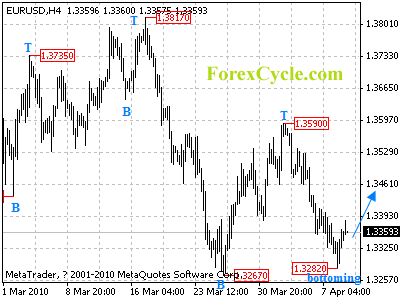
EURUSD rebounds from 1.3282

Being contained by 1.3267 previous low support, EURUSD rebounds from 1.3282, suggesting that a cycle bottom is being formed on 4-hour chart. Further rise to 1.3450 area would more likely be seen in a couple of days. Key support is at 1.3267, below this level will indicate that the longer term downtrend from 1.5144 (Nov 25, 2009 high) has resumed, then another fall towards 1.3100 could be seen.

eurusd

Daily Forex Analysis

Forex Daily Market Commentary

By GCI Forex Research

Fundamental Outlook at 1500 GMT (EDT + 0500)

The euro appreciated vis-à-vis the U.S. dollar today as the single currency tested offers around the US$ 1.3365 level and was supported around the $1.3280 level.  As expected, the European Central Bank did not announce a change to its monetary policy today and European Central Bank President Trichet reiterated views he has made in recent policy statements.  The big news in the eurozone remains the worsening situation in Greece.  There are reports that western banks have pulled their repo lines with Greek banks, reducing the ability of Greek banks to secure funding in the international capital markets.  Trichet today said the Greek situation is not even an “issue” but added responsbilities must be undertaken to contend with the problem.  The capital markets might disagree with Trichet’s assessment of Greece’s worsening problems, however, as Greek assets depreciated significantly today.  Spreads on five-year Greek credit default swap spreads blew out by 55bps during the European session and Greek cash bonds also moved lower with yields on 10-year Greek bonds reaching 7.5% today – their highest level since the advent of the euro.  European Union finance ministers will convene in Madrid on 16-18 April and G20 officials convene 22 April ahead of the annual IMF and World Bank meetings on 24-25 April.  The most pressing test for Greece will come on 19 May when some €8.1 billion in debt comes due.  It is estimated that at least two syndications would be required to refinance the maturing debt and there is growing concern that investors may have insufficient appetite for more Greek paper, even at higher yields.  Credit default swap spreads on other heavily-indebted countries including Spain and Portugal also widened.  The ECB also announced a more liberal collateral eligibility policy that is partially designed to assure that Greek debt can be utilized in repo transactions into 2011.  Data released in the eurozone today saw February retail sales off 0.6% m/m and off 1.1% y/y.  In U.S. news, Minneapolis Fed President Kocherlakota reported the Fed needs to retain supervisory powers and said “banks with large amounts of commercial real estate risk-exposure face a correspondingly elevated risk of failure.  This threat could well lead to continued declines in bank lending, which could curtail the recovery.” Federal Reserve Governor Tarullo said the need to low rates will not “diminish soon,” reiterating dovish comments made by Fed Chairman Bernanke yesterday.  Data released in the U.S. today saw weekly initial jobless claims climb to 460,000 from a revised 442,000 while continuing jobless claims fell to 4.550 million from 4.681 million. Also, March ISCS chain store sales were up a significant 9.0% y/y.  February wholesale inventories data will be released tomorrow.  Euro bids are cited around the US$ 1.3175 level.

¥/ CNY

The yen appreciated vis-à-vis the U.S. dollar today as the greenback tested bids around the ¥92.85 level and was capped around the ¥93.40 level.  Bank of Japan maintained its assessment of the economy overnight, reporting “Japan’s economy has been picking up mainly due to improvement in overseas economic conditions and to various policy measures.”  BoJ reiterated the economy still lacks “momentum to support a self-sustained recovery in domestic private demand.”  Nikkei reported BoJ Governor Shirakawa and Prime Minister Hatoyama will meet regularly to discuss the economy.  The central bank also reported corporate sentiment is improving, capital spending is leveling out, and the deceleration in consumer prices will moderate.  Data released in Japan overnight saw the February current account total print at ¥ 1.47 trillion while February machine orders were off 5.4% m/m and 7.1% y/y.  Also, March bankruptcies were off 14.5% y/y and March machine tool orders were up 262.1% y/y.  Additionally, the March economy watchers’ survey improved at the both the current and outlook levels.  The Nikkei 225 stock index lost 1.10% to close at ¥11,168.20.  U.S. dollar offers are cited around the ¥96.85 level.  The euro moved lower vis-à-vis the yen as the single currency tested bids around the ¥123.40 level and was capped around the ¥124.60 level.  The British pound moved lower vis-à-vis the yen as sterling tested bids around the ¥140.95 level while the Swiss franc moved lower vis-à-vis the yen and tested bids around the ¥86.15 level. In Chinese news, the U.S. dollar depreciated vis-à-vis the Chinese yuan as the greenback closed at CNY 6.8243 in the over-the-counter market, down from CNY 6.8255.  The move higher in the yuan was expected by most dealers as simmering tensions between the U.S. and China have thawed a little bit in the run-up to next week’s meeting in Washington, D.C. between leadership from the two countries.  Treasury Secretary Geithner met with Chinese leadership in Beijing today to stress the importance of bilateral relations.  People’s Bank of China sold about CNY 15 billion in three-year bills today, its first sale since June 2008 and the central bank’s latest attempt to drain liquidity and manage money supply growth.  There is a growing sense that China is close to announcing an important shift in its currency policy, possibly including a further liberalization of the yuan’s exchange rate.

The British pound appreciated vis-à-vis the U.S. dollar today as cable tested offers around the US$ 1.5275 level and was supported around the $1.5140 level.  Many data were released in the U.K. today. First, March Halifax house prices were up 1.1% m/m and 5.2% y/y for the most recent three-month period.  Second, February industrial production was up 1.0% m/m and off 0.1% y/y.  Third, February manufacturing production was up 1.3% m/m and 1.4% y/y.  Fourth, the March NIESR GDP estimate came in at +0.4%, unchanged from the revised prior reading.  As expected, Bank of England’s Monetary Policy Committee kept its main Bank rate unchanged at 0.50% and kept its asset purchase program unchanged at £200 billion.  Bank for International Settlements today issued a stern warning about the size of U.K. sovereign debt.  Cable bids are cited around the US$ 1.4455 level.  The euro moved lower vis-à-vis the British pound as the single currency tested bids around the £0.8735 level and was capped around the £0.8780 level.

CHF

The Swiss franc appreciated vis-à-vis the U.S. dollar today as the greenback tested bids around the CHF 1.0715 level and was capped around the CHF 1.0785 level.  Data released in Switzerland today saw the March unemployment rate decline to 4.2% from 4.4% in February.  Swiss National Bank’s 2009 Annual Report was released today in which the central bank indicated it expects GDP growth around 1% this year, down from the prior forecast of 1.5%.  Swiss National Bank is thought to have intervened again yesterday by selling the franc but this will remain unconfirmed and is far from certain because while the pair appreciated quickly, it did not appreciate by more than 35 pips.  U.S. dollar offers are cited around the CHF 1.0920 level.  The euro moved lower vis-à-vis the Swiss franc as the single currency tested bids around the CHF 1.4320 level while the British pound moved higher vis-à-vis the Swiss franc and tested offers around the CHF 1.6395 level.

Forex Daily Market Commentary provided by GCI Financial Ltd.

GCI Financial Ltd (”GCI”) is a regulated securities and commodities trading firm, specializing in online Foreign Exchange (”Forex”) brokerage. GCI executes billions of dollars per month in foreign exchange transactions alone. In addition to Forex, GCI is a primary market maker in Contracts for Difference (”CFDs”) on shares, indices and futures, and offers one of the fastest growing online CFD trading services. GCI has over 10,000 clients worldwide, including individual traders, institutions, and money managers. GCI provides an advanced, secure, and comprehensive online trading system. Client funds are insured and held in a separate customer account. In addition, GCI Financial Ltd maintains Net Capital in excess of minimum regulatory requirements.

DISCLAIMER: GCI’s Daily Market Commentary is provided for informational purposes only. The information contained in these reports is gathered from reputable news sources and is not intended to be U.S.ed as investment advice. GCI assumes no responsibility or liability from gains or losses incurred by the information herein contained.