U.S. Trade Balance May Lead to Dollar Losses

By Dan Eduard – U.S. imports most likely increased in February, which if true, would signal further growth in the American economy. This is the prevailing sentiment among analysts ahead of the monthly Trade Balance report scheduled to be released at 12:30 GMT today. While imports appear to be on the rise, there is still cause for concern regarding the U.S. export market, which is not forecasted to see the same level of growth. The trade balance figure, which measures the difference in value for imported and exported goods and services, is predicted to come in at -38.5B. If correct, the figure would be slightly worse then last month’s figure of -37.3B.

Last month, the U.S. trade balance unexpectedly improved, which gave the Dollar a boost against its major counterparts, especially the Canadian Dollar. This month, traders can expect the greenback to fall slightly, providing the figure comes in as predicted. That being said, a better then expected result could help USD recoup some of its recent losses to the Euro.

Tomorrow, traders will want to pay close attention to the testimony from Fed Chairman Bernanke. A speech by the Fed Chairman typically leads to market volatility, and tomorrow should be no different. Traders will want to pay attention to any talk regarding interest rates or long term predictions for the U.S. economy. Any positive sentiment will likely bode well for the Dollar.

Forex Market Analysis provided by Forex Yard.

© 2006 by FxYard Ltd

Disclaimer: Trading Foreign Exchange carries a high level of risk and may not be suitable for all investors. There is a possibility that you could sustain a loss of all of your investment and therefore you should not invest money that you cannot afford to lose. You should be aware of all the risks associated with Foreign Exchange trading.
Euro Higher On Greece Aid Package, U.S. Budget Deficit Narrowed

Source: Forex Yard

The European Union finally agreed upon an aid package for Greece. The aid package of $61 Billion sent investors to buy the EUR, pushing it significantly higher against all its major counterparts. Greek fiscal problems seem close to be over, however, investors are still suspicious of other European nations, and the EUR pulled back against the dollar later during the trading day, currently the EUR/USD pair is trading at 1.3584 after trading at 1.3691, yesterday’s highest price.

Economic News

USD – U.S. Budget Deficit Narrowed

In the absence of major news from the U.S. yesterday, trade was mainly influenced by the aid package provided to Greece. Later, during yesterday’s trading, the U.S. published the budget balance, which showed improvement over previous months. However, the figure was negative, indicating the government was still spending more than making revenue during March.

The EUR/USD pair was quite volatile yesterday, as the euro increased the most in seven months against the greenback. The trend turned around as the trading day advanced, and the euro lost a part of its gains against the U.S. Dollar, as investors are still cautious about the global economy and in particular Europe. The change in investor mood influenced commodities and dependent commodities currencies such as the AUD which ended lower against the USD, the pair is currently trading at 0.9257.

The USD is expected to continue to strengthen today against its major counterparts. Investors are advised to follow the Trade Balance today at 12:30GMT, and thereafter follow the outcome of Treasury Secretary Geithner’s speech at 16:45GMT.

EUR – Euro Gains on Greek Bailout

Greek fiscal problems seem close to an end. The aid package offered to Greece, sent investors to accumulate the recently over sold currency. The support of the European Union helped eliminate some of the uncertainty around Greece. Investors are advised to continue to monitor news regarding the aid package. New developments about Greece’s debts or aid plan would have an impact over the euro against its major counterparts.

The British pound also gained by the rush to riskier assets. However, it is viewed as a short term correction rather than a new long term trend. With UK election coming up beginning of May, investors are expected volatility to increase for the GBP/USD pair. The pair is currently trading at 1.5349.

Later today, the UK will publish trade balance figures, and although it is not forecasted to turn positive, a better than expected figure may support the GBP against its major counterparts.

JPY – USD/JPY Crosses Below 93

The Japanese Yen saw some volatility yesterday versus the USD and is currently trading at 92.63, below a key support level at 93. Investors forecast the pair would reach 100, after BOJ Governor signaled he prefers a weak Yen in order to support the Japanese economy, which is facing deflation. Producer Prices published yesterday declined less than expected, but the figure was still negative. On Wednesday, BOJ Governor Shirakawa will probably relate to interest rates and easing measures in his speech.

The EUR/JPY also saw high volatility yesterday, while investors sold EUR and bought the JPY. The pair was down by almost 150 pips from yesterday’s trade high price.

OIL – Crude Oil Prices Continue to Rise

Oil is currently trading at $84.00, down for the fourth day after it traded last week at almost $87 a barrel. The price started to decline after last week’s inventories report which was less than expected. The day actually started positive for crude oil as the euro’s rally weakened the greenback and helped to push price of spot crude oil higher at the start of the day. However, as the day progressed and the USD strengthened, spot crude oil prices were sent lower to $84 during yesterday’s trade.

Technical News

EUR/USD

Yesterday the pair was unable to breach below the 1.3567 support line on the 4-hour chart. This level may provide further support for the pair today as the chart shows a potential bearish cross forming on the Slow Stochastic. Should the cross take place, the price could rise in the short term. A price target may be the 50% Fibonacci retracement level at 1.3800.

GBP/USD

The pair dropped below the support line of 1.5380, but found support at the 1.5350 level. The support line happens to be a 50% Fibonacci retracement level on the daily chart. This may be an opportunity for traders to enter into a strong trending environment. The ADX 14 on the daily chart shows a reading of 39 and rising. This indicates a strong bullish trend. Traders may want to go long on the pair as it appears the price could rebound from this retracement level.

USD/JPY

The Stochastic Slow lines on the 1-hour chart appear to be close to forming a cross at the lower resistance level, indicating a bullish correction is possible. This sentiment is supported by the Bollinger Bands on the daily chart. The widening of the bands indicates a price change may occur soon, but the direction is unknown. Traders may want to take a wait and see approach for this pair today.

USD/CHF

Most technical indicators show that this pair is currently trading in neutral territory, and will likely continue to do so today. The exception is the Relative Strength Index, (RSI) on both the 4-hour and 8-hour charts, which shows the pair currently in oversold territory. This usually indicates a bearish correction could take place in the near future. Traders may want to go long with tight stops today.

The Wild Card

Dow Jones Industrials

Following the Dow Jones recent climb to above 11000, most technical indicators are now showing the CFD trading in neutral territory. Still, the Relative Strength Index, (RSI) on both the 1-hour and 2-hour charts show signs that a bullish move may be possible in the next few hours. Forex traders may want to go long with tight stops today, as it is possible the CFD will continue moving upward.

Forex Market Analysis provided by Forex Yard.

© 2006 by FxYard Ltd

Disclaimer: Trading Foreign Exchange carries a high level of risk and may not be suitable for all investors. There is a possibility that you could sustain a loss of all of your investment and therefore you should not invest money that you cannot afford to lose. You should be aware of all the risks associated with Foreign Exchange trading.

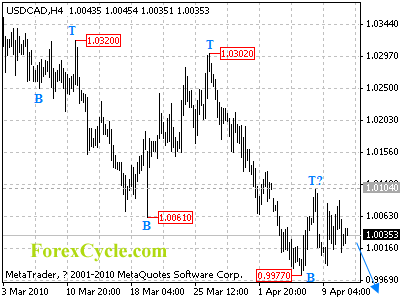
USDCAD stays in a trading range between 1.9977 and 1.0104

USDCAD stays in a trading range between 1.9977 and 1.0104. Lengthier sideways movement in the range is still possible later today. However, the price action in the trading range is more likely consolidation of downtrend from 1.0302, as long as 1.0104 resistance holds, another fall towards 0.9900 is still possible after consolidation, and a breakdown below 0.9977 could signal resumption of downtrend.

usdcad

Daily Forex Signals

Forex Daily Market Commentary

By GCI Forex Research

Fundamental Outlook at 1400 GMT (EDT + 0400)

The euro appreciated vis-à-vis the U.S. dollar today as the single currency tested offers around the US$ 1.3690 level and was supported around the $1.3565 level.  The common currency extended gains from late last week after it was reported that eurozone officials reached an agreement to provide financial assistance to Greece if that country cannot meet its refinancing needs in the market.  Greece has billions of euro in bonds maturing over the next couple of months and the recent increase in Greek yields may render it too expensive – or even impossible – for Greece to refinance its maturing debt.  The package offered by Greek officials is said to total some US$ 61 billion.  The spread between Greek ten-year bonds and German bunds narrowed today to around 350bps.  Dealers will again focus on the significant fiscal problems of Spain and Portugal and eurozone officials may be forced to assist them as well.  European Central Bank President Trichet reported the Greek plan as a “positive” step and called on the Greek government to meet its fiscal obligations.  German Chancellor Merkel is said to be facing major criticisms in her country for agreeing to the new financial assistance to Greece at below-market rates.  Data to be released in Germany tomorrow include March consumer price inflation followed by French February current account data and March consumer price inflation data on Wednesday.  In U.S. news, the March monthly budget statement printed at –US$ 65.4 billion.  Data to be released in the U.S. tomorrow include the March NFIB small business optimism index, February trade balance, and March import price index.  Fed Governors Duke and Tarullo spoke today about non-monetary issues.  Euro bids are cited around the US$ 1.3175 level.

¥/ CNY

The yen depreciated vis-à-vis the U.S. dollar today as the greenback tested offers around the ¥93.60 level and was supported around the ¥92.90 level.  Minutes from the Bank of Japan Policy Board meeting on 16-17 March were released overnight in which some rate-setters concluded “there was no solid justification for enhancing monetary conditions. The market may also increasingly come to consider that the bank would take whatever policy action the market has anticipated.”  BoJ policymakers doubled a lending program for commercial banks to ¥20 trillion.  Many members said the program’s expansion “reaffirmed the bank’s stance on continuing to consistently make a contribution” to improve economic growth and overcome deflation.  One common criticism is that the program will accomplish little as far as actually improving liquidity measures in the real economy and stimulating final private demand.  Data released in Japan overnight saw March bank lending decline 1.8% y/y, worse than the prior reading of -1.5%.   Data to be released in the Australasian session will include the March domestic corporate goods price index and March Tokyo-area condominium sales.  The Nikkei 225 stock index climbed 0.42% to close at 11,251.90.  U.S. dollar offers are cited around the ¥96.85 level.  The euro moved higher vis-à-vis the yen as the single currency tested offers around the ¥127.45 level and was supported around the ¥126.60 level.  The British pound moved higher vis-à-vis the yen as sterling tested offers around the ¥144.50 level while the Swiss franc moved higher vis-à-vis the yen and tested offers around the ¥88.30 level. In Chinese news, the U.S. dollar appreciated vis-à-vis the Chinese yuan as the greenback closed at CNY 6.8257 in the over-the-counter market, up from CNY 6.8236.  U.S. and Chinese officials will convene in Washington, D.C. this week to discuss China’s exchange rate policy and other financial aspects of the bilateral relationship.  China today reported its foreign exchange reserves totaled US$ 2.447 trillion at the end of March.  Also, China’s trade surplus in the first quarter was off 77% to US$ 14.49 billion.  China is said to have posted a rare US$ 7.24 billion trade deficit in March.

The British pound appreciated vis-à-vis the U.S. dollar today as cable tested offers around the US$ 1.5485 level and was supported around the $1.5365 level.  Traders are closely monitoring the lead-up to the U.K. general election on 6 May amid talk that Prime Minister Brown may have narrowed the gap against Tory challenger Cameron, the presumed favourite.  Dealers are still speculating the most likely scenario will be a hung Parliament and sterling has generally been weaker as a result of this premise.  Data to be released in the Australasian session include the BRC March retail sales monitor and the March RICS house price balance.  Cable bids are cited around the US$ 1.5140 level.  The euro moved higher vis-à-vis the British pound as the single currency tested offers around the £0.8845 level and was supported around the £0.8805 level.

CHF

The Swiss franc appreciated vis-à-vis the U.S. dollar today as the greenback tested bids around the CHF 1.0530 level and was capped around the CHF 1.0615 level.  Data to be released in Switzerland tomorrow include the March producer and import price index. On Friday, Swiss National Bank Governing Board member Danthine said “avoiding inflation” is a “medium-term” challenge.  Data released in Switzerland last week saw the March unemployment rate decline to 4.2% from 4.4% in February.  U.S. dollar offers are cited around the CHF 1.0920 level.  The euro moved lower vis-à-vis the Swiss franc as the single currency tested bids around the CHF 1.4380 level while the British pound moved lower vis-à-vis the Swiss franc and tested bids around the CHF 1.6270 level.

Forex Daily Market Commentary provided by GCI Financial Ltd.

GCI Financial Ltd (”GCI”) is a regulated securities and commodities trading firm, specializing in online Foreign Exchange (”Forex”) brokerage. GCI executes billions of dollars per month in foreign exchange transactions alone. In addition to Forex, GCI is a primary market maker in Contracts for Difference (”CFDs”) on shares, indices and futures, and offers one of the fastest growing online CFD trading services. GCI has over 10,000 clients worldwide, including individual traders, institutions, and money managers. GCI provides an advanced, secure, and comprehensive online trading system. Client funds are insured and held in a separate customer account. In addition, GCI Financial Ltd maintains Net Capital in excess of minimum regulatory requirements.

DISCLAIMER: GCI’s Daily Market Commentary is provided for informational purposes only. The information contained in these reports is gathered from reputable news sources and is not intended to be U.S.ed as investment advice. GCI assumes no responsibility or liability from gains or losses incurred by the information herein contained.

Market Myths Exposed: Inflation Is Not A Threat, Deflation Is

Our free eBook reveals the 10 most common financial misconceptions

By Nico Isaac

Most people are confident they can recognize a myth when they hear one: Wearing a hat causes baldness; eating a bunch of carrots gives you perfect vision; ‘light’ cigarettes are better for your health than the regular kind.

But what about this sentence: Inflation is the number one threat to the US economy? Ask the mainstream experts, and this statement is in no way a fabrication of the truth; it is truth itself. Case in point, this recent insight from a reputable news source:

“Given the extraordinary amounts of government spending, we believe inflation is likely to rear its ugly head.” (CNBC)

It looks reliable. It sounds reliable. But the reality is different. That fact is the subject of Chapter Three in Club EWI’s free educational eBook Market Myths Exposed, aptly titled “Myth No. 3: Worry About Inflation Rather Than Deflation.”

With groundbreaking insight from EWI’s president Bob Prechter, this chapter reveals how the most vital financial players have been led right up to the water of easy money. Yet, like the saying goes, no amount of incentive — be it record low interest rates or trillions of dollars in federal bailouts — has gotten them to “drink.” Here, the “Market Myths” chapter sheds light on this global leverage fast:

  • Banks: The premier dispensers of credit are about “95% invested in mortgages,” which can fall in dollar value at the start of a crisis. Also, a chart of Credit Standards At All Banks since 1997 reveals a new trend of tighter lending criterion. Both are deflationary.
  • Consumers: The premier devourers of credit are paying off their balances. See: chart of Total Consumer Credit (Annual Rate of Change) since 2000. This is deflationary.
  • Private Equity: “Of the ten largest leveraged buyout deals since 2007, four have defaulted and two are in distress. Just in this small group, there is nearly one-half a trillion dollars worth of loans headed for the dump.”
  • Small Businesses are self-liquidating; meaning, they create profits to pay back loans versus consumers. YET, “Market Myths” Chart of Bank Loan Availability to these small Enterprises contains a big, black arrow pointing DOWN. This is deflationary.
  • Home owners: Real estate values continue to fall, foreclosures continue to soar. Mortgage delinquencies are rising, and more and more people are walking away from their properties. All of these conditions are deflationary.

Six pages of riveting charts and commentary later and there’s no putting the pieces of this shattered myth back together: One by one, the key players in the creation and expansion of credit are adopting a stance of conservation and conservatism. This ultimately leads to a decline in the value of outstanding debt — a precondition of deflation, not inflation.

Believe it or not, this is just the beginning. In all, Market Myths Exposed throws light on the TEN most common financial misconceptions via excerpts and charts from EWI’s most popular editorial material of the last decade. Such as:

  • Myth No. 1: Earnings Drive Stock Prices
  • Myth No. 5: To Do Well In Investing, You Have To Diversify
  • Myth No. 8: Bubbles Can Unwind Slowly

The complete, NO-COST report is just a Club EWI sign-up away. Simply click here to get started.

Nico Isaac writes for Elliott Wave International, a market forecasting and technical analysis firm.

AUD/USD Sets New 2010 Highs

By Fast Brokers – The Aussie darted beyond previous 2010 highs today after the EU’s decision to provide Greece with aid benefited the risk trade across the board.  Due to the RBA’s comparatively hawkish stance coupled with solid Australia economic fundamentals the Aussie was ready to participate.  However, the Aussie has come off of intraday highs after nearly testing November 2009 highs.  Regardless, the Aussie’s uptrend is chugging along and with light data on the wire until Wednesday current momentums could carry on for the time being.  Although the U.S. will release its Trade Balance figure tomorrow, this likely won’t have too large of an impact on the FX markets unless it registers a large deviation from analyst expectations.  Meanwhile, Aussie investors should be paying close attention to developments in China.  China is clamping down on lending as the government battles to contain its real estate bubble and inflationary pressures.  China will release key data on Thursday, highlighted by CPI and GDP.  Should China’s economic recovery cool from the implementation of tighter liquidity measures, the Aussie could be dragged lower amid lowered expectations for demand for Australia’s commodities.  On the other hand, should China’s economic recovery plow ahead the Aussie could benefit directly since China’s rebound is helping fuel Australia’s economic growth.

Technically speaking, the Aussie faces technical barriers in the form of intraday and 11/17/09 highs.  As for the downside, the Aussie has multiple uptrend lines serving as technical cushions along with intraday, 4/9, and 4/5 lows.  Additionally, the psychological .93 and.92 levels could serve as technical cushions over the near-term.

Price: .9291
Resistances: .9306, .9316, .9330, .9342, .9353, .9383
Supports: .9291, .9273, .9259, .9247, .9234, .9215, .9202
Psychological: .93, .92, November 2009 highs, April lows

(click chart to enlarge)

Market Commentary provided by Fast Brokers.

Disclaimer: FastBrokers’ market commentary is provided for information purposes only and under no circumstances should be regarded neither as an investment advice nor as a solicitation or an offer to sell/buy any financial product. FastBrokers assumes no responsibility or liability from gains or losses incurred by the information herein contained.

Risk Disclosure: There is a substantial risk of loss in trading futures and foreign exchange. Please carefully review all risk disclosure documents before opening an account as these financial instruments are not appropriate for all investors.

Gold Continues Impressive Climb

By Fast Brokers – Gold is marching higher, nearly hitting $1170/oz as the precious metal benefits from today’s pop in the risk trade.  The EU’s announcement of financial assistance for Greece has sent the Euro, Cable, and Aussie higher with investor uncertainty abating.  Gold has benefitted from its negative Dollar correlation, surging past previous 2010 highs.  Gold has been in a win-win situation lately.  Investors have fled to the precious metal amid EU uncertainty and are buying up the commodity in reaction to Dollar weakness and correlative forces.  Meanwhile, it will be interesting to see whether the EUR/USD can sustain today’s upward momentum and build a solid uptrend.  Such a development could prove beneficial for gold due to the reasons listed above.  The data wire will be relatively quiet again tomorrow until the U.S. releases its Trade Balance data, meaning present momentums could stay in play unless there is an unexpected psychological development.

Technically speaking, gold faces topside technical barriers in the form of intraday and 12/08 highs.  Additionally, the $1170/oz area could serve as a technical barrier should it be tested.  As for the downside, gold has fresh uptrend lines serving as technical cushions along with intraday and 4/9 lows.  Additionally, the psychological $1160/oz and $1150/oz areas could serve as solid supports over the near-term

Present Price: $1161.55/ oz
Resistances: $1161.91/oz, $1163.20/oz, $1164.77/oz, $1166.21/oz, $1167.50/oz, $1169.22/oz
Supports: $1160.33/oz, $1158.61/oz, $1157.34/oz, $1156.14/oz, $1154.95/oz, $1153.73/oz
Psychological:$1170/oz, $1160/oz,  $1150/oz, 2010 highs and April lows

(click chart to enlarge)

Market Commentary provided by Fast Brokers.

Disclaimer: FastBrokers’ market commentary is provided for information purposes only and under no circumstances should be regarded neither as an investment advice nor as a solicitation or an offer to sell/buy any financial product. FastBrokers assumes no responsibility or liability from gains or losses incurred by the information herein contained.

Risk Disclosure: There is a substantial risk of loss in trading futures and foreign exchange. Please carefully review all risk disclosure documents before opening an account as these financial instruments are not appropriate for all investors.

USD/JPY Consolidates Despite Volatility in European Currencies

By Fast Brokers – The USD/JPY is moving sideways despite volatility taking place in the Euro and Pound after the EU announced an aid offer for Greece to settle credit markets.  While once may expect the USD/JPY to benefit from such a development due to its positive correlation with the risk trade, investors are instead opting to keep the currency pair locked beneath its April highs.  However, its new uptrend is still intact and we will have to see how the remainder of the trading session plays out.  A possible element weighing on the USD/JPY could be speculation that China will appreciate the Yuan soon, which would likely benefit the Yen.  Additionally, the BoJ may provide an upward revision for its economic performance outlook, also a Yen positive.  Meanwhile, the data wire is relatively quiet until tomorrow’s U.S. Trade Balance data.  Investors will be looking to see if U.S. imports increased.  Strong U.S. imports implies an increase in demand for Japanese exports, a USD/JPY positive.

Technically speaking, the USD/JPY faces technical barriers in the form of previous April highs and the currency pair’s psychological 95 level.  As for the downside, the USD/JPY has multiple uptrend lines serving as technical cushions along with intraday, 3/30, and 3/25 lows.  Additionally, the psychological 93 level could serve as a psychological cushion for the near-term.

Present Price: 93.28
Resistances: 93.35, 93.45, 93.57, 93.71, 93.86, 94.06, 94.26
Supports: 93.14, 93.04, 92.84, 92.70, 92.59, 92.40, 92.26
Psychological: .94, .93, 2010 highs

(click chart to enlarge)

Market Commentary provided by Fast Brokers.

Disclaimer: FastBrokers’ market commentary is provided for information purposes only and under no circumstances should be regarded neither as an investment advice nor as a solicitation or an offer to sell/buy any financial product. FastBrokers assumes no responsibility or liability from gains or losses incurred by the information herein contained.

Risk Disclosure: There is a substantial risk of loss in trading futures and foreign exchange. Please carefully review all risk disclosure documents before opening an account as these financial instruments are not appropriate for all investors.

GBP/USD Pops with Greece Aid

By Fast Brokers – The Cable has popped to new April highs after the EU announced it is providing Greece with roughly $40 billion @ 5%.  The deal has sparked a rally in the risk trade and the Cable has been more than willing to participate.  After all, last week’s UK housing and manufacturing came in strong, placing the Cable in an environment to benefit from positive risk flows.  The Cable is separating itself further from any meaningful downtrends, meaning this new upturn stemming from March lows could have legs.  Should conditions in the EU continue to calm then focus will likely turn more towards economic fundamentals, meaning investors should keep a closer eye on the data wire.  Although the UK was quiet on the data wire today, it will reenter the fray tomorrow by releasing the BRC Retail Sales Monitor, RICS House Price Balance, and its Trade Balance figures.  The U.S. will follow with its own Trade Balance data, meaning investors will be digesting both import and export data.  Since the UK’s manufacturing data has printed well, it would be surprising to see a smaller than expecting deficit.  Meanwhile, investors should also keep an eye out for any election polls hitting the news wire throughout the week since we’ve seen these numbers have a noticeable impact on the Pound over the past month.  Should the Conservatives lose ground to Labor this could drag on the Cable, and vice versa.

Technically speaking, the Cable faces technical barriers in the form of intraday, 2/23, and 2/17 highs.  Additionally, the psychological 1.55 level could serve as a solid obstacle should it be tested.  As for the downside, the Cable has fresh uptrend lines serving as technical cushions along with intraday lows.  Additionally, the psychological 1.54 area could serve as a solid support over the near-term.

Present Price: 1.5402
Resistances: 1.5414, 1.5436, 1.5453, 1.5470, 1.5494, 1.5522
Supports: 1.5358, 1.5337, 1.5311, 1.5292, 1.5273, 1.5253
Psychological: 1.55, 1.54, February highs and April Lows

(click chart to enlarge)

Market Commentary provided by Fast Brokers.

Disclaimer: FastBrokers’ market commentary is provided for information purposes only and under no circumstances should be regarded neither as an investment advice nor as a solicitation or an offer to sell/buy any financial product. FastBrokers assumes no responsibility or liability from gains or losses incurred by the information herein contained.

Risk Disclosure: There is a substantial risk of loss in trading futures and foreign exchange. Please carefully review all risk disclosure documents before opening an account as these financial instruments are not appropriate for all investors.

EUR/USD Surges After EU Gives Greece Support

By Fast Brokers – The EUR/USD surged when the markets opened, toppling previous April highs with ease and tapped 1.37 after the EU announced it will provide Greece with roughly $40 billion @ 5% and the IMF will cover the rest.  The EU finally caved in to supporting Greece after Greek bonds collapsed last week and yields surged to a record high.  Greece is satisfied with the aid pledge thus far, although 5% is a bit above what the government was hoping for.  Regardless, the risk trade has received a boost of confidence as Greece fears ease.  Additionally, this could be the burst that the EUR/USD needs to shake free from its funk and piece together a nice uptrend, though we will have to see how conditions play out.  Meanwhile, the data wire is calm until tomorrow when investors receive U.S. Trade Balance data.  Since the EU will be quiet the Euro may continue to outperform unless there is a negative psychological development over the near-term.  The story now becomes whether the EUR/USD can sustain its new upward momentum and build a more substantial uptrend.

Technically speaking, despite today’s upswing the EUR/USD faces fresh downtrend lines along with intraday, 3/3, and March highs.  As for the downside, the EUR/USD has new uptrend lines serving as technical cushions along with intraday and 3/5 lows.  Additionally, the psychological 1.36 and 1.35 levels could serve as technical cushions for the near-term.

Present Price: 1.3589
Resistances: 1.3597, 1.3613, 1.3624, 1.3632, 1.3642, 1.3655
Supports:  1.3586, 1.3577, 1.3563, 1.3551, 1.3540, 1.3531
Psychological: April and March highs, 1.35, 1.36, 1.37

(click chart to enlarge)

Market Commentary provided by Fast Brokers.

Disclaimer: FastBrokers’ market commentary is provided for information purposes only and under no circumstances should be regarded neither as an investment advice nor as a solicitation or an offer to sell/buy any financial product. FastBrokers assumes no responsibility or liability from gains or losses incurred by the information herein contained.

Risk Disclosure: There is a substantial risk of loss in trading futures and foreign exchange. Please carefully review all risk disclosure documents before opening an account as these financial instruments are not appropriate for all investors.