Greek Debts, Greek Deficit, Euro Tumbles

By Forex Yard – A volatile day ended yesterday with the U.S. dollar gaining against most currencies after the European Union review over Greece deficit surprised investors sending traders back to the greenback while taking the EUR/USD pair to year low.

Economic News

USD – Dollar Remains Strong after Positive Macro Data Released

Strong macro data published yesterday lifted the greenback against the major currencies. Existing Home sales came in better than forecasted at 5.35M, unemployment claims released came in at 456K compared to 480K previous month.

The greenback managed to gain against the Japanese yesterday, currently trading at 93.44, after a warning of rating downgrade due to government debts, by Fitch Ratings was published yesterday morning. The pair has seen resistance at 93.10 and may well be on its way to 100, supported by lower chances for a near term rate increase by the BoJ as previously anticipated.

Durable goods to be published later today may continue to support the U.S. dollar against other major currencies if data turns out to be better than expected. Greek debts will continue to shadow any movement in the EUR/USD pair today and next week.

EUR – Greek Debts Sends EUR to New Year Low

The EUR tumbled yesterday when the European Union published their conclusion regarding Greek’s deficit. The data surprised investors who are concerned Greece may not have enough to pay its debts. Investors fear that Greece might need to activate the European Union bail out after all. The EUR/USD is currently at 1.3225, falling further during the Asian trading hours. It seems that stop orders which were activated, initiated further sales of the EUR.

The GBP/USD was also trading lower yesterday. The pound improved in recent week against the greenback supported by positive macro data, and despite the weakness of the EUR. The pound lost part of its gains yesterday, due to the sharp decline in the EUR, sending investors away from risky currencies.

The UK election coming in two weeks may add some volatility to the pair which is currently trading at 1.5344. Greek debts will also continue to weigh over the GBP/USD pair today and during next week.

JPY – Yen Slides as Risk Appetite Grows

The Japanese Yen was weaker at the start of yesterday’s trade due to the downgrade warning because of growing Japanese debt. However, when the EUR started to decline after the Greek deficit was released by the European Union, investors responded by moving back to safe heaven currencies such as the Yen and the USD. The EUR/JPY pair was lower at the end of yesterday’s trading, currently at 123.51, and the GBP/JPY was down slightly and currently trading at 143.34.

As long as the Greek debt issue continues to occupy investors, the trend will continue to support the JPY against the EUR and against the GBP. The JPY might however be less bullish against the USD. Expectations for the USD/JPY pair would reach 100 because the U.S. economy seems stronger while the Japanese economy is still experiencing deflation.

OIL – Crude Oil Prices Rebounded Strongly

Crude Oil price started yesterday’s trading lower, reaching as low as $82 per barrel. The price decline came along with fears from the European economy and a strongly hit EUR. However, later during yesterday’s trade after the release of positive existing home sales and unemployment claims by the U.S., Crude Oil rebounded and ended the trading day slightly higher. Currently Spot Crude Oil is at $83.65.

Crude Oil was also supported by Obama’s speech to Wall Street, in which he emphasized the improvement in employment and the overall U.S. economy, compared to previous year. Any change in the positive sentiment in regards to the economic recovery might send Oil prices down rapidly.

Core Durable Goods and New Home Sales to be published later today should support Oil prices in the last trading day for this week. So far Crude Oil for the week is slightly down, but crude oil might end higher for this week if it is supported by further positive data.

Technical News

EUR/USD

Yesterday the EUR/USD fell as low as 1.3200. This price level is the 76.4% Fibonacci level from pair’s previous uptrend on the monthly chart that began in October of 2008. The pair also breached the lower channel line that the pair had been trading in on the 4-hour chart. The price move broke past the short term 1.3280 support level. Traders may want to be short and target the next support level on the daily chart of 1.3070.

GBP/USD

The pair’s Bollinger Bands appear to be tightening on both the daily chart and the 4-hour. The price action has also shown resilience to trade above the 20-day moving average line of the daily chart. Traders may want to wait for the price to break above the resistance line of 1.5380 and go long with a price target of 1.5510.

USD/JPY

The daily chart shows a bullish flag that formed since the beginning of the month. To verify a true breakout of the chart pattern, traders may want to wait for the price to rise to the 94.93 price level (10% of the flag pole) and go long, with a first price target of 250 pips, the length of the flag pole.

USD/CHF

The pair has appreciated for the last 7-consecutive trading days. The recent bullish run began from the 38.2% Fibonacci retracement level on the daily chart near the price of 1.0500 and appears to be targeting the high of the long term bullish trend that began in December. Traders may want to be long with a price target of 1.0890.

The Wild Card

Dow Jones Industrials

The 4-hour chart displays a strong uptrend with a tightening of the pair’s Bollinger Bands. This signals a possible breakout move. The MACD histogram is also trending higher, indicating the momentum is to the upside. CFD traders may want to go long prior to a breakout to the upside.

Forex Market Analysis provided by Forex Yard.

© 2006 by FxYard Ltd

Disclaimer: Trading Foreign Exchange carries a high level of risk and may not be suitable for all investors. There is a possibility that you could sustain a loss of all of your investment and therefore you should not invest money that you cannot afford to lose. You should be aware of all the risks associated with Foreign Exchange trading.
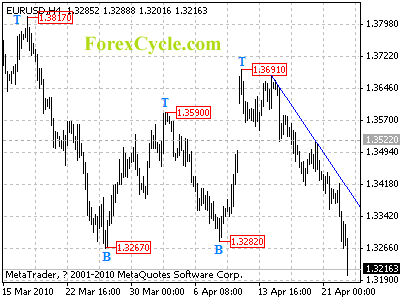
EURUSD breaks below 1.3267 previous low

EURUSD breaks below 1.3267 previous low, suggesting that the long term downtrend from 1.5144 (Nov 25, 2009 low) has resumed. Deeper decline is still possible after a minor consolidation, and next target would be at 1.3100 area. Resistance is at the falling trend line on 4-hour chart, as long as the trend line resistance holds, downtrend could be expected to continue.

eurusd

Daily Forex Analysis

Forex Daily Market Commentary

By GCI Forex Research

Fundamental Outlook at 1400 GMT (EDT + 0400)

The euro depreciated vis-à-vis the U.S. dollar today as the single currency tested bids around the US$ 1.3255 level and was capped around the $1.3420 level.  The common currency continues to weaken on worsening conditions in Greece.  The European Union is now estimating that Greece’s 2009 deficit is worse than previously reported and Moody’s Investors Service downgraded the government’s debt ratings to A3 from A2.  Many dealers expected a greater credit downgrade. Credit default swaps on Greek five-year debt surged 91 basis points to a record 577 and ten-year bond yields touched 9%, the highest level since 1998.  All of these factors render it increasingly likely Greece will be forced to accept a bailout from eurozone partners and/ or the International Monetary Fund.  Greece may be forced to reduce or postpone payments to bond investors for now.  Data released in the eurozone today saw April PMI services print at 55.5, up from the prior reading of 54.1, while EMU-16 consumer confidence improved to -15 in April from -17.  It was also reported that the eurozone’s debt-to-GDP ration escalated to 78.7% at the end of 2009 from 69.4% at the end of 2008.  In U.S. news, data released today saw the March headline producer price index climb 0.7% m/m and 6.0% y/y while the core rate was up 0.7% m/m and 0.9% y/y.  Also, weekly initial jobless claims fell to 456,000 from the revised prior reading of 480,000 while continuing jobless claims fell to 4.646 million from the prior reading of 4.686 million.  Moreover, March existing home sales were up 6.8% m/m to an annualized 5.35 million units and the February house price index was off 0.2% m/m.  President Obama called for a financial overhaul that would offer the “strongest consumer protection ever.”  Obama’s plan calls for a ban on future bank bailouts.  Euro bids are cited around the US$ 1.3175 level.

¥/ CNY

The yen depreciated vis-à-vis the U.S. dollar today as the greenback tested offers around the ¥93.35 level and was supported around the ¥92.75 level.  There is increasing speculation the BoJ will raise its outlook for the economy and prices next week amid positive improvements in certain economic measures including the export sector, the unemployment rate, and consumer confidence.  The Democratic Party of Japan reported it will likely call for an inflation target for the central bank in this year’s election platform.  It is likely legislators will try and prompt the central bank to seek inflation of up to two per cent.   The International Monetary Fund this week called on Japan to enact a “credible” medium-term fiscal plan.  Bank of Japan Governor Shirakawa warned complacency is the “most dangerous risk” for central banks and said “over-confidence” damaged Japan and the U.S.  Finance minister Kan said concerns over Japan’s terrible debt situation will ease when a new fiscal plan is issued.  Data released overnight saw March supermarket sales off 6.6% y/y.  The Nikkei 225 stock index lost 1.27% to close at ¥10,949.09.  U.S. dollar offers are cited around the ¥96.85 level.  The euro moved lower vis-à-vis the yen as the single currency tested bids around the ¥123.30 level and was capped around the ¥125.15 level.  The British pound moved lower vis-à-vis the yen as sterling tested bids around the ¥142.40 level while the Swiss franc moved lower vis-à-vis the yen and tested bids around the ¥86.00 figure. In Chinese news, the U.S. dollar appreciated vis-à-vis the Chinese yuan as the greenback closed at CNY 6.8264 in the over-the-counter market, down from CNY 6.8275. People’s Bank of China sold bills at lower yields for the first time in fifteen months, evidencing the banking system’s large surplus of cash. Many China-watchers believe China may allow the yuan to appreciate at any time between now and the end of the quarter.

The British pound depreciated vis-à-vis the U.S. dollar today as cable tested bids around the US$ 1.5340 level and was capped around the $1.5470 level.  Data released in the U.K. today saw March retail sales climb 0.4% m/m and 2.2% y/y while the March public sector net cash requirement grew to £25.8 billion from February’s level of £8.0 billion.  Also, March public sector net borrowing printed at £23.5 billion, up from the prior reading of £9.7 billion.  Additionally, March mortgage approvals grew marginally to 52,000 from the prior reading of 48,000 and the March M4 money supply expanded 0.1% m/m and 3.5% y/y.  Minutes from Bank of England Monetary Policy Committee’s April meeting were released yesterday and they revealed a unanimous vote to keep interest rates unchanged and the central bank’s asset purchase plan unchanged at £200 billion.  Traders are talking about a surge in the polls by the Liberal Democratic Party and the likely impact this will have on the 6 May General Election.  Many political pundits believe the contest will result in a hung Parliament and some now say the general election is too close to call with Cameron perhaps still holding a slight lead over Brown.  Cable bids are cited around the US$ 1.5140 level.  The euro moved lower vis-à-vis the British pound as the single currency tested bids around the £0.8630 level and was capped around the £0.8695 level.

CHF

The Swiss franc depreciated vis-à-vis the U.S. dollar today as the greenback tested offers around the CHF 1.0805 level and was supported around the CHF 1.0670 level.  Swiss National Bank and Swiss regulators announced new regulations today that mandate UBS and Credit Suisse to hold larger amounts of reserves to defend against crisis scenarios.  Data released in Switzerland today saw the March trade balance expand to CHF 2.01 billion from the prior reading of CHF 1.29 billion while the April ZEW expectations survey fell back to 53.4 from 53.8.  Dealers continue to cite talk that Swiss National Bank may be intervening by bidding the euro/ franc cross higher.  U.S. dollar offers are cited around the CHF 1.0920 level.  The euro moved lower vis-à-vis the Swiss franc as the single currency tested bids around the CHF 1.4320 level while the British pound moved higher vis-à-vis the Swiss franc and tested offers around the CHF 1.6580 level.

Forex Daily Market Commentary provided by GCI Financial Ltd.

GCI Financial Ltd (”GCI”) is a regulated securities and commodities trading firm, specializing in online Foreign Exchange (”Forex”) brokerage. GCI executes billions of dollars per month in foreign exchange transactions alone. In addition to Forex, GCI is a primary market maker in Contracts for Difference (”CFDs”) on shares, indices and futures, and offers one of the fastest growing online CFD trading services. GCI has over 10,000 clients worldwide, including individual traders, institutions, and money managers. GCI provides an advanced, secure, and comprehensive online trading system. Client funds are insured and held in a separate customer account. In addition, GCI Financial Ltd maintains Net Capital in excess of minimum regulatory requirements.

DISCLAIMER: GCI’s Daily Market Commentary is provided for informational purposes only. The information contained in these reports is gathered from reputable news sources and is not intended to be U.S.ed as investment advice. GCI assumes no responsibility or liability from gains or losses incurred by the information herein contained.

FOREX: Existing-Home Sales rebound. US Dollar higher as Euro falls, Stocks dip

By CountingPips.com

U.S. existing-homes sales data rebounded in March after three straight months of decline, according to the monthly report produced by the National Association of Realtors (NAR). The NAR report showed that existing-home sales including single family homes, co-ops and townhouses rose by 6.8 percent in March to a seasonally adjusted annual rate of 5.35 million units. February’s existing-homes sales data had decreased by a revised 0.8 percent to a 5.05 million home rate.

On an annual basis, March’s existing-home sales increased by 16.1 percent over the March 2009 level. Market forecasters had predicted the sales data would rise by 5.3 percent in March to a 5.29 million unit sales pace.

NAR chief economist Lawrence Yun commented in the report about the rebound in sales figures, “Sales have been above year-ago levels for nine straight months, and inventory has trended down from year-ago levels for 20 months running,” he said. “The home buyer tax credit has been a resounding success as these underlying trends point to a broad stabilization in home prices. This is preserving perhaps $1 trillion in largely middle class housing wealth that may have been wiped out without the housing stimulus measure.”

Sales in the Northeast increased by 6.0 percent in March while the Midwest sales rose by 7.2 percent. The West saw its existing-home sales rise by 6.6 percent and sales gained by 7.1 percent in the South. On an annual basis, the Northeast leads the increases above the March 2009 level with an increase of 25.4 percent with the South (13.9%), West (14.0%) and Midwest (15.5%) all showing rises on an annual basis.

Weekly Jobless Claims fall

U.S. weekly jobless claims decreased in the week that ended on April 17th, according to a release by the U.S. Labor Department today. New jobless claims fell by 24,000 workers to a total of 456,000 unemployed workers. The 4-week moving average of unemployed workers increased by 2,750 workers from the previous week to a total of 460,250.

Market forecasts were expecting jobless claims to fall to 450,000 workers following the prior week’s 480,000 claims.

Meanwhile, workers seeking continuing claims for unemployment benefits for the week ending April 10th also decreased for the week. Continuing claims fell by 40,000 workers to a total of 4,646,000 unemployed workers. The 4-week moving average of continuing claims dropped by 5,500 workers to a total of 4,643,750.

Producer Prices gain more than expected

The Producer Price Index, released in a separate report by the Department of Labor, rose more than expected in March as food and energy costs increased and boosted inflation on finished goods. Producer prices increased by 0.7 percent in March following a decrease of 0.6 percent in February and an increase by 1.4 percent in January. The annual rate of increase for March showed that producer prices were 6.0 percent higher than March of 2009 after February’s annual rate registered a 4.4 percent increase.

Market forecasts were expecting monthly producer prices to gain by 0.5 percent and the annual rate of increase to register 6.0 percent.

Core producer prices, excluding food and energy prices, rose by 0.1 percent in March following a 0.1 percent rise in February and matched market expectations of a 0.1 percent gain. On an annual basis, core producer prices advanced by 0.9 percent in March compared with an increase of 1.0 percent in February and matched expectations.

Helping to contribute to the increased producer prices in March was the cost of consumer foods which advanced by 2.4 percent for the month while the index for finished energy goods rose by 0.7 percent.

FOREX: US Dollar higher versus Euro, Majors. US Stocks lower

The U.S. dollar has been on the rise in the forex markets today while U.S. stocks have traded lower as investor risk has fallen to the wayside in the U.S. trading session today. The dollar has increased higher today versus the euro, Swiss franc, British pound, Japanese yen and the Canadian dollar while falling to the New Zealand dollar and trading almost unchanged against the Australian dollar, according to currency data by Oanda at 2:16 pm EST.

The Greece situation put risk aversion in the markets as Moody’s downgraded Greece’s sovereign debt (from A3 to A2)  and it was also released that Greece’s budget deficit of last year was higher than previously estimated. The Greece budget deficit of 2009 is now estimated to be 13.6 percent of GDP compared with the previous estimate of 12.7 percent of GDP. The latest news sent the euro sharply lower against the dollar, touching its lowest level in almost a full year at the 1.3260 exchange rate.

The U.S. stock markets, meanwhile, have had a negative trading session today with the Dow Jones falling by over 25 points, the Nasdaq decreasing over 1 point and the S&P 500 showing over a 3 point shortfall. Oil has edged lower to the $83.45 per barrel level while gold has been lower by $5.70 to the $1,142.50 per ounce level.

AUD/USD Edges Lower as Risk Trade Falters

By Fast Brokers – The Aussie is being dragged lower today due to considerable weakness in the Euro.  Greek bond yields have hit an all-time high and EU budget deficits are widening.  The deteriorating fiscal situation in the EU has stirred uncertainty all around the risk trade as the Cable and gold also retreat.  However, the Aussie has managed to stay in a somewhat respectable positive due to its relative strength stemming from the RBA’s hawkish monetary stance.  Australia has released little economic data this week, allowing the Aussie to move according to its positive psychological forces.   Stevens will speak tomorrow and it will be interesting to see whether he maintains the positive sentiment seen in the RBA’s recent meeting minutes.  If so, the Aussie should hold onto its relative strength.  However, the EU, UK, and U.S. will likely hog the spotlight.  That being said, investors should keep an eye on the data wire as the European trading session rolls around.  If the data should turn sour this could weigh on the risk trade as a whole, Aussie included.  Additionally, corporate earnings will continue to flood in and results should have a noticeable impact on the greenback.

Technically speaking, the Aussie faces technical barriers in the form of 4/21, 4/15 and 4/12 highs.  Additionally, the psychological .93 and .94 levels could serve as psychological obstacles over the near-term.  As for the downside, the Aussie has multiple uptrend lines serving as technical cushions along with 4/13 and 4/19 lows.

Price: .9258
Resistances: .9272, .9282, .9292, .9306, .9316, .9329
Supports: .9257, .9245, .9234, .9222, .9209, .9192
Psychological: .93, .94, .92, April highs and lows

(click chart to enlarge)

Market Commentary provided by Fast Brokers.

Disclaimer: FastBrokers’ market commentary is provided for information purposes only and under no circumstances should be regarded neither as an investment advice nor as a solicitation or an offer to sell/buy any financial product. FastBrokers assumes no responsibility or liability from gains or losses incurred by the information herein contained.

Risk Disclosure: There is a substantial risk of loss in trading futures and foreign exchange. Please carefully review all risk disclosure documents before opening an account as these financial instruments are not appropriate for all investors.

Gold Back to $1140/oz after $1150/oz Test

By Fast Brokers – Gold was unable to break through its highly psychological $1150/oz level and the precious metal is back to the $1140/oz area.  Conditions in the EU certainly aren’t helping gold’s cause right now.  Greek bond yields hit an all-time high as EU budget deficits widen.  Uncertainty in the EU has led investors away from the risk trade and towards the dollar, a negative for gold due to correlative forces.  U.S. unemployment claims remain above 450k and that isn’t benefitting the risk trade either.  Meanwhile, investors are awaiting U.S. existing home sales.  If today’s housing data comes in strong this could ebb the risk-averse flows.  On the other hand, weak existing home sales could boost the dollar further and weaken gold.  The data train will keep on rolling tomorrow with key releases from across the globe, including UK prelim GDP, Germany’s Ifo business climate, and durable goods figures.  Additionally, the U.S. will provide new home sales, filling out the housing picture.

Technically speaking, gold has managed to avoid a retest of April 21 highs so far, a positive development for the near-term.  Speaking of which, gold has 4/21, 4/20, and 4/19 lows serving as technical cushions along with multiple uptrend lines.  As for the topside, gold faces multiple downtrend lines along with the psychological $1150/oz level.

Present Price: $1139.95/ oz
Resistances: $1140.70/oz, $1141.47/oz, $1142.43/oz, $1143.11/oz, $1144.07/oz, $1145.03/oz
Supports: $1139.54/oz, $1138.87/oz, $1138.20/oz, $1137.33/oz, $1135.79/oz, $1134.83/oz
Psychological: $1150/oz, $1140/oz, $1130/oz, April highs and lows

(click chart to enlarge)

Market Commentary provided by Fast Brokers.

Disclaimer: FastBrokers’ market commentary is provided for information purposes only and under no circumstances should be regarded neither as an investment advice nor as a solicitation or an offer to sell/buy any financial product. FastBrokers assumes no responsibility or liability from gains or losses incurred by the information herein contained.

Risk Disclosure: There is a substantial risk of loss in trading futures and foreign exchange. Please carefully review all risk disclosure documents before opening an account as these financial instruments are not appropriate for all investors.

USD/JPY Hangs Around 93

By Fast Brokers – Another day same story, the USD/JPY is hugging 93 as it continues another one of its common tight range periods.  It’s interesting the USD/JPY is so calm despite high volatility in the EU region.  However, investors should keep in mind that the USD/JPY has the potential to jolt to life, particularly if there is a technical game changing move in another major dollar pair.  Hence, investors should keep an eye on activity in the Euro and whether the EUR/USD sacrifices key support levels.  Meanwhile, investors are waiting on U.S. existing home sales.  Weak U.S. housing data could weigh on the USD/JPY, and vice versa.  U.S. unemployment claims made little improvement and today’s earnings releases have disappointed, taking a bit of steam out of the USD/JPY’s upward momentum.  Japan’s trade balance printed in line with estimates as export demand improves.  On another note, the IMF mentioned that Japan may need to loosen liquidity further over the medium-term in order to counter deflation, echoing the DPJ’s sentiment.  This is a positive development for the USD/JPY, yet clearly isn’t having much of an impact thus far.  Governor Shirakawa will address the public tomorrow and statements with BoJ members carry the potential to impact the Yen.  However, the attention will likely remain focused on the EU, UK and U.S. with key data releases from all three.  Hence, the week could end on a volatile note.

Technically speaking, the USD/JPY faces technical barriers in the form multiple downtrend lines along with intraday, 4/14, and 4/7 highs.  As for the downside, the USD/JPY has multiple uptrend lines serving as technical cushions along with intraday, 3/29, and 4/19 lows.  Additionally, the psychological 92 level could continue to serve as a psychological cushion should it be tested.

Present Price: 93.10
Resistances: 93.10, 93.20, 93.38, 93.51, 93.64, 93.75
Supports:  92.91, 92.81, 92.71, 92.57, 92.47, 92.37
Psychological: .92, .93, April highs and lows

(click chart to enlarge)

Market Commentary provided by Fast Brokers.

Disclaimer: FastBrokers’ market commentary is provided for information purposes only and under no circumstances should be regarded neither as an investment advice nor as a solicitation or an offer to sell/buy any financial product. FastBrokers assumes no responsibility or liability from gains or losses incurred by the information herein contained.

Risk Disclosure: There is a substantial risk of loss in trading futures and foreign exchange. Please carefully review all risk disclosure documents before opening an account as these financial instruments are not appropriate for all investors.

GBP/USD Takes a Step Lower After EU News

By Fast Brokers – The Cable is taking a step lower right now along with the rest of the risk trade as the Euro tumbles in the wake of Greek bond yields hitting 8.2%+.  Greece’s budget deficit came in higher than anticipated, placing even more pressure on the government to seek outside help.  Additionally, the overall EU budget shortfall as hit its highest level since the formation of the union over 10 years ago.  The fear of contagion is understandably delivering a blow to the risk trade and the Cable is no exception.  UK retail sales came in 3 basis points below analyst expectations, giving investors little to cheer about.  However, the Cable is still holding up relatively well as it derives strength from yesterday’s impressive CCC figure.  As for the U.S., weekly unemployment claims hung above 450k and PPI came in hotter than anticipated, encouraging investors to pick up the dollar in the process.  Meanwhile, investors should keep their eyes on the EUR/USD and monitor its ability to hold 1.33 and April lows.  If the currency pair tumbles below key supports this could drag the whole market lower.  Investors are also awaiting U.S. existing home sales.  If today’s housing data also disappoints this could fuel risk-aversion.  The data wire won’t slow tomorrow with important releases from around the globe.  In fact, the UK will print Prelim GDP.  Considering the improvements in employment and manufacturing, it wouldn’t be surprising to receive a solid GDP number, which could help buoy the Cable.

Technically speaking, the Cable has multiple uptrend lines serving as technical cushions along with 4/21,4/20, and 4/19 lows.  Additionally, the psychological 1.53 area could serve as a psychological cushion should it be tested.  As for the topside, the Cable faces multiple downtrend lines along with intraday, 4/12, and 4/15 highs.

Present Price: 1.5385
Resistances: 1.5388, 1.5404, 1.5419, 1.5435, 1.5453, 1.5469
Supports: 1.5371, 1.5354, 1.5341, 1.5325, 1.5310, 1.5285
Psychological: 1.55, 1.54, 1.53, 1.52, April highs and lows

(click chart to enlarge)

Market Commentary provided by Fast Brokers.

Disclaimer: FastBrokers’ market commentary is provided for information purposes only and under no circumstances should be regarded neither as an investment advice nor as a solicitation or an offer to sell/buy any financial product. FastBrokers assumes no responsibility or liability from gains or losses incurred by the information herein contained.

Risk Disclosure: There is a substantial risk of loss in trading futures and foreign exchange. Please carefully review all risk disclosure documents before opening an account as these financial instruments are not appropriate for all investors.

EUR/USD Knocked Lower by Greece

By Fast Brokers – The EUR/USD is getting hammered after moving higher during the Asia trading session.  Greek debt continues to set new all-time highs and is leaving beyond the 8% threshold.  The yield is rising today after Greece reported a budget deficit of 13.6% of GDP, higher than analyst expectations.  Additionally, the budget shortfall in the EU region hit an all-time high of 6.3%.  This ignites speculation of contagion and is clearly weighing on the Euro as the currency slides against the Pound.  The risk trade as a whole is taking a hit and extending intraday losses after U.S. Unemployment Claims remained above 450k.  Nokia and QCOM earnings disappointed, souring the positive earnings so far this week.  To top the cake, U.S. PPI printed stronger than anticipated, giving investors just another reason to favor the Dollar over the Euro.  The EUR/USD is now approaching key supports as a result, and it will be interesting to see whether the currency pair can withstand a test of previous April lows.  Meanwhile, investors are casting aside more positive data from the EU region as Flash PMIs impressed.  This adds onto the encouraging consumer confidence data we saw earlier this week.  Hence, fiscal fears are dominating and the EUR/USD could continue to get punished until negative psychological forces recede.  The data wire will stay active tomorrow as the EU releases Germany’s Ifo business climate index.  Additionally, the U.S. will print its DGO and new home sales figures, meaning the trading week could end with a surge in activity.

Technically speaking, the EUR/USD is testing the patience of key uptrend lines now, particularly the 1st tier running through April lows.  Therefore, 1.33 could prove to be a key psychological battleground.  As for the topside, downtrends are accumulating and the EUR/USD also faces technical barriers in the form of 4/8, 4/9, and intraday highs.

Present Price: 1.3339
Resistances: 1.3348, 1.3359, 1.3366, 1.3375, 1.3381, 1.3390
Supports:  1.3337, 1.3330, 1.3324, 1.3314, 1.3306, 1.3296
Psychological: April highs and lows, 1.34, 1.33

(click chart to enlarge)

Market Commentary provided by Fast Brokers.

Disclaimer: FastBrokers’ market commentary is provided for information purposes only and under no circumstances should be regarded neither as an investment advice nor as a solicitation or an offer to sell/buy any financial product. FastBrokers assumes no responsibility or liability from gains or losses incurred by the information herein contained.

Risk Disclosure: There is a substantial risk of loss in trading futures and foreign exchange. Please carefully review all risk disclosure documents before opening an account as these financial instruments are not appropriate for all investors.