Euro Gains on Asian Market Risk Taking

By Forex Yard – After making strong gains against the USD, among others, the EUR now seems to be facing sell pressure as the opening of the US markets draw near. Initially receiving a boost from the surge of risk appetite following well performing Asian equities, such as the Nikkei 225, riskier currencies like the EUR, CHF, AUD, and NZD now seem to be leveling off.

The EUR/USD pair has fallen from 1.3400 this morning towards 1.3295 a few hours after the European markets opened. Asian traders dumping their safe-havens in exchange for riskier currencies has changed the dynamic in the forex market so far today, but with little market news this impact is difficult to determine in light of other fundamentals. Analysts are beginning to point to a possible retracement of the EUR/USD, saying that a valid target may be near 1.3440 in the short-term.

In other news, the Canadian Dollar (CAD) appears to have sustained its growth and is steadily holding its ground above parity with its American counterpart, the US Dollar. The Loonie has gained from an above average performance of its economy as well as rising crude oil prices, which are always a boon to the North American economy. With the USD experiencing mixed price behavior from likewise mixed economic reports, the USD/CAD pair may remain below parity for some time.

Forex Market Analysis provided by Forex Yard.

© 2006 by FxYard Ltd

Disclaimer: Trading Foreign Exchange carries a high level of risk and may not be suitable for all investors. There is a possibility that you could sustain a loss of all of your investment and therefore you should not invest money that you cannot afford to lose. You should be aware of all the risks associated with Foreign Exchange trading.

Interest Rates Announcements Expected From Both U.S. And Japan This Week

By Forex Yard – During last week’s trading session, the Dollar continued to strengthen, mostly due to the Greek debt crisis which weakens the Euro. This week however, Interest Rates Announcements are expected from the U.S, Japan and New Zealand. This promises a much more volatile week, with unique opportunities to see high profits. Will you take advantage?

Economic News

USD – U.S. Interest Rates Announcement Expected on Wednesday

The Dollar rallied last week against the most of the major currencies. The Dollar gained about 200 pips against the Euro, and saw a 300 pips rise against the Yen. The Dollar slightly tumbled against the Pound.

The Dollar soared following a series of positive data from the U.S. economy. The Producer Price Index climbed by 0.7% in March, beating expectations for 0.4% rise. This shows that inflation is steadily rising in the U.S. which means that an Interest Rates hike might take place soon. In addition, the Existing U.S. Home Sales rose by 6.8% in March to a 5.35 million annual rate, from a 5.01 million pace in February. Considering that the housing sector in the U.S. was the main reason for the recent recession, every positive data regarding the building industry tends to boost the Dollar. The positive data from the U.S. economy continued as the Core Durable Goods Orders rose by 2.8% on March. This report is a leading indicator of production, and the positive result shows that the economy is advancing faster than expected.

As for the week ahead, many interesting economic publications are expected from the U.S. Yet the publication which holds the greatest impact on the market will surely be the Federal Funds Rate. The Federal Funds Rate is in fact the U.S. Interest Rates for May. Current expectations are that the Fed will leave rates at lower than 0.25%, however, considering the recent positive economic data, an interest rates hike won’t be a complete surprise. This means that every decision is likely to have a large impact on the market, and traders are advised to follow this publication.

EUR – Euro Continues To Tumble on Greek Fiscal Crisis Woes

The Euro dropped against most of the major currencies during last week’s trading session. The Euro dropped about 200 pips against the Dollar as the EUR/USD pair reached a weekly low a 1.3200. The Euro dropped about 200 pips against the Pound as well.

The main reason for the Euro’s bearishness continues to be the fragile Greek debt issue. There are currently concerns that that the $60 billion bailout plan by the Euro-Zone will fail to ease investors’ woes regarding Greece’s ability to recover from the debt crisis. It appears that until Greece will publish concrete data that shows real improvement regarding its fiscal crisis, the Euro might continue to tumble. Even several positive data from the Euro-Zone’s leading nations failed to support the Euro. The German ZEW Economic Sentiment rose to 53.0 points. This reflects the best result in 6 months, indicating that German investors feel greater confidence regarding their financial outlook. In addition, the German Manufacturing Purchasing Managers’ Index rose to a record high in April. The manufacturing sector rose to 61.3 in April from 60.2 in March, marking a record high. Yet it seems that as long as the Greece debt crisis continues to be the main story, the Euro could fall farther.

Looking ahead to this week, traders are advised to look for every update regarding the Greek fiscal crisis, as every data on this issue tends to have an instant impact on the Euro. In addition, traders should follow the major publications from the German economy. Such as the Preliminary Consumer Price Index on Wednesday and the Unemployment Change on Thursday.

JPY – Yen Drops On All Fronts

The Yen tumbled against all its major counterparts during last week’s trading session. The Yen dropped about 200 pips against the Dollar and about 300 pips against the Euro. The Yen marked its greatest drop against the Pound, as the GBP/JPY pair gained over 500 pips in one week.

There appear to be two major factors for the Yen’s freefall. The first factor is the positive U.S. economic data, and the second factor is the rise in most of the Asian Stocks. The combination of the two is leading investors to look for riskier assets than the Yen, as risk-appetite increases following the recovery of two of the largest economies. It currently seems that as long as the U.S. and the Japanese economies will continue to report positive data, the Yen might weaken further.

As for this week, a batch of data is expected from the Japanese economy. However the most significant publication looks to be the Overnight Call Rate on Friday. The Overnight Call Rate is the Japanese Interest Rates announcement for May. Analysts have forecasted that the Bank of Japan (BoJ) will leave rates at 0.10%. Nevertheless, if the BoJ will surprise and decides to hike rates, the Yen is likely to be boosted as a result.

Crude Oil – Crude Oil Recovers to $85 a Barrel

Crude Oil saw mixed trading during last week’s session. With the beginning of last week’s trading, Crude Oil saw a bearish trend and dropped below $82 a barrel. However by Thursday Crude Oil began to recover, and is currently trading at $85.50 a barrel.

It seems that speculations regarding an increasing demand for energy are boosting Crude Oil. The main reason for these speculations is the series of positive data from the U.S. economy, which were published lately. The report showed that the inflation in the U.S. is risings, and also that the housing sector in the U.S. is recovering. Considering that the U.S. is the world’s largest energy consumer, the positive reports create speculations that American citizens will feel safer to consume, and as a result will increase demand for oil.

Looking ahead to this week, traders are advised to continue follow the major data from the U.S. and the Euro-Zone, as these publications seem to have a large impact on oil prices. In addition, traders should follow the U.S. Crude Oil Inventories release on Wednesday, as this report tends to have an immediate impact on the market.

Technical News

EUR/USD

While most indicators for the pair are currently floating in neutral territory, the pair’s recent downward trend may continue today as well as the 2 hour RSI seems to be floating in the overbought territory and an impending bearish cross is evident on the hourly MACD. Going short for the day may be advised.

GBP/USD

The pair may be seeing a correction to its recent bullish trend today as the hourly RSI is floating in the overbought territory with a bearish cross evident on the hourly and 2 hour charts’ Slow stochastic. Furthermore a breach of the upper Bollinger Band is evident on the 2 hour and 4 hour charts. Going short for the day may a good option.

USD/JPY

The RSI for the pair is floating in the overbought territory on the 2 hour, 4 hour and 8 hour charts. Furthermore, a bearish cross is evident on the 8 hour and daily charts’ Slow Stochastic. Going short for the day may be advised.

USD/CHF

While most indicators for the pair are currently floating in neutral territory, the pair’s recent upward correction may continue today as well as the 2 hour RSI seems to be floating in the oversold territory and an impending bullish cross is evident on the hourly MACD. Going long for the day may be advised.

The Wild Card

USD/MXN

Some upward correction may be seen for the pair today as the hourly and 2 hour RSI is floating in the oversold territory and a bullish cross is seen on the 2 hour, 4 hour and 8 hour charts’ Slow Stochastic. Forex traders may be advised to go long for the day.

Forex Market Analysis provided by Forex Yard.

© 2006 by FxYard Ltd

Disclaimer: Trading Foreign Exchange carries a high level of risk and may not be suitable for all investors. There is a possibility that you could sustain a loss of all of your investment and therefore you should not invest money that you cannot afford to lose. You should be aware of all the risks associated with Foreign Exchange trading.

Forex Weekly Market Review April 26, 2010

By eToro – The equity markets rebounded this week as strong earnings and economic data convinced investors that equities were a robust place to invest.  Despite the shadow of the SEC charge against Goldman Sachs and the trepidation in Europe, the S&P 500 index was able to notch up a 25-point rally.  The index closed the week at 1217 up 2.1%.

Is Europe Out of the Woods?

Greece is on the verge of delivering some calm to markets that have been on a bumpy ride during the past 3 months.  On Friday, PM Panpadremos formerly announced that it is seeking to activate the Eur45 billion-aid package.  In televised comments, Panpadremos said, “the time has come” for Greece to request aid. “It is a necessity. It is a national and pressing necessity for us to officially request from our partners the activation of the support mechanism.” On Thursday, Eurostat said that Greece’s deficit last year is at least 13.6% and not the 12.9% the government estimated on April 9. The deficit may be 0.3-0.5% higher if the over the counter swaps, classification of some public entities, and social security funds are added.  Eurostat also noted that the Irish deficit was 14.3%, giving it the honor of the largest deficit in the euro zone.  Additionally, Moody’s downgraded the debt of Greece by notch to A3.  Moody’s kept Greek debt rating on negative watch.

There are a number of issues that Europe still faces, and activating a backstop is just the first.  Whether the size of the facility is sufficient to cover this year, and part of next year’s debt, is a question that will only be answered with time.  There is a good chance that Greece may still try to raise funds when market conditions allow for it.  Greece will probably need a multi-year program and European officials seem to have ignored this reality.  Additionally, officials seem to be stuck in a reactive mode and have not been able to get ahead of the curve.  Specifically, as recently as Thursday, IMF head Strauss-Kahn ruled out a preemptive package for Portugal and/or Spain, arguing there was no need.  The thought that a contagion could develop is not even on the minds of the IMF or ECB.  Another issue, which is not being addressed, is the issue of competitiveness in the periphery of Europe.  The focus is largely on Greece’s ability to service its debt.  One of the consequences of the fiscal austerity that is being mandated is that it will keep aggregate demand  suppressed  and  could  then  still  produce  a  widening  of the output gap in Europe.  An example is reflected in Germany.  On Thursday, Germany’s flash manufacturing PMI rose to an all-time high of 61.3, while services edged fractionally higher.  On Friday, German released a stronger than expected IFO survey.    The business climate reading came in at 101.6 (98.2 last), the highest since May 2008.  The assessment of current conditions and expectations also rose.  This reinforces ideas that domestic demand remains weak but exports, as traditionally the case, are leading the economy.  As Germany has become more competitive as export nations, Greece has suffered in its shadow.

Despite apparent approval of an aid package, Greek yields moved higher even on Friday.  Greek 2-year yields had fallen below 10% on the aid news, but finished the trading week at 10.23% Ominously, Portugal 2-year is doing worse, with its yield up losing 10 basis points on Friday, closing the week at 2.94%.

The Data does not help Labour

The UK is the first G7 country to report preliminary first GDP figures.  The numbers were rather disappointing.  The consensus expected a 0.4% expansion and instead ONS said the economy expanded half as much.   The 0.2% rise was also half the pace reported in the fourth quarter 009.  Because of the base effect, the year-over-year retraction eased to -0.3% from -3.1% in fourth quarter 09.  The economic trough was hit in the second quarter at almost -6.0%.  The preliminary report indicated that services expanded 0.2%, while industry expanded by 0.7%.  During the week, the UK reported higher than expected inflation, which forces BOE Governor King to write another letter to Darling to explain the overshoot.  The headline CPI rose 0.6%, twice what the consensus had expected.  The year-over-year rate rose to 3.4% from 3.0%.  The consensus had expected a 3.1% increase.  Some questions have been raised over whether the BOE’s assessment of inflation is really just a transitory issue.   Although energy was a strong component of the increase in the headline CPI, prices for fuel have not declined, which can create a problem for the central bank.  Although unemployment claims shrank by 33 thousand, which can be spun in a positive light, Labour is facing lower than expected growth and higher than expected inflation at a time when the budget deficit and government spending are the core focus of the upcoming election.

Petroleum’s Bearish Fundamental Could Be Overlooked

The opening of numerous Airports in Europe during the week, after volcanic ash kept them closed for more than 5 days, counteracted the relatively bearish inventory report.  Crude oil was able to rally $2.17 per barrel during the week.  According to the Department of Energy, U.S. commercial crude oil inventories (excluding those in the Strategic Petroleum Reserve) increased by 1.9 million barrels from the previous week. At 355.9 million barrels, U.S. crude oil inventories are above the upper limit of the average range for this time of year. Total motor gasoline inventories increased by 3.6 million barrels last week, and are above the upper limit of the average range.  Distillate fuel inventories increased by 2.1 million barrels, and are above the upper boundary of the average range for this time of year.  As the US moves into driving season, which is usually the time of year, that demand for gasoline and diesel increases, supplies have continued to increased at a time when inventory is increasing.  Not only is the trajectory of supplied continuing to increase, but the days supply (the amount of gasoline held in inventory that can be used without producing any new gasoline) of gasoline stocks have increased relative to last year.  Petroleum has been trading in a highly correlated fashion with the dollar and the US equity markets.  Any down turn in equities (or an upturn in the dollar) could be detrimental for the oil markets.

Is Inflation Hitting the US?

The US Producer Price Index for finished goods rose 0.7% in March.  This was greater than expected and shows that input costs are rising at a faster pace than the Federal Reserve might want.  An example of increasing intermediate prices is the skyrocketing cost of rubber, a major tire component, which has climbed nearly 74% this year after rising 92% in 2009. Another rapidly rising raw materials Palladium, which goes into car exhaust systems, is up nearly 39% this year, potentially boosting costs for U.S. carmakers as they try to recover from the recession.  Lumber, a major cost for homebuilders, is up nearly 59%.  This could hurt the underlying profits for homebuilders.  Iron-ore prices also are rising, while oil and copper prices have tacked on to last year’s huge gains.  Data on producer prices released by the Bureau of Labor Statistics on Thursday shows how rapidly the pressure on corporate America is mounting. The producer-price index showed that crude goods such as iron ore, construction sand and pulp shot up 44.5% year-over-year the fastest rate since 1974. Including energy and food costs, crude goods prices rose 33.4%.  So far, input prices at the producer level have not spilled over into the consumer sectors.  Consumer prices were up only 2.3% in March on a year over year basis.  At the core level, CPI was flat and flat for the first quarter.  Although the producer prices at face value are somewhat alarming, until they filter their way into the CPI, PPI will take a back seat.

Japanese Debt

The same day that Moody’s cut Greece’s sovereign rating to A3 from A2, Fitch warned that Japan’s credit rating was threatened by its mounting debt.  Yet, ironically, the latter may be a source of funds for the former.  Although Greece will be drawing on the European/IMF funds, it may also seek to raise funds from the market, when conditions permit.   The Japanese government is actively engaged in deepening the samurai bond market.  Samurai bonds are yen-denominated bonds issued by non-Japanese corporate or sovereign entities.  The state-backed Japan Bank for International Cooperation (JBIC) is providing guarantees to support the sale of samurai bonds by a wide range of developing countries, from Mexico to Vietnam, from Turkey to Uruguay.   The specific purpose of JBIC is to boost the usage of the yen as an international currency.   With JBIC guarantees, these samurai bonds take on partial function of Japanese government credit worthiness.

This weekend’s G7/G20/IMF/EU meeting will supply the markets with interesting fodder for trading.  On Tuesday, US Consumer Confidence will headline the economic releases.  Since confidence and retail sales have opposed each other (confidence continuing to come in weaker), this number will be watched carefully.  Wednesday, the FOMC will make their interest rate decision.  No change is expected.  On Thursday, EMU consumer confidence and US Jobless claims will be watched carefully.  On Friday, the BOJ will release its interest rate decision.  This will be followed later in the day, by US GDP and the Chicago PMI.

Market Analysis provided by eToro

Disclaimer: Trading in the Foreign Exchange market might carry potential rewards, but also potential risks. You must be aware of the risks and are willing to accept them in order to trade in the foreign exchange market. Don’t trade with money you can’t afford to lose.

© 2009 eToro Blog.

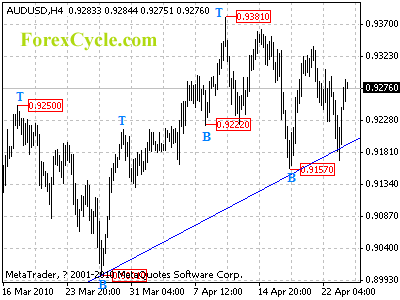
AUDUSD consolidates in a range between 0.9157 and 0.9381

AUDUSD consolidates in a range between 0.9157 and 0.9381. Lengthier sideways movement in the range is still possible in a couple of days. As long as 0.9157 support holds, we’d expect uptrend to resume, and another rise towards 0.9500 is possible after consolidation. However, a breakdown below 0.9157 support could indicate that the uptrend from 0.8577 (Feb 5 low) has completed at 0.9381 already, then the fallow downtrend could take price back to 0.8500 area.

audusd

Daily Forex Analysis

EURUSD’s downtrend extends to 1.3202

EURUSD’s downtrend from 1.5144 extends to as low as 1.3202 level. Deeper decline to 1.3000 to reach next cycle bottom on daily chart is still possible, and next cycle bottom is nearing. Resistance is now at the upper border of the falling price channel, and key resistance remains at 1.3817, a break above this level could indicate that the bearish movement from 1.5144 has completed at 1.3202 already.

For long term analysis, EURUSD is moving to 1.3000 area to reach next cycle bottom on weekly chart and the next cycle bottom is nearing, a break above 1.3817 will indicate that a cycle bottom has been formed.

eurusd

Weekly Forex Reports

Forex Daily Market Commentary

By GCI Forex Research

Fundamental Outlook at 1400 GMT (EDT + 0400)

The euro appreciated vis-à-vis the U.S. dollar today as the single currency tested offers around the US$ 1.3375 level and was supported around the $1.3200 figure.  The common currency retraced some of its intraweek losses after Greece officially requested financial assistance from the European Union and the International Monetary Fund.  The European Commission, European Central Bank, and the Eurogroup reported they are “taking note” of Greece’s request to “activate the financial support mechanism,” adding they “will decide upon the activation of this mechanism.”  There is market talk that Greece will receive its first funding tranche before 19 May.   The speed with which the European Union agrees to rescue Greece will partially be determined by the speed with which German Chancellor Merkel can push the unpopular bailout through the German legislature.  Yesterday, Greece’s debt ratings were downgraded by Moody’s Investor Services. The activation of the financial assistance package for Greece will provide the country with a little bit of financial stability but there is talk that Greece will require well in excess of €100 billion in aid from the international community.  Additionally, the euro may still continue to probe new multi-month lows because there is a higher threat that contagion will see Greece’s fiscal problems move to other highly-indebted eurozone countries including Portugal and Spain.  G-7 and G-20 officials will discuss sovereign credit risk, exchange rates, Greece, global financial reform, and other key topical issues when they convene this weekend in Washington, D.C.  Eurozone February industrial new orders were up 1.5% m/m and 12.2% y/y in data released today.  Also, the German April Ifo business climate index rallied to 101.6 from 98.2 while the April Ifo current assessment index improved to 99.3 and the April Ifo expectations index rallied to 101.9.  Also, French March consumer spending was up 1.2% m/m and 2.5% y/y.  In U.S. news, data released today saw March durable goods orders decline 1.3%, a reversal from the revised prior reading of +1.1%, while the ex-transportation component was up 2.8%, up from the revised prior reading of 1.7%.  Also, March new home sales were up 26.9% y/y to an annualized 411,000 units, a multi-decade record-setting pace.  Press reports suggest Federal Reserve Chairman Bernanke is not convinced about the timing of asset sales to reduce the Fed’s balance sheet.  Euro bids are cited around the US$ 1.3175 level.

¥/ CNY

The yen depreciated vis-à-vis the U.S. dollar today as the greenback tested offers around the ¥94.20 level and was supported around the ¥93.30 level.  The pair continues to rise as there are increasing signs the U.S. economic recovery is taking root.  The Japanese media is reporting Bank of Japan may raise its consumer price index forecast for fiscal year 2011 to near zero per cent growth, up from January’s estimate of -0.2%.  Bank of Japan Governor Shirakawa spoke yesterday and reported inflation targets are one cause of asset price bubbles.  It is likely that Shirakawa and other BoJ officials will resist the government’s likely call to adopt an inflation target, perhaps as high as 2% per year.  Ahead of this weekend’s G-7 and G-20 meetings in Washington, D.C., Shirakawa said exchange rates should not be utilized to resolve trade disputes.  Data released in Japan overnight saw the February all-industry activity index decline 2.3% m/m, a reversal from the upwardly revised +3.4% climb in January.   The Nikkei 225 stock index lost 0.32% to close at ¥10,914.46.  U.S. dollar offers are cited around the ¥96.85 level.  The euro moved higher vis-à-vis the yen as the single currency tested offers around the ¥125.20 level and was supported around the ¥123.40 level.  The British pound moved higher vis-à-vis the yen as sterling tested bids around the ¥144.50 level while the Swiss franc moved higher vis-à-vis the yen and tested offers around the ¥87.30 level. In Chinese news, the U.S. dollar appreciated vis-à-vis the Chinese yuan as the greenback closed at CNY 6.8274 in the over-the-counter market, up from CNY 6.8264.  Attention will be focused on the G-7 and G-20 meetings in Washington, D.C. this weekend to determine how much multilateral pressure there is on China to revalue its yuan currency.  Many China-watchers believe China may allow the yuan to appreciate at any time between now and the end of the quarter.  Data released in China overnight saw the March leading index decline to 104.98 from the revised prior reading of 105.11.

The British pound depreciated vis-à-vis the U.S. dollar today as cable tested bids around the US$ 1.5295 level and was capped around the $1.5400 figure.  Data released in the U.K. today saw Q1 gross domestic product up 0.2% q/q and off 0.3% y/y, lower-than-expected on the quarterly basis and stronger-than-expected on the year-over-year basis.  Prime Minister Brown will likely note these data suggest the economy is accelerating while his opponents in the 6 May General Election will note that economic growth remains very weak.  Many political pundits believe the contest will result in a hung Parliament and some now say the general election is too close to call with Cameron perhaps still holding a slight lead over Brown.  Cable bids are cited around the US$ 1.5140 level.  The euro moved higher vis-à-vis the British pound as the single currency tested offers around the £0.8700 figure and was supported around the £0.8605 level.

CHF

The Swiss franc depreciated vis-à-vis the U.S. dollar today as the greenback tested offers around the CHF 1.0850 level and was supported around the CHF 1.0745 level.  Swiss National Bank Chairman Hildebrand said he is “skeptical” of the International Monetary Fund’s G-20 bank tax proposal.  Swiss National Bank and Swiss regulators announced new regulations this week that mandate UBS and Credit Suisse to hold larger amounts of reserves to defend against crisis scenarios.  Data released in Switzerland today saw the March trade balance expand to CHF 2.01 billion from the prior reading of CHF 1.29 billion while the April ZEW expectations survey fell back to 53.4 from 53.8.  Dealers continue to cite talk that Swiss National Bank may be intervening by bidding the euro/ franc cross higher.  U.S. dollar offers are cited around the CHF 1.0920 level.  The euro moved higher vis-à-vis the Swiss franc as the single currency tested offers around the CHF 1.4355 level while the British pound moved lower vis-à-vis the Swiss franc and tested bids around the CHF 1.6490 level.

Forex Daily Market Commentary provided by GCI Financial Ltd.

GCI Financial Ltd (”GCI”) is a regulated securities and commodities trading firm, specializing in online Foreign Exchange (”Forex”) brokerage. GCI executes billions of dollars per month in foreign exchange transactions alone. In addition to Forex, GCI is a primary market maker in Contracts for Difference (”CFDs”) on shares, indices and futures, and offers one of the fastest growing online CFD trading services. GCI has over 10,000 clients worldwide, including individual traders, institutions, and money managers. GCI provides an advanced, secure, and comprehensive online trading system. Client funds are insured and held in a separate customer account. In addition, GCI Financial Ltd maintains Net Capital in excess of minimum regulatory requirements.

DISCLAIMER: GCI’s Daily Market Commentary is provided for informational purposes only. The information contained in these reports is gathered from reputable news sources and is not intended to be U.S.ed as investment advice. GCI assumes no responsibility or liability from gains or losses incurred by the information herein contained.

Goldman Sachs Charged With Fraud: Who Could Have Guessed? Part III

The firm’s history suggests its vulnerability in periods of negative social mood.
(See Part One & Part Two)

By Elliott Wave International

In the November 2009 issue of Elliott Wave International’s monthly Elliott Wave Financial Forecast, co-editors Steven Hochberg and Peter Kendall published a careful study of Goldman Sachs history — and made a sobering forecast for its future.

In this special three-part series, we will release the entire Special Report to you free of charge. Part III is below. You can find the entire series here: EWI forecasts Goldman Sachs company troubles.

Get tomorrow’s financial news today! To understand what that means, you must think and act independently from the crowd. Learn how by downloading Elliott Wave International’s FREE 118-page Independent Investor eBook here.

Special Section: A Flickering Financial Star, Part III

With the market’s downtrend recently in abeyance, these transgressions failed to capture the imagination of the public or the scrutiny of law enforcement. But the extreme recriminatory power of the next leg down in social mood suggests that Goldman’s dealings will become a lighting rod for public discontent.

In January 2008, Elliott Wave Financial Forecast noted that Goldman’s success relative to the rest of Wall Street pointed “to the eventual appearance of a much larger public relations problem in the future. In the negative-mood times that accompany bear markets, conflict of interest charges will come pouring out.” The recent revelations about Paulson’s and Friedman’s actions are exactly that to which we were referring. Additional claims against Goldman — including front-running its clients and profiting from inside information — are already too numerous to mention. As the bear market intensifies, the firm will attract scrutiny as easily as it brushed it off in the mid-2000s.

Based strictly on the form of its advance, a July 2007 issue of The Short Term Update called for a peak in Goldman shares at $234. Goldman managed one more new high to $250 in October 2007; it then fell 81 percent to a low of $47 in November 2008. The stock market’s wave 2 rise brought Goldman back to $193 on October 14. Its affinity for marching in lock-step with the DJIA strongly suggests that Goldman will decline to below its November 2008 low.

Another key socionomic trait is for the most successful recipients of bull-market goodwill to be singled out for special treatment in the ensuing decline. Even fellow financiers are taking aim. In a not-so-veiled reference to Goldman, one Wall Street titan said that big profits made by investment banks are “hidden gifts” from the state, and resentment of such firms is “justified.” Let the bloodletting begin.

Let the Buyers (of Stock) Beware
Goldman’s heavy involvement in the hedge fund industry is another bull market asset that will become a huge liability in the next wave lower. In January, when some minor insider trading charges were brought forward, Elliott Wave Financial Forecast stated that they were only a first puff of “what promises to be a huge mushroom cloud.” The next much larger puff, and its ability to quickly envelop the financial markets, was put on display as the hedge fund Galleon Group went from insider trading charges to complete liquidation in a matter of days. The headlines are already pointing to a potential chain-reaction: “Galleon Wiretaps Rattle Funds as Insider Trading Targeted.” Reports indicate that the Galleon investigation actually began in November 2007, one month after the start of Cycle wave c.

Back in 2007 when Elliott Wave Financial Forecast talked about the “conspicuously tight knit” nature of hedge fund participants, we added that in bear market times, these “men will turn on each other out of a need to survive.” According to reports, that is exactly what happened. The central witness “who brought down the hedge fund” suffers from “financial woes” and “is working with law enforcement in hopes of receiving a lighter sentence.” The bear market is already squeezing the most aggressive bulls from every angle. New legislative and administrative initiatives are being proposed, and in some cases enacted, that will reduce executive pay at bailed-out financial institutions by up to 90% and attempt to shift the cost of bailouts from taxpayers to other large financial companies. The most far reaching “reforms” probably won’t take effect until later, when the decline is over or nearly so.

Finance led the way down in 2007; so we shouldn’t be surprised by its apparent willingness to do so again. … This time however, the decline will be a third wave at Primary degree, which should be far more intense than the initial Primary-degree decline from October 2007 to March 2009. Stay tuned.

Get tomorrow’s financial news today! To understand what that means, you must think and act independently from the crowd. Learn how by downloading Elliott Wave International’s FREE 118-page Independent Investor eBook here.

This article was syndicated by Elliott Wave International. EWI is the world’s largest market forecasting firm. Its staff of full-time analysts provides 24-hour-a-day market analysis to institutional and private investors around the world.

Forex Market Review 23/04/2010

Market Analysis By Finexo.com

Past Events
• USD PPI, out at 0.7% versus expected 0.4%, prior -0.6%
• USD  Unemployment Claims, out at 456K versus expected 452K, prior 480K (revised)
• USD Existing Home Sales, out at 5.35m versus 5.28m, prior 5.01m (revised)
• GBP Public Sector Net Borrowing, out at 23.5bn versus expected 24.1bn, prior 9.7bn (revised)
• GBP Retail Sales, out at 0.4% versus expected 0.7%, prior 2.5% (revised)
• CAD Bank of Canada Monetary Policy Report
• CAD  Bank of Canada Press Conference

Upcoming Events
• USD Core Durable Goods Orders m/m (1230 GMT)
• USD New Home Sales (1400 GMT)
• EUR German Ifo Business Climate (0800 GMT)
• GBP Prelim GDP q/q (0830 GMT)
• CAD Core CPI m/m (1100 GMT)
• CAD Core Retail Sales m/m (1100 GMT)

Market Commentary

In the US wholesale prices rose more than forecast in March, boosted by higher costs for energy and the biggest gain in food since 1984.The 0.7% increase in prices paid to factories, farmers and other producers followed a 0.6% drop in February, the Labor Department said today in Washington. Excluding fuel and food, so-called core prices rose 0.1% for a second month, restrained by cheaper cars and appliances.

Inflation may be limited as companies rely on productivity gains to offset higher costs of energy and raw materials. Excess capacity and slow job growth underscore the Federal Reserve’s pledge to keep interest rates close to zero for an “extended period.”
The number of Americans filing first-time claims for unemployment benefits dropped by 24,000 to 456,000 in the week ended April 17th, the Labor Department said in a separate report yesterday. The number of people receiving unemployment insurance and those getting extended benefits also fell.
Sales of U.S. previously owned homes rose in March for the first time in four months as buyers took advantage of a government tax credit and the weather improved. Purchases climbed 6.8% to a 5.35 million annual rate, from a 5.01 million pace in February, figures from the National Association of Realtors showed yesterday in Washington. The median prices climbed 0.4% from March 2009.
The thawing out from February’s blizzards probably helped the market last month, while the Obama administration’s credit worth up to $8,000 may keep underpinning demand through June, when it’s next due to lapse. The outlook for the second half of the year depends on the speed and magnitude of the recovery in the job market, indicating the housing rebound may be slow to develop.
The US dollar climbed against the euro for the fourth day, gaining 0.75% to close at EUR1.32854.

In the UK yesterday public sector net borrowing came in below the Treasury’s forecast made one month ago according to figures released by the Office for National Statistics. The borrowing figure for the 2009-10 fiscal year is lower than the £166.5bn predicted by Chancellor Alistair Darling in April’s Budget. Borrowing totaled £152.8bn – lower than the £155.9bn forecast.

March’s deficit was £23.5bn, below the forecast level of £24.1bn. Borrowing in March is typically high as civil servants seek to spend the remainder of their annual budgets.

While the government may be able to highlight that borrowing has come in below recent forecasts made in the budget, the level of public sector debt remains at record high levels. Total government debt now stands at £890bn – equivalent to 62% of GDP. The £163.4bn borrowed is equivalent to 11.6% of GDP.

With the election only two weeks away, parties are sparring over when and how to tackle the biggest budget deficit in the G7. Opinion polls show both Labour and the Conservative parties losing support to a resurgent Liberal Democrat party, raising the prospect that Labour will emerge as the largest party in Parliament and remain in power with Liberal Democrat support.

Also in the UK retail sales volumes grew moderately in March as retailers raised prices, according to data released yesterday. The volume of retail sales including auto fuel rose by 0.4% on the month in March to stand 2.2% above levels a year earlier. However the rise was below the median forecast for an increase of 0.7% on the month and 2.5% on the year.

There was, however, an upward revision to the February output which now shows growth of 2.5% from an originally estimated 2.1% increase. Excluding auto fuel sales volumes rose 0.2% on the month and were up 4% on the year.
While volumes of sales grew moderately there was evidence that retailers increased prices in March. The value of sales was up 0.9% on the month and the implied deflator, a measure of High Street inflation, rose to 2.5% from 1.8% including auto fuels. Excluding auto fuel the deflator increased to 0.7% from 0.1%. The rising deflator may well be due to the depreciation in Sterling seen over the past year which will have pushed up the cost of many imported goods sold by retailers.

The pound fell slightly against the US dollar yesterday, losing 0.11% to close at GBP 1.53686.
In Europe new data from Greece now shows a budget deficit of 13.6% of GDP, not the 12.7% first reported. Eurostat, which was given new data by Greece, said doubts over the figures meant they could be revised again.
The organization said in a statement: “Eurostat is expressing a reservation on the quality of the data reported by Greece… this could lead to a revision for the year 2009 of the order of 0.3 to 0.5 percentage points of GDP for the deficit and 5 to 7 percentage points of GDP for the debt.”

The news hit the euro and stock markets, amid new worries that Greece might default on its debts. Greece’s benchmark 10-year bond yield soared to 8.49%, the highest since the introduction of the single currency in 1998 and more than twice the comparable German rate. The euro fell for a fifth day against the pound, dropping 0.61% to close at GBP 0.86334. Against the US dollar the single currency posted a fourth day of losses, falling 0.75% to close at EUR 1.32854.
Greece is currently negotiating the details of an emergency joint rescue package from the euro zone and International Monetary Fund.

The Greek government has said it wants to reduce the deficit to 5.6% of GDP in 2011 and 2.8% of GDP in 2012. But spending cutbacks measures being introduced by Athens to restore its finances are being resisted. Yesterday tens of thousands of Greek civil servants staged a 24-hour strike in protest against the austerity measures.
The Bank of Canada yesterday continued to keep financial markets guessing about when policy rate increases may begin, but said their time has come. Likely dates are June 1st or July 20th for the first of a series of increases.
Canada’s dollar traded near a 22- month high against its US counterpart as the central bank signaled an increase in interest rates and reiterated that the need for economic stimulus is fading. The currency hit a high of CAD 0.99606 before dropping back to close just below parity at CAD 1.00061.

The Bank only provided detail in a Monetary Policy Report to outlines given Tuesday when it maintained the year-long rock-bottom overnight rate target at 0.25%. It said the need for such extraordinary stimulus is over and it is time “to begin to lessen the degree of monetary stimulus.” However, the timing and size of rate increases “will depend on the outlook for economic activity and inflation.” And here, on economic activity and recovery from recession, the Report is laced through with cautions.

Inflation is expected to remain anchored at around the 2% target through 2012, with the Bank evidently little concerned about it. Looking at growth, though there was a strong 5.8% recovery in the first quarter of this year, and 3.8% expected GDP increase in the present quarter, this recovery is “front-loaded,” the Bank says. Growth will diminish to 3.5% in the second half and more rapidly in 2011, down to just 1.9% in the two final quarters of next year.
From now on, Canadian growth “will revert more quickly to trend,” in the Bank’s assessment. From the present second quarter this year through all of 2011, growth slows because policy stimulus measures had brought forward “considerably more expenditures” late last year and early this year than expected. Moreover, the Bank expects “a somewhat weaker outlook for US economic growth starting in the second half of 2010.” Another drag is “the higher assumed level for the Canadian dollar.”

The Bank bases its assessments in part on a Canadian dollar averaging 99 cents against the US dollar over its projection period (through 2012). The Canadian dollar was at parity with the US dollar Wednesday.

On an average annual basis, Canadian GDP is expected by the Bank to grow by 3.7% this year, against just 2.9% expected in the January Monetary Policy Report. Then, growth slows gradually to 3.1% in 2011 (3.5% expected last January), and down to 1.9% in 2012.

Forex Market Review & Analysis by Finexo.com

Disclaimer: Trading the foreign exchange (Forex) carries a high level of risk, and may not be suitable for all investors. All information and opinions contained on this website are to be used for general informational purposes only and do not consitute investment advice.

Forex Technical Analysis – USD/JPY – Bullish Flag

By Russell Glaser – The USD/JPY appears to be ending a period of consolidation as the pair formed a bullish flag pattern on the daily chart. Below is a possible trade setup for the USD/JPY

The daily chart shows a sharp price appreciation in the pair beginning on March 24th and continued on to set the yearly high for the pair at a price of 94.78. Following this sharp price jump of 432 pips, the pair formed a price channel with a negative slope as shown in the chart below. The Forex Technical Analysis shows this pattern to be a bullish flag.

To trade the pattern, traders may want to wait for a confirmation of the breakout. An entry long on the USD/JPY at 10% above the flagpole at the price of 95.21 (432*0.1 = 43) should provide enough clarity. This would also allow the price to breach the resistance line at the price of 95.

A stop of 25% of the flagpole can be set at 93.70 (432*0.25). This would make for a risk of 108 pips and help contain the risk of the trade.

The first take profit level would be the amount at risk, or 108 pips, at a price level of 96.29.

A second take profit level would be the full length of the flagpole of 432 pips at a price of 99.53.

Forex Market Analysis provided by Forex Yard.

© 2006 by FxYard Ltd

Disclaimer: Trading Foreign Exchange carries a high level of risk and may not be suitable for all investors. There is a possibility that you could sustain a loss of all of your investment and therefore you should not invest money that you cannot afford to lose. You should be aware of all the risks associated with Foreign Exchange trading.

Euro Tumbles on Possible Greek Default

By Peter Robinson – Greek debt worries returned to dominate the forex market yesterday. Investor concerns increased yesterday after the European Union (EU) published the Greek budget deficit. Greece may need to use the bailout offered by the EU as traders don’t believe Greece would be able to repay its debts despite moves to cut expenses.

The EUR has taken a dive against the USD to its lowest price in a year. The EUR also declined against JPY and other major counterparts. Today we have news mainly from the U.S. which should support its trend up against its major counterparts. The U.S. economy is showing signs of recovery, which also was acknowledged yesterday by Obama in his speech to Wall Street.

Today’s leading indicators:

8:00 GMT: EUR – German Ifo Business Index

– This survey is highly regarded and it previously came in much better than expected. The data released today is anticipated to be positive and signal economic expansion in Germany. This is also a positive indication about wider Europe, but doubts exist whether it will be enough to boost the EUR against its major counterparts.

12:30 GMT: USD – Core Durables Goods

– This indicator measures manufacturing activity. After positive data released yesterday for home sales and unemployment, it would interesting to see if manufacturers are indeed increasing activity. Better than expected results would support commodities, mainly Crude Oil, if results turn less than expected, Oil prices could decline sharply.

14:00 GMT: USD – New Home Sales

– Investors received great news by existing home sales yesterday and would be pleased to see improvement in new home sales too. The real estate industry is the most sought after indicator after unemployment rates. Continual improvement in these indicators would increase consumer and investor confidence in regards to the U.S. economy.

Forex Market Analysis provided by Forex Yard.

© 2006 by FxYard Ltd

Disclaimer: Trading Foreign Exchange carries a high level of risk and may not be suitable for all investors. There is a possibility that you could sustain a loss of all of your investment and therefore you should not invest money that you cannot afford to lose. You should be aware of all the risks associated with Foreign Exchange trading.