March, 25th – Belize City, Belize – RoboForex, an international forex broker, improves the bonus program conditions for its clients and partners. The improvements affected most of the Company’s bonus programs offered to clients, such as “Classic Bonus”, “Profit Share Bonus”, “Cashback”, and “VIP client”. In addition to that, the Company has changed the conditions of affiliate commission payouts.
The maximum amount of the Classic bonus has been increased up to 120% of the deposited sum, while in the case of the Profit Share bonus this number is 60% now. Apart from this, both programs no longer apply any restrictions on the minimum deposited amount and their trading volume requirements for withdrawing the bonus have been reduced twice.
Conditions for receiving Cashback on Prime accounts have also changed. From now on, the Cashback amount is multi-level, 5%, 7%, and 10%, and depends on the client’s trading volume.
It’s easier now to become a VIP client. Requirements for the minimum amount of funds on the client’s accounts to get access to the VIP program have been decreased to 3,000 USD.
Also, partners of RoboForex may find improvements in the Company’s Loyalty interesting. The minimum amount of affiliate commission is now 10% of the client’s trading volume and paid after the volume reaches 500 USD.
Denis Golomedov, Chief Marketing Officer at RoboForex, is commenting on these innovations: “We’ve introduced several improvements in payment and settlement procedures within frameworks of our bonus and loyalty programs. These changes will allow our clients and partners to increase their potential earnings. By doing this, we want to support them in the time of global economic instability which we’re experiencing these days. As I said on numerous occasions before, we consistently improve our trading conditions, enhance the Company’s products and services in order to create a more comfortable environment for our clients, because our top priority is providing them with quality services and satisfying their interests.”
About RoboForex
RoboForex is a company, which delivers brokerage services on a world-wide basis. The company provides traders, who work on financial markets, with access to its proprietary trading platforms. RoboForex Ltd has the brokerage license IFSC/60/271/TS. More detailed information about the Company’s products and activities can be found on the official website at www.roboforex.com
By CentralBankNews.info Albania’s central bank lowered its key interest rate for the first time since June 2018 to lower the cost of new borrowing and the cost of servicing existing debt, and to ease the flow of liquidity to businesses and households. The Bank of Albania’s supervisory council cut the key policy rate in half, or by 50 basis points to 0.50 percent, and the overnight loan rate to 0.9 percent from 1.9 percent while the overnight deposit rate was unchanged at 0.1 percent. Since October 2011 the central bank has been steadily lowering its policy rate and has now cut it 18 times and by a total of 4.75 percentage points since then. The previous cut came in June 2018 when the rate was cut by 25 points to 1.0 percent. Albania’s lek has been steadily appreciating against the euro since June 2015 but has declined in the last week in more volatile trading. Today the lek was trading at 124 to the euro, down 1.7 percent this year but up 14.5 percent since highs around 142 in mid-June 2015. The bank’s governor, Gent Sejko, said today’s rate cut complements earlier measures by the central bank to mitigate the impact of the COVID-19 pandemic on the country’s economic and financial health and should facilitate the smooth functioning of the monetary policy transmission, relieve pressure on economic operators’ finances, and give them more “time, space and breath to cope with the shock.” While the precautions taken to limit the spread of the virus, such as a temporary reduction in production and employment, will lower the supply of goods and services, social distancing is reducing demand, shrinking sales, revenue and business liquidity, Sejko said in a statement. Measures taken by the central bank in recent days include guaranteeing the supply of currency and banknotes, ensure the smooth functioning of the electronic payment system, injecting unlimited supply of liquidity into the banking sector and simplifying the process of postponing credit payments to business and households affected by the crises. “In line with the measures taken by other central banks and depending on the evolution of the situation, the Bank of Albania remains ready to use all operational instruments and regulatory space available to minimize consequences of the pandemic in the Albanian economy and financial system,” Sejko said, adding: “Our monetary, regulatory and institutional measures will remain in place for as long as necessary.”
The Critical Investor takes a deep dive into this explorer’s projects, joint venture and financing.
Alianza Minerals Ltd. (ANZ:TSX.V) was ready for its Phase II drill program at its fully owned flagship Haldane silver project, after their Phase I drill target defining program was completed earlier during the summer of last year. The company has been busy raising additional cash for 2020 exploration, and it started out with a small financing of $250,000 at 5 cents per unit on January 30, 2020. This wasn’t really impressive, but the same financing ended up being oversubscribed unexpectedly to no less than $1.1 million during February, which you don’t hear too often for tiny explorers, and provides Alianza with enough cash for Haldane for the remainder of this year.
The timing of this financing was near perfect, as the coronavirus started to wreak havoc on the world directly after this, and is on its way to paralyze the entire world economy now, as countries are shutting down the borders, and entire sectors deemed non-vital in many countries are being shut down at the moment, including mining operations in countries like Peru most recently, which declared a state of emergency. Other countries are likely to follow suit soon.
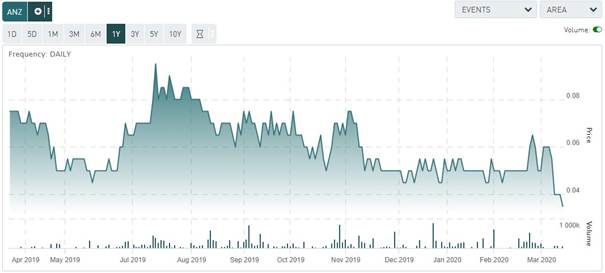
As a consequence, a recession is becoming more and more likely for this year according to many analysts, although a recession already was in the cards based on many indicators. As I believe this myself as well, I see the virus combined with the oil move of Saudi Arabia and Russia as a perfect storm type catalyst for an accelerated initiation of a recession. So far, Alianza Minerals hasn’t been hit directly by the virus, as in staff being infected, although President and CEO Jason Weber and Executive Chairman Mark Brown visited the last PDAC convention in Toronto. The share price has been another story, as hardly any stock has been immune to the latest market meltdown:
Fortunately fundamentals of the company are only improving, so the opportunity presented keeps getting better in my view. Another development illustrates this further, as the other important news of this new year so far was that Alianza Minerals managed to reel in Coeur Mining in January to do a JV on one of its properties. The option agreement relates to a Letter of Intent where a wholly owned subsidiary of Coeur Mining can earn an 80% interest in the property by (i) funding $3.55 million in exploration over five years and (ii) making scheduled cash payments totaling $575,000 over eight years. Coeur must also fund a feasibility study and notify Alianza of its intention to develop a commercial mine on the property on or before the 8th anniversary from the date of notification of the class 1 exploration permit.
All pictures are company material, unless stated otherwise.
All currencies are in US Dollars, unless stated otherwise.
Management was obviously very pleased with the increased raised amount, as Jason Weber, president and CEO, commented: “Management appreciates the support of shareholders and participants in the current financing, enabling us to significantly expand the placement. We are very much looking forward to 2020 and our first drill program in Nevada with our partner Hochschild PLC in April.”
They had no clue the additional amount was coming in, as they tried for months, but were pleasantly surprised.
This 5c round involved a full warrant, which is something I don’t really like to see for dilution reasons, but in theseat the time of the raisealready dire times, a half warrant was too much to ask for apparently. This warrant is valid for three years and is exercisable at 10c.
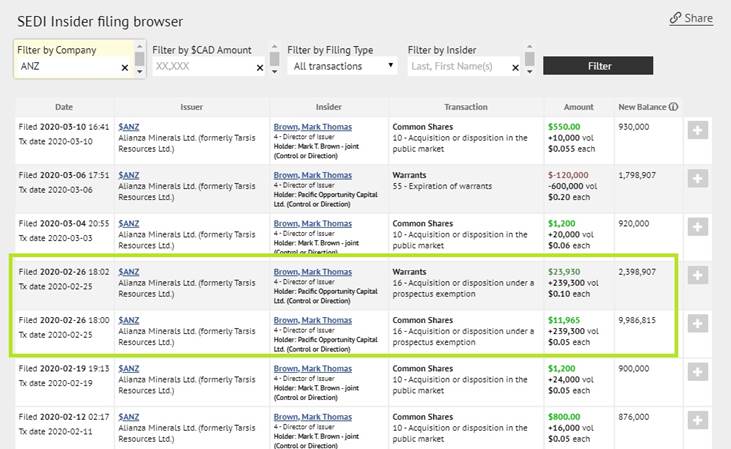
Finder’s fees of 7.5% in cash and 7.5% in finder’s warrants were paid to eligible parties, amounts weren’t disclosed. Mark Brown, one of the largest shareholders, participated a bit in this offering, as can be seen here:
The proceeds of this round will be used for working capital, general expenses and exploration at the Haldane project, as stated by Jason Weber:
“With Alianza’s working capital covered for 2020 and into 2021, we are in an excellent position to build upon the upcoming drill program with Hochschild at our Horsethief Gold Project in Nevada, and advance or option out additional projects. Exploration expenditures in 2020 will exceed $1.5 million with the majority of that funded by our partners.”
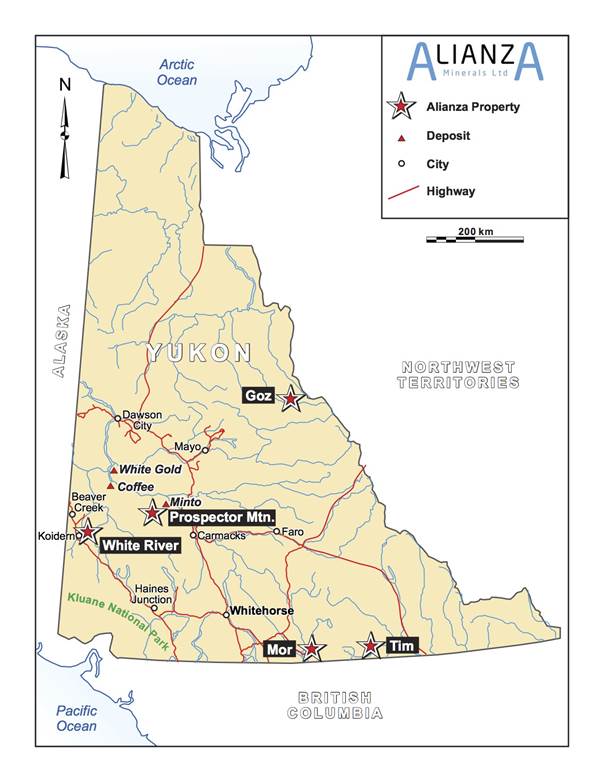
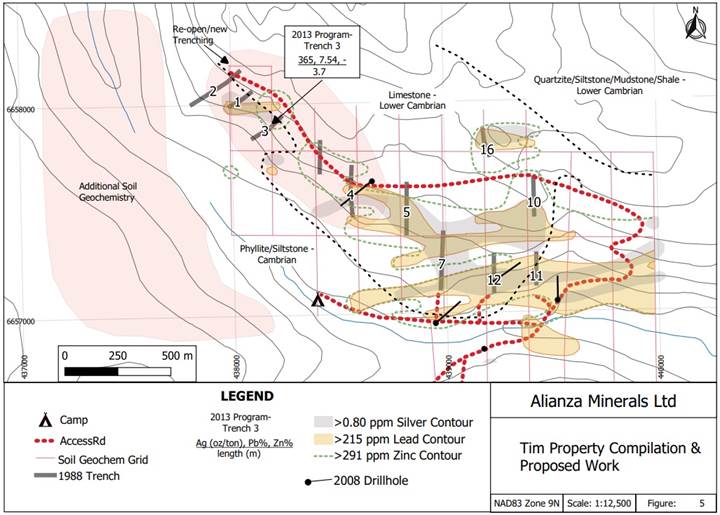
Earlier on at the end of January, Alianza Minerals signed an option agreement relating to a Letter of Intent (LOI) with a wholly owned subsidiary of Coeur Mining, to explore the road-accessible Tim property in the southern part of Yukon. Exploration at Tim is targeting high-grade silver-lead mineralization similar to that being mined by Coeur at its Silvertip operation, located 12 kilometers south of the property.
Coeur can earn an 80% interest in the property by funding C$3.55 million in exploration over five years and making scheduled cash payments totaling C$575,000 over eight years. Coeur must also fund a feasibility study (FS) and notify Alianza of its intention to develop a commercial mine on the property on or before the 8th anniversary from the date of notification of the Class 1 exploration permit.
“We are very pleased to have partnered with Coeur to advance the Tim Silver Property,” stated Jason Weber, president and CEO of Alianza Minerals. “Tim looks to be a Silvertip analog, and the Coeur team is an obvious choice to move the project forward. It will be a great advantage to have Coeur’s geological expertise applied to the project.”
As described in earlier analysis about Alianza, it was basically decided on a coin flip whether Tim or Silvertip was to be explored and developed, because of the similar characteristics. The Silvertip analog isn’t going to be smooth sailing though. The operating high grade Silvertip Mine in British Columbia didn’t immediately turn out to be the valuable asset Coeur thought it would be, as it had to impair Silvertip massively in their Q4 financials:
“- $250.8 million impairment, and temporarily suspending mining and processing activities at Silvertip – Reduction in carrying value to $150.0 million and temporary suspension of mining and processing activities driven by further deterioration in zinc and lead market conditions as well as processing facility-related challenges. The Company plans to (i) double its exploration investment in 2020 to potentially further expand the resource and extend the mine life, and (ii) pursue a mill expansion to improve the asset’s cost structure and its ability to deliver sustainable cash flow.”
Keep in mind the Silvertip Mine was valued by Coeur at US$400 million but acquired for US$250 million (US$200 million in direct payments and US$50 million in milestone payments) from a partnership between Denham Capital and JDS Silver in September 2017. JDS Silver is closely related to JDS Energy and Mining, who did the economic studies, engineering and contracting on this project, as represented on their website:
“JDS, as the general contractor, completed the construction of the Silvertip mine located on the Yukon-British Columbia border. JDS also completed the Preliminary Economic Assessment of the Project which provided the client with preliminary engineering and development plans as well as and economic information that provided an initial view of project viability and a guide for advancement of the project. Consistent with the JDS formula for value addition, the work performed identified the most practical and profitable direction for project development JDS is currently managing all aspects of the mine construction as lead EPCM provider.
JDS is also currently working on providing support for the Silvertip Project paste plant design and construction with the use of equipment from the Diavik Diamond Mine. JDS was also responsible for the teardown and demobilization of the equipment at its prior to transporting to the Silvertip site.”
JDS Silver began construction in December 2015 and began production in October 2016, which was halted in 2017 due to ramp-up issues. After the acquisition by Coeur, production efficiency was improved and commercial production restarted again at the end of 2018, but problems started to surface during 2019 as production remained below target primarily due to extended planned downtime, which was implemented to complete key projects targeting improved mill availability. It all didn’t really work out, as an impairment analysis generated the massive devaluation conclusion based on a slow ramp-up, weaker-than-forecast zinc and lead prices, and significantly higher treatment charges for zinc and lead concentrates. A new plan for increased production and resource expansion has been launched by Coeur, showing the invalidity of both resource and mine plan from earlier stages.
As the new owner of Silvertip, which has a relatively limited resource and likewise mine life, Coeur could have an interest in Tim to develop it as a backup resource, if Silvertip exploration doesn’t generate the desired resource expansion. If Tim results in an economic resource, it could at the very least serve as an extra source of ore for the Silvertip mill and processing plant. Of course the hypothetical Tim resource would need to have the same metallurgy otherwise Coeur would have to install a different flow sheet at the processing plant, increasing sustaining capex further. According to Weber, the potential for likewise metallurgy is one of the reasons Coeur is keen on Tim, as it sees the same units and style of mineralization so it feels the metallurgy has a good chance to likely be similar.
The 2020 exploration program at Tim is expected to target high-grade silver-lead-zinc Carbonate Replacement Mineralization (“CRM”), similar to that found at Coeur’s Silvertip operation. Coeur’s tentative exploration plans are in-line with those recently announced by Alianza, and will consist of detailed mapping, soil geochemical surveys and reopening old trenches, which date back to 1988.
As the coronaor COVID-19virus is impacting mining operations everywhere, I asked CEO Jason Weber if exploration programs for his projects would be affected. He answered the following: “At this point in time we are proceeding with plans for our projects. The length and degree to which business and travel is limited by the virus mitigation methods enacted by the U.S. and Canadian governments is the largest factor, but we want to be ready to start projects as soon as is safe to do so.”
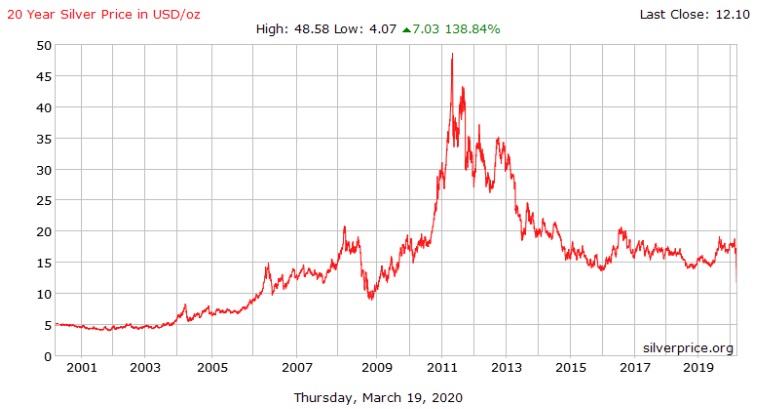
Alianza Minerals already worked on the Tim project in the past, as early as 2008 in a JV with International KRL Resources, and never lost interest in it, despite silver prices crashing from US$30-45/oz levels since then. Besides this, silver got hit extremely hard the last few weeks, and is trading in the US$12/oz range now, which is a level not seen since 2009.
Unfortunately, drilling by KRL in 2008 didn’t hit any interpreted carbonate-replacement style mineralization associated with identified IP anomalies, and the property was returned to the predecessor of Alianza Minerals later that year.
In 2013, Alianza funded a small program to complete a focused work program and re-evaluated a historical zone of silver-lead rich Carbonate Replacement Mineralization (CRM) originally exposed by mechanized trenching in 1988. Historical chip sampling across the zone returned 352 g/t silver and 9.12% lead across 4.00 meters. In addition to this exposure, similar mineralization was also reported in adjacent trenches. This zone has never been tested with drilling. Alianza resampled the central trench in 2013, returning 3.7 meters assaying 365 g/t silver and 7.5% lead from a channel sample, which was a decent sampling result.
Three series of sawn channel samples were taken across the exposure at approximately 1 meter spacing between channels. Weighted average assays for each of the channel series are shown below and are interpreted to be near true width:
Channel
Interval (m)
Silver (g/t)
Lead (%)
Central
6.40
220
4.74
Including
3.70
365
7.54
including
0.70
976
8.32
West
2.70
269
8.23
including
0.70
829
7.94
East
2.50
280
10.28
Drilling on the property targeted IP geophysical anomalies again, but unfortunately didn’t return any economic results. However, according to management, at least some of the holes appear to be drilled parallel to mineralization. Further mapping and soil geochemical work is required to gain a better understanding of the structural and stratigraphic setting and how that relates to both IP and soil geochemical data. Ideally, that would lead to the identification of thick receptive carbonate horizons interacting with structure to produce potentially economic CRD mineralization. With a better understanding of the geology of the nearby Silvertip Mine, mapping may allow for a reinterpretation of the geology in the context of Silvertip.
I was wondering how Tim and its sampling/IP results resembled Silvertip, how exploration progressed Silvertip from discovery into a resource, if and how this strategy could be useful (or not) for Tim, and what Alianza hopes to find when drilling Tim out further. Jason Weber stated that he is planning a tour of the Silvertip Mine and surrounding exploration targets this summer. This will help tie together the geology at Tim and the Silvertip Mine. Coeur has been very pleased with their brownfields exploration on site and believes there is excellent potential to add significantly at the Silvertip Mine and find a resource at Tim. The exact specifics of comparable geology aren’t ready to be disclosed to the public yet.
I am looking forward to exploration programs at Tim, and according to Weber Coeur was planning to get on site this spring. Coeur is the operator.
Until recently, the Haldane project in the Yukon has seen the most work. According to Weber, exploration programs for this project will likely consist of some additional groundwork including soil geochemistry and trenching and later drilling and this will start in the summer. Plans are still in the initial phase as the 2019 program data is still being evaluated. Besides Haldane, the company also had a JV with Hochschild in Nevada, initially involving three projects. The Horsethief property is considered the most prospective and remains active, the BP and Bellview projects were recently returned.
When I talked to Jason Weber the last time, he stated that Horsethief hosts five primary drill targets, of which four target areas are defined by surface exposures of altered carbonate rocks and one target at depth, interpreted from induced polarization (IP) and resistivity geophysical surveys. Management has been working with Hochschild’s technical team to prioritize these targets for a 2,500 meter drilling program in 2020. The original plan was to start drilling Horsethief in October/November of this year, but this plan was already deferred into Q1, 2020 as Hochschild was re-prioritizing exploration programs across the board, and now the coronavirus is kicking in, things have changed again. According to Jason, they are still targeting a spring startup but may be affected by the virus mitigation efforts. The plan is for a 3,000 meter program in 10 holes starting in May. The company intends to have logistics in place to commence the program as soon as it safe to do so if startup is indeed delayed.
Conclusion
Alianza Minerals did very well to raise C$1.1 million in February, much more than anticipated and right before the coronavirus outbreak, effectively crippling all money-raising efforts for most companies. Of interest is the new Coeur JV regarding the Tim project, which has all the hallmarks of a Silvertip analogy, notwithstanding the fact that Coeur has issues to optimize operations over there, not helped by a lowering silver price lately. Exploration at Tim will start at this spring. The company is also preparing step out drilling after the winter break at Haldane, and the Horsethief project is awaiting a drill program in May if conditions permit, with Alianza being the operator. So despite the corona pandemic, Alianza doesn’t seem to be hampered a lot, and their JV partners simply continue operations and exploration programs, of course by following precautionary measures wherever applicable, as health of staff is a primary concern. Results of the various programs should start to come in around June/July, and although sentiment for anything equity-related is at a low right now, Alianza Minerals has two good chances of hitting economic intercepts.
I hope you will find this article interesting and useful, and will have further interest in upcoming articles on mining. To never miss a thing, please subscribe to The Critical Investor’s free newsletter, http://www.criticalinvestor.eu, in order to get an email notice of my new articles soon after they are published.
Disclaimer:The author is not a registered investment advisor, and currently has a long position in this stock. Alianza Minerals is a sponsoring company. All facts are to be checked by the reader. For more information go to www.alianzaminerals.com and read the company’s profile and official documents on www.sedar.com, also for important risk disclosures. This article is provided for information purposes only, and is not intended to be investment advice of any kind, and all readers are encouraged to do their own due diligence, and talk to their own licensed investment advisors prior to making any investment decisions.
Streetwise Reports Disclosure: 1) The Critical Investor’s disclosures are listed above. 2) The following companies mentioned in the article are sponsors of Streetwise Reports: None. Click here for important disclosures about sponsor fees. The information provided above is for informational purposes only and is not a recommendation to buy or sell any security. 3) Statements and opinions expressed are the opinions of the author and not of Streetwise Reports or its officers. The author is wholly responsible for the validity of the statements. The author was not paid by Streetwise Reports for this article. Streetwise Reports was not paid by the author to publish or syndicate this article. Streetwise Reports requires contributing authors to disclose any shareholdings in, or economic relationships with, companies that they write about. Streetwise Reports relies upon the authors to accurately provide this information and Streetwise Reports has no means of verifying its accuracy.
4) The article does not constitute investment advice. Each reader is encouraged to consult with his or her individual financial professional and any action a reader takes as a result of information presented here is his or her own responsibility. By opening this page, each reader accepts and agrees to Streetwise Reports’ terms of use and full legal disclaimer. This article is not a solicitation for investment. Streetwise Reports does not render general or specific investment advice and the information on Streetwise Reports should not be considered a recommendation to buy or sell any security. Streetwise Reports does not endorse or recommend the business, products, services or securities of any company mentioned on Streetwise Reports. 5) From time to time, Streetwise Reports LLC and its directors, officers, employees or members of their families, as well as persons interviewed for articles and interviews on the site, may have a long or short position in securities mentioned. Directors, officers, employees or members of their immediate families are prohibited from making purchases and/or sales of those securities in the open market or otherwise from the time of the interview or the decision to write an article until three business days after the publication of the interview or article. The foregoing prohibition does not apply to articles that in substance only restate previously published company releases. As of the date of this article, officers and/or employees of Streetwise Reports LLC (including members of their household) own securities of Coeur Mining, a company mentioned in this article.
Everyone makes mistakes; it’s part of being human.
And traders are not the exception to being human. Though, often, the FX best traders are the ones who most resemble robots!
Even the most experienced forex traders make mistakes. Sometimes the difference between a rookie messing up and an expert messing up is that the expert knows what they did wrong.
So, there is nothing unique about having a trade not work out, or, indeed, lots of trades working out.
In fact, often the road to success is not so much in eliminating bad trades, but developing a forex strategy that compensates for or minimizes the impact of regular old human error.
The Point of a Problem is to Fix It
The whole reason to care about the most common mistakes that all forex traders can make is that, well, we can make them too. And if we know what they are, we’ll be in a better position to do something about them.
So, what are these common mistakes all traders make?
Pulling the Trigger
Let’s start with one that, well, OK, let’s be honest and say it’s rather stupid.
But, we’ve all done it, so none of us can complain: that’s rushing into a trade in the spur of the moment because just as you were deciding whether or not the trade was a good idea, the market moved and you clicked trade.
Often day traders have to make quick decisions, especially in more volatile markets. And there is a certain anxiety that comes before entering a trade.
You might enter the trade out of fear that the opportunity window is closing, or the market will suddenly move in your favor and you’ll take that as confirmation that the trade is a good idea.
Brassing It Out
Actually, there are mistakes that are more common among experienced forex traders. One of those is getting overconfident, and getting into the market without dotting the I’s and crossing the T’s.
As you get more comfortable in your forex trading, you might find yourself slacking off on the basics, and neglecting to check certain things before jumping into the market. And, often, a couple of losing trades will bring an FX trader back to earth.
Feels Over Reals
Trading is best done cold; and while it can be a lot of fun, it’s inevitable that a forex trader, at some point, will mistake feeling like it’s a good trade for thinking it’s a good trade.
True, some people just have a knack for trading, and talent is definitely a thing. But forex trading is a numbers game, whereas betting is a gut-feeling game.
The bottom line is that good FX traders are going to make lots of trades over their careers, and trading mistakes are inevitable. Having a little margin in your strategy to account for potential errors, as well as keeping safeguards is, therefore, a vital part of a successful forex trader’s toolkit.
Slower UK producer output prices decline bullish for GBPUSD
Britain’s producer price index declined less than expected in February: the PPI declined 1.2% in February after 0.3% growth in January, when a 2% drop was expected. This is bullish for GBPUSD.
Coronavirus – not Brexit, nor the 2008 financial crash – is likely to deliver the biggest hammer blow to the British pound, warns the CEO of one of the world’s largest independent financial advisory and services organizations.
The stark warning from deVere Group’s chief executive and founder, Nigel Green, came as sterling fell to its lowest level on record against the currencies of Britain’s major trading partners on Tuesday.
The exchange rate, measured against a basket of currencies corresponding to the UK’s trade flows, fell to a low of 72.9, according to the Bank of England. It was slightly up on Wednesday to 74.4.
Mr Green notes: “These are unprecedented times. The pound is weaker now than at any point during the Brexit process, the 2008 financial crash, or 1992’s Black Wednesday when speculators forced the government’s hand in pulling the pound from the European Exchange Rate Mechanism.”
This is happening for three main reasons, says the deVere CEO.
“First, the coronavirus pandemic has triggered a flight-to-safety. As is typical in times of economic turbulence, the U.S. dollar attracts more buyers, in turn pulling down the price of sterling.
“Second, investors are seeking liquidity and the most liquid assets of all are U.S. Treasuries, which explains why dollars are always in demand.
“Third, before the pandemic, many investors had piled into sterling anticipating more gains following a decisive general election outcome.”
The beleaguered pound will impact in numerous ways.
“The significant drop in the value of the pound will contribute to reducing people’s purchasing power and a drop in UK living standards. Weaker sterling means imports are more expensive, with rising prices being passed on to consumers.
“The fall in the pound is good for exports some claim, but it must be remembered that around 50 per cent of UK exports rely on imported components. These will become more expensive as the pound falls in value.
“A low pound is, of course, bad news for British expats who receive income or pensions in sterling.
“In addition, the UK’s financial services sector – which contributes 6 per cent of GDP – will suffer from another knock to the pound. It will be hit because it is built on foreign investment that puts its faith in a strong pound.”
Nigel Green concludes: “Coronavirus – not Brexit, nor the 2008 financial crash – is likely to deliver the biggest hammer blow to the British pound as the world moves into unchartered and uncertain waters.
“As such, we can expect to see an increase in domestic and international investors in UK assets considering the international options available to them in order to build and safeguard their wealth.”
About:
deVere Group is one of the world’s largest independent advisors of specialist global financial solutions to international, local mass affluent, and high-net-worth clients. It has a network of more than 70 offices across the world, over 80,000 clients and $12bn under advisement.
Yesterday, the US dollar fell again relative to a basket of major currencies. The dollar index (#DX) closed in the negative zone (-0.96%). US authorities have agreed on an incentive package to mitigate the economic impact of the coronavirus outbreak. Reportedly, the total aid volume will amount to about $2 trillion. According to the plan, the text of the agreement will be presented on Wednesday evening. Also, US President Donald Trump wants to end quarantine by mid-April, but the Department of Health is opposed. WHO said on Tuesday that there was a “very large acceleration” in the coronavirus spread in the United States.
On Wednesday, China reported a decrease in the number of newly confirmed cases of coronavirus due to a slowdown in the “importation” of the infection from the outside and the absence of locally transmitted cases. According to the National Health Commission of the PRC, 47 new cases were registered yesterday, all of which are related to people who returned from abroad, while a day earlier 78 new cases were recorded.
The “black gold” prices are growing. Currently, futures for the WTI crude oil are testing the $23.45 mark per barrel. At 16:30 (GMT+2:00), US crude oil inventories will be published.
Market indicators
Yesterday, there were aggressive purchases in the US stock market: #SPY (+9.06%), #DIA (+11.02%), #QQQ (+7.74%).
The 10-year US government bonds yield fell again. At the moment, the indicator is at the level of 0.83-0.84%.
The news feed on 2020.03.25:
– German IFO business climate index at 11:00 (GMT+2:00);
– Core durable goods orders in the US at 14:30 (GMT+2:00).
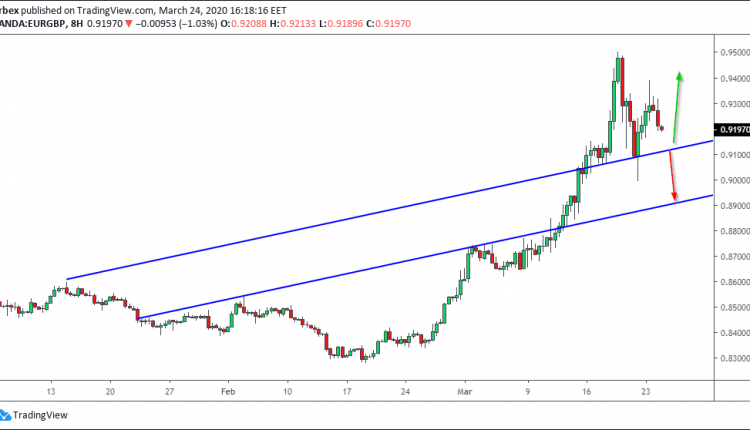
With the backdrop of the current pandemic, the euro found temporary safe haven status finding willing buyers. The strength in the euro caused EURGBP to retest 10-year highs of the 0.9500 handle.
The pair likely has put on a temporary top and is currently on a retrace.
The 8-hour chart above shows two distinct levels where the retrace could end and swing back higher.
The first level comes to around the 0.9100 handle, while better-listed support would come lower to .8875. As of now, we could expect a 0.9100 test and consolidation.
If the bounces remain shallow, we can potentially drop lower to the next resistance turning support at .8870.
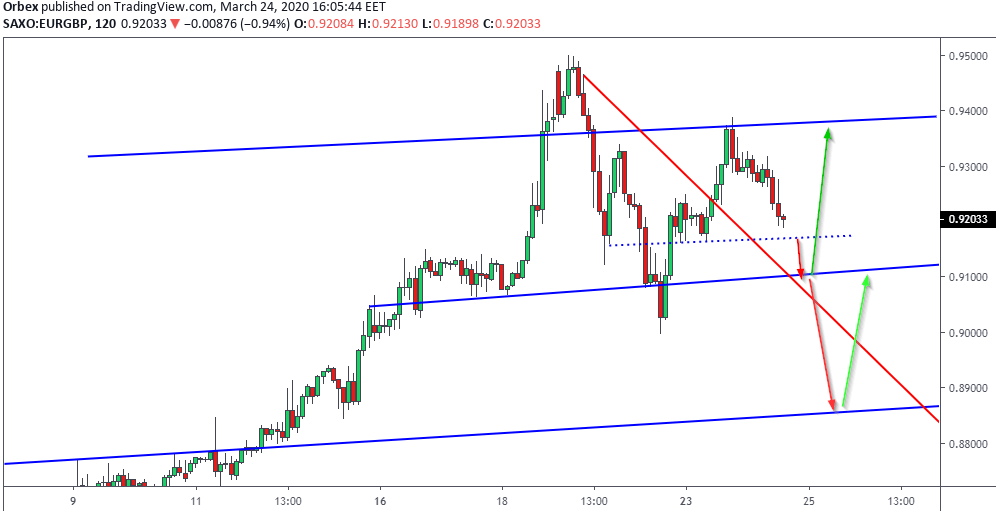
The 2-hour chart below shows an initial support to just under the 0.9200 handle. A break lower to expose 0.9110 is in line with the 8 hours.
The main resistance lies right around to the 0.9400 handle.
The EUR/USD currency pair keeps consolidating. There is no defined trend. Yesterday, Germany and EU published quite weak data on business activity. US senators and White House officials reached an agreement on an incentive package to mitigate the economic impact of the COVID-19 virus pandemic. The total aid volume will amount to about $2 trillion. At the moment, EUR/USD quotes are consolidating in the range of 1.07200-1.08600. The current technical picture signals a possible correction of the trading instrument. Open positions from key levels.
The Economic News Feed for 25.03.2020:
– German IFO business climate index – 11:00 (GMT+2:00);
– Durable Goods Orders (US) – 14:30 (GMT+3:00);
Indicators do not give an accurate signal: 50 MA crossed 100 MA.
The MACD histogram has started to rise, indicating that EUR/USD quotes are recovering.
The Stochastic Oscillator is located in the neutral zone, the line %K is below the line %D, which gives a sell signal for EUR/USD.
Trading recommendations
Support levels: 1.07200, 1.06350
Resistance levels: 1.08600, 1.09550, 1.10600
If the price fixes above 1.08600, the correction of the EUR/USD currency pair is expected toward 1.09400-1.11000.
Alternatively, the quotes could descend toward 1.06500-1.06000.
The GBP/USD currency pair
Technical indicators of the currency pair:
Prev Open: 1.15087
Open: 1.17432
% chg. over the last day: +1.81
Day’s range: 1.17403 – 1.19276
52 wk range: 1.1466 – 1.3516
GBP/USD quotes went up after a significant collapse. During yesterday’s and today’s trades sterling added over 400 points. At the moment, the currency pair GBP/USD is testing resistance level 1.19300. The mark 1.17200 is already a mirror support. The trading instrument can correct further. We recommend you to monitor the current information about the coronavirus pandemic and its impact on the global economy. Open positions from key levels.
The Economic News Feed for 25.03.2020 is calm.
The indicators signal the power of buyers: the price has fixed above 50 MA and 100 MA.
MACD histogram is in the positive zone, which indicates a bullish sentiment.
The Stochastic Oscillator is located in the overbought zone, the %K line crossed the %D line. No signals at the moment.
Trading recommendations
Support levels: 1.17200, 1.14500
Resistance levels:1.19300, 1.21350, 1.22800
If the price fixes above 1.19300, expect further correction toward 1.21000-1.21500.
Alternatively, the quotes could descend toward 1.16000-1.15000.
The USD/CAD currency pair
Technical indicators of the currency pair:
Prev Open: 1.45076
Open: 1.44658
% chg. over the last day: -0.25
Day’s range: 1.42955 – 1.44830
52 wk range: 1.2949 – 1.4668
The USD/CAD currency pair has moved down. The trading instrument has updated the local lows. Currently, the CAD is testing the round level of 1.43000. The mark 1.44500 is the nearest resistance. The technical picture signals a further correction of USD/CAD quotes. We recommend you to pay attention to the “black gold” price dynamics. Open positions from key levels.
The Economic News Feed for 25.03.2020 is calm.
The indicators signal the sellers’ strength: the price has fixed below 50 MA and 100 MA.
MACD histogram is in the negative zone and continues to decline, which indicates a bearish sentiment.
The Stochastic Oscillator is located in the oversold area, the %K line crossed the %D line. There are no signals at the moment.
Trading recommendations
Support levels: 1.43000, 1.41500, 1.40000
Resistance levels: 1.44500, 1.45550, 1.46600
If the price fixes below 1.43000, expect further correction to 1.42000-1.41000.
Alternatively, the quotes could grow toward 1.45000-1.46000.
The USD/JPY currency pair
Technical indicators of the currency pair:
Prev Open: 111.222
Open: 111.328
% chg. over the last day: +0.05
Day’s range: 110.752 – 111.568
52 wk range: 101.19 – 112.41
USD/JPY currency pair is still in a sideways movement. There is no defined trend. Financial markets participants are waiting for additional drivers. Currently, the following local support and resistance levels can be distinguished: 110.200 and 111.600, respectively. Technical correction of a trading instrument is not ruled out in the nearest future. We recommend you to pay attention to the dynamics of US government bonds yield. Open positions from key levels.
The Economic News Feed for 25.03.2020 is calm.
Indicators do not give accurate signals: the price is consolidating near 50 MA.
Histogram of MACD is in positive zone, which indicates a bullish sentiment.
The Stochastic Oscillator is located in the neutral zone, the %K line crosses the %D line. No signals at the moment.
Trading recommendations
Support levels: 110.200, 109.300, 108.500.
Resistance levels: 111.600, 112.000
If the price fixes below 110.200, expect the quotes to correct toward 109.300-108.500.
Alternatively, the quotes will grow toward 112.000-112.500.
The Australian dollar, New Zealand dollar and Canadian dollar powered higher in early trading on Wednesday. The ‘comdolls’ were lifted as fresh stimulus hopes boosted risk appetite and global equity markets rebounded.
After US lawmakers reached a $2 trillion aid deal on Tuesday, the Dow rallied by 11%, marking its largest gain since 1933. The massive relief package aims to provide financial support to businesses, hospitals and American families left in need as a result of the coronavirus pandemic.
However, upcoming economic data is expected to reflect the profound damage to the economy caused by the fallout from the coronavirus. Federal Reserve Bank of St. Louis President James Bullard told Bloomberg on Sunday that unemployment could rise as high as 30% and gross domestic product could plunge by 50%.
According to data from Johns Hopkins University, at the time of this writing Coronavirus COVID-19 global cases have risen to 435,006, with 19,625 fatalities. On Tuesday, the death toll in Italy from the pandemic increased by 743 in one day to 6,820. Meanwhile, WHO spokeswoman Margaret Harris told reporters that the US has the “potential” to overtake Europe as the new epicenter of the coronavirus.
China is the largest trading partner for both Australia and New Zealand and consequently their currencies have been particularly hard hit during the crisis. The Canadian dollar, which has a close positive correlation with crude oil, has also suffered due to the oil price war between Saudi Arabia and Russia. These three currencies (AUD, NZD and CAD) are known as ‘comdolls’ because their respective economies are highly dependent on exporting commodities. They are viewed as risk sensitive currencies and tend to perform better during periods of stability and confidence.
Looking at the AUD/USD daily chart we can see that price nearly reached the 50% retracement of the down move that began on March 9th. The recent low of 0.5503 marks the lowest the pair has been since 2002.