FOREX: Large Currency Speculators add to Euro positions, trim Dollar shorts

By CountingPips.com

The latest Commitments of Traders (COT) report, released on Friday by the Commodity Futures Trading Commission (CFTC), showed that futures speculators trimmed their short positions of the US dollar against the other major currencies for a second straight week. Non-commercial futures positions, those taken by hedge funds and large speculators, were overall net short the US dollar by $23.2 billion against other major currencies as of the February 22nd data release. This is a decrease from a total short position of $23.2 billion on February 15th, according to the CFTC data and calculations by Reuters which calculates the dollar positions against the euro, British pound, Japanese yen, Australian dollar, Canadian dollar and the Swiss franc.

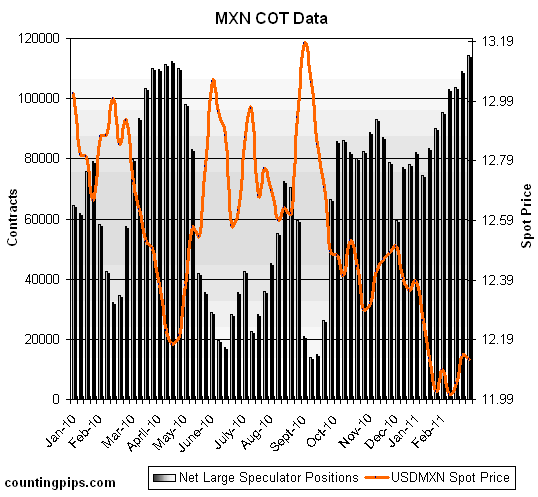
This week’s data saw some notable changes with euro positions increasing to their highest level since October while Japanese yen positions have fallen to their lowest level since May 2010. Mexican peso long positions have risen for seven straight weeks and now sit at the highest net long position in over a year.

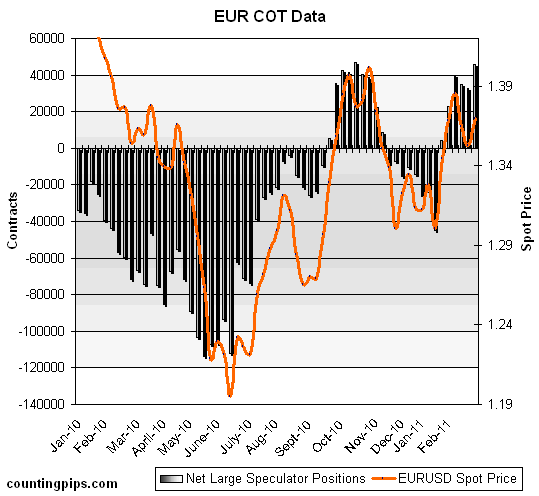
EuroFx: Currency speculators added to their net long positions for the euro against the U.S. dollar after declines the previous two weeks. Futures positions in the euro rose to a total of 45,598 long positions as of February 22nd following a total of 32,464 long positions on February 15th. This is the highest net long euro position since October 19th when euro positions were +46,748.
euro cot

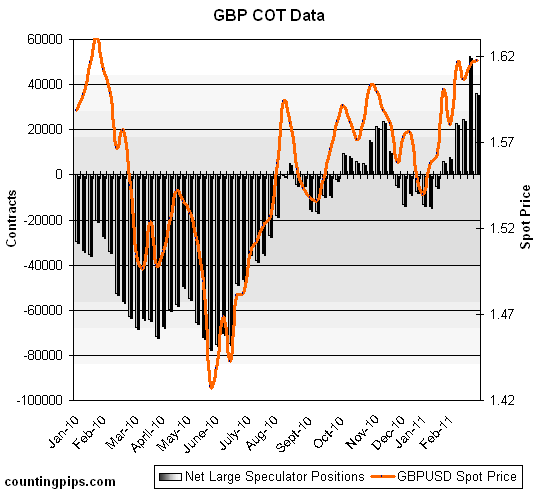
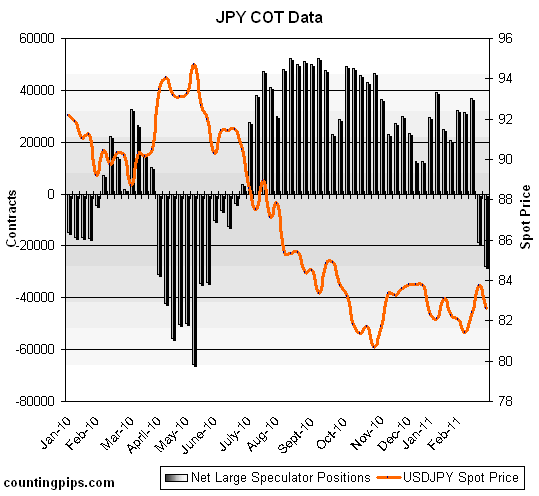
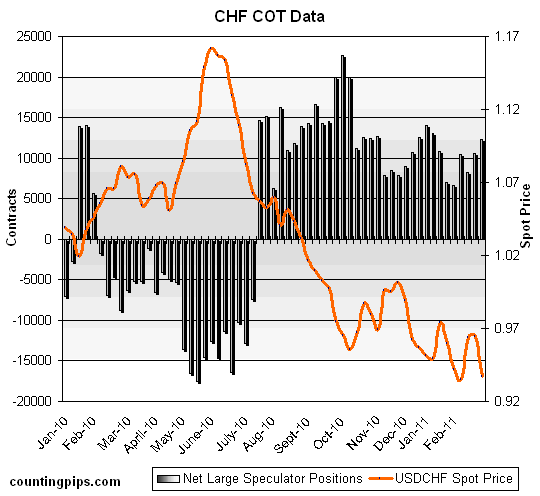
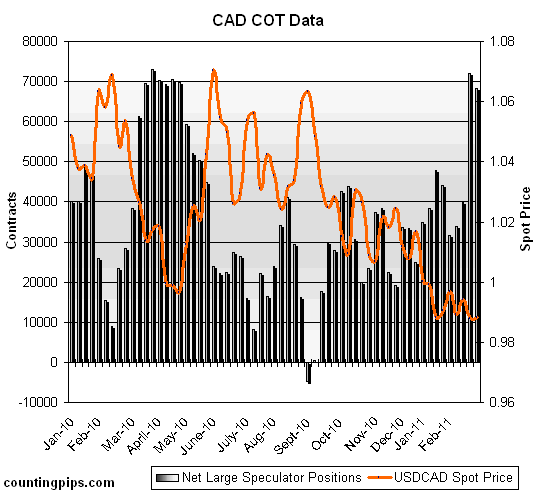
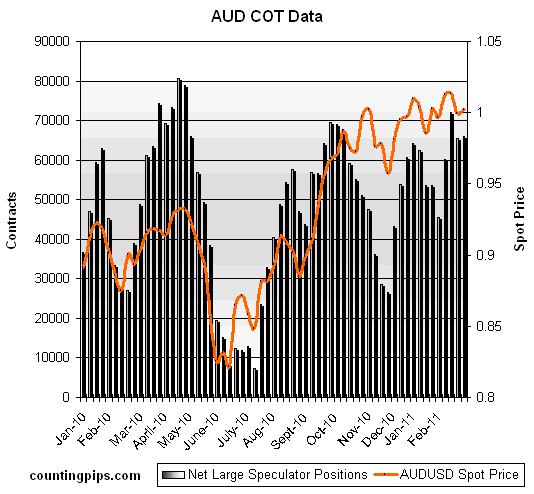
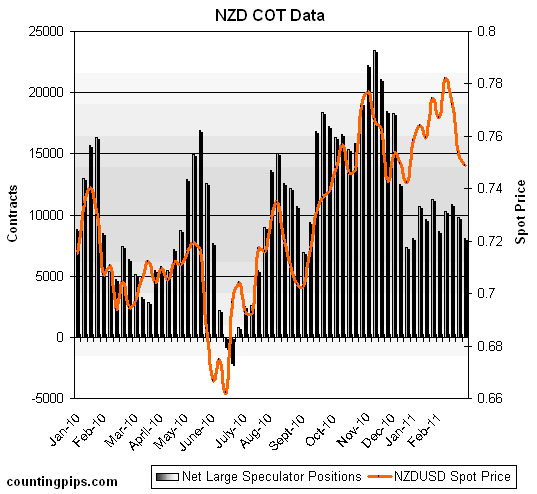
The COT report is published every Friday by the Commodity Futures Trading Commission (CFTC) and shows futures positions as of the previous Tuesday. It can be a useful tool for traders to gauge investor sentiment and to look for potential changes in the direction of a currency or commodity. Each currency contract is a quote for that currency directly against the U.S. dollar, where as a net short amount of contracts means that more speculators are betting that currency to fall against the dollar and net long position expect that currency to rise versus the dollar. The graphs overlay the forex spot closing price of each Tuesday when COT trader positions are reported for each corresponding spot currency pair.

GBP: Speculators decreased their net long British pound sterling bets following six straight weeks of gains. Sterling long positions declined to a total of 36,009 long positions after totaling 52,572 long positions as of February 15th.
british pound sterling cot

JPY: The Japanese yen net contracts decreased for a second straight week as of February 22nd to the lowest level since May 2010. Yen positions fell to a total of 27,746 short contracts following a total of 18,548 net short contracts reported on February 15th.
japanese yen cot

CHF: Swiss franc long positions rose for a second consecutive week to a total of 12,291 long contracts, according to the COT data as of February 15th. Franc contracts totaled a net of 10,518 long contracts on February 8th.
swiss franc cot

CAD: The Canadian dollar positions retreated after advancing sharply higher the previous week to the highest level since March 2010. Canadian dollar long positions dipped to a total of 68,348 net long contracts on February 22nd after registering 72,090 net longs on February 15th.
canadian loonie dollar cot

AUD: The Australian dollar long positions were almost unchanged from the previous week. AUD contracts totaled a net amount of 66,064 long contracts as of February 22nd after AUD positions had totaled 65,514 net long contracts on February 15th.
australian dollar cot

NZD: New Zealand dollar futures positions headed lower for a second week to a total of 8,101 long positions as of February 22nd. NZD large speculator long positions had dipped the previous week to a total of 9,810 long contracts on February 15th.
new zealand kiwi dollar cot

MXN: Mexican peso long contracts continued to rise higher for a seventh consecutive week. Peso long positions increased to 114,276 net long positions as of February 22nd after totaling 109,096 longs the week prior on February 15th.
mexican peso cot

COT Data Summary as of February 22, 2011
Large Speculators Net Positions vs. the US Dollar

Euro: +45,598
British pound sterling: +36,009
Japanese yen: -27,746
Swiss franc: +12,291
Canadian dollar: +68,348
Australian dollar: +66,064
New Zealand dollar: +8,101
Mexican peso: +114,276

Further COT Resources from around the web:

Trading Trend Reversal Patterns in Sideways Market

By Taro Hideyoshi

Generally, traders need solid uptrends and downtrends to take profits from the market. However in non-trending or sideways market, swing traders, who short-term trade, present a lower risk opportunity.

Traders can use the reversal patterns; I have introduced you in previous articles, to trade in sideways. Using the patterns to plan to enter a trade and establish tight stop loss. Also use trailing stop when prices move up or move down in the same direction as your trade.

To trading using the reversal patterns in sideways market, first you have to define the ranges of traded price. Then you have to wait until the price traded around the boundary of that range. When the price traded near the boundary, keep monitoring it to spot any reversal patterns it might form.

For example, if you wish to participate on the long side in non-trending market, you should wait until the price traded around the lower boundary. While the price is trading near lower boundary, there is a chance that he price will form the reversal pattern. In this case you may seek for double bottom or reverse head-and-shoulder pattern.

If you spot the double bottom, go long as the price reverses from second low, as it rises over the high of the previous low day.

If you spot the reverse head-and-shoulder pattern, go long as the price complete the right shoulder, as it rises over the neckline resistance.

Do not forget to set your stop loss point. You may place the stop few ticks below the neckline since it works as support level after it has been broken. While you are defining stop loss and exit point, you will see your risk/reward ratio (as I discussed about this in one of my article). You risk/reward ratio should be at least 1:3 to be worth for you to enter the trade.

For going short, you can use the same rules as going long but reverse them.

When you are trading using reversal patterns, do not use them as standalone indicator. You have to put it together with other indicators. For example, if you anticipate going long, besides the double bottom or reverse head-and-shoulder, you should consider the indicator such as the relative strength index (RSI). If RSI makes a bullish divergence, it supports that the reversal is coming.

The risk is lower when all signals tell you the same. So, wait until all indicators are in gear in order to minimize your risk.

About the Author

Taro is an experience trader who trades in stocks, futures, forex. He strongly focuses on technical analysis, trading systems and money management.

If you would like to find more articles on MetaStock Tutorials, MetaStock Formulas, Trading Systems and Money Management. Please go to MetaStock Trading System.

Some Helpful Tips To Make You Succeed With Currency Trading

By Cedric Welsch

If you want a way to make money without leaving your home you can start by trading currencies online. Online forex trading has become a good source of income for a lot of people. You can decide today to become one of these people. However, before you rush to go and sign up with the first online forex site, there are a couple of things you have to know. This is what will make you to succeed in trading currencies online.

Good, experienced and supportive help is very important for you to make it in trading currencies online. There are a lot of forex brokers online but you have to make a good choice. Forex brokers come in different types just like stock brokers. Register with a reputable forex broker that has an efficient site with very good support and service.

The next thing is for you to start doing a lot of learning. Knowing the in and out of trading currencies online will give you a good foundation to get to the top. There is a lot to learn. You have to be familiar with the language and systems of the business. The forex broker you choose should also have a lot of learning resources on its site for you o upgrade your knowledge in online currency trading.

Using a demo account is a good way to train yourself and test your hand before using real money. Your forex broker will definitely have a free demo account for you to use. Stay with the demo account for at least six months. After about six months, you can now start trading currencies with some money. Start with a little money and increase as you become better in trading.

Forex trading involves a lot of technicalities and understanding of currency movements. You also have to become familiar with the different currency pairs. This is where a lot of people fail and lose money. Taking your time to become familiar with the trading systems will really give you a boost in trading currencies online.

Emotional control is one other important thing with online currency trading. A trade is made at the click of a mouse. Emotions can make or break you in currency trading. Emotions can make you go against sound trading principles and make you lose a lot of money. Successful traders have learnt to have a grip on their emotions when making trading decisions.

About the Author

If you can be consistent with live forex news education, and even the forex broker reviews feeds, that should be key to trading success.

Forex Trading Experts Can Share Very Valuable Tips To You

By Cedric Welsch

Currency trading experts are professionals in the field of foreign currency exchange who have learned the strategies and techniques in trading successfully. As a newbie, training and knowledge in forex (FX) are essential to gaining profit from trades. However, the trends in the currencies market are quite unpredictable and therefore provide a good chance for loss as well. Nevertheless, with proper guidance from experts, you will learn how to minimize your losses and maximize profit.

The foreign exchange market is considered the world’s biggest market. With over 2 trillion USD being traded each day, it dwarfs the stock exchange market many fold. Due to this fact, as well as its liquidity, it has attracted a large number of investors. However, keep in mind that although the chance of gaining huge profits is quite high, it also poses an equal risk to lose.

Currency trading is none other than the exchange of one specific currency for another. This situation is usually experienced by travelers who need to convert their country’s currency to the currency of the country they are visiting. It is quite noticeable that the exchange rates between two different currencies fluctuate often times. This is where the potential to gain profit comes into play.

In order to learn the basics of the trade, learn it either by yourself or with the guidance of currency trading experts. Although forex websites usually provide free materials on currency trading instructions and training courses, experts often provide a better approach to teaching the necessary skills. However, be sure that the expert has vast experience in the field and is completely willing to train or impart knowledge to you.

Becoming an apprentice of a successful forex trader is a good idea. Although some fancy themselves as experts, they may not have a good record when it comes to winning trades. The measure of one’s success is not seen by the number of trades won though, but by the ratio between money gained and money lost. Under the tutelage of a professional trader, you learn the trading in a more efficient manner than simply reading books or watching videos. However, written materials and videos are quite helpful as well.

Although it may take a while to become as good as currency trading experts are, patience and determination are vital attributes a learner must possess. With diligence and practice, you will soon become a successful trader like the masters.

About the Author

Any good investor must read forex news online regularly, just as you check forex trading reviews on a regular basis.

Oil Markets Impact On Forex

By James McKee

Continued conflict in the Middle East has resulted in price hikes on oil throughout and now the rest of the world must either pay or go without. Such a precarious position is one that Western countries will begin to feel the squeeze from financially very shortly. The USD and other western currency will suffer greatly if the cost of oil goes up because so to will the cost of all other goods. A rise in the price of goods corresponding with an ailing US dollar will result in a very decreased purchasing ability for US citizens as well as those in Europe and Asia.

Oil is used in everything from gasoline to toothpaste, petroleum products are used in every aspect of our daily lives and as a result we are implicitly dependent on them. This type of dependence results in a high premium being placed on oil and the ability to purchase it as affordably as possible. Already the world’s stock markets have fallen one percent overall as risk appetite is falling through the floor with most investors fearing further conflict in oil producing countries. This is driving the value of currencies such as the EUR through the floor since they have both domestic and international problems knocking on their door.

The conflicts currently occurring show little sign of slowing down until those involved are satisfied they have achieved their goals. Seeing that the problems in Middle East are rooted in inadequate food supplies and other infrastructural shortcomings this problem may continue for some time. Those on the forex currency exchange should keep an eye on the value of oil which is currently up to $94.00 a barrel, those who invested in oil futures are doing significantly well while the rest of us are waiting for the next tidal wave.

About the Author

Author is a Forex trader and financial analyst residing in Denver, Colorado. To stay up to date on all the latest developments in the financial world and beyond be sure to check out the forex exchange rates regularly.

Investing In The Forex Market – A Solution To Your Growing Financial Concern

By Cedric Welsch

Are you one of the millions of people today who are affected by the much reported global economic crisis in any way? If you are not really affected financially or in any physical manner, but somehow you worry for your future, then you should still count yourself to be one of them. Financial stability is surely a growing concern not just by some entire nations but also by individuals like you.

The good news is that there are effective solutions to counter this growing concern, and one of them is none other than the foreign exchange market. If you think you are slowly losing your sense of security on your current employment status or if you are afraid that there may be a chance of massive layoffs happening within the very company you are working for, then it might be time for you to think of a more stable means of filling in your financial needs. Any form of investment is surely a solution to secure your financial needs in the coming future. And no doubt, foreign exchange trading is one of the best forms of investment available today.

But what makes investing in the foreign exchange market such a rewarding career for any individual who decides to go for it? Well, the first benefit is the reward of convenience. You can trade in the forex market at the convenience of your own home. As long as you have a computer and internet access, trading can be done even in your pajamas.

You don’t have to be an already wealthy investor or businessman for you to be able to start investing in the trading business. Forex trading is a dream opportunity to many people who want to make profits out of the idea of putting their investments in. You can surely start small when investing in the forex market, yet could potentially end up becoming wealthy later on. Indeed this opportunity is for the wealthy, the semi rich, the not so rich, and even for the simple fellow. A better way to put it is that this opportunity is open to everyone who has the desire to become wealthy out of the idea of investing.

Now, this all may sound very enticing for you that you may want to jump in on the forex trading wagon immediately right this very moment. Well not too fast though. A big percentage of the people who decide to become traders actually lose money fast. But don’t get discouraged just yet. The reason why people are losing their investments is because they do not take the time to study and learn the entire business.

As long as you are committed to make profits out of your investments and are willing to put your mind and heart into the forex trading business, then this opportunity can indeed be the one you’ve been looking for.

About the Author

Only the reputable currency news sources must be listened to by traders. This is important in making forex analysis.

US Government Budget May Cause Catastrophe

By James McKee

Democrats and Republicans are fighting in Washington DC over which budgets trim and which ones to outright decimate as options become slimmer and slimmer in light of a failing economy. Issues such as medicare and social security are causing deep divides along party lines as constituents demand something be done about a worsening economy. Whether or not these efforts will have any impact in the long run remains to be seen but one thing is certain: change is coming. The government is going to make every attempt to save money but unfortunately the budget being cut is going to have many adverse effects that can only be speculated upon.

Federal funding that once covered institutions like police departments has been cut to the point that these departments are being forced to alter the way they operate in an effort to cope with the financial short fall. In all likelihood the Republicans and Democrats will reach a compromise however whether or not this occurs in time to address the issues at hand is anyone’s guess. There is also rumblings of a complete shut down of government that would be caused by failure to reach a disposition by March 4th, which is when the government runs out of allocated money.

While this shutdown is unlikely many are crying out for something to be done and be done soon, the current state of the economy globally, nationally and now more and more locally has been something Americans are no longer willing to live with. The impact upon the USD with regard to an unstable economy and an infuriated population will surely be negative. Those on the forex currency exchange are encouraged to pursue a steadfast line of awareness with regard to the actions of the US government in order to stay ahead of the upcoming curve.

About the Author

Author is a Forex trader and financial analyst residing in Denver, Colorado. To stay up to date on all the latest developments in the financial world and beyond be sure to check out the forex exchange rates regularly.

Turtle Trading 4 Entries

By Taro Hideyoshi

The next piece, following markets and position sizing, of turtle trading system is entries.

Most traders believe that entry is the most important aspect in any trading system. For the turtles, they used only a very simple entry system based on channel breakout systems taught by Richard Donchian.

The turtles’ rules for entry consist of two different but related breakout systems called System1 and System2.

System1 was a shorter-term system based on a 20-days breakout. The turtles entered positions when price exceed high or low of the preceding 20-days. The entry signal would be ignored if the latest breakout would have resulted in a winning trade. And this breakout would be considered a losing breakout if the price moved 2N (N was calculated according to position sizing rule) against the position before a profitable 10-days exit occurred.

However if the System1 breakout was ignored due to the winning trade, the System2 would be used for entry to avoid missing of major moves.

System2 was a longer-term system based on a 55-days breakout. The turtles entered positions when the price exceeded by a single tick the high or low of 55-days. All breakouts for System2 would always be taken whether the previous breakout had been a winner or lost.

After turtles entered a single unit positions at the breakout, they would add to positions every 0.5N intervals following their initial entry until the maximum permitted number of units was reached.

Example

Suppose a turtle was trading Gold. The N was calculated as 2.50.

The price broke the 55-days high at 310.

Hence, turtle added first unit at 310.00.

Therefore the second would be added at 310 + (0.5*2.50) = 311.25.

The third unit added at 311.25 + (0.5*2.50) = 312.50 and so on.

The most of profits in a year might come from two or three large winning trades. Therefore the turtles have to be consistency because if a signal was skipped, this could affect the returns for the year.

About the Author

Taro is an experience trader who trades in stocks, futures, forex. He strongly focuses on technical analysis, trading systems and money management.

If you would like to find more articles on MetaStock Tutorials, MetaStock Formulas, Trading Systems and Money Management. Please go to MetaStock Trading System.

Trade Interceptor releases multi-broker forex trading applications

Trade Interceptor, a multi-broker forex trading platform, has released live trading capabilities on its desktop, iPad, iPhone and Android applications. The platform allows investors to trade with leading FX brokers simultaneously, from a single interface. New features include Touch-Chart-Trading™; real-time trading synchronization between the desktop and mobile apps; server-side price alerts; unlimited paper trading on the desktop; trading in the past, replaying historical data series for traders training; and multi-time frame, multi-currency trading simulation for strategy back testing.

Trade Interceptor currently offers live trading with FXCM and Dukascopy. Other forex brokers including GFT, ACM, FXSolutions and MBTrading are currently under integration. The mobile applications can be downloaded for free from the Apple iTunes Store, the Android Market, the BlackBerry App World and the Windows Phone Marketplace. Access to the full desktop application is free after registration on TradeInterceptor.com website.

“Our objective is to give forex traders access to different liquidity providers – considering that many traders now have more than one broker account – combined with highly innovative features, at no cost”, explains Rodolfo Festa Bianchet, CEO of Riflexo, the software company which develops Trade Interceptor. “We believe that the volume of mobile trading will grow exponentially in the next 2 years and we are well positioned and prepared to satisfy this demand”, he adds.

Trade Interceptor was launched in July 2009 with the release of its informative mobile apps for iPhone, BlackBerry, Windows Mobile, Android and iPad. “The platform has registered over 35.000 users in the last 12 months and has 12.000 active traders. We are currently growing at 5.000 new free users every month, and, since the launch of the life trading capabilities, we are introducing approximately 20 new clients per week to our broker partners”, says Rodolfo Festa Bianchet. “The success of the platform and the ongoing appraisal and feedback we get from our clients shows that the market needs an alternative to existing technologies, and that the multi-broker technology is something that traders had been waiting for”, he concludes.

Trade Interceptor has also been designed as a professional training tool for beginners. The company offers free online education to help traders improve their trading skills, where Rodolfo Festa Bianchet shares the knowledge he has accumulated both as a trader and trainer for many years. The training features of Trade Interceptor are the direct result of his experience.

www.tradeinterceptor.com

How to Use the Gold-Crude Oil Ratio

By Sara Nunnally, Editor, Smart Investing Daily, taipanpublishinggroup.com

Before we kick things off today, Smart Investing Daily reader J.N.M. wrote in about last Friday’s article, “Are Pink Sheet Listings Appropriate for Your Investment Portfolio?” I’d like to share the comment with you:

You should add to your discussion of “Pink Sheet” stocks that they usually have a very large spread between bid and asked prices. A good way for the amateur to get ripped off when either buying or selling.

Another reason to have a care when delving into this area of the market.

Now, let’s get down to business. The geopolitical upheaval in the Middle East has levied crude oil prices back up to nearly $100 a barrel, and gold prices above $1,412 an ounce.

We know the psychological reasons for this: Unrest has split Libya in two — and Libya is a major crude oil-producing country… and a member of OPEC. Economic questions of stability in the Middle East have also sent investors back to the relative safety of gold.

But these two commodities have a relationship — and one that investors might be able to exploit, if they know what tools to use.

Back in 2005, I stumbled across an article by Adam Hamilton, written in 2004 for ZEAL, LLC, titled, “Gold/Oil Ratio Extremes.” It was part of a series that tried to explain some of the big moves in both gold and oil, but more importantly, it found an important relationship between the two.

You should read the article for all the intricate details, but for simplicity’s sake, Hamilton shows that historically — on average — one ounce of gold buys 15.4 barrels of crude oil.

This is the Gold-Oil ratio.

(Investing doesn’t have to be complicated. Sign up for Smart Investing Daily and let me and my fellow editor Jared Levy simplify the stock market for you with our easy-to-understand investment articles.)

What Does the Gold-Crude Oil Ratio Mean?

What this ratio infers is that when the current ratio is below 15.4, gold is either too cheap, or oil is too expensive. When the ratio is greater than 15.4, oil is either too cheap or gold is too expensive, as noted in this InflationData.com chart.

Gold vs. Oil Price
View larger chart

Let me give you an example. Back in the beginning of 2009, crude oil prices were at $34.57 a barrel. Gold prices were at $874.50 per ounce. This means that back in 2009, one ounce of gold bought about 25 barrels of crude oil. That’s not on the chart above…

Since then oil prices have nearly tripled, while gold has gained 61%.

Now, 61% is not a paltry gain, but compared to the behavior of oil prices, you can tell which commodity was out of balance within the ratio. The Gold-Oil ratio sits just under 15 as of yesterday.

That’s pretty close to the ratio’s average… but some investors thing the sharp drop from 2009 could mean gold has room to move higher.

Let’s see if this line of thinking makes sense.

Will Gold Prices Push Higher?

Credit Suisse reports, as per Bloomberg:

“We see potential for gold to outperform oil over the coming months,” Stefan Graber, Zurich-based analyst with Credit Suisse, said in an e-mailed interview yesterday. “We think an ounce of gold could potentially buy a few additional barrels of oil. This assessment is based on our positive view on gold versus a neutral view on the oil market.”

But something’s not quite right with his assessment.

Crude oil prices have climbed nearly $12 in the past five days, or 13.6%. Gold prices have climbed $27, or 1.95%. Credit Suisse says that OPEC has spare capacity of more than 5 million barrels a day. And the U.S. has seen its crude inventory climb by 11.4 million barrels over the past year.

It’s clear that speculation of supply disruptions has caused oil prices to climb back to $100 a barrel, not actual disruptions.

This could mean — should no actual disruption occur — that crude oil prices could drop. So let’s try something. Let’s take out the oil price rise over the past five days, and see what the Gold-Oil ratio looks like then.

At $1,412 an ounce, and $88 a barrel, the Gold-Oil ratio is 16.04, meaning that crude oil is cheap, or gold is expensive. Slightly…

In other words, the only way gold could climb significantly against oil is if oil prices fall.

Believe me, I’m all for holding gold as an inflation hedge — even at these high levels, but for gold to close even half the gap in the Gold-Oil ratio difference between 2009 and today, gold prices would have to climb to more than $1,900 an ounce.

For gold to trade for just “a few additional barrels of oil,” as Credit Suisse suggests might happen in the coming months, gold would have to climb to $1,700 an ounce.

I don’t see that happening in such a short time frame, particularly if oil prices stay at around $100 a barrel.

Using the Gold-Crude Oil Ratio

As I’ve done here, you can use the Gold-Oil ratio as a “reality check” to some predictions. But you can also use it to see if gold or crude oil is overpriced or underpriced. But it’s only the first step in your analysis.

Clearly, when oil prices were trading at $34 a barrel, crude was hugely underpriced. Just as oil was massively overpriced at the peak in 2008. Right? In hindsight we know this to be true.

Once you determine the relationship between the two, you have to look at fundamentals to decide which commodity you think is going to move. For example, when oil prices peaked in 2008, and the ratio was an anemic 6, one of three things could have happened to bring the ratio back to 15.4.

  • Oil could have stayed at $147 a barrel, and gold could have climbed to $2,264 an ounce.
  • Gold could have stayed at about $885 an ounce, and oil could have fallen to $57.50 a barrel.
  • Oil could have fallen as gold climbed.

Each of these three scenarios would mean very different investments.

That’s why the Gold-Oil ratio is a tool, a barometer of sorts.

With the ratio at just about 15, fundamentals are more important for direction in each commodity, and I’m thinking that if oil supply is not disrupted by the uprisings in the Middle East and North Africa, then we could likely see prices fall back below $90 a barrel.

That said, investors will look to gold during this time as a place of safety for their money — but perhaps not to the tune of “a few additional barrels of oil.”

In other words, we could see gold climb, but not in a significant manner in the immediate future… And we could see oil prices fall, but not so far as to make oil seem underpriced.

Editor’s Note: More than $4.6 trillion in commerce (5% of the global economy!) depends on a critical group of natural resources. And China has a choke hold on the supply! The battle to secure these vital resources will drive the shares of several companies through the roof. This URGENT FREE REPORT shows how you could make gains of 950% or more in this coming crisis. Get the details here.

About the Author

Sara is Managing Editor of Smart Investing Daily. As Senior Research Director and global correspondent, Sara Nunnally’s diverse resume includes studies in art history, computer science and financial research. She has appeared on news media such as Forbes on Fox, Fox News Live, and CNBC’s Squawk Box, as well as numerous radio shows around the country. Most recently, Sara co-authored a book with Sandy Franks called, Barbarians of Wealth.

As Senior Research Director, global correspondent and managing editor of Smart Investing Daily, Sara has traveled all over the world in search of the best investment opportunities to recommend to her readers, be they in developed economies like France and Italy, in emerging markets like the Czech Republic and Poland, or in frontier terrain like Vietnam and Morocco. Her unique “holistic” approach of boots-on-the-ground research has given her an edge in today’s financial marketplace as she searches for the next investment opportunities in hot sectors like alternative energy, currency markets and commodities.