Libya Spirals Into Chaos

By James McKee

The Middle Eastern nation of Libya has proven itself to be the worst off in a series of political revolutions throughout the region. Egypt and Tunisia have already seen regime changes brought on by massive public demonstrations that have ignited the Arab world with a desire to end their undesirable living conditions. This series of conflicts has spelled out an out of control oil price due to a complete shutdown of Libyan oil exports. Italy’s close ties to Libya and importation of Libyan oil has resulted in more serious financial consequences for Italy than other countries in the Western world.

The Euro has been suffering as a result not only of one of their members’ ties to Libya, but also skyrocketing oil prices. The EUR stands to drop even further as the Libyan conflict heats up, there have already been thousands killed for the protests that have occurred so far. Libyan revolutionaries have captured half of the country so far, so it seems highly unlikely that this conflict will end anytime soon. While it is true that a shortage in oil affects all Western currencies there are some that will fall faster than others.

The Euro and USD will fall the fastest; Europe has the most direct ties to Libya while the US is the world’s most voracious consumer of everything…including oil. Once the oil prices skyrocket US goods will become more expensive almost immediate due to increased costs across the board. Those on the Forex currency exchange should keep a close eye on Libya as well as the cost of crude oil that is vital to price of all Western currencies. The nation of Libya could just be the third in a series of Middle Eastern regime collapses as time goes on. There are signs of civil unrest occurring in Saudi Arabia already.

About the Author

Author is a Forex trader and financial analyst residing in Denver, Colorado. To stay up to date on all the latest developments in the financial world and beyond be sure to check out the forex exchange rates regularly.

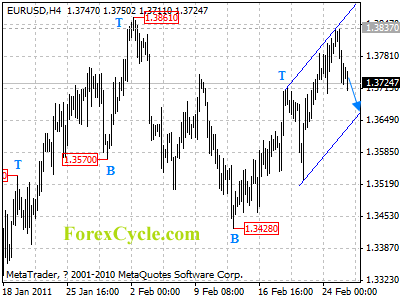
EURUSD pulled back from 1.3837

Being contained by 1.3861 resistance, EURUSD pulled back from 1.3837, suggesting that lengthier consolidation of uptrend from 1.3428 is underway. Deeper decline towards the lower border of the price channel on 4-hour chart could be seen. As long as the channel support holds, we’d expect uptrend to resume, and another rise towards 1.4000 is still possible. However, a clear break below the channel support will indicate that sideways consolidation in a range between 1.3428 and 1.3861 is being formed, then next target would be at 1.3450-1.3500 area.

eurusd

Daily Forex Forecast

Turtle Trading 5 Stops

By Taro Hideyoshi

The critical piece of trading system is how to get out of a losing trade. Traders who do not cut their losses cannot be successful in long term.

The most important thing about stops that traders must keep in mind is to define the stops before enter a trade. This is of course not a coincidence that every famous trader has this trading rule in their trading system.

For the turtles, they did not place their stop with the brokers since they did not want to reveal their trading strategies. As they traded future contracts commodities, they used either limit orders or market orders instead.

No trade of turtles could incur more than 2% risk of equity. Because the turtles used N-based stops while N of price movement represented 1% of account equity, therefore the maximum stop allowed 2% risk would be 2N.

According to the entry rule of turtles, that a unit would be added into positions every 0.5N, the stops would be placed at 2N from the most recently added unit to minimize the total position risk.

Example

Crude Oil: N = 1.20, 55-days breakout = 28.30

In this case turtles would enter the first unit at 28.30. Then if price moved to 30.10 the positions of turtles would be as follow.

First Unit: entry [28.30] stop [27.70]

Second Unit: entry [28.90] stop [27.70]

Third Unit: entry [29.50 stop [27.70]

Fourth Unit: entry[ 30.10 stop [27.70]

The turtles were also told of an alternate stop strategy called the whipsaw. This strategy resulted in better profitability but incurred more losses, which resulted in lower win/loss ratio.

For this strategy, the stops were placed at 0.5N for 0.5% account risk. If a given unit was stopped out, it would be re-entered when the market reached the original entry price. Using of the whipsaw did not require moving the stops when a unit added. The maximum risk would not exceed 2% because the maximum unit is four.

Example

Crude Oil: N = 1.20, 55-days breakout = 28.30

In this case turtles would enter the first unit at 28.30. Then if price moved to 30.10 the positions of turtles would be as follow.

First Unit: entry [28.30] stop [27.70]

Second Unit: entry [28.90] stop [28.30]

Third Unit: entry [29.50] stop [28.90]

Fourth Unit: entry [30.10] stop [29.50]

Since the N in N-based stops was adjusted according to the volatility of markets, this resulted in better diversification and risk management.

About the Author

Taro is an experience trader who trades in stocks, futures, forex. He strongly focuses on technical analysis, trading systems and money management.

If you would like to find more articles on MetaStock Tutorials, MetaStock Formulas, Trading Systems and Money Management. Please go to MetaStock Trading System.

Should You Be Investing In The Currency Trading Market?

By Cedric Welsch

Currency values keep rising and falling all over the world. Due to this, currency exchange may either earn a profit or incur a loss to an investor. Currency trading happens in a distributed foreign exchange market named as Forex. This is the biggest selling market in the whole world with an estimated selling volume per day of more than $3 trillion .Millions of people, companies and institutions, in a daily basis invest in this market to make huge profits although in some cases, they incur very huge losses.

Currency trading is a very unusual happening in the foreign exchange market. It is in fact like no other trade in the financial markets and in the world. To start with, trading is made over the telephone and computers rather than on the floor of an exchange. Its operations are carried out for 24 hours through out the week except the weekends. This market is very much affected by some economic factors, but some non economic factors such as wars and drought have also influenced the trading.

There are many participants in the currency trading market. International companies and foreign tourists visiting a particular country are the smaller participants. The big players are referred to as the speculators. These types of investors engage in this currency trading for the major purpose of earning profits. This is done in such a way that when the market is rising, they sell them. The biggest examples of speculators are investment, commercial and central banks.

Currency trading is somehow tricky and intricate. It carries with it various risks, therefore one should be vigilant and gather enough information about the whole trade before settling down to invest in it. In this trading, anything can happen so one ought to be prepared for losses even in the well operating businesses. Speculating in this market require proper evaluation and being very attentive to every detail.

There are many devices that can aid in currency trading. To begin with, there are consultants that can advice on how to invest in them, other devices that can help in this trading are the online calculators, and also the robots that do all the evaluations and invest for that same reason. However, the use of robots is greatly prohibited due to insecurities and lack of advisory services. The most secure method to invest is by getting the basic knowledge yourself, after which track the development for a substantial period of time and then make a move to invest in the currency trading.

About the Author

Any good investor must read forex news online regularly, just as you check forex trading reviews on a regular basis.

Turtle Trading 7 Tactics

By Taro Hideyoshi

The tactics is about miscellaneous guidelines to cover the rest of trading the turtle system rules. Besides the other six pieces of turtle trading system, there are some remaining important details that can make difference in profitability of trading.

One thing of tactics is how to enter orders. Turtles were told to place limit orders instead of market orders since the limit orders offer a chance for better fills and less slippage than do market orders.

The idea behind using limit orders is to place order at the end of the bounce of prices. It takes some skill to be able to determine the best point to place a limit order but with practice, traders should be able to get better.

There will be some times that market moves very quickly, called fast market. During fast market conditions, placing a limit order might not get filled. Turtles were advised not to panic and wait before placing an order. They would wait until some indication of at least a temporary price reversal before placing orders which often resulted in much better than achieved with a market order.

There will also be some times that signals come at once. Traders should buy the strongest and sell short the weakest. As turtles, they used various measures to determine strength and weakness.

Some would consider from how many N the price had advanced since the breakout, and buy the market that had moved the most. Others would subtract the price 3 months ago from the current price and then divide by the current N to normalize across markets. The strongest was the highest and the weakest was the lowest.

That’s it for turtle trading rules. The keys of success trading are consistency and discipline because by knowing these rules is not enough to make you succeed.

About the Author

Taro is an experience trader who trades in stocks, futures, forex. He strongly focuses on technical analysis, trading systems and money management.

If you would like to find more articles on MetaStock Tutorials, MetaStock Formulas, Trading Systems and Money Management. Please go to MetaStock Trading System.

Is It Worth Going To Forex Trading Events?

By James Woolley

If you are involved in the forex industry in any way, you will know that there are a number of different forex events held throughout the year. Some are free to attend, while others require some form of payment. So are they worth attending or are they simply a waste of time?

Well it all depends on what type of event it is. If it is an event held by a forex broker or some other finance company that you are involved with, then the benefits won’t be that great. They may be free to attend for valued customers and you may get some free food and drink, but you are unlikely to learn very much.

It is mainly a way for the company in question to get to know their customers a little better and to find out what they can actually do better themselves to give their traders a better trading experience. For you it is a chance to talk to senior employees and find out what goes on behind the scenes, but that’s about it really.

The better events are those that include some professional forex traders or fund managers as guest speakers. These events can be free to attend but if they are then you know that they will be pitching you with an offer to buy one of their products at the end of the event. In fact you may find that the whole event turns out to be one big sales pitch, in which case they may be a complete waste of time.

The better events are those that generally require an upfront fee, but do not try and sell you anything during the actual event. All you are paying for is the actual forex training that you receive from the various speakers.

These types of events can be really useful because they often feature some full time traders. Plus if they are held during the week, then they will also include plenty of live trading so you can see some of the strategies being put to the test in real time.

This type of education can be invaluable because I always think the best way to learn how to become a profitable forex trader yourself is to learn from someone who does this for a living. Unfortunately these types of seminars are quite rare, and even if you do see one or two being advertised, they may be held in another country or at least several hours away.

Anyway the point is that a lot of forex trading events are not really worth going to because you will either learn very little or you will be hit with a long sales pitch. However the good ones that are run by professional traders who have nothing to sell will of course be well worth attending. You will generally have to pay an admission fee, which can be quite substantial, but they may still turn out to be good value for money if you pick up some useful trading tips and strategies.

About the Author

Click here to learn how you can get a complete forex education and to read a review of the Forex Big Event 2011.

Allstate Takes on Citigroup

By James McKee

Banking giants Allstate and Citigroup are entering a lawsuit in which Allstate is alleging wrongdoing by Citigroup with regard to its handling of mortgages. Allstate is attempting to recover nearly 2 billion dollars worth of securities that it claims were lost due to misleading data regarding mortgage debt purchases. Allstate alleges that Citigroup and its umbrella companies deceived them regarding the supposed stability of the mortgage debt in question. These securities were actually highly volatile time bombs, which Citigroup is believed to have been aware of in this case by the plaintiffs. While it stands to reason that any investment has some inherent risks misleading an investor can result in adverse consequences in some instances.

Citigroup is believed to have been all-too aware of the rate of default at which its loans were experiencing, despite this they promoted and sold this toxic debt to companies such as Allstate. Legal battles between titans such as Allstate and Citigroup do not bode well for the US economy and no matter what the ruling it will have an adverse affect on the USD. The number of lawsuits resulting from large companies deceiving one another has only risen in recent months leading many to question what the eventual consequences of these conflicts will be.

One has to beg the question on a matter of principle in business, if someone knowingly sells something “toxic” does that make them liable for the other party’s loss if there was no promise regarding the return on investment? While the numbers may have been misleading on Citigroup’s side of the equation one has to question what Allstate’s responsibility was in this situation with regard to analyzing their investment. Those on the forex currency exchange should pay careful attention to large lawsuits such as these because a ruling in either direction has a negative impact on the USD and the market at large.

About the Author

Author is a Forex trader and financial analyst residing in Denver, Colorado. To stay up to date on all the latest developments in the financial world and beyond be sure to check out the forex exchange rates regularly.

Buying Exchange Traded Funds – The Importance Of Timing

By James Woolley

ETFs, short for exchange traded funds, are widely popular with both fund managers and individual traders. This is largely due to the fact that they can be bought and sold at any time, just like traditional stocks. However if you want to make consistent profits trading these instruments, then you have to get your timing right.

They say that timing is everything when investing in the stock market, and the same applies to exchange traded funds. These instruments tend to track a certain index or market. So this could include major indices such as the FTSE 100 and Dow Jones, major currency pairs such as the GBP/USD and EUR/USD pairs or commodities such as corn, crude oil, copper, gold, natural gas and wheat. The truth is that you can find an ETF for pretty much anything nowadays.

Anyway the point is that whatever you are interested in investing in, you have to buy at the most opportune moment. Therefore one option you have is to trade breakouts because a lot of the most popular markets are watched avidly by breakout traders, so any resulting price move can become self-fulfilling to a certain degree.

So for example if the price of crude oil happens to trade between $80 and $100 for months on end before finally breaking through the $100 barrier, then it might be worth buying the crude oil ETF. If the price continues heading higher to around the $120 mark, then you should make around 20% profit from your ETF investment.

An alternative approach is to wait for a market to be massively undervalued. For instance if the S&P 500 drops sharply over a period of several months and the RSI and stochastic indicators are now both below 20 and there is a clear MACD divergence pattern forming, then it may be worth drip feeding some money into an S&P 500 ETF for the long term.

To give you a few examples of how much money you can potentially make from exchange traded funds, let’s look back at 2008 and 2009. During this time you could have bought ETFs in the FTSE 100 when the price was around 3500 (now 6000+) and the Dow Jones when the price was around 6500 (now 12300+). Similarly you could have bought a crude oil ETF when the price per barrel was around $34 (now $93).

So the point I want to make is that ETFs provide you with plenty of opportunities to invest in a variety of different instruments whether it’s indices, currencies or commodities, for instance. However you still need to get your timing absolutely right otherwise you will struggle to make any money in the long run.

About the Author

Click here for a complete guide to long term investing and to read a full Portfolio Prophet review to learn about how you can successfully trade ETFs.

A Unique Formation in Crude Oil Prices — Should You Buy Here?

By Jared Levy, Editor, Smart Investing Daily, taipanpublishinggroup.com

This has been a turbulent week on the geopolitical front, triggering waves in the stock market and sending the price of crude oil through the roof. While the stock market corrects itself (as we anticipated), the price of crude oil seems to be creeping ever higher, putting upward pressure on the price of fuel and energy. Worse still is the serious effect this could have on the economic recovery that everyone has been banking on.

A couple of weeks ago I showed you a way you could partially hedge some of your fuel costs with the rise in crude oil prices. But higher gasoline prices at the pump are only part of the problem for most of us. A continued rise in crude oil will wreak havoc on the prices of many things that we need to live and work.

There are three questions I want to address today:

  1. Are prices moving higher?
  2. What the heck is the difference between Brent Crude and West Texas Crude?
  3. How can you profit from a potential move in either?

Where Does Crude Oil Go From Here?

From a technical perspective, you have to be careful here if you are going long. The prices of West Texas Crude (and Brent crude) have almost gone parabolic. A “parabolic” move comes from the mathematical term “parabola,” which describes even curvature from a point called the apex.

For us non-math folks who are simply looking at price charts, a parabolic move means the asset (in this case the price of oil) is exploding higher, on increasing volume and in much bigger percentage moves than usual. This is extremely abnormal. Buying anything after its price has “gone parabolic” increases the risk of a sharp pullback in the near term.

The chart formation looks like a bit like a steep parabola; take a look at the shape of the arrow!

Crude Oil Continuous Chart
View Larger Chart

The price of crude oil recently jumped from $84 to $100 in about four days; it broke its recent resistance of $92 and exploded on huge volume. A $16 rally in four days is extreme. I know this by looking at the average trading range (ATR), which tells me what the typical movements are. The normal WEEKLY price moves in crude oil are less than $5 — a third of what we’ve seen in the past four days. Another factor is that volume is double its recent average.

As for the next move in oil, look for a pullback in the short term, maybe back to the $95 level (we saw a small reprieve yesterday), but with the long-term fundamental demand strong, geo-political unrest in the Middle East and the summer driving season upon us, bet on $120 oil in the next six to eight months.

(Investing doesn’t have to be complicated. Sign up for Smart Investing Daily and let me and my fellow editor Sara Nunnally simplify the stock market for you with our easy-to-understand investment articles.)

Brent Versus West Texas

Now, when we talk about oil, we’re mainly talking about West Texas Intermediate (WTI) oil. But there are other types out there, and there seems to be a great amount of confusion (and hype) concerning two specific types of oil: WTI and Brent crude. Let me try to clarify. Recently, Brent crude prices have been higher than WTI, but that is not always the case; there are many factors that can influence the price relationship between the two. Also keep in mind that that prices usually won’t get too far apart, because of the ability to ship oil from one place to another to take advantage of prices.

West Texas Crude (WTI for short)

In North America, WTI is traded on the NYMEX under the ticker “CL.” It is the most common measurement that we use HERE to track the price of crude oil. It is also considered “light, sweet crude” and is generally refined in and around the Americas. ALL the futures contracts for WTI oil are traded on the NYMEX and all are delivered and settled in Cushing, Okla. There are pipelines and storage tanks in and around Cushing that help distribute and store oil. When there is a glut in storage, prices generally go lower, when there is a big reduction in the amount of oil in storage, prices may go higher.

Brent Crude (Also called London Brent, Brent Blend, Brent petroleum and North Sea crude)

Brent crude blend prices actually account of two-thirds of the world’s oil supply. Most of Brent crude oil comes from the North Sea, hence the name. Brent crude is traded on the ICE (IntercontinentalExchange) and on the NYMEX (Ticker “LO”) as well. Brent oil fuels Europe and Asia and is delivered in several areas. Brent provides a pricing benchmark for most of Europe and Asia in the same way we use WTI.

Both WTI and Brent are priced in U.S. dollars

There are actually dozens of different types and blends of oil around the world. WTI and Brent prices are simply popular benchmarks for big oil companies and traders to use. Don’t get too caught up in the struggle between the two. Right now, because of Middle East tensions heating up and Canada’s oil sands sending supply to Cushing, Okla., the price of WTI is lower than Brent, but they are indeed highly correlated.

How Can You Profit?

The most efficient way to invest in the price of oil is to purchase futures contracts directly. Of course, there are things you need to know before doing so and you must have a futures account and understand the risks.

For those of you who are not ready to start your futures trading career just yet or can’t decide if you should buy Brent or WTI, I have a solution. There is an ETF that contains the “pick and shovel” oil companies. These are the guys that get the oil out of the ground and sell it to refiners. If the price of oil (Brent or WTI) is on the rise, these companies are usually following right along. It’s called the Oil Services HOLDRS (OIH:AMEX), and you can buy and sell it just like a stock with regular commissions.

Right now, the long-term prospects for oil look good and the Oil Services HOLDRS is a great alternative way for the average investor to participate. You can view the holdings and learn more here.

If I’m on target with my prediction for oil to hit $120 in the next six to eight months, I wouldn’t be surprised to see the Oil Services HOLDRS knocking on $200’s door. And for traders out there, the Oil Services HOLDRS does offer options.

Editor’s Note: This coming crisis could blow a 950% profit your way! The U.S. wants to use “green technology” to decrease our dependence on oil. But China has a 97% monopoly on a natural resource that is vital to green technology… and we’re about to experience a serious shortage! Learn which companies could solve this crisis and hand you 950% gains in as few as 24 months in this exclusive investment report.

About the Author

Jared Levy is Co-Editor of Smart Investing Daily, a free e-letter dedicated to guiding investors through the world of finance in order to make smart investing decisions. His passion is teaching the public how to successfully trade and invest while keeping risk low.

Jared has spent the past 15 years of his career in the finance and options industry, working as a retail money manager, a floor specialist for Fortune 1000 companies, and most recently a senior derivatives strategist. He was one of the Philadelphia Stock Exchange’s youngest-ever members to become a market maker on three major U.S. exchanges.

He has been featured in several industry publications and won an Emmy for his daily video “Trader Cast.” Jared serves as a CNBC Fast Money contributor and has appeared on Bloomberg, Fox Business, CNN Radio, Wall Street Journal radio and is regularly quoted by Reuters, The Wall Street Journal and Yahoo! Finance, among other publications.
PSEi – More Bad Days To Come??

philippine stock exchange composite index, PCOMP, PSEI, phisix, philippines economy, ron acoba, stock market trading, descending channel

The past 3 months weren’t particularly well for the Philippine Stock Exchange Composite Index despite all the positive hype that the Philippine economy has been getting as of late. The PCOMP or PSEi, being a leading barometer of the Philippine economy, has been telling a different story. As you can see from its chart above, the index has been steadily losing ground as it has been trading within a descending channel since it peaked at a high of 4,413.42 back in November 4, 2010. Since then it has already lost around 15.53% when it closed to 3,737.04 last Friday (February 25, 2011).

So the question that a lot people are asking is, “where will the index now?”

Well, I’m sorry to break the ice but in my technical point of view, the index and most of the listed stocks could face some more selling pressure in the days to come. You see, the index had already broken its primary uptrend (the one which could be traced back to to its bottom back in March 2009). Moreover, the last major support that should prevent it from falling further, which is its 200-day moving average, was also recently breached last week for the first time in almost two years! The index has now been trading below the said moving average for three straight days. Hence, if it does not rally past it in the next few days, then most likely it would head lower. Even it it does rally, a heavy resistance at the 4,000.00 level and the channel’s resistance could still weigh on the index. On the even bearish note, a move below last week’s low of 3,705.58 could send it down to 3,600.00.

Given the index’s present trend, which is downwards, and the uncertainty in the markets due to the political turmoil in the Middle East, I think it is prudent that we at least lighten up our long positions. At these times, it is better to stay away with our money intact for awhile and just re-enter the market again when everything has cleared already.

More on LaidTrades.com